
If Ye Break Faith
On the ‘Palestine Poppy’, the Order of Love, and a Remembrance Left Undefended

I. A Flower in November
The Church gives November to her dead. The month opens with the Solemnity of All Saints and the Commemoration of All the Faithful Departed, and through the weeks that follow the faithful are bidden to remember the holy souls at the altar and at the graveside. In these islands the same weeks belong also to a civic rite which, for all its secular dress, has never quite shed its Christian bones: the red flower worn on the lapel, the two minutes’ silence, the wreaths laid at the Cenotaph and at the thousands of village crosses and plaques that carry the names of the fallen. A people that has in large measure forgotten how to pray for its dead has not yet forgotten that it owes them something. The poppy is the outward sign of that remembered debt.
This year the poppy has a rival. A badge cut to its familiar shape, but with its petals divided into the black, white and green of the Palestinian flag and set within a ring of red, has gone on sale as the ‘Palestine Poppy’ a few weeks before Remembrance Sunday. It has drawn the anger of veterans and of politicians of more than one party, and a careful statement from the Royal British Legion. It has drawn nothing, so far as can be found, from the Secretary of State charged with the peace of the realm.

The ‘Palestine Poppy’ has drawn the anger of veterans and of politicians of more than one party, and a careful statement from the Royal British Legion. It has drawn nothing, so far as can be found, from the Secretary of State charged with the peace of the Realm.
What follows is a critique, and a severe one, but it is meant to serve something larger than critique. It argues four things:
First, that the badge is a hijacking of the poppy rather than an extension of it, and that its makers knew exactly what they were taking.
Second, that the order of Christian charity, the ordo amoris of Augustine and Aquinas, explains why the hijacking wounds, and why it is no failure of charity to resent it.
Third, that the desecration of the Battle of Britain Monument a week earlier displayed the same disregard for a nation’s mourning in a cruder form, and that the Home Secretary’s silence before both is a failure of the honour that public office owes the dead.
Fourth, because this journal has argued it before and will not unsay it now, that the remedy for an offensive badge lies with the conscience and not with the constable.
II. The Object and Its Pedigree
The facts first. The badge is a small metal pin of about three centimetres, its three petal-like sections coloured in the Palestinian flag and arranged about a red ring and a black centre in plain imitation of the remembrance poppy.[1] It is sold on eBay for £1.78 and listed as not-for-profit, the price said to cover production and a donation to charities working in Palestine and to organisations campaigning, through legal routes, against what the sellers call “the occupation of Palestine”.[2] Well over a thousand had been bought by the weekend on which the story broke.[3] The project’s website names among its beneficiaries the Friends of Al-Aqsa and the International Centre of Justice for Palestinians.[4]
The first of these is not a neutral charity. The Times of Israel reports that the Home Office itself has described Friends of Al-Aqsa as ‘far-Left and Islamist’, and that ‘its founder once denied that Hamas is a terrorist organisation’; the Labour Party barred the group from its own conference after Members of Parliament raised concerns about its values.[5] The same website carries a video bearing the slogan ‘from the river to the sea’, a phrase whose meaning for the existence of the State of Israel is not seriously in doubt.[6] Its creator hopes the badge will become an ‘anti-apartheid symbol’, to be worn as the raised fist was once worn.[7]
Nor was the borrowing accidental. The website tells the story of the remembrance poppy at some length: John McCrae and In Flanders Fields, Moina Michael, Anna Guérin and the first poppy appeals. It goes on to claim the poppy as “the official national flower of Palestine”, a claim that does not survive inspection, since the Palestinian Council of Ministers designated the Faqqua iris, Iris haynei, as the national flower in 2016.[8]
Thus I have no difficulty in charging the badge makers:
The makers knew precisely whose symbol they were adapting, and they reached for a pedigree to cover the adaptation.
The reaction was swift. Trevor Coult MC, who now works on behalf of veterans, told LBC that “the badge was simply another device for sowing division before Remembrance” (2026), and that “none of the money raised would help a single former serviceman”.[9] Lieutenant Colonel Stuart Crawford called it ‘unashamedly political, designed to divide rather than unite’.[10] The Shadow Defence Minister, David Reed, put the matter in words that deserve to stand: ‘The fallen deserve our gratitude, not our agendas.’[11] Nigel Farage accused the sellers of having no respect for the country, and Stuart Fawcett, a former Royal Navy officer who now sits as a Labour councillor, spoke of “a national symbol hijacked”.[12] That last voice matters, for it shows that the offence is not the property of one party.
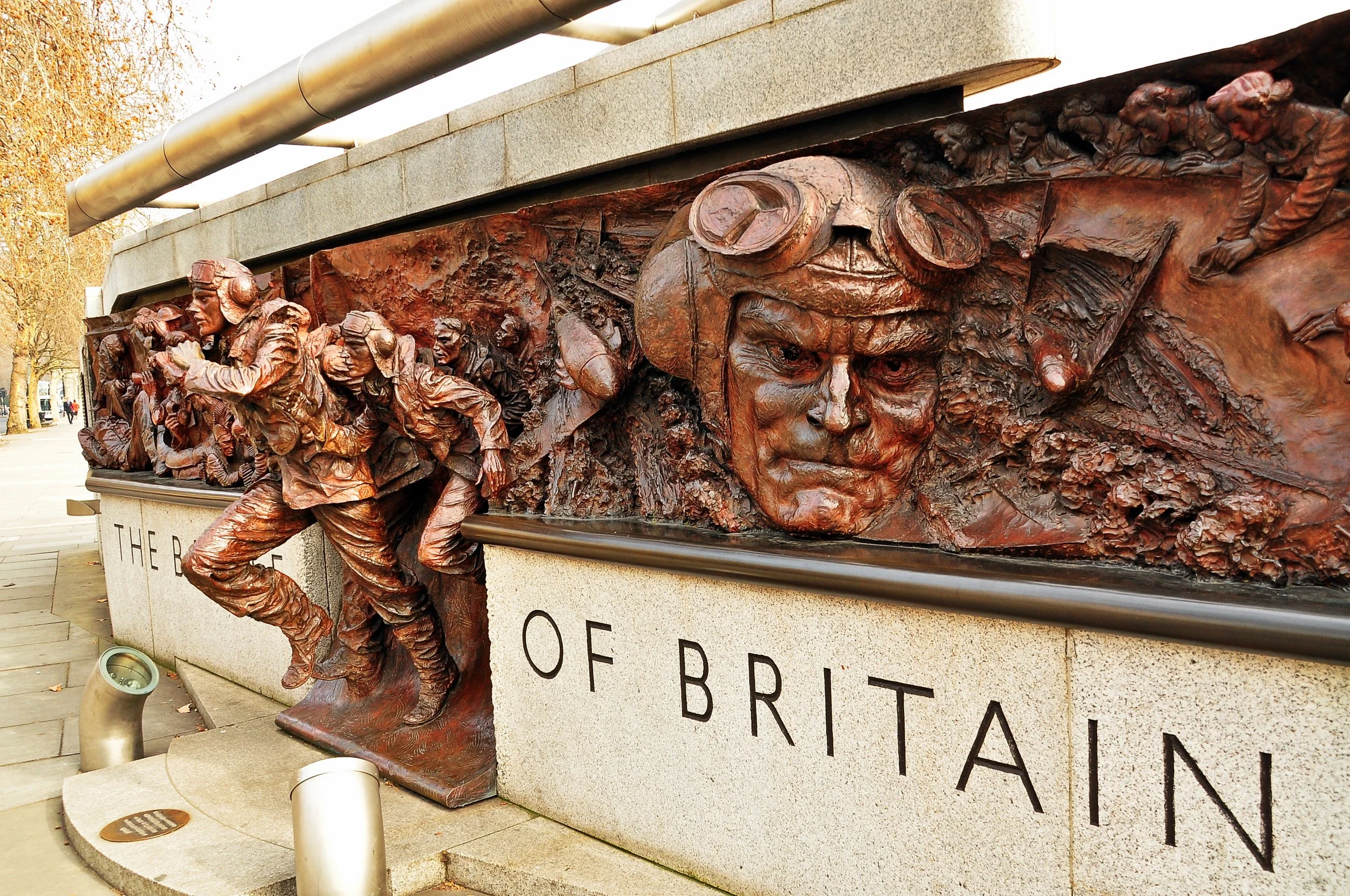
The Battle of Britain Memorial Monument, Embankment, London, was the scene of a disgraceful desecration in October 2026, carried out by Palestinian Support vandals. To date, and so far as we are aware, the Home Office Secretary - Shabana Mahmoud - has not had the time or the initiative to publicly and unequivocally condemn the deed.
The Royal British Legion was more measured. It noted that “its two-petal poppy is a registered trade mark”, that “the red poppy is a symbol of remembrance and of hope for a peaceful future”, and, crucially, that “the money it raises supports the Armed Forces community, its veterans and their families, whatever the need”.[13] It also acknowledged, as it has in other years, that “people are free to choose whether to wear a poppy and which”.[14] That restraint should be noted and honoured. It will matter later in the argument.
III. Borrowed, Not Shared
The defence of the badge is not difficult to construct, and fairness requires that it be stated. The poppy, it is said, is a flower of the field and belongs to no one; it speaks of a shared humanity and of the toll of every war; the Palestinian dead are as truly dead as the dead of the Somme; and to object to their commemoration under a poppy is to turn remembrance into a cudgel. A version of this argument was made in the first months of the war in Gaza under the title ‘The Poppy Belongs to Palestinians Too’.[15] It has a surface probability, and some who buy the badge will mean nothing by it but grief.
It fails nonetheless, because a symbol of remembrance is not a botanical fact but a social one. The red poppy does not mean ‘the dead of all wars’ in general. It means, quite particularly, the men and women of the Armed Forces of Britain and the Commonwealth who have died in service since 1914, and it means the living who served beside them and the families they left behind. It is constituted by more than a century of use: by the tray and the tin, by the widow’s pension and the disabled ex-serviceman’s workshop, by the names cut into the plaque on the church wall. To recolour such a sign in the flag of a present political cause is not to widen its meaning but to hijack it, to take a vessel filled by one people’s grief and pour another people’s politics into it.
Three marks of hijacking are plain:
The first is timing. The badge was not launched in May or in July. It was launched into the one season of the year in which the red poppy is worn, so that it would be seen beside it, and against it.
The second is the money. The red poppy’s meaning includes the coin in the tin, which buys a veteran’s care; the Palestine poppy’s coin goes in part to campaigning bodies, one of them of the terrorist character already described. A badge that borrows the poppy’s shape while diverting its purse has kept the form and abandoned the substance.
The third is the slogan. A video calling for a Palestine ‘from the river to the sea’ is not mourning but a programme with a specific agenda. Whatever else the badge commemorates, it also campaigns, implying the demise of Israel and of the Jewish People in the process.
Fr. G.V.W. Lewis:
“To recolour Remembrance Red Poppy in the flag of a present political cause (Palestine) is not to widen its meaning but to hijack it, to take a vessel filled by one people’s grief and pour another people’s politics into it.”
It will be said that motives cannot be read off an object, and that is true. This journal does not claim to know the heart of every seller or every wearer; some are sincere, and some will not have thought about it at all. But the argument does not rest on motive. Whoever designs a rival to a nation’s mourning badge, cuts it to the same shape, sets out the history of the original on his website, and releases it into the very weeks of that nation’s mourning cannot be surprised when it is received as a provocation. The wound was foreseeable, and what is foreseen and done anyway is chosen. Whether or not the badge was designed to hurt, it was certain to hurt, and its makers went ahead.
IV. The Order of Love
A Christian reader may feel a scruple at this point. Is charity not universal? Should a priest not welcome any gesture of mourning, from any quarter, for any of the dead? The scruple deserves an answer, and the tradition supplies one in the doctrine that charity has an order. Augustine states the principle in De doctrina christiana:
Omnes autem aeque diligendi sunt; sed cum omnibus prodesse non possis, his potissimum consulendum est, qui pro locorum et temporum vel quarumlibet rerum opportunitatibus constrictius tibi quasi quadam sorte iunguntur.
All are to be loved equally; but since you cannot do good to all, you are to have regard above all for those who, by the circumstances of place and time or of any other kind, are bound more closely to you, as though by a kind of lot.[16]
Thomas Aquinas develops the point in the Secunda secundae, where he asks whether one neighbour is to be loved more than another and answers that he is. Charity follows the order of nature and of grace, so that we rightly love more those who are more closely joined to us; and among those ties he gives a particular weight to the bond of blood, which touches the very substance of a man.[17] This is not a grudging concession to human weakness. It is the shape of a love that is real rather than notional. A charity that loved everyone equally would, in practice, love no one in particular.
This writer knows a man who counts eight of his own kindred among the war dead. When such a man says, without apology, that he cares first and most for his own dead, and less for the dead of others, he is not confessing a hardness of heart. He is describing the ordo amoris in the first person. A man who grieved a stranger exactly as he grieves his father would not be more Christian than his neighbours; he would have lost something that belongs to being human. Remembrance was in its origin the grief of hundreds of thousands of families made national, and the nation’s day of remembrance belongs to those families before it belongs to anyone else.
Honesty requires that the other edge of the Gospel be set beside this, and not blunted:
ἀγαπᾶτε τοὺς ἐχθροὺς ὑμῶν καὶ προσεύχεσθε ὑπὲρ τῶν διωκόντων ὑμᾶς.
Love your enemies and pray for those who persecute you.[18]
The command stands, and nothing in the order of charity repeals it. The Christian prays for all the dead and commends every soul, friend and enemy alike, to the mercy and the judgment of God. But the command to love one’s enemy is not a command to surrender to him the day one has set apart for one’s own. It requires that we will his good and pray for him. It does not require that we allow our mourning to be rededicated to his cause. The order of love and the love of enemies are not rival principles to be bargained against each other; the Church has always held them together, and the order is precisely what keeps the universal command from dissolving into indifference.
Fr. G.V.W. Lewis:
“The hijacking of the Poppy wounds. It is not merely a breach of manners. It is a stranger lifting the wreath from a family’s grave in order to lay it somewhere else. It’s vulgar, callous, and grotesque!”
The poppy has a theology of its own, and the Gospel supplies that too:
μείζονα ταύτης ἀγάπην οὐδεὶς ἔχει, ἵνα τις τὴν ψυχὴν αὐτοῦ θῇ ὑπὲρ τῶν φίλων αὐτοῦ.
Greater love has no one than this, that someone lay down his life for his friends.[19]
What the nation remembers in November is a debt of friendship: men and women who laid down their lives for their friends, their families and their country. That is why the hijacking of their sign wounds. It is not merely a breach of manners. It is a stranger lifting the wreath from a family’s grave in order to lay it somewhere else.
V. The Men of Gaza and Beersheba
There is one point at which the critic of the Palestine poppy must take care, for the strength of his case depends on it. It is tempting to say that the badge honours the enemy’s dead on the day set aside for our own. That would be inaccurate. In the wars the red poppy chiefly commemorates, the Arabs of Palestine were not, for the most part, Britain’s enemy.
The irony runs deeper still. In 1917 the soldiers of Britain and her Empire fought one of the hardest campaigns of the Great War across the very ground now called Gaza. Two assaults on the Ottoman line at Gaza failed in the spring of that year; Beersheba fell at the end of October and Gaza in the first week of November, and General Sir Edmund Allenby entered Jerusalem on December 11, 1917, ending 400 years of Ottoman rule.[20] British, Australian, New Zealand and Indian soldiers died in that campaign, and some three thousand Commonwealth servicemen of the First World War lie in the war cemetery at Gaza itself. They are among the dead the red poppy remembers. In the Second World War, Arab and Jewish volunteers from Mandatory Palestine served in British uniform, among them the men of the Palestine Regiment raised in 1942; and the Palestine Poppy’s own website appeals to the memory of Palestinian soldiers who fought against Nazi Germany.[21]
This sharpens the charge rather than softening it. If the makers wished to honour Palestinians who served beside British soldiers, the red poppy already does so, for it remembers all who served in the forces of the Crown. If they wished to honour the men who died before Gaza in 1917, the red poppy is already theirs. The new Palestine Poppy badge does neither. It takes the memory of service, detaches it from the dead who earned it, and bends it towards a present war that has no bearing on them. The fault is not that the badge remembers the wrong dead. It is that it exploits remembrance to say something else.
VI. Memoria and Monumentum
The Palestine poppy did not appear in a vacuum. On Saturday 10 October, during a march through central London, protesters climbed the Battle of Britain Monument on the Victoria Embankment, the memorial to the aircrew of 1940, beneath a banner reading ‘Imperialists must die’.[22] The wreaths of poppies laid at its foot were trampled and broken, and the Metropolitan Police arrested six people on suspicion of criminal damage.[23]
It would be unjust to identify the vandals on the Embankment with the sellers of the badge, and this essay does not do so; there is no evidence that they are the same people. But the two episodes disclose the same disregard in different degrees:
the one hijacks the sign of remembrance,
the other tramples it underfoot.
Augustine, writing on the care owed to the dead, gives the Christian reason why both matter:
Sed ideo memoriae vel monumenta dicuntur ea quae insignita fiunt sepulcra mortuorum, quoniam eos qui viventium oculis morte subtracti sunt, ne oblivione etiam cordibus subtrahantur, in memoriam revocant et admonendo faciunt cogitari: nam et memoriae nomen id apertissime ostendit, et monumentum eo quod moneat mentem, id est admoneat, nuncupatur.
The marked tombs of the dead are called memorials or monuments for this reason: they call back to memory those whom death has withdrawn from the sight of the living, lest forgetfulness withdraw them from their hearts as well, and by admonishing they cause them to be thought of. The very word ‘memorial’ shows this most plainly, and a ‘monument’ is so named because it admonishes the mind, that is, puts it in remembrance.[24]
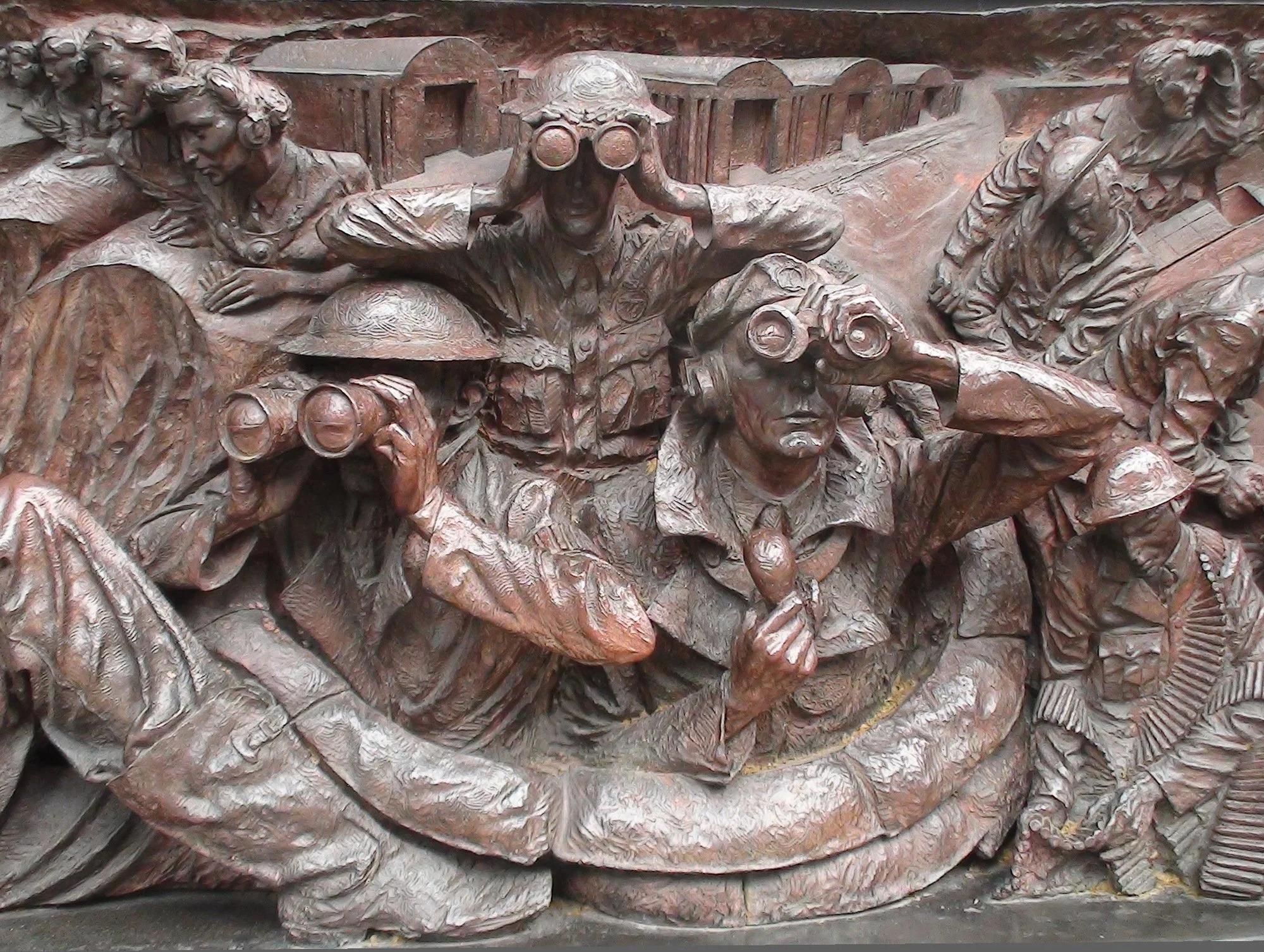
A monument exists to admonish the mind; that is what its name means. The Battle of Britain Monument admonishes all who pass it that a few thousand young men once flew against heavy odds, and that many did not come back. To climb it as a platform for a banner is to refuse its admonition outright. And because, as Augustine says elsewhere, the rites we pay the dead console the living more than they aid the departed, the injury falls on the living:
Curatio funeris, conditio sepulturae, pompa exsequiarum magis sunt vivorum solacia quam subsidia mortuorum.
The care of the funeral, the manner of burial, the pomp of the obsequies, are a solace to the living rather than an aid to the dead.[25]
The trampled wreath was not an insult to stone. It was an insult to whoever laid it, and to every family for whom that monument stands in place of a grave.
VII. The Silence in Marsham Street
Shabana Mahmood has been Home Secretary since September 2025, and was kept in that office when Andy Burnham formed his administration in July.[26] Her department answers for public order, for the policing of protest, and for the framework within which the nation’s memorials are protected as public places. In the face of a war memorial desecrated in the capital, and a week later of a rival poppy sold in part to fund a group her own department has reportedly called Islamist, this journal has been unable to find any public word from her. It is possible that something was said and not reported; if so, this journal will gladly correct the record. As matters stand, the silence is conspicuous.
It is not the silence of a sympathiser. The march on the Embankment carried a placard denouncing the Home Secretary and the Mayor of New York as traitors to their faith; she is no hero to those who climbed the monument.[27] That is what makes the silence harder to explain. It does not look like partisanship. It looks rather like a failure to see that the defence of remembrance belongs to her office at all. Others saw it. A Shadow Minister spoke, a party leader spoke, veterans spoke, and a Labour councillor spoke. The Government that holds the seals of office said nothing.
The apostolic counsel to the Christian citizen is to render to all their due:
ἀπόδοτε πᾶσι τὰς ὀφειλάς, τῷ τὸν φόρον τὸν φόρον, τῷ τὸ τέλος τὸ τέλος, τῷ τὸν φόβον τὸν φόβον, τῷ τὴν τιμὴν τὴν τιμήν.
Render to all what is owed to them: tribute to whom tribute is due, revenue to whom revenue, fear to whom fear, honour to whom honour.[28]
Honour is owed to the magistrate (i.e. the State); but honour is also owed by him/the State. The State’s dead are those who died in its service and at its command, and the one day in the year on which the State honours them is not a day on which its ministers may be indifferent.
To ask the Home Secretary for a single sentence, saying that the poppy belongs to those who fell in this country’s service and that a war memorial is not a climbing frame, is not to ask for much. It is to ask that the office pay the honour it owes.
Readers will draw their own comparisons with occasions on which ministerial disapproval has been swift and public. This essay does not need to prove a double standard; the absence is enough on its own. When the honour of the dead is at stake, a Home Secretary who will not speak has left a vacancy in public speech, and such vacancies do not long stay empty.
VIII. Not the Constable, but the Conscience
Here the argument must turn, because this journal has a record and means to keep faith with it. In Nineteen in Twenty and No Further Action it argued at length that the British State has misused the criminal law against free speech, arresting citizens for their words and treating the arrest itself as the sentence.[29] It would be a contemptible inconsistency to demand now that the State do to the sellers of a badge what this journal condemned when it was done to street preachers. The Palestine poppy is offensive; it is not, and must not be made, a crime. No one should be arrested for selling it or for wearing it, and the Royal British Legion’s acknowledgement that people may choose their own poppy is a better guide here than any appetite for prohibition.
The distinction is not difficult. Climbing a memorial and breaking its wreaths is an act against property and against a public trust, and the law rightly treats it as criminal damage. Wearing a badge is speech, however ill-judged. What is asked of the Home Secretary is not a warrant but a word. What is asked of the citizen is not a complaint to the police but a witness of his own.
That witness is simple:
Wear the red poppy.
Put money in the tin.
Stand in the silence.
Mr Reed has said that he will tell anyone he sees wearing the badge exactly what he thinks of it. That is his freedom, and this journal would defend it; but the Christian adds that rebuke is meant to persuade rather than to humiliate, and that the most eloquent answer to a fake is the genuine article worn in greater numbers. The pulpits have their part to play as well. On Remembrance Sunday the clergy of every church, mainstream and independent, will stand before their congregations wearing the red flower. They might say, plainly and without rancour, why.
IX. The Communion of Memory
The deepest answer to the Palestine poppy is not political but theological, and it concerns what remembrance is for. The Church has always believed that the living can help the dead. The sacred author praises Judas Maccabeus for the offering he sent to Jerusalem on behalf of his fallen soldiers:
Sancta ergo et salubris est cogitatio pro defunctis exorare, ut a peccatis solvantur.
It is therefore a holy and wholesome thought to pray for the dead, that they may be loosed from their sins.[30]
The Council of Trent set the same faith down as doctrine:
…purgatorium esse, animasque ibi detentas fidelium suffragiis, potissimum vero acceptabili altaris sacrificio iuvari.
…that there is a purgatory, and that the souls detained there are helped by the suffrages of the faithful, and above all by the acceptable sacrifice of the altar.[31]
Seen in this light, the national silence at the eleventh hour is a half-remembered prayer, and the poppy a half-remembered sacramental: the outward sign of a communion between the living and the dead which the Church names with precision and the nation still feels without being able to name. That communion is exactly what is broken when the sign is hijacked. Remembrance unites a people across its parties, its classes and, increasingly, its creeds, because the dead belong to all who stand in their debt. A sign that divides is, in the nature of the case, no longer a sign of remembrance. Worse even, it is a sign of contempt.
John McCrae, who knew the poppies of Flanders at first hand and was buried among the war dead in France in 1918, put the obligation into the mouths of the dead themselves, and wrote the iconic World War I poem "In Flanders Fields" in May 1915 during the Second Battle of Ypres in Belgium:
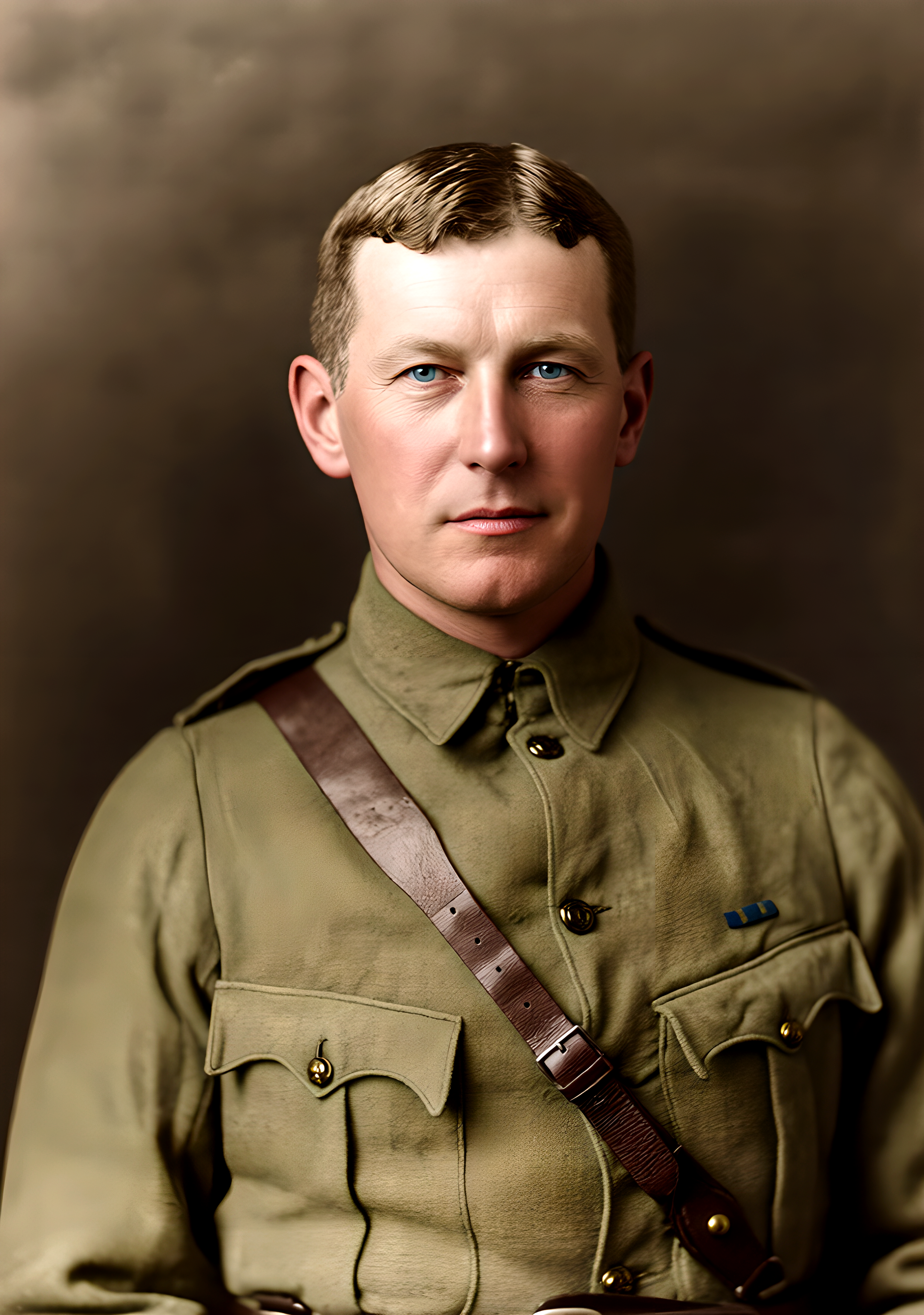
Lt Col John McCrae
(Nov. 30, 1872 – Jan. 28, 1918
In Flanders Fields
In Flanders' Fields the poppies blow
Between the crosses, row on row,
That mark our place; and in the sky
The larks, still bravely singing, fly
Scarce heard amid the guns below.
We are the Dead. Short days ago
We lived, felt dawn, saw sunset glow,
Loved and were loved, and now we lie
In Flanders' Fields.
Take up our quarrel with the foe:
To you from failing hands we throw
The torch; be yours to hold it high.
If ye break faith with us who die
We shall not sleep,
though poppies grow
In Flanders' Fields.[32]
To keep faith with the dead is to keep their sign for them:
To wear it,
to pay for it, and
to refuse to let it be cut into the colours of another flag.
That obligation is the same whether or not a Home Secretary finds her voice.
It belongs to every one of us who has a name on a memorial somewhere, and to every one who owes a debt to those who have.
Corpora ipsorum in pace sepulta sunt, et nomen eorum vivit in generationem et generationem.
Their bodies are buried in peace, and their name lives on from generation to generation.[33]
On Sunday 8 November, and again on Armistice Day, let the red flower be worn and the silence kept, and let the Christian who keeps it add the words the nation has forgotten how to say:
Requiem aeternam dona eis, Domine, et lux perpetua luceat eis.
Eternal rest grant unto them, O Lord, and let perpetual light shine upon them.
AMEN
✠
[1]“Veteran Outrage as Palestine Poppy ‘Hijacks’ National Symbol of Remembrance,” AOL, October 18, 2026, https://www.aol.co.uk/articles/veteran-outrage-palestine-poppy-hijacks-190700000.html.
[2]Jamie Shapiro, “‘Palestine Poppy’ Criticised as Attempt to ‘Hijack’ Remembrance Day,” Jewish Chronicle, October 19, 2026, https://www.thejc.com/news/uk/palestine-poppy-criticised-as-attempt-to-hijack-remembrance-day-ugsohxk1.
[3]“Veteran Outrage,” AOL. Reported figures vary between some 1,200 and more than 1,400.
[4]“‘Stop Hijacking Remembrance’: Veterans’ Fury over ‘Palestine Poppy’ Accused of Dividing Britain,” LBC, October 2026, https://www.lbc.co.uk/article/palestine-poppy-remembrance-day-veterans-trevor-coult-lbc-5Hjdk6g_2/.
[5]Michael Bachner, “Anti-Israel Activists Accused of ‘Hijacking’ UK’s Remembrance Day with ‘Palestine Poppy’,” Times of Israel, October 19, 2026, https://www.timesofisrael.com/anti-israel-activists-accused-of-hijacking-uks-remembrance-day-with-palestine-poppy/. The characterisation is attributed to the Home Office by the Times of Israel; the original Home Office document has not been traced for this essay. On the Labour conference, see “Veteran Outrage,” AOL.
[6]“Veteran Outrage,” AOL.
[7]David Katz, “The Remembrance Poppy Is the Latest Symbol Hijacked by the Palestinian Cause,” HonestReporting, October 18, 2026, https://honestreporting.com/the-remembrance-poppy-is-the-latest-symbol-hijacked-by-the-palestinian-cause/.
[8]Katz, “Remembrance Poppy,” citing the records of the Palestine Wildlife Society.
[9]“Stop Hijacking Remembrance,” LBC.
[10]Shapiro, “‘Palestine Poppy’ Criticised,” reporting Colonel Crawford’s remarks to GB News.
[11]“Stop Hijacking Remembrance,” LBC.
[12]Shapiro, “‘Palestine Poppy’ Criticised.” Mr Fawcett’s remarks were first given to the Daily Telegraph, October 18, 2026, which could not be consulted directly for this essay.
[13]Shapiro, “‘Palestine Poppy’ Criticised,” reporting the Legion’s statement to the Daily Telegraph.
[14]Katz, “Remembrance Poppy.”
[15]Kitanya Harrison, “The Poppy Belongs to Palestinians Too,” Medium, November 2023, https://kitanyaharrison.medium.com/the-poppy-belongs-to-palestinians-too-80d2acd1c648.
[16]Augustine, De doctrina christiana 1.28.29, ed. Joseph Martin, CCSL 32 (Turnhout: Brepols, 1962).
[17]Thomas Aquinas, Summa theologiae II-II, q. 26, aa. 6–8, in Opera omnia, Leonine ed., vol. 8 (Rome, 1895).
[18]Matt 5:44, Novum Testamentum Graece, Nestle-Aland, 28th ed. (Stuttgart: Deutsche Bibelgesellschaft, 2012).
[19]John 15:13, Novum Testamentum Graece, Nestle-Aland, 28th ed. (Stuttgart: Deutsche Bibelgesellschaft, 2012).
[20]National Army Museum, “Egypt and Palestine Campaign,” https://www.nam.ac.uk/explore/egypt-and-palestine-campaign.
[21]On the website’s appeal to Palestinian service against Nazi Germany, see “Stop Hijacking Remembrance,” LBC. The Gaza War Cemetery is maintained by the Commonwealth War Graves Commission.
[22]“Twenty Arrested and Battle of Britain Memorial Vandalised at Anti-Israel March in Central London,” Jewish Chronicle, October 11, 2026, https://www.thejc.com/news/uk/twenty-arrested-and-battle-of-britain-memorial-vandalised-at-anti-israel-march-in-central-london-lg417yst.
[23]“20 Arrested at Anti-Israel Protest, Including 6 for Criminal Damage after Climbing War Memorial,” Jewish News, October 12, 2026, https://jewishnews.co.uk/20-arrested-at-anti-israel-protest-including-6-for-criminal-damage-after-climbing-war-memorial.
[24]Augustine, De cura pro mortuis gerenda 4.6, ed. Joseph Zycha, CSEL 41 (Vienna: Tempsky, 1900).
[25]Augustine, De civitate Dei 1.12, ed. Bernhard Dombart and Alfons Kalb, CCSL 47 (Turnhout: Brepols, 1955).
[26]“Shabana Mahmood Retained as Home Secretary as Burnham Announces Ministerial Appointments,” July 21, 2026, https://gazettengr.com/?p=487639. She was first appointed in September 2025.
[27]“Twenty Arrested,” Jewish Chronicle.
[28]Rom 13:7, Novum Testamentum Graece, Nestle-Aland, 28th ed. (Stuttgart: Deutsche Bibelgesellschaft, 2012).
[29]G. V. W. Lewis, “Nineteen in Twenty: On Burglars, Blasphemers, Keyboard Warriors, and What the Law Is Actually For,” Mind the Limoges, September 7, 2026, https://crshj.org/blog/hmhct1lqeoukja9issw7pvdinp5l55; idem, “No Further Action,” Mind the Limoges, September 20, 2026, https://crshj.org/blog/9qkna4jd37wk58hszeh5jeipdn4vlf.
[30]2 Macc 12:46, Biblia Sacra Vulgatae Editionis (Sixto-Clementine).
[31]Council of Trent, Session 25, Decretum de purgatorio (December 3, 1563), in Heinrich Denzinger and Peter Hünermann, eds., Enchiridion symbolorum, 43rd ed. (San Francisco: Ignatius Press, 2012), no. 1820.
[32]John McCrae, “In Flanders Fields,” Punch, December 8, 1915.
[33]Sir 44:14, Biblia Sacra Vulgatae Editionis (Sixto-Clementine).