

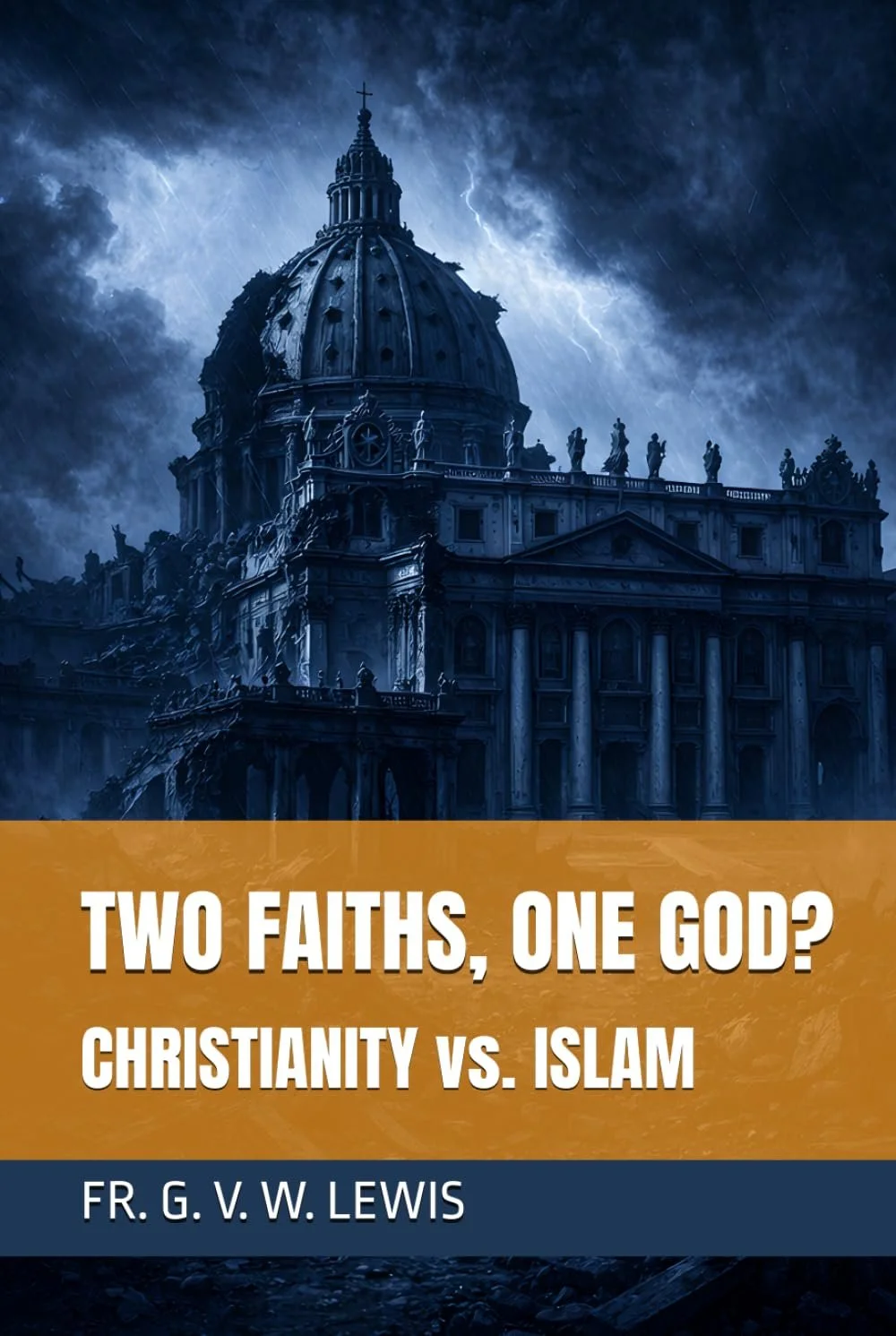
How Should Christians Respond?
Pastoral and Practical Guidance for Christian Engagement with Islam
Fr. G. V. W. Lewis
Two Faiths, One God?...
<>
The Islam Issue Facing the Western World
<>
On Amazon NOW!
<>
Two Faiths, One God?... <> The Islam Issue Facing the Western World <> On Amazon NOW! <>

You shall love the Lord your God with all your heart and with all your soul and with all your mind. This is the great and first commandment. And a second is like it: You shall love your neighbour as yourself.
Matthew 22:37-39
Always be prepared to make a defence to anyone who asks you for a reason for the hope that is in you; yet do it with gentleness and respect.
1 Peter 3:15
Dialogue requires that each side enters it with the totality of its own convictions.
Pope John Paul II, Redemptoris Missio, §56
We have covered a great deal of difficult ground in the preceding chapters. We have examined the irreconcilable theological incompatibilities between Christianity and Islam — on the nature of God, the identity of Jesus, the reality of the crucifixion and resurrection, the authority of scripture, and the meaning of the Abrahamic heritage. We have looked honestly at the civic and social tensions created by certain currents of Islamic law and theology — the classical treatment of non-Muslims, the question of apostasy, the status of women. We have tried to do all of this with both intellectual honesty and genuine respect for the people and the tradition we have been examining.
Now we turn to the most practically important question of all: given everything we have seen, how should Christians actually respond? How should they think, speak, and act in relation to Islam and to the Muslim men and women they encounter in their daily lives, their workplaces, their communities, and their churches?
This chapter is addressed to Christians of every tradition and background — from the theologian who has spent decades in interfaith dialogue to the ordinary churchgoer who has a Muslim colleague or neighbour and is not quite sure how to engage. It offers not a simple formula but a set of principles, grounded in the Gospel and in the preceding analysis, that can guide Christian engagement with Islam in the complexity of real life.
I. Begin With the Gospel, Not With Fear
The starting point for Christian engagement with Islam — or with any other religion, or with any other human being — must be the Gospel. Not anxiety about civilisational threat. Not defensiveness about Christian identity. Not political calculation about demographic trends. The Gospel.
The Gospel tells Christians who they are. They are people who have been loved by God before they did anything to deserve it. They are people who have been reconciled to the God from whom their sin had separated them — not by their own effort or merit, but by the free, unilateral act of grace that took the form of a cross and an empty tomb. They are people who have been sent into the world not to protect their own interests but to bear witness to the love that found them. [103]
This identity — loved, reconciled, sent — is the foundation from which Christian engagement with Islam must proceed. It means that the Muslim neighbour, colleague, or interlocutor is not primarily a theological problem to be solved, a demographic threat to be managed, or a soul to be conquered. They are a human being, made in the image of the same God who made the Christian, loved by the same God who loves the Christian, and encountered in the same world that God declared good at its creation.
The first letter of John puts it with characteristic directness: “We love because he first loved us” (1 John 4:19). The sequence matters: love of the neighbour — including the Muslim neighbour — is a response to prior grace, not an achievement of spiritual superiority. Christians who engage with Muslims from a posture of fear, contempt, or condescension have not understood what the Gospel has done to them.
II. Know What You Believe
The second principle is equally fundamental: Christians should know what they believe before they attempt to engage with what Islam believes.
This may seem obvious. It is, in practice, surprisingly rare. A great deal of the confusion in Christian-Muslim relations — and a great deal of the unnecessary surrender in the name of dialogue — comes from Christians who are themselves unclear about what the Nicene Creed means, why the crucifixion matters, what the resurrection claims, and why these things cannot be compromised without destroying the structure of the faith and endangering our Western ways of life.
Pope St. John Paul II's observation in Redemptoris Missio is exactly right:
“Genuine dialogue requires that each side enters it
with the totality of its own convictions”.
A Christian who does not know what they believe, or who has quietly set aside the most challenging elements of Christian teaching in the interests of interfaith harmony or fear of retribution, is not engaging in dialogue. They are engaging in surrender — and it is a surrender that serves neither the Christian faith nor the Muslim interlocutor, who fully deserves a genuine encounter with what Christianity actually claims. This is a useful lesson applicable to politicians as well as Christian leaders, especially the Bishops. [104]
Knowing what you believe means being able to articulate clearly:
The doctrine of the Most Holy Trinity and why it is not the same as polytheism;
The Incarnation and what it claims about the relationship between God and humanity;
The crucifixion as an event of historical and salvific significance that cannot be allegorised or set aside;
The resurrection as the ground of Christian hope; and
The authority of the apostolic witness preserved in the New Testament.
It also means being able to distinguish between what is essential and what is negotiable. Not every element of Christian practice or tradition is equally central. The Church has always distinguished between the dogmatic core — the things that must be believed by all who call themselves Christian — and the vast range of theological opinion, liturgical practice, and cultural expression that varies across traditions and centuries. Christians in dialogue with Muslims should know the difference, and should be able to say with confidence:
On this I cannot yield, because it belongs to the core; or
On this I hold an opinion that others who share my faith may not.
III. Distinguish Between Islam and Muslims
This distinction is so important, and so frequently collapsed in both directions, that it deserves a dedicated section.
Islam is a religion — a set of theological claims, legal traditions, spiritual practices, and historical experiences that has shaped the lives of hundreds of millions of people across fourteen centuries. Muslims are human beings — individuals of enormous diversity, who relate to their tradition in an enormous variety of ways, from the most devout to the most nominal, from the most conservative to the most reforming, from the most scholarly to the most practically oriented.
The theological incompatibilities documented in this book are incompatibilities between Christianity and Islam as theological systems. They are not judgements about individual Muslim men and women. A Muslim who has never heard of the doctrine of tahrif, who does not endorse the classical position on apostasy, who has no sympathy for jihadist ideology, and who lives a life of genuine devotion, compassion, and moral seriousness is not the enemy of Christianity. They are a human being deserving of full respect, full dignity, and genuine friendship.
The great Spanish (Mallorca) mystic Ramon Llull (aka Raymond Lully) — a medieval Christian who devoted decades of his life to learning Arabic and engaging seriously with Islamic thought in order to argue for Christianity on its merits — is a better model for Christian engagement with Muslims than either the Crusader who killed in Christ's name or the modern liberal who dissolves Christian distinctness in the interest of agreement. Llull took Islam seriously enough to learn it deeply, and took Christianity seriously enough to defend it honestly. He did both from a posture of genuine love for the people he was engaging with. [105]
In practical terms, this distinction means:
Christians can and should maintain warm, genuine, humanly rich friendships and working relationships with Muslim neighbours, colleagues, and fellow citizens.
Christians can share meals, collaborate on community projects, support each other in times of need, and treat each other with the full warmth and dignity that every human being deserves.
None of this requires theological agreement. None of it requires pretending that the disagreements do not exist. It simply requires treating people as people — which is what the Gospel demands. However, this is a ‘road with two directions’, meaning that:
Muslims can and should maintain warm, genuine, humanly rich friendships and working relationships with Christian neighbours, colleagues, and fellow citizens.
Muslims can share meals, collaborate on community projects, support each other in times of need, and treat each other with the full warmth and dignity that every human being deserves.
IV. Speak Truthfully Without Speaking Cruelly
One of the most practically difficult challenges for Christians engaging with Islam is the question of how to speak honestly about the theological incompatibilities and the civic concerns without speaking in ways that are cruel, dismissive, or dehumanising. The answer is not to avoid speaking the truth. It is to speak it in a way that is worthy of it.
Peter's instruction in his first letter is the classic formulation:
“Always be prepared to make a defence to anyone who asks you for a reason
for the hope that is in you; yet do it with gentleness and respect”
(1 Peter 3:15).
The defence — the clear, honest articulation of Christian faith and of the reasons for Christian conviction — is required. But so are the manner and the spirit: gentleness and respect. These are not rhetorical decorations. They are theological necessities, because a truth spoken in contempt or anger is a truth that has been dishonoured by its own mode of delivery. [106]
What does this mean in practice?
It means that Christians can say, clearly and without apology: the Quran's denial of the Trinity, the divinity of Jesus, and the reality of the crucifixion means that Islam and Christianity make mutually incompatible claims about what is ultimately true.
It means that Christians can say: certain interpretations of Islamic law create real and serious tensions with the equal dignity of all human persons and the freedom of conscience that every person deserves.
It means that Christians can say: the persecution of Christian minorities in Muslim-majority societies is a serious injustice that must be named and addressed.
The line between honest theological engagement and dehumanising generalisation or cruelty is not always easy to draw. Feeling assertively challenged often leads to a panic response. But that fine line can be drawn — and it must be, by Christians who are serious about being both truthful and charitable. We cannot claim to uphold Western values when we fail to put them into practice, but we must uphold them if we demand that everyone else upholds them as well. Moral authority depends upon how we behave.
V. The two stumbling blocks
Christians engaged with Islam face two opposite stumbling blocks, and both must be managed with equal firmness.
The First stumbling block
The first stumbling block is what might be called theological accommodation — the impulse to smooth over the real differences between Christianity and Islam in the interests of harmony, to speak as though the two faiths are essentially saying the same thing in different languages, or to quietly set aside the distinctive claims of Christianity for fear of causing offence. This temptation is most commonly found among Christians who are deeply committed to interfaith dialogue and who have genuine, warm relationships with Muslim friends and colleagues. It arises from good intentions. But it produces bad theology.
Theological accommodation does not serve Muslim interlocutors. It deprives them of the encounter with genuine Christian conviction that genuine dialogue requires. It treats them as too fragile to be disagreed with, which is its own form of condescension. And it produces a Christianity that has nothing distinctive to say — which is not Christianity at all.
The Second stumbling block
The second stumbling block is what might be called civilisational hostility — the defensive impulse to treat Islam as a civilisational existential threat to be defeated, and to allow theological concern to turn into ethnic, racial, or cultural contempt for Muslim people in general. This often occurs among Christians and Westerners in general, who are sincerely panic-stricken by the violence done in the name of Islam and by the genuine incompatibilities between classical Islamic (Sharia) Law and Western democratic values. It arises from real and justified concerns, and Muslim aggression hasn’t done all of this any favours. Muslim imams and leaders who call for conversion of Western societies to Sharia Law, and gradual submission of Western countries to Islamic Sovereignty or long gone caliphates, aggravate the problem and make the emergence of negative Western response increasingly present.
Christians who have internalised the theology of the cross — the God who entered Humanity in love rather than overcoming it by force — and who have taken seriously Jesus's command to love enemies and pray for persecutors (Matthew 5:44) should not allow genuine theological disagreement to become the ground for treating Muslim people as less than fully human. These are not peripheral Gospel injunctions. But it is equally true that internalising the theology of the Cross also means standing at the foot of the Cross and defending the values the Cross stands for.
There is a very narrow path between these two stumbling blocks, which is not always comfortable. But it is the path the Gospel requires.
VI. Engage in Genuine Dialogue
Genuine interfaith dialogue — as opposed to the polite avoidance of real disagreement — is both possible and valuable, even between traditions that hold irreconcilable theological positions. But it requires a clear understanding of what dialogue is and what it is not.
Dialogue is not the attempt to find a theological synthesis that both parties can accept. On the questions examined in this book — the Trinity, the divinity of Christ, the crucifixion, the authority of scripture — no such synthesis is possible, and the attempt to find one produces confusion rather than clarity. Christians who enter dialogue expecting to emerge with a revised theology that incorporates Islamic insights about God's oneness at the expense of Trinitarian faith have misunderstood what dialogue is for.
Dialogue is the attempt to understand the other tradition as it understands itself, to articulate one's own tradition as honestly and clearly as possible, and to find the genuine common ground — on human dignity, on care for the poor, on the reality of God and the moral accountability of human beings — that makes practical cooperation possible even where theological agreement is not.
The best models of Christian-Muslim dialogue are those that combine theological seriousness with human warmth. The exchanges between the eighth-century Christian theologian John of Damascus and his Muslim interlocutors — conducted under Umayyad rule, in Arabic, with genuine mutual respect — show that it is possible to disagree deeply about the nature of God while engaging with the other tradition as a serious intellectual conversation partner. [108] The twentieth-century encounters between Louis Massignon and his Muslim friends, or between Kenneth Cragg and generations of Arab Christian and Muslim scholars, demonstrate the same thing in more recent times.
For the ordinary Christian without specialist theological training, genuine dialogue looks like this:
Asking genuine questions about what Muslim friends and neighbours believe, and why;
Listening to the answers with real attention;
Being willing to explain one's own faith clearly and honestly when asked;
Acknowledging disagreement without hostility; and
Finding the shared human ground — family, community, justice, hope — on which genuine friendship can be built.
VII. Witness Without Coercion
Christianity is a missionary faith. It believes that Jesus Christ is the Lord of all creation, that the salvation he offers is available to all, and that those who have received it are commissioned to share it. This is not an optional element of Christian identity that can be set aside in the interests of interfaith harmony. It is intrinsic to the Church's self-understanding and to its obedience to Christ's command.
The Great Commission — “Go therefore and make disciples of all nations, baptising them in the name of the Father and of the Son and of the Holy Spirit” (Matthew 28:19) — has not been revoked or qualified by the imperatives of interfaith dialogue. The Church is sent. The message it carries is universal in its scope and ultimate in its significance. To pretend otherwise is not humility. It is a failure of nerve. [109]
But the Church's commission is to witness, not to coerce. The history of forced conversion — of the Inquisition, of the conquistadors, of the compulsory baptism of Jews — is a history of betrayal of the Gospel's own inner logic. Faith cannot be compelled. The God who respects the freedom of his creatures enough to permit their rejection of him cannot be authentically represented by those who force assent at the point of a sword or under threat of punishment.
Dignitatis Humanae's insistence that the act of faith is by its very nature free — that no one can be compelled to believe — is not a modern accommodation to secular liberalism. It is a recovery of something that was always implicit in the Gospel's understanding of the relationship between God and the human person. God invites. He does not coerce. And his witnesses are called to the same posture: to offer, to explain, to commend, to invite — and to accept the freedom of the person to say no. [110]
In the context of Christian-Muslim relations, this means that Christians can and should be willing to explain why they believe what they believe about Jesus, about the cross, about the resurrection. They should be willing to invite Muslim friends and neighbours to consider the Christian claim. They should do so with clarity, with humility, and with full respect for the other person's freedom. And they should do so knowing that the outcome is in God's hands, not theirs.
VIII. Pray
This may seem too simple for a chapter on practical guidance. It is not. Prayer is not a supplement to Christian engagement with Islam. It is its foundation and its sustaining source.
Christians are called to pray for their Muslim neighbours. Not in a patronising sense — not as if Muslims are simply a problem that God needs to fix — but in the sense of genuinely presenting before God the people with whom Christians share neighbourhoods, workplaces, cities, and a common humanity. Prayer that is genuinely attentive to the other — that takes seriously the depth and sincerity of Muslim devotion, Islamic spirituality at its best, the suffering of Muslim communities caught in cycles of Islamic fundamentalism, violence and poverty — is prayer that shapes the one who prays as much as it intercedes for those being prayed for.
Christians are also called to pray for wisdom in engagement — the wisdom that, as Paul describes it to the Corinthians, is not the world's wisdom but the folly of the cross: the conviction that power is found in weakness, that truth is served by love, and that the most important things are often the most paradoxical (1 Corinthians 1:18-25). [111] Engaging with Islam requires this kind of wisdom — the wisdom that can hold together honesty and charity, clarity and humility, conviction and openness.
And Christians are called to pray for persecuted Christians in Muslim-majority countries — specifically, by name where possible, and always with the kind of solidarity that Paul describes in his letter to the Corinthians: “if one member suffers, all suffer together” (1 Corinthians 12:26). The ancient churches of the Middle East, the Christians of Pakistan and Nigeria and Egypt and Indonesia, are not distant strangers. They are members of the same Body.
IX. Practical Principles for Everyday Life
Beyond the large theological and political questions, there are practical principles that can guide ordinary Christian engagement with Islam in everyday life. These are not rules but guidelines — habits of mind and heart that can shape how Christians navigate the complexities of living alongside Muslim neighbours in pluralist societies.
1. Learn something about Islam.
Not just its most difficult passages — but its history, its spiritual depth, its theological seriousness, its diversity. Read the Quran, or at least significant portions of it. Read a biography of Muhammad written by a sympathetic scholar. Explore the Sufi tradition. This is not surrender. It is the kind of knowledge that makes genuine engagement possible, and that prevents the lazy caricatures that feed prejudice rather than understanding.
2. Know your own faith deeply.
The Christian who is uncertain about the Trinity, vague about the resurrection, or uncomfortable with the exclusive claims of the Gospel is not well-equipped for honest engagement with a tradition that holds equally strong convictions from a very different direction. Study the Nicene Creed. Read the early Fathers. Understand why the Ecumenical Council of Chalcedon mattered. Know what Paul is actually arguing in Romans and Galatians. The depth of your engagement with the other tradition will only ever be as deep as your rootedness in your own.
3. Build relationships before building arguments.
Theological exchange that is not grounded in genuine human relationship tends to produce heat rather than light. The Christian who knows Muslim people — who has eaten with them, visited their homes, celebrated their joys, shared their sorrows — is in a far better position to engage honestly about theological difference than the Christian who knows Islam only from books and Press headlines. Relationship does not require agreement. It requires presence, attention, and genuine care.
4. Speak about Islam accurately.
In public discourse, at dinner tables, in church communities — whenever Islam is discussed — insist on accuracy. Correct the caricatures, whether they come from the anti-Muslim right or from the apologetic left. Islam is not identical to Jihad. Nor is it a religion of pure peace that has no texts commanding violence. It is a complex tradition of fourteen centuries, containing both. Speaking accurately is a form of respect — and a form of witness to the Christian commitment to truth.
5. Support the persecuted.
Make the suffering of Christian minorities in Muslim-majority countries a matter of prayer, of financial support through reputable organisations, and of political advocacy. Write to representatives. Support organisations that document and oppose religious persecution. Tell the stories of Asia Bibi, of the Copts of Egypt, of the Christians of Mosul, in your churches and communities. Solidarity with the suffering is not a political act. It is a Gospel act.
6. Refuse the politics of fear.
Fear of Islam is genuine and aggravated by Muslim violence. Notwithstanding, you should resist the extremism of political movements that capitalise on fear about Islam to promote generalised and arbitrary racist prejudice. These movements are incompatible with the Gospel even when they use Christian language. The issues are theological, primarily. Where theological issues cross over the line to cultural, societal and political spheres impacting the makeup of Western societies, they should be addressed candidly but firmly in full observance of our cultural heritage, with charity and kind resolve.
7. Be patient.
Genuine mutual understanding between Christianity and Islam — two traditions with fourteen centuries of a complex, sometimes violent, relationship — will not be achieved quickly or easily. It will be the work of generations, built relationship by relationship, conversation by conversation, act of kindness by act of kindness. Christians who engage with this work with realistic expectations and long-term commitment will serve the cause far better than those who expect dramatic breakthroughs or who give up when the difficulties become apparent.
X. The Call to Holiness
The most powerful Christian response to Islam — and to every other religion, and to the secular world, and to every challenge the Church faces — is not a better argument. It is a holier life.
This is not a counsel of quietism or an excuse for avoiding the hard intellectual and political work that honest engagement with Islam requires. It is a reminder of something that the Christian tradition has always known: that the most persuasive witness to the truth of the Gospel is not primarily verbal but incarnate, lived everyday. It is the life that has actually been transformed by the love of God — the life that shows, in its concrete particularity, what it looks like to live under the rule of the crucified and risen Christ.
The early Church did not win the Roman Empire by out-arguing the philosophers. It won it, over three centuries, by living differently — by the extraordinary quality of its communal life, by its care for the poor and the sick and the abandoned, by the courage of its martyrs who faced death without hatred for their persecutors, by its scandalous inclusion of people that Roman society despised. Tertullian records the pagan observers saying of the early Christians: See how they love one another. That is the witness that changed the world. [112]
In the context of Christian-Muslim relations, holiness looks like this:
the Christian who treats their Muslim neighbour with genuine, unhurried, interested respect;
Who does not pretend to agree when they disagree,
But who disagrees without contempt;
Who is visibly and concretely shaped by the love of God in ways that are recognisable even across the greatest theological divides;
Who can be trusted to be honest about what they believe and equally honest about what they do not know;
Who is present in suffering and generous in blessing;
Who prays for those who regard them as the practitioners of shirk, the gravest of all sins.
Who returns to and goes to Church regularly,
Who engages in the practise of the Christian Faith
This is not easy. It is, in fact, impossible without the grace of the God in whose name it is undertaken. But it is the calling. And it is, in the end, the most important thing this book can say about how Christians should respond to Islam.
Not with fear. Not with rage. Not with a kind of diplomatic emptiness that has nothing to say. But with the full, clear, costly, loving witness of a life that has been found by Jesus Christ, has been given back to itself in him, and is being — slowly, imperfectly, but genuinely — transformed into his image (2 Corinthians 3:18). [113]
Summary
Christian engagement with Islam must be grounded in the Gospel — in the identity of a people loved, reconciled, and sent — rather than in fear or political calculation. It requires knowing what Christians believe before attempting to engage with what Islam believes, and being willing to articulate that clearly and without apology. It requires distinguishing carefully between Islam as a theological system and Muslims as individual human beings of enormous diversity, most of whom deserve full dignity, genuine friendship, and human warmth. It requires speaking truthfully without speaking cruelly — maintaining the distinction between honest theological engagement and dehumanising generalisation. It requires resisting two opposite hurdles: theological accommodation that dissolves Christian distinctness in the interests of harmony, and civilisational hostility that allows theological disagreement to become the ground for contempt. Genuine dialogue — which aims not at theological synthesis but at genuine understanding and practical cooperation — is both possible and valuable. Christian witness to Muslims must be clear, confident, and free of coercion, respecting the freedom of conscience that the Gospel itself demands. Prayer, relationship, accuracy, solidarity with the persecuted, and the refusal of fear-based politics are practical orientations for everyday Christian life alongside Muslim neighbours. And ultimately, the most powerful Christian response to Islam — as to every challenge — is not a better argument but a holier life: the life of a community that has actually been transformed by the love of God and is living, visibly and concretely, under the rule of the crucified and risen Christ.