

FOREWORD
NOT THE SAME GOD
A Christian Theological Examination of Islam
Fr. G. V. W. Lewis
— PREFACE —
A Word Before We Begin
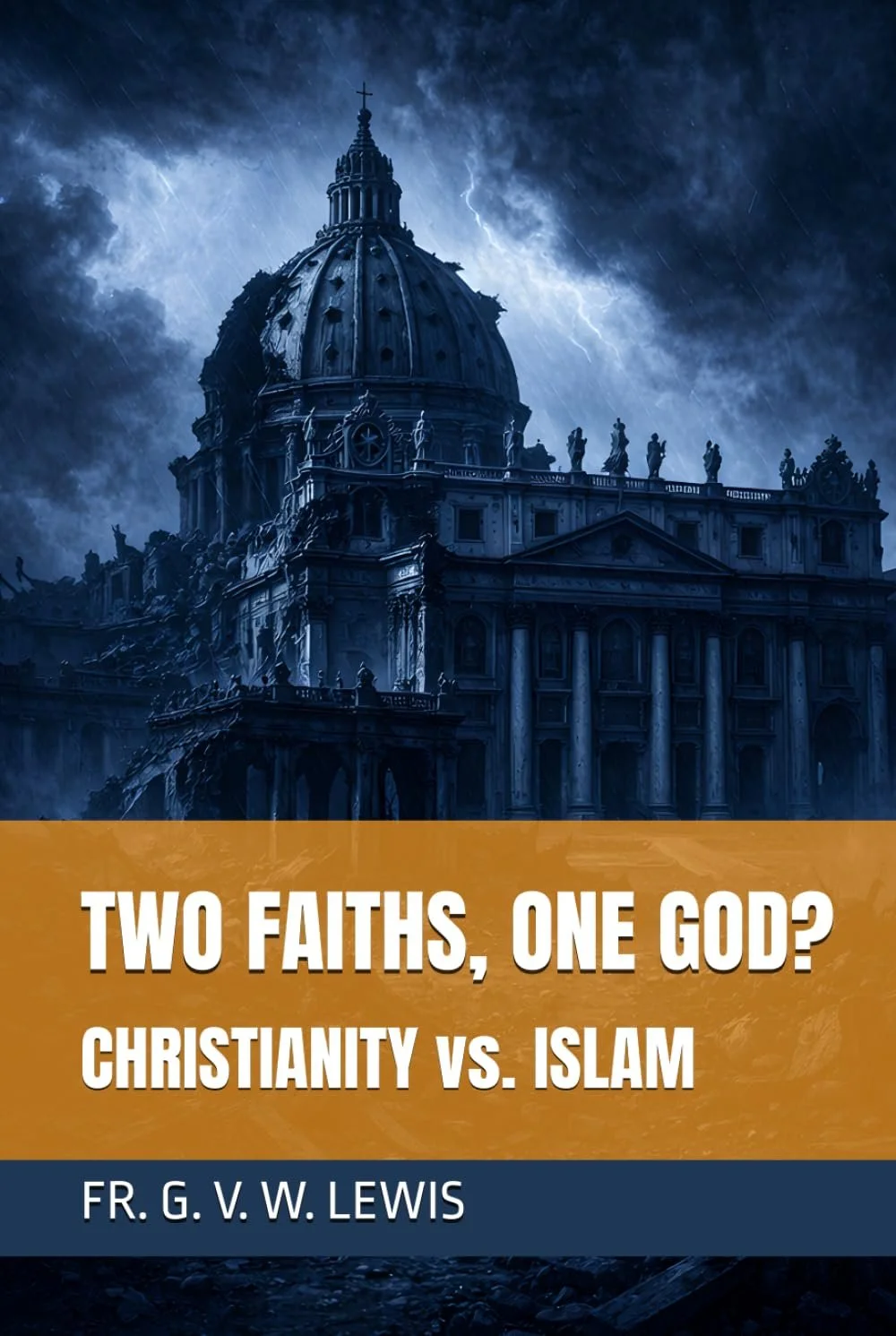
Two Faiths, One God?...
<>
The Islam Issue Facing the Western World
<>
On Amazon NOW!
<>
Two Faiths, One God?... <> The Islam Issue Facing the Western World <> On Amazon NOW! <>
There is a conversation that Christians urgently need to have, and are not quite having. It concerns Islam — the faith of nearly two billion of our fellow human beings, the tradition that has shaped vast swathes of human history, art, science, and civilisation, and the tradition that, in our own time, has become the subject of a peculiar double silence.
On one side of that silence are those who insist that Islam and Christianity are essentially compatible — that the differences between them are matters of cultural emphasis rather than theological substance, and that to suggest otherwise is a form of bigotry. On the other side are those who speak of Islam in the language of civilisational threat, who use the darker passages of the Quran as evidence that Muslims as a people are dangerous, and who have allowed a genuine theological concern to curdle into something that looks uncomfortably like hatred.
This book is written in the conviction that both silences are wrong, and that Christians deserve — and are capable of handling — something better than either.
What follows is an attempt at honest theological examination. It is not a polemic. It is not a defence of any political position. It is an effort to look clearly at what Christianity and Islam actually teach, to name the points at which those teachings are not merely different but irreconcilable, and to do so in a way that is worthy of the seriousness of both traditions.
A word about who I am and why I have written this
I am a Christian theologian and a Catholic priest — the Superior General of a religious institute in the Old Catholic tradition. I have spent much of my ministry engaged with questions of inclusion, theological integrity, and the relationship between faith and reason. I have written elsewhere about the Church's responsibility to welcome those whom it has historically marginalised. I say this not to establish credentials but to make clear where I stand: I am not someone whose instinct is toward exclusion or hostility. I believe deeply in the dignity of every human person.
It is precisely because I hold that conviction that I have written this book. The Muslim men and women who live alongside us in our cities, our streets, and our workplaces deserve the same honest engagement that we would want for ourselves. To pretend that the theological differences between our faiths do not exist, or do not matter, is not a form of respect. It is a form of complacency — a refusal to take the other tradition seriously enough to engage with what it actually says.
I have also been moved to write by a pastoral concern. Christians — particularly those in the West — are increasingly uncertain how to think about Islam. They sense that something important is at stake, but they lack the theological vocabulary to name it clearly. They have been told, from one direction, that any concern about Islamic teaching is Islamophobic; and from another direction, that Islam is an existential threat to Western Civilisation. Both messages are, in different ways, unhelpful. What is needed is theological clarity, delivered with pastoral care.
That is what this book attempts to offer.
Let me be clear about what this book is not
It is not a generalised attack on Muslim people. The nearly two billion Muslims in the world are not all, automatically, our enemies. The majority of Muslims live peacefully, love their families, seek justice, and have no interest or hidden agenda whatsoever in conquest, domination or the destruction of Western Civilisation and its cultural Heritage. Any book about Islam that loses sight of this reality has already failed, as we must be able to distinguish between moderate and peaceful people, and radicalised and dangerous individuals and organised groups with a destructive agenda.
It is not a defence of the political movements that have adopted the language of Christianity for dubious political purposes, although we do not deny the validity of the many genuine concerns regarding the existential stability of Western societies. The equation of theological critique with political hostility is a dishonest approach in contemporary public discourse, and this book refuses to make it. One can believe, as this book does, that Islam and Christianity hold profound and reciprocally incompatible theologies, meaning the understanding of God, Jesus, and salvation — and simultaneously insist that Muslims must be treated with full human dignity and equal civic rights. These positions are not in tension. They are both required by intellectual integrity and by the Gospel. But we also stand by the principle that this is a two-way highway, and its success depends as much on Muslims as it depends on Westerners, no matter whether they are believers of unbelievers.
It is not a work of political science or security studies. This book does not assess the geopolitical dimensions of political Islam, evaluate counterterrorism strategies, or analyse demographic trends. We readily accept these are important subjects, but they belong in different books written by different people holding a wide variety of professional competencies.
What this book is, simply, is theology. It asks the questions that theology is equipped to ask: What does each tradition claim about God? What does each tradition claim about Jesus? Where do those claims agree, where do they diverge, and where are they in direct collision? And what should Christians make of all this?
The Second Vatican Council's Declaration Nostra Aetate — one of the great achievements of twentieth-century Christian thought — affirmed that the Church regards Muslims with esteem. It noted that Muslims adore the one, merciful God, honour Jesus as a prophet, and revere his mother Mary. The Catechism of the Catholic Church (§841) includes Muslims among those whose plan of salvation includes acknowledgment of the Creator.
These affirmations are genuine and important, and this book does not retreat from them. There is real common ground between Christianity and Islam: a shared monotheism, a shared reverence for Abraham and Moses and Jesus, a shared commitment to prayer and almsgiving and care for the poor, a shared conviction that human life has ultimate significance and that we are accountable to a God who is just and merciful.
But Nostra Aetate, read carefully, does not say that Islam and Christianity teach the same thing about God. It does not say that the Muslim understanding of Jesus is compatible with the Christian one. It says that Muslims acknowledge the Creator — not that they acknowledge the Triune God revealed in Jesus Christ. That distinction, which a careful reading of the Council documents makes clear, is not a footnote. It is the whole question.
"I am the way, the truth, and the life. No one comes to
the Father except through me."
John 14:6
Christianity's claim — stated plainly in the Gospel of John and confessed in the Nicene Creed by Christians of every tradition for sixteen centuries — is that Jesus of Nazareth is the eternal Son of God, the second Person of the Holy Trinity, who took human flesh, died on the cross for the sins of humanity, and rose bodily from the dead. This is not one Christian opinion among others. It is the irreducible core of the faith.
Islam's claim — stated with equal clarity in the Quran and confessed by Muslims in the shahada since the seventh century — is that God is absolutely one and undivided, that he has no son, that Jesus was a prophet and not divine, and that the crucifixion as Christians understand it did not occur. These claims are not peripheral to Islam. They are central to it.
Both sets of claims cannot be true simultaneously. This is not a matter of perspective or interpretation. It is a matter of basic logic. And it is the starting point of this book.
A further word about the literal reading of the Quran
One of the most serious concerns this book addresses is the consequence of reading the Quran's more difficult passages — those commanding warfare, prescribing the subordination of non-Muslims, or denying fundamental freedoms of conscience — in a flat, literal manner, without the moderating influence of contextualising scholarship or hermeneutical tradition.
Every major religion has texts that, read without context or interpretive tradition, would produce horrifying results. The Hebrew Bible commands genocide. The New Testament has been used to justify slavery, the persecution of Jews, and the subordination of women. The history of Christian violence is long and shameful. No serious Christian theologian would defend a purely literal, non-contextual reading of every biblical text — and the mainstream Christian tradition has developed rich hermeneutical frameworks precisely to prevent such misreadings.
Islam, too, has its mainstream hermeneutical traditions — centuries of sophisticated jurisprudence, contextual scholarship, and theological reflection that moderate and qualify the plain sense of difficult texts. The overwhelming majority of Muslim scholars and Muslim communities operate within these traditions and are genuinely committed to peaceful coexistence.
But — and this is a point that honest engagement requires us to make — the literal reading of certain Quranic passages has been, and continues to be, used to justify violence, the denial of equal rights to non-Muslims, the systematic destruction of non-Muslim Culture and cultural output in the Arts, Music, Literature, Architecture and so forth, and the suppression of freedom of conscience and democratic living patterns. These readings are not fabrications of hostile critics. They have roots in classical Islamic scholarship. And they are deployed, in our own time, by movements with agendas that cause real harm to real people and to the societal contexts they live in.
To name this is not to condemn Islam or Muslims. It is to take seriously the power of sacred texts — and the responsibility that falls on all communities of faith to develop and maintain the interpretive traditions that prevent their most difficult passages from becoming weapons.
This book is organised in two parts.
The first part addresses the theological incompatibilities between Christianity and Islam. It examines, in turn, the doctrine of God (Trinity versus Tawhid), the identity of Jesus Christ, the crucifixion and resurrection, the nature of scripture and the doctrine of tahrif, and the Quranic claim that Abraham and all the prophets were proto-Muslims. These chapters are unapologetically theological. They assume a reader who takes doctrinal questions seriously and wants to understand not just that the two faiths differ, but why, and at what depth.
The second part addresses the civic and social concerns that arise from certain interpretations of Islamic teaching: the theology and practice of jihad, the classical Islamic legal framework governing non-Muslims, questions of freedom of conscience and apostasy, and the treatment of women. These chapters are written with particular care to distinguish between the texts, the classical interpretive traditions, and the diversity of contemporary Muslim practice — because the failure to make those distinctions is responsible for much of the worst discourse on this subject.
The book closes with a chapter addressed directly to Christians: how should we respond? What does intellectual honesty about these incompatibilities require of us in terms of our attitudes, our speech, our civic engagement, and our personal relationships with Muslim neighbours and friends?
The Nicene Creed — confessed every Sunday by Catholics, Orthodox, Old Catholics, Liberal Catholics, Anglicans, Lutherans, Methodists, Reformed Christians and many others — begins with the words: “I believe in one God, the Father Almighty, maker of heaven and earth”. It continues through the Incarnation, the crucifixion, the resurrection, and the sending of the Holy Spirit. Every word of that Creed is at stake in the questions this book addresses.
Christians who take the Creed seriously — who believe that it describes reality, not merely religious preference — cannot also believe that the Muslim denial of the Trinity, of the divine sonship of Jesus, and of the redemptive significance of the cross is simply a different but equally valid way of approaching the same truth. The Creed does not permit that conclusion. Neither does intellectual integrity.
But Christians who take the commandment to love their neighbours seriously — who believe that every human being is made in the image of God and deserves to be treated accordingly — cannot allow theological disagreement to become a license for contempt, discrimination, or violence. The Gospel does not permit that conclusion either.
The narrow path between these two errors is the path this book tries to walk. It is not always comfortable. Honest examination rarely is. But it is, I believe, what faithful Christian witness in our time requires.🟥
+ Fr. G. V. W. Lewis
Superior General
Canons Regular of the Sacred Heart of Jesus
Palm Sunday 2026