
The God
Question
Trinity
and
Tawhid
Fr. G. V. W. Lewis
Two Faiths, One God?...
<>
The Islam Issue Facing the Western World
<>
On Amazon NOW!
<>
Two Faiths, One God?... <> The Islam Issue Facing the Western World <> On Amazon NOW! <>
Hear, O Israel: the Lord our God, the Lord is one.
Deuteronomy 6:4Say: He is Allah, the One. Allah, the Eternal Refuge. He neither begets nor is born, nor is there to Him any equivalent.
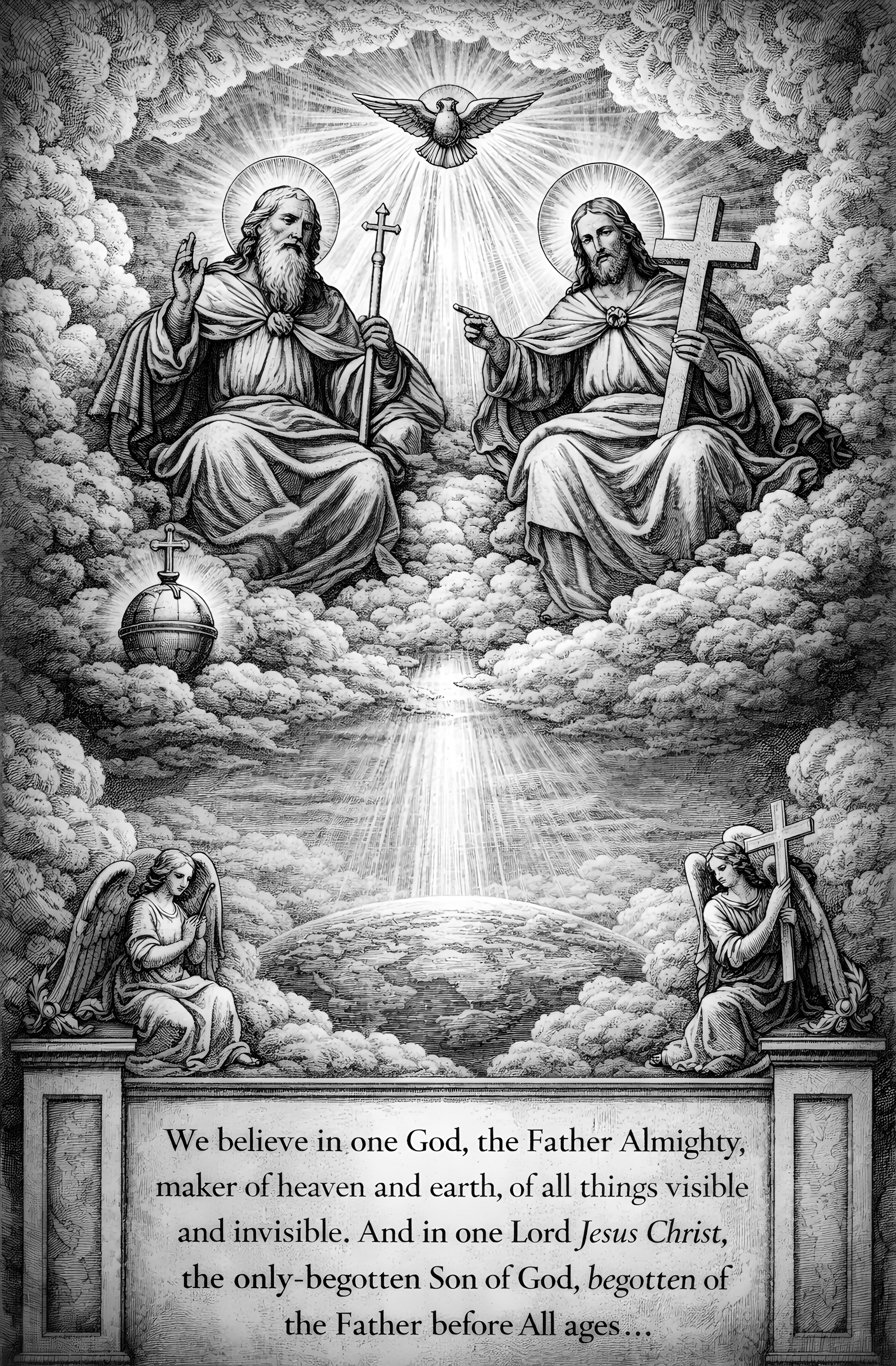
Quran 112:1-4 (Surah Al-Ikhlas)We believe in one God, the Father Almighty, maker of heaven and earth, of all things visible and invisible. And in one Lord Jesus Christ, the only-begotten Son of God, begotten of the Father before all ages...
The Nicene Creed, 325 AD
Every serious conversation between Christians and Muslims must begin here: with the question of God. Not because it is the most politically urgent question — it is not! Not because it leads most quickly to practical conclusions about how we should live together — it does not! But because it is the question on which everything else depends. If we do not understand clearly what each faith claims about the nature of God, we cannot understand anything else about them with any real depth. The disagreements about Jesus, about scripture, about salvation, about law and society — all of these are downstream of the God question. Get this question wrong, or fudge it in the interests of politeness, and the entire subsequent conversation rests on a false foundation.
So let us begin at the beginning.
I. The Christian Confession: God as Trinity
Christianity's understanding of God is Trinitarian. This is not one theological opinion among others within the Christian tradition. It is the dogmatic core of the faith, defined by the first two Ecumenical Councils — Nicaea in 325 AD and Constantinople in 381 AD — and confessed ever since in the Nicene Creed by Christians of every tradition: Roman Catholic, Old Catholic, Liberal and Reformed Catholic, most other Catholic, Orthodox, Anglican, Lutheran, Reformed, Methodist, and most others.
The doctrine of the Trinity holds that God is ONE in being or essence — ONE God, NOT three — but that this one God exists eternally as three distinct Persons: the Father, the Son, and the Holy Spirit. These three Persons are not three gods. They are not three parts of one God. They are not three modes or masks that one God puts on at different times. They are three co-equal, co-eternal Persons who share fully and completely in the one divine nature, each distinct from the others in their relations, but one in everything that makes God… Well… GOD.
The language is demanding, and Christians have always acknowledged this. The doctrine of the Trinity is a mystery — not in the sense of being irrational, but in the sense of exceeding what unaided human reason could have arrived at independently. It was not deduced from first principles. It was disclosed. Christians believe that God revealed himself as Trinity through the events of salvation history: through the Incarnation of the Son, through the Transfiguration of Jesus (see Matthew 17:1–8, Mark 9:2–13, and Luke 9:28–36), through the life, death, and resurrection of Jesus, and through the outpouring of the Holy Spirit at Pentecost. The doctrine is the Church's attempt, over several centuries of intense theological reflection, to state faithfully what those events disclose about the inner life of God.
The Nicene Creed — still the most widely shared statement of Christian faith across all traditions — expresses this with precision: the Son is begotten, not made, of one being with the Father. The Greek word used is homoousios (ὁμοούσιος)— of the same substance or essence, i.e., consubstantial. This was the crucial word at Nicaea, the word over which the Church fought bitterly for decades, and the word that ultimately defined orthodoxy. Jesus Christ is not a lesser god, not a demigod, not a created being exalted to divine status. He is fully and truly God — the same God as the Father, distinct in Person but identical in nature.[1]
The Holy Spirit, the third Person of the Trinity, is likewise fully God — proceeding eternally from the Father (and, in the Western tradition, from the Son), the Lord and giver of life, who with the Father and the Son together is worshipped and glorified.
This is the God Christians profess. Not an abstract philosophical principle, not a distant unmoved mover, but a God whose inner life is eternally relational — a communion of Persons/Natures in love. The great Christian mystic and theologian Richard of St. Victor in the twelfth century argued that love, by its nature, requires an other; a God who is purely solitary cannot be said to be love in any full sense. The Trinity is the Christian answer to the question of how God can be, as John's Gospel declares, love itself — not merely loving, but constitutively, essentially love.
II. The Islamic Confession: God as Tawhid
Islam's understanding of God is governed by the principle of tawhid — a word that comes from the Arabic root meaning to make one, or to declare one. Tawhid is the absolute, undivided, uncompromising oneness of God. It is the theological heartbeat of Islam, the conviction from which everything else in the tradition flows.
The most concise and beloved expression of tawhid is Surah Al-Ikhlas, the 112th chapter of the Quran, which Muslims regard as equal in worth to a third of the entire Quran and which is recited daily in prayer across the Muslim world Say:
He is Allah, the One.
Allah, the Eternal Refuge.
He neither begets nor is born,
nor is there to Him any equivalent.
Four verses. Every word carries weight.
God is One. This means not merely that there is only one God — though it means that too — but that God's oneness is of an absolute, unqualified kind. There is nothing in God that is divided, multiple, or composite. God does not have parts. God does not have an inner life that could be described in terms of relationships between Persons. God simply is — one, eternal, self-sufficient, utterly transcendent, entirely beyond the categories of creaturely existence.
He neither begets nor is born. This phrase is a direct repudiation of any theology that speaks of God having a son, whether in the biological sense or in any other. The very concept of divine generation — of one divine Person being eternally begotten from another — is, from the standpoint of tawhid, an assault on the absolute singularity of God. It introduces multiplicity into the divine nature. It suggests that God stands in relation to another being of the same nature. Both ideas are, in Islamic theology, simply impossible.
Nor is there to Him any equivalent. This clause closes off any possibility of a being equal to God — which is precisely what the Christian doctrine of the Trinity claims: that Father, Son, and Holy Spirit are co-equal in divinity. From the standpoint of tawhid, this is not merely wrong. It is the gravest possible theological error and a fatal sin— what Islam calls SHIRK. [3]
III. Shirk: The Gravity of the Incompatibility
The word shirk comes from the Arabic root meaning to share or to associate. In Islamic theology it denotes the association of partners, equals, or rivals with God — the attribution of divine qualities, divine status, or divine worship to anything or anyone other than the one God. It is the cardinal sin of Islam, the one transgression that the Quran explicitly states God will not forgive if a person dies without repenting of it. [4] And if discovered in life, the punishment is death.
The Quran addresses shirk with a force and frequency that makes clear how central the concern is. Surah 4:48 states plainly: “Indeed, Allah does not forgive association with Him, but He forgives what is less than that for whom He wills”. This verse is not a warning about a peripheral matter. It identifies shirk as the one sin that places a person definitively outside the mercy of God — not because God is unloving, but because shirk is understood as the most fundamental possible rejection of truth about the nature of reality of God.
Now… We must face the full weight of what this means for the question of Christian-Muslim theological compatibility.
Christianity confesses that Jesus Christ is the eternal Son of God, the second Person of the Holy Trinity, fully divine and fully human, co-equal with the Father. It confesses that the Holy Spirit is likewise fully God, proceeding from the Father, co-equal and co-eternal. It worships the one God as Trinity — Father, Son, and Holy Spirit — and directs prayer, praise, and devotion to all three Persons.
From the standpoint of Islamic theology, every single element of that confession constitutes shirk, punishable by death. Not a minor theological imprecision. Not a cultural misunderstanding that patient dialogue might resolve. Shirk — the gravest sin in the Islamic moral and theological order. Every Christian who recites the Nicene Creed, who is baptised in the name of the Father and of the Son and of the Holy Spirit, who prays to Jesus as Lord, is, by the standards and fundamental definition of Islamic theology, guilty of the worst offence a human being can commit against God.
This is not a hostile characterisation of Islam invented by its critics. It is what Islamic theology itself teaches, clearly and consistently, across the centuries and across the different schools of Islamic jurisprudence and theology. It must be stated plainly, not to generate alarm, but because intellectual honesty demands it. Any account of Christian-Muslim relations that does not reckon with this reality is not an honest account and places the Christian, Western world in terrible danger.
IV. The Quranic Case Against the Trinity
The Quran does not merely imply its opposition to the Christian doctrine of the Trinity. It addresses that doctrine directly, explicitly, and repeatedly. This is worth examining carefully, because it reveals something important about the nature and depth of the incompatibility.
Surah 4:171 — one of the most theologically significant verses in the Quran for Christian-Muslim dialogue — reads: “O People of the Scripture, do not commit excess in your religion or say about Allah except the truth. The Messiah, Jesus the son of Mary, was but a messenger of Allah and His word which He directed to Mary and a soul from Him. So believe in Allah and His messengers. And do not say 'Three'; desist — it is better for you. Indeed, Allah is but one God. Exalted is He above having a son”. [5]
Several things are worth noting about this verse.
First, it is addressed directly to Christians — “People of the Scripture” — and it commands them to cease their Trinitarian confession. It does not ask them to refine it, reinterpret it, or explain it more clearly. It tells them to stop.
Second, it frames the Trinity as a form of excess — a going beyond what is true — rather than as a misunderstanding.
Third, it closes with the affirmation that God is exalted above having a son: the divine sonship of Jesus is not merely incorrect but incompatible with the transcendence and majesty of God.
Surah 5:72-73 is equally direct: “They have certainly disbelieved who say Allah is the Messiah, the son of Mary... They have certainly disbelieved who say Allah is the third of three. And there is no god except one God”. [6] The word translated as disbelieved is the Arabic word kafara — from the same root as kufr, unbelief. This is not a gentle critique. It is a declaration that the Christian confession of the Trinity constitutes a fundamental rejection of divine truth.
The Quran repeats the denial that God has a son no fewer than twelve times across different surahs. [7] This is not incidental repetition. In the rhetorical structure of the Quran, repeated emphasis signals supreme importance. The denial of divine sonship is one of the most insistently stressed theological claims in the entire Quranic text.
V. A Misunderstanding of the Trinity?
Some scholars — both Muslim and Christian — have suggested that the Quran's rejection of the Trinity may be based partly on a misunderstanding of what Christians actually mean by it. There is something to this argument, and it deserves honest engagement.
Surah 5:116 records Allah asking Jesus: “O Jesus, son of Mary, did you say to the people: Take me and my mother as deities besides Allah?” This verse suggests that the Quran may have understood the Christian Trinity as consisting of God the Father, Jesus, and Mary — a view that no mainstream Christian theological tradition has ever held. [8] If this is the Trinity the Quran is rejecting, it is rejecting a position that Christianity itself rejects.
Similarly, when the Quran asks: “How can Allah have a son when He has no consort?” (Surah 6:101), the question seems to be understanding divine sonship in biological terms — as if Christians were claiming that God physically fathered a child through Mary. Again, this is not the Christian claim. The Nicene formula “begotten, not made” is precisely intended to rule out any biological or creaturely understanding of the Father-Son relationship. The eternal generation of the Son from the Father is an ontological reality within the divine life, not a physical event in time.
These observations suggest that some of the Quranic polemic against Trinitarian theology may be aimed at popular or heterodox forms of Christianity that existed in the Arabian Peninsula in the sixth and seventh centuries, rather than at the classical Trinitarian theology of Nicaea and Constantinople. Muslim scholars are aware of this, and some have argued that a properly understood Nicene Trinity might be less objectionable to Islam than the Quran's direct critiques suggest.
This is an interesting argument, and interfaith dialogue has made genuine progress by exploring it. But it does not resolve the fundamental incompatibility. For even if we grant that the Quran is rejecting a misunderstood Trinity, the doctrine of tawhid as it has been developed in classical Islamic theology leaves no room for the orthodox Christian understanding either. The absolute divine oneness that tawhid affirms — one God, no Persons, no eternal relations within the divine nature, no generation or procession — is incompatible and in direct collision course with Trinitarian theology regardless of whether the Quran accurately represents that theology. The issue is not whether the Quran fairly characterises Christianity. The issue is whether tawhid and Trinity can both be true. And they cannot.
VI. Do Christians and Muslims Worship the Same God?
This is perhaps the most frequently asked question in Christian-Muslim dialogue, and it is one of the most genuinely difficult. The answer depends on what we mean by “same”.
If the question is whether Christians and Muslims both direct their worship toward the Creator of the universe — the ultimate ground of all being, the God of Abraham — then there is a meaningful sense in which the answer is YES. Both traditions are monotheistic. Both profess that there is one God who made all things, who is sovereign over history, who holds humanity morally accountable, and who is merciful and just. When a Muslim prostrates in prayer five times a day and when a Christian kneels before the altar, both are oriented toward the same ultimate reality — the ONE God who is the source and ground of all existence.
The Catholic Church's teaching reflects this. The Catechism states (§841) that the plan of salvation also includes those who acknowledge the Creator, of whom the Muslims are first named. [9] Pope St. John Paul II, in a remarkable gesture at Casablanca in 1985, addressed a gathering of young Muslims with the words: “We believe in the same God, the one God, the living God, the God who created the world and brings His creatures to their perfection”. [10]
But if the question is whether the God Christians confess — the Triune God, Father, Son, and Holy Spirit, who became incarnate in Jesus Christ — is the same as the God Islam confesses — the absolute, undivided One of tawhid, who has no son and admits no partners — then the answer, stated with equal honesty, must be: not entirely, and in the most theologically significant respects, NO.
The God of Christian confession is not simply a God who happens to have a Son and a Spirit in addition to being the Creator. The Trinitarian nature of God is not an add-on to an otherwise Islamic theology of divine oneness. It is constitutive of who God is. To say that God is love, as John's Gospel does, is to say something about the inner life of God — that God is eternally self-giving, eternally in relation, eternally a communion of Persons. A God who is absolute solitary oneness — however majestic and merciful — is a fundamentally different kind of God from the Triune God of Christian confession.
The most honest answer, then, is something like this: Christians and Muslims worship toward the same God in the sense that both are directed toward the one Creator and Lord of all. But they hold incompatible understandings of who that God is, what God's inner life is like, and how God has acted in history. And those incompatibilities are not peripheral. They go to the heart of both faiths.
VII. Why This Matters Pastorally
A reader might ask at this point: why does it matter? If both Christians and Muslims are trying to orient their lives toward the one God, toward goodness and justice and mercy, why spend so much effort on doctrinal distinctions that most ordinary believers — Christian or Muslim — rarely think about?
The answer is that doctrines are not merely intellectual positions. They shape how people understand themselves, their neighbours, and their obligations. The doctrine of the Trinity, in particular, has profound practical implications that go far beyond the lecture hall.
If God is Trinity — if the inner life of God is an eternal communion of love between Persons — then love is not merely a moral obligation but a participation in the very nature of God. To love one's neighbour is to reflect the life of God in the world. The Church's understanding of human dignity, of the sanctity of every person made in the image of a Trinitarian God, of the call to community and solidarity — all of this flows from the Trinitarian doctrine of God. It is not separable from it.
Conversely, if tawhid is true — if God is absolute, solitary oneness, utterly transcendent, admitting no inner relational life — then the relationship between God and humanity is necessarily different in character. God commands; humanity submits. The very word “Islam” means “submission”. This is not a criticism — it describes a genuine and profound spiritual orientation. But it is a different orientation from the Christian vision of humanity as called into communion with a God whose own life is communion.
These different understandings of God generate, over time, different understandings of the human person, of community, of law, of freedom, and of the relationship between the sacred and the secular. The theological differences are not merely theological. They are civilisational — in the best and most serious sense of that word.
VIII. A Note on Respect
Nothing in this chapter should be read as a suggestion that the Islamic understanding of God is contemptible, foolish, or unworthy of serious engagement. It is none of these things. The great tradition of Islamic theology — from Al-Ghazali to Ibn Sina to Ibn Rushd to the Mutakallimun — represents one of the most sophisticated bodies of theological and philosophical reflection in human history. The Islamic conviction that God is absolutely one, utterly transcendent, and infinitely merciful has sustained the prayer and the hope of hundreds of millions of human beings across fourteen centuries. It deserves respect.
What it does not deserve is false agreement. The most profound form of respect we can offer to any tradition — including Islam — is to take its claims seriously enough to engage with them honestly. That means acknowledging where it agrees with Christianity and where it does not. It means being willing to say, clearly and without hostility: on the question of whether God is Trinity, we disagree, and the disagreement is not resolvable by dialogue. It is a matter on which one of us must be wrong.
Christians believe that the Triune God revealed in Jesus Christ is the truth about who God is. They believe this not because they are arrogant, but because they trust the testimony of the apostles, the witness of the resurrection, and the guidance of the Holy Spirit across twenty centuries of theological reflection. That conviction does not make Muslims their enemies. It makes them neighbours with whom Christians disagree about the most important question there is — and whom Christians are called, by the very God they confess, to love.
Summary
The Christian doctrine of the Trinity and the Islamic doctrine of tawhid represent two fundamentally incompatible understandings of the nature of God. Christianity confesses one God in three Persons — Father, Son, and Holy Spirit — co-equal and co-eternal. Islam confesses one God of absolute, undivided oneness, admitting no Persons, no inner relations, and no divine son. The Quran addresses the Trinity directly and repeatedly, declaring the Christian confession a form of shirk — the gravest sin in Islamic theology. Some of the Quranic polemic may rest on a misunderstanding of Nicene Trinitarianism, but the doctrine of tawhid as developed in classical Islamic theology is incompatible with orthodox Trinitarian theology regardless. Christians and Muslims are both directed toward the one Creator God, but they hold irreconcilably different understandings of who that God is. This incompatibility is not peripheral to either faith. It is constitutive of both.🟥