
Who Is Jesus?
The Quran's Portrait
and
Christianity's Answer
Fr. G. V. W. Lewis
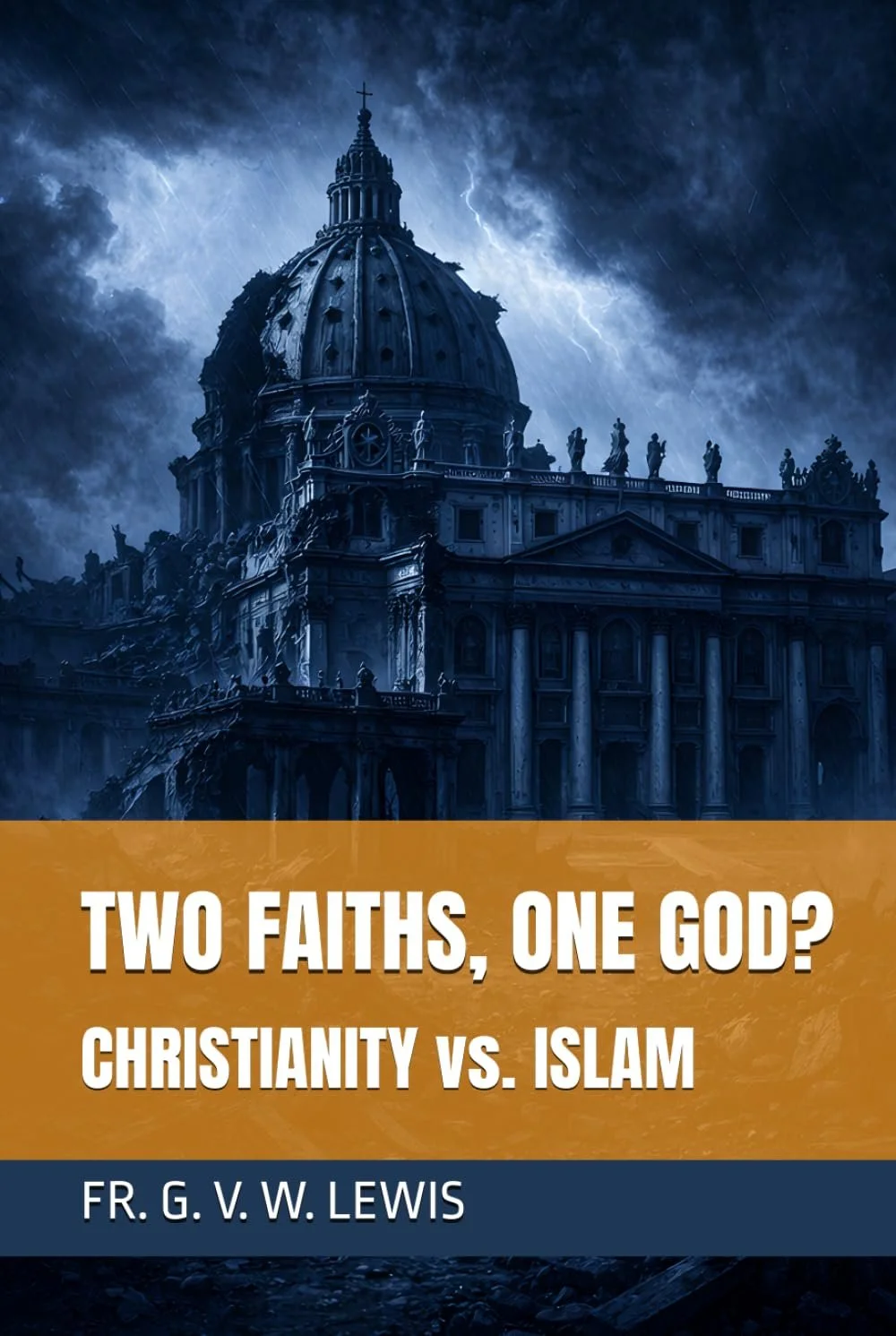
Two Faiths, One God?...
<>
The Islam Issue Facing the Western World
<>
On Amazon NOW!
<>
Two Faiths, One God?... <> The Islam Issue Facing the Western World <> On Amazon NOW! <>
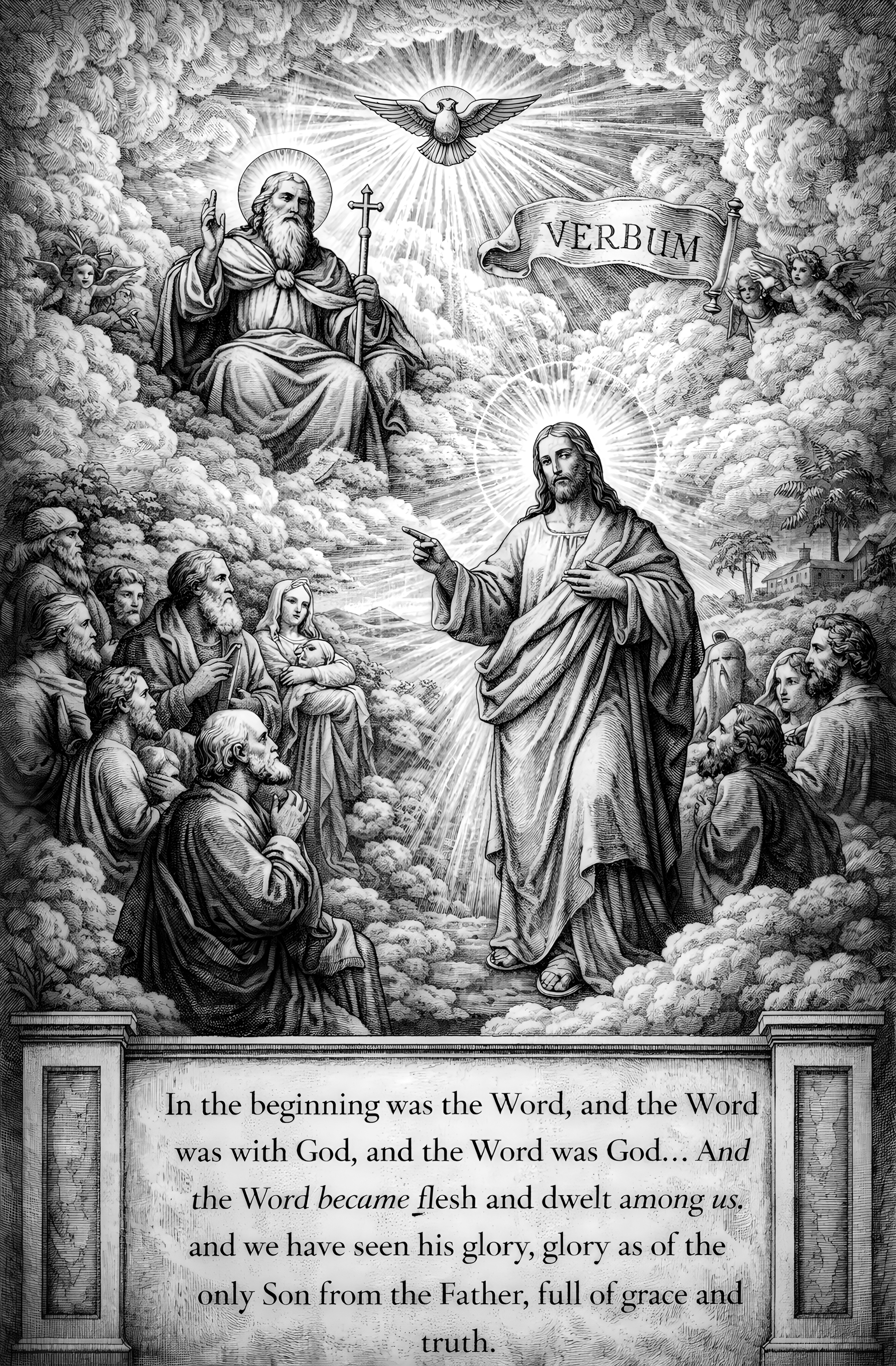
In the beginning was the Word, and the Word was with God, and the Word was God... And the Word became flesh and dwelt among us, and we have seen his glory, glory as of the only Son from the Father, full of grace and truth.
John 1:1, 14The Messiah, Jesus the son of Mary, was but a messenger of Allah and His word which He directed to Mary and a soul from Him. So believe in Allah and His messengers. And do not say 'Three”.
Quran 4:171.
No figure in human history has been claimed, contested, and interpreted by more traditions than Jesus of Nazareth. Historians regard him as one of the most consequential human beings who ever lived. Jews remember him as a rabbi whose followers parted ways with the synagogue. Christians confess him as the eternal Son of God incarnate, crucified for the sins of the world, risen from the dead, and reigning as Lord over all creation. And Muslims — and this surprises many people when they first encounter it — revere him as one of the greatest prophets ever sent by God, born of a virgin, worker of miracles, and destined to return at the end of time.
The fact that Islam holds Jesus in such high regard is one of the most commonly cited reasons for hoping that Christianity and Islam might find deep common ground. It is a genuine point of contact, and it deserves to be acknowledged honestly. But it is also, when examined carefully, one of the clearest illustrations of the depth of the incompatibility between the two faiths. For the Jesus of the Quran and the Jesus of the New Testament are not the same figure. They share a name, a mother, a miraculous birth, and a reputation for holiness. But they differ on the questions that matter most: who Jesus is, what He came to do, and what happened to Him.
This chapter examines both portraits — the Quran's and the New Testament's — with the care and honesty they deserve.
I. Jesus in the Quran: Honoured but Human
Jesus — referred to in the Quran as Isa ibn Maryam, Jesus son of Mary — appears by name twenty-five times across fifteen different surahs. He is called by an array of remarkable titles: the Messiah(al-Masih), the Word of God(Kalimat Allah), a Spirit from God(ruh minhu), a servant of God(abd Allah), and a messenger(rasul). He is one of the five greatest prophets in Islamic tradition — the Ulul Azm, or Prophets of Firm Resolve — alongside Noah, Abraham, Moses, and Muhammad. [11]
The Quran devotes more verses to the story of Mary, the mother of Jesus, than the New Testament does. Surah 19 — Maryam — is named after her and tells the story of the annunciation, the virgin birth, and the infant Jesus speaking from the cradle to defend his mother's honour. The Quran affirms the virgin birth directly and unambiguously: Mary conceives without a human father, by the word and breath of God. This is not a minor detail. It is a point of genuine theological convergence between the two traditions, and it is worth pausing to appreciate it.
Jesus in the Quran performs miracles — remarkable, extraordinary miracles. He heals the blind and the leper. He raises the dead. He breathes life into clay birds. [12] These are not modest signs. They are the kinds of miracles associated, in both traditions, with divine power at work. And the Quran is explicit that these miracles are genuine — not illusions or fabrications.
Furthermore, the Quran speaks of Jesus with a warmth and honour that goes beyond its treatment of most other prophets. He is described as illustrious in this world and the next (3:45). He is a sign to all peoples (21:91). He is strengthened with the Holy Spirit (2:87, 2:253). He is, in the Quran's own words, righteous — one of the good(3:46).
All of this is genuine common ground. Christians reading these passages for the first time often feel a kind of surprised recognition — yes, this is Jesus, or at least something recognisably like Him. The reverence is real. The honour is sincere. And it creates the foundation for a genuine conversation about the figure at the centre of both traditions' interest.
But then comes the qualification — and it changes everything.
II. The Quranic Qualification: Jesus is Not Divine
For all the honour the Quran accords to Jesus, it is equally insistent — relentlessly, almost anxiously insistent — that He is not divine. He is not the Son of God. He is not God incarnate. He is not to be worshipped. He is a human being, a prophet, a servant of God, who performed his mighty works not by his own divine power but by God's permission and at God's command.
The key verse is 3:59, which states the Quranic position with crystalline clarity: “The similitude of Jesus before Allah is as that of Adam; He created him from dust, then said to him: 'Be.' And he was”. [13] This analogy is theologically precise and deliberately chosen. Adam was created directly by God — without a human father or mother — and yet no one considers Adam divine. Jesus, the Quran says, is in the same category. His miraculous origin does not make him God any more than Adam's miraculous origin makes Adam God. He is a creature — an extraordinary creature, a supremely gifted and honoured creature, but a creature nonetheless.
The Quran reinforces this point by repeatedly emphasising that Jesus performed his miracles by Allah's leave — a phrase that appears multiple times in connection with his healings and raising of the dead (3:49, 5:110). [14] The classical Islamic commentators understood this phrase as deliberately and carefully placed: it is there to prevent any reader from concluding that Jesus's miraculous power was his own, inherent, divine power. His power is borrowed. It is delegated. It is God's power working through a human instrument — not God himself acting in human form.
And then there is the direct questioning of Jesus himself. Surah 5:116 records one of the most striking passages in the Quran: “And when Allah said: O Jesus son of Mary, did you say to the people: Take me and my mother as deities besides Allah? He said: Exalted are You! It was not for me to say that to which I had no right”. [15] Here Allah interrogates Jesus about the Christian claim to his divinity — and Jesus himself disowns it. From the Quran's perspective, the veneration of Jesus as God is not merely a theological error made by Christians after his time. It is an error that Jesus himself, when asked directly, explicitly repudiates.
III. Jesus in the New Testament: Lord and God
The New Testament's portrait of Jesus could hardly be more different — not in its depiction of his compassion, his wisdom, or his miraculous power, which are consistent with the Quran's portrait, but in its fundamental claim about who he is.
The Gospel of John opens not with a birth narrative but with a cosmic prologue that reaches back before creation itself: In the beginning was the Word, and the Word was with God, and the Word was God(John 1:1). The Word — the eternal Logos, the principle of divine reason and creative power — has always existed, has always been in intimate communion with God, and has always been, in its own right, divine. And then, in the fourteenth verse, comes the most audacious claim in the history of religious literature: And the Word became flesh and dwelt among us. The eternal God entered human history. The Creator took on creaturely form. The Word became a particular human being, born of a particular woman, in a particular place and time.
The rest of the New Testament consistently maintains this astonishing claim. Paul's letter to the Philippians describes Christ Jesus as being in the form of God before the Incarnation — not resembling God, not reflecting God, but existing in the very form and nature of God (Philippians 2:6). [16] The letter to the Colossians calls him the image of the invisible God, the firstborn of all creation, and states that in him all the fullness of God was pleased to dwell (Colossians 1:15, 19). The letter to the Hebrews opens by describing the Son as the radiance of the glory of God and the exact imprint of his nature (Hebrews 1:3).
In the Gospel of John, Jesus makes claims about himself that, in their Jewish context, could only be understood as claims to divine identity. When he says “Before Abraham was, I am” (John 8:58), he is not merely claiming to have pre-existed Abraham — he is using the divine name, the ego eimi of the Greek, echoing the I AM WHO I AM of Exodus 3:14. His audience understood exactly what he was claiming — they picked up stones to kill him for blasphemy. [17]
The resurrection is the event that, for the New Testament writers, confirms and vindicates all of these claims. Thomas, encountering the risen Jesus, falls at his feet and cries: “My Lord and my God!” (John 20:28). This is not a moment of metaphorical enthusiasm. It is the culmination of the entire Gospel — the moment at which a human being, face to face with the risen Christ, confesses his full divine identity. And Jesus does not correct him.
IV. The Titles: Where Agreement Ends
One of the most illuminating ways to see the depth of the disagreement is to examine the titles both traditions apply to Jesus — because some of the same titles are used, but they carry fundamentally different meanings:
The Messiah (al-Masih in Arabic, Christos in Greek). Both the Quran and the New Testament call Jesus the Messiah. But the word carries very different weight in each tradition. In the New Testament, the title Messiah — the Anointed One — connects Jesus to the entire sweep of Israel's hope for a divine deliverer, a king of David's line through whom God himself would come to save his people. By the time the New Testament reaches its climax, Messiah has become virtually synonymous with Lord and Son of God. [18] In the Quran, Messiah is a title of honour — but its precise meaning is not developed, and it carries none of the eschatological and soteriological weight it bears in the New Testament. Jesus is the Messiah in the Quran, but the Quran does not explain what that means in any depth, and it certainly does not mean that he is divine.
The Word of God (Kalimat Allah). This title, applied to Jesus in Quran 4:171 and 3:45, is one of the most theologically rich in the Quran — and one of the most contested between the traditions. In John's Gospel, the Word (Logos) is explicitly identified with God: the Word was God. The Word is the eternal divine principle through whom all things were made, who took flesh in Jesus. [19] In the Quran, Jesus as the Word of God means something quite different: he is the word of God's creative command — God said Be, and Jesus came into existence. He is the product of God's word, not the Word himself as a divine Person. The same title, two irreconcilable meanings.
A Spirit from God (ruh minhu). This title, also from Quran 4:171, has generated centuries of theological reflection. Christian theologians have noted that it sounds remarkably close to the language of divine anointing — that Jesus is not merely a man whom God inspired, but a being in whom God's own Spirit dwells in a unique and constitutive way. Some early Christian theologians reading the Quran have found in this title an opening for dialogue about the divine nature of Jesus. [20] But Islamic theology has consistently resisted this reading. The spirit given to Jesus is understood as a created spirit — an extraordinary gift from God, as the Quran says that God breathed his spirit into Adam at creation (15:29) — not as an indication of divine nature. Once again, the title is shared; the meaning is not.
V. The Virgin Birth: Genuine Common Ground
It is worth pausing here to acknowledge a point of genuine theological convergence, because honesty requires it.
Both the New Testament and the Quran affirm the virgin birth of Jesus. The Gospel of Luke gives the most detailed account: the angel Gabriel appears to Mary, announces that she will conceive by the power of the Holy Spirit, and she accepts with her famous response: “Let it be to me according to your word” (Luke 1:38). The Gospel of Matthew confirms: “she was found to be with child from the Holy Spirit” (Matthew 1:18). [21]
The Quran's account in Surah 19 (Maryam) is equally vivid. Mary withdraws to a private place, an angel appears to her (described as a well-proportioned man), and she is told that Allah will give her a son, though no man has touched her. She is told: Thus will it be. Your Lord says: It is easy for Me, and We will make him a sign to the people and a mercy from Us. And it is a matter already decreed (19:21). [22] The Quran's Mary is not merely an instrument. She is a woman of remarkable faith, chosen above all women of the world (3:42), whose story is told with a dignity and tenderness that has moved Muslim readers for fourteen centuries.
Here, then, is real common ground — and it is not trivial. The miraculous birth of Jesus from a virgin mother, without a human father, by the direct creative act of God, is affirmed by both traditions. It establishes that Jesus is unique among all human beings who have ever lived — that his origin is different in kind from anyone else's. Christians and Muslims agree on this.
Where they diverge is in the theological conclusion drawn from that unique origin. For Christians, the virgin birth is the sign of the Incarnation — God himself entering human existence from within, the eternal Son taking human flesh. The miracle of the birth points to the miracle of who is being born. For Muslims, the virgin birth is a sign of God's power and of Jesus's unique prophetic status — but it does not make him divine, any more than the miraculous creation of Adam from dust made Adam divine. The common ground is real. But it does not reach as far as some would like it to.
VI. Prophet, Messenger, or Lord?
The most fundamental disagreement about Jesus can be stated simply: Is he a prophet, or is he Lord?
Islam's answer is clear. Jesus is a prophet — the greatest prophet before Muhammad, honoured above all others in certain respects, but a prophet nonetheless. His role is to deliver a message from God to humanity. His authority is derived — given to him by God, exercised on God's behalf, never his own in any ultimate sense. When he performs miracles, he does so by God's permission. When he speaks, he conveys God's revelation. When his mission is complete, he returns to God as all human beings do. He is, in the deepest sense, God's servant.
Christianity's answer is equally clear, and it is different at every point. Jesus is not merely a messenger who delivers a message from God. He is himself the Message — God's definitive, personal, embodied self-communication to humanity. He does not merely tell us about God. He shows us God, because he is God. His authority is not derived from God — it is his own, because he shares fully in the divine nature. When he forgives sins, he forgives them in his own name, not merely as God's representative — and his contemporaries understood the scandal of this perfectly.
The sharpest expression of this difference is Jesus's own question to his disciples in Matthew 16:15: “But who do you say that I am?” Peter's answer — “You are the Christ, the Son of the living God” — is, in the Gospel's account, not a human insight but a divine revelation: “Flesh and blood has not revealed this to you, but my Father who is in heaven” (Matthew 16:17). [23] The identity of Jesus is not something that can be worked out by ordinary human reasoning. It is something that must be disclosed — and Christianity's claim is that it has been disclosed, definitively, in the events of Jesus's life, death, and resurrection.
Islam does not deny that Jesus asked this question. It gives a different answer. And that different answer — prophet, not Lord; messenger, not God incarnate — is not a minor theological adjustment. It is the difference between two entirely different understandings of who stood on the shores of the Sea of Galilee, who healed the sick and raised the dead, who was arrested in the garden and led away to his trial.
VII. The Quran's Jesus and History
A brief but important historical observation is worth making here.
The Quran was revealed, according to Islamic tradition, to Muhammad in the Arabian Peninsula between approximately 610 AD and 632 AD — six centuries after the events of Jesus's life. Its portrait of Jesus draws on traditions, stories, and theological debates that were circulating in that environment: some derived from the canonical Gospels, some from apocryphal gospels and traditions, some from Jewish sources, and some from the theological controversies that had been raging in Christianity for centuries. The story of Jesus breathing life into clay birds, for instance, does not appear in any of the four canonical Gospels but is found in the second-century apocryphal Infancy Gospel of Thomas. [24]
This is not said to diminish the Quran's authority within its own tradition. Muslims believe the Quran is the direct word of God, and that belief is not subject to external adjudication. But it does help to explain some of the differences between the Quranic and New Testament portraits of Jesus — and it suggests that the Quran was engaging, in its own revelatory mode, with a complex and contested set of Christian traditions rather than with the canonical New Testament texts directly.
It also underlines a point that is important for the question of compatibility:
The New Testament's portrait of Jesus is not merely older than the Quran's — it is the product of eyewitness testimony and communities in direct contact with those who knew Jesus personally. Paul's letters, the earliest New Testament documents, were written within 20 years of the crucifixion. The Gospels were written within living memory of the events they describe. Whatever one makes of the theological claims they contain, their historical proximity to Jesus of Nazareth is not in doubt. At all!
VIII. The Question of the Second Coming
There is one further point of convergence between the two traditions' portraits of Jesus that is worth noting, precisely because it is so unexpected.
Both Christianity and Islam teach that Jesus will return at the end of time. The New Testament's expectation of the Parousia — the return of Christ in glory to judge the living and the dead — is one of the most consistent themes of the apostolic writings. [25] And Islamic tradition, drawing on hadith rather than the Quran itself, teaches that Jesus (Isa) will descend near the end of history, kill the false messiah (Dajjal), break the cross, and establish justice on earth. [26]
The agreement is striking — but so is the difference:
In the Christian understanding, the returning Christ is the same Jesus who rose from the dead, the divine Lord returning in the glory that was his before the foundation of the world.
In the Islamic understanding, Jesus returns as a great prophet completing his earthly mission — not as God, not as a divine saviour, but as a righteous servant of Allah fulfilling a role assigned to him.
Even in their agreement about the future, the two traditions are telling different stories about the same figure.
IX. Why the Disagreement Cannot Be Dissolved
Some readers will feel, at this point, that the disagreement between the two traditions about Jesus is simply too large, too fundamental, and too deeply embedded in each faith's self-understanding to be resolved by dialogue. They are right! — but they should not be discouraged by this.
The recognition that a disagreement is genuine and irresolvable is not a failure of dialogue. It is, on the contrary, one of dialogue's most important achievements. It replaces a false harmony — the pretence that the differences do not exist or do not matter — with an honest understanding of where the two traditions actually stand. And honest understanding, even of disagreement, is always more fruitful than comfortable or convenient confusion.
What the disagreement about Jesus reveals is that Christianity and Islam are not two different paths up the same mountain. They are two different accounts of who God is, what God has done in history, and what it means for humanity to be saved. The Jesus of Christianity — the eternal Word made flesh, crucified and risen — is not a more detailed or more developed version of the Jesus of the Quran. He is a different figure, making different claims, achieving a different purpose.
Christians who engage seriously with Muslim friends and neighbours will find that this disagreement, stated honestly and respectfully, is not necessarily a barrier to relationship. Many Muslims have a deep and genuine respect for those who hold their own convictions with integrity. What they respect far less — and rightly so — is a Christianity that dissolves its own claims in the interests of easy agreement.
The Church has always taught that Jesus Christ is, as the Council of Chalcedon declared in 451 AD, truly God and truly man — one Person in two natures, without confusion, without change, without division, without separation. [27] This is not a negotiable position. It is the heart of the Christian confession about Jesus. To surrender it in the name of interfaith harmony would not be an act of openness. It would be an act of inexcusable apostasy.
X. A Note on Respect, Again
The Muslim Jesus — honoured prophet, worker of miracles, born of a virgin, destined to return — is a figure of genuine spiritual power and significance. The Islamic tradition's reverence for Jesus is not a pretence. It is real, and it has produced beautiful theological reflection, remarkable poetry, and profound mystical writing across fourteen centuries.
The scholar Tarif Khalidi, in his remarkable study ‘The Muslim Jesus’, gathered over three hundred sayings and stories about Jesus from classical Islamic literature — and many of them are of extraordinary spiritual depth. The Muslim Jesus is a figure of radical renunciation, profound prayer, and burning compassion for the poor. He is described in one tradition as saying: “The world is a bridge — pass over it, but do not build upon it”. [28] These traditions reveal a genuine spiritual engagement with the figure of Jesus that goes far beyond what the Quran alone requires.
Christians who discover this tradition often find in it an unexpected source of reflection and even challenge. The Muslim Jesus sometimes holds a mirror up to the Christian tradition, highlighting aspects of Jesus's teaching — his simplicity, his indifference to worldly power, his identification with the suffering — that the Church has not always kept at the centre of its life.
Appreciation of this does not require agreement about who Jesus is. It requires only the kind of openness that genuine interfaith encounter makes possible — the willingness to receive something from another tradition without surrendering what one's own tradition holds to be true.
Summary
Both the Quran and the New Testament hold Jesus in high regard — but they hold irreconcilably different understandings of who he is:
The Quran honours Jesus as the Messiah, the Word of God, a Spirit from God, and the greatest prophet before Muhammad; it affirms his virgin birth and his miracles. But it insists with equal force that he is not divine, not the Son of God, not to be worshipped — a human prophet who performed his works by God's permission and not by his own inherent power.
The New Testament confesses Jesus as the eternal Son of God incarnate, fully divine and fully human, whose identity as Lord is confirmed by the resurrection.
These two portraits are not complementary accounts of the same figure. They are incompatible accounts, rooted in different understandings of what God has done in history and who stands at the centre of human salvation. The shared titles — Messiah, Word of God, Spirit from God — carry fundamentally different meanings in each tradition. The genuine common ground — the virgin birth, the miracles, the expectation of a second coming — does not reach to the question that matters most: Is Jesus Lord, or is he prophet? On that question, Christianity and Islam give different and irreconcilable answers.🟥