
The Cross and the Empty Tomb
The Most Irreconcilable Point Between Christianity
and Islam
Fr. G. V. W. Lewis
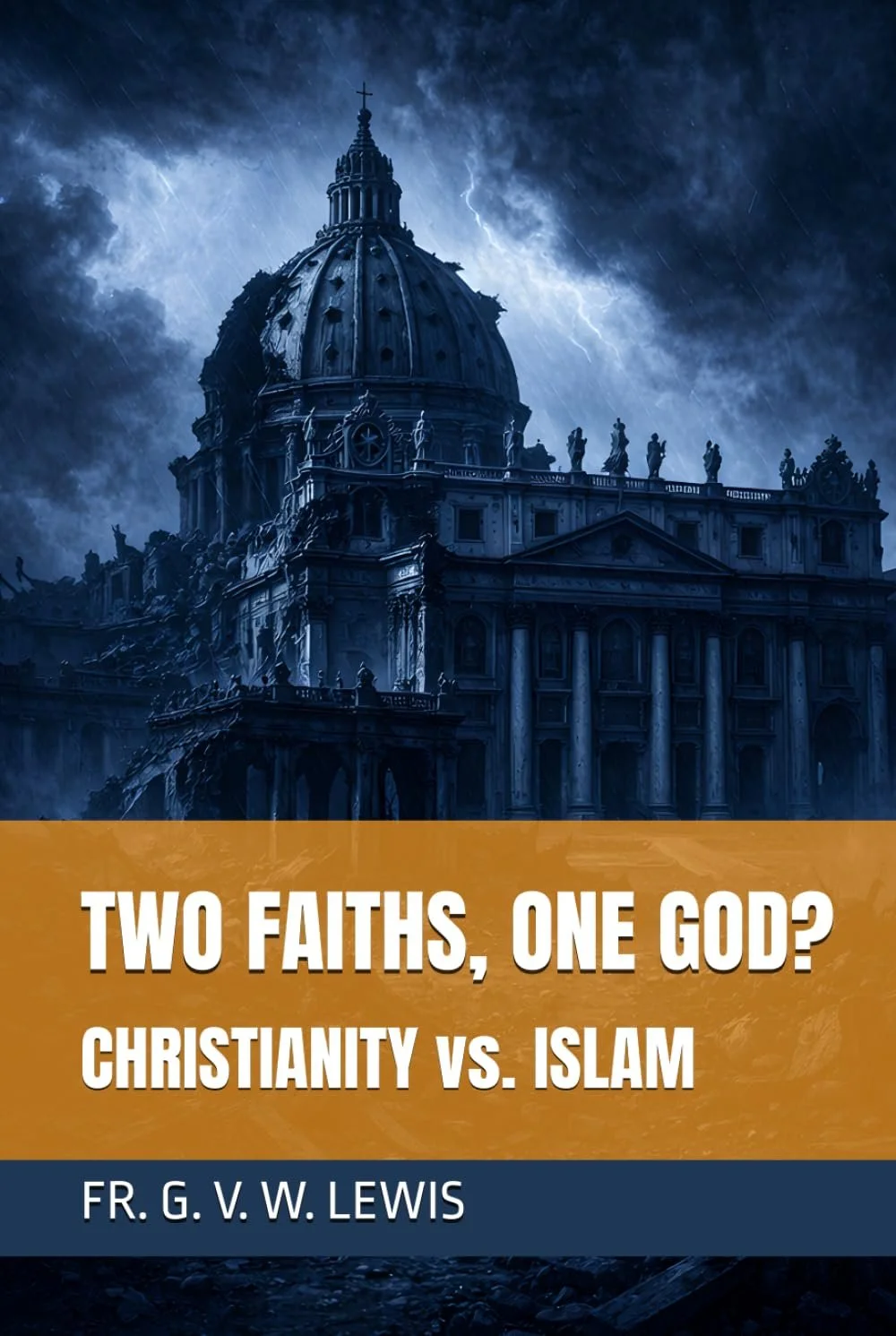
Two Faiths, One God?...
<>
The Islam Issue Facing the Western World
<>
On Amazon NOW!
<>
Two Faiths, One God?... <> The Islam Issue Facing the Western World <> On Amazon NOW! <>
For I delivered to you as of first importance what I also received: that Christ died for our sins in accordance with the Scriptures, that he was buried, that he was raised on the third day in accordance with the Scriptures, and that he appeared to Cephas, then to the twelve.
1 Corinthians 15:3-5 — Paul, writing 20 years after the crucifixion
And because of their saying: We slew the Messiah, Jesus son of Mary, Allah's messenger — they slew him not nor crucified him, but it appeared so unto them; and lo! those who disagree concerning it are in doubt thereof; they have no knowledge thereof save pursuit of a conjecture; they slew him not for certain.
Quran 4:157
There is a point in the theological geography of Christianity and Islam where the two traditions do not merely diverge. They collide... In a train-crash fashion. On the questions we have examined so far — the nature of God, the identity of Jesus — the two faiths hold different positions, and those positions cannot both be true. But they are, in a sense, differences of affirmation: Christianity affirms the Trinity; Islam does not. Christianity affirms the divinity of Jesus; Islam does not. One tradition adds what the other withholds.
The crucifixion is different!!! Here we are not dealing with an affirmation that one tradition makes and the other simply omits. We are dealing with a direct, explicit, unambiguous denial! The Quran does not merely fail to affirm the crucifixion of Jesus. It states, in plain language, that the crucifixion did not happen. At all! That what the disciples and the crowds witnessed was an appearance, not a reality. That the Romans and the Jewish authorities did not, whatever they believed, kill Jesus the son of Mary.
And Christianity's entire understanding of salvation depends on the claim that they did.
This is the most irreconcilable point between the two faiths. Not because it is the most theologically complex — the Trinity is more philosophically demanding. Not because it is the most emotionally charged — the question of who Jesus is carries enormous personal weight. But because it is the point at which the two traditions make flatly contradictory claims about a historical event, and the implications of each claim for the other tradition are totally consequential. If the Quran is right that the crucifixion did not occur, there is no Christian gospel. If the New Testament is right that it did, the Quran's account is in error at its most theologically consequential point.
This chapter examines both claims with the care they deserve.
I. The Cross at the Heart of Christianity
It is impossible to overstate the centrality of the cross in Christian theology. The cross is not one important event among others in the story of Jesus. It is the event toward which the entire story moves, the event from which everything else derives its meaning. It is THE event!
Paul, writing to the Christians in Corinth approximately 20 years after the crucifixion — within living memory of the event itself — describes the death and resurrection of Jesus as of first importance: the non-negotiable core of the gospel he received and handed on (1 Corinthians 15:3). [29] Earlier in the same letter he writes with deliberate starkness: “I decided to know nothing among you except Jesus Christ and Him crucified” (1 Corinthians 2:2). This is not rhetorical flourish. It is a precise theological statement about what stands at the centre.
The Gospel of Mark — almost certainly the earliest of the four canonical Gospels — has been described by scholars as a passion narrative with an extended introduction. More than a third of its text is devoted to the final week of Jesus's life, the events leading to the crucifixion, and the resurrection. The cross is not the tragic ending of a hopeful story. It is, in Mark's telling, the destination toward which Jesus has been moving from the moment he began his ministry. [30]
Why does the cross matter so much? The Christian answer is that the crucifixion of Jesus is not merely an execution. It is an act of atonement — a word that means, at its root, the making of two parties into one, the reconciliation of what has been separated. Christian theology has expressed this in various ways across the centuries: as a substitutionary sacrifice, in which Jesus bears the punishment that sin deserves; as a victory over the powers of death and evil; as an act of divine solidarity with human suffering; as the supreme revelation of the love of God. These different models of atonement are not mutually exclusive — they are different facets of a reality that exceeds any single formulation, precisely because it reshapes the entire History of Mankind.
But what they all have in common is this: the crucifixion must actually have happened. A substitutionary sacrifice that did not take place is no sacrifice. A victory over death that was only apparent is no victory. A revelation of divine love enacted in a death that was not real is not a revelation but a deception. Paul draws the conclusion with characteristic bluntness: “If Christ has not been raised, your faith would have been futile and you would be still in your sins” (1 Corinthians 15:17). [31] The resurrection, which Christianity also affirms, depends entirely on the death having been real. You cannot be raised from a death you did not die.
The cross, then, is not a symbol that can be reinterpreted or relocated to the margins without destroying the structure of Christian faith. It is the load-bearing wall. Remove it, and everything collapses.
II. What the Quran Says
The Quranic denial of the crucifixion is contained primarily in one verse — Surah 4:157 — but it is stated with a force and clarity that leaves no room for ambiguity within the traditional Islamic interpretive framework.
“And because of their saying: We slew the Messiah, Jesus son of Mary, Allah's messenger — they slew him not nor crucified him, but it appeared so unto them; and lo! those who disagree concerning it are in doubt thereof; they have no knowledge thereof save pursuit of a conjecture; they slew him not for certain. But Allah took him up unto Himself. Allah was ever Mighty, Wise.”
Quran 4:157-158
The verse is addressed in the context of a critique of the Jewish authorities who boasted of having killed the Messiah. The Quran's response is not simply to deny their authority or their righteousness in the act — it is to deny the act itself: they did not kill him, they did not crucify him. What appeared to have happened was an appearance only. The verse uses the Arabic “shubbiha lahum” — it was made to appear so to them — a phrase that has generated enormous discussion among Islamic scholars about precisely what happened in place of the crucifixion. [32]
The following verse (4:158) states that Allah took him up unto Himself — that Jesus was raised to God alive, without dying. This is the classical Islamic position: Jesus did not die on the cross. He was taken up by God and is alive with God, from whence he will return at the end of time to complete his earthly mission.
The Quran does not specify who, if anyone, was crucified in Jesus's place — it simply denies that Jesus was. Islamic tradition developed various answers to this question, the most common being that another person — sometimes identified as Simon of Cyrene, sometimes as Judas Iscariot, sometimes as a nameless volunteer — was given Jesus's appearance and crucified in his stead. But the Quran itself is silent on this detail. What it is not silent on is the denial.
III. The Historical Question
The crucifixion of Jesus under Pontius Pilate’s orders is one of the best-attested events of ancient history. This is not a claim made only by Christians. It is the consensus of secular historians of the ancient world, including those with no religious stake in the matter.
The Roman historian Tacitus, writing around 116 AD, refers to the execution of Christ by Pontius Pilate in the context of describing Nero's persecution of Christians: Christus, from whom the name had its origin, suffered the extreme penalty during the reign of Tiberius at the hands of one of our procurators, Pontius Pilatus. Tacitus was not a Christian sympathiser — he describes Christianity as a destructive superstition. His reference to the crucifixion is incidental, which makes it all the more historically significant. [33]
The Jewish historian Josephus, writing in the late first century, also refers to the execution of Jesus: When Pilate, upon hearing him accused by men of the highest standing amongst us, had condemned him to be crucified... The precise wording of Josephus's account has been debated by scholars — Christian scribes appear to have added material — but the core references to the Crucifixion under Pilate are widely accepted as authentic. [34]
The New Testament sources, while explicitly theological in their interpretation of the crucifixion, are also historical documents. Paul's letters, written within 20 years of the event, contain material — including the tradition in 1 Corinthians 15 — that scholars have identified as even earlier oral tradition, possibly dating to within as little as five or seven years of the crucifixion itself. The four Gospels, whatever their theological differences, are unanimous in their account of the death of Jesus. The earliest Christian communities were formed in Jerusalem, within walking distance of the tomb, within living memory of the events — and they staked their lives on the claim that Jesus had died and risen.
No serious historian of the ancient world — whether Christian, Jewish, Muslim, or secular — doubts that a man named Jesus of Nazareth was executed by crucifixion under the Roman governor Pontius Pilate in approximately 30 AD. The event is as well attested as almost anything from the ancient world.
This is not said to settle the theological question by historical argument alone. Christians do not believe in the crucifixion because historians confirm it — they believe in it because they trust the testimony of the apostles and the witness of the Spirit. But the historical consensus does matter, because the Quran's denial of the crucifixion is not a theological reinterpretation of an acknowledged event. It is a denial that the event occurred at all. And that denial places it in direct conflict not only with Christian theology but with the broad secular consensus of ancient historical evidence.
IV. The Gnostic Connection
The Quran's denial of the crucifixion is not without precedent in the history of religious thought. Several early Christian groups — collectively known as Docetists, from the Greek word meaning to seem or to appear — held similar positions in the first and second centuries.
Docetism was the view that Jesus only appeared to be human, and therefore only appeared to suffer and die. Since a divine being could not truly suffer or be killed, the crucifixion was an illusion — what the disciples witnessed was not the true Christ but a phantom. Various Gnostic groups developed this idea in different directions: some held that the divine Christ departed from the human Jesus before the crucifixion; others held that Simon of Cyrene was transformed to resemble Jesus and crucified in his place.
The early Church rejected Docetism firmly and consistently. The letters of Ignatius of Antioch, written around 107 AD, are among the earliest and most forceful responses to Docetic teaching. Ignatius insists with remarkable intensity that Jesus truly suffered, truly died, and truly rose: He suffered truly, as he also truly raised himself — not as certain unbelievers say, that he suffered in appearance, being themselves mere appearance. For Ignatius, a merely apparent crucifixion produces a merely apparent redemption — which is to say, no redemption at all. [35]
The Quran's position on the crucifixion is structurally very similar to certain Gnostic and Docetic positions. This is not a coincidence to be dismissed — it reflects the theological environment of late antiquity, in which various Jewish-Christian, Gnostic, and proto-Islamic communities were actively debating the identity of Jesus and the meaning of the events of his life. The Quran appears to have engaged with these debates and reached conclusions that the mainstream Church had already rejected as incompatible with the apostolic testimony.
The point here is not to accuse Islam of Gnosticism. It is to note that the question of whether the crucifixion was real or apparent is not a new question — it was asked and answered within Christianity some 500 years before Islam emerged. The Church's answer, rooted in the testimony of those who were present, was unequivocal: it was real.
V. The Resurrection: Everything Depends on the Death
The resurrection of Jesus is the cornerstone of Christian faith — the event that, in Paul's words, if it did not happen, makes the entire enterprise of Christianity futile (1 Corinthians 15:14). But the resurrection can only be what Christianity claims it to be if the death was real.
This is not a logical nicety. It is the heart of the matter. The resurrection is not the resuscitation of a body that narrowly escaped death, nor the spiritual survival of a soul that never truly inhabited flesh. It is the bodily raising of a man who had truly died — whose body had been placed in a sealed tomb, guarded by Roman soldiers, and found empty on the third day. The resurrection is the reversal and transformation of death, not its avoidance.
The bodily resurrection is attested by all four Gospels, by Paul's letters, and by the book of Acts. Paul's account in 1 Corinthians 15 is particularly significant because of its early date and because it provides a list of resurrection appearances — to Peter, to the twelve, simultaneously to more than 500 people at once, to James, to all the apostles, and finally to Paul himself — that reads like a legal deposition, almost an invitation to interrogate the witnesses. [36] Paul wrote this when many of those witnesses were still alive. He was not writing mythology. He was making a historical claim that he knew could be checked and fully vetted.
The disciples' transformation is itself one of the most compelling pieces of evidence for the reality of the resurrection. Men and women who had fled at the arrest of Jesus, who had denied and betrayed him, who were hiding in fear behind locked doors — these same people, within weeks of the crucifixion, were publicly proclaiming in Jerusalem that Jesus had risen from the dead, and were prepared to die for that proclamation. Several of them did die for it. People do not die for something they know to be a fabrication.
What changed them? The New Testament has one answer: they encountered the risen Christ. They were not telling a story about something that might have happened. They were reporting something that had happened to them — an encounter with the same Jesus who had been crucified, now alive in a transformed but recognisably bodily form.
If - for the purposes of a purely rhetorical assumption - we were to consider that the Quran is correct that Jesus was not crucified, then there was no resurrection — because there was no death to be reversed. The disciples' witness becomes, at best, a misunderstanding — they thought they had seen the risen Christ, but they had seen someone who had never died. And the entire foundation of Christian faith would dissolve.
VI. What the Denial Means for Soteriology
The word soteriology comes from the Greek soteria — salvation. It refers to the branch of theology concerned with how human beings are saved — rescued from sin, reconciled to God, restored to the fullness of life for which they were created.
Christianity's soteriology is entirely and irreducibly cross-shaped. The mechanism of salvation — however one understands its inner logic — runs through the death and resurrection of Jesus. God in Christ entered human existence, bore the full weight of human sin and mortality, died the death that sin produces, and rose to a new life that is now available to all who are united with him by faith and baptism. This is not one possible account of salvation among others in Christianity. It is the account — the one on which all other accounts depend.
Islam has its own soteriology, and it is a serious and coherent one — but it has no need of the cross. In Islamic theology, human beings are not fallen in the radical sense that Christian theology describes. Adam and Eve sinned, but their sin was forgiven by God's mercy and does not pass to their descendants as an inherited condition requiring redemption. Human beings are weak and forgetful — the Arabic word insan, human being, is related to the root meaning to forget — but they are not ontologically broken in the way that the Christian doctrine of original sin describes. They need guidance, not redemption. They need a prophet, not a saviour. [37]
This is why the cross is not merely absent from Islamic soteriology — it is theologically unnecessary to it. Islam does not need the crucifixion because Islam does not hold the view of the human condition that makes the crucifixion necessary. The two soteriologies rest on different diagnoses of what is wrong with humanity and therefore prescribe different remedies.
This is a genuine and important difference, and it deserves to be stated clearly rather than obscured. The Christian claim is that humanity is in a condition of radical estrangement from God — not merely ignorant of God's will, but alienated from God at the deepest level of its being, unable by its own efforts to restore what has been broken. The healing of that condition requires something that only God can do — an act of divine self-giving that reaches into the depths of human brokenness and transforms it from within. That act is what Christians see in the cross.
Whether or not one accepts the Christian diagnosis, it is important to understand it clearly — because without it, the cross appears arbitrary or even grotesque. Why would God need his Son to die? The question makes sense as a challenge only if one has not understood what Christianity believes the cross is for.
VII. The Meaning of the Cross for Christian Life
The cross is not only a doctrine. It is a way of life. And this is worth dwelling on, because it shapes everything about how Christians understand themselves and their calling in the world.
Jesus's own words, recorded in all three Synoptic Gospels, are unambiguous: If anyone would come after me, let him deny himself and take up his cross and follow me (Mark 8:34). [38] The cross is not merely something that happened to Jesus. It is a pattern — the pattern of self-giving love that defines the Christian life. To follow Jesus is to accept the logic of the cross: that life comes through death, that strength is perfected in weakness, that the grain of wheat must fall into the ground and die before it can bear fruit (John 12:24).
This theology of the cross has shaped the Christian tradition's understanding of suffering, poverty, oppression, exploitation, abuse, as well as of service, of martyrdom, and of the Church's relationship to worldly power. It has produced the great tradition of Christian self-sacrifice — the hospitals and schools built in places of poverty, the missionaries who went to dangerous places, the martyrs who chose death over apostasy. The theology of the cross has also, when distorted, produced a theology of passive resignation to injustice that the liberation theologians rightly challenged. But the root is the same: the cross as the definitive revelation of what love looks like in a world disfigured by sin in its many horrific forms.
A Christianity without the cross is not a purer or more spiritual Christianity. It is not Christianity at all. It is something else — perhaps something admirable in its own way, but something different in kind. The cross is not an embarrassment to be explained away or a cultural accretion to be removed. It is the signature of God's action in history.
VIII. Engaging the Islamic Position Honestly
Honesty requires us to engage with the Islamic position on the crucifixion not simply as an error to be refuted but as a position held by serious people for serious reasons.
The Quran's denial of the crucifixion arises from a theological conviction about God's dignity and power. The idea that God's chosen messenger — the Messiah, the Word of God, a Spirit from God — could be humiliated, arrested, tortured, and executed by his enemies is, from the standpoint of certain understandings of divine majesty, deeply troubling. If God truly honoured Jesus, why would God allow him to die in such a manner? The Quran's answer — that God rescued Jesus from this fate and raised him up — reflects a theology in which God's protection of his prophets is a sign of his honour and power.
Christians understand this instinct. It is, in fact, precisely the instinct that Peter expressed when Jesus first spoke of his coming death: Peter rebuked him, saying “God forbid, Lord! This shall never happen to you” (Matthew 16:22). Jesus's response — “Get behind me, Satan” — is striking in its force. The instinct to protect God's dignity by protecting Jesus from suffering is, in the Gospel's account, a temptation to be resisted, not a piety to be affirmed.
The Christian theology of the cross turns the Islamic instinct on its head. It is not despite the cross that God's power and love are revealed — it is through the cross. The scandal of a crucified God is not a problem for Christian theology. It is the solution. Paul calls it foolishness to the Greeks and a stumbling block to the Jews (1 Corinthians 1:23) — and he embraces the scandal rather than dissolving it, because it is in precisely this reversal of human expectations about power and dignity that the true nature of God is revealed.
The Letter to the Hebrews makes this point with great theological depth. Jesus, it says, learned obedience through what he suffered (Hebrews 5:8). The incarnate Son of God entered fully into human vulnerability — not despite his divine identity, but as an expression of it.
A God who remains serene and untouched above the suffering of his creatures is, from the Christian perspective, a lesser God than one who descends into that suffering and transforms it from within. [39]
This is not a position that can be forced on anyone. But it is the position Christianity holds — and it is a position of considerable theological power and depth.
To explain it clearly to Muslim interlocutors, without defensiveness or aggression, is one of the most important missions of Christian-Muslim dialogue.
IX. The Empty Tomb and the Witnesses
The resurrection is, in Christian faith, not a metaphor for the survival of Jesus's teaching or the persistence of his movement. It is a claim about something that happened — a bodily raising from death that transformed the material existence of the one who had died.
The empty tomb traditions are among the earliest and most consistently attested in the Gospel narratives. All four Gospels record that the tomb was found empty on the third day. The presence of women as the primary witnesses is significant: in the legal culture of first-century Judaism, women's testimony was accorded less weight than men's. If the resurrection story were a later fabrication, it is unlikely that its architects would have placed women at its centre. Their prominence in the accounts is a mark of historical authenticity — the storytellers are recording what happened, not constructing a narrative for maximum credibility.
The range of resurrection appearances — to individuals, to small groups, to larger gatherings — and the physical detail of the accounts (Jesus eating with the disciples, Thomas touching his wounds, the disciples recognising his voice) point to a tradition that was not dealing in symbols but in memory. The risen Christ is not a spiritual vision. He is, in Paul's remarkable phrase, the first fruits of those who have fallen asleep (1 Corinthians 15:20) — the beginning of a new creation, the first instance of the bodily resurrection that awaits all humanity at the end of time. [40]
Islam teaches the general resurrection of the dead at the Last Day. It looks forward to the same ultimate horizon of divine judgement and renewal that Christianity does. On this final hope — that death is not the last word, that God will bring all things to their fulfilment — the two traditions share a profound conviction. What they do not share is the belief that this hope has already been inaugurated, that the new creation has already broken into the old in the bodily rising of Jesus from the dead.
That belief is the nerve centre of Christian faith. It is what makes Christianity not merely a religion of good teaching and moral guidance, but a proclamation — an announcement that something has happened that changes everything.
X. Why This Cannot Be Bridged
Some readers will ask whether the gap between the two traditions on the crucifixion and resurrection might be narrowed by creative theological work. Perhaps, they might suggest, the two accounts can be understood as complementary perspectives — the Quran concerned with the spiritual truth that God ultimately vindicates his messenger, the New Testament concerned with the historical and soteriological events through which that vindication was accomplished.
The proposal is generous in spirit, but it does not survive scrutiny. The Quran does not offer a different interpretation of the crucifixion. It denies that it occurred. The New Testament does not offer a different interpretation of a rescue from death. It insists that Jesus died. These are not two perspectives on the same event. They are two contradictory claims about what happened.
A mediating position — that both accounts are true in different ways — would require either that Jesus both died and did not die on the cross (a logical impossibility) or that one account is speaking metaphorically while the other is speaking historically. But neither tradition presents its account as metaphor. Both are making claims about historical reality. The Quran says the crucifixion did not happen. The New Testament says it did. One of them is wrong.
Christians believe the New Testament. They believe it because they trust the apostolic testimony, because the historical evidence supports it, because the theology it generates is coherent and life-giving, and because the experience of two thousand years of Christian life has confirmed it. They believe that Jesus of Nazareth died on a Roman cross outside Jerusalem, that he was buried, and that on the third day he rose from the dead. They believe that this is the hinge of history — the event on which the entire meaning of human existence turns.
Muslims believe the Quran. They believe that God rescued his prophet from humiliation and death, that Jesus is alive with God, and that the Christian account of the crucifixion is a misunderstanding of what actually occurred. They hold this conviction with equal integrity and sincerity.
Both positions cannot be true. The honest acknowledgement of this is not a failure of dialogue. It is the beginning of genuine dialogue — the kind that takes both traditions seriously enough to be honest about where they stand.
Summary
The crucifixion and resurrection of Jesus are not peripheral elements of Christian faith that can be reinterpreted or set aside in the interests of interfaith harmony. They are the load-bearing structure of the entire theological edifice.
The Christian claim is that Jesus Christ truly died on the cross, was buried, and rose bodily from the dead on the third day — and that these events constitute the definitive act of divine salvation for humanity. The Christian claim is fully supported by virtually all secular historians through the ages to the present day.
The Quran explicitly denies that the crucifixion occurred, stating that it appeared so to the witnesses but was not real, and that God took Jesus up to himself alive. This denial is rooted in a different understanding of God's relationship to his prophets and a different diagnosis of the human condition. Islamic soteriology has no need of the cross because it does not hold the Christian doctrine of original sin and radical human fallenness.
The two positions are not complementary perspectives on the same events. They are direct contradictions. One tradition affirms what the other denies. This is, of all the incompatibilities between Christianity and Islam, the most total — and the one from which the most far-reaching consequences flow.