
The Word and
the Words
Scripture, Revelation, and the Problem of ‘Tahrif’
Fr. G. V. W. Lewis
Two Faiths, One God?...
<>
The Islam Issue Facing the Western World
<>
On Amazon NOW!
<>
Two Faiths, One God?... <> The Islam Issue Facing the Western World <> On Amazon NOW! <>
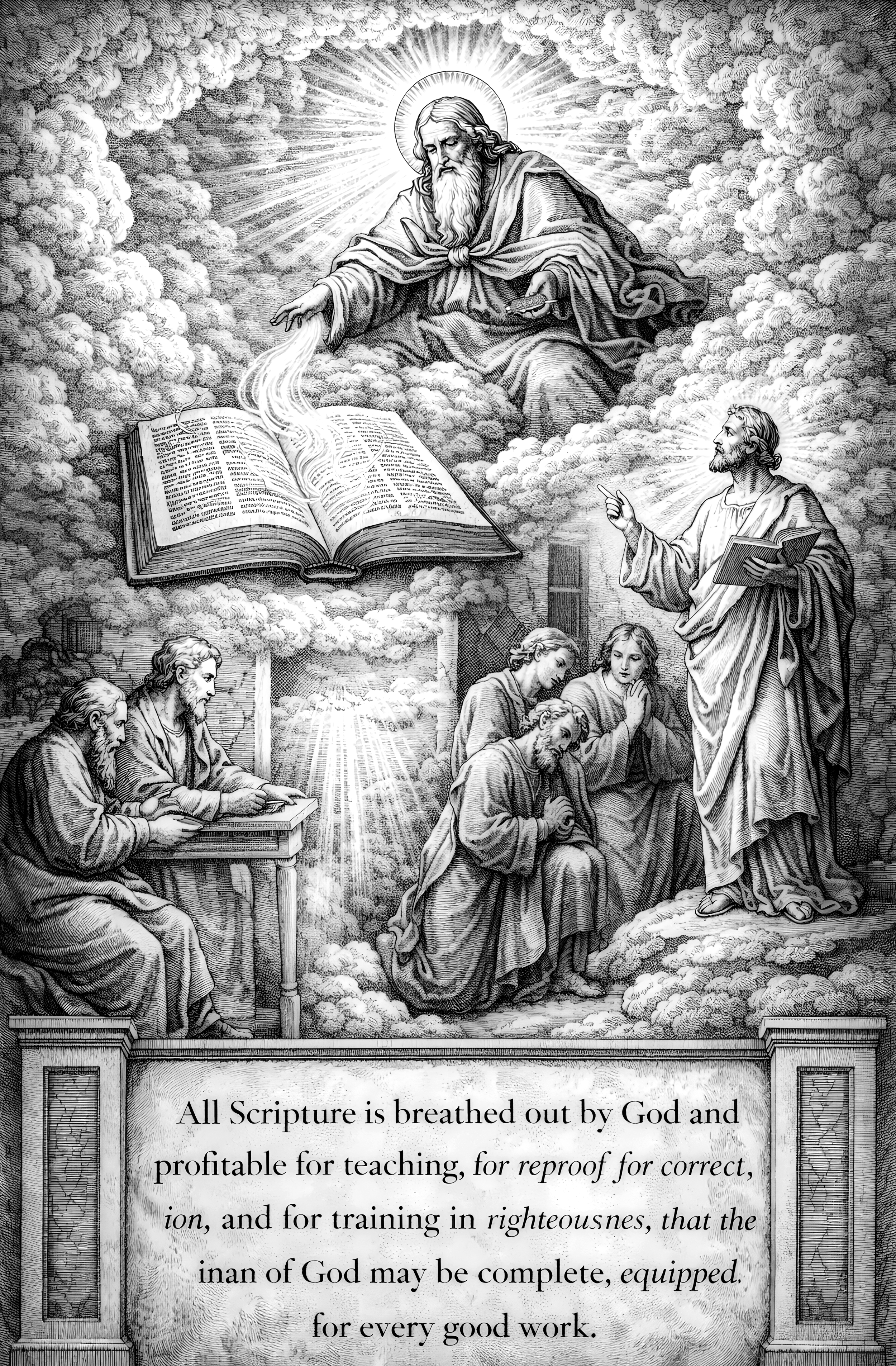
All Scripture is breathed out by God and profitable for teaching, for reproof, for correction, and for training in righteousness, that the man of God may be complete,
equipped for every good work.
2 Timothy 3:16-17
And We have revealed to you the Book in truth, confirming that which preceded it of the Scripture and as a criterion over it.
Quran 5:48
Do they not then reflect on the Quran? If it had been from other than Allah, they would have found within it much contradiction.
Quran 4:82
Every serious disagreement between Christianity and Islam eventually comes back to a question about texts. Christians appeal to the Bible — the Old and New Testaments — as the authoritative written record of God's self-revelation in history, culminating in the life, death, and resurrection of Jesus Christ. Muslims appeal to the Quran — the direct, verbatim word of God revealed to Muhammad — as the final, definitive, and perfectly preserved revelation that supersedes all that came before it. When the two traditions disagree about Jesus, about salvation, about the nature of God, the disagreement is ultimately grounded in a disagreement about which texts are authoritative and why.
This chapter examines how each tradition understands its own scriptures, what each tradition claims about the other's scriptures, and why the resulting impasse is one of the deepest structural obstacles to theological compatibility between Christianity and Islam.
At the centre of that impasse is a doctrine that most Christians have never heard of, but which shapes every serious Christian-Muslim theological encounter: tahrif — the Islamic doctrine of the corruption of prior scriptures.
I. How Christianity Understands the Bible
The Christian Bible is a library rather than a single book. It contains sixty-six books in the Protestant canon, seventy-three in the Catholic canon, and additional texts in the Orthodox traditions — spanning more than a thousand years of composition, encompassing poetry and prophecy, history and law, letters and apocalypse, and above all, the four Gospels and the apostolic writings that record and interpret the life, death, and resurrection of Jesus.
Christian theology speaks of scripture as the inspired word of God — breathed out by God, as Paul puts it to Timothy (2 Timothy 3:16), through human authors who wrote in their own languages, from their own historical contexts, with their own literary styles and pastoral concerns, but under the guidance of the Holy Spirit. This doctrine of inspiration does not mean that God dictated the biblical texts word for word to passive human secretaries. It means that God worked in and through the full humanity of the biblical authors — their intelligence, their personalities, their historical situations, their political, cultural and societal contexts — to produce texts that reliably communicate what God intends to communicate. [41]
The Bible is therefore both a human document and a divine one. Its human character is visible on every page: the different styles of Isaiah and Amos, of Paul and John, of the Psalmists and the authors of Kings. Its divine character is the Church's confession: that in and through this thoroughly human collection of writings, God has spoken, and continues to speak, with authority.
The relationship between the two Testaments is itself a matter of sophisticated theological reflection. The New Testament does not simply replace the Old — it fulfils it, interprets it, and in some respects recontextualises it. Jesus explicitly says: “Do not think that I have come to abolish the Law or the Prophets; I have not come to abolish them but to fulfil them” (Matthew 5:17). The Christian reading of the Hebrew scriptures is Christological: they are read as pointing forward to, preparing for, and finding their completion and occasionally their reform, suppression or replacement, in Jesus Christ.
For Christians, the canon of scripture is closed with the New Testament. The apostolic writings — produced within the first generation of the Church, by those who knew Jesus personally or were in direct contact with those who did — constitute the definitive written witness to the revelation that reached its climax in Jesus Christ. There is, in the Christian understanding, nothing to add. God's self-communication is complete in Christ: “In these last days he has spoken to us by his Son” (Hebrews 1:2). [42]
II. How Islam Understands the Quran
The Islamic understanding of revelation is both similar to and profoundly different from the Christian one. It is similar in that both traditions affirm that God has communicated with humanity through chosen human vessels. It is profoundly different in the mechanism of that communication, the nature of the resulting text, and the relationship of the final revelation to what preceded it.
In Islamic theology, the Quran is not merely inspired — it is the direct, verbatim, uncreated word of God, dictated to Muhammad through the angel Jibril (Gabriel) over a period of approximately 23 years, from 610 to 632 AD. Muhammad's role was not that of an author giving literary form to divine inspiration. He was a recipient.a “private secretary” as it were — a channel through which God's exact words were transmitted to humanity. The Arabic text of the Quran is therefore, in Islamic theology, divine in a way that goes beyond what Christianity claims for the Bible. It is not a human document that God worked through. It is God's own speech, in God's own words. [43]
This has a profound implication:
The Quran in Arabic is the Quran. Translations are not the Quran — they are interpretations of the Quran, useful tools but incapable of conveying what the Arabic original conveys. This is why Muslims who do not speak Arabic are required to recite their prayers in Arabic — because the Arabic is not a vehicle for God's word; it is God's word. [44]
The Quran presents itself as the final revelation in a long series of divine communications to humanity. God sent scripture to previous prophets: the Torah (Tawrat) to Moses, the Psalms (Zabur) to David, and the Gospel (Injil) to Jesus. The Quran stands in continuity with these prior revelations — confirming what was true in them — while also standing above them as the final, definitive, and perfectly preserved word of God, the criterion by which all other claims to divine revelation must be measured.
The Quran explicitly claims this role: “And We have revealed to you the Book in truth, confirming that which preceded it of the Scripture and as a criterion over it” (5:48). [45] The Arabic word translated as criterion is muhaymin — a word that can mean guardian, overseer, or judge. The Quran does not merely supplement prior scripture. It judges it.
III. The Problem: When the Texts Disagree
The collision between these two understandings of scripture becomes apparent the moment one sets the Quran and the New Testament side by side.
The Quran affirms that God sent the Gospel to Jesus, that this Gospel contained guidance and light, and that Christians are obligated to judge by it. It speaks of the Torah and the Gospel as genuine divine revelations. It describes the People of the Book — Jews and Christians — as recipients of authentic divine communication.
And yet, as we have seen in the preceding chapters, the Quran's account of Jesus contradicts the New Testament's account at almost every theologically significant point. The Quran says Jesus was not crucified; the New Testament says he was. The Quran says Jesus was not divine; the New Testament says he was. The Quran says God has no son; the New Testament says Jesus is God's eternal Son. The Quran portrays Jesus as a prophet who submitted to God; the New Testament portrays him as the Lord before whom every knee shall bend and every head shall bow.
This creates an exceedingly acute theological problem. If both the Quran and the New Testament are authentic divine revelations, how can they contradict each other so fundamentally? God cannot simultaneously affirm and deny the crucifixion of Jesus. God cannot simultaneously declare that he has no son and that Jesus is his eternal Son.
Islamic theology has a clear answer to this problem. The answer is tahrif.
IV. Tahrif: Islam’s Doctrine of Biblical Corruption
tahrif is an Arabic word derived from the root meaning to change, distort, or corrupt. As a theological doctrine, it holds that the scriptures given to Moses and Jesus — the original Torah and the original Gospel — were genuine revelations from God, but that they were subsequently corrupted by their human custodians. Jews and Christians altered the texts, whether through deliberate falsification, careless transmission, biased interpretation, or some combination of these, in ways that obscured the true divine message and removed references to the coming of Muhammad. [46]
The doctrine of tahrif explains, within the Islamic framework, why the Bible as Christians and Jews have it differs from what the Quran says. The Bible does not contradict the Quran because the Quran is wrong. It contradicts the Quran because the Bible has been corrupted. The original scriptures, if they could be recovered, would agree with the Quran perfectly.
The Quran itself contains verses that are read as supporting this view, though the degree to which the Quran directly accuses Jews and Christians of textual falsification is debated by Muslim scholars. Surah 2:75 speaks of some who used to hear the words of Allah and then distort it after they had understood it. Surah 3:78 describes people who distort their tongues with the Scripture so you would think it is from the Scripture, but it is not from the Scripture. Surah 5:13 speaks of Jews who distort words from their proper usages. [47]
Islamic scholars have distinguished between two forms of tahrif:
• tahrif al-lafz (corruption of the actual text) and
• tahrif al-ma'na (corruption of meaning through misinterpretation, while the text itself may be preserved).
Classical scholars differed on which form corruption had occurred. Some, like Ibn Khaldun and Ibn Hazm, argued for textual corruption — that the actual words of the Torah and Gospel had been changed. Others argued that the texts were largely preserved but systematically misread. [48]
What virtually all classical Islamic scholarship agreed on, however, was that the scriptures as Jews and Christians now have them do not accurately represent the original divine revelation.
V. The Christian Response
What the Evidence Shows
The doctrine of tahrif raises an immediate historical question: is there any evidence that the biblical texts were corrupted in the ways Islamic theology describes?
The genuine and honest answer, from the standpoint of textual scholarship, is NO!!! — or at least, not in any way that approaches the scale the doctrine requires.
The textual history of the New Testament is extraordinarily well documented. We possess more than 5000 (five thousand) Greek manuscripts of the New Testament, ranging from small fragments to complete copies, spanning the second century to the medieval period. The science of textual criticism — the discipline of comparing manuscripts to establish the most reliable text — has been applied to the New Testament for centuries by scholars of every religious persuasion, including many secular scholars with no religious or spiritual interest in Christian apologetics. The result is a high degree of confidence in the text we have. The variations between manuscripts are real but overwhelmingly minor — differences of spelling, word order, and small additions or omissions. There is no manuscript tradition that presents a substantially different account of Jesus from the one Christians have always read. [49]
More significantly, the New Testament documents predate the emergence of Islam by 600 years. If the texts were corrupted in the ways tahrif describes — if references to Muhammad were removed, if the theology of the Trinity and the crucifixion were inserted where they did not originally exist — this corruption must have occurred before Muhammad's time, and it must have been so thorough and so universal that not a single manuscript tradition in any language preserves traces of the original, ‘incorrupt’ text. No such original text has ever been found. No ancient source — Jewish, pagan, or heretical Christian — describes a version of the Gospel that more closely resembles the Quran's portrait of Jesus.
The early Church's engagement with the Gnostic movements, the Marcionites, the Docetists, and other heterodox groups produced an enormous body of polemical literature — heresiological writing that catalogued and refuted every deviation from apostolic teaching. If the mainstream Christian account of Jesus had been a late fabrication imposed on an earlier, simpler tradition, these documents would likely preserve traces of the older version. They do not. The Jesus of Ignatius of Antioch, writing around 107 AD, is recognisably the same Jesus as the Jesus of the Nicene Creed. The Trinitarian and incarnational theology that Islam regards as a later corruption was already present, and fiercely defended, within decades of the apostolic generation of Peter and his companions.
The Old Testament presents a more complex picture — the Samaritan Pentateuch, the Septuagint, and the Dead Sea Scrolls all attest to a more fluid textual tradition in the pre-Christian period. But here again, the variations are of a kind that textual scholars can map and explain. There is no evidence of the systematic theological falsification that the doctrine of tahrif suggests. [50]
VI. Why tahrif Was Developed
If the historical evidence does not support tahrif, why did the doctrine develop? The honest answer requires a degree of historical bluntness that Muslim and Christian scholars alike have sometimes been reluctant to offer.
The doctrine of tahrif appears to have developed not from direct evidence of textual corruption, but as a theological response to a problem that Islamic theology encountered when it came into extended contact with actual Christian and Jewish communities and their scriptures.
The Quran, as we have seen, affirms that God sent the Gospel to Jesus and that Christians should judge by it. Early Muslim encounters with Christians would naturally have led to the question: what does the Gospel say? And the answer — that the Gospel speaks of Jesus as the Son of God, describes his crucifixion in detail, and contains no reference to a coming prophet named Muhammad — was, from the standpoint of Islamic theology, deeply problematic.
The resolution was tahrif: the texts Christians actually possessed were not the original Gospel but a corrupted version of it. The original Gospel would have confirmed Muhammad's prophethood and denied the crucifixion. This explanation has a certain theological elegance, but its development was driven by apologetic necessity rather than by independent evidence of corruption. As the Christian scholar Sidney Griffith has shown in his careful historical work, the doctrine of tahrif hardened progressively as Muslim-Christian polemical exchange intensified. [51]
This is not said to cast doubt upon the sincerity of Muslim scholars who hold the doctrine. It is said because intellectual honesty about the historical development of theological ideas is part of what serious interfaith engagement requires. tahrif is a doctrine developed to explain a problem. It was not established on independent historical grounds, nor was it proven by scientific and historical examination of all the available evidence.
VII. The Practical Consequences for Dialogue
The doctrine of tahrif has profound practical consequences for Christian-Muslim theological dialogue, and they are consequences that both traditions need to reckon with honestly.
If tahrif is true — if the Bible as Christians have it is a corrupted text that cannot be trusted to accurately represent God's original revelation — then Christian appeals to biblical authority carry no weight in dialogue with a Muslim interlocutor who holds this doctrine. The Christian might quote the Gospel of John on the divinity of Jesus; the Muslim response is that John's Gospel has been corrupted. The Christian might cite Paul on the centrality of the crucifixion; the Muslim response is that Paul was himself a distorting influence - an impostor - who took the simple message of Jesus and overlaid it with alien theological fabrications.
This effectively renders the Bible invisible as a theological authority in Christian-Muslim dialogue. And since Christian theology is entirely dependent on the biblical witness — there is no access to the revelation of God in Christ except through the apostolic testimony preserved in the New Testament — tahrif does not merely challenge one element of the Christian case. It removes the foundation. [52]
Christians need to understand this dynamic clearly, because it means that dialogue conducted on the assumption that both traditions share a common scriptural authority is conducted on a false premise. They do not share a common scriptural authority. The Quran regards the Bible as at best a partially reliable witness to a revelation that has been superseded and largely corrupted. The Bible regards itself as the complete and sufficient written record of God's definitive self-communication in Jesus Christ.
This does not make dialogue impossible. But it does mean that dialogue must be honest about where each tradition stands. Christians should not expect Muslims who hold tahrif to be persuaded by biblical arguments. And Muslims should not expect Christians who trust the biblical witness to simply accept that their scriptures have been corrupted on the basis of a doctrine whose historical foundations are, at best, uncertain.
VIII. The Quran's Self-Understanding
It is worth pausing to understand how Muslims experience the Quran, because the depth of the commitment to its authority goes far beyond what most Christians understand from the outside.
For a devout Muslim, the Quran is not a book about God. It is the speech of God — God's own voice, preserved in Arabic, transmitted through an unbroken chain of oral recitation from Muhammad to the present day. The tradition of Quranic recitation — tajwid — is itself a sacred discipline, governed by detailed rules about pronunciation, breath, and rhythm that have been transmitted across fourteen centuries with extraordinary care. To hear the Quran recited by a skilled qari is, for many Muslims, one of the most moving experiences of their religious life. It is not merely the content that moves them. It is the sound — the voice of God himself, as they understand it.
The Quran's own claim to divine origin is reinforced by the doctrine of i'jaz — the inimitability of the Quran. The Quran challenges its hearers to produce a text of comparable literary and spiritual quality: “If you are in doubt about what We have revealed to Our servant, then produce a surah like it” (2:23). Muslims regard this challenge as having stood unanswered for fourteen centuries — evidence that the Quran is of divine rather than human origin. [53]
Christians who engage with Islam need to understand this depth of commitment, because it means that asking a Muslim to treat the Quran as a human document subject to historical criticism is asking something qualitatively different from asking a Christian to treat the Bible the same way. Christians have, over the last two centuries, developed sophisticated traditions of historical-critical biblical scholarship that examine the human dimensions of scripture with rigorous academic tools — and while this scholarship is controversial in some Christian communities, it is broadly accepted across the mainstream traditions. Nothing comparable exists within mainstream Sunni Islam, where the Quran's divine origin and textual integrity are non-negotiable dogmas.
IX. What Christians Believe About Their Scriptures
It is equally important to state clearly what Christians believe about the Bible — because it is sometimes assumed that Christian trust in scripture is a form of fundamentalist literalism that educated Christians have moved beyond.
The mainstream Christian traditions — Catholic, Orthodox, and most Protestant — do not hold that the Bible is a perfect, error-free text in every detail of history, science, and chronology. They hold that the Bible reliably and authoritatively communicates what God intends to communicate for the sake of human salvation. These are not the same claim. The Bible contains literary forms — poetry, apocalyptic, parable, hyperbole — that are not intended to be read as literal reportage. The Church reads it with the guidance of tradition, reason, and the Holy Spirit, and has never been committed to a flat, non-contextual literalism.
But the Christian traditions are committed to the historical reliability of the core events of the gospel: the life, death, and resurrection of Jesus Christ. These are not myths or symbols. They are, in the Church's confession, things that happened — events in history, witnessed by real people, recorded in texts of genuine historical value. The Second Vatican Council's document on divine revelation, Dei Verbum, states that the four Gospels faithfully hand on what Jesus Christ, while living among men, really did and taught for their eternal salvation. [54] Faithfully — not perfectly in every historical detail, but faithfully in what matters for salvation.
This is the claim that tahrif challenges. Not the claim that every word of every biblical book is verbally inerrant. But the claim that the Gospel — the account of who Jesus was, what he did, and what it means — has been faithfully preserved and reliably transmitted. That claim, Christians hold, is supported by the historical and textual evidence. And it is a claim they are not prepared to surrender.
X. A Note on the Possibility of Common Ground
The picture painted in this chapter might seem entirely bleak for the prospect of Christian-Muslim engagement. If the two traditions cannot agree on which texts are authoritative — if Muslims regard the Bible as corrupted and Christians regard the Quran as a later, post-apostolic document that cannot supersede the apostolic witness — then what common ground remains for serious theological dialogue?
More than might be expected, actually. And it is worth naming it.
Both traditions affirm, on the basis of their respective scriptures, a set of convictions about the nature of reality that places them on the same side of many of the most important debates in contemporary secular culture. Both affirm that God exists and is the Creator of all things. Both affirm that human beings are made for a relationship with God that transcends the merely material. Both affirm that human life has transcendent dignity and meaning. Both affirm that we are morally accountable for our actions. Both affirm that justice, compassion, and care for the poor are not optional extras but core obligations of the life God calls us to.
These shared convictions do not require agreement about the authority of each other's scriptures. They are positions that can be argued from within each tradition independently, and defended in public discourse without requiring one's interlocutor to accept one's own scriptural premises.
Pope Benedict XVI's Regensburg Address of 2006 — one of the most important papal interventions in Christian-Muslim dialogue in recent decades — argued that both Christianity and Islam are committed, at their best, to the unity of faith and reason: to the conviction that God is rational, that his creation is intelligible, and that human reason is capable of arriving at genuine moral and metaphysical truths. [55] This shared commitment to reason as a gift of the Creator — rather than reason as an autonomous human faculty standing over against revelation — is genuine common ground, and it has practical implications for how the two traditions can engage with each other and with the secular world.
Common ground built on reason, natural law, and shared moral conviction is real and valuable. What it cannot do is resolve the theological disagreements about Jesus, salvation, and the nature of God that are grounded in the incompatible scriptural authorities each tradition holds. Those disagreements remain, and they must be named honestly even as the common ground is cultivated gratefully.
Summary
Christianity and Islam hold fundamentally different understandings of the nature of scripture and divine revelation. Christianity regards the Bible as the inspired word of God, reliably preserving the apostolic testimony to the life, death, and resurrection of Jesus Christ — a human document written through divine guidance, and the complete written record of God's definitive self-communication. Islam regards the Quran as the direct, verbatim, uncreated speech of God revealed to Muhammad — not merely inspired but divine in itself, the final and perfect revelation that supersedes and judges all prior scriptures. When the Quran contradicts the Bible, Islamic theology explains the discrepancy through the doctrine of tahrif — the corruption of prior scriptures by their human custodians. This doctrine, while theologically coherent within the Islamic framework, lacks independent historical support: the textual evidence for the New Testament is extraordinarily robust, and no ancient source preserves a version of the Gospel that more closely resembles the Quran's portrait of Jesus. tahrif appears to have developed not from historical evidence but as a theological response to the problem posed by the Bible's disagreement with the Quran. Its practical consequence is to render biblical authority invisible in theological dialogue — since any Christian appeal to scripture can be dismissed as evidence of corruption. This structural impasse cannot be dissolved by goodwill, but it can be named honestly — and honest naming is the beginning of genuine dialogue.