
Father of
Us All?
Abraham, the Prophets,
and the
Supersessionist Claim
Fr. G. V. W. Lewis
Two Faiths, One God?...
<>
The Islam Issue Facing the Western World
<>
On Amazon NOW!
<>
Two Faiths, One God?... <> The Islam Issue Facing the Western World <> On Amazon NOW! <>
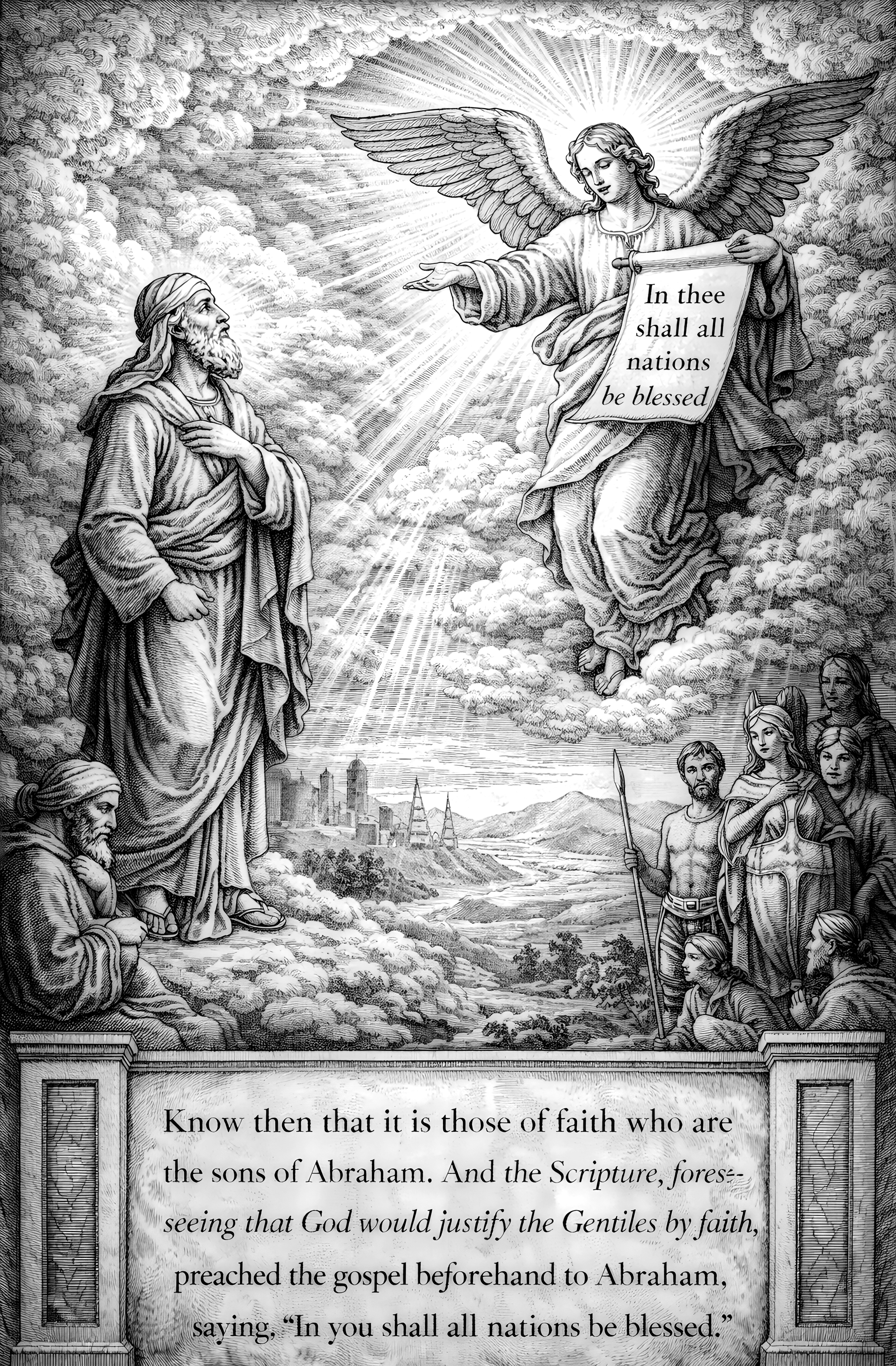
Know then that it is those of faith who are the sons of Abraham. And the Scripture, foreseeing that God would justify the Gentiles by faith, preached the gospel beforehand to Abraham, saying, 'In you shall all the nations be blessed.'
Galatians 3:7-8
Abraham was neither a Jew nor a Christian, but he was
a true Muslim and was not of the polytheists.
Quran 3:67
We did not send before you any messenger but that We revealed
to him that there is no deity except Me, so worship Me.
Quran 21:25
Few phrases in contemporary interfaith discourse are repeated more often, or examined less carefully, than 'the three Abrahamic faiths.' The phrase is ubiquitous. It appears in political speeches and academic syllabi, in newspaper editorials and interfaith council statements, in the programmes of dialogue events and the titles of university departments. It carries an implicit message: that Judaism, Christianity, and Islam are sibling traditions — related members of a common family, sharing a common ancestor, engaged in a family disagreement that careful conversation might help to resolve.
The phrase is not entirely wrong. All three traditions do trace a significant part of their spiritual heritage to the figure of Abraham — the man who left his homeland in obedience to God's call, who trusted God's promise of descendants as numerous as the stars, who was prepared to sacrifice his son at God's command, and who became, for all three traditions, the paradigm of faith. In this very general sense, the Abrahamic connection is real.
But the phrase, as it is typically used, papers over a set of theological claims that are anything but fraternal. When one examines what each of the three traditions actually says about Abraham — and about the prophets who followed him — the picture that emerges is not a family photograph but a map of competing supersessionist claims, each tradition insisting that itself, and not the others, is the true heir of the Abrahamic heritage.
This chapter examines those claims honestly — with particular attention to the Islamic claim, which is the most comprehensive and the most directly challenging to both Jewish and Christian self-understanding.
I. Abraham in the Hebrew Bible
In the Hebrew Bible, Abraham — originally called Abram — is the recipient of the founding covenant between God and the people of Israel. God calls him out of Ur of the Chaldees, promises him a land and a people, and establishes with him and his descendants a permanent relationship of covenant faithfulness. The sign of this covenant is circumcision; its content is the promise of land, descendants, and blessing — for Abraham and, through him, for all the nations of the earth.
Abraham's faith is the defining feature of his portrait in Genesis. He goes where God sends him without knowing where he is going (Hebrews 11:8). He trusts God's promise of descendants even when he and his wife Sarah are far beyond the age of childbearing. And in the climactic test of the Akedah — the binding of Isaac — he is prepared to sacrifice his only son, the son through whom God's promise was to be fulfilled, trusting that God is able to raise him from the dead (Hebrews 11:19). [56]
In the Jewish tradition, Abraham is the ancestor of the Jewish people through his son Isaac and Isaac's son Jacob, who is renamed Israel. The covenant God made with Abraham is the foundation of Israel's identity as God's chosen people — a calling that, in the Jewish understanding, is particular, historical, and ongoing. Abraham belongs, in a unique and irreplaceable sense, to Israel.
II. Abraham in the New Testament
Christianity's relationship to Abraham is shaped by a theological move of extraordinary boldness. Paul, in his letter to the Galatians, argues that the promise made to Abraham was always intended for Gentiles as well as Jews — and that it finds its fulfilment not through physical descent or observance of the Mosaic law, but through faith in Jesus Christ.
The argument turns on a detail of the Genesis narrative. The promise to Abraham — in you shall all the nations be blessed (Genesis 12:3) — was made before the institution of circumcision and before the giving of the law at Sinai. Abraham was justified by faith while still uncircumcised (Romans 4:10-11). This means, Paul argues, that the Abrahamic covenant was never primarily a matter of ethnic descent or legal observance. It was always a matter of faith — the kind of trust in God's promise that Abraham exemplified. [57]
The conclusion Paul draws is sweeping: “Know then that it is those of faith who are the sons of Abraham” (Galatians 3:7). The true heirs of Abraham are not those who are physically descended from him, but those who share his faith — and that faith has now been definitively expressed and fulfilled in Jesus Christ. Those who believe in Jesus Christ, whether Jew or Gentile, are Abraham's offspring and heirs according to promise (Galatians 3:29). [58]
This is, of course, a supersessionist claim — an assertion that the Church is the true continuation and fulfilment of the covenant God made with Abraham, and that the Jewish people's claim to that covenant is not superseded but radically recontextualised by the coming of the Messiah. It has had painful consequences in the history of Jewish-Christian relations, and the Church has had to wrestle seriously with the implications of its own supersessionism. But it is the New Testament's position, stated plainly.
For our present purposes, the key point is this: Christianity does not merely add itself to the Abrahamic family as a third sibling. It claims to be the fulfilment of what the Abrahamic covenant was always pointing toward. Abraham believed in a promise; Christians claim that promise has been kept, in a form that transcends what either Abraham or Moses could have anticipated.
III. Abraham in the Quran: The Most Radical Claim
Islam's claim on Abraham is the most radical of the three — and the one that most directly challenges both Jewish and Christian self-understanding.
The Quran does not present Abraham as the ancestor of a particular people, nor as a figure whose faith points forward to Jesus Christ. It presents Abraham as a Muslim — the first and greatest exemplar of Islam in its literal sense of submission to God — whose religion was the pure, original faith that both Judaism and Christianity subsequently corrupted and distorted. [59]
The Quranic verse is unambiguous: “Abraham was neither a Jew nor a Christian, but he was a true Muslim and was not of the polytheists” (3:67). This is not a modest claim. It is a complete and ‘flagrant’ usurpation of the Abrahamic heritage by Islam, combined with an explicit denial that either Judaism or Christianity have a legitimate claim to it. Abraham was not the ancestor of the Jewish people in any spiritually significant sense. He was not a proto-Christian whose faith pointed forward to Jesus. He was a Muslim — and Jews and Christians who claim him as their spiritual father, are actually claiming a figure who, properly understood, belongs to Islam. It is theological embezzlement running wild on the wheels of historical anachronism.
The Quran reinforces this claim by presenting Abraham as the builder, with his son Ishmael, of the Ka'aba in Mecca — the sacred cube at the centre of the Islamic world, toward which all Muslims pray: And when Abraham was raising the foundations of the House and Ishmael: “Our Lord, accept this from us; indeed You are the Hearing, the Knowing” (2:127). [60] Abraham and Ishmael pray together in Arabic, asking God to accept their work and to raise up from their descendants a Muslim community. According to IslamThe Ka'aba — Islam's most sacred site — was built by the patriarch whom Jews and Christians regard as their founding father.
The significance of this claim can hardly be overstated. Islam does not present itself as a new religion that emerged in the seventh century of the common era. It presents itself as the original religion — the pure monotheism that God intended from the beginning, revealed to every prophet from Adam to Muhammad, and now finally and perfectly restored in its Quranic form after centuries of Jewish and Christian distortion.
IV. The Universal Prophethood
Islam as the Original Faith (???)
The Quranic claim about Abraham is part of a larger and even more bizarre claim: that Islam — submission to the one God — is not a seventh-century (610-630 AD) initiative but actually the religion of all the prophets of all time.
The Quran states explicitly: “We did not send before you any messenger but that We revealed to him that there is no deity except Me, so worship Me” (21:25). In other words - and bear with us - every prophet God ever sent — Adam, Noah, Abraham, Moses, David, Solomon, Jonah, John the Baptist, Jesus — was actually a ‘Muslim’, in the sense that he submitted to the one God and called others to do the same. The message of all the prophets was identical in substance: tawhid, the oneness of God, and the call to submission. [61]
This claim - no matter how materially inaccurate and theologically unsubstantiated it may seem - has a profound implication for how Islam understands Judaism and Christianity. They are not, in the Islamic view, independent revelations that stand alongside Islam as parallel paths to God. They are distorted versions of the one original revelation — temporary custodianships of a divine message that their custodians corrupted, misinterpreted, and ultimately failed to preserve. The Jews corrupted the Torah and rejected the prophets sent to correct them. The Christians took the message of Jesus — a faithful ‘Muslim’ prophet — and transformed it into a religion of Trinity worship and deification of a human being.
Islam, in this narrative, is not a new religion. It is a restoration — the recovery of the pure Abrahamic faith that humanity was always meant to hold, now definitively preserved in the perfectly intact Quran, the final and uncorrupted word of God.
Internally, within Islam, it is a ‘consistent’ theological narrative. It is also, from the perspective of both Judaism and Christianity, wholesale looting and shameless usurpation of their respective heritages — an assertion that their traditions are failed or corrupted versions of a religion that did not exist until the seventh century AD, and that their founding figures — Abraham, Moses, Jesus — were actually members of a faith that did not in fact exist, and would not be named or formally constituted for seven centuries after their deaths.
V. The Historical Problem
The Quranic narrative of universal prophethood raises acute historical questions that deserve honest engagement.
The claim that Abraham, Moses, and Jesus were all Muslims — that they submitted to the one God, rejected polytheism and idolatry, and called their contemporaries to the pure monotheism that Islam embodies — is not supported by the historical and textual evidence of the traditions that actually preserved their stories.
The Hebrew Bible's account of Abraham is not the account of a proto-Muslim. It is the account of a man chosen by the God of Israel — a personal, covenanting God who makes specific promises to a specific people, who is identified by name (YHWH) and who enters into a relationship of mutual obligation with Abraham and his descendants. This is not the abstract, transcendent tawhid of Islamic theology. It is something more personal, more particular, and more embedded in the specificity of Israel's history.
The New Testament's account of Jesus is similarly irreducible to the Quranic portrait of a Muslim prophet. As we have seen in Chapters Two and Three, Jesus in the New Testament makes claims about himself that go far beyond anything a prophet would claim — claims to divine identity, claims to forgive sins, claims to a unique relationship with the Father that his contemporaries understood as claims to equality with God. The Islamic narrative requires us to believe that all of this was a later fabrication — that the real Jesus was a simple monotheistic prophet whose message was transformed beyond recognition by his followers. [62] But as we have seen, the historical evidence does not support this reconstruction. The high Christology of the New Testament is not a late development imposed on an earlier, simpler tradition. It is present in the earliest documents we have.
The claim that all prophets were Muslims is, in other words, a retrospective theological construction — Islam reading its own commitments back into the figures and traditions that preceded it. This is not unique to Islam: Christianity makes a similar move when it reads the Hebrew scriptures as pointing forward to Jesus, and Judaism makes a related move when it reads the same scriptures as the foundation of ongoing Jewish practice and identity. All three traditions claim the same story. The question is which claim is most consistent with the evidence.
VI. The 'Abrahamic Faiths' Framework Examined
With this background in mind, we can now evaluate the 'three Abrahamic faiths' framework more carefully.
The framework has genuine usefulness as a description of shared heritage. All three traditions do trace important elements of their theology, ethics, and spirituality to Abraham. All three revere figures — Moses, the prophets, Jesus — who stand in the tradition that Abraham inaugurated. All three hold that God is the Creator of the universe, that he is one, that he holds humanity morally accountable, and that he has communicated his will through chosen human messengers. These are real points of contact.
But the framework becomes misleading when it is used to imply that the three traditions are approximately equal variants of a common faith — that their differences are essentially matters of emphasis or cultural expression rather than irreconcilable theological commitments. This implication is false, and it is false precisely because of what each tradition claims about Abraham himself.
Judaism claims Abraham as the ancestor of the Jewish people and the recipient of the covenant that defines Jewish identity — a covenant that remains in force and that has not been superseded by either Christianity or Islam. Christianity claims that the promise to Abraham finds its fulfilment in Jesus Christ, and that those who believe in Christ are Abraham's heirs regardless of ethnic descent. Islam claims that Abraham was a Muslim, that his religion was the pure original faith now restored in the Quran, and that both Judaism and Christianity are corrupted versions of that faith.
These three claims are not complementary. They are competing. They cannot all be true simultaneously. Each tradition claims Abraham for itself in a way that relativises or delegitimises the others' claim. The 'Abrahamic faiths' framework smooths over this competition in the interests of dialogue — but the competition is real, and pretending otherwise does not serve genuine understanding.
VII. Islam's Supersessionism and Its Implications
Of the three traditions' supersessionist claims, Islam's is the most comprehensive and the most structurally challenging. Christianity supersedes Judaism in the sense that it claims to fulfil the Jewish covenant — but it does not deny that the covenant was real, that Moses was a genuine prophet, or that the Torah contained authentic divine revelation. It builds on its predecessor even as it claims to transcend it.
Islam's supersessionism is more total. It does not merely claim to fulfil what came before. It claims that what came before — in its current form — is corrupted, and that the original, uncorrupted version of those prior revelations would agree with the Quran. This means that the Torah as Jews have it is not the real Torah. The Gospel as Christians have it is not the real Gospel. The prophets as the Hebrew Bible and New Testament describe them were not quite what those texts say they were — they were Muslims, calling people to tawhid, whose messages were subsequently distorted.
The practical audacity of this implication is striking. Islam presents itself as the corrector and restorer of both Judaism and Christianity. It does not stand alongside them as a sibling tradition that simply developed differently. It stands over them as the judge of their authenticity and the repository of the original truth that they failed to preserve. This is a position of remarkable theological audacity — and it is one that both Jews and Christians need to understand clearly, because it shapes every serious Islamic theological engagement with the other traditions. [63]
For Christians in particular, this means that Christian-Muslim dialogue is never quite a conversation between equals — at least not from the standpoint of classical Islamic theology. The Christian brings to the table a collection of scriptures that Islamic theology regards as corrupted, a theology that Islamic theology regards as a deviation from pure monotheism, and a saviour whom Islamic theology regards as a human prophet whose message was distorted by his followers. The Muslim brings a text that claims to be the definitive correction of all prior revelation.
This asymmetry does not make dialogue impossible. But it does mean that dialogue conducted without awareness of it is likely to produce more confusion than clarity.
VIII. The Ishmael Question
One further dimension of the Abrahamic narrative deserves attention, because it illuminates the depth of the divergence between the traditions.
In the Hebrew Bible, Abraham has two sons: Ishmael, born of Hagar the Egyptian slave, and Isaac, born of his wife Sarah. The covenant promise — i.e., the inheritance, the land, the blessing — passes through Isaac and his descendants, the people of Israel. Ishmael is blessed and will father a great nation, but the covenant line runs through Isaac.
The Quran's account is similar in its bare outlines — both Ishmael and Isaac are mentioned as sons of Abraham — but its theological weight is different. In Islamic tradition, the son whom Abraham was commanded to sacrifice is Ishmael, not Isaac. [64] And it is Ishmael, not Isaac, who is Abraham's partner in building the Ka'aba in Mecca. The covenant line of prophets runs not only through Isaac and the people of Israel but through Ishmael and the Arabs — culminating, eventually, in Muhammad, the descendant of Ishmael who received the final and perfect revelation.
The significance of this divergence goes beyond genealogy. It means that the two traditions are telling fundamentally different stories about which line of Abraham's descendants carries the primary spiritual inheritance. The Hebrew Bible and New Testament tell the story of Israel — the people of the covenant, through whose history God acts in the world, culminating in Jesus of Nazareth, a Jew of the tribe of Judah, of the house of David. The Quran tells a story in which the Arab line of descent through Ishmael is equally central — culminating in Muhammad, the final prophet, through whom God's word is definitively given to all humanity.
These two stories are not parallel tracks that happen to end at different destinations. They are competing accounts of where the primary axis of divine action in human history runs. They cannot both be right, and neither tradition pretends they can.
IX. What Christians Should Understand
Christians engaging with Islam need to understand several things clearly about the Abrahamic heritage question.:
1. First, the 'Abrahamic faiths' framework, while useful as a conversation starter, should not be allowed to create the impression that the three traditions are theological equals who happen to have different approaches to the same inheritance. They are not. Each makes claims about that inheritance that exclude or relativise the others.
2. Second, Islam's claim on Abraham is not simply a claim to share a heritage. It is a claim to be the authentic and definitive form of the faith that Abraham practised — a claim that implicitly delegitimises both Judaism's and Christianity's claim to that heritage. Christians should be aware of this when they enter dialogue with Muslims on the basis of shared Abrahamic identity.
3. Third, and most importantly, the Christian claim on Abraham is not primarily genealogical or cultural. It is theological and Christological. Abraham is significant for Christianity not because he is the ancestor of Jesus (though he is — Matthew 1:1 opens with precisely that genealogy) but because his faith — his trust in God's promise against all visible evidence — is the paradigm of the faith that justifies before God, and that finds its ultimate object in Jesus Christ.
Paul's reading of Abraham in Romans 4 and Galatians 3 is one of the most theologically profound passages in the New Testament. It shows that the Christian claim on Abraham is not a late appropriation of a Jewish figure, but a reading of the Abraham narrative that is internal to that narrative itself — a reading that takes seriously what Genesis actually says about the basis of Abraham's justification before God. [65] Christians should be able to articulate this reading clearly in dialogue with both Jews and Muslims, not as a polemical move but as an explanation of what Christianity actually believes about why Abraham matters.
X. The Deeper Question: Whose Story Is This?
Behind all the specific disagreements about Abraham, the prophets, and the nature of the Abrahamic inheritance, there is a deeper question that each tradition is implicitly answering: whose story is the story of salvation?
For Judaism, it is the story of Israel — God's chosen people, called into covenant relationship, sustained through exile and dispersion, awaiting the fulfilment of God's promises in the age to come.
For Christianity, it is the story of all humanity — a story that began with creation, ran through Israel, reached its climax in Jesus Christ, and is now being extended to all nations through the proclamation of the gospel. Israel's story is not abandoned or replaced but fulfilled and expanded — the blessings promised to Abraham becoming available to all through faith in Christ.
For Islam, it is the story of all humanity's call to submission — a story as old as creation itself, told through a long succession of prophets to every people, now finally and definitively articulated in the Quran and the practice of the Muslim community.
These three accounts of the same story are not reconcilable. Each claims to be the definitive account. Each relativises the others. Christians who understand this clearly are in a much better position to engage honestly with Muslims — not pretending that the differences are minor, not retreating into a vague Abrahamic solidarity that belongs to none of the traditions, but engaging from the full depth of their own conviction while treating their interlocutors with the respect that genuine disagreement, honestly acknowledged, actually requires.
The great twentieth-century theologian Karl Barth — not always known for his generosity toward other religions — made a point that is relevant here. He argued that the Church must engage with other traditions from a position of clarity about its own identity. A Christianity that has dissolved its own convictions in the interests of accommodation is not in a better position to engage with Islam. It is in a worse position — because it has nothing to say. The dialogue partner who knows what they believe, and can articulate it with both conviction and humility, is always more valuable than the one who has pre-emptively surrendered the ground on which genuine encounter could take place. [66]
Summary
The 'three Abrahamic faiths' framework, while useful as a starting point for interfaith conversation, conceals a set of competing supersessionist claims that each tradition makes about the Abrahamic heritage. Judaism claims Abraham as the ancestor of the covenant people; Christianity claims that the Abrahamic promise finds its fulfilment in Jesus Christ and is available to all through faith; Islam claims that Abraham was a Muslim — a practitioner of the pure, original monotheism that Islam has now definitively restored — and that both Judaism and Christianity are corrupted versions of this original faith. These claims are not complementary. They are competing. Islam's supersessionist claim is the most comprehensive: it presents itself not as a third sibling in the Abrahamic family but as the authentic and definitive form of the religion all the prophets always practised, of which Judaism and Christianity are distortions. The Quranic insistence that all prophets — Adam, Noah, Abraham, Moses, Jesus — were Muslims is a retrospective theological construction that is difficult to reconcile with the historical evidence of the traditions that preserved their stories. Christians need to understand this clearly in order to engage with Islam from a position of informed conviction rather than a vague Abrahamic solidarity that belongs to none of the three traditions as they actually understand themselves.