
The Question
of ‘Jihad’
What the Texts Say, What the Traditions Do With Them
Fr. G. V. W. Lewis
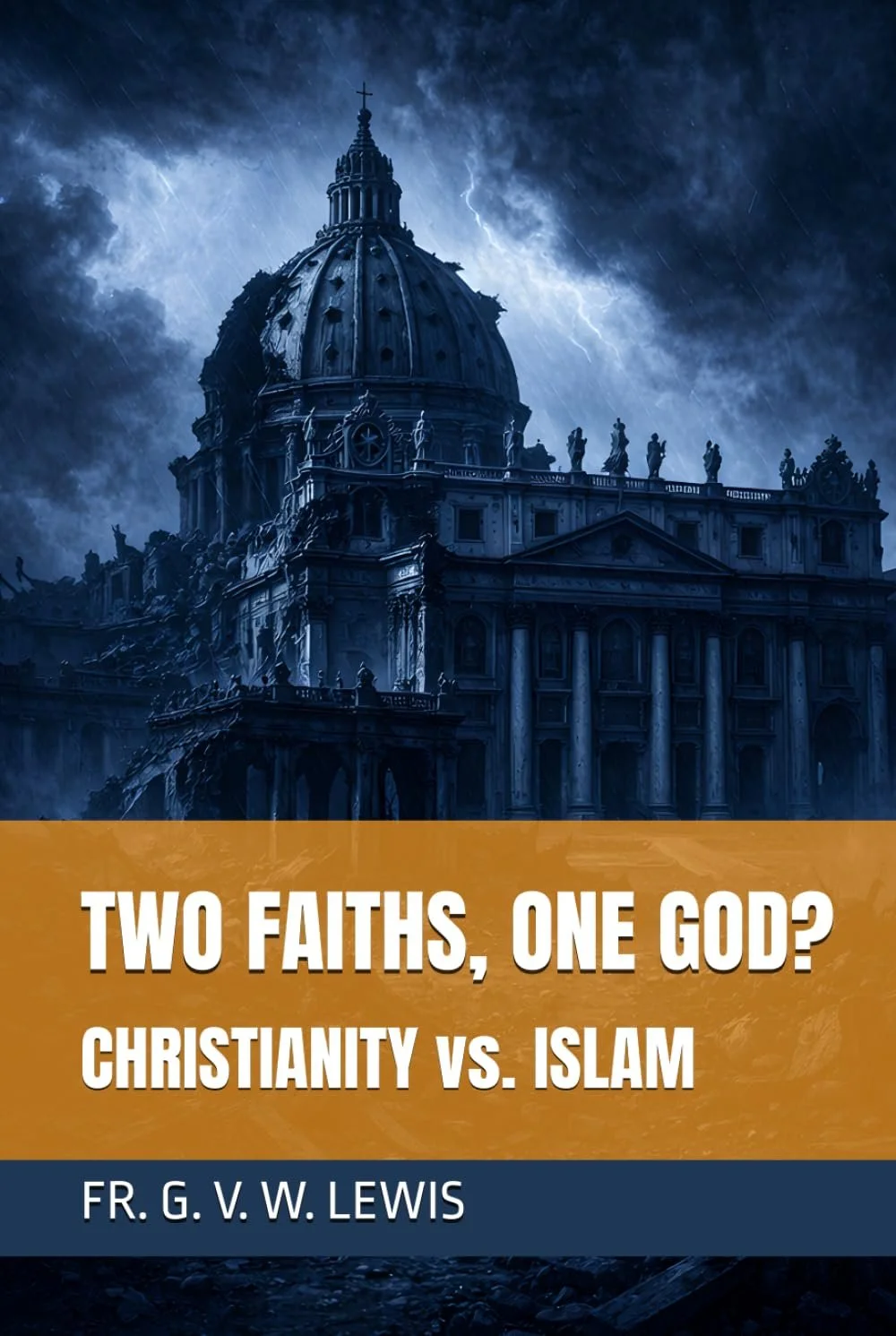
Two Faiths, One God?...
<>
The Islam Issue Facing the Western World
<>
On Amazon NOW!
<>
Two Faiths, One God?... <> The Islam Issue Facing the Western World <> On Amazon NOW! <>

Fight in the way of Allah those who fight you but do not transgress.
Indeed, Allah does not like transgressors.
Quran 2:190
Then, when the sacred months have passed, slay the idolaters wherever you find them,
and take them captive, and besiege them, and prepare for them each ambush.
Quran 9:5 — the 'Verse of the Sword'
The greatest jihad is to battle your own soul — to fight the evil within yourself.
Hadith attributed to the Prophet Muhammad
No word in the Islamic vocabulary has generated more heat and less light in Western public discourse than jihad. In the years since the attacks of September 2001, the word has become, for many Western readers, almost synonymous with terrorism — a religious sanction for indiscriminate violence against non-Muslims. On the other side, Muslim apologists and interfaith advocates have sometimes responded by insisting that jihad means nothing more than spiritual self-improvement — the inner struggle against one's own vices and temptations — and that its association with violence is entirely a distortion.
Both of these positions are wrong, and both are unhelpful. The honest picture is more complex, more interesting, and more sobering than either caricature allows.
Jihad is a word with genuine range of meaning. It does include the inner spiritual struggle — this dimension is real and important, and the hadith literature attributes to the Prophet himself the description of it as the greater jihad. But it also, in both the Quran and the classical Islamic jurisprudential tradition, includes armed combat in the service of God's cause — and this dimension is equally real, equally important, and cannot be wished away by those who find it inconvenient.
This chapter examines what the Quran and the classical tradition actually teach about jihad — without the distortions of either the polemicist who sees only the violent dimension or the apologist who denies it exists. And it asks what Christians, engaging with this material honestly, should make of it.
I. The Meaning of the Word
The Arabic word jihad comes from the root j-h-d, meaning to strive, to exert effort, to struggle. It is a broad word, applicable to any sustained effort in pursuit of a worthy goal. In its Quranic usage, it almost always appears in the phrase jihad fi sabil Allah — striving in the way of God — and this context shapes its meaning decisively. [67]
The tradition distinguishes, broadly, between:
• the greater jihad (al-jihad al-akbar) — the internal spiritual struggle against one's own ego, sinful tendencies, and moral failings — and
• the lesser jihad (al-jihad al-asghar) — armed combat in defence and extension of the Islamic community.
The famous hadith attributed to the Prophet after the Battle of Badr — “We have returned from the lesser jihad to the greater jihad” — has been widely cited to argue that the spiritual dimension is primary. [68]
The Sufi mystical tradition within Islam placed enormous emphasis on the greater jihad, developing rich interior disciplines of self-examination, prayer, and purification that drew on this concept. For many Muslim thinkers across the centuries, the real battlefield was the human soul, and the real enemy was the ego's resistance to God's sovereignty.
This is genuine and important. But it does not exhaust what the Islamic tradition — and above all, what the Quran itself — teaches about jihad. The classical jurists who developed Islamic law took both dimensions seriously, and they spent considerable intellectual energy on the lesser jihad — its conditions, its rules, its aims, and its limits.
II. Jihad in the Quran: The Textual Landscape
The Quran contains numerous passages relevant to jihad, and they do not all say the same thing. Understanding them requires attention to their context, their chronology, and the interpretive tradition that has surrounded them.
The earliest Quranic passages on the subject, revealed during the Meccan period when Muhammad and his followers were a vulnerable minority, are largely pacific in tone. They emphasise patience, persuasion, and trust in God. Surah 16:125 instructs: “Invite to the way of your Lord with wisdom and good instruction, and argue with them in the best way”. Surah 2:256 contains one of the most cited verses in interfaith dialogue: “There is no compulsion in religion”. [69]
After the migration to Medina in 622 AD — the Hijra — Muhammad's community became a political and military entity, and the Quranic revelations of this period increasingly address questions of warfare, self-defence, and the organisation of the nascent Islamic state. It is in this Medinan context that the more explicitly martial verses appear.
Surah 2:190-193 introduces the concept of fighting in God's way, with a defensive rationale: “Fight in the way of Allah those who fight you but do not transgress”. But the passage quickly extends beyond pure self-defence: “And fight them until there is no more fitnah and religion is for Allah” (2:193). The word fitnah — here translated as persecution or disorder — is interpreted by classical scholars as meaning the existence of unbelief or polytheism, which suggests a mandate that extends beyond defence against attack. [70]
Surah 9 — Al-Tawbah, Repentance — is the most sustained and the most challenging. Revealed late in the Medinan period, it contains the verses most frequently cited by both critics of Islam and by jihadist movements. Verse 5, the so-called Verse of the Sword, commands: “Then, when the sacred months have passed, slay the idolaters wherever you find them, and take them captive, and besiege them, and prepare for them each ambush”. [71] Verse 29 extends the command to the People of the Book(Jews and Christians): “Fight those who do not believe in Allah or in the Last Day and who do not consider unlawful what Allah and His Messenger have made unlawful and who do not adopt the religion of truth from those who were given the Scripture — fight until they give the jizyah willingly while they are humbled”. [72]
These are not obscure or peripheral verses. They are among the most heavily commented upon in the entire Quran. They exist, and they say what they say.
III. The Doctrine of Abrogation
One of the most important — and most contested — tools in the Islamic interpretive tradition is the doctrine of abrogation (naskh). This doctrine holds that later Quranic revelations can supersede or qualify earlier ones. Since the Quran was revealed over a period of twenty-three years, and since the circumstances of the Muslim community changed dramatically over that period, some apparent contradictions within the text are explained by the principle that the later revelation takes precedence. [73]
The practical consequence of this doctrine for the jihad question is significant. Classical scholars who applied abrogation to the jihad verses typically argued that the more martial Medinan verses — particularly those of Surah 9 — abrogated the earlier, more pacific Meccan verses. On this reading, the command to fight until there is no more fitnah supersedes the injunction that there is no compulsion in religion. The later overrides the earlier.
This is not the only possible application of the doctrine — other scholars argued that the abrogation was more limited, or that the martial verses applied to specific historical circumstances and were not general commands. But the classical mainstream position, represented by scholars like Ibn Kathir and Ibn Rushd, was that Surah 9:5 had abrogated a significant number of earlier, more tolerant verses, and that the duty of armed jihad against unbelievers was a genuine and continuing religious obligation, subject to the conditions and limits set by Islamic law.
Contemporary Muslim reform thinkers have challenged this reading forcefully, arguing that the abrogation doctrine has been misapplied and that the Medinan martial verses must be read in their specific historical context rather than as timeless commands. This is a genuine and important debate within Islam, and it has produced serious scholarship. But it is a debate — not a settled consensus — and the reformist position, however intellectually compelling, does not represent the dominant view in classical Islamic jurisprudence.
IV. Classical Islamic Law on Jihad
Islamic jurisprudence developed an elaborate body of law governing armed jihad — its conditions, its conduct, its aims, and its limits. This legal tradition is sophisticated, internally complex, and often misrepresented by both critics and defenders of Islam.
Classical Islamic law divided the world into two domains:
1. The dar al-Islam - House of Islam — territories under Islamic governance; and
2. The dar al-harb - House of War — territories not under Islamic governance.
Some jurists added a third category:
• The dar al-'ahd or dar al-sulh - House of Treaty — territories with which the Islamic state had concluded a peace agreement.
The relationship between these domains was, in the classical view, one of ongoing tension that could be temporarily suspended by treaty but not permanently resolved short of the entire world coming under Islamic governance. [74]
The classical scholars — representing the four major Sunni legal schools (Hanafi, Maliki, Shafi'i, and Hanbali) as well as Shi'a jurisprudence — generally held that offensive jihad against the dar al-harb (House of War) was a collective religious obligation (fard kifaya) — a duty that fell on the Muslim community as a whole and was discharged when a sufficient number fulfilled it. The aim of this offensive jihad was not the forced conversion of non-Muslims but the extension of Islamic political sovereignty — bringing more territory under the governance of Islamic law, under which non-Muslims (People of the Book) could live as protected but subordinate subjects (dhimmis) paying the JIZYA TAX: [75]
This is a far more legally structured and qualified position than the popular Western caricature of jihad as mindless holy war. The classical tradition had detailed rules about who could be fought and who must be spared, about the treatment of prisoners, about the conduct of sieges, about the terms of surrender. It was not a tradition of unlimited violence. It was a tradition of regulated violence in the service of a defined political and religious objective.
But that ultimate goal — the extension of Islamic political sovereignty over the entire world — is not, in classical Islamic jurisprudence, a peripheral or optional aspiration. It is the framework within which the entire theory of jihad operates. And it is a goal that is structurally incompatible with the modern international order of sovereign nation-states, religious pluralism, and equal citizenship regardless of faith. It is impossible to overstate this reality strongly enough!
V. The Verse of the Sword: Context and Controversy
No verse in the Quran has generated more controversy in Christian-Muslim relations than 9:5 — the Verse of the Sword. It deserves careful examination, both because of its importance and because it is frequently either weaponised by critics or explained away by apologists in ways that distort its actual meaning.
The immediate context of Surah 9 is the breakdown of treaty relations between the early Muslim community in Medina and certain Arab polytheist tribes who had violated their agreements. The surah opens by announcing a repudiation of these treaties and giving the treaty-breakers a four-month period of safety, after which:
“Then, when the sacred months have passed,
slaughter the idolaters wherever you find them”. [76]
Those who argue for a strictly contextual reading of this verse point out that it was addressed to specific treaty-breaking tribes in a specific historical situation, and that the very next verses (9:6-7) qualify it significantly: “those who seek refuge are to be granted it and conducted to safety; those who have honoured their treaties are to be respected”. The verse, on this reading, is a specific military directive, not a general command to murder all non-Muslims.
Those who argue for a broader reading point out that the verse is not addressed only to those who have broken specific treaties — it says “slay the idolaters wherever you find them”, a formulation that is geographically and temporally unlimited.
They also note that the classical interpreters — including Ibn Kathir, one of the most authoritative and widely read Quranic commentators — explicitly understood the verse as abrogating prior, more tolerant commands and as establishing a general principle.
The honest assessment is that both readings have legitimate grounding in the text and the tradition. The contextual reading is historically defensible and ethically attractive. The expansive reading is the position of significant portions of the classical tradition and generally the mainstream position in the popular psyche. Neither can be declared obviously wrong from within the resources of Islamic scholarship itself. This is precisely why the verse remains contested — and why it has been, and continues to be, cited by jihadist movements as divine sanction for violence against non-Muslims in general and particularly the Western world. [77]
VI. The Parallel with Christian History
At this point in the discussion, a comparison with Christian history is both unavoidable and genuinely illuminating — though it must be handled with care.
Christianity also has texts that have been used to justify violence. The conquest narratives of the Hebrew Bible — which Christianity inherits as part of its canon — describe God commanding the slaughter of entire populations. The book of Joshua describes what can only be called genocide, carried out at divine command. Deuteronomy 13 mandates the killing of apostates and of entire cities that turn to other gods. The Holy Crusades drew on a theology of holy war that had deep roots in the Christian tradition. The Spanish conquest of the Americas was conducted under the banner of the cross.
These facts matter. They mean that the relationship between sacred texts and the violence of its adherents is not a problem unique to Islam. Every major religious tradition that has ever held political power has found ways to legitimate violence in the name of the sacred. Christians who engage with the jihad question from a position of moral superiority have not fully understood their own tradition's history.
But — and this distinction matters — the Christian tradition developed, over many centuries, theological frameworks that progressively limited and eventually largely rejected the legitimation of offensive violence in the name of religion. The just war tradition, developed from Augustine through Aquinas and into the modern period, established criteria for the legitimate use of force that explicitly exclude religious expansion as a just cause. [78] The Second Vatican Council's Declaration on Religious Liberty, Dignitatis Humanae, represents the Church's formal repudiation of any claim that the faith may be imposed by coercion. These developments did not come easily or quickly — but they came.
The question for Islam is not whether its history includes violence — of course it does, as does every civilisation's. The question is what resources exist within the Islamic tradition for the kind of theological development that has largely occurred within Christianity: the principled, theologically grounded repudiation of offensive religious violence. Those resources exist — we will examine them shortly — but they remain contested, and they have not achieved the kind of mainstream institutional endorsement that would allow one to say with confidence that the problem has been resolved.
VII. Contemporary Islamic Reform: The Dissenting Voices
It would be seriously misleading to discuss the jihad question without giving substantial attention to the voices within Islam that have challenged the classical tradition's treatment of armed combat — and there are many such voices, making important and serious arguments.
Mahmoud Mohamed Taha, the Sudanese Muslim thinker executed in 1985 for apostasy, argued that the entire Medinan legislative framework of the Quran — including the martial verses of Surah 9 — was a concession to the historical circumstances of seventh-century Arabia, and that the earlier Meccan verses represent the permanent, universal message of Islam. On this reading, “There is no compulsion in religion” is not abrogated by the Verse of the Sword — it is the deeper truth that the Verse of the Sword temporarily qualified. [79]
Abdullahi Ahmed An-Na'im, Taha's student and a distinguished legal scholar, developed this approach into a comprehensive framework for Islamic human rights — arguing that the Medinan material, including the classical jihad doctrine and the dhimma system, should be understood as historically conditioned legislation that is no longer binding, while the Meccan material represents the timeless ethical core of the faith. [80]
Khaled Abou El Fadl, one of the most prominent contemporary Islamic legal scholars, has written extensively and forcefully against what he calls the authoritarian and puritanical trends in contemporary Islamism, arguing that the Islamic tradition contains powerful resources for pluralism, tolerance, and the limitation of violence — resources that have been suppressed by Wahhabi and Salafi interpretations but that represent an authentic strand of the tradition. [81]
Tariq Ramadan, Amina Wadud, Farid Esack, and many other contemporary Muslim thinkers have developed related arguments from within their own traditions, reaching conclusions about violence, pluralism, and human rights that are broadly compatible with Western democratic values.
These are not fringe voices. They are serious scholars making serious arguments from within the Islamic tradition. Christians engaging with Islam should know their work — both because it represents the best of what the tradition has to offer, and because dialogue with these thinkers is genuinely productive in ways that dialogue with classical jihadist theology cannot be.
VIII. Why Caution Remains Legitimate
Acknowledging the importance of Islamic reform movements does not mean that the concerns about jihad doctrine can be set aside. Several reasons for continued concern remain, and honesty requires naming them.
1. First, the reformist positions, however intellectually compelling, represent a minority within global Islam as measured by institutional and popular support. The classical tradition — including its doctrine of armed jihad as a collective obligation in the service of extending Islamic governance — remains normative in large portions of the Muslim world, taught in major centres of Islamic learning including Al-Azhar University in Cairo, the most prestigious institution in Sunni Islam.
2. Second, jihadist movements — from Al-Qaeda to Islamic State to various regional organisations such as Hamas and Hezbollah — do not misrepresent the classical tradition when they quote it in support of violence. They quote real texts and real scholars. Their hermeneutics may be selective and their applications brutal, but the textual basis for their claims is not fabricated. The Pakistani jihad leader Beitullah Mehsud's claim that the Quran commands jihad on hundreds of occasions may be an exaggeration, but the classical tradition's support for offensive armed jihad is not a fiction invented by enemies of Islam. It is very serious and remains an existential threat to the Western world. [82]
3. Third, the gap between what Muslim communities confess in Friday sermons at the mosques, and what their leaders say to Western audiences is often considerable. This is not a universal phenomenon — many Muslim leaders speak with equal frankness in both contexts. But the phenomenon of presenting a moderate face to Western interlocutors while maintaining classical violent jihadist positions within the Muslim community is real enough to be documented, and it does not serve honest dialogue. Indeed, it should caution all Western citizens everywhere about the dangers of Islamic influence gaining unwarranted strength and the potential consequences for Western societies, the arts, culture, architecture, music, all Western Heritage, non-Muslim religions and pluralism in general.
4. Fourth, and perhaps most importantly, the combination of the classical jihad doctrine with the doctrine of tahrif — i.e., the corruption of Christian scripture — creates a theological framework and mindset amongst Muslims, in which Christians are not simply people who hold wrong beliefs, but people who allegedly have deliberately falsified God's revelation and are therefore in a state of active rebellion against divine truth. This framing, where it prevails, generates the sort of hostility toward Christianity that goes beyond ordinary theological disagreement, to engage in an agenda of systematic and sustained erosion of all things Western, including but not limited to Arts & Culture, literature, libraries, music - classical and any other form or musical style of Western origin - dancing and ballet, theatre, opera, cinema and other performing arts, architecture including but not limited to churches of all sizes and ranks, and other National and International Heritage.
IX. Jihad and the West: A Specific Question
A question that Christians in Western democracies legitimately ask is whether the classical doctrine of jihad poses a specific threat to the values and institutions of open, pluralist societies. The honest answer is: it depends on which version of the doctrine is operative in a given community, and how that community understands its relationship to the non-Muslim world around it.
Where the classical framework is operative in its full form — where the world is divided into dar al-Islam (House of Islam) and dar al-harb (House of War), where offensive jihad to extend Islamic sovereignty is a collective duty, and where non-Muslims are understood as living in a state of divinely ordained subordination — then yes, this framework is structurally incompatible with the values of religious equality, equal citizenship, and the secular governance of pluralist democratic states.
It is important to note that the a fair majority of Muslims living in Western democracies do not operate from this classical framework in its full form. They are citizens who vote, pay taxes, serve in armies, run businesses, raise families, and participate fully in civic life. Their faith is a matter of personal and communal devotion, not a political programme of territorial expansion. The fatwa issued in 2005 by the Amman Message — signed by scholars from all major Islamic schools — explicitly condemned terrorism and affirmed the permissibility of Muslims living as minority communities under non-Muslim governance. [83]
But the theological frameworks that legitimate violence in the name of Islam are not extinct. They are present, they are taught, and they are acted upon by individuals and groups whose numbers, while small relative to the general Muslim population, are sufficient to cause catastrophic harm. Honest engagement with this reality is not Islamophobia. It is the responsible exercise of civic life and duty, and pastoral attention.
X. What Christians Should Say and Do
Christians engaging with the jihad question need to hold several things in tension simultaneously.
They should be clear and open-eyed about what the classical doctrine says, and should not pretend that the martial verses of the Quran say something other than what they say. The texts exist! The classical and violent interpretive tradition exists! The phenomenon of religiously motivated violence justified by appeal to those texts is real. None of this should be denied or minimised in the interests of diplomatic courtesy or political correctness.
They should be equally clear-eyed about the diversity of Muslim opinion, and should resist the temptation to treat the jihadist position as definitive of Islam as such.
The reformist voices within Islam are numerous, serious, and theologically grounded. The majority of the world's Muslims are not jihadists, do not support terrorism, and are as appalled by political violence conducted in the name of their faith as Christians are by violence conducted in the name of theirs.
They should draw on their own tradition's just war theory as a basis for moral conversation — not as a polemical weapon to demonstrate Christian superiority, but as a shared framework for the moral evaluation of the use of force that both traditions can engage with, even from different starting points.
They should support and amplify the voices of Muslim reformers, both in dialogue and in public discourse.
Thinkers like An-Na'im, Abou El Fadl, and Ramadan are doing work of profound importance — not only for their own tradition but for the shared future of Christian and Muslim communities in pluralist societies.
They deserve to be taken seriously, engaged respectfully, and not dismissed as insufficiently authentic Muslims by those who prefer the narrative of inevitable civilisational conflict. [84]
And they should be honest, with themselves and with their Muslim interlocutors, about the specific point at which the classical jihad doctrine creates an irreconcilable tension with the values that open democratic societies depend on. That tension is real. Naming it is not an act of hostility. It is an act of respect — the kind of respect that takes the other tradition seriously enough to disagree with it openly.
Summary
Jihad is a word with genuine range of meaning — encompassing both the inner spiritual struggle against sin and, in both the Quran and the classical jurisprudence tradition, armed combat in the service of God's cause. Neither the popular Western reduction of jihad to terrorism nor the apologetic reduction of it to mere spiritual self-improvement reflects the full complexity of the tradition. The Quran contains both peaceful verses and explicitly violent ones, including the Verse of the Sword (9:5) and the command to fight the People of the Book until they pay tribute in submission (9:29). Classical Islamic jurisprudence developed an elaborate and internally complex legal framework around armed jihad — more nuanced than popular caricature, but oriented toward the eventual extension of Islamic political sovereignty over the entire world. This framework, in its full classical form, is structurally incompatible with the modern values of religious equality, equal citizenship, and secular governance. Significant contemporary Islamic reform movements challenge this framework on internal Islamic grounds, and their arguments deserve serious engagement. But they represent a contested minority position, not a settled consensus. The classical tradition retains enormous authority, and jihadist movements draw on genuine textual and jurisprudence resources when they cite it in support of violence. Christians engaging with this question must hold together clear-eyed assessment of the texts and tradition, respect for the diversity of Muslim opinion, and honest acknowledgement of the specific tensions between classical jihad doctrine and the values of open democratic societies.