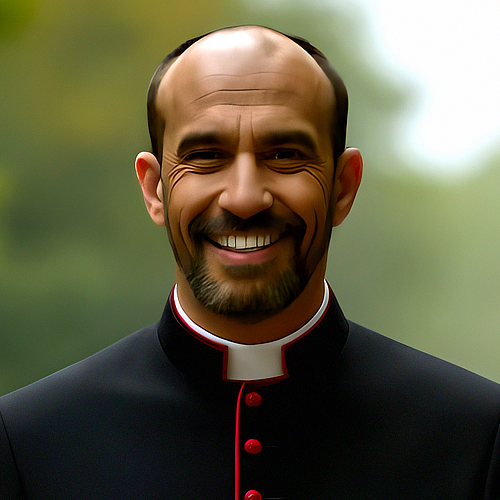

No Further Action
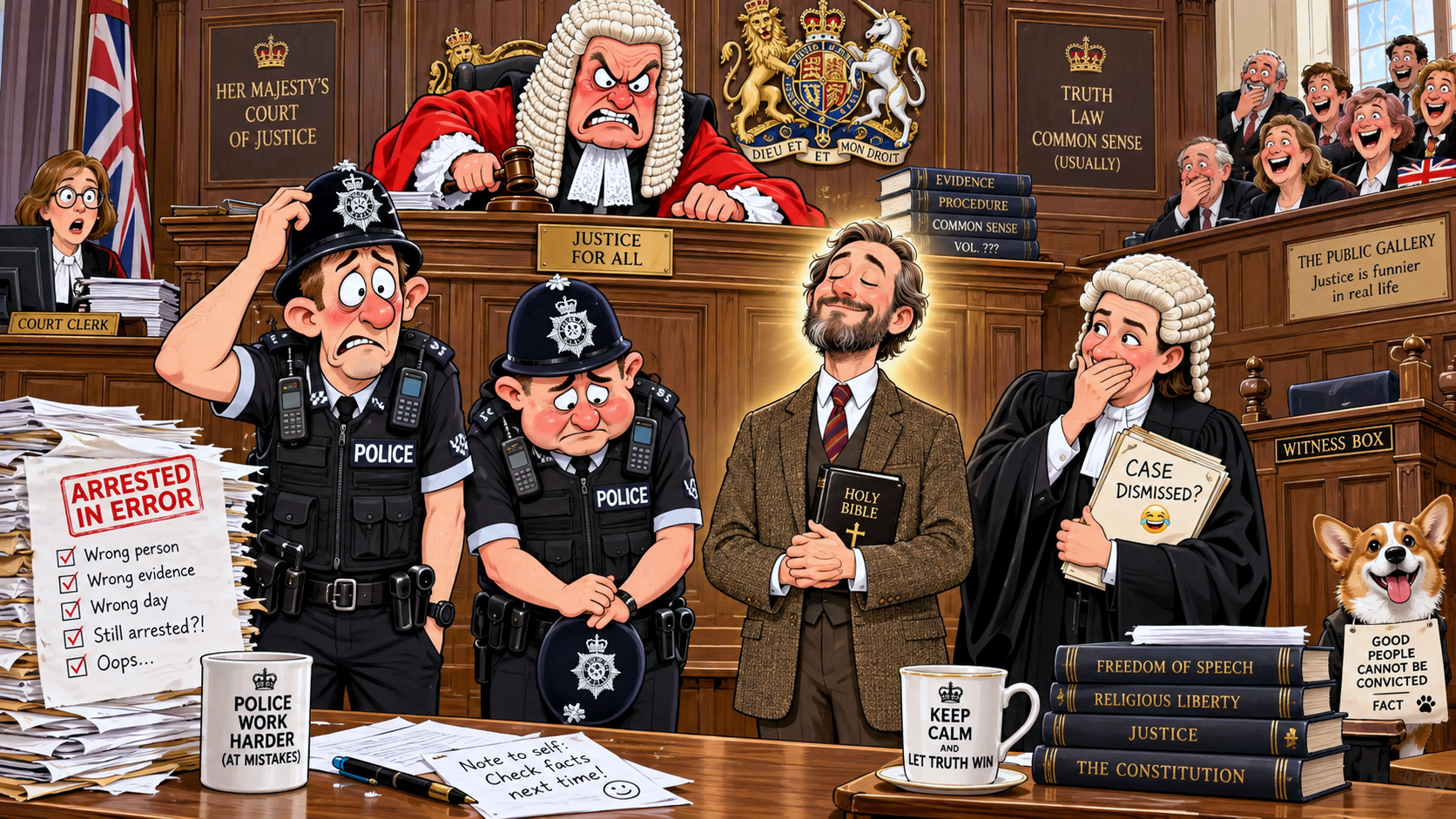
On Arrest as Sentence, the Complainant’s Veto, and
a State That Has Learned to Punish Without Convicting
I. Two Doors
In November of last year a Pentecostal pastor named Dia Moodley was preaching in Broadmead, in the centre of Bristol, on the subjects of Islam and of transgender ideology. Officers of Avon and Somerset Police arrested him. He spent some eight hours in a cell. He was released on bail conditions which forbade him to enter Bristol city centre, and which therefore forbade him to preach there, over Christmas. In May of this year the force wrote to inform him that no further action would be taken. It was the second time they had arrested him and the second time they had concluded that there was nothing to charge him with.[1]
In January of the same year six officers of Hertfordshire Constabulary arrested a married couple at their home, in front of their three-year-old daughter, and held them eleven hours. They had complained by email and in a parents' group chat about the appointment of a head teacher at their elder daughter's primary school. The investigation was closed after five weeks. Ten months later the force accepted liability and paid twenty thousand pounds.[2] I have written elsewhere about that case, and about the sixty-two thousand arrests for communications offences of which it forms one line.[3]
Two doors, then. A pastor in a cell in Bristol; a mother and father in a cell in Hertfordshire. One was preaching, and one was complaining about a school. The gulf between the two grievances is enormous, and the shape of what happened to them is identical, and it is the shape, not the grievance, that I want to examine. In neither case was anybody charged. In both cases the citizen was seized, held, deprived of liberty and of property, subjected to a period of uncertainty measured in months, and then informed that the matter was closed. In neither case did anything the State did require a court to agree with it.
That is the thesis of this essay, and I will put it before I argue it, so that nobody need read to the end to find out what I am accusing the Crown of. The State is not attempting to convict these people. It does not need to. It has discovered that the process is sufficient, and that a conviction is an expensive and unreliable luxury when an arrest will do the same work by Thursday.
II. The State Loses. This Is Not the Good News.
Take the street preachers first, because their record is the more extraordinary and the less known.
Dale McAlpine took seven thousand pounds and costs from Cumbria Police, who accepted that they had acted unlawfully. A second Cumbrian preacher took four thousand. Oluwole Ilesanmi, arrested outside a London tube station, driven four miles and put out at the roadside, took two thousand five hundred from the Metropolitan Police. Michael Overd and Mike Stockwell were convicted at Bristol and acquitted on appeal. John Sherwood was arrested at Uxbridge and cleared. Angus Cameron recovered damages from Police Scotland over an arrest arising from a recorded non-crime hate incident which the force's own papers showed had furnished no ground to suspect any offence at all.[4]
Hatun Tash was held some fifteen hours after an arrest at Speakers' Corner, strip-searched, and questioned in the small hours. Among the grounds advanced were criminal damage to a Qur'an which belonged to her, and the wearing of a t-shirt. The Metropolitan Police settled.[5] The Christian Institute, which has run a legal defence fund for twenty years, states that it has not lost a street-preacher case yet.[6]
Now read that list again with the eye of a man assessing a litigation record rather than a martyrology. The State's success rate in these matters is close to zero. When these arrests are tested before a judge, they collapse. The forces pay. The convictions are quashed. The investigations are dropped. On any ordinary reading of how law is supposed to work, this is a system correcting itself, and the proper response is relief.
I do not feel relief, and I invite the reader not to feel it either, for a reason that becomes obvious the moment one asks what the losing party lost. Cumbria lost seven thousand pounds. Hertfordshire lost twenty thousand. Not one officer has been dismissed. Not one chief constable has resigned. No force has been restrained by injunction from doing the same thing next week, and Avon and Somerset, having arrested Pastor Moodley once and abandoned the case, arrested him again.
Set against that, consider what the winning party won. He won his name back, eventually, at the cost of a year of his life, the seizure of his telephone, a period on bail during which he could not go where his work was, and the knowledge that it can happen again on any afternoon on which somebody is sufficiently annoyed. There is a word for a contest in which the loser pays a nominal sum and the winner is ruined by winning, and the word is not justice.
III. Tertullian’s Objection
The Church has been here before, and she wrote the objection down in the second century in a form which has not been improved upon since.
The younger Pliny, governing Bithynia, wrote to the Emperor Trajan to ask what he was to do about the Christians, and received the reply that has governed the memory of the persecutions ever since: they are not to be sought out, but if they are accused and convicted, they are to be punished.[7] Tertullian fastened upon this with the delight of a lawyer who has been handed his opponent's brief by mistake.
O sententiam necessitate confusam! Negat inquirendos ut innocentes, et mandat puniendos ut nocentes. Parcit et saevit, dissimulat et animadvertit.
What a judgment, confounded by its own necessity! It refuses to have them sought out, as though they were innocent, and orders them punished, as though they were guilty. It spares and it savages; it looks away and it strikes.
Tertullian, Apologeticum 2.7–9 (CCSL 1)
The argument is not rhetorical but structural, and it cuts exactly where we need it to cut. If the thing is a crime, why is nobody hunting it? And if it is not, why is anybody being punished for it? A State which declines to pursue an offence but punishes those brought before it has abandoned the only ground on which punishment could be justified, namely that a wrong has been done which the commonwealth is obliged to redress.[8]
Tertullian presses further, and his second point is the one our own constabularies have reinvented without knowing it. The Christians, he observes, are not convicted of the crimes imputed to them. The crimes are not proved and the prosecutors do not much try to prove them. What is punished is the name itself.[9]
Substitute for the name the utterance, and the fit is exact. Nobody was required to prove that Pastor Moodley's preaching had harmed a single person. Nobody was required to prove that a parents' group chat had injured a head teacher. Nobody is required, under section 127, to produce a victim at all. The constable does not ask what damage was done. He asks what was said, and whether somebody minded. That is the punishment of the name, and it was already an old scandal when Tertullian named it.
And our own version has a refinement the Romans lacked. Trajan at least required a conviction before punishment. We have dispensed with the conviction and kept the punishment, and we have done it by the simple expedient of moving the penalty forward, out of the sentence and into the process.
IV. The Complainant’s Veto
Every one of these cases begins with a complaint. That is the hinge on which the whole apparatus turns, and it deserves to be looked at directly rather than assumed.
The purest specimen is not a Christian case at all, which is why I use it. On 13 February 2025 Hamit Coskun, an atheist of Armenian and Kurdish descent who had sought asylum here from Turkey, burned a copy of the Qur'an outside the Turkish Consulate in London as a protest against the religious direction of the Turkish State, shouting as he did so that Islam is a religion of terrorism. A bystander threatened to kill him, went indoors, returned with a knife, chased him into the road and kicked him as he fell. A passing cyclist assaulted him too. Coskun was then prosecuted, and convicted, of a religiously aggravated public order offence, the magistrate treating the fact that he had been attacked as evidence that his own conduct had been disorderly.[10]
Southwark Crown Court quashed the conviction in October, holding that there is no offence of blasphemy in the law of England and Wales, that freedom of expression must extend to what offends, shocks and disturbs, and that a court should be wary of allowing one man's criminal reaction to make a criminal of another.[11] The Crown Prosecution Service appealed. The High Court dismissed the appeal in February.[12]
Set beside that the fact that Parliament abolished the common law offences of blasphemy and blasphemous libel in 2008, offences which had in practice protected only Christianity.[13] The prosecuting authority of this realm therefore spent a year of public money attempting to establish, by the combination of a public order section and a religious aggravation, a protection for one religion which Parliament had seventeen years earlier deliberately withdrawn from another. It did not succeed. It tried twice.
Now observe the mechanism, because it is the same mechanism in Broadmead and in Borehamwood. The offence is not constituted by the harm the speaker does. It is constituted by the reaction he provokes. Whoever is angriest, and whoever is most willing to act upon anger, determines what may lawfully be said. A man with a knife is thereby promoted to the office of censor, and a man with a telephone and a grievance about a schoolteacher is promoted to the office of informer. This is not a marginal defect in the drafting. It is the operative principle.
Scripture legislates against precisely this, and it does so in the one place where the Law of Moses is at its most procedurally exact.
לֹא־יָקוּם עֵד אֶחָד בְּאִישׁ לְכָל־עָוֺן ... וְעָמְדוּ שְׁנֵי־הָאֲנָשִׁים אֲשֶׁר־לָהֶם הָרִיב לִפְנֵי יְהוָה ... וְדָרְשׁוּ הַשֹּׁפְטִים הֵיטֵב וְהִנֵּה עֵד־שֶׁקֶר הָעֵד ... וַעֲשִׂיתֶם לוֹ כַּאֲשֶׁר זָמַם לַעֲשׂוֹת לְאָחִיו
A single witness shall not stand against a man for any offence … the two men who have the dispute shall stand before the LORD … and the judges shall enquire diligently, and if the witness is a false witness … then you shall do to him as he had meant to do to his brother.
Deuteronomy 19:15–19
Three provisions, and we have quietly repealed all three.[14] The single witness is not to suffice: with us a single complaint is enough to put a man in a cell. The judges are to enquire diligently before anything is done: with us the enquiry, when there is one, comes after the arrest and frequently concludes that there was nothing to enquire into. And the false accuser is to bear the penalty he sought to impose: with us the vexatious complainant bears nothing whatever. He is not named, not questioned, not charged, and not so much as written to. He has been handed a power to injure his neighbour at no cost to himself, and there is no surer way to guarantee that a power will be used.
The Church has never forgotten what an untested accusation does. She keeps the memory in a text she reads in Lent, in which two men of standing lay an information against a woman, and the assembly convicts her on it without examination, and a young man stops the execution by the radical expedient of cross-examining the witnesses separately and discovering that they cannot agree on a tree.[15]
V. Punishment Moved Forward
It is worth stating plainly what the citizen actually suffers in these cases, because the formula ‘no further action’ is designed to suggest that he suffered nothing.
He suffers arrest, which is to say the public application of force to his person, frequently at his home and frequently in front of his family. He suffers detention for a period which in the cases above ranges from eight to fifteen hours. He suffers the seizure of his telephone and computers, which in a modern life is the seizure of his correspondence, his photographs, his banking and his work. He suffers bail conditions, which are an injunction granted without a hearing, on evidence never tested, by an officer who is not a judge; and in Pastor Moodley's case the condition was precisely coextensive with the activity complained of, so that the man was restrained from preaching in the place he preached, over Christmas, by an authority that never charged him with anything. He suffers the recorded fact of the arrest. And he suffers months of not knowing.
Every one of those is a penalty. Not one of them required a court to find him guilty of anything. Put them together and you have a sentence: a short custodial element, confiscation of goods, a geographical exclusion order, a period of licence, and a record. We would recognise it instantly as a sentence if a judge had imposed it. We do not recognise it because it was imposed by a custody sergeant, and because it ends with a letter saying that no further action will be taken, as though a man who has been through all of it has been vindicated rather than merely released.
The Roman jurists understood the priority here, and stated it in the form that passed into the whole Western tradition of criminal procedure.
Satius enim esse impunitum relinqui facinus nocentis quam innocentem damnari.
For it is better that the crime of a guilty man go unpunished than that an innocent man be condemned.
Ulpian, Digesta 48.19.5
That principle is not a technicality, and it is not a gift from the Enlightenment.[16] It is the recognition that the machinery of punishment is itself a terrible thing, and that its application to a man who has done nothing is a wrong which no subsequent acquittal repairs. The modern constabulary has inverted it: better that a hundred innocents be arrested than that one offensive sentence go unremarked.
I add, with some discomfort, a comparison the Church can make without blushing only because she learned it the hard way. Our own penal law requires the Ordinary (the Bishop), on receiving information about a delict, to enquire cautiously into the facts and the imputability before any process begins; and it directs him in terms to take care that nobody's good name be endangered by that enquiry.[17] The canon exists because we know what an investigation does to a man quite apart from its outcome. Whatever else may be said of the Roman Curia, and a great deal may be, the Code of Canon Law protects the reputation of the accused more carefully than the practice of an English police force in the year 2026.[18]
VI. A Charge of Recklessness, and Why It Is Not a Charge of Conspiracy
At this point the argument must either name a defendant or admit that it has none, and I intend to name one. But I will first say what I am not alleging, because the version of this accusation that circulates on the internet is both wilder and weaker than the one the evidence will carry, and I have no wish to be confused with it.
I do not allege that there exists a policy, instruction or understanding in any constabulary that Christian preaching is to be suppressed. I have seen no evidence of one and I do not believe there is one. I do not allege that the officers who made these arrests were moved by hostility to the faith; what moves a particular constable is not knowable from a desk in Durham, and a priest who claims otherwise is doing precisely the rash judgement his own tradition forbids him. I do not allege that the Home Office directs any of it. Chief constables are operationally independent of ministers, and the decision to prosecute Mr Coskun and to appeal twice was taken not by any police force at all but by the Crown Prosecution Service, which answers to the Attorney General and not to the Home Secretary. An essay that blurred those lines would deserve the contempt it received.
The charge I do lay is narrower, colder, and a good deal harder to answer. It is that these forces have been told what their conduct does, have been told repeatedly, have paid for it, and have gone on doing it; and that a body which behaves in that manner is answerable for the consequences as if it had intended them.
Consider what the forces knew, and when. Cumbria accepted that it had acted unlawfully in arresting Dale McAlpine and paid him. Hertfordshire accepted liability for the arrest of the Allens, paid twenty thousand pounds on the express footing that the legal test of necessity had not been met, and has continued since to defend the decision to investigate them at all. Avon and Somerset arrested Pastor Moodley in March 2024, concluded that there was nothing to charge him with, and arrested him again in November 2025 for doing the same thing in the same place. The Christian Institute has not lost one of these cases in twenty years, and has offered the forces a written understanding about street preaching in an attempt to stop them recurring.
Now set against that knowledge the choices actually made. A constable may arrest only where he has reasonable grounds to believe that arrest is necessary, and the Code expressly requires him to consider whether a voluntary interview would do instead.[19] In every case in this essay a voluntary interview by appointment was available. It was not taken. Six officers went to a house at breakfast, in front of a three-year-old child, and took two parents away for eleven hours, when a letter would have secured the same attendance; and the force's own settlement concedes that the necessity test was not met. That is not a judgment call made under pressure in a crowded police station. It is the selection, from a range of lawful options, of the most coercive one available, made repeatedly, by forces that have already been told what it costs.
The sharpest instance is the one that has attracted least attention. Pastor Moodley was released on bail conditions forbidding him to enter Bristol city centre. Bail conditions may be imposed only for certain purposes, all of which concern the integrity of the proceedings or the safety of persons: securing surrender, preventing further offences, protecting witnesses, protecting the defendant himself.[20] Ask which of those was served. There was no evidence in the city centre to preserve. There was no witness there to shield. The man was not going to abscond to Somerset. The condition achieved one thing and one thing only: it stopped him preaching, in the place he preaches, over Christmas — and then the force decided it had nothing to charge him with.
A restraint which secures by condition exactly what the authority has no evidence to secure by charge is not an administrative slip. Whatever was in the mind of the officer who framed it, the thing framed was an injunction against lawful activity, granted without a hearing, on untested material, by a person who is not a judge, and lifted only when it had run its useful course. Add the seizure of telephones and computers, which takes a man's correspondence and his livelihood without any finding against him; add the fourteenfold variation between the most and least enthusiastic forces, which tells us that what varies is not the conduct of citizens but the appetite of constabularies; and the pattern is complete.
The lawyers have long had a way of describing conduct of this kind without pretending to read minds, and it is the older and better way.
Magna negligentia culpa est: magna culpa dolus est.
Gross negligence is fault; gross fault is intent.
Paulus, Digesta 50.16.226
The civilians understood that beyond a certain threshold the law declines to distinguish between the man who meant the harm and the man who could not be troubled to find out whether he was causing it.[21] There is a point at which not knowing is itself a thing chosen, and the choosing is imputable.
Our own moralists reached the same place by a different road, and put it with more precision. St Thomas Aquinas distinguishes the ignorance a man simply suffers from the ignorance he arranges to keep — ignorantia affectata, the not-knowing that is directly willed because knowing would be inconvenient. Such ignorance does not lessen the voluntary character of what is done. It increases it, because the man has chosen not merely the act but the darkness in which he performs it.[22]
That is my charge, and I make it in those terms. Not that these forces conspired against the Gospel; they did not, and I would not say so. But that they have been told, and paid, and told again, and have arranged not to learn — no officer dismissed, no practice altered, no preacher left unarrested, the same force returning to the same man in the same area — and that a public authority which cultivates that degree of ignorance about the effects of its own conduct has passed out of the country of mistake and into the country of fault. Gross fault is intent. They may be judged as though they meant it, because at this distance from the first warning there is no honest way left to suppose they did not.
I add the qualification that makes the charge stick rather than the one that softens it. The first arrest in any of these series was a mistake, and I do not indict anybody for it. Constables are not canon lawyers, complaints arrive without context, and a man who has never encountered the question may get it wrong in good faith. It is the second that is culpable, and the third that is indefensible, and it is the second and third that this country's police forces have specialised in.
VII. Uncondemned, and in Public
What, then, is the Christian to do when this happens to him? The received wisdom in English parishes is that he should bear it meekly, and there is a text that is always produced in support, which is the one about turning the cheek. I want to set beside it a passage which is never produced, and which describes an apostle in exactly this position.
Paul and Silas had been beaten with rods at Philippi and thrown into prison without trial. In the morning the magistrates, having thought better of it overnight, sent word that the men could go. It is precisely our own formula: no further action, the door is open, say no more about it. Paul declined:
δείραντες ἡμᾶς δημοσίᾳ ἀκατακρίτους, ἀνθρώπους Ῥωμαίους ὑπάρχοντας, ἔβαλαν εἰς φυλακήν, καὶ νῦν λάθρᾳ ἡμᾶς ἐκβάλλουσιν; οὐ γάρ, ἀλλὰ ἐλθόντες αὐτοὶ ἡμᾶς ἐξαγαγέτωσαν.
They beat us publicly, uncondemned, men who are Romans, and threw us into prison; and now they are throwing us out secretly? No indeed. Let them come themselves and bring us out.
Acts 16:37 (NA28)
Every word of it is to our purpose.[23] Δημοσίᾳ — the injury was done in public, and a private release does not answer a public injury. Ἀκατακρίτους — uncondemned; the whole grievance is compressed into that single word, that punishment preceded judgment. Λάθρᾳ — secretly, quietly, by the back door, which is how magistrates have always preferred to unmake their mistakes. And the refusal: no indeed, let them come themselves. Paul does not want the door opened. He wants the men who shut it to walk down and open it in front of everybody, and the narrative records that they came.[24]
This is not an isolated flourish. The same Apostle asserts his citizenship to stop a flogging and appeals to Caesar to remove himself from a rigged provincial court.[25] He is entirely willing to use the civil law against the magistrate, and he does it without any sense that he is falling short of the Gospel. The meekness that the Church commends is meekness about one's own honour. It has never required a Christian to assist the State in concealing an injustice, and a bishop who counsels silence on that ground has stupidly confused the beatitude with the quiet life.
So the pattern of response is given to us. It is not to sue for damages and go away, which is the present settlement and which costs a constabulary rather less than its Christmas catering. It is to require that the thing be undone as publicly as it was done: that the force say what it did, name the officer who decided it, publish what it now accepts about the lawfulness of it, and do so where the arrest was seen. Twenty thousand pounds paid without an admission is the modern equivalent of the quiet release at Philippi, and it should be refused in the same terms.
VIII. The Objections, and One Confession
Three objections stand against what I have written, and I will not pretend that the first two are weak.
The first is that some street preaching is genuinely abusive; that some of it is aimed at individuals rather than at doctrines; that crowds gather and tempers rise; and that a constable in a shopping precinct with twenty people shouting is not conducting a seminar on the Public Order Act. All of that is true, and I concede it without reservation.[26] My argument does not rest on the merits of any single arrest, which I am in no position to adjudicate from a desk in Durham. It rests on the pattern of outcomes, which is a different kind of evidence. When one arrest in a series fails, that is the ordinary friction of policing. When the series fails almost entirely, and the same forces repeat the same arrests afterwards, the failure has stopped being friction and become the design.
The second is that the comparison flatters the preachers by borrowing a case that is not theirs. Hamit Coskun is an atheist. He burned a book that a great many people hold sacred, and he shouted things about their religion that no Christian should wish to have shouted. I have used him as the clearest instance of the principle, and I am obliged to say what follows from that. The principle protects him against us as much as it protects us against him. If it is not a crime to burn the Qur'an and say what he said, then it is not a crime to burn the Scriptures outside this house and say the corresponding things about the Sacred Heart; and I had better be willing to say so now, when the question is abstract, rather than discover a sudden enthusiasm for public order when it is my own book on the fire. I am willing. The remedy for blasphemy is not the constable. It never was.
The third objection is the one I feel most, and it is that the Church has no standing to say any of this. We burned books. We ran a Holy Office which punished by process with a thoroughness the Hertfordshire Constabulary could not dream of, and which understood perfectly well that the summons does the work whatever the verdict. The objection is just, and I have answered it elsewhere at length from Dignitatis humanae and will not repeat the argument here.[27] I add only this, which is not an answer but a confession: it is because we did it that we recognise it. A man who has kept a shop knows a thief's hand better than the customers do. That is not a qualification I would have chosen, but it is the one we have, and it is a poor reason for keeping quiet.
IX. What the Sword Was For
I have argued elsewhere that the magistrate holds the sword under a description, and that a magistrate who becomes a terror to the good work and an irrelevance to the evil has wandered out from under the warrant that Romans 13 gives him. I will not rehearse that argument. I will only observe that the evidence has since got worse. In the year to March 2026, seventy-two per cent of residential burglaries in England and Wales were closed with no suspect ever identified, and five per cent resulted in a charge.[28] Nineteen in twenty. While that was the record, six officers were available in Hertfordshire for a group chat about a head teacher, and a constabulary in the West Country found the resources to arrest the same preacher twice and charge him neither time.
And here is the detail on which I want to end, because it is the one that ought to trouble the bishops of this country more than anything else in these pages. When Hamit Coskun was convicted for burning a Qur'an, seventeen years after Parliament had abolished the blasphemy law that protected Christianity alone, the body that funded his defence, carried his appeal, and argued in open court that offending a religion is not a crime in England, was the National Secular Society.[29]
Let that be stated without ornament. The principle that the civil power has no jurisdiction over what a man says about God — a principle the Church spent the twentieth century learning to articulate and paid for in the blood of her own confessors under regimes I am old enough to remember at close quarters — was defended in an English court in 2026 by the secularists, at their own expense, while the churches - mainstream and independent - watched.
The preachers had the Christian Institute and a legal aid fund the size of a parish roof appeal. The posters had Big Brother Watch. The blasphemer had the atheists and agnostics of the National Secular Society. And the bishops of England and Wales, of all churches big and small, mainstream and independent, so far as the law reports disclose, had nothing to say about any of it.
I do not ask the State to be gentler. I ask it to do its work, which is the punishment of those who do harm and the praise of those who do good, and to cease and desist from doing the work it has taken up instead, which is the supervision of opinion by means of an arrest that leads nowhere and was never meant to. And I ask the Churches of this country, most notably their bishops, with rather more urgency, to notice that the defence of the freedom to speak about God has been left to people who do not believe in Him, and to consider what that says about where they have been while it was happening.
[1] Pastor Dia Moodley was arrested in Broadmead, Bristol, on 22 November 2025 by Avon and Somerset Police on suspicion of inciting religious hatred and of a religiously aggravated offence under s. 4A of the Public Order Act 1986, held some eight hours in a police cell, and bailed on conditions barring him from Bristol city centre over Christmas. The force informed him on or about 16 May 2026 that no further action would be taken. It was the second such arrest and the second such conclusion, the first having followed his arrest in March 2024. See ADF International, press release, 16 May 2026.
[2] For the arrest and detention of Maxie Allen and Rosalind Levine at Borehamwood on 29 January 2025, the eleven hours in custody, the closure of the investigation after five weeks and the payment of £20,000 by Hertfordshire Constabulary in November 2025, see the author's “Nineteen in Twenty: On Burglars, Blasphemers, Keyboard Warriors, and What the Law Is Actually For,” Mind the Limoges, 7 September 2026, https://www.crshj.org/blog/hmhct1lqeoukja9issw7pvdinp5l55, at n. 4 and the sources there cited.
[3] Big Brother Watch, report on communications offences (September 2026): 62,199 arrests over five years, 18,510 charged, 12,292 convicted. See “Nineteen in Twenty,” n. 1, for the arithmetic and for the distinction between the number never charged and the number never convicted.
[4] Dale McAlpine, arrested at Workington on 20 April 2010, received £7,000 and costs from Cumbria Police, who accepted that they had acted unlawfully. A second Cumbria preacher received £4,000 and costs in 2019. Oluwole Ilesanmi, arrested outside Southgate station in February 2019 and driven four miles before being released at the roadside, received £2,500 from the Metropolitan Police. Michael Overd and Mike Stockwell, convicted at Bristol magistrates, were acquitted on appeal to the Crown Court. John Sherwood, arrested at Uxbridge in April 2021, was cleared. Angus Cameron recovered damages from Police Scotland over an arrest arising from a non-crime hate incident which the force's own internal papers showed gave no ground to suspect an offence.
[5] Hatun Tash was detained some fifteen hours following an arrest at Speakers' Corner in June 2022, strip-searched, and questioned during the night; the grounds advanced included criminal damage to a Qur'an which was her own property and the wearing of a t-shirt bearing a Charlie Hebdo cartoon. The Metropolitan Police settled the civil claim, reported at £10,000. The same force had apologised for a separate arrest of her in 2022.
[6] The Christian Institute states that it has won every street-preacher case it has run since establishing its Legal Defence Fund in 2006. The claim is made by an interested party, but it has not to my knowledge been contradicted, and the individual outcomes listed above are independently reported.
[7] Pliny the Younger, Epistulae X.96–97, ed. R. A. B. Mynors, Oxford Classical Texts (Oxford: Clarendon Press, 1963). Trajan's rescript directs that Christians are not to be sought out (conquirendi non sunt), but that those accused and convicted are to be punished.
[8] Tertullian, Apologeticum 2.7–9, ed. Eligius Dekkers, CCSL 1 (Turnhout: Brepols, 1954), 88–89.
[9] Tertullian, Apologeticum 2.18–20, CCSL 1:90, on the punishment of the name itself in the absence of any proved crime; cf. Apol. 1.4 on condemnation without investigation.
[10] Rex v. Hamit Coskun, Southwark Crown Court, judgment of 10 October 2025 (Bennathan J with two lay justices), https://www.judiciary.uk/wp-content/uploads/2025/10/Rex-v-Hamit-Coskun.pdf. Coskun burned a copy of the Qur'an outside the Turkish Consulate in London on 13 February 2025 in protest against the Islamisation of Turkish politics under President Erdoğan, and was set upon, kicked and threatened with a knife by a bystander. He was convicted at Westminster Magistrates' Court in June 2025 of a s. 5 Public Order Act 1986 offence religiously aggravated under ss. 28 and 31 of the Crime and Disorder Act 1998, and fined £240.
[11] Bennathan J observed that there is no offence of blasphemy in the law of England and Wales, that a court should be wary of allowing the criminal reaction of one person to make a criminal of another for exercising the right to free speech, and that freedom of expression must include the freedom to express what offends, shocks or disturbs. The formulation follows the settled Strasbourg language of Handyside v. United Kingdom (1976) 1 EHRR 737, § 49.
[12] The Crown Prosecution Service appealed the quashing; the High Court (Warby LJ and Obi J) dismissed the appeal in February 2026, holding that the conclusions reached below were rationally open to the court. The defence and both appeals were funded by the National Secular Society.
[13] Criminal Libel Act 1819 (repealed); the common law offences of blasphemy and blasphemous libel were abolished by the Criminal Justice and Immigration Act 2008, s. 79. It is common ground that the offence had always been confined in practice to attacks upon Christianity, and specifically upon the tenets of the Church of England.
[14] Deuteronomy 19:15–19, Biblia Hebraica Stuttgartensia, ed. Karl Elliger and Wilhelm Rudolph, 5th ed. (Stuttgart: Deutsche Bibelgesellschaft, 1997); Septuaginta, ed. Alfred Rahlfs and Robert Hanhart, rev. ed. (Stuttgart: Deutsche Bibelgesellschaft, 2006).
[15] Daniel 13 (Susanna) in the Theodotionic text, Septuaginta, ed. Joseph Ziegler and Olivier Munnich, Septuaginta: Vetus Testamentum Graecum XVI/2, 2nd ed. (Göttingen: Vandenhoeck & Ruprecht, 1999). The book is deuterocanonical and is printed by the Vulgate as Daniel 13; those who follow the Hebrew canon may take the argument from Deuteronomy alone, where it is in any case stated as law rather than as narrative.
[16] Ulpian, Digesta 48.19.5 pr., in Corpus Iuris Civilis, vol. 1, ed. Theodor Mommsen and Paul Krüger, 16th ed. (Berlin: Weidmann, 1954). I cite the maxim in the form in which it is conventionally quoted; the reader should verify the Mommsen text.
[17] Codex Iuris Canonici (1983), c. 1717 §§ 1–2. The canon requires the Ordinary, on receiving information having at least the semblance of truth, to enquire cautiously into the facts and the imputability, and expressly directs that care be taken lest anyone's good name be endangered by the investigation.
[18] CIC (1983), c. 1717 § 2 in fine, and c. 220, which asserts the right of every person to the protection of his good name. The contrast drawn in the text is with the practice, not with the statute law, of the constabularies.
[19] Police and Criminal Evidence Act 1984, s. 24(4)–(5), as substituted by the Serious Organised Crime and Police Act 2005, s. 110: a constable may arrest only where he has reasonable grounds for believing that arrest is necessary for one of the purposes there specified. See also PACE Code G, paras 2.4–2.9, which requires the officer to consider whether the objective could be met by a voluntary interview.
[20] Bail Act 1976, s. 3(6), and Police and Criminal Evidence Act 1984, s. 47(1A): conditions may be imposed only for the specified purposes — securing surrender to custody, preventing further offences, preventing interference with witnesses or the course of justice, and the defendant's own protection.
[21] Paulus, Digesta 50.16.226, in Corpus Iuris Civilis, vol. 1, ed. Theodor Mommsen and Paul Krüger, 16th ed. (Berlin: Weidmann, 1954): magna neglegentia culpa est, magna culpa dolus est.
[22] Thomas Aquinas, Summa theologiae I-II, q. 6, a. 8, and q. 76, a. 3, in Opera omnia iussu Leonis XIII P. M. edita, vols 6–7 (Rome: Typographia Polyglotta, 1891–92), on ignorance as it bears upon the voluntary. Ignorance directly willed — what the tradition calls ignorantia affectata — does not diminish the voluntary character of the act but increases it, precisely because the not-knowing is itself chosen.
[23] Acts 16:37, Novum Testamentum Graece, ed. Barbara and Kurt Aland et al., 28th rev. ed. (Stuttgart: Deutsche Bibelgesellschaft, 2012). Hereafter NA28.
[24] NA28, Acts 16:38–39. The magistrates' alarm is at their own exposure, the beating of an uncondemned Roman citizen being a serious matter; but the narrative records their coming in person, which is what Paul had demanded.
[25] NA28, Acts 22:25–29; 25:11. The Apostle's willingness to invoke the civil remedies available to him is a standing rebuke to the pious notion that a Christian wronged by the magistrate should say nothing.
[26] I record without qualification that some street preaching is abusive, that some of it is directed at private individuals rather than at doctrines, and that a constable facing a gathering crowd is not sitting in a seminar. The argument in the text concerns the pattern of outcomes across the reported cases, not the merits of any arrest considered alone.
[27] Second Vatican Council, Declaratio de libertate religiosa Dignitatis humanae (7 December 1965), § 7, AAS 58 (1966): 929–46; DH 4244. For the fuller treatment of the objection from the Church's own record, see “Nineteen in Twenty,” § V, and the discussion of Leo XIII, Libertas praestantissimum, there.
[28] Home Office, Crime Outcomes in England and Wales 2025 to 2026 (London: Home Office, 23 July 2026), § 2.5: 72.4 per cent of residential burglaries closed with no suspect identified; charge rate 5.0 per cent. See “Nineteen in Twenty,” §§ I and VII.
[29] I take the phrase from the National Secular Society's submissions in Coskun, where it was argued that a conviction would hand extremists a veto over lawful expression. That the phrase is theirs and not mine is precisely the point made in § IX above.