
The Two Usurpations
On Piddington, Proscription, and the Sword That Belongs to Neither
I. The Occasion
A village in Oxfordshire has voted to leave the United Kingdom. On 16 September the parish of Piddington held a referendum on its own secession and carried it by two hundred and eighty-five votes to twenty-six, with one ballot spoiled. The vote has no legal force whatever, and everybody involved knows it. It was an act of rhetoric, and as rhetoric it was eloquent: a community of a few hundred souls, informed that the Crown intends to house one thousand two hundred and fifty-six single men at a former military base on its doorstep, and finding that no ordinary channel of representation had produced the slightest purchase on the decision, reached for the only instrument left to it and declared itself a foreign country.[1]
Into this arrived Mr Daniel Thomas, who trades under the name Danny Tommo and co-founded, in June of this year, an organisation calling itself the Patriot Platform, which claims some forty-five thousand members. The Platform had already put masked men into Dover and Portsmouth, where they blocked roads and attempted to obstruct the transport of newly landed migrants. Speaking to Mr Tommy Robinson, Mr Thomas floated the proposal of bringing five thousand men with tents to Piddington, surrounding the site, and preventing the asylum seekers from entering it at all. The Home Secretary replied by describing him as far-right and outright racist, promising him the full force of the law, and distinguishing — the formula is worth noticing — between the legitimate concerns of residents and the extremists who would hijack them. She has separately instructed chief constables to make freer use of face-covering directions and surveillance technology. From the other flank, Baroness Chakrabarti has urged the Government to consider proscribing the Platform under terrorism legislation.[2]
So we have a village with a real grievance, a private army offering to defend it, and a ministry reaching for its proscription powers. I want to argue that there are two usurpations here and not one, that they are opposite in direction and equal in gravity, and that the Catholic tradition possesses the resources to condemn both without collapsing either into the other. The State has claimed a jurisdiction that does not belong to it. The private band has claimed a sword that does not belong to it. Neither condemnation touches the villagers of Piddington, whose grievance is legitimate, whose only weapon so far has been a ballot of no legal effect, and whose own parish representatives have said plainly that they did not ask for masked men and that their opposition long predated the arrival of Mr Thomas.
II. Duo Sunt
Begin where the Latin Church has always begun when the competence of the temporal power is in question. In 494 Pope Gelasius wrote to the Emperor Anastasius:
Duo sunt quippe, imperator auguste, quibus principaliter mundus hic regitur:
auctoritas sacrata pontificum et regalis potestas.
“Two there are, august Emperor, by which this world is chiefly governed:
the sacred authority of the pontiffs and the royal power.”
Gelasius I, Ep. ad Anastasium
Two there are, august Emperor, by which this world is chiefly governed.[3] The sentence is quoted most often in disputes about the relative dignity of the two powers, which is not my interest here. Its more durable teaching is the plural. The temporal power is a power among powers. It is not the whole of government, and it therefore has an object, a boundary, and a description under which it is authorised. Whatever lies outside that description it may still be able to do — states are rarely short of capacity — but it does so without warrant, and an act without warrant is not an act of authority at all.
St Thomas Aquinas gives the description its classical form:
lex est quaedam rationis ordinatio ad bonum commune, ab eo qui curam communitatis habet, promulgata.[4]
“Law is an ordinance of reason for the common good, promulgated by the one who has care of the community.”
Every clause bears weight, and the clause that bears most is ad bonum commune. Law is not whatever the competent body enacts; it is ordered reason directed to the good held in common. Where that ordination fails, Thomas does not say that we have a bad law which nonetheless binds. He says we have something that is not simply law at all, but rather a perversion of it — non est simpliciter lex, sed magis quaedam perversitas legis — and, more bluntly still, that such enactments are magis violentiae quam leges, violences rather than laws.[5]
III. The First Usurpation: The Ministry
The Christian warrant for the coercive power of the magistrate is given in Romans, and it is given under a description:
οἱ γὰρ ἄρχοντες οὐκ εἰσὶν φόβος τῷ ἀγαθῷ ἔργῳ ἀλλὰ τῷ κακῷ …
οὐ γὰρ εἰκῇ τὴν μάχαιραν φορεῖ· θεοῦ γὰρ διάκονός ἐστιν ἔκδικος εἰς ὀργὴν τῷ τὸ κακὸν πράσσοντι.
“For rulers are not a terror to good conduct, but to evil … for he does not bear the sword in vain:
he is God’s minister, an avenger to execute wrath upon the evildoer.”
Rom 13:3–4 (NA28)
The sword is not carried in vain, but neither is it carried at large.[6] It is carried τῷ τὸ κακὸν πράσσοντι, against the one who is doing the evil — a present participle, an agent identified by an act. St John Chrysostom, preaching on the passage, insists that the Apostle commends the office and not the officer, the πρᾶγμα and not the man who happens to hold it; obedience is owed to a function performing its function.[7] The magistrate who punishes the evildoer acts as θεοῦ διάκονος. The magistrate who punishes something else is simply a man with a sword.
Now consider what proscription does to that description. When an association is proscribed, the offence ceases to be an act and becomes a status. One is liable not for having done the evil but for membership, for support, for expression of support, for presence, for a placard, for a set of letters on a piece of cardboard. Whatever one thinks of Palestine Action — and I hold no brief for it — the arrest of something in the order of sixteen hundred people across two days of demonstration is not the punishment of evildoers. It is the administrative management of a political current, conducted through the criminal law because the criminal law was the instrument nearest to hand.[8]
And the instrument does not stay in one hand. That is the lesson of the present moment, and it is the reason I press it rather than gloating over it. Within a single year the proscription power has been used against a movement of the left and is now publicly urged — by a former shadow Attorney General, by a peer with a lifetime’s record in civil liberties — against a movement of the right. Whoever forges such a tool should assume that it will one day be held by his enemies, and should ask himself whether he is content with that. The Christian answer has never depended on who holds the handle:
Remota itaque iustitia quid sunt regna nisi magna latrocinia?[9]
“Without justice, what are kingdoms but great bands of robbers?”
St. Augustine of Hippo
Augustine asks the question of states that have become efficient and lost their warrant, which is precisely the condition under discussion.
The face-covering directions fall under the same objection in a milder form. A direction that sweeps up the ordinary attender together with the man who came to blockade a port punishes association rather than act; it substitutes a proxy for the κακὸν πράσσων because proxies are cheaper to police. Add to this the wider apparatus — some sixty-two thousand arrests in five years for communications offences, and the non-crime hate incident, which is not a punishment at all but a record kept against a man for an opinion — and the shape of the thing becomes plain. A state that requires a censorship board is at least obliged to defend censorship in public; this was arguably the case with the Spanish and Portuguese Fascist dictatorships of the 20th Century. But, as is the case in 21st Century Britain, a state that possesses a charging standard, a bail condition and a database requires nothing of the kind. It disciplines without ever having to justify itself, and it never has to lose.[10]
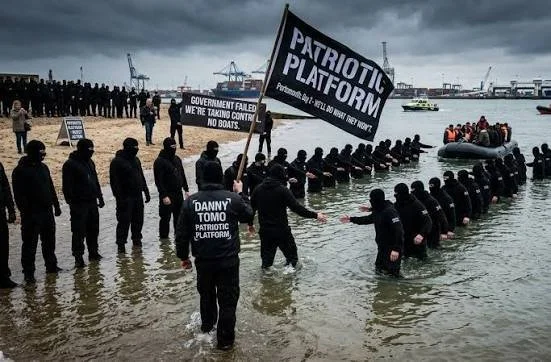
In fairness to them: the site contains nothing unlawful and disavows the obvious charge directly — love of country, not hate. The word lawful appears three times in short compass, attached each time to action. On the evidence of this page alone, Baroness Chakrabarti's call has no warrant whatever. A body whose public online charter confines its members to lawful action is not a terrorist organisation. But action must match charter.
Here I must be honest about an asymmetry, since the alternative is to build on sand. The Catholic tradition does not hand me a liberal maxim about free expression, and any writer who implies otherwise is selling counterfeit goods. Pope Leo XIII denies flatly that there exists an unbounded liberty of speaking and of publishing, and Immortale Dei is of a piece with it.[11] The Millian argument is not available to me and I do not want it. The Catholic objection is narrower, and because it is narrower it is harder to answer. It is this: that the restraint of expression and of association is licit only for the sake of a just public order — iustus ordo publicus, the deliberately restrictive criterion of Dignitatis Humanae — and never for the moral tutelage of the subject.[12] The interior life has another magistrate. When the State begins to keep files on opinions, and to name political associations criminal by ministerial order, it is no longer restraining disorder; it is forming consciences, which is the one office Pope Gelasius explicitly denied it, back in the year 494 AD.
IV. The Second Usurpation: The Cordon
Now turn the blade the other way, because the tradition does not permit me to stop here, and because a polemic that only ever indicts one’s opponents is not a theological argument but a partisan one wearing vestments.
St Thomas Aquinas is unambiguous that the coercive sword is public. A private person may not take it up: the authority to do so belongs to him who has care of the community, and the private man who kills in the community’s name sins precisely by usurping a public office.[13] Even resistance to tyranny — which the tradition permits, and which Thomas treats without squeamishness — must proceed auctoritate publica and by the community acting as such, not privata praesumptione; it must be proportionate; and it must not produce a disorder worse than the one it removes.[14]
Measure the proposed cordon against that. Five thousand men, mustered by a private association three months old, arriving in a village that did not summon them, to prevent by the interposition of their bodies the execution of a lawful administrative decision. This is not protest. Protest addresses the magistrate and leaves him his office; a cordon dispenses with him. And note carefully where the coercion actually lands. It does not land on the Home Secretary, who will sleep undisturbed. It lands on men in a camp. The minister is inconvenienced; the stranger is besieged.
That is the point at which the Gospel ceases to be ambiguous. Whatever the correct immigration policy of this kingdom may be — and I shall come to the fact that revelation does not supply one — the men in that camp are not the enemy, and a Christian may not treat them as the object of a siege.
ξένος ἤμην καὶ συνηγάγετέ με.
Mt 25:35 (NA28)
The verb is συνάγω, to gather in. Its precise opposite is to stand in a ring around a place and refuse entry. I do not claim that this verse settles a policy; it does not, and I shall say so plainly in a moment. I claim only that it forbids a particular posture of the heart, and that the posture proposed at Piddington is the one it forbids.
There remains the mask, and the mask is the most theologically revealing thing in the whole affair. The Lord’s diagnosis is not obscure: πᾶς γὰρ ὁ φαῦλα πράσσων μισεῖ τὸ φῶς (“For everyone who practises evil hates the light.”), while he who does the truth comes to the light.[15] Set beside this the παρρησία of the Apostles before the Sanhedrin, who neither concealed their faces nor withheld their names, and who answered the prohibition by continuing to speak in the open and accepting what followed.[16] A movement that believes itself to be speaking for a nation, and that covers its face while doing so, has already conceded the argument to its opponents. It has also — and this is the graver matter — handed the Home Office the one justification it could not have manufactured for itself.
The parish of Piddington understood this better than its self-appointed defenders. Its representatives have said that the community did not ask for protection by masked activists and that its own opposition to the scheme predated their arrival. The villagers are in danger of being used twice over: once by a department that treats them as an obstacle to a logistics problem, and once by an organisation that treats them as a recruiting ground.
V. The Grievance Is Real
None of the foregoing diminishes the substance of the complaint, and I want to be emphatic about this, because the characteristic vice of the respectable commentary on these events is to assume that having condemned Mr Thomas one has thereby answered Piddington.
The Catechism holds two things at once and refuses to drop either. Prosperous nations are obliged, so far as they are able, to receive the foreigner in search of security and of the means of livelihood; and public authority may, in view of the common good, make the right of immigration subject to juridical conditions; and the immigrant is himself bound to respect the laws and the patrimony of the country that receives him.[17] Pope John XXIII asserts a right to emigrate; he does not assert a correlative and unconditional right to be admitted anywhere one pleases.[18] Pope Pius XII, writing with the displaced of Europe before him, still presumes throughout that the receiving state has an ordering function to perform.[19]
The text least cited and most useful is St Thomas on the polity of the Old Law. Considering how Israel dealt with foreigners, he distinguishes the stranger who comes as a traveller or a sojourner, from the stranger seeking incorporation into the people, and he observes that admission to the latter was granted gradually, by generations, and differently according to the nation concerned and the history between them.[20] Thomas presents this not as meanness but as prudence. Political friendship has a formation time. A commonwealth that admits faster than it can assimilate injures both parties: the receiving body, which loses its coherence, and the received, who are settled into a population rather than into a people. That is a restrictionist argument of impeccable provenance, and it is not the same argument as contempt for the migrant. It is important that the two be visibly distinguished, since the entire rhetorical strategy of the department depends on their being confused.
So too with the ordo caritatis. Charity is ordered, and real proximity — of blood, of citizenship, of actual and assignable responsibility — establishes a genuine priority of obligation.[21] But notice exactly what that principle does and does not do. It orders the sequence of duties. It does not license contempt for those further down the sequence, and it never converts the stranger into a non-neighbour; the tenth chapter of Luke exists precisely to bar that exit.[22]
To tell a parish of a few hundred that it may not reasonably object to the settlement of 1,256 single men nearby is not a Christian position. It is an administrative position wearing a cassock. The villagers are entitled to press their authorities hard, publicly, persistently and lawfully, and the Church has nothing to say against them for doing so.
And here the second honesty. Nothing in the foregoing yields a number. The Magisterium binds me to the common good and to the dignity of every man in that camp; it does not hand me a cap, a quota, or a dispersal formula, and any writer who claims that it does is overclaiming a thin warrant. That cuts both ways, and I intend it to. Whoever tells you the Gospel demands open borders is doing the same thing in the opposite direction. The numbers are prudential; the dispositions are not.
VI. Fear, and the Managerial Temptation
What is actually being witnessed is a state that has become frightened and has reclassified a political problem as a security one. The formula deployed by the Home Secretary — legitimate concerns, hijacked by extremists — is not in itself false. It is, as it happens, a fair description of Piddington. But observe the use to which the formula is invariably put. Having distinguished the concern from the hijacking in a sentence, the department proceeds to file them together, because the concern is politically intractable while the hijacking is operationally addressable, and departments do what they can do.
This is the managerial temptation in its purest form, and it is older than any modern ideology. It is the temptation to answer a moral and political failure with a public-order remedy, and thereby to convert citizens with a grievance into a category of risk. It was the Pharaoh’s solution and it is not improved by databases.

St. Thomas Aquinas
But — and this is the point at which the honest concession becomes the sharper weapon — an apparatus does not have to be fascist in order to be unjust. Tyranny in the theological sense is a species of injustice, not a costume.
The definition St. Thomas Aquinas gives is about the object of rule: government directed to the private good of the ruler rather than to the common good of the ruled.
A ministry that criminalises association because association is inconvenient to it has met that definition in a particular and limited respect, and it is no defence to say that it has met it in a civilised manner and with a right of appeal.
Those who reach at this point for the word fascism should be careful, and I say this as one who does not doubt the drift. The Home Office loses in the courts with some regularity. The press reports all of this without permission. Government changed hands in July by the ordinary means. There is no political police, no prior censorship, no detention without trial, no war being fought with conscripts. A state that can be halted by a district council’s injunction is not the thing the word properly names, and to insist otherwise is to hand one’s opponents a costless refutation. But — and this is the point at which the honest concession becomes the sharper weapon — an apparatus does not have to be fascist in order to be unjust. Tyranny in the theological sense is a species of injustice, not a costume. The definition St. Thomas Aquinas gives is about the object of rule: government directed to the private good of the ruler rather than to the common good of the ruled.[23] A ministry that criminalises association because association is inconvenient to it has met that definition in a particular and limited respect, and it is no defence to say that it has met it in a civilised manner and with a right of appeal.
VII. To the Magistrate, and to the Crowd
To the magistrate, then, this. Your warrant is to punish the evildoer, and it is a warrant under a description; when you punish the category rather than the act you have stepped outside it, and the obedience you are owed does not follow you there. You have spent five years building an apparatus for the criminalisation of speech and of association, and you are now discovering that a country you have taught not to argue in public will eventually assemble in the street instead. You will find, when it does, that you have already spent the moral capital you would need in order to police that street justly. The discontent at Piddington is not a security problem and cannot be made into one. It is a political failure, and there is no charging standard that will answer it.
To the crowd, this. Your grievance is real, the Church does not ask you to swallow it, and no bishop has the authority to tell you that a prudential judgement about a former airbase is an article of faith. But you have no sword. The sword is public and it is not lent to private men, however numerous, however aggrieved, however certain. And the particular sword you propose to draw would fall upon the poor, who are the only people at Piddington with less power than yourselves. Take off the mask. Give your names. Say the thing in daylight and accept what follows, as the Apostles did before the Sanhedrin. You will lose less that way than you imagine, and you will keep the one thing a movement cannot recover once it has traded it away.
Two powers govern this world, said Gelasius, and neither of them is a crowd and neither of them is a filing system. The present disorder is that each of our contending parties has reached for the other’s office: the ministry legislating for consciences, the movement mustering for coercion. The remedy is not that one of them should win. It is that both should go back to their own work — the magistrate to the punishment of actual wrongdoing, the citizen to the open and unmasked pressing of his case — and that the Church, which is charged with neither sword nor cordon, should say so to both while it is still worth anything to say it.
[1] On the Piddington poll and the proposed accommodation of 1,256 male asylum seekers at a former military base in Oxfordshire, see the reporting of 17–18 September 2026 in the national press, including The Guardian and the Western Morning News.
[2] Home Office statements reported 17–19 September 2026; Baroness Chakrabarti’s remarks were delivered at a Lord Speaker’s lecture and reported on 18 September 2026.
[3] Gelasius I, Epistola VIII (XII) ad Anastasium imperatorem, in PL 59:41–47; critical text in A. Thiel, Epistolae Romanorum Pontificum Genuinae (Braunsberg, 1868), 349–358.
[4] Thomas Aquinas, Summa theologiae I-II, q. 90, a. 4, c. (ed. Leonina, vol. 7).
[5] ST I-II, q. 92, a. 1, ad 4; q. 96, a. 4, c. (ed. Leonina, vol. 7). Cf. Augustine, De libero arbitrio I.5.11 (CCSL 29:217): non videtur esse lex quae iusta non fuerit.
[6] Novum Testamentum Graece, ed. B. and K. Aland et al., 28th rev. ed. (Stuttgart: Deutsche Bibelgesellschaft, 2012), ad loc.
[7] John Chrysostom, In epistulam ad Romanos homilia XXIII, PG 60:615–618. Similarly Ambrosiaster, Commentarius in epistulam ad Romanos, ad 13:1–4, CSEL 81/1:417–420.
[8] On the arrests following the demonstrations of 9 August and 6 September 2025, and the Home Secretary’s public support for the Metropolitan Police in respect of them, see contemporaneous reporting and the Home Office statement of September 2025.
[9] Augustine, De civitate Dei IV.4 (CCSL 47:101).
[10] Big Brother Watch, report of September 2026, recording 62,199 arrests for communications offences over five years. I have argued the point at length in the essays on the sword and the stranger published in this journal: crshj.org/blog/3jng9zksm0lon7percsw9rfw6bwhs3; crshj.org/blog/tjip7onjailblpywx2wwe7savwp1sx; crshj.org/blog/7xf1f609gj5z2hqd6nykipx1tz7rot.
[11] Leo XIII, Libertas praestantissimum (1888), §§23–24; Immortale Dei (1885), §32; texts in Denzinger–Hünermann, Enchiridion symbolorum, 43rd ed., nn. 3250–3255.
[12] Vatican II, Declaratio de libertate religiosa Dignitatis humanae (1965), §7; Denzinger–Hünermann, n. 4247.
[13] ST II-II, q. 64, a. 3, c.; cf. q. 40, a. 1, c., on the auctoritas principis required for the just waging of war (ed. Leonina, vols. 8–9).
[14] Thomas Aquinas, De regno ad regem Cypri I.6 (ed. Leonina, vol. 42); cf. ST II-II, q. 42, a. 2, ad 3.
[15] Jn 3:20–21 (NA28).
[16] Acts 4:13, 19–20; 5:29 (NA28). On παρρησία as an apostolic duty rather than a civil liberty, see the discussion in the ICC volume on Acts.
[17] Catechismus Catholicae Ecclesiae, n. 2241.
[18] John XXIII, Pacem in terris (1963), §25; Denzinger–Hünermann, n. 3961.
[19] Pius XII, Constitutio apostolica Exsul familia nazarethana (1952), AAS 44 (1952), 649–704.
[20] ST I-II, q. 105, a. 3, c. and ad 1 (ed. Leonina, vol. 7); the scriptural substratum is Deut 23:4–9.
[21] ST II-II, q. 26, aa. 6–8 (ed. Leonina, vol. 8).
[22] Lk 10:29–37 (NA28). Cf. Ep. ad Diognetum V (SC 33bis:62–66), on Christians as resident aliens in every fatherland.
[23] ST II-II, q. 42, a. 2, ad 3; De regno I.1–2 (ed. Leonina, vol. 42).