
Lifted Up… The Exaltation of the Holy Cross
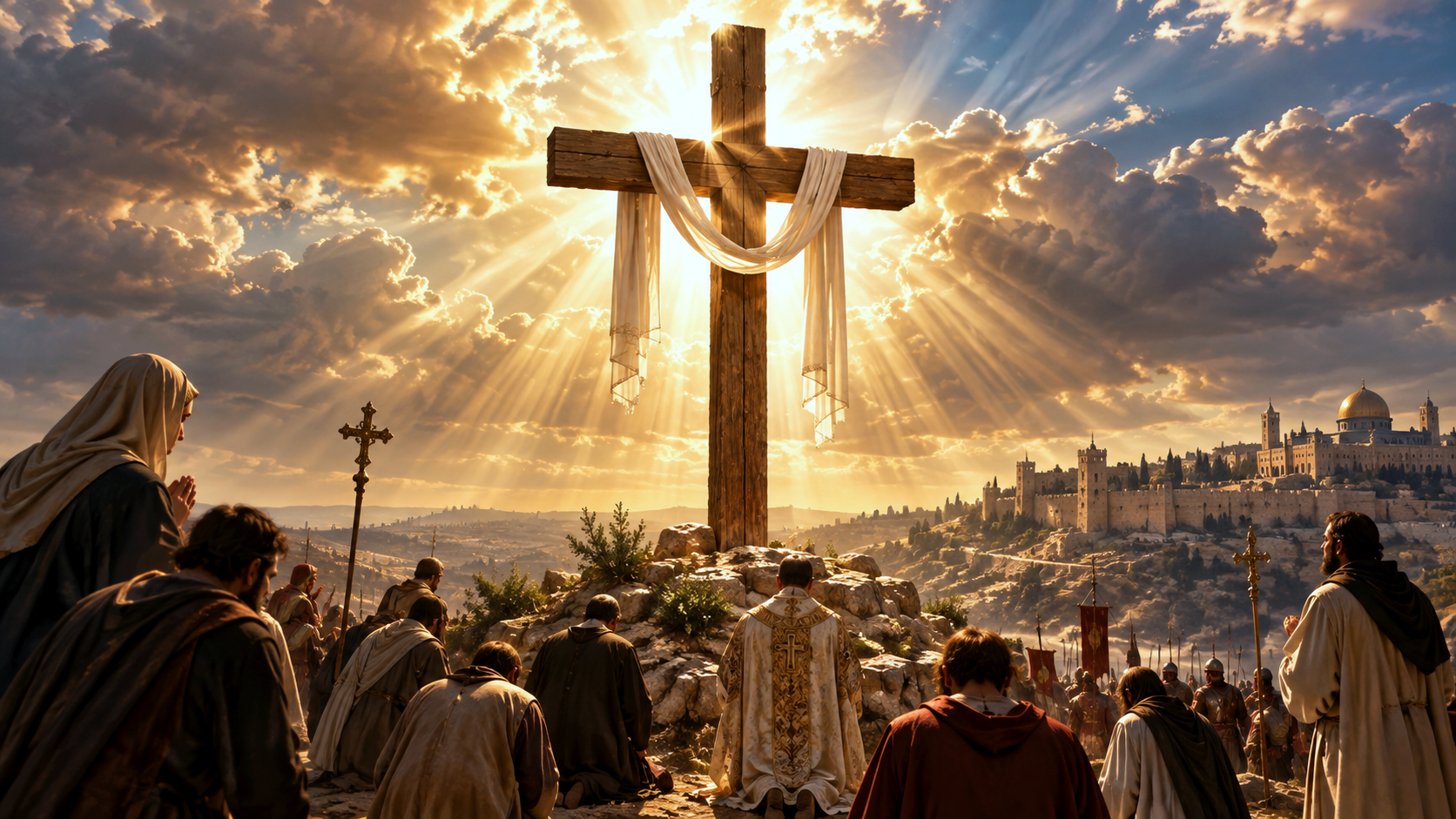
Exaltation of the Holy Cross, 14th September
I
A Feast with an Impossible Name
The Roman Calendar names tomorrow's feast the Exaltatio Sanctae Crucis. The Byzantine books name it Ἡ Παγκόσμιος Ὕψωσις τοῦ Τιμίου καὶ Ζωοποιοῦ Σταυροῦ, the Universal Elevation of the Precious and Life-giving Cross. Both titles are built upon a verb of raising, and both attach that verb to an object which no one in the ancient world would have thought raisable in any sense but the literal and the degrading.
It is worth resisting the anaesthesia of familiarity here. Cicero, defending Rabirius, told a Roman jury that the very word crux ought to be kept away not merely from the bodies of Roman citizens but from their thought, their eyes and their ears.[1] That is not rhetorical decoration; it is a description of a social fact. The cross was the punishment reserved for slaves, rebels and the provincial poor, and its purpose was not simply to kill but to display, at length and in public, a body being unmade. To speak of exalting such a thing is, on its face, either a euphemism or a joke.
The Church intends neither. The name of the feast is an exegetical claim, and it is a claim she did not invent. She took it from a verb in the Fourth Gospel and from the theology that verb carries. What follows attempts to set that theology out: first the Johannine ὑψόω and its Isaian root; then the type of the bronze serpent and the curse of Deuteronomy which the type presupposes; then the answering compound in the Philippians hymn; then the wood itself, in the apostolic preaching and in the Fathers; then the feast, with an honest account of what it does and does not rest upon; and last the wound in the lifted body, which is where a community of canons regular of the Sacred Heart has a particular reason to arrive.
II
The Verb John Chose
Three times in the Fourth Gospel the Son of Man is spoken of as being lifted up.
καὶ καθὼς Μωϋσῆς ὕψωσεν τὸν ὄφιν ἐν τῇ ἐρήμῳ, οὕτως ὑψωθῆναι δεῖ τὸν υἱὸν τοῦ ἀνθρώπου.
“Just as Moses lifted up the snake in the wilderness, so the Son of Man must be lifted up, that everyone who believes may have eternal life in him."
John 3:14 (NA28)
ὅταν ὑψώσητε τὸν υἱὸν τοῦ ἀνθρώπου, τότε γνώσεσθε ὅτι ἐγώ εἰμι.
"So Jesus said, 'When you have lifted up the Son of Man, then you will know that I am'"
John 8:28
κἀγὼ ἐὰν ὑψωθῶ ἐκ τῆς γῆς, πάντας ἑλκύσω πρὸς ἐμαυτόν. τοῦτο δὲ ἔλεγεν σημαίνων ποίῳ θανάτῳ ἤμελλεν ἀποθνῄσκειν.
“I stood up from the earth, always I attract before him. This was said by means of a
death which was bound to be reposed”John 12:32–33
The last of these is decisive for method, because the evangelist glosses himself.[2] He tells us that the lifting-up designates the manner of the death. That forbids us to spiritualise the verb — to make the exaltation a heavenly event of which the crucifixion is merely the regrettable precondition. Whatever ὑψόω means in John, it means something that happened to a body on a piece of timber outside a city wall.
But the verb's other register is not thereby cancelled, and this is the whole point. In the Greek Bible ὑψόω is ordinarily a word of honour: God is exalted among the nations, the horn of the anointed is exalted, the poor man is lifted from the dunghill. John does not use σταυρόω in these three sayings, though he uses it freely elsewhere in the passion narrative. He selects a word which means both to hoist and to glorify, and he places it where both meanings are live at once. The result is not ambiguity but simultaneity: the hoisting is the glorifying, under one verb, with no interval between them.
The surrounding vocabulary confirms it. The hour that comes is the hour ἵνα δοξασθῇ ὁ υἱὸς τοῦ ἀνθρώπου (12:23); when Judas has gone out into the night, Jesus says νῦν ἐδοξάσθη ὁ υἱὸς τοῦ ἀνθρώπου (13:31). The glorification is not scheduled after the passion. It is the passion, seen truly. And 8:28 makes the lifted body the place of revelation — then you will know that I am — while 12:32 makes it the place of universal attraction. Elevation, revelation, attraction: three functions of a throne, predicated of a gallows.
This double sense is characteristic of the Gospel rather than exceptional within it. ἄνωθεν at 3:3 means both again and from above; πνεῦμα at 3:8 is both wind and Spirit; the water of 4:10 is both running and living. John writes this way habitually.[3] It has often been proposed that the ὑψόω sayings rest instead on a Semitic idiom in which one root serves for both lifting and crucifying. The proposal is attractive and cannot be disproved, but it is also unnecessary, and the honest position is that we cannot get behind the Greek text to verify it.[4]
III
Isaiah's Servant
and Where the Verb Came From
John did not coin the usage. It is already made for him, in the opening line of the fourth Servant Song.
Ἰδοὺ συνήσει ὁ παῖς μου καὶ ὑψωθήσεται καὶ δοξασθήσεται σφόδρα.
“I will meet my father and he is exalted and glorified fiercely”.
Isaiah 52:13 (LXX)
The two verbs that structure the Johannine passion stand here side by side, in the future passive, of a single figure — and the very next verses describe that figure as one whose appearance was marred beyond human likeness, from whom men hid their faces.[5] Isaiah has already performed the operation which the feast's title performs. He has placed exaltation and disfigurement in the same breath and refused to let the reader choose between them.
How firmly John depends on this specific Greek form is a fair question, and it should not be overstated. The Hebrew has three verbs where the Greek has two, and two shared lexemes are a slender thread on which to hang a literary dependence.[6] But the thread is not the only one. When John reaches the end of the public ministry, immediately after the third ὑψόω saying, he cites Isaiah twice in Greek form and then says something remarkable: that Isaiah said these things because he saw his glory.[7] The evangelist himself tells us that the prophet is the seer of the glory whose hour has just been declared. That John should have taken his two verbs from the prophet he names at exactly this point is, at the least, economical.
IV
The Serpent in the Wilderness
The first ὑψόω saying is a typological one, and the type is deeply strange. Israel in the wilderness speaks against God and against Moses; serpents come among the people, and they die; Moses is told to make a serpent and set it on a pole, and whoever is bitten shall look at it and live.
A small point of vocabulary carries some weight here. The Greek of Numbers does not say that Moses lifted up the serpent. It says that he set it, or placed it, upon a sign — θὲς αὐτὸν ἐπὶ σημείου, and then ἔστησεν αὐτὸν ἐπὶ σημείου.[8] The verb ὑψόω does not appear in the passage. John's καθὼς Μωϋσῆς ὕψωσεν is therefore not a quotation but an assimilation: the evangelist reaches back into Numbers and re-describes what Moses did in the vocabulary he has chosen for what will be done to Christ. The type has been drawn toward the antitype, deliberately and by a single word.
What the type teaches is that the remedy takes the form of the affliction. What kills is a serpent; what heals is the image of a serpent. The sign hanging on the pole is a likeness of the very thing destroying the people, and it is by looking at that likeness that they live. The Book of Wisdom is already uneasy with this and hedges it carefully: the thing set up was a σύμβολον σωτηρίας - a symbol of salvation, but the one who turned toward it was saved not by what he looked at, but by the Saviour of all.[9] The hedge is well placed. Scripture will not permit the sign to become the source.
Nor will it permit the sign to become an idol. The bronze serpent survives into the monarchy, and Hezekiah smashes it, because Israel had been burning incense to it; and the chronicler records the contemptuous name they gave the fragments — Nehushtan, a piece of bronze.[10] That episode sits in the canon of a Church which venerates relics of the wood, and it is not an embarrassment to be managed. It is a discipline the Scriptures themselves impose: a sign that God gave may be destroyed by God's command once it is loved in the wrong way. The Church who lifts up the Cross tomorrow reads the smashing of the serpent in the same Bible.
The Fathers seize the typology early and press it exactly where it is strongest. Barnabas has it; Justin turns it against Trypho's objection; Augustine reduces it to an epigram — death is put to death by a death; Gregory of Nyssa and Cyril of Alexandria both make the crucial qualification, that the bronze serpent had the form of the venomous creature without its venom, as Christ came ἐν ὁμοιώματι σαρκὸς ἁμαρτίας (to be like a flesh of sin), in the likeness of sinful flesh and not in its substance.[11][12][13] The type is not an accident of imagery. It is a precise statement of how the atonement works: the curse is displayed, in effigy and then in truth, and looking at it saves.
V
The Curse Upon the Wood
The exaltation language would be unremarkable were it not that the Law had already pronounced upon a hanged body. Deuteronomy is blunt: the corpse must not remain overnight upon the tree, for the one hanged is cursed of God, κεκατηραμένος ὑπὸ θεοῦ πᾶς κρεμάμενος ἐπὶ ξύλου - blessed by God, hanging on wood, and the land must not be defiled.
That this text was being read against crucifixion before the apostolic preaching is not a Christian inference. The Temple Scroll applies the hanging of Deuteronomy to a man handed over to a foreign power, and the Nahum commentary uses comparable language of men hanged alive.[14] When Paul writes that Christ redeemed us from the curse of the Law by becoming a curse for us, and cites the verse, he is not making an ingenious connection. He is answering the objection everyone was already making.
The form of his citation deserves an honest note. Paul writes ἐπικατάρατος πᾶς ὁ κρεμάμενος ἐπὶ ξύλου - cursed by the hanged man on wood and does not reproduce the Septuagint's ὑπὸ θεοῦ - out of God. Whether he knew a text-form lacking those words or dropped them himself cannot be settled from the evidence we have, and commentators divide.[15] What can be said with confidence is narrower and still worth saying: Paul writes that Christ became a curse for us, not that God cursed him. The distinction will bear a good deal of dogmatic weight, but it will not bear the weight of a textual argument, and it should not be asked to.
The scandal (the Crucifixion), at any rate, is not softened anywhere in the New Testament. Paul tells the Corinthians that the preaching of a crucified Messiah is a σκάνδαλον - scandal to Jews and μωρία - moronism to Greeks, and offers no third audience for whom it might be neither. Justin's Trypho concedes a suffering Messiah readily enough and balks precisely at the manner of death — that he should be crucified and die so shamefully, cursed by the Law, this we cannot accept.[16] The objection is exact, and the Christian answer to it is not that the shame has been discovered to be a misunderstanding. Melito states the answer in the only register that fits: he who hung the earth is hanging.[17] The exaltation does not remove the scandal. It relocates it, from the wood to the one on it, and then declares that this is where the glory was all along.
VI
The Answer in the
Same Verb, Compounded
Paul, or the hymn Paul is using, answers John's verb with a compound of it.
ἐταπείνωσεν ἑαυτὸν γενόμενος ὑπήκοος μέχρι θανάτου, θανάτου δὲ σταυροῦ. διὸ καὶ ὁ θεὸς
αὐτὸν ὑπερύψωσεν καὶ ἐχαρίσατο αὐτῷ τὸ ὄνομα τὸ ὑπὲρ πᾶν ὄνομα.
“And being found in appearance as a man, he humbled himself by becoming obedient to death—
even death on a cross! Therefore God exalted him to the highest place
and gave him the name that is above every name”
Philippians 2:8–9
The compound ὑπερυψόω is used of Christ nowhere else in the New Testament; in the Psalter it is used of the LORD himself.[18] Its force here is entirely in the conjunction. Paul does not write and yet or nevertheless. He writes διὸ καί — therefore also. The super-exaltation is not consolation offered after an unfortunate death, nor a reversal of it. It is its consequence. The descent terminates at the words θανάτου δὲ σταυροῦ, death on a cross, and it is from that terminus, and on account of it, that God raises the name above every name.
Set the two texts side by side and the grammar of the feast is complete. In John, men lift him up, and in doing so unwittingly enthrone him. In Philippians, God lifts him higher still, and does so because of what men did. One verb, two agents, one act. That is what the Church means when she says Exaltatio: not that she has decided to admire an instrument of torture, but that the raising performed by the executioners and the raising performed by God are, in the event, the same raising.
A word on the critical ground, since it is contested. Much of the last century's exegesis has treated Phil 2:6–11 as a pre-Pauline hymn into which Paul inserted θανάτου δὲ σταυροῦ - death on the Cross, on metrical grounds; others have rejected both the hymn hypothesis and the interpolation with it.[19] The reading offered here does not depend on the outcome. If the phrase is Paul's addition, it shows him insisting that the descent be named at its lowest point. If it stood in the hymn from the beginning, it shows the Church insisting on the same thing before Paul wrote. The argument is indifferent between them, and it is better to say so than to borrow a contested reconstruction for support the case does not need.
VII
The Wood:
ξύλον, the Tree, and a Verse
That Is Not There
The earliest preaching, as Acts reports it, has a curious habit. Peter tells the council that God raised Jesus, whom you killed by hanging him ἐπὶ ξύλου - on wood; he says the same in the house of Cornelius; Paul says it at Antioch in Pisidia; the First Letter of Peter says that he bore our sins in his body ἐπὶ τὸ ξύλον - on the wood.[20] The word is not σταυρός - cross but ξύλον - timber, the word of Deuteronomy. The apostolic preachers reach for the vocabulary of the curse rather than away from it. They are not concealing what happened under a neutral term; they are naming it with the term that makes the legal difficulty explicit, and then preaching the resurrection of the man to whom it applied.
Once ξύλον - xylon, wood, timber, tree is in place, a second typology opens which is not about curse at all but about origins. A tree stood in the garden, a hand reached out to it in disobedience, and death followed. Irenaeus makes the correspondence structural: the disobedience enacted at a tree is undone by an obedience enacted on a tree, and the whole economy is recapitulated in the reversal.[21] The Apocalypse completes the figure by putting the tree of life in the city at the end, its leaves for the healing of the nations. Between the two trees stands a third, which is the second and the first at once — the instrument of the curse (the Cross), becomes the tree whose fruit is life.
This is the point at which honesty requires a small demolition. The Latin liturgical tradition has long sung that God reigned from the wood, regnavit a ligno Deus, as though quoting the Psalter: say among the nations that the Lord has reigned — from the tree. Justin accuses Jewish copyists of excising the phrase; Tertullian repeats it as scriptural; it passes into the Old Latin, into Fortunatus, and into the hymnody of this very feast.[22][23]
It is not in the Bible. No Hebrew witness and no Greek manuscript of the Psalter contains it, and the sober judgement of textual scholarship is that the words are a Christian gloss which found its way into part of the Latin tradition — that is, that Justin's accusation runs precisely backwards, and that the corruption, such as it is, is ours.[24] This ought to be said plainly rather than left in the footnotes of other people's books, and it costs the argument nothing. The gloss is bad textual criticism and excellent theology: four words which say, in Latin and about a psalm, exactly what John's ὑψόω says in Greek and about a Gospel. The Church may keep the hymn. She should not keep the accusation.
VIII
Why This Death:
The Fathers on the Shape
Athanasius asks a question that a modern reader may find almost impertinent, and answers it at length: why this death and not another? His reasons are worth rehearsing because they are exegetical rather than sentimental. The death had to be inflicted by others and not chosen, so that no one could allege that the Lord had contrived a weakness in himself and then recovered from it. It had to be public and complete, so that the resurrection could not be dismissed as a rumour. It had to leave the body whole, undivided, since a body dismembered could not stand as the sign of a Church that is one. And it took place in the air, between heaven and earth, which he reads against the prince of the power of the air. Above all, it is the death of outstretched arms, and here he quotes Isaiah: all day long I stretched out my hands to a disobedient people — one hand toward Israel and one toward the nations, drawing both into a single embrace.[25]
Gregory of Nyssa presses the shape further, taking the four arms of the cross as the four dimensions of Ephesians — breadth and length, height and depth — so that the figure of the crucified spans and holds together the whole created order. It is a beautiful reading and it has been enormously influential, and it should be labelled accurately: Paul does not mention the cross in that verse, and the fourfold construal is a theological reading of a shape rather than the exegesis of a text about a shape.[26] Named for what it is, it remains valuable. Passed off as exegesis, it teaches the reader bad habits which will cost more elsewhere than they gain here.
IX
The Feast, and What It
Does Not Rest Upon
The Greek name of the feast describes a liturgical action rather than an idea. Ὕψωσις is what the bishop does: he takes the wood and raises it above the people, at the four points of the compass, while they cry for mercy. The feast performs John's verb. Whatever else is said about the day, that is its centre — a lifting-up, done in church, in imitation of a lifting-up done outside the wall.
The historical furniture around it repays a clear eye. On 13 and 14 September 335 the basilicas Constantine had built over Golgotha and the tomb were dedicated, and Egeria, visiting half a century later, describes the octave of that dedication and the veneration of the wood in the same days.[27] Cyril of Jerusalem, writing from the city within about 20 years of the dedication, refers repeatedly and without argument to fragments of the wood distributed across the world — he treats it as something his hearers already know.[28] The cult of the relic, then, is early, local to Jerusalem, and attested by a witness on the ground.
The famous narrative of the finding is a different matter. Eusebius devotes a long stretch of the Life of Constantine to this very site: the demolition of the shrine of Aphrodite, the clearing of the ground, the uncovering of the tomb, the building and the dedication. He says nothing whatever about discovering the cross.[29] That silence is not easily explained. It is not the silence of a man with no interest in the subject or no access to the facts; it is the silence of the imperial panegyrist describing the excavation itself, at length, in the place where the discovery is supposed to have occurred.
The inventio surfaces some sixty years later — in Ambrose's funeral oration for Theodosius, then in Rufinus, then in the fifth-century historians, with the Syriac Protonike and Judas Cyriacus cycles later still and irreconcilable with each other.[30] The most that can responsibly be said is that a relic venerated at Jerusalem from an early date acquired, over several generations, a foundation legend of increasing circumstantial richness. That is a familiar pattern and not a scandalous one, but it should be described accurately.
None of this touches the feast. The Church does not on 14 September commemorate an archaeological success. She raises the wood and says that the one who was lifted on it reigns; and if every splinter now venerated were spurious, the claim would be untouched, because the claim is about a verb in a Gospel and not about a provenance. This is the discipline the bronze serpent already taught. The sign is given to be looked at, not to be trusted in; and the moment it is trusted in, it may be broken up and given a contemptuous name, and the God who gave it will be the one who orders the hammer.
X
The Wound in the Lifted Body
One thing remains, and for the Canons Regular of the Sacred Heart of Jesus (CRSHJ) it is the thing. John does not leave the lifted body intact upon the page. He shows us a soldier and a lance.
ἀλλ᾽ εἷς τῶν στρατιωτῶν λόγχῃ αὐτοῦ τὴν πλευρὰν ἔνυξεν, καὶ ἐξῆλθεν εὐθὺς αἷμα καὶ ὕδωρ.
“I am of these soldiers, his lance flanked it, and there came forth blood and water”
John 19:34
The evangelist then does something he does nowhere else with such insistence: he swears to it. The one who has seen has borne witness, and his witness is true, and he knows that he tells the truth, so that you also may believe. Then he supplies two fulfilment texts — a bone of him shall not be broken, and they shall look upon him whom they pierced. The second is worth a moment's attention, since John is not following the Septuagint at that point but a text agreeing with the Hebrew, which suggests he has gone looking for the verse rather than stumbled upon it.[31] The piercing is not incidental reportage. It is the scriptural terminus of the whole ὑψόω sequence: they will look — as Israel looked at the serpent, as the lifted-up Son draws all men to himself — and what they will look at is a wound.
The Fathers read the opened side as the origin of the Church and her sacraments. Augustine notices that the evangelist chose his verb with care — the side was opened, not merely struck — and reads it against the door set in the side of the ark and against the woman taken from the side of the sleeping Adam; the Church is born from the side of the second Adam as he sleeps in death.[32] Chrysostom finds the two sacraments in the blood and the water, baptism and the eucharist flowing from the same wound.[33] Bonaventure will gather the whole tradition under the figure of the tree, and find the Heart at the centre of it.[34]
This is why, in a community whose devotion is fixed upon the Heart of Jesus, the devotion to the Heart is not a second devotion running alongside devotion to the Cross. It is the same devotion at closer range. The Heart is visible only because the side was opened; the side was opened only because the body was lifted; and the lifting is what the feast is named for. Haurietis aquas grounds the whole devotion in this verse, and it is right to do so, because there is nowhere else it could be grounded.[35] We do not venerate an emblem of divine affection in the abstract. We venerate an opened wound in a body that was raised up in public, on wood, under a legal curse, and we say that this is what the love of God looks like when it is made visible.
Andrew of Crete, preaching on this feast, calls the Cross the trophy and the throne, and Fortunatus tells the wood that no forest ever bore such leaf and flower and fruit.[36] Both are saying what John said with one verb. Tomorrow the wood is lifted over the people and the people bow — not to timber, and not to a legend about a Roman empress, but to the height at which love consented to be seen, and to the wound it was opened by.
[1] Cicero, Pro Rabirio perduellionis reo 5.16, in M. Tulli Ciceronis Orationes, ed. Albert Curtis Clark, Oxford Classical Texts (Oxford: Clarendon Press, 1911).
[2] Novum Testamentum Graece, ed. Barbara and Kurt Aland et al., 28th rev. ed. (Stuttgart: Deutsche Bibelgesellschaft, 2012), hereafter NA28. All Greek New Testament text follows this edition unless otherwise noted.
[3] On the Johannine double entendre as a sustained compositional technique, see C. K. Barrett, The Gospel according to St John, 2nd ed. (London: SPCK, 1978), 214–15; and for the ὑψόω sayings specifically, Raymond E. Brown, The Gospel according to John (i–xii), Anchor Bible 29 (Garden City, NY: Doubleday, 1966), 145–46.
[4] The suggestion is that an underlying Aramaic or Syriac idiom (ܙܩܦ, zeqaph) carried both senses. The Peshitta does render the sayings with that root; but a Syriac version of the second century or later attests the translator's ingenuity, not the evangelist's source. The argument advanced here requires no Semitic substrate and does not rest on one.
[5] Septuaginta, ed. Alfred Rahlfs, rev. Robert Hanhart (Stuttgart: Deutsche Bibelgesellschaft, 2006). For Isaiah, see also Joseph Ziegler, ed., Isaias, Septuaginta: Vetus Testamentum Graecum XIV, 3rd ed. (Göttingen: Vandenhoeck & Ruprecht, 1983).
[6] The Masoretic text has three verbs (yārûm wə-niśśāʾ wə-gābah məʾōd); the Greek reduces them to two. Whether John depends on this specific Greek form or on the Hebrew tradition cannot be settled from the two verbs alone; the proximity of the Isaian citations at John 12:38 and 12:40, both in Greek form, is suggestive but not decisive.
[7] John 12:38 cites Isa 53:1; 12:40 cites Isa 6:10; 12:41 states that Isaiah saw his glory (εἶδεν τὴν δόξαν αὐτοῦ) and spoke concerning him. The evangelist thus closes the public ministry by naming Isaiah as the seer of the glory whose hour has just been announced.
[8] Numeri, ed. John William Wevers, Septuaginta: Vetus Testamentum Graecum III.1 (Göttingen: Vandenhoeck & Ruprecht, 1982), ad loc. LXX Num 21:8–9 uses τίθημι and ἵστημι with ἐπὶ σημείου; ὑψόω does not occur in the passage.
[9] Wisdom 16:5–7; the σύμβολον σωτηρίας of v. 6 is immediately qualified in v. 7: the one who turned was saved not διὰ τὸ θεωρούμενον but διὰ σὲ τὸν πάντων σωτῆρα.
[10] 2 Kgs 18:4 (LXX 4 Kgdms 18:4). The Hebrew nəḥuštān plays on nāḥāš (serpent) and nəḥōšet (bronze); the LXX transliterates.
[11] Barnabas 12:5–7, in Die Apostolischen Väter, ed. Andreas Lindemann and Henning Paulsen (Tübingen: Mohr Siebeck, 1992); Justin Martyr, Dialogus cum Tryphone 91.4, 94.1–3, ed. Miroslav Marcovich, Patristische Texte und Studien 47 (Berlin: de Gruyter, 1997).
[12] Augustine, In Iohannis euangelium tractatus CXXIV 12.11, ed. Radbod Willems, CCSL 36 (Turnhout: Brepols, 1954).
[13] Gregory of Nyssa, De vita Moysis II.271–277, ed. Jean Daniélou, SC 1 bis, 3rd ed. (Paris: Cerf, 1968); Cyril of Alexandria, Commentarii in Iohannem, on John 3:14, PG 73:249–56.
[14] 11QTemple (11Q19) LXIV.6–13 applies the hanging of Deut 21:22–23 to a living man handed over to a foreign power; 4QpNah (4Q169) 3–4 i.7–8 uses comparable language. The rabbinic and Qumran evidence together indicate that the verse was read against crucifixion well before the apostolic preaching.
[15] Gal 3:13 reads ἐπικατάρατος πᾶς ὁ κρεμάμενος ἐπὶ ξύλου, without the LXX's ὑπὸ θεοῦ. Whether Paul knew a text-form lacking the phrase or removed it himself is disputed and cannot be resolved on present evidence; what can be said is that Paul writes γενόμενος ὑπὲρ ἡμῶν κατάρα and never that Christ was accursed by God. See F. F. Bruce, The Epistle to the Galatians, NIGTC (Grand Rapids: Eerdmans, 1982), 165–67.
[16] Justin, Dialogus 89.2 (Marcovich, PTS 47). Trypho concedes a suffering Messiah and balks precisely at the manner of death.
[17] Melito of Sardis, Peri Pascha 96, ed. Othmar Perler, SC 123 (Paris: Cerf, 1966); also Stuart George Hall, ed., Melito of Sardis: On Pascha and Fragments, Oxford Early Christian Texts (Oxford: Clarendon Press, 1979).
[18 ]ὑπερυψόω occurs in the New Testament only at Phil 2:9. In the Greek Psalter it is used of the LORD: σφόδρα ὑπερυψώθης ὑπὲρ πάντας τοὺς θεούς (Ps 96:9 LXX = 97:9 MT).
[19] For the hymn hypothesis in its classic form see Ernst Lohmeyer, Kyrios Jesus: Eine Untersuchung zu Phil. 2,5–11 (Heidelberg: Winter, 1928), and Ernst Käsemann, 'Kritische Analyse von Phil. 2,5–11', Zeitschrift für Theologie und Kirche 47 (1950): 313–60; for a sustained rejection, Gordon D. Fee, Paul's Letter to the Philippians, NICNT (Grand Rapids: Eerdmans, 1995), 39–46, 192–94. The reading offered here holds on either view, and I do not rest it on the supposed interpolation.
[20] Acts 5:30; 10:39; 13:29; Gal 3:13; 1 Pet 2:24. Cf. Ernst Haenchen, The Acts of the Apostles: A Commentary, trans. Bernard Noble and Gerald Shinn (Oxford: Blackwell, 1971), 251n.
[21] Irenaeus, Aduersus haereses V.16.3–17.4, ed. Adelin Rousseau, Louis Doutreleau and Charles Mercier, SC 152–153 (Paris: Cerf, 1969).
[22] Justin, Dialogus 73.1–2 (Marcovich, PTS 47); Tertullian, Aduersus Marcionem III.19.1, ed. Emil Kroymann, CCSL 1 (Turnhout: Brepols, 1954), and Aduersus Iudaeos 10.11, CCSL 2.
[23] Venantius Fortunatus, Vexilla regis prodeunt, in Venanti Honori Clementiani Fortunati presbyteri Italici opera poetica, ed. Friedrich Leo, MGH Auctores antiquissimi 4.1 (Berlin: Weidmann, 1881), II.6.
[24] No Hebrew witness and no Greek manuscript of the Psalter supports ἀπὸ τοῦ ξύλου at Ps 95:10 LXX. The phrase is a Christian gloss that entered part of the Old Latin tradition; Justin's charge of Jewish excision inverts the direction of the corruption. See Alfred Rahlfs, ed., Psalmi cum Odis, Septuaginta X, 3rd ed. (Göttingen: Vandenhoeck & Ruprecht, 1979), ad loc.
[25] Athanasius, De incarnatione Verbi 24–25, ed. Charles Kannengiesser, SC 199 (Paris: Cerf, 1973). The citation of Isa 65:2 (ὅλην τὴν ἡμέραν ἐξεπέτασα τὰς χεῖράς μου) stands at 25.3.
[26] Gregory of Nyssa, Oratio catechetica 32, ed. Ekkehard Mühlenberg, Gregorii Nysseni Opera III/4 (Leiden: Brill, 1996); Fr. trans. Raymond Winling, SC 453 (Paris: Cerf, 2000). It should be said plainly that Eph 3:18 does not mention the cross, and that the fourfold reading is a theological construal of a shape rather than the exegesis of a text about that shape.
[27] Egeria, Itinerarium 48–49, ed. Pierre Maraval, SC 296 (Paris: Cerf, 1982).
[28] Cyril of Jerusalem, Catecheses ad illuminandos 4.10, 10.19, 13.4, PG 33; Epistula ad Constantium 3, PG 33:1165–76. Cyril writes from Jerusalem within roughly two decades of the dedication and treats the dispersal of fragments as common knowledge.
[29] Eusebius of Caesarea, De vita Constantini III.25–40, ed. Friedhelm Winkelmann, GCS Eusebius Werke I.1, 2nd ed. (Berlin: Akademie-Verlag, 1991). Eusebius describes the clearance of the site, the discovery of the tomb and the construction and dedication of the basilicas at length, and says nothing of the finding of the wood.
[30] Ambrose, De obitu Theodosii 40–49, ed. Otto Faller, CSEL 73 (Vienna: Hoelder-Pichler-Tempsky, 1955); Rufinus, Historia ecclesiastica X.7–8, ed. Theodor Mommsen, GCS Eusebius Werke II.2 (Leipzig: Hinrichs, 1908); Socrates, HE I.17; Sozomen, HE II.1; Theodoret, HE I.18. The Syriac Protonike and Judas Cyriacus cycles are later still and mutually irreconcilable. See Jan Willem Drijvers, Helena Augusta (Leiden: Brill, 1992), 79–180.
[31] LXX Zech 12:10 reads ἐπιβλέψονται πρός με ἀνθ' ὧν κατωρχήσαντο; John 19:37 has ὄψονται εἰς ὃν ἐξεκέντησαν, agreeing with the Hebrew against the Old Greek and standing close to the later revisions. The evangelist is not quoting the Septuagint here.
[32] Augustine, In Iohannis euangelium tractatus 120.2 (CCSL 36). Augustine's reading turns on the Latin aperuit rather than percussit — a translational choice bearing real theological weight, and one that ought to be acknowledged as such rather than passed over.
[33] John Chrysostom, In Iohannem homiliae 85.3, PG 59:463–64.
[34] Bonaventure, Lignum vitae, in Opera omnia, ed. PP. Collegii S. Bonaventurae, vol. 8 (Quaracchi: Collegium S. Bonaventurae, 1898), 68–86.
[35] Pius XII, encyclical letter Haurietis aquas (15 May 1956), AAS 48 (1956): 309–53, esp. §§ 33–36 and 55, which ground the devotion in the opened side of John 19:34.
[36] Andrew of Crete, Oratio X: In exaltatione sanctae crucis, PG 97:1017–36; Venantius Fortunatus, Pange lingua gloriosi proelium certaminis (Leo, MGH AA 4.1, II.2).