
Nineteen in Twenty
On Burglars, Blasphemers, Keyboard Warriors,
and What the Magistrate Is Actually For
I. The Occasion, or, Nineteen Burglaries in Twenty
Sixty-two thousand, one hundred and ninety-nine. Yes… 62,199!
That is not the gate at a football match. It is the number of persons arrested in the United Kingdom over five years for what the law is pleased to call communications offences. Of that number, 18,510 (eighteen thousand five hundred and ten) were charged and 12,292 (twelve thousand two hundred and ninety-two) convicted. Subtract, and you are left with something in the order of 44,000 (forty-four thousand) men and women who were seized by officers of the Crown, who in many cases had their doors knocked upon (some during the night - something slightly reminiscent of films about the Gestapo) and their telephones carried away in a bag, and who were then released without anybody ever getting round to putting a charge to them.[1]
Forty-four thousand (44,000)!… Consider the logistics. Consider the overtime. Consider the sheer quantity of trained adult human beings who spent a working day of their one irreplaceable life reading somebody else's group chat.😂
The instruments are two, and both were drafted with an entirely different sort of person in mind. Section 127 of the Communications Act 2003 was aimed at the heavy breather on the telephone. Section 1 of the Malicious Communications Act 1988 was aimed at the poison pen. Neither Parliament imagined for an instant that it was legislating against a woman in Wigan with a view about a policy. The Malicious Communications Act has since been quietly trimmed — the threat limb and the falsehood limb were repealed in 2024 — and what survives is precisely the limb the draftsman would have thought least dangerous and which has turned out to be the most: the one about giving gross offence. Section 127 stands untouched. The statutes have been left with their teeth in and their purpose out.[2]
Observe the apparatus in motion. Officers of West Midlands Police attended the home of a vulnerable adolescent girl in connection with a video posted to TikTok which carried a photograph of a teacher and some unkind words about her. The girl had not made the video. She had not shared the video. She had not commented upon the video. Reconstructing the alleged offence as generously as the facts permit, she appears to have seen it. For this she was required to hand over every electronic device in her possession and to attend a voluntary interview — voluntary in the specialised constabulary sense of the term, meaning that the alternative on offer was arrest. The investigation concluded, in the fullness of time, with the child being formally notified that no further action would be taken. One trusts she was reassured.[3]
In Hertfordshire, six officers arrested a couple at their home in front of their three-year-old daughter and held them for eleven hours. Their crime was to have complained — by email, and in a group chat with other parents — about their older daughter's primary school, and in particular about the process by which it had appointed a head teacher. The suspected offences included malicious communications, which is to say one of the very statutes under discussion. After five weeks the investigation was closed with no further action. Ten months after that the force accepted liability and paid £20,000 compensation, on the elegant footing that the legal test around necessity of arrest had not been met. That is the modern State's way of saying sorry without moving its lips. It has continued, meanwhile, to defend the decision to investigate at all, which tells you that nothing whatever has been learned.[4]
Now set beside all this is another set of figures, drawn not from campaigners but from the Government's own statistics.
In the year ending March 2026, 72.4% of residential burglaries in England and Wales were closed because no suspect had ever been identified.[5]
The charge rate for residential burglary was 5.0%.[6]
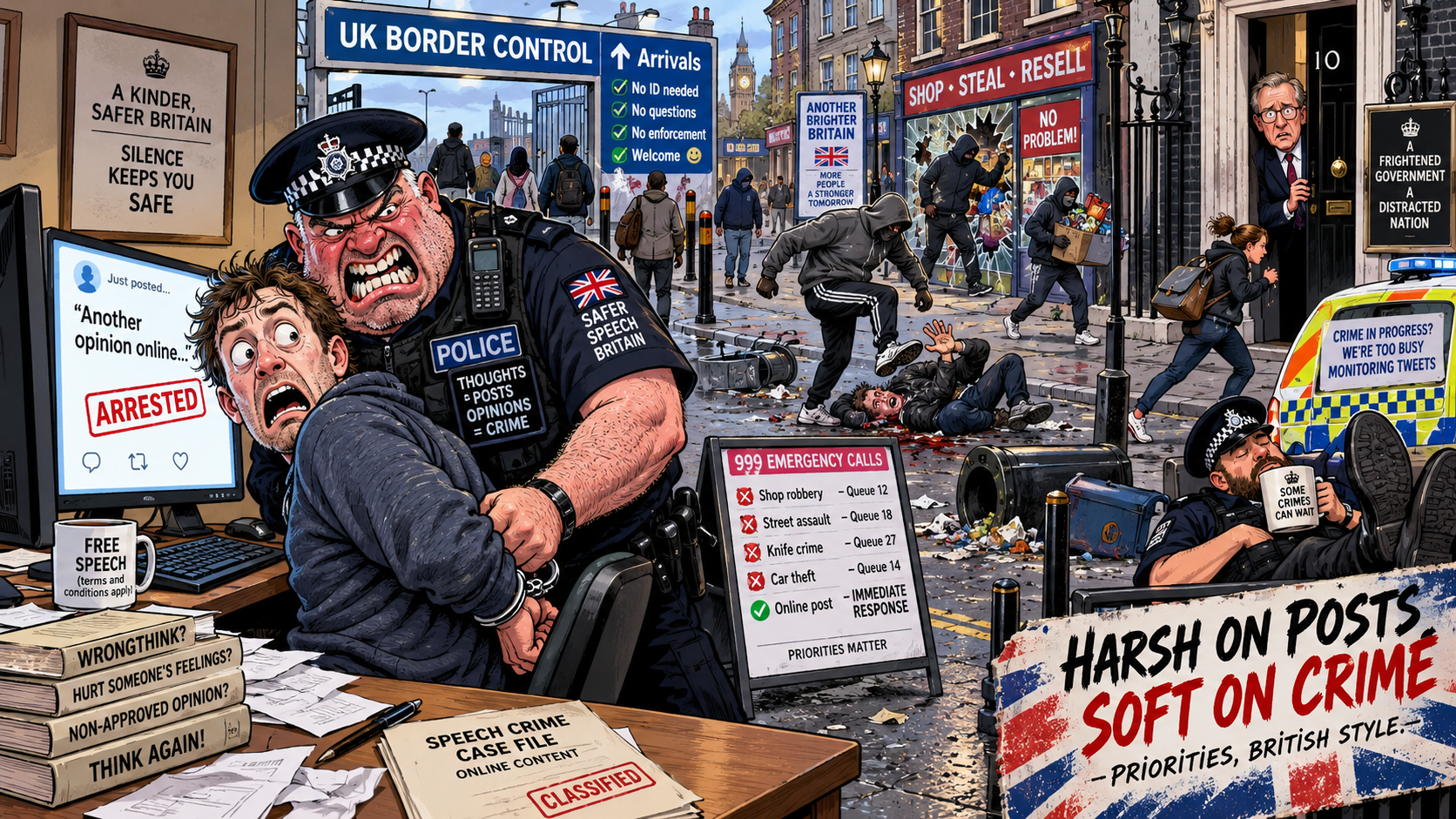
Read those two sentences together and the whole shape of the thing stands up and introduces itself. Break into a family's house and take away the things they own, and there are nineteen chances in twenty that no one will ever be charged with it. Post a foolish sentence about a schoolteacher, and the constabulary may be at your door inside a week, wanting your telephone and a word.
Let me be plain about what follows. This is not a defence of foolish sentences. Foolish sentences are, as it happens, my professional territory: I hear them in confession, I have preached a few, and I am not under the impression that what people say to one another on the internet is of no moral consequence whatever. It is an accusation, and it is this. A State which arranges its coercive power in this manner has not merely got its priorities in a muddle, as though the thing were a filing error to be corrected by a better spreadsheet. It has forfeited the warrant under which Christians are told to obey it.
II. The Sword Is Given Under a Description
St. Paul’s Epistle to the Romans Chapter 13 is the passage governments like. It is produced whenever obedience is wanted, generally by ministers who have not read it and occasionally by churchmen who have read it and are hoping nobody will ask them about verse three. It is not a charter of civil obedience. It is a charter of civil obedience under a condition, and the condition is stated so plainly, so early, and so much in the open that only long familiarity could have rendered it invisible.
οἱ γὰρ ἄρχοντες οὐκ εἰσὶν φόβος τῷ ἀγαθῷ ἔργῳ ἀλλὰ τῷ κακῷ. θέλεις δὲ μὴ φοβεῖσθαι τὴν ἐξουσίαν· τὸ ἀγαθὸν ποίει, καὶ ἕξεις ἔπαινον ἐξ αὐτῆς· θεοῦ γὰρ διάκονός ἐστιν σοὶ εἰς τὸ ἀγαθόν. ἐὰν δὲ τὸ κακὸν ποιῇς, φοβοῦ· οὐ γὰρ εἰκῇ τὴν μάχαιραν φορεῖ· θεοῦ γὰρ διάκονός ἐστιν ἔκδικος εἰς ὀργὴν τῷ τὸ κακὸν πράσσοντι.
³ For rulers are not a terror to good conduct, but to bad. Would you have no fear of the one who is in authority?
Then do what is good, and you will receive his approval, ⁴ for he is God's servant for your good.
But if you do wrong, be afraid, for he does not bear the sword in vain.
For he is the servant of God, an avenger who carries out God's wrath on the wrongdoer.
Rom 13:3–4 (NA28)
The rulers are not a terror to the good work but to the evil. Do the good and you will have praise from it. He does not bear the sword for nothing; he is God's servant, an avenger for wrath upon the one who practises evil.[7]
St. Peter says the same and gets there faster: governors are sent (εἰς ἐκδίκησιν κακοποιῶν, ἔπαινον δὲ ἀγαθοποιῶν), for the punishment of evildoers and the praise of those who do well.[8]
The decisive point is grammatical before it is theological, which is why it has survived so long unnoticed by people who prefer their politics unrestricted by syntax. Paul does not say that the ruler is a terror. He says the ruler is not a terror to the good work but to the evil, and he says it as the ground of the obedience he is commanding. The γάρ is not upholstery. Obey, for the ruler punishes the wicked and commends the good. Remove the second clause and the first is left standing on nothing, like a man who has sawn through the branch and is briefly surprised.
Chrysostom saw this and said so from the pulpit. Preaching on this very passage, he insists that the Apostle is not speaking of a ruler simply, but of the office as it performs its proper act; the whole force of the exhortation rests upon the assumption that the magistrate, the Police, the Authority is doing the thing magistrates, Police and Authorities exist to do.[9]
Ambrosiaster reads it in the same key. The power is from God, and it is from God for an end.[10]
Nor is this some patristic eccentricity that modern scholarship has swept tidily under the rug. Cranfield, whose treatment in the International Critical Commentary remains the most careful in English and is not notable for its revolutionary temper, is clear that Paul is describing the function of authority, and that the description is doing work.[11]
Here I must stop and be honest, because an argument that will not police itself has no business complaining about the police. What this establishes is not that a citizen may disobey whenever he judges the magistrate to have got something wrong. Paul is not distributing private vetoes to the aggrieved, and if he were, the queue would go round the block. What it establishes is narrower, and harder to wriggle out of: that the magistrate's claim upon the Christian conscience is a claim made in a particular character, and that a magistrate who systematically inverts that character — who becomes a terror to the good work and a matter of sublime indifference to the evil — is no longer standing where Paul put him. He has wandered off. He may still be owed a good deal on other grounds, but he must find those grounds elsewhere, because Romans 13 will not lend him any.
And that is precisely the case before us. The State has made itself a terror to the man who posts an ill-judged sentence and a negligible inconvenience to the man who empties a house. The sword has not been laid down. It has been turned inward, upon the citizen who speaks, and away from the criminal who acts.
Augustine put the general principle with a bluntness that the modern ear finds shocking, which is a comment on the modern ear rather than on Augustine [12]:
“remota itaque iustitia quid sunt regna nisi magna latrocinia”
“with justice removed, what are kingdoms but great robberies?”
He is not saying that every imperfect government is a criminal gang, and I am not saying it either. He is saying that justice is not an ornament hung upon the State but the thing that distinguishes it from a gang. A power which punishes according to whom it finds irritating rather than according to who has done harm has begun to mislay the distinction, and ought to be told so while it can still hear.
III. What Human Law Is For, and What It Is Not For
The Angelic Doctor supplies the instrument for the finer cut. “Law is an ordinance of reason for the common good, made by him who has care of the community, and promulgated”. Every word in that definition is load-bearing, and the phrase which should be printed on the inside of every ministerial red box is “ad bonum commune”.[13]
From this St. Thomas Aquinas draws a conclusion which our legislators might usefully read before drafting their next Bill, or indeed during. Human law does not repress every vice. It represses the graver vices, from which the greater part of the multitude can abstain, and chiefly those which are to the hurt of others, without the prohibition of which human society could not be maintained.[14]
Mark the criterion: “quae sunt ad nocumentum aliorum”, those which are to the harm of others. Not those which are disagreeable. Not those which are ill-mannered. Not those which cause a person of ordinary sensibility to feel that she has been got at. Harm.
The statutes under which 62,000 people were arrested do not require harm:
Section 127 requires that a message be grossly offensive. It requires no victim, no threat, no injury, no loss, no damage, nothing that a jury could point at. It requires that somebody, somewhere, in a position to take offence, took it, and that a constable was satisfied the taking of it was reasonable. This is a criminal law with the element of harm surgically excised and the resulting cavity packed with sentiment.
St. Thomas Aquinas has a name for legislation of this character. Where the legislator exceeds the power committed to him, his enactments are [15]:
magis violentiae quam leges
acts of violence rather than laws
I use the phrase advisedly; I have checked it in the original Latin, and I decline to soften it:
A rule which permits the arrest of forty-four thousand (44,000) people who are never charged with anything is not performing the work of law. It is performing the work of intimidation, and — this is the uncomfortable part — it is performing that work with real efficiency, because intimidation requires no conviction rate at all. It requires only that the neighbours see the police car outside number twelve and draw their own conclusions.
There is a further mark of the thing's lawlessness, and it is decisive. Law must be general; generality is what distinguishes a law from the mood of an official. Yet the enforcement of these offences varies across the country by a factor of fourteen (14). Cumbria Constabulary arrested 25.7 persons per ten thousand over the period. Neighbouring Northumbria managed 1.9.[16]
I have been to both places, and I am unable to report that the people of Cumbria are thirteen times the blackguards their neighbours in Tyne and Wear are. In other words:
What varies is not the conduct. What varies is the appetite of the constabulary. A norm applied with that degree of variance is not a law which a citizen can know and obey. It is a weather system. And a man who cannot tell in advance whether his words are criminal does not enjoy a liberty hedged about by law; he enjoys a licence, held at pleasure, revocable at the discretion of whoever is on duty.
IV. Not a Right, but an Incapacity
It would be easy here to reach for the vocabulary of the age and start talking about a right to self-expression. I decline, and not out of fastidiousness. The liberal case for free speech rests on the sovereignty of the individual will and on a settled scepticism about truth: because we cannot know which opinion is right, the State must not privilege any of them. That is not the Christian case. A priest who borrows it in order to sound reasonable at a conference has surrendered rather more than he has borrowed, and will find the loan called in later.
The Christian case runs the other way. It begins not with a right but with an obligation, and the obligation exists precisely because the truth is knowable and has been entrusted. Peter and John, forbidden by the Sanhedrin to speak in the Name, answer:
εἰ δίκαιόν ἐστιν ἐνώπιον τοῦ θεοῦ ὑμῶν ἀκούειν μᾶλλον ἢ τοῦ θεοῦ, κρίνατε· οὐ
δυνάμεθα γὰρ ἡμεῖς ἃ εἴδαμεν καὶ ἠκούσαμεν μὴ λαλεῖν.
"But Peter and John replied, 'Which is right in God’s eyes: to listen to you, or to him? You be the judges!
As for us, we cannot help speaking about what we have seen and heard.'"
Acts 4:19–20 (NA28)
The construction repays a moment's attention. Οὐ δυνάμεθα … μὴ λαλεῖν: not we will not be silent, but we cannot be. The Apostles do not assert a liberty. They confess an incapacity — the incapacity of a man who has seen something and cannot successfully pretend that he has not. And when the Council presses them a second time, the answer is that celebrated sentence which every Christian under an overbearing government has had occasion to remember, and which every overbearing government has had occasion to regret: πειθαρχεῖν δεῖ θεῷ μᾶλλον ἢ ἀνθρώποις… Discipline God?… Or Men? [18]
This is the tradition into which the Church's quarrel with the speech-policing State properly falls. It is the tradition of παρρησία, the frank and unafraid speech which the New Testament treats not as a temperament but as a gift and a duty. It is the tradition of the Baptist, who told a king what kings are not told, οὐκ ἔξεστίν σοι ἔχειν τὴν γυναῖκα τοῦ ἀδελφοῦ σου (“you are not in the woman of your brother”), and lost his head for the sentence.[19]
It is the tradition of Ambrose, who shut the doors of his basilica against an Emperor and demanded the Emperor’s penance for a massacre — a piece of pastoral practice which would today generate a great many emails.[20]
And it is the tradition of every martyr who declined to say the required words in front of the required image, which is to say that:
The Church's oldest and costliest political testimony is a testimony about compelled and forbidden speech. We did not acquire this position last week from a think tank.
Here is the sting, and I direct it at the bishops quite as much as at the ministers. A State which trains its citizens to expect that the wrong sentence brings a knock at the door is training them out of parrhesia (bold freedom of speech). It is manufacturing a population that weighs every word before an invisible constable — and a man who has learned to do that before the constable will do it before his colleagues, before his family, and at last before God. The chilling of speech is not merely a civic injury to be lamented in a leader column. It is a formation in cowardice; and cowardice, whatever the age may think, is not a small sin. The State that produces it is doing catechetical work of a sort. It is simply doing it against us, and rather more successfully than we are doing ours.
V. The Objections, Two of Which Are Serious
A polemic that will not state the case against itself is not an argument but a noise, and there is quite enough noise. Three objections stand against everything written above. Two of them are serious and one is not, and I will take the serious ones first, which is not the usual order in this genre.
The first is that the Catholic tradition is not a free-speech tradition and that I am smuggling in Mill under a Roman collar. This has real weight and I feel it. Pope Leo XIII in Libertas praestantissimum denies flatly that there exists a right to unbridled liberty of speech and writing; error, he insists, has no claim upon the protection of the laws, and a State which permits the promiscuous propagation of falsehood fails in its duty to the common good.[21]
I do not evade this and I will not pretend that Leo is on my side in the form in which he wrote. He is not. But notice what Pope Leo denies and what he presupposes. He denies a right to propagate falsehood, and he presupposes a commonwealth ordered to truth whose magistrate is competent to discern it. The British State of 2026 makes no such claim and would be embarrassed to be caught making it. It does not ask whether a proposition is true. It asks whether it is grossly offensive. It has therefore abandoned Leo's criterion altogether and substituted the sensibility of the hearer for the truth of the thing said. Pope Leo's principle, applied honestly to the present case, does not defend our legislators. It indicts them, and on a graver count than mine:
They punish speech without the least reference to whether it is true, and they punish true speech about their own failures rather more briskly than they punish theft.
The second objection is that the Church has no clean hands here. The Index, the blasphemy prosecutions, the confessional State: a Catholic priest denouncing the policing of speech is open to the charge that he objects to the policeman only when the policeman is not his own. I concede the history without qualification — it is not improved by being explained — and I decline the charge, on the ground that the Church herself has settled the question against her own former practice. Dignitatis humanae holds that the exercise of religious liberty may be restrained only within the just requirements of public order, and that freedom is to be respected as far as possible and curtailed only when and in so far as necessary.[22]
The presumption runs toward liberty; the burden lies on the one who would restrain it. Nothing in the present arrangements comes within sight of discharging that burden. And the deeper principle is a great deal older than the Council: Gelasius wrote to the Emperor Anastasius that there are two by which this world is chiefly governed, and that the sacred authority of pontiffs is not the imperial power.[23]
The magistrate, the politician, the legislator, the Authority, the State, have no jurisdiction over the interior man. They never had. That the Church sometimes forgot it is an argument for remembering it, not a licence for the State to forget it in her place.
The third objection is the one most often made, the least serious, and the one certain to be thrown at anyone who cites these figures. It is that the 62,000 were not sixty-two thousand dissidents; that the category of communications offences includes stalkers, abusers, and men sending credible threats to women who have left them; and that the campaigners themselves say so.[24]
They do say so, and so do I, and I say it first rather than last. Not one of these arrests should be doubted merely because the aggregate is alarming. Where a man terrorises his former wife by telephone, the constable who arrests him is doing precisely what Romans 13 describes, and I would defend that constable against any libertarian who said otherwise, at length, and with some warmth.
But press the objection and it demolishes the position it was raised to save. If a great many of these arrests are for genuine threat and harassment, then the offences of genuine threat and harassment exist and are available to be charged, and the State stands in no need of a further offence covering speech that is merely gross. And the conviction figures finish the job without assistance: fewer than one arrest in five ends in a conviction. Where the conduct is a real threat, the evidence is generally plain and the charge follows. The vast residue of arrests that go precisely nowhere is, by definition, the portion of this enforcement that is not catching abusers. It is the portion knocking on the doors of adolescent girls about videos they did not make.
Nor has the position improved with the newer legislation, which is where the reformers would like us to look. The Online Safety Act 2023 created false communications and threatening communications offences and repealed parts of the older provisions, and the Crown Prosecution Service's own guidance notes that the new offences are considerably wider in scope than the ones they replaced. The architecture was not dismantled. It was extended, and given better windows.[25]
VI. Sin, Crime, and the Constable Who Cannot Absolve
Let nobody mistake what is being argued for here, least of all those who would find it convenient to mistake it. The Church does not hold that speech is morally weightless, and her doctrine on the sins of the tongue is considerably more exacting than anything on the statute book. Rash judgement, detraction and calumny are all named and all condemned; the man who without objectively valid reason discloses another's faults to those who did not know them offends against justice and charity, and the man who by remarks contrary to the truth harms another's reputation and gives occasion for false judgements sins gravely.[26]
Nor is this a question of mere unkindness. Thomas classes detraction as a species of injustice, on the ground that a man's good name is a good belonging to him and may be stolen like any other of his possessions — and, one might add, with rather better odds of getting away with it than burglary now offers, which is saying something.[27]
By the Church's reckoning, then, a very great deal of what passes on social media is sinful. Probably a good deal more of it than the Crown Prosecution Service has ever contemplated charging. The Christian who defends the liberty to speak is not defending the licence to slander, and anyone who reports him as saying so is himself furnishing a serviceable example of detraction. He is not saying that the words do not matter. He is saying, with the whole weight of the tradition behind him, that they matter far too much to be handed over to a police constable.
This is the distinction upon which everything turns, and its collapse is the real disaster of which the 62,000 are merely the symptom. Sin is not crime. The forum of sin is the conscience, and its remedies are contrition, confession, penance and amendment — remedies which reach the interior act, which the law cannot reach and should not pretend to. The forum of crime is the public order, and its criterion is harm done to another.
When the State begins to punish speech because it is offensive rather than because it is injurious, it has not extended the criminal law. It has annexed the confessional. And it has annexed it without the seal, without absolution, and without the faintest interest in the amendment of the sinner.
A State which does that has taken up an office it is constitutionally incapable of discharging. It cannot forgive. It has nothing whatever to offer the man it has convicted of a wrong opinion except a record, and a record has never reconciled anybody to anything. It is, in the exact and unflattering sense, a parody of the Church's own work; and it will produce what parodies of penance always produce. Not contrition but concealment. Not amendment but silence. Not better citizens but quieter ones, which is, one begins to suspect, the specification.
VII. A Word to the Magistrate, and a Shorter One to the Bishops
So I say to the government of this country what the Church has always finally said to governments, and which is not a request:
You were given the sword for the punishment of those who do evil and for the praise of those who do good. That is the whole of your warrant. There is no second page. You hold it on those terms or you do not hold it at all, and you have inverted it with a thoroughness that would be impressive if it were not disgraceful. You have made yourselves a terror to the good work: to the parent complaining about a school, to the frightened girl with a telephone full of somebody else's videos, to the citizen who says the wrong thing about your policies in the wrong tone of voice. And to the evil work you have made yourselves very nearly nothing at all. Nineteen burglaries in twenty closed without a charge. Whole streets of them. Year upon year. While your officers compose their reports upon the tweets of the nation.
Nineteen in twenty. Take the number seriously, because the householders whose doors were forced have no choice but to. There is a family in this country sleeping tonight in a house that was entered last month, and nobody will ever be charged with it, and somewhere a constable is scrolling through a schoolgirl's messages and calling it work:
That is not only disgraceful. It is lazy.
Spare me the explanation about resources. Resource is what you spend on what you have decided matters, and you have decided. This is not a failure. It is a disclosure. It tells us what you are afraid of, and it is not the burglar — the burglar has never once questioned your legitimacy, and indeed has a certain professional interest in your continuing.
You are afraid of the citizen who speaks, because speech is the one power the unarmed retain, and you have grasped rather more quickly than most of my brother bishops that a people who can be taught to watch their words can be brought to accept a very great deal else besides.
To the Church I say something shorter and less comfortable:
We have been quiet. Let us not dignify that with the name of prudence. Prudence is a virtue ordered to the good, and it has never once counselled silence while the innocent are being frightened. The Baptist did not hold out for a more sympathetic defendant.
The magistrate holds the sword as θεοῦ διάκονος, God's servant. He may forget it; the word does not alter to accommodate him. Servants are called to account by their masters, and the account will be taken not of the offence caused by the citizen but of the (in)justice done to him.
Let the streets be policed, and the tweets be left to God, who judges the heart, who requires no freedom-of-information request to discover what was said in the group chat, and before whom the ministers of this realm will one day, in their deathbeds, give an account of the 44,000 victims they seized and never charged.🟥
[1] Big Brother Watch, report on communications offences (September 2026), drawn from freedom-of-information returns from UK police forces and reported in the national press, 5–6 September 2026: at least 62,199 arrests between 2021 and 2026, of which 18,510 were charged and 12,292 convicted. Some outlets reporting the same figures give the number charged as 18,150; on either reckoning the number arrested and never charged is between roughly 43,700 and 44,050. The figure of some fifty thousand, which has circulated in commentary on the report, is the number arrested and never convicted (49,907), and is not the same claim.
[2] Communications Act 2003, s. 127(1); Malicious Communications Act 1988, s. 1(1)(a)(i). The Malicious Communications Act has been narrowed since the arrests in this series began: s. 1(1)(a)(ii) (a message conveying a threat), s. 1(1)(a)(iii) (a message conveying information known or believed to be false) and s. 1(2) were repealed by the Online Safety Act 2023, s. 189(2), with effect from 31 January 2024 (S.I. 2024/31, reg. 2). What survives, and what matters for the present argument, is the limb directed at the indecent or grossly offensive message, alongside s. 127(1) of the Communications Act 2003, which remains in force in full.
[3] Big Brother Watch, report cited above at n. 1, which records the attendance of officers of West Midlands Police at the home of a vulnerable teenage girl over a TikTok post bearing a teacher's image and disparaging remarks, the demand that she surrender her devices and attend a voluntary interview or be arrested, and the eventual conclusion of the investigation with no further action taken.
[4] Maxie Allen and Rosalind Levine were arrested at their home in Borehamwood on 29 January 2025, on suspicion of harassment, malicious communications and causing a nuisance on school property, following complaints made by them about Cowley Hill Primary School by email and in a parents' group chat. They were detained for eleven hours; the investigation was closed after five weeks with no further action. In November 2025 Hertfordshire Constabulary accepted liability and paid £20,000 in damages and costs, on the footing that “the legal test around necessity of arrest was not met” in that instance. The force has continued to defend the decision to investigate.
[5] Home Office, Crime Outcomes in England and Wales 2025 to 2026 (London: Home Office, 23 July 2026), § 2.5 (“Theft offences”): 72.4 per cent of residential burglary offences recorded in the year ending March 2026 were closed because no suspect had been identified, against 73.1 per cent in the previous year.
[6] Ibid. The charge/summons rate for residential burglary offences recorded in the year ending March 2026 was 5.0 per cent, up from 4.7 per cent. Within that category the rate for home burglary was 5.9 per cent and for burglary of an unconnected building 2.4 per cent.
[7] Novum Testamentum Graece, ed. Barbara and Kurt Aland et al., 28th rev. ed. (Stuttgart: Deutsche Bibelgesellschaft, 2012), Rom 13:3–4. Hereafter NA28.
[8] NA28, 1 Pet 2:14.
[9] John Chrysostom, In epistulam ad Romanos homilia 23, PG 60:615–20. Chrysostom is at pains to observe that Paul does not speak of a ruler simply, but of the office as it discharges its proper function, and that the Apostle's argument would collapse if the magistrate were a terror to the good.
[10] Ambrosiaster, Commentarius in epistulas Paulinas: Ad Romanos, ed. Heinrich Josef Vogels, CSEL 81/1 (Vienna: Hoelder–Pichler–Tempsky, 1966), ad loc.
[11] C. E. B. Cranfield, A Critical and Exegetical Commentary on the Epistle to the Romans, ICC, 2 vols. (Edinburgh: T. & T. Clark, 1975–79), 2:660–73.
[12] Augustine, De civitate Dei IV.4, ed. Bernhard Dombart and Alphons Kalb, CCSL 47 (Turnhout: Brepols, 1955), 101.
[13] Thomas Aquinas, Summa theologiae I-II, q. 90, a. 4, in Opera omnia iussu Leonis XIII P. M. edita, vol. 7 (Rome: Typographia Polyglotta, 1892), 152.
[14] Aquinas, ST I-II, q. 96, a. 2, Leonine ed., 7:180–81.
[15] Aquinas, ST I-II, q. 96, a. 4, Leonine ed., 7:183: enactments of this kind are acts of violence rather than laws, since a law exceeding the power committed to the lawgiver does not bind in conscience.
[16] Big Brother Watch, report cited above at n. 1. Cumbria Constabulary is recorded as arresting 25.7 persons per 10,000 over the five-year period, against 1.9 per 10,000 for Northumbria Police — a ratio of approximately 13.5 to one. The report's headline figure for the spread between the most and least active forces is fourteenfold. Northumbria Police covers Northumberland together with Tyne and Wear.
[17] NA28, Acts 4:19–20.
[18] NA28, Acts 5:29.
[19] NA28, Mark 6:18.
[20] Ambrose of Milan, Epistula extra collectionem 11 (Maur. 51), ed. Michaela Zelzer, CSEL 82/3 (Vienna: Hoelder–Pichler–Tempsky, 1982), 212–18.
[21] Leo XIII, Libertas praestantissimum (20 June 1888), ASS 20 (1887–88): 593–613, at §§ 23–24; cf. Denzinger–Hünermann, Enchiridion symbolorum, definitionum et declarationum de rebus fidei et morum, ed. Peter Hünermann, 43rd ed. (San Francisco: Ignatius Press, 2012), nn. 3245–55.
[22] Second Vatican Council, Declaratio de libertate religiosa Dignitatis humanae (7 December 1965), § 7, AAS 58 (1966): 929–46, at 934–35; DH 4244.
[23] Gelasius I, Epistula 12 ad Anastasium imperatorem, in Epistolae Romanorum pontificum genuinae, ed. Andreas Thiel (Braunsberg: Peter, 1868), 350–51.
[24] Big Brother Watch, report cited above at n. 1, which states expressly that a proportion of the arrests recorded will have been justified — notably interventions against threatening messages in cases of domestic abuse. The present essay does not dispute it and does not wish to.
[25] Online Safety Act 2023, ss. 179 (false communications) and 181 (threatening communications); the repeals of Communications Act 2003, s. 127(2)(a)–(b) and of the corresponding limbs of Malicious Communications Act 1988, s. 1, are effected by s. 189 of the same Act. Crown Prosecution Service, prosecution guidance on communications offences, observes that the offences created by ss. 179 and 181 are considerably wider in scope than the provisions they replaced.
[26] Catechismus Catholicae Ecclesiae, § 2477 (Vatican City: Libreria Editrice Vaticana, 1997), on rash judgement, detraction and calumny.
[27] CCE § 2479; cf. Aquinas, ST II-II, q. 73, a. 2, on detraction as a species of injustice against a neighbour's good name.