
Multiculturalism: The Great Western Fiasco!

Multiculturalism - The greatest fiasco in post-war Europe, is considered the result of negligent policies implemented by incompetent governments, without the consent of European populations. The result has been and remains the most grievous breach of social peace and quiet, systematic wreaking of European Heritage, destruction of public and private property, abuse and cultural violation of European peoples.
The Question Rightly Put
Within the space of four months, between October 2010 and February 2011, the heads of government of Germany, Britain and France each declared, in terms that would have been unsayable a decade earlier, that multiculturalism had failed.[1] The declarations were political, and politics forgets its confessions quickly; but they gave official voice to something ordinary citizens across Western Europe had been saying among themselves for a generation. The difficulty is that the word failed is too blunt to be useful, and its bluntness has invited an equally blunt reply: that Britain, France and Germany are full of people of foreign origin who are entirely at home, and that those who speak of failure are therefore either mistaken or malicious.
Both the charge and the reply miss the decisive variable. Multiculturalism has not failed everywhere and for everyone. It has failed unevenly, and the unevenness has a pattern. Where newcomers come from cultures closely related to that of the host — sharing its religious inheritance, its conception of law, the shape of its family, its moral grammar — they fuse into the host society with remarkable speed, often within a single generation, and frequently in the teeth of initial hostility. Where they come from cultures distant on precisely those foundational matters, fusion is slow, partial, or does not occur at all, and in its place grows the condition that the Home Office’s own reviewers, writing after the riots in the northern mill towns in 2001, called “parallel lives.”[2]
This essay argues that the failure of multiculturalism is a failure proportioned to cultural distance — and specifically to distance on what a people loves in common — and that the policy failed because it treated distance as a heritage to be preserved rather than a gap to be crossed. The argument is not about race, nor about the worth of persons, every one of whom bears the image of God and is owed the charity of Christ. It is about the conditions under which a multitude becomes a people. Those conditions were observed by Aristotle, refined by St. Augustine, codified in the graduated hospitality of the Mosaic law as Aquinas read it, and dramatised in the Book of Ruth. They are not modern prejudices but ancient observations; and the modern evidence, read honestly, largely confirms them — though not without qualifications that this essay will not hide.
A word on terms:
Diversity is a fact: a society contains people of many origins.
Multiculturalism, in the sense intended here, is a doctrine and a policy: the commitment of the state to recognise and sustain distinct cultural communities as communities, to deal with citizens through them, and to decline to privilege the inherited culture of the host society over the cultures of those who arrive.
Integration is the process by which newcomers come to share the common goods and common loves of the society they join, while retaining whatever of their own inheritance does not contradict them.
The critique that follows is of the doctrine, not of the fact; and its constructive aim is integration, not uniformity.
What a People Is
In the nineteenth book of the City of God, St.Augustine takes up Cicero’s definition of a people — a multitude bound together by agreement about right and by a community of interest — and finds it wanting.[3] Agreement about right, he argues, presupposes true justice, and true justice presupposes the worship of the true God; on Cicero’s terms Rome was never a people at all. St. Augustine therefore proposes a definition that will hold for every human commonwealth, good or bad:
Populus est coetus multitudinis rationalis rerum quas diligit concordi communione sociatus … profecto ut videatur qualis quisque populus sit, illa sunt intuenda quae diligit.
A people is the association of a multitude of rational beings united by a common agreement about the things it loves … and so, to see what kind of people any people is, one must look at what it loves.
— St. Augustine, De civitate Dei XIX.24
On this account a people is not constituted by a territory, a passport, or a labour market, but by shared objects of love held concordi communione, in harmonious fellowship. The nobler the objects, the better the people; but some common objects there must be, or there is no people, only a crowd sharing a postcode. Elsewhere in the same book St. Augustine describes the peace of the earthly city as resting on “a certain composition of wills” (quaedam compositio voluntatum) concerning the things that pertain to mortal life.[4] Thus, Peace is not the absence of disagreement; it is the presence of enough agreement, about enough things that matter, for disagreement about the rest to be borne.

St. Augustine of Hippo:
Peace is not the absence of disagreement; it is the presence of enough agreement about enough things that matter.
Multiculturalism, in its doctrinal form, proposes a people whose members are encouraged to love different ultimate things and to share only procedures: tolerance, the statute book, the market. That is a thinner bond even than Cicero’s, and St. Augustine’s point is that procedure without love does not hold.
The decisive question about any newcomer, then, is not where he was born but what he loves, and how far those loves stand from the loves that constitute the people he joins. Cultural distance, rightly understood, is measured along this axis. It is not the distance between gastronomies, climates or costumes. It is the distance between what two diverse peoples hold sacred, what they take law to be, how they order the household, and what they believe a man owes to God and what to Caesar.
Measured so, some apparently great distances turn out to be small, and some small ones great. Consider, as a case, a Catholic from southern Europe who settles in Britain:
He meets a different language, a different cuisine, a different climate, and a national church that broke with Rome four and a half centuries ago. Notwithstanding all of that, the furniture of his mind is the furniture of his neighbours’ minds:
the same Scriptures and
the same calendar of feasts,
the inheritance of Roman and canon law,
monogamy and
the moral equality of husband and wife before God,
the distinction between the spiritual and the temporal powers,
the idea that conscience is answerable to truth and not to the clan.
Within a few years he is at home; his children are British without remainder, and nobody, least of all they, thinks the fusion remarkable. The distance he crossed was real but shallow, because the loves on either side of it were kindred.
Until They Breathe Together
Aristotle, cataloguing the causes of stasis — faction, civil strife — in the fifth book of the Politics, sets down an observation that has lost none of its force:
Στασιωτικὸν δὲ καὶ τὸ μὴ ὁμόφυλον, ἕως ἂν συμπνεύσῃ· ὥσπερ γὰρ οὐδ’ ἐκ τοῦ τυχόντος πλήθους πόλις γίγνεται, οὕτως οὐδ’ ἐν τῷ τυχόντι χρόνῳ· διὸ ὅσοι ἤδη συνοίκους ἐδέξαντο ἢ ἐποίκους, οἱ πλεῖστοι διεστασίασαν.
Difference of stock is also a cause of faction, until the peoples come to breathe together; for just as a city does not come into being from any chance multitude, so neither does it come into being in any chance length of time. Hence most of those who have admitted joint settlers or later settlers have fallen into faction.
— Aristotle, Politics V.3, 1303a25–28
Two variables are named:
the multitude, and
the time.
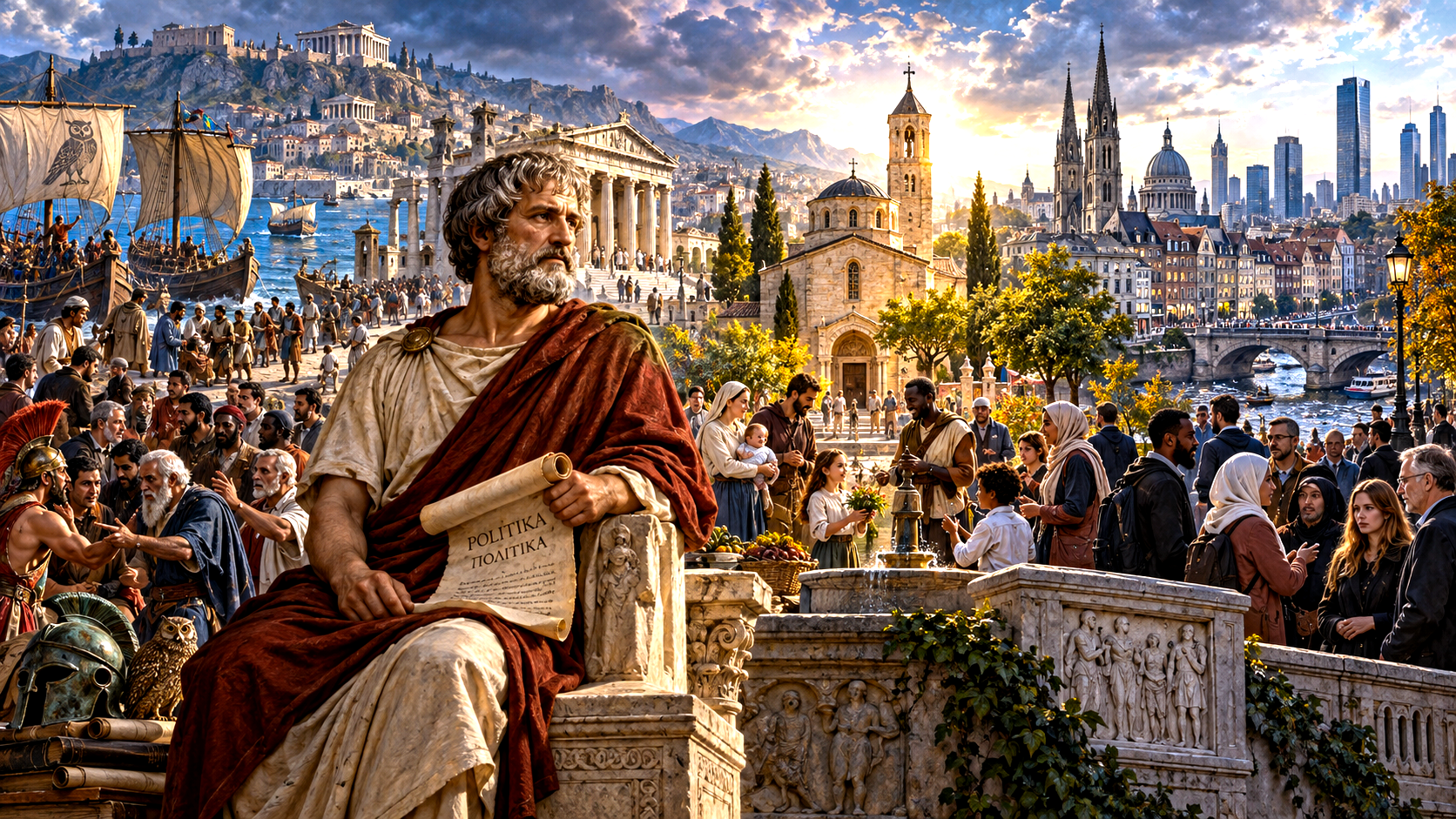
A city is not made from any crowd whatever, nor in any span whatever. The verb Aristotle chooses for the completed process is luminous: sympneusē, “until they breathe together.” Integration is not the signing of a register; it is the slow synchronising of a common breath.[5]
Aristotle:
The verb Aristotle chooses for the completed process is luminous: sympneusē, “until they breathe together.” Integration is not the signing of a register; it is the slow synchronising of a common breath.
Honesty requires two qualifications before we lean on the passage.
First, Aristotle’s word is homophylon, “of one stock” or “of one tribe”: he is thinking in categories of kinship, and the modern argument from culture cannot simply be read back into him.
Second, and more interesting, the examples he goes on to give — Achaeans and Troezenians at Sybaris, the settlers of Thurii, Byzantium, Antissa, Zancle — are mostly cases of Greeks settling among Greeks: peoples who shared a language, a pantheon and a political vocabulary, and who nonetheless fell into faction when thrown together in haste.
Aristotle’s evidence therefore argues more directly for the importance of time and numbers than for the importance of affinity. Yet the two arguments are not independent. If even kindred peoples required time to breathe together, and fell into strife when denied it, then peoples further apart will require even more time, and will be more endangered by its absence.
Aristotle does not establish the affinity thesis; he establishes the floor beneath it. A fuller treatment of the cities he names, and their modern counterparts, must await another occasion.
Graded Hospitality:
Aquinas on the Law of Admission
The affinity argument proper is found in Aquinas, in his commentary on the judicial precepts of the Old Law. Deuteronomy provides that the Edomite and the Egyptian may enter the assembly of the Lord in the third generation, while the Ammonite and the Moabite may never enter it.[6] Asked whether the Law ordered relations with foreigners fittingly, Aquinas answers that it did, and explains the delay in terms that are as political as they are theological. If strangers were admitted at once to the management of the people’s affairs, he says, many dangers could follow, since strangers,
nondum habentes amorem firmatum ad bonum publicum
not yet having a love made firm towards the common good
— Thomas Aquinas, Summa theologiae I-II, q. 105, a. 3
might attempt something against it. The Law therefore graded admission, and it graded it by affinity: those nations were received in the third generation which had some kinship with Israel,
habentibus aliquam affinitatem ad Iudaeos
having some affinity with the Jews
— Thomas Aquinas, Summa theologiae I-II, q. 105, a. 3
the Egyptians, among whom they had been born and nourished, and the Edomites, sons of Esau, Jacob’s brother.[7] I have discussed these graduated provisions elsewhere, in connection with the Church’s teaching on the stranger and the civil sword.[8] Here the point to notice is the structure of the reasoning. The good to be secured is a love of the common good that has been made firm, amor firmatus. Such love takes time to form. And the time it takes varies with the distance the newcomer must travel to reach it: shorter where there is affinity, longer where there is none.

St. Thomas Aquinas:
The good to be secured is a love of the common good that has been made firm, amor firmatus. Such love takes time to form. And the time it takes varies with the distance the newcomer must travel to reach it: shorter where there is affinity, longer where there is none.
Here too honesty requires a caveat. The permanent exclusion of Ammon and Moab rests, in Aquinas’s reading, not on cultural distance but on remembered hostility — they had met Israel with enmity on the road from Egypt. And the provisions are positive law for a particular polity under a particular covenant; they do not bind Christian nations as such. But Aquinas is clear that the judicial precepts embody reasons, and the reason here — that love of the common good must be made firm before full participation, and that affinity shortens the road — is a reason of natural prudence, not of Israel’s peculiar vocation. It is precisely the reason Aristotle had glimpsed, now joined to the measure that Aristotle lacked.
The Evidence of Kindred Arrivals
If the thesis is sound, we should expect the historical record to show that kindred arrivals fuse quickly even when they are numerous, sudden and unwelcome, and that the friction they meet is economic and political rather than civilisational. That is, broadly, what we find.
The Huguenots who fled Louis XIV’s France for England in the later seventeenth century — perhaps fifty thousand of them, concentrated in London — met suspicion and occasional riot. Within three generations they had vanished into the English population, leaving behind little but surnames, silk-weaving lofts in Spitalfields, and a long roll of distinguished descendants.[9] They were foreign in language and manners; they were not foreign in faith, law or household. The Polish servicemen and their families who remained in Britain after the Second World War under the Polish Resettlement Act of 1947 — well over a hundred thousand people — kept their parishes and their Saturday schools, yet their grandchildren are indistinguishable from their neighbours in everything but a fondness for Christmas Eve.
The most striking cases are the great repatriations of the late colonial period, because they combine every factor that ought to have made integration difficult: enormous numbers, extreme suddenness, economic crisis, and public resentment. Some eight hundred thousand pieds-noirs crossed from Algeria to metropolitan France in 1962, most of them within a few months, into a country that received them with a coldness they did not forget.[10]
Thirteen years later, more than half a million settlers arrived in Portugal from Angola and Mozambique in the course of 1975 alone, into a country of roughly nine million in the immediate aftermath of revolution.[11] In proportion to the receiving population, no Western European country has absorbed a larger single influx in modern times.
It would be dishonest to present either episode as idyllic. Delaunay shows that the official Portuguese memory of a smooth and exemplary integration coexists with a returnee memory of abandonment by the authorities, and both must be weighed against the archives. The pieds-noirs nursed a long grievance against the metropole. But the grievances were about housing, compensation, employment and political betrayal — about how the newcomers were treated — not about who they were. Within a generation the children of both migrations were in the schools, the workforce, the parishes and the professions, marrying and being married without remark. The friction was real and the fusion was swift, because the newcomers and the host nations loved the same things and needed no time to learn to.
There is a counter-case within the family of close cultures, and it is instructive. Irish Catholics in Britain shared the language, the common law and the broad Christian inheritance of their hosts, yet for the better part of a century they met hostility, segregation in housing and employment, and periodic violence. What kept them apart was not language or law but confession: Protestant England’s suspicion of Rome. The friction was located exactly at the point of remaining distance, on the axis of what was held sacred; and as confessional hostility faded in the twentieth century, so did the separation. The Irish case therefore refines the thesis rather than refuting it. It shows that the axis of distance that matters most is the religious one, and that even a narrow distance on that axis can delay fusion by generations.
Distance on What Matters
The thesis must now face its strongest test, and pass it in qualified form or not at all. Cultural distance is not destiny. Britain contains communities whose ancestral cultures stand very far from the English inheritance — Hindu and Sikh communities from the Punjab and Gujarat, Chinese and other East Asian communities, the nearly thirty thousand Ugandan Asians expelled by Idi Amin in 1972 — and several of these show educational and economic outcomes equal to or better than the national average. Any honest version of the argument must account for them.
The account, I suggest, is that distance is not one thing. On some axes these communities stood far from their hosts: in religion, in diet, in the forms of family life. On others they stood close: many arrived already formed by British institutions, fluent in English, familiar with the common law and the habits of commerce, and — crucially — their religions made no claim to supply a rival civil law for the society they had joined. The Ismaili community among the Ugandan Asians was explicitly urged by its own spiritual leadership to loyalty and integration in its new homes. Where a faith is content to be a faith, its adherents can be wholly faithful and wholly citizens; the distance between their worship and their neighbours’ is real, but it does not run through the public square.
The distances that matter most for civic fusion are therefore not all distances but a specific few.
They concern:
whether religion carries a comprehensive law claiming public jurisdiction over believers;
the standing of women in law and in the household;
freedom of conscience, including the freedom to leave one’s religion without punishment;
whether the primary unit of loyalty is the citizen and the household or the citizen and the clan;
and the relation between honour and violence.
These are distances between systems of belief and custom, not judgements upon individuals:
many who come from cultures distant on these axes reject the features in question, and
plenty more emigrated precisely to escape them.
But where a community as a whole stands far from its hosts on these matters, the composition of wills on which civil peace depends is hardest to achieve, and multiculturalism made it harder still.
The social-scientific evidence, read with appropriate caution, points in the same direction. The economist Paul Collier has argued that the rate at which a diaspora is absorbed depends on two factors:
the cultural distance between migrants and hosts, and
the size of the diaspora already present — the larger the community, the more its members interact with one another rather than with the host society, and the slower the absorption.[12]
That is Aristotle’s multitude and Aquinas’s affinity restated as a model.
Ruud Koopmans, comparing integration outcomes across eight European countries, found that those which combined strong multicultural policies with generous welfare states — he names the Netherlands, Belgium and Sweden — showed weaker labour-market participation and higher residential segregation among immigrants than countries with more demanding integration regimes.[13]
Robert Putnam’s study of American communities found that, in the short run, greater ethnic diversity was associated with lower social trust, not only between groups but within them, a phenomenon he called “hunkering down.”[14]
Each of these findings carries qualifications that a careful writer must state. Koopmans’s classifications are disputed. Putnam measured ethnic diversity, not cultural distance, and insisted that the effect could be overcome in the longer run by building broader shared identities — which is, in fact, the integrationist position. Later meta-analysis finds the association between diversity and trust real but modest. The evidence is convergent rather than conclusive. But it converges on the importance of distance, of numbers, of time, and of policies that either close gaps or widen them.
How Multiculturalism Widened the Gap
If distance on the foundational loves makes fusion harder, the question becomes what the hosting society does about it.
Multiculturalism answered:
nothing, and less than nothing.
It treated distance not as a gap to be crossed but as a heritage to be preserved, and it built institutions that preserved it. There could hardly be a policy more disastrous!
The state learned to deal with immigrant communities through self-appointed community leaders, who acquired an interest in the continued distinctness of the communities they represented.
Funding, consultation and recognition flowed to identity rather than to citizenship.
Schools, housing estates and whole neighbourhoods were entitled to become monocultural, so that a child could grow up in Britain without meaningful contact with British life.
Cantle’s “parallel lives” were not an accident of settlement patterns alone; they were tolerated, and sometimes subsidised, by a policy that regarded them as the “flowering of diversity”.
Fifteen years after Cantle, Dame Louise Casey’s review for the government found high and growing concentrations of particular communities in particular places, regressive practices towards women in some of them, and public institutions that had failed to confront such practices — in part, she reported, for fear of being thought of as racist.[15]
It should be said, in fairness, that Casey also found white British communities left behind and disconnected; the failure of integration is not a failure on one side only. But the institutional pattern she described is exactly what the argument predicts: where distance on the foundational loves was greatest, the state was most reluctant to name it, and so least able to help close it.
The Mosaic Law, which graded admission by affinity, was equally clear that once the stranger was within the gates there was to be one law for all:
תּוֹרָה אַחַת יִהְיֶה לָאֶזְרָח וְלַגֵּר הַגָּר בְּתוֹכְכֶם
There shall be one law for the native-born and for the stranger who sojourns among you.
— Exodus 12:49
The same law commands, with equal force, love for the stranger: “you shall love him as yourself, for you were strangers in the land of Egypt.”[16] The two precepts stand together. Love without one law dissolves the people; one law without love hardens it into a fortress.
Multiculturalism kept the sentiment of the first precept and quietly abandoned the second — not by legislating separate laws outright, but by tolerating separate jurisdictions in practice, separate norms in family life, and separate moral worlds in which the law of the land became a distant rumour.
Ruth-the Crossing of the Greatest Distance
It may be objected that all this proves too much: that if distance is so decisive, Scripture itself should counsel against receiving the distant at all. Scripture does the opposite, and in doing so it shows precisely how distance is overcome. The most famous convert in the Old Testament is a woman of Moab — the very nation that Deuteronomy excluded from the assembly forever.[17] Her words to Naomi are the charter of every true integration:
כִּי אֶל־אֲשֶׁר תֵּלְכִי אֵלֵךְ וּבַאֲשֶׁר תָּלִינִי אָלִין עַמֵּךְ עַמִּי וֵאלֹהַיִךְ אֱלֹהָי
For where you go I will go, and where you lodge I will lodge; your people shall be my people, and your God my God.
— Ruth 1:16
Ruth crosses the greatest distance the law of Israel recognised, and she crosses it entirely: she becomes the great-grandmother of David and is named in the genealogy of Christ.[18] The Book of Ruth is therefore the decisive refutation of any racial or fatalistic reading of the argument. No distance is uncrossable. But notice how it is crossed. Ruth does not ask Bethlehem to become Moab, nor to recognise Moab as an equally valid community within its gates. She transfers her loves: your people shall be my people, and your God my God. St. Augustine’s definition is vindicated in the life of a single woman. She becomes one of the people because she comes to love what the people loves.
The New Testament extends the pattern to the whole world. The Church fused Jew and Gentile — the two most mutually distant peoples of the ancient Mediterranean, divided by law, diet, worship and centuries of contempt — into a single body within a generation. Saint Paul tells the Gentile converts of Ephesus what they have become:
ἄρα οὖν οὐκέτι ἐστὲ ξένοι καὶ πάροικοι ἀλλ’ ἐστὲ συμπολῖται τῶν ἁγίων καὶ οἰκεῖοι τοῦ θεοῦ
So then you are no longer strangers and sojourners, but you are fellow citizens with the saints and members of the household of God.
— Ephesians 2:19 (NA28)
The Church is the historical proof that cultural distance is not destiny, and at the same time the proof that it is overcome only by common love — in her case, by a common worship of the one God in Christ. Sympolitai, fellow citizens: the word belongs to the vocabulary of the polis, and Paul deliberately applies it to a people made from the most dissimilar materials imaginable. The fusion was not achieved by preserving the distance as a heritage; the dividing wall of hostility was broken down (Eph. 2:14). Multiculturalism wanted the fusion without the crossing — the sympoliteia without the common worship, the common law, or even the common story. It is no wonder that it did not come.
The Church’s teaching on migration holds both duties together. The Catechism teaches that:
“the more prosperous nations are obliged, to the extent they are able, to welcome the foreigner in search of security and a livelihood he cannot find at home”; and, in the same paragraph, that
“immigrants are obliged to respect with gratitude the material and spiritual heritage of the country that receives them, to obey its laws and to share its civic burdens”.[19]
Welcome and gratitude, hospitality and the inheritance, are not rival principles but a single covenant with two parties. Multiculturalism kept the first clause and treated the second as an embarrassment.
The Host That Has Ceased to Love
It is commonly said, and truly, that multiculturalism failed because newcomers were never taught to cherish the culture of the country that received them. But that observation conceals a harder one. A people cannot teach a love it no longer has. The Western societies that adopted multiculturalism were, at the same moment, abandoning confidence in their own inheritance — in its faith first of all, and then in the moral and civic culture that grew from that faith. Joseph Ratzinger, later Pope Benedict XVI, diagnosed in Europe “a strange and almost pathological hatred of itself, a readiness to honour every culture but its own”;[20]
Roger Scruton named the same disposition oikophobia, the repudiation of one’s own home.[21] Multiculturalism was not only a policy towards newcomers. It was the self-portrait of a civilisation that had lost the thread of its own story.
Return to Ruth. Naomi came home to Bethlehem embittered — “call me not Naomi, call me Mara,” bitter (Ruth 1:20) — yet she came home, to her people and to the Lord, and it was something real that Ruth chose to follow. A host society that offers newcomers only procedures, rights and a labour market is a Naomi with no Bethlehem to return to. The newcomer from a distant culture, finding nothing in his new home that asks to be loved, keeps the loves he brought with him. The failure of multiculturalism is therefore a shared failure. It belongs to newcomers who did not cross the distance, as well as to hosts who no longer believed there was anything on their own side of it worth crossing towards.
Objections Honestly Met
First, that the argument is racial or essentialist in disguise.
It is not, and the distinction is not cosmetic. The argument concerns loves, beliefs and customs — things that are held, taught and changeable — and not ancestry, which is none of these. Ruth is the proof. A person of any origin may cross any distance, and countless individuals have; the argument concerns the aggregate conditions under which such crossings are easy or hard, frequent or rare. Those who conflate a critique of cultural and religious systems with hostility to persons do a disservice to both.
Second, that distant cultures have integrated successfully.
Some have, as the previous sections conceded. The thesis has been refined in response: what matters is distance on the specific foundational loves that bear on civic life — law, the household, conscience, the unit of loyalty, etc… — together with the numbers and the pace of arrival. A thesis that survives its counter-examples only by refinement is weaker than one that needs none; but it is stronger than one that ignores them.
Third, that the host society’s hostility, not cultural distance, is the real cause of failure.
There is substantial truth here, and the Windrush Generation shows it most painfully. The Caribbean migrants who arrived from 1948 onwards were overwhelmingly Christian, English-speaking and formed by British institutions — culturally close by almost every measure this essay has proposed — yet they met a “colour” bar in lodging, employment and even in some churches.[22] Their integration was delayed not by distance but by prejudice. The concession must be made plainly: closeness of culture is a necessary condition of swift fusion, not a sufficient one. The host’s justice is the other condition, and where it fails, even kindred newcomers are kept apart. The thesis claims that distance makes integration harder; it does not claim that closeness guarantees it.

A child born in Bradford or Huddersfield whose parents were originally from a distant heritage inherits his parents’ distance unless something closes it — school, parish, neighbourhood, shared civic life, etc… — but multiculturalism dismantled or neglected precisely those instruments. The persistence of distance across generations is the clearest evidence that the policy failed to do what integration requires.
Fourth, that the gravest failures are found not among migrants but among their native-born children and grandchildren.
This is true, and it confirms rather than weakens the argument from formation with which this essay began. Distance does not close by itself. A child born in Bradford or Huddersfield whose parents were originally from a distant heritage inherits his parents’ distance unless something closes it — school, parish, neighbourhood, shared civic life, etc… — but multiculturalism dismantled or neglected precisely those instruments. The persistence of distance across generations is the clearest evidence that the policy failed to do what integration requires.
Fifth, that the empirical evidence is weaker than the argument implies.
It is weaker than polemicists on either side tend to admit. The relation between diversity and trust is modest in magnitude; cross-national comparisons are hostage to classification; causation is difficult to establish. The case made here rests on the convergence of ancient observation, historical experience and contemporary research, not on any single study. Convergent evidence warrants a firm judgement about tendency. It does not warrant certainty, and this essay claims none.
Towards Breathing Together
What follows from all this is not hostility to the stranger, whom the Law commands Israel to love as itself and whom Christ identifies with himself (Matt. 25:35). What follows is a set of principles for receiving him well:
First, the number and pace of arrival must be proportioned to the distance to be crossed: this is the joint counsel of Aristotle’s multitude and time and Aquinas’s graded admission by affinity, and it is a counsel of prudence, not of exclusion.
Second, there must be one law for the native and the stranger, without parallel jurisdictions, without tolerated exceptions in the household, and without the quiet abandonment of women and children to norms the law of the land forbids.
Third, newcomers and natives alike must be taught the inheritance — its story, its faith, its law, its literature — not as one option among many but as the common home into which all are invited. Fourth, and most fundamentally, the host must recover its own loves, because no people can integrate others into a love it does not itself possess. For a Christian, that recovery runs through the Church, which is both the source of Europe’s common loves and the one institution in history that has repeatedly made a single people out of the most distant materials.
Aristotle’s verb deserves the last word, read now with Christian eyes. A multitude becomes a city, he said, when its peoples breathe together — sympneusōsi. The Church knows of a common breath. At Pentecost, men “from every nation under heaven” heard one proclamation, each in his own tongue (Acts 2:5–6), and the many became one by receiving the one Spirit, the Pneuma, who is the love of the Father and the Son.
That is the pattern of every true integration: not the erasure of the stranger, and not the preservation of his distance as a monument, but his coming to love, with us, what is worth loving — your people my people, your God my God. Where that happens, distance of origin ceases to matter. Where a society forbids itself even to name what it loves, no policy can make it happen; and the honest name for that condition is not diversity but vacancy.🟥
[1]On Angela Merkel’s remarks to the youth wing of the CDU at Potsdam, see “Merkel Says German Multicultural Society Has Failed,” BBC News, 17 October 2010. David Cameron, “PM’s Speech at Munich Security Conference,” 5 February 2011, published at gov.uk, attacked what he called “state multiculturalism.” Nicolas Sarkozy made a similar declaration in a televised interview, Paroles de Français, TF1, 10 February 2011.
[2]Ted Cantle, Community Cohesion: A Report of the Independent Review Team (London: Home Office, 2001).
[3]St. Augustine of Hippo, De civitate Dei XIX.21, ed. Bernhard Dombart and Alfons Kalb, CCSL 48 (Turnhout: Brepols, 1955).
[4]St. Augustine of Hippo, De civitate Dei XIX.17, CCSL 48.
[5]Aristotle, Politica V.3, 1303a25–28, ed. W. D. Ross, Oxford Classical Texts (Oxford: Clarendon Press, 1957). Translations in this essay are my own unless otherwise noted.
[6]Deuteronomy 23:4–9 (English versions 23:3–8), in Biblia Hebraica Stuttgartensia, ed. Karl Elliger and Wilhelm Rudolph, 5th ed. (Stuttgart: Deutsche Bibelgesellschaft, 1997).
[7]Thomas Aquinas, Summa theologiae I-II, q. 105, a. 3, in Opera omnia iussu Leonis XIII P.M. edita, vol. 7 (Rome: Typographia Polyglotta, 1892). In the same article Aquinas draws on Aristotle’s treatment of citizenship in Politics III.
[8]G. V. W. Lewis, “The Sword and the Stranger,” Mind the Limoges (crshj.org).
[9]Robin D. Gwynn, Huguenot Heritage: The History and Contribution of the Huguenots in Britain, 2nd rev. ed. (Brighton: Sussex Academic Press, 2001).
[10]Todd Shepard, The Invention of Decolonization: The Algerian War and the Remaking of France (Ithaca, NY: Cornell University Press, 2006).
[11]Morgane Delaunay, “Portugal and the Return of Its Settlers from Angola and Mozambique: Governmental Response and Memory,” CIDADES, Comunidades e Territórios 44 (2022).
[12]Paul Collier, Exodus: How Migration Is Changing Our World (Oxford: Oxford University Press, 2013).
[13]Ruud Koopmans, “Trade-Offs between Equality and Difference: Immigrant Integration, Multiculturalism and the Welfare State in Cross-National Perspective,” Journal of Ethnic and Migration Studies 36, no. 1 (2010): 1–26. His measures and country classifications have been contested in the subsequent literature.
[14]Robert D. Putnam, “E Pluribus Unum: Diversity and Community in the Twenty-first Century,” Scandinavian Political Studies 30, no. 2 (2007): 137–74. For a meta-analytical review finding a negative but modest association, see Peter Thisted Dinesen, Merlin Schaeffer and Kim Mannemar Sønderskov, “Ethnic Diversity and Social Trust: A Narrative and Meta-Analytical Review,” Annual Review of Political Science 23 (2020): 441–65.
[15]Louise Casey, The Casey Review: A Review into Opportunity and Integration (London: Department for Communities and Local Government, December 2016).
[16]Exodus 12:49; Leviticus 19:34; cf. Leviticus 24:22, in Biblia Hebraica Stuttgartensia.
[17]Deuteronomy 23:4. Rabbinic tradition resolved the tension by reading the prohibition as applying to Moabite men and not to Moabite women: Mishnah Yevamot 8:3.
[18]Ruth 4:17; Matthew 1:5, in Novum Testamentum Graece, ed. Barbara Aland et al., 28th rev. ed. (Stuttgart: Deutsche Bibelgesellschaft, 2012).
[19]Catechism of the Catholic Church, 2nd ed. (Vatican City: Libreria Editrice Vaticana, 1997), no. 2241.
[20]Joseph Ratzinger and Marcello Pera, Without Roots: The West, Relativism, Christianity, Islam, trans. Michael F. Moore (New York: Basic Books, 2006).
[21]Roger Scruton, England and the Need for Nations (London: Civitas, 2004).
[22]Peter Fryer, Staying Power: The History of Black People in Britain (London: Pluto Press, 1984).