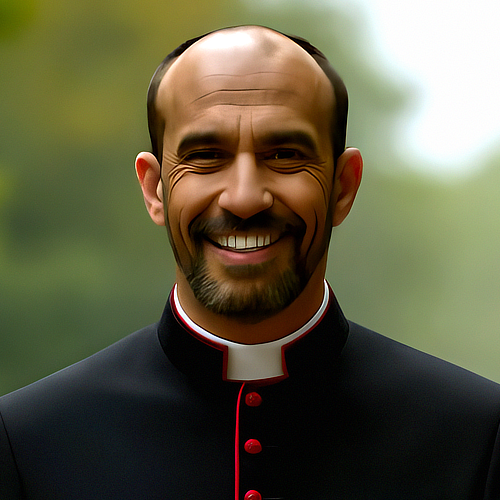

NOT AGAINST FLESH AND BLOOD
A Pastoral Address to Christian Writers on the
Charge of Racism and the Critique of Islam/Sharīʿa
Foreword

A Christian writer publishes a study of sharīʿa. He has done what such a study ought to do. He has read the Qurʾān, the canonical ḥadīth collections and the standard manuals of the classical schools. He has distinguished sharīʿa from fiqh, the law of worship from the law of persons and property, the classical doctrine from the modern reformist reading. He has said plainly where the evidence is thinner than polemicists like to pretend, where Muslim scholars have argued for change, and where the history of his own Church is no cleaner than he would wish. And he has concluded that sharīʿa, as a body of public law governing marriage, divorce, inheritance, evidence, crime and civil status, cannot be reconciled with the equality of persons before the law. He has argued that conclusion, moreover, on behalf of those who would lose most if sharīʿa were given legal force: Muslim women, Muslim doubters, and Muslims who have become Christians. He expects disagreement. What he receives, in a good many of the replies, is not disagreement but a verdict:
“He is a racist”

Islam is not a race. Muslims belong to countless ethnicities across every continent. Sharia is a legal tradition, not an ethnic identity. Yet some ideological actors insist on racialising Islam for three reasons:
To create moral immunity: If Islam is treated as an ethnicity, critique becomes taboo. This shields sharia and Islamism from examination.
To collapse identity and ideology: The claim that critique of sharia is an attack on Muslims allows ideological actors to avoid defending the legal system itself. It also pressures ordinary Muslims to identify with a jurisprudential tradition they may not personally endorse.
To weaponise Western guilt: Accusations of racism carry enormous emotional and social weight. They can silence writers, derail conversations, and intimidate institutions. Ideological actors understand this and use it strategically. This racialisation is not a theological argument. It is a rhetorical manoeuvre designed to prevent honest discussion.
The experience is now common enough to deserve pastoral attention. It is disorienting, because the charge names a sin the writer has not committed and a category his argument never touched:
Islam is not a race,
Sharīʿa is not an ethnicity, and
A manual of jurisprudence has no colour.
It is hurtful and deeply offensive, because the accusation is among the gravest a public writer can now bear, and because it attaches to the person rather than to any proposition he has advanced. And it is tempting, in two opposite directions:
It tempts towards silence, which leaves the field to those who would prefer the question were never asked;
It tempts, equally, towards bitterness, which hardens the writer’s heart against the very people on whose behalf he first took up his pen.
This letter is addressed to Christian writers who find themselves in that position, or who expect to. Its argument can be stated briefly. The charge of racism, laid against a careful critique of a legal and/or religious system, is in most cases a category error, and the Christian writer need not and should not allow it to silence him. But the charge is frequently made in bad faith; it is not always made by the same kind of person; and it is never safe for a Christian simply to dismiss it. Where it is an argument, it is to be answered with argument. Where it is an insult, it is to be borne with patience. And in every case it is to be received as an occasion for the examination of conscience, because the one defence that cannot fail is a text, and a heart, that give the accusation nothing to hold. The governing text is the Apostle’s:
ὅτι οὐκ ἔστιν ἡμῖν ἡ πάλη πρὸς αἷμα καὶ σάρκα ἀλλὰ πρὸς τὰς ἀρχάς, πρὸς τὰς ἐξουσίας, πρὸς τοὺς κοσμοκράτορας τοῦ σκότους τούτου, πρὸς τὰ πνευματικὰ τῆς πονηρίας ἐν τοῖς ἐπουρανίοις.
For our struggle is not against blood and flesh, but against the principalities, against the powers, against the world-rulers of this darkness, against the spiritual forces of wickedness in the heavenly places.
— Ephesians 6:12 (NA28)[1]
The struggle in which the Christian writer is engaged is a struggle against error, against powers, against ideas and institutions that bind and diminish human beings. It is never a struggle against flesh and blood. A writer who keeps that distinction in his prose and in his prayers has already given the only reply to the charge that finally matters. What follows is an attempt to show how the distinction may be kept, why it is not a modern evasion but an ancient Christian discipline, and what it requires of the writer himself.
I
The Shape of the Accusation
It is worth setting out the structure of the accusation, because its force depends on its being left unexamined. It proceeds in three movements:
First, a critique of a legal system and/or a religion is restated as an attack on the people who belong, or are presumed to belong, to the religious community associated with it.
Secondly, that community is treated as though it were an ethnic or racial group.
Thirdly, the critique is accordingly classified as racism, and the writer, once classified, need not be answered.
Each movement contains a slip, and together they convert a question of jurisprudence into a question of character. A question of character is far easier to settle than a question of jurisprudence, and that is a large part of its appeal.
The first slip confuses a system with its adherents. A study which concludes that the classical rules of inheritance, under which a son takes twice the share of a daughter and difference of religion bars succession altogether, are incompatible with equality before the law has said something about a set of rules. It has said nothing about the Muslim family in the next street, which may never have consulted those rules, may reject them, or may have come to Britain precisely in order to escape a state that enforces them. To criticise the Code of Canon Law is not to despise Catholics. To criticise the rabbinic rules that leave a woman chained to a husband who withholds the get is not to despise Jews, and it is Jewish women’s advocates who have done so most persistently. Nor is every critic of sharīʿa a non-Muslim. Some of its most searching critics are Muslims, among them the Sudanese jurist Abdullahi An-Naʿim, who has argued that sharīʿa can be observed as sharīʿa only when it is freely chosen, and never when it is enforced by the coercive power of the State.[2] If criticism of sharīʿa were racism, An-Naʿim would be a racist, which is absurd.
The second slip confuses religion with race. Islam is a faith professed by something like a quarter of the human race, on every continent and in every family of nations: Arabs and Persians, Turks and Kurds, Malays and Indonesians, Hausa and Somali, Bosnians and Albanians, Pakistanis and Bangladeshis, and converts in every country of Europe. English law has long recognised the difference. The Equality Act 2010 lists race and religion or belief as distinct protected characteristics, and the courts, applying the test of an ethnic group laid down by the House of Lords in Mandla v Dowell Lee, have held that Muslims as such are not a racial group, precisely because adherence to Islam crosses every line of descent.[3] Parliament, moreover, when it created offences of stirring up religious hatred in 2006, wrote into the statute an express protection for exactly the kind of work the Christian writer undertakes:
Nothing in this Part shall be read or given effect in a way which prohibits or restricts discussion, criticism or expressions of antipathy, dislike, ridicule, insult or abuse of particular religions or the beliefs or practices of their adherents, or of any other belief system or the beliefs or practices of its adherents, or proselytising or urging adherents of a different religion or belief system to cease practising their religion or belief system.
— Public Order Act 1986, s. 29J[4]
The Christian writer will not need the whole of that liberty. Ridicule and abuse have no place in his work. But the provision establishes, as a matter of law, that criticism of a religion and the practices of its adherents is different from hatred of persons.
More recently still, the present Government has drawn the same line. In March 2026, after a year’s work by an independent working group under the chairmanship of Dominic Grieve, it adopted a non-statutory working definition of “anti-Muslim hostility”. The exercise was criticised from more than one direction: by some Muslim organisations as too narrow, and by defenders of free speech as an invitation to the very confusion this letter describes. Whatever its merits, the definition and its accompanying text drew the distinction at issue with some care. It is directed, the Government explained, at Muslims as individuals and not at Islam as a religion; and lawful criticism, debate and even ridicule of religion, Islam included, remain safeguarded, as does the raising of concerns in the public interest.[5] The Christian writer who distinguishes a legal system from its adherents is therefore not inventing a convenient evasion. On this point he stands with the statute book, with the courts, and with the stated policy of the Government itself.
The third slip is the one with practical force. Once the critique has been classified as racism, it no longer requires an answer. Its arguments are not refuted; they are disqualified. A simple test will often reveal what has happened. How many of the replies identify a statement of fact that is false? A study that misreported the rulings of the Shāfiʿī manual could be corrected by citing the manual; one that misread a Qurʾānic verse could be corrected by citing the verse. When the reply is a verdict on the writer’s character and not the identification of an error, it is reasonable, though not certain, to infer that no error has been found. The writer should hold that inference lightly. It is, nonetheless, an inference he is entitled to draw.
II
Three Sources of a Single Charge
It is at this point that Christian writers are most tempted to an error of their own. Having seen the logical weakness of the accusation, they conclude that it must be made in bad faith, and that those who make it are, without exception, ideological operators who know perfectly well that Islam is not a race and deploy the charge as a tactic. A great many are indeed. But not all. Honesty requires the writer to distinguish at least three sources from which the same words may come, because each calls for a different reply, and because to attribute strategy where there is only pain is itself a failure of the charity the writer professes.
The strategic charge
There are activists and organisations for whom the extension of protected categories to cover doctrine and religious law is a deliberate project. The aim is to make it socially impossible to criticise sharīʿa, Islamism or particular Islamic institutions, by assimilating every such criticism to racial hatred. The controversy over the definition proposed in 2018 by the All-Party Parliamentary Group on British Muslims, which described Islamophobia as rooted in racism and as a type of racism targeting expressions of “Muslimness”, showed both the attraction of the move and its danger. Critics observed that almost any criticism of a religious practice can be described as criticism of an expression of religious identity, so that a definition framed in those terms could be used to chill legitimate argument. Successive governments declined to adopt it.[6] Against the strategic charge the writer owes argument and a steady refusal to be moved. He does not owe the strategist the concession of his premise.
The wounded charge
Many who reach for the word are not strategists at all. They are ordinary Muslims for whom faith, family, language, food and ancestry are woven into a single garment, so that criticism of the law their grandparents revered is felt as an assault on the grandparents. They have, moreover, often experienced hostility of a kind that does not trouble to distinguish religion from race. The man who abuses a woman in a headscarf on a bus has not been reading the Shāfiʿī law of inheritance. Those who attacked Sikhs in the months after September 2001 took them for Muslims because of their beards and turbans. The Government’s own definition recognises that hostility directed at Muslims is often aimed at those perceived to be Muslim, on the basis of assumptions about ethnicity, race or appearance.[7] In practice, then, Muslims are sometimes racialised, and not only by their own spokesmen. They are racialised by their enemies.
A Muslim who has learned from experience that hostility to Islam and hostility to brown skin often travel together is not being dishonest when he hears the one and fears the other. He is mistaken about this particular text, for reasons that are entirely understandable. To him the writer owes patience and clarity, and something more than either: evidence, in the text and in the writer’s conduct, that this time the critique really does concern the law or the religion, and not the person.
The conceptual charge
Finally, there are scholars who argue, seriously and in good faith, that religion and race cannot be cleanly separated in the modern West: that “Muslim” has become a racialised category through a history of empire, migration and security policy, and that criticism of Islam operates within that history whatever its author intends. This is a theory, and it can be answered as a theory. The Christian writer may reply that it proves too much. If every criticism of a religion professed largely by people of colour is racial in its effect, then no such religion may be criticised at all, and its women, its doubters and its converts lose the protection that public argument alone can give them. The theory, pressed to its conclusion, would shelter precisely the rules that bear most heavily on the most vulnerable Muslims. But the writer should make that reply, and not sneer at the question.
How is the writer to know which kind of accuser he faces? Often he cannot. Motives are hidden, and here a word of St Paul is directly to the point:
ὥστε μὴ πρὸ καιροῦ τι κρίνετε ἕως ἂν ἔλθῃ ὁ κύριος, ὃς καὶ φωτίσει τὰ κρυπτὰ τοῦ σκότους καὶ φανερώσει τὰς βουλὰς τῶν καρδιῶν.
Therefore do not pass judgement on anything before the time, until the Lord comes, who will both bring to light the things hidden in darkness and make manifest the purposes of hearts.
— 1 Corinthians 4:5 (NA28)
The practical consequence is a discipline: answer the claim, not the presumed motive. The writer who replies to every accuser as though he were the strategist will wound the hurt, insult the scholar, and confirm the strategist’s own story, which is that critics of sharīʿa despise Muslims. The writer who answers the claim itself, by showing that his text concerns a body of law, by pointing to the passages in which Muslim persons are defended, and by inviting the correction of any error of fact, leaves the strategist without material, gives the wounded reason to reconsider, and gives the scholar an argument worth answering.
III
What the Misapplied Charge Costs
Even granting all this, the misapplied accusation does real damage, and the Christian writer may say so without self-pity. Its costs fall in four places:
It costs the writer. Reputations, livelihoods and institutional standing are at stake, and the rational response to such stakes is self-censorship. Quietly, he stops writing on the subject. Editors decline his work; institutions keep their distance. The field then passes to the reckless, who care nothing for the accusation because they court it. This is the most perverse consequence of all. A tactic that silences careful critics leaves the public conversation to careless ones, and the careless critic, who really does speak of Muslims as a mass and a menace, is the genuine enemy of Muslims.
It costs the Muslims whom the critique would protect: the woman whose husband withholds a religious divorce; the young woman pressed into a marriage she did not choose; the widow whose inheritance is halved; the doubter who dares not say what he thinks; the convert who has received baptism at the price of his family. When a critique of the rules that bind them is classified as racism, the classification protects the rules, not the persons. It is worth remembering that when the province of Ontario considered permitting family arbitration under sharīʿa in 2004 and 2005, much of the opposition that defeated the proposal was led by Muslim women’s organisations, who saw with perfect clarity what was at stake.[8] If they were racists, the word has lost all meaning.
It costs the word itself, and therefore the real victims of racism. Racism is a real sin with a real definition, and it has real victims, many of them Muslims. Each time the word is applied to a study of Islam as a faith, a political ideology or a juridical order, its edge is blunted. Those who most need it to keep its edge are those who suffer genuine racial contempt; and they are poorly served by its use as an all-purpose instrument for ending arguments.
It costs, finally, the common good. A free society settles its disputes by argument. Whether religious tribunals should have any effect in family law, whether arbitration under section 46 of the Arbitration Act 1996 should be open to religious codes, whether every religious ceremony of marriage should be required to be a civil marriage as well: these are real questions with real stakes, on which Parliament must legislate and on which the Government consulted as recently as this summer.[9] If one side of such a question can be disqualified by an epithet, the question is decided not by reason but by intimidation, and decisions so reached are neither stable nor just.
IV
The Ancient Distinction
Against all this, the Christian writer has resources far older than the controversy. The distinction between the person and the error is not a device invented to escape an accusation. It lies at the heart of the Gospel, which proclaims the love of God for sinners and the judgement of God upon sin, and which never confuses the two. St Augustine gave it a formula that has passed into the common speech of Christians:
cum dilectione hominum et odio vitiorum.
with love for persons and hatred of vices.
— Augustine, Epistula 211.11 (CSEL 57)[10]
Honesty requires a note on context. Augustine wrote those words to a community of religious women, and he was speaking of fraternal correction within the community, not of controversy with another religion. Their application here is by extension. But the principle extends without strain: the vice that is opposed is not the person, and the correction of the one is an act of love towards the other. It must be added that the formula has also been abused, worn as a password by those whose contempt for persons is barely concealed. The mnemonic “Hate the Sin, Love the Sinner” thrown at the LGBTQ Communities illustrates just that perfectly. The distinction is not a phrase to be recited. It is a discipline to be practised, and its practice is visible, or invisible, in every sentence a writer publishes.
The Apostle unites what controversy tends to divide:
ἀληθεύοντες δὲ ἐν ἀγάπῃ αὐξήσωμεν εἰς αὐτὸν τὰ πάντα, ὅς ἐστιν ἡ κεφαλή, Χριστός.
But, speaking the truth in love, let us grow up in every respect into him who is the head, Christ.
— Ephesians 4:15 (NA28)
The participle ἀληθεύοντες is wider than “telling the truth”: it means something closer to living and doing the truth, and the Apostle does not allow it to stand apart from love. Truth without love ceases to build up the body; love without truth ceases to be love at all, and becomes a kind of flattery that leaves the beloved in his error. The Christian writer is bound to both, at once, in the same sentence.
St Peter, writing to Christians already suffering slander, anticipated almost exactly the situation of the writer accused of hatred he does not bear:
κύριον δὲ τὸν Χριστὸν ἁγιάσατε ἐν ταῖς καρδίαις ὑμῶν, ἕτοιμοι ἀεὶ πρὸς ἀπολογίαν παντὶ τῷ αἰτοῦντι ὑμᾶς λόγον περὶ τῆς ἐν ὑμῖν ἐλπίδος, ἀλλὰ μετὰ πραΰτητος καὶ φόβου, συνείδησιν ἔχοντες ἀγαθήν, ἵνα ἐν ᾧ καταλαλεῖσθε καταισχυνθῶσιν οἱ ἐπηρεάζοντες ὑμῶν τὴν ἀγαθὴν ἐν Χριστῷ ἀναστροφήν.
But sanctify Christ as Lord in your hearts, always ready to make a defence to anyone who asks you for a reason concerning the hope that is in you; yet do it with gentleness and reverence, keeping a good conscience, so that, in the very matter in which you are slandered, those who abuse your good conduct in Christ may be put to shame.
— 1 Peter 3:15–16 (NA28)
Three things in this passage deserve the writer’s attention. The first is the vocabulary of the law court. The Christian is to be ready with an ἀπολογία, a reasoned defence, and to give a λόγος, an account: he is to argue, not merely to assert. The second is the manner of the defence: μετὰ πραΰτητος καὶ φόβου, with gentleness and with reverence, a reverence directed towards God but shown in the treatment of the questioner. The third is the expected outcome. Peter does not promise that slander will cease. He promises that the slanderer will be put to shame, and he locates the instrument of that shame not in a counter-accusation but in the writer’s own good conduct. The reply to the charge of hatred is a life, and a body of writing, in which hatred cannot be found.
And the Lord Himself gave the double instruction that governs every Christian’s engagement with a hostile world:
Ἰδοὺ ἐγὼ ἀποστέλλω ὑμᾶς ὡς πρόβατα ἐν μέσῳ λύκων· γίνεσθε οὖν φρόνιμοι ὡς οἱ ὄφεις καὶ ἀκέραιοι ὡς αἱ περιστεραί.
Behold, I send you out as sheep in the midst of wolves; be therefore prudent as serpents and guileless as doves.
— Matthew 10:16 (NA28)
Φρόνιμοι: prudent, clear-sighted, unwilling to be deceived. The Christian writer is not obliged to pretend that the strategic charge does not exist, or that there are no movements seeking to shelter a legal and political programme behind the language of identity. Ἀκέραιοι: unmixed, unadulterated, without admixture of guile. Having seen the strategy, he does not answer it in kind. Prudence names the danger; innocence refuses to imitate it.
V
A Long Conversation
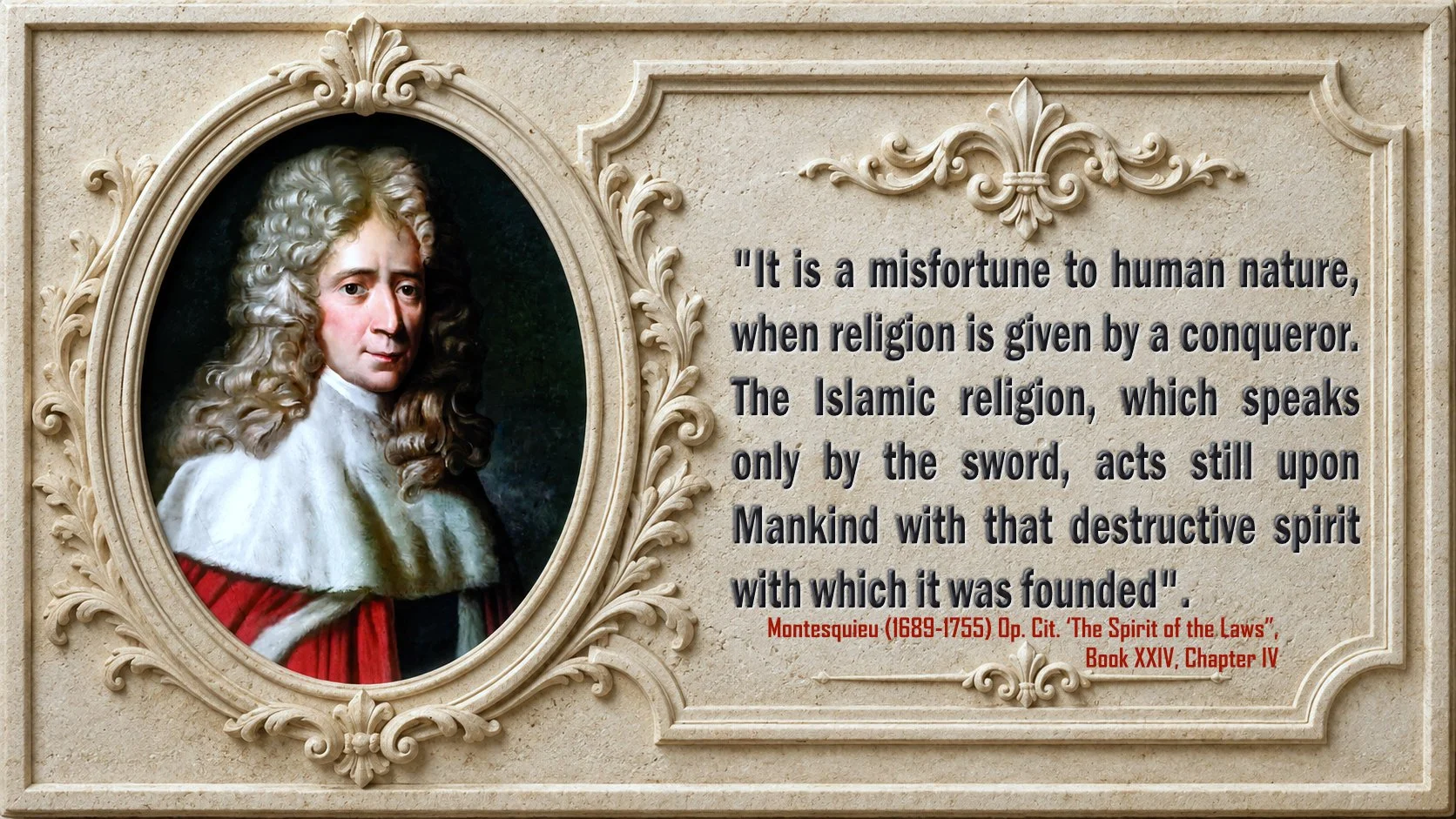
Charles Louis de Secondat, baron of La Brède et de Montesquieu (18 January 1689 – 10 February 1755), generally referred to as simply Montesquieu, was a French jurist, historian, and political philosopher. His most famous intervention regarding Islam is still deemed to be true, and teaches the lesson argued for in this Pastoral Address. The “thing”, not the person, is in question.
Christians have been arguing with Muslims since the seventh century. The record of that argument is neither a golden age of dialogue nor an unbroken history of war, and the writer who invokes it must do so honestly. Some of the most celebrated Christian authorities wrote about Islam with a severity that no modern editor would print; some of the most charitable conceded more than later Christians thought prudent. What the record yields is not a single model to be copied but a set of disciplines, learned slowly and often imperfectly, which remain instructive for the writer today.
Under the caliphs: the discipline of knowledge
One of the earliest substantial Christian treatments of Islam comes from within the caliphate itself. St John of Damascus, whose family had served in the fiscal administration of Umayyad Damascus, closed his catalogue of heresies with a chapter on the religion of the Ishmaelites (Muslims). It opens thus:

St. John of Damascus:
Ἔστι δὲ καὶ ἡ μέχρι τοῦ νῦν κρατοῦσα λαοπλανὴς θρησκεία τῶν Ἰσμαηλιτῶν, πρόδρομος οὖσα τοῦ Ἀντιχρίστου.
There is also the people-deceiving religion of the Ishmaelites, which prevails to this day, being a forerunner of the Antichrist.
— John of Damascus, De haeresibus 100
(Kotter IV; PG 94)[11]
The Damascene is no model of gentle speech, and it would be dishonest to present him as one. His language is that of a heresiologist, and his account of the origins of Islam draws on the Christian polemic of his day. What he models is something else. He knew the Qurʾān: he cites its suras by name, among them “the Woman”, “the Table” and “the Cow”, and he argues from its text. He wrote, moreover, not from a distance but from among those he argued against, in a city where Christian and Muslim lived and worked side by side. The first discipline the modern writer may learn from him is the most elementary and the most often neglected: know the sources. A critique of sharīʿa that cites the manuals can be answered from the manuals; a critique that cites only other critics invites, and deserves, the suspicion that it is repeating a prejudice rather than examining a law.
At the court of Baghdad: the discipline of courtesy
Around the year 781 the Catholicos Timothy I, patriarch of the Church of the East, spent two days in conversation with the Caliph al-Mahdī, and recorded the exchange in a letter that circulated widely. The caliph pressed him on the Trinity, the Incarnation, the corruption of Scripture and the prophethood of Muḥammad. Timothy conceded nothing on any point of doctrine. Yet the record is one of courtesy on both sides, and it contains two passages that have been remembered ever since:
In the first, Timothy compares the religions of the world to men groping in a dark house for a precious pearl that has fallen among them: each picks up something and believes he holds the pearl, and only the coming of daylight will show who was right.
In the second, asked what he thought of Muḥammad, he answered that the Prophet had “walked in the path of the prophets”, in so far as he taught the unity of God and turned the Arabs from idolatry; a generous judgement, carefully bounded, that stopped well short of confessing him a prophet.[12]
Some later Christians thought Timothy too generous; that judgement is open to debate. What is not open to debate is that he showed the second discipline: courtesy is compatible with conceding nothing. The Christian writer may be entirely firm in substance and entirely gracious in manner, and the combination is more persuasive than either alone.
In the language of the other: the discipline of intelligibility
In the same generation Theodore Abū Qurra, bishop of Ḥarrān, did something that seems obvious now and was then a considerable achievement: he wrote Christian theology in Arabic, the language of his Muslim interlocutors, and developed a vocabulary in which the doctrine of the Trinity could be argued with the theologians of Islam on terms they could recognise.[13] The third discipline is to write in terms the other can understand. A Christian critique of sharīʿa that a thoughtful Muslim reader could not follow, or could follow only as a list of insults, has failed before it begins, whatever its accuracy.
Cluny: the discipline of understanding before refuting
In 1142 Peter the Venerable, abbot of Cluny, travelled to Spain and there commissioned the first Latin translation of the Qurʾān, completed by Robert of Ketton in 1143, together with a collection of other Arabic texts. His reason, he explained, was that no Christian had answered Islam because no Christian had understood it. He then wrote a treatise addressed to Muslims themselves, in which the following words appear:
Aggredior, inquam, vos, non ut nostri saepe faciunt armis, sed verbis; non vi, sed ratione; non odio, sed amore.
I approach you, I say, not with arms, as our people often do, but with words; not by force, but by reason; not in hatred, but in love.
— Peter the Venerable, Contra sectam Saracenorum (ed. Glei)[14]

Peter the Venerable, Abbot of Cluny, with Robert Ketton, to whom he commissioned the translation of the Qur’an into Latin, in Spain, 1143. Artist’s impression, © CRSHJ, 2026.
Here, too, the whole picture must be given. The same Peter wrote a Summa of what he called the whole heresy of the Saracens in terms considerably harsher than these; he did not oppose the crusades of his age; and his writing against the Jews of his day is among the bitterest of the century. He is not a saint of interreligious courtesy, and he should not be made one. But the sentence stands, and so does the order of his work: he first secured the sources in translation, then studied them, then argued, and he addressed his argument to Muslims as persons capable of reason and worthy of love. The fourth discipline is to understand before refuting, and to address the person with love even while refuting the doctrine.
Two generations later, in 1219, St Francis of Assisi crossed the lines at Damietta during the Fifth Crusade and preached Christ before the Sultan al-Malik al-Kāmil. The sources agree that he spoke openly of the Christian faith and that the sultan received him with courtesy and let him go unharmed.[15] The episode has been romanticised in every direction, and little can be said of it with certainty beyond this. But that much is instructive: open proclamation of the faith, made without contempt, did not provoke the hostility that both parties might have expected.
Aquinas: the discipline of common ground
When St Thomas Aquinas set out, in the Summa contra Gentiles, to defend the faith against those who did not share it, he observed that one cannot argue with every opponent in the same way:
Quia quidam eorum, ut Mahumetistae et pagani, non conveniunt nobiscum in auctoritate alicuius Scripturae, per quam possint convinci, sicut contra Iudaeos disputare possumus per vetus testamentum, contra haereticos per novum. Hi vero neutrum recipiunt. Unde necesse est ad naturalem rationem recurrere, cui omnes assentire coguntur.
For some of them, such as the Mohammedans and the pagans, do not agree with us in accepting the authority of any Scripture by which they might be convinced, as we can dispute against the Jews by means of the Old Testament and against heretics by means of the New. These receive neither. Hence it is necessary to have recourse to natural reason, to which all are compelled to assent.
— Thomas Aquinas, Summa contra Gentiles I, c. 2 (Leonine ed.)[16]
Aquinas’s own judgement on the founder of Islam, a few chapters later, is severe, and the modern writer need not adopt its tone.[17] But his method is of permanent value, and it bears directly on the critique of sharīʿa. A Christian who argues that sharīʿa may not be enshrined in Western law because it contradicts the Trinity has argued from a premise his Muslim reader denies, and has, incidentally, argued badly, since the civil law of a free society does not rest on the doctrine of the Trinity. A Christian who argues that it may not be enshrined because it denies the equality of persons before the law and the freedom of conscience argues from premises that any rational reader, Muslim or not, can examine and test. The fifth discipline is to argue from common ground. It is also, as it happens, the best protection against the charge of racism, because an argument from reason addresses its reader as a fellow rational creature, which is the opposite of contempt.
The Council: the discipline of esteem
In 1965 the Second Vatican Council, in its declaration on the relation of the Church to non-Christian religions, spoke of Muslims in terms that no earlier council had used:
Ecclesia cum aestimatione quoque Muslimos respicit qui unicum Deum adorant, viventem et subsistentem, misericordem et omnipotentem, Creatorem caeli et terrae, homines allocutum.
The Church regards with esteem also the Muslims, who adore the one God, living and subsisting, merciful and almighty, the Creator of heaven and earth, who has spoken to men.
— Second Vatican Council, Nostra aetate 3[18]
The Council did not say that the Qurʾān is revealed or that Muḥammad is a prophet, and it passed over the points of doctrinal disagreement in silence rather than resolving them. Its esteem is directed at persons, at Muslims as worshippers of the one God, and at what they hold in common with Christians. It went on to acknowledge that the centuries had seen no small number of quarrels and enmities between Christians and Muslims, and to urge both to set the past aside, to work sincerely for mutual understanding, and to defend together social justice, moral goods, peace and freedom. The Christian writer who criticises sharīʿa is not in tension with this teaching. He is in tension with it only if his criticism of a legal system becomes contempt for the persons whom the Council regarded with esteem. The sixth discipline is precisely that: esteem the persons, and keep the argument with the doctrine.
Regensburg: the lesson of two replies

Pope Benedict XVI (16 April 1927 - 31 December 2022)
The most instructive modern case is recent enough to be remembered. On 12 September 2006 Pope Benedict XVI delivered a lecture at the University of Regensburg on “Faith, Reason and the University”. In the course of it he quoted a passage from a dialogue of the Byzantine Emperor Manuel II Palaiologos which was sharply critical of the Prophet of Islam. The reaction was swift. There were protests across the Muslim world, effigies were burned, churches in the West Bank and Gaza were attacked, and on 17 September an Italian missionary sister, Leonella Sgorbati, was shot dead in Mogadishu, a killing many at the time connected with the controversy. The Pope expressed his regret that the passage had been taken as an expression of his own view.
But there was a second reply. A month after the lecture, thirty-eight Muslim scholars published an open letter to the Pope which engaged his argument point by point: it disagreed, corrected, conceded, and argued. A year later, one hundred and thirty-eight Muslim scholars and leaders published A Common Word Between Us and You, proposing the love of God and the love of neighbour as common ground between Christians and Muslims, and in November 2008 the first Catholic–Muslim Forum met in Rome.[19]
Three lessons follow:
The first is that the same text received two kinds of answer, and that Muslims did not respond as a bloc. Both the strategist’s claim to speak for all Muslims and the bigot’s assumption that Muslims speak with one voice were refuted by the event itself.
The second is that the scholars’ letter did not call the Pope a racist. It argued with him. That is the kind of interlocutor the Christian writer should seek out, honour, and answer with his best work.
The third lesson is an uncomfortable one for writers. Even a scholar of the first rank, writing with care, chose a quotation whose likely reception a more cautious choice would have avoided, and he acknowledged afterwards that it had been misunderstood. A writer in a polemical field must weigh not only whether a sentence is true but how it will be heard by those who read in haste. That is not a counsel of timidity; it is a counsel of charity towards the reader.
VI
The Examination of Conscience
Everything so far might be read as a defence of the writer against his accusers. This section is a defence of Muslims against the writer: against his own worst instincts, which every writer has. For the charge of racism, even when it is misapplied to a particular text, puts a question that the Christian writer must ask himself honestly, and ask regularly: is there anything in me, or in what I write, that gives it purchase?
The Lord blessed those who are reviled for His sake:
μακάριοί ἐστε ὅταν ὀνειδίσωσιν ὑμᾶς καὶ διώξωσιν καὶ εἴπωσιν πᾶν πονηρὸν καθ᾽ ὑμῶν [ψευδόμενοι] ἕνεκεν ἐμοῦ.
Blessed are you when they revile you and persecute you and utter every kind of evil against you [falsely] on my account.
— Matthew 5:11 (NA28)[20]
The textual question is real, and it should not be smoothed over: the word ψευδόμενοι, “falsely”, is bracketed in the critical text. But even if it is set aside, the beatitude is conditioned. The reviling that is blessed is reviling ἕνεκεν ἐμοῦ, on Christ’s account. A writer who is reviled for a careless or contemptuous sentence is not reviled on Christ’s account, and may not claim the blessing. The beatitude is a consolation for the faithful witness. It is not a licence for the writer who has given offence of his own making and then calls the consequences persecution.
The examination may be conducted by way of a few plain questions.
Does he say “Muslims” when he means a doctrine, a school of law, or a movement? Precision of nouns is the first form of charity. The Shāfiʿī manual is not “Muslims”. The Muslim Brotherhood is not “Muslims”. A jihadist cell is not “Muslims”. A writer who uses the name of a quarter of mankind where he means a text, an institution or a faction has already made the slip of which he complains in his accusers, only in the opposite direction.
Does he apply adjectives of contempt to persons, or adjectives of assessment to propositions? A rule may be unjust, a doctrine false, an institution dangerous.
Does he take the worst Muslim as representative and the best as an exception? A writer who cites every atrocity and no reformer, no Muslim women’s organisation, no Muslim neighbour who stood by a convert when his family would not, has not described Muslims. He has selected them.
Does he apply the same standard to his own tradition? A critique of sharīʿa that pretends that Christendom never burned heretics, or that the Church’s courts never governed marriage and wills, invites, and deserves, the charge of a double standard. The recent study of sharīʿa published in this journal’s section on Islam recorded without evasion that in 1520 Pope Leo X condemned the proposition that the burning of heretics is against the will of the Holy Spirit.[21] Such honesty does not weaken the argument. It disarms the accusation of hypocrisy before it is made, and it shows that the writer’s concern is with justice and not with tribal advantage.
Does his argument serve anyone? A critique of sharīʿa made on behalf of the Muslim woman, the doubter and the convert is an act of love towards them. A critique made merely to win, or to wound, or to give a sympathetic audience the pleasure of agreement, is not, even if every sentence in it is true.
Does he rejoice at Muslim misfortune? The Apostle’s portrait of love is precise on this point:
οὐ χαίρει ἐπὶ τῇ ἀδικίᾳ, συγχαίρει δὲ τῇ ἀληθείᾳ.
It does not rejoice at wrongdoing, but rejoices with the truth.
— 1 Corinthians 13:6 (NA28)
A writer who finds himself pleased by a report of disorder in a Muslim community, or by an atrocity because it confirms his argument, should stop writing and pray.
Does fear govern him? There are real dangers, and the Christian is not asked to deny them: terrorism, the intimidation of apostates and converts, the capture of institutions by movements with a political programme. Prudence names such dangers precisely. Fear generalises them. The test of the difference is whether the writer can name a threat without enlarging it to a people. Fear sees categories; love sees faces. And the Apostle John is clear about which of the two belongs to the Christian:
φόβος οὐκ ἔστιν ἐν τῇ ἀγάπῃ ἀλλ᾽ ἡ τελεία ἀγάπη ἔξω βάλλει τὸν φόβον.
There is no fear in love, but perfect love casts out fear.
— 1 John 4:18 (NA28)
The examination is uncomfortable, and it is meant to be. But it yields a peculiar freedom. A writer who has examined himself honestly, and amended what needed amending, can bear the misapplied charge with a quiet conscience, because he knows it to be false. And a writer who discovers that, in some sentence, the charge was not false has learned something he needed to know, and can correct it before it does harm to others or to himself.
VII
How to Answer
From all this some practical counsel may be drawn. It is offered not as a technique for winning arguments but as a way of conducting them that is consistent with the faith the writer professes:
Answer the argument, not the motive. This has been said already, and it bears repeating, because it is the counsel most often broken. The writer cannot see the heart of his accuser, and he loses nothing by declining to guess at it.
State the distinction once, plainly, and do not apologise for it. Repeated apology concedes the frame. A writer who apologises for having criticised a legal system implies that the criticism itself was wrong. A single clear statement is enough: that the study concerns a body of law and not a people; that it defends the persons most affected by that law, many of whom are Muslims; and that any error of fact will gladly be corrected.
Ask for the sentence. Invite the accuser to identify the statement that is false, or the sentence that expresses contempt for persons. If one is found, correct it publicly and thank the person who found it; a writer who does so has turned an accuser into a collaborator. If none is found, the request has made the point more effectively than any rejoinder could.
Distinguish the accusers.
The Book of Proverbs sets two counsels side by side, apparently contradictory:
Ne respondeas stulto iuxta stultitiam suam, ne efficiaris ei similis. Responde stulto iuxta stultitiam suam, ne sibi sapiens esse videatur.
Do not answer a fool according to his folly, lest you become like him. Answer a fool according to his folly, lest he seem wise in his own eyes.
— Proverbs 26:4–5 (Vulgate)[22]
The juxtaposition is deliberate. There are accusers whom it is folly to answer on their own terms, and accusers whose error must be shown lest it pass for wisdom; practical wisdom decides which is which. As a general rule, the writer should answer in public only what will help a reader, and decline what would merely feed a quarrel:
To the wounded he owes patient, and often private, conversation.
To the scholar he owes argument.
To the strategist he owes a single clear statement, and then silence.
Let the law and the public record speak. Section 29J of the Public Order Act, the decisions of the courts, and the Government’s own account of its definition of anti-Muslim hostility all draw the distinction the writer draws. He should cite them, not in order to hide behind them, but in order to show that the distinction is not his private invention.
Seek out Muslim voices, and let them be heard. The strongest refutation of the charge is the existence of Muslims who share the writer’s conclusions, or who disagree with them by argument and not by epithet: reformist jurists such as An-Naʿim and Abdullah Saeed;[23] the Muslim women’s organisations who opposed religious family arbitration in Ontario; the scholars of A Common Word. The writer should quote them, honour them, and engage them seriously. He should never use them merely as shields, which would be its own form of disrespect.
Do not court the charge. Headlines, images and phrases chosen to provoke are not courage but vanity. The Christian writer is not asked to seek reviling; he is asked to bear it when the truth requires it. A sweeping title, a lurid picture, or a sentence written for the applause of those who already agree will do more to sustain the accusation than any number of careful pages can do to dispel it.
Pray for the accuser. The Lord’s command admits no exception:
ἀγαπᾶτε τοὺς ἐχθροὺς ὑμῶν καὶ προσεύχεσθε ὑπὲρ τῶν διωκόντων ὑμᾶς.
Love your enemies, and pray for those who persecute you.
— Matthew 5:44 (NA28)
This is not a pious flourish at the end of a list. It is the most practical counsel of all. The writer who prays by name for the person who called him a racist will find it very difficult to hate him; and the struggle that is “not against flesh and blood” ceases to be a phrase and becomes a habit of the heart.
Epilogue: Non Odio, Sed Amore
Nearly nine centuries ago an abbot of Cluny addressed the Muslims of his day with words, not arms; with reason, not force; in love, not hatred. He did not always live up to his own sentence, and the Christian writer of today will not always live up to it either. But the sentence remains the right standard, and it remains within reach.
The misapplied charge of racism is a modern weapon. The temptations it presents, to silence or to bitterness, are ancient, and so are the remedies. The writer who knows his sources; who speaks with courtesy and concedes nothing to error; who writes in terms his reader can understand; who argues from the common ground of reason; who esteems persons while contesting doctrines; who examines his own conscience before he examines his accuser’s; who distinguishes among those who accuse him; and who prays for them by name: that writer has done what can be done. He may still be called a racist. He will not be one. And over time, a body of writing that consistently defends Muslim persons while criticising a legal and religious system will refute the charge more effectively than any rejoinder, because the evidence of love, patiently accumulated, is harder to dismiss than any argument.
Our struggle is not against flesh and blood. The error is to be opposed; the person is to be loved; and the Christian writer who keeps these two commands distinct, and keeps them both, has nothing to fear from any card that may be played against him. ✠
[1]Barbara Aland et al., eds., Novum Testamentum Graece, 28th ed. (Stuttgart: Deutsche Bibelgesellschaft, 2012), hereafter NA28. All New Testament Greek in this letter follows NA28; the English renderings are the author’s own.
[2]Abdullahi Ahmed An-Naʿim, Islam and the Secular State: Negotiating the Future of Shariʿa (Cambridge, MA: Harvard University Press, 2008), ch. 1.
[3]Equality Act 2010, ss. 4, 9–10; Mandla v Dowell Lee [1983] 2 AC 548 (HL); J H Walker Ltd v Hussain [1996] ICR 291 (EAT).
[4]Public Order Act 1986, s. 29J, inserted by the Racial and Religious Hatred Act 2006, s. 1 and sch.
[5]Ministry of Housing, Communities and Local Government, “A Definition of Anti-Muslim Hostility,” GOV.UK, 9 March 2026; see also the Government’s written answers in the House of Lords on the scope of the definition, HL2157 and HL2158 (July 2026). The working group’s membership and terms of reference are published at GOV.UK under “Working Group on Anti-Muslim Hatred/Islamophobia Definition”.
[6]All-Party Parliamentary Group on British Muslims, Islamophobia Defined: The Inquiry into a Working Definition of Islamophobia (London: APPG on British Muslims, 2018). The Government confirmed in July 2026 that it has not adopted the APPG definition: written answer HL2157.
[7]MHCLG, “A Definition of Anti-Muslim Hostility.” The accompanying text notes that such hostility also affects Sikhs, Hindus and those who have left Islam.
[8]Marion Boyd, Dispute Resolution in Family Law: Protecting Choice, Promoting Inclusion (Toronto: Ministry of the Attorney General, 2004); Family Statute Law Amendment Act, S.O. 2006, c. 1. See further G. V. W. Lewis, “Sharīʿa and the Western Legal Order: What It Is, What It Requires, and Why It Must Not Be Enshrined in Our Law,” Canons Regular of the Sacred Heart of Jesus, https://www.crshj.org/shariah, pt. IV.
[9]Arbitration Act 1996, s. 46(1)(b); Ministry of Justice, Tying the Knot: Reforming Weddings Law in England and Wales (consultation, 16 July 2026, closed 24 September 2026).
[10]Augustine, Epistula 211.11, in S. Aureli Augustini Hipponiensis episcopi epistulae, pt. 4, ed. A. Goldbacher, CSEL 57 (Vienna: Tempsky, 1911).
[11]John of Damascus, De haeresibus 100, in Die Schriften des Johannes von Damaskos, vol. 4, ed. Bonifatius Kotter, Patristische Texte und Studien 22 (Berlin: de Gruyter, 1981); also PG 94:764–73. See Daniel J. Sahas, John of Damascus on Islam: The “Heresy of the Ishmaelites” (Leiden: Brill, 1972).
[12]Martin Heimgartner, ed., Timotheos I., ostsyrischer Patriarch: Disputation mit dem Kalifen al-Mahdī, CSCO 631–632, Scriptores Syri 244–245 (Leuven: Peeters, 2011); English translation in A. Mingana, “The Apology of Timothy the Patriarch before the Caliph Mahdi,” Woodbrooke Studies 2 (Cambridge: Heffer, 1928).
[13]Sidney H. Griffith, The Church in the Shadow of the Mosque: Christians and Muslims in the World of Islam (Princeton: Princeton University Press, 2008), ch. 4.
[14]Peter the Venerable, Contra sectam Saracenorum, in Reinhold Glei, ed., Petrus Venerabilis: Schriften zum Islam, Corpus Islamo-Christianum, Series Latina 1 (Altenberge: CIS-Verlag, 1985); now re-edited with French translation in Alain Galonnier, ed., Les écrits anti-sarrasins de Pierre le Vénérable, Philosophes médiévaux 67 (Leuven: Peeters, 2020). See also James Kritzeck, Peter the Venerable and Islam (Princeton: Princeton University Press, 1964).
[15]Jacques de Vitry, Historia occidentalis 32; Bonaventure, Legenda maior 9.8.
[16]Thomas Aquinas, Summa contra Gentiles I, c. 2, in Opera omnia iussu Leonis XIII P. M. edita, vol. 13 (Rome: Typis Riccardi Garroni, 1918).
[17]Aquinas, Summa contra Gentiles I, c. 6.
[18]Second Vatican Council, Declaration Nostra aetate (28 October 1965), 3, AAS 58 (1966): 740–44.
[19]Benedict XVI, “Glaube, Vernunft und Universität: Erinnerungen und Reflexionen” (lecture, University of Regensburg, 12 September 2006), AAS 98 (2006): 728–39; Benedict XVI, Angelus, 17 September 2006; “Open Letter to His Holiness Pope Benedict XVI” (12 October 2006), with thirty-eight signatories; A Common Word Between Us and You (13 October 2007), with one hundred and thirty-eight signatories; the first seminar of the Catholic–Muslim Forum was held in Rome on 4–6 November 2008.
[20]NA28 prints ψευδόμενοι in square brackets, signalling doubt about whether it belongs to the text; it is absent from Codex Bezae (D) and from part of the Old Latin tradition. The argument made here does not depend on its retention: even without it, the blessing is conditioned by ἕνεκεν ἐμοῦ.
[21]Leo X, Bull Exsurge Domine (15 June 1520), prop. 33 (DH 1483); cited in Lewis, “Sharīʿa and the Western Legal Order,” pt. III.
[22]Biblia Sacra iuxta Vulgatam Versionem, ed. Robert Weber and Roger Gryson, 5th ed. (Stuttgart: Deutsche Bibelgesellschaft, 2007). The Hebrew text (BHS) presents the same juxtaposition.
[23]Abdullah Saeed and Hassan Saeed, Freedom of Religion, Apostasy and Islam (Aldershot: Ashgate, 2004).