
Until They Breathe Together
Aristotle on Settlers and Civil Strife, and the
Christian Road from Stranger to Fellow-Citizen
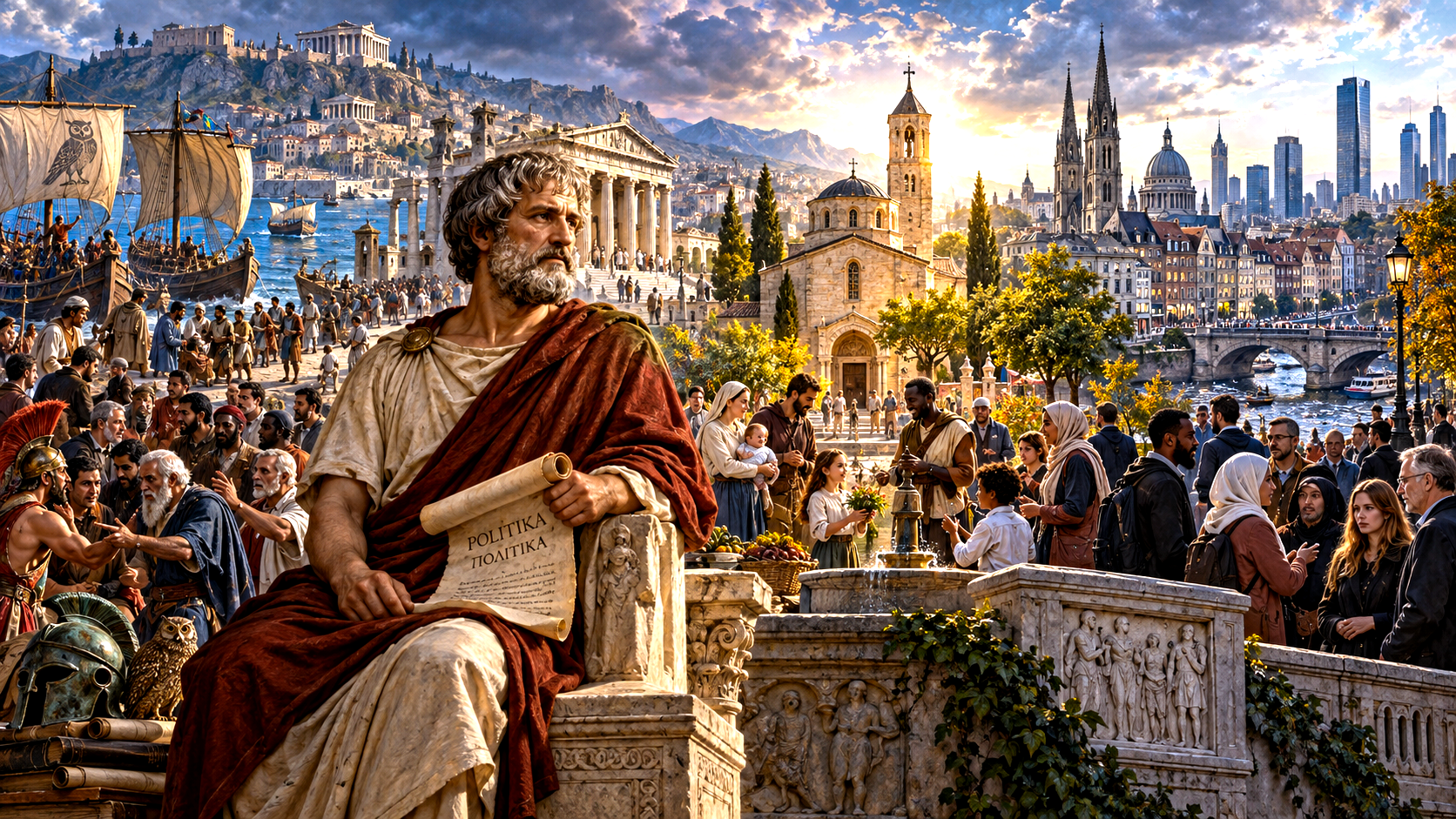
Aristotle’s findings, as relevant 2500 years ago, as now in the 21st Century
στασιωτικὸν δὲ καὶ τὸ μὴ ὁμόφυλον, ἕως ἂν συμπνεύσῃ.
Difference of stock is also a cause of faction, until they come to breathe together.
Aristotle, Politics V.3, 1303a25–26
ἄρα οὖν οὐκέτι ἐστὲ ξένοι καὶ πάροικοι ἀλλὰ ἐστὲ συμπολῖται τῶν ἁγίων καὶ οἰκεῖοι τοῦ θεοῦ.
So then you are no longer strangers and sojourners, but fellow-citizens with the saints and members of the household of God.
Ephesians 2:19 (NA28)
I
A Sentence in Book Five
Some of the most consequential sentences in political philosophy are not the famous ones. Aristotle’s definition of man as a political animal is quoted in every introductory lecture; his remark about cities that took in migrants is quoted almost nowhere. Yet the second may tell us more about the condition of the West in our own decade than the first. It sits in the middle of the fifth book of the Politics, in a dense catalogue of the causes of civil conflict, and it is followed by a list of eight Greek cities in which the thing he describes actually happened.
The fifth book is Aristotle’s anatomy of stasis, the word the Greeks used for faction, sedition and, at its worst, civil war. He has already named the deep source of all such conflict, which is disagreement about justice: men who are equal in one respect think themselves equal in all, and men who are unequal in one respect think themselves unequal in all.[1] He then lists the occasions on which that latent disagreement breaks into open conflict: gain and honour, insolence and fear, contempt, disproportionate growth of one part of the city, electioneering, negligence, small changes that pass unnoticed, and finally dissimilarity, ἀνομοιότης.[2] It is under this last heading that the sentence appears. Here’s Aristotle’s original text:
στασιωτικὸν δὲ καὶ τὸ μὴ ὁμόφυλον, ἕως ἂν συμπνεύσῃ· ὥσπερ γὰρ οὐδ᾽ ἐκ τοῦ τυχόντος πλήθους πόλις γίγνεται, οὕτως οὐδ᾽ ἐν τῷ τυχόντι χρόνῳ· διὸ ὅσοι ἤδη συνοίκους ἐδέξαντο ἢ ἐποίκους, οἱ πλεῖστοι διεστασίασαν· οἷον Τροιζηνίοις Ἀχαιοὶ συνῴκησαν Σύβαριν, εἶτα πλείους οἱ Ἀχαιοὶ γενόμενοι ἐξέβαλον τοὺς Τροιζηνίους, ὅθεν τὸ ἄγος συνέβη τοῖς Συβαρίταις· καὶ ἐν Θουρίοις Συβαρῖται τοῖς συνοικήσασιν (πλεονεκτεῖν γὰρ ἀξιοῦντες ὡς σφετέρας τῆς χώρας ἐξέπεσον)· καὶ Βυζαντίοις οἱ ἔποικοι ἐπιβουλεύοντες φωραθέντες ἐξέπεσον διὰ μάχης· καὶ Ἀντισσαῖοι τοὺς Χίων φυγάδας εἰσδεξάμενοι διὰ μάχης ἐξέβαλον· Ζαγκλαῖοι δὲ Σαμίους ὑποδεξάμενοι ἐξέπεσον αὐτοί· καὶ Ἀπολλωνιᾶται οἱ ἐν τῷ Εὐξείνῳ πόντῳ ἐποίκους ἐπαγαγόμενοι ἐστασίασαν· καὶ Συρακούσιοι μετὰ τὰ τυραννικὰ τοὺς ξένους καὶ τοὺς μισθοφόρους πολίτας ποιησάμενοι ἐστασίασαν καὶ εἰς μάχην ἦλθον· καὶ Ἀμφιπολῖται δεξάμενοι Χαλκιδέων ἐποίκους ἐξέπεσον ὑπὸ τούτων οἱ πλεῖστοι αὐτῶν.
Difference of stock is also a cause of faction, until they come to breathe together. For just as a city does not come into being from any chance multitude, so neither does it in any chance span of time. That is why most of those who have hitherto admitted fellow-settlers or later settlers have fallen into faction. Thus the Achaeans founded Sybaris together with the Troezenians, and then, having become the more numerous, the Achaeans drove the Troezenians out, whence the curse that befell the Sybarites. At Thurii the Sybarites fell out with those who had settled alongside them: claiming more than their share, as though the land were theirs, they were thrown out. At Byzantium the later settlers were detected plotting and were driven out in battle. The Antissaeans took in the Chian exiles and then drove them out by fighting. The Zanclaeans received the Samians and were themselves expelled. The Apolloniates on the Black Sea brought in later settlers and fell into faction. The Syracusans, after the time of the tyrants, made the foreigners and the mercenaries citizens, fell into faction and came to battle. And the Amphipolitans received settlers from Chalcis, and most of them were expelled by these.
Aristotle, Politics V.3, 1303a25–b3 (ed. Ross)
Three words in this passage carry the whole argument, and each deserves a moment before we turn to the cities.
The first is ὁμόφυλος, which I have rendered ‘of the same stock’. Its root is φυλή, the tribe or clan, the kin-group into which a Greek was born and through which he worshipped, fought and voted. It is not a racial term in the modern sense, and translators who write ‘difference of race’ import a nineteenth-century category into a fourth-century text. For a Greek the φυλή was a community of descent, but descent was never merely biological: it was inherited cult, inherited custom, inherited loyalty, the gods of one’s fathers and the graves of one’s grandfathers. Achaeans and Troezenians were both Greeks, spoke dialects of the same language and sacrificed to the same Olympians. Aristotle nonetheless counts them as not ὁμόφυλοι. The difference that matters to him is therefore not the gross difference between Greek and barbarian but the finer difference between peoples formed in different places by different histories.
The second word is the verb συμπνεῖν, ‘to breathe together’. It is a beautiful expression, and Aristotle chose it with care. To breathe together is to share a rhythm so deeply that one no longer notices it; it is the condition of a choir or a crew of oarsmen. The later Stoics would use the noun σύμπνοια for the inner sympathy that binds the whole cosmos into one living thing. Here it describes the moment at which two peoples cease to be two and become one civic body. Aristotle does not say that such a moment cannot come. He says that faction is likely until it comes: ἕως ἂν συμπνεύσῃ.
The third is the phrase ἐν τῷ τυχόντι χρόνῳ, ‘in any chance span of time’. Aristotle pairs it deliberately with ἐκ τοῦ τυχόντος πλήθους, ‘from any chance multitude’. A city cannot be made from just anyone, and it cannot be made in just any length of time. The two conditions belong together. The question is not only who is admitted, but how quickly the admitted are asked to become fellow-citizens with those already there. This is the hinge of everything that follows, and it is worth stating at the outset what Aristotle does not say. He does not say that admission is always wrong. He does not say that the stranger must forever remain a stranger. He diagnoses a danger and names its cure, and the cure is time.
In an earlier essay in this journal I argued that identity is formed by inheritance and affinity over generations rather than conferred by a passport, and I proposed the grafted olive of Romans 11 as the Christian figure of belonging.[3] The present essay stands on its own, but it can be read as the political counterpart of that one. Grafted In asked what belonging is. This essay asks what happens to a city when belonging is demanded faster than it can grow.
II
The Eight Cities
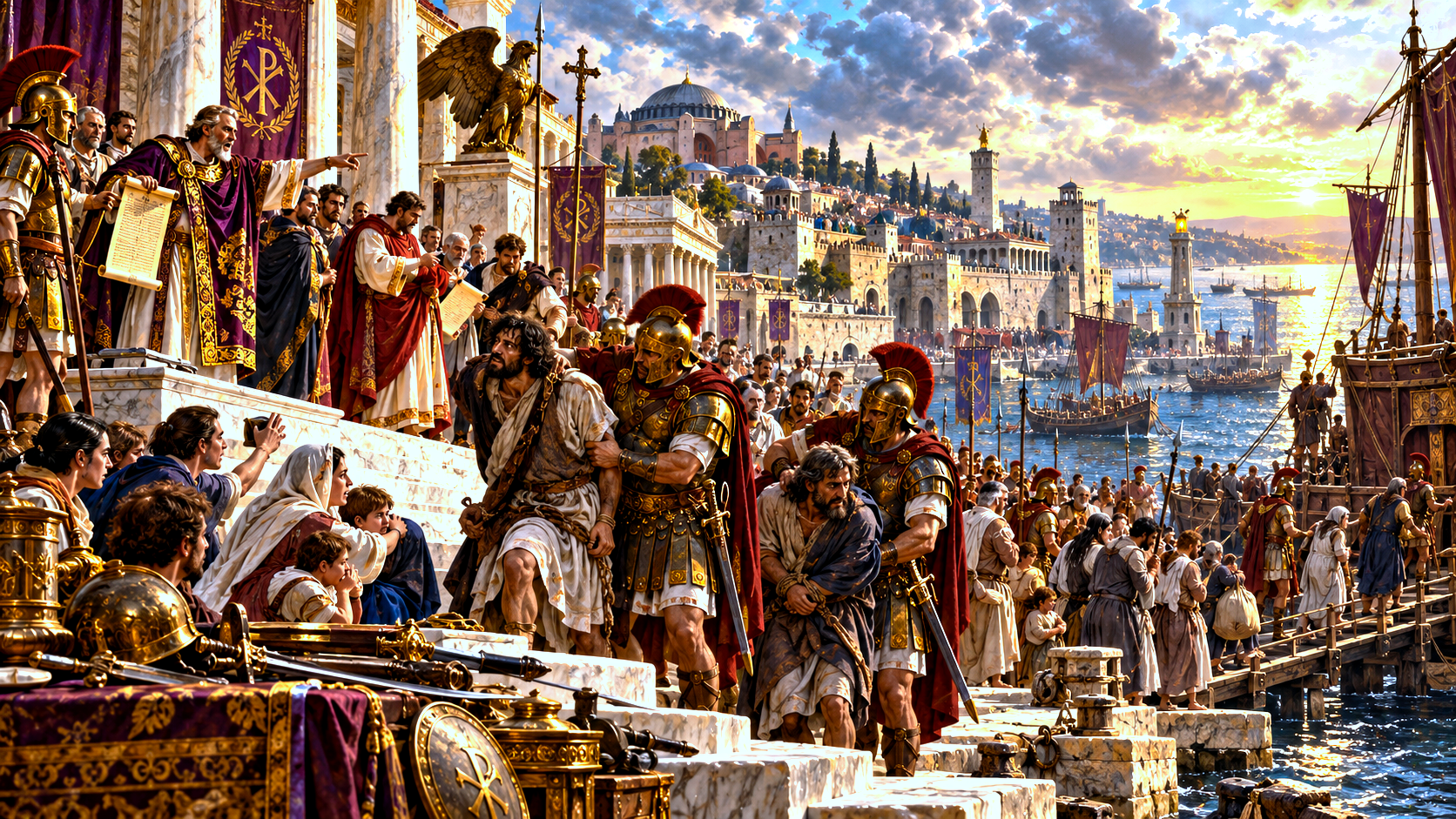
Aristotle does not take sides between natives and newcomers. In his list the original inhabitants are sometimes the victims (Zancle, Amphipolis) and sometimes the aggressors (Sybaris, Thurii). His concern is the city, and the city suffers whichever party wins. That even-handedness is itself instructive, and it should discipline any modern use we make of him.
Aristotle names his cities in a single breath, as though his readers would know the stories. Many of them did; we mostly do not. To feel the weight of his argument we must recover the events, and here honesty requires a preliminary confession. For four of the eight cities we possess substantial independent narratives in Herodotus, Thucydides, Diodorus and Strabo. For the other four we have little or nothing beyond Aristotle’s own narrative. I shall tell what can be told and say plainly where the evidence fails, rather than dress a sentence up as a history.
1. Sybaris: the majority that turned on its partners
Sybaris was founded around 720 BC on the instep of Italy, between two rivers, the Crathis and the Sybaris, in some of the most fertile land in the Greek world. Its founders were Achaeans from the northern Peloponnese, and with them, according to Aristotle, came settlers from Troezen in the Argolid.[4] The city grew so rich that its name became a byword; ‘sybarite’ still means a man devoted to luxury. Strabo reports that at its height it ruled four neighbouring peoples and twenty-five subject towns.
Aristotle’s point about Sybaris is precise. The partnership held while the two groups were roughly balanced. When the Achaeans became the more numerous (πλείους γενόμενοι), they used their numbers to expel their partners. Aristotle adds that a curse, ἄγος, fell upon the Sybarites in consequence. He does not say what the curse was. Later readers linked it to the city’s total destruction in 510 BC, when the army of neighbouring Croton defeated Sybaris and, by tradition, diverted the river over its ruins. That connection is plausible, but Aristotle does not make it himself, and I shall not make it for him.
Sybaris is the one case in Aristotle’s list where numbers are explicitly decisive. It is also a case in which the original community turned on the partners it had invited. That should be noticed at once. Aristotle’s list is not a catalogue of newcomers behaving badly. It is a catalogue of what happens between two bodies of people who have not yet become one, and in it the violence runs in both directions.
2. Thurii: the claim of the first-comers
Thurii was born from the ruins of Sybaris. Some sixty years after the destruction, the surviving Sybarites attempted to refound their city, failed under renewed pressure from Croton, and appealed to Sparta and Athens for help. Athens responded, and in 444/3 BC a Panhellenic colony was planted near the old site, with settlers drawn from many Greek cities. It was among the most self-consciously rational foundations of the classical age: tradition associates Protagoras with its laws and Herodotus with its citizen body, and Aristotle himself elsewhere calls Herodotus ‘of Thurii’.[5]
Diodorus tells us what went wrong. The old Sybarites, regarding the land as ancestrally theirs, reserved for themselves the chief magistracies and the best land near the city, and gave their own wives precedence at public sacrifices. The other colonists, who now outnumbered them, rose and killed most of them, and the survivors were driven out.[6] Aristotle compresses this into a phrase: ‘claiming more than their share, as though the land were theirs’ (πλεονεκτεῖν γὰρ ἀξιοῦντες ὡς σφετέρας τῆς χώρας).
Thurii is a disturbing case for anyone who wishes to read Aristotle’s list in a single direction. Here it is the original people of the place, the heirs of a real and grievous loss, who claim precedence by right of prior possession, and it is they who are destroyed. The lesson is not that first-comers have no claims. It is that claims to precedence pressed by one group upon another, before any common life exists to make sense of them, are a sure road to faction. A shared citizen body cannot be founded on the permanent superiority of one part of it.
3. Zancle: the guests who took the house
Zancle, on the Sicilian side of the strait facing Italy, is the most vivid of Aristotle’s cases, because Herodotus tells it in full. After the Persians crushed the Ionian revolt and sacked Miletus in 494 BC, the Zanclaeans sent an invitation across the Greek world: let any Ionians who wished come and found a new city at Kale Akte, the ‘Fair Shore’ on the north coast of Sicily. A party of Samians, with some Milesian refugees, accepted and set sail. On the way they put in at Epizephyrian Locri, where Anaxilas, tyrant of Rhegium and an enemy of Zancle, met them with a proposal. The Zanclaean king Scythes was away with his army besieging a Sicilian town; Zancle itself lay undefended. Why found a city on an empty shore when a finished one could be had for the taking? The Samians took his advice and seized Zancle.[7]
The sequel was worse. Scythes appealed to his ally Hippocrates, tyrant of Gela, who came, betrayed him, threw him in chains, enslaved most of the Zanclaeans and divided the spoils with the Samians. The Samians themselves did not enjoy their prize for long. Thucydides records that Anaxilas later expelled them in turn, resettled the place with a mixed population and renamed it Messana after his own ancestral Messenia, the name it still bears as Messina.[8]
Zancle is often read as the purest example of hosts betrayed by their guests, and so it was. But it is also a story of local rulers using newcomers as instruments in their own quarrels. Anaxilas did not want the Samians for their own sake; he wanted Zancle weakened. Hippocrates did not defend his ally; he sold him. The refugees were real refugees, fleeing a real catastrophe, and they were drawn into a crime by men who had their own purposes. The invitation was generous; what it lacked was any means of turning invited strangers into fellow-citizens before an opportunist could turn them into a weapon.
4. Syracuse: citizens by decree
In the early fifth century the tyrant Gelon made Syracuse the greatest power in the Greek West. Part of his method was demographic. He transplanted whole populations into the city and enrolled large numbers of foreign mercenaries as citizens; Diodorus puts the number of mercenaries so enfranchised at more than ten thousand.[9] These men owed their citizenship not to any shared life with the Syracusans but to the will of the tyrant, and their loyalty ran to the dynasty that had made them.
When the dynasty fell with the expulsion of Gelon’s brother Thrasybulus in 466 BC, the old citizens and the new found themselves face to face. The restored democracy proposed to confine the magistracies to the older citizens; the enfranchised mercenaries, who held the island of Ortygia and the quarter of Achradina, refused. What followed was open civil war within the city, with sieges, sorties and pitched fighting, until the mercenaries were at last defeated and, by a general settlement, removed to the territory of Messana.[10]
Syracuse is the clearest case of what we might call citizenship by decree: the mass grant of membership as an act of power, unaccompanied by any process of formation. The mercenaries had the legal status of citizens without the thing that status is meant to signify. When the power that had conferred it vanished, the gap between the legal fact and the social reality was filled with blood.
5. Amphipolis: settlers brought in by a faction
Amphipolis was founded by Athens in 437/6 BC at a strategic crossing of the river Strymon in Thrace, under the leadership of Hagnon. It controlled timber, silver and the land route to the Hellespont, and the Athenians valued it highly. Yet Thucydides notes that the Athenian element in its citizen body was small; most of its inhabitants were of mixed origin. When the Spartan general Brasidas appeared before the city in the winter of 424 BC and offered generous terms, the mixed population accepted them, and Athens lost the place for good. The historian Thucydides, who commanded the relieving squadron and arrived too late, was exiled for the failure.[11]
Aristotle refers to a later episode, the date of which is uncertain. Settlers from Chalcis were received into the city, and they expelled most of the original Amphipolitans. In a second passage of the same book he supplies a detail that changes the colour of the whole story: it was an Amphipolitan named Kleotimos, a man who had squandered his own estate, who brought the Chalcidian settlers in, and who, once they had arrived, set them in faction against the wealthy.[12] The newcomers were not the authors of the conflict. They were imported as an instrument of a native faction’s ambitions.
This detail deserves more attention than it usually receives. In Amphipolis, as at Zancle and Syracuse, the people who decided to bring strangers in did so for their own advantage, and the city as a whole paid. The pattern is one in which the choice to admit is made by a part of the city for the sake of that part, rather than by the whole for the sake of the whole.
6–8. Byzantium, Antissa, Apollonia: the limits of the evidence
Of the remaining three cities we know almost nothing beyond Aristotle’s words. At Byzantium, the Megarian foundation on the Bosporus, a body of later settlers plotted against the city, were discovered and were driven out by force; we do not know when, nor who they were, nor what they wanted. At Antissa, on the island of Lesbos, the citizens took in exiles from Chios and later drove them out by fighting; again neither date nor cause survives. At Apollonia on the Black Sea, the Milesian colony on the site of modern Sozopol in Bulgaria, the introduction of new settlers led to faction. Aristotle mentions Apollonia once more in the same book, where a dispute over the embezzlement of public funds also divided the city, but he does not connect the two episodes.[13]
I shall not invent stories for these places. Their value lies precisely in their brevity: Aristotle evidently expected his hearers to recognise the pattern without further explanation. A teacher does not need to argue a point when his students can supply examples from memory. That he could name eight cities in a sentence suggests that the phenomenon was common knowledge in the Greek world of the fourth century.
III
What the Cases Share
Read together, the eight cases do not prove that settlement leads inevitably to strife. They show something more specific, and more useful:
First, in every case where we have a narrative, the settlers came as a body (as co-founders, as an organised party of refugees, as an army of mercenaries or as an imported faction) rather than as individuals and families gradually absorbed. A body that arrives together can act together, and it brings its own leaders, loyalties and grievances with it. Aristotle’s words συνοίκους and ἐποίκους denote precisely such groups.
Second, the conflict was triggered by a claim to precedence or by a shift in proportion. At Sybaris the founders became the majority and expelled the minority. At Thurii the first-comers claimed priority by ancestral right and were overwhelmed by the more numerous newcomers. At Syracuse the old citizens tried to exclude the new from office. The danger point is reached when one group can impose its will on the other before the two have learned to will together.
Third, in at least three cases, Zancle, Syracuse and Amphipolis, the admission of strangers was the work not of the city as a whole but of a ruler or a faction acting for its own ends. The newcomers were used as instruments, and the city as a whole bore the cost.
Fourth, and this is Aristotle’s own point, what was missing in every case was time. None of these bodies of settlers was given, or gave itself, the generations required for two peoples to become one. The Samians held Zancle for a few years; the mercenaries of Syracuse were citizens for a generation, but citizens of a tyrant rather than of a city; the Chalcidians of Amphipolis were brought in by a faction and set to work at once.
Aristotle does not take sides between natives and newcomers. In his list the original inhabitants are sometimes the victims (Zancle, Amphipolis) and sometimes the aggressors (Sybaris, Thurii). His concern is the city, and the city suffers whichever party wins. That even-handedness is itself instructive, and it should discipline any modern use we make of him.
IV
Aristotle’s Wider Argument
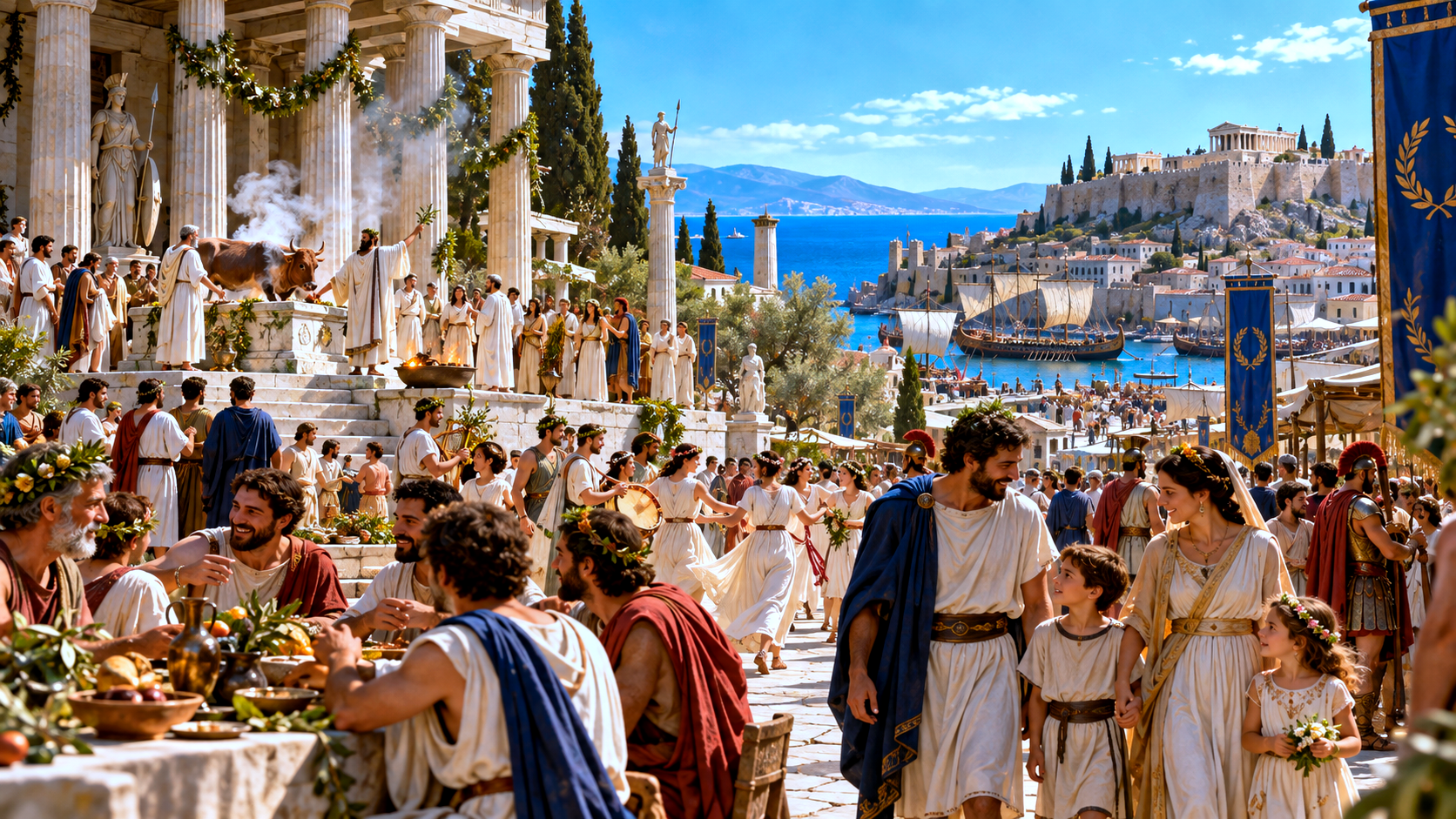
A city is constituted by φιλία, civic friendship: a shared understanding of the good, expressed in common festivals, common sacrifices, intermarriage and the ordinary ‘pastimes of living together’ (διαγωγαὶ τοῦ συζῆν). Law, trade and mutual security are necessary conditions, but they are not the thing itself. Friendship of this kind cannot be legislated into existence. It grows from shared life, and shared life takes time. That is why Aristotle can say that a city is not made ‘in any chance span of time’
The sentence in Book Five is not an isolated observation. It belongs to a coherent account of what a city is, and that account explains why difference of stock should be dangerous and why time should be its remedy.
In the third book Aristotle asks what makes a city one city. It is not walls, he says; one could build a wall around the whole Peloponnese without making it a city. It is not contracts or alliances; the Etruscans and the Carthaginians had treaties governing trade and mutual defence, but nobody supposed that they were fellow-citizens. It is not even proximity: if ten thousand men lived side by side, carpenter beside farmer beside cobbler, exchanging goods and pledging not to wrong one another, they would still not be a city if they shared nothing else.
φανερὸν τοίνυν ὅτι ἡ πόλις οὐκ ἔστι κοινωνία τόπου, καὶ τοῦ μὴ ἀδικεῖν σφᾶς αὐτοὺς καὶ τῆς μεταδόσεως χάριν· ἀλλὰ ταῦτα μὲν ἀναγκαῖον ὑπάρχειν, εἴπερ ἔσται πόλις, οὐ μὴν οὐδ᾽ ὑπαρχόντων τούτων ἁπάντων ἤδη πόλις … τὸ δὲ τοιοῦτον φιλίας ἔργον· ἡ γὰρ τοῦ συζῆν προαίρεσις φιλία.
It is evident, then, that the city is not a sharing of place, nor does it exist for the sake of not wronging one another and of exchange. These things must be present if there is to be a city, but even when all of them are present there is not yet a city … Such a thing is the work of friendship; for the deliberate choice to live together is friendship.
Aristotle, Politics III.9, 1280b29–39
Here is the theoretical root of the remark in Book Five. A city is constituted by φιλία, civic friendship: a shared understanding of the good, expressed in common festivals, common sacrifices, intermarriage and the ordinary ‘pastimes of living together’ (διαγωγαὶ τοῦ συζῆν). Law, trade and mutual security are necessary conditions, but they are not the thing itself. Friendship of this kind cannot be legislated into existence. It grows from shared life, and shared life takes time. That is why Aristotle can say that a city is not made ‘in any chance span of time’.
In the seventh book he adds a consideration about size. A city must not be so large that its citizens cannot know one another’s character, for without such knowledge they cannot judge justly or distribute offices according to merit.
ἀναγκαῖον γνωρίζειν ἀλλήλους, ποῖοί τινές εἰσι, τοὺς πολίτας … ἔτι δὲ ξένοις καὶ μετοίκοις ῥᾴδιον μεταλαμβάνειν τῆς πολιτείας· οὐ γὰρ χαλεπὸν τὸ λανθάνειν διὰ τὴν ὑπερβολὴν τοῦ πλήθους.
The citizens must know one another, what sort of people they are … Moreover, it becomes easy for foreigners and resident aliens to share in the citizenship, for it is not hard to pass unnoticed because of the excessive size of the population.
Aristotle, Politics VII.4, 1326b14–21
The point is not that strangers must be kept out. It is that in a city too large to be surveyed, membership ceases to be a matter of recognised character and becomes a matter of administrative chance. Some will slip in who have formed no attachment to the city at all, and no one will notice until it matters.
A few pages later Aristotle reports a common objection to a city’s having a port: some say, he notes, that ‘the sojourning of people brought up under other laws is unprofitable to good order’ (τὸ ἐπιξενοῦσθαί τινας ἐν ἄλλοις τεθραμμένους νόμοις ἀσύμφορον εἶναι πρὸς τὴν εὐνομίαν).[14] His own answer is characteristically moderate. The advantages of trade and sea power are real; the dangers are real too, but they can be managed ‘by laws stating and defining who ought and who ought not to mingle with one another’.[15] Aristotle is no isolationist. He wants the city open to the world and governed in its openness by law and prudence.
Two further passages complete the picture, and both cut against any crude reading. In the third book Aristotle discusses the reforms of Cleisthenes, who after the expulsion of the tyrants from Athens ‘enrolled in the tribes many foreigners and slave-born resident aliens’ (πολλοὺς γὰρ ἐφυλέτευσε ξένους καὶ δούλους μετοίκους). The question these men raise, he says, is not whether they are citizens, for plainly they are, but whether they were made citizens justly.[16] He does not answer the question, and he does not treat the enrolment as a catastrophe. Athens survived Cleisthenes and flourished. Elsewhere he observes that cities short of citizens admit those of foreign or servile descent, and that as their population recovers they gradually narrow the terms again.[17] Citizenship rules, for Aristotle, are prudential instruments adjusted to circumstance, not fixed laws of nature.
The second passage is perhaps the most important in the whole book for our purposes. Having surveyed every cause of the dissolution of constitutions and every means of their preservation, Aristotle names the greatest of all.
μέγιστον δὲ πάντων τῶν εἰρημένων πρὸς τὸ διαμένειν τὰς πολιτείας, οὗ νῦν ὀλιγωροῦσι πάντες, τὸ παιδεύεσθαι πρὸς τὰς πολιτείας.
But the greatest of all the things mentioned for the permanence of constitutions, and one which everyone now neglects, is education suited to the constitution.
Aristotle, Politics V.9, 1310a12–14
This is the positive counterpart of the warning about difference of stock. What turns a multitude into a city, and newcomers into citizens, is παιδεία: formation in the laws, customs, loves and loyalties of the common life. The eighth book opens with the same conviction: that the legislator’s first concern must be the education of the young, ‘since each constitution must be educated for’, and that education must be common to all.[18] ‘Breathing together’ is learned. It is not issued with a certificate.
Aristotle was not the first to see this. His teacher Plato, discussing the founding of a new colony in the Laws, weighs the advantages of settlers drawn from a single city against those drawn from many. A homogeneous colony has the friendship that comes from shared race, language, laws and worship, but it clings to its old customs even when they were the cause of its troubles. A colony gathered from many places may be more willing to accept new laws; ‘but then, to make them combine and pull together, as they say of horses, is a most difficult task, and the work of years’.[19] Master and pupil agree: a city can be made from many peoples, but not quickly.
V
A Witness: Alcibiades on Sicily
Aristotle did not draw his examples from theory. Thucydides, writing two generations earlier, gives us a contemporary judgment on the same Western Greek world from which half of Aristotle’s cases come. In 415 BC the young Alcibiades urged the Athenian assembly to send a great fleet against Syracuse. The Sicilian cities, he argued, would not resist effectively, because they were not true cities at all:
ὄχλοις τε γὰρ ξυμμείκτοις πολυανδροῦσιν αἱ πόλεις καὶ ῥᾳδίας ἔχουσι τῶν πολιτῶν τὰς μεταβολὰς καὶ ἐπιδοχάς.
For their cities are populous with mixed multitudes, and they readily admit changes of citizens and new enrolments.
Thucydides VI.17.2
Such people, Alcibiades went on, have no sense of a fatherland of their own; each man is ready to take what he can from the common stock and move elsewhere if things go badly. It is a hostile witness, and Alcibiades was trying to win a vote. Events proved him wrong about Syracuse, which destroyed the Athenian expedition utterly in 413. But the diagnosis he offered was one his audience found credible, and it is the same diagnosis Aristotle would later give in philosophical form. Notice too the irony: the city that defeated Athens did so after it had, in the decades since 466, worked its way through civil war towards something like a common citizen body. Syracuse in 413 was no longer Gelon’s city of mercenaries.
VI
Rome: The Counter-Case
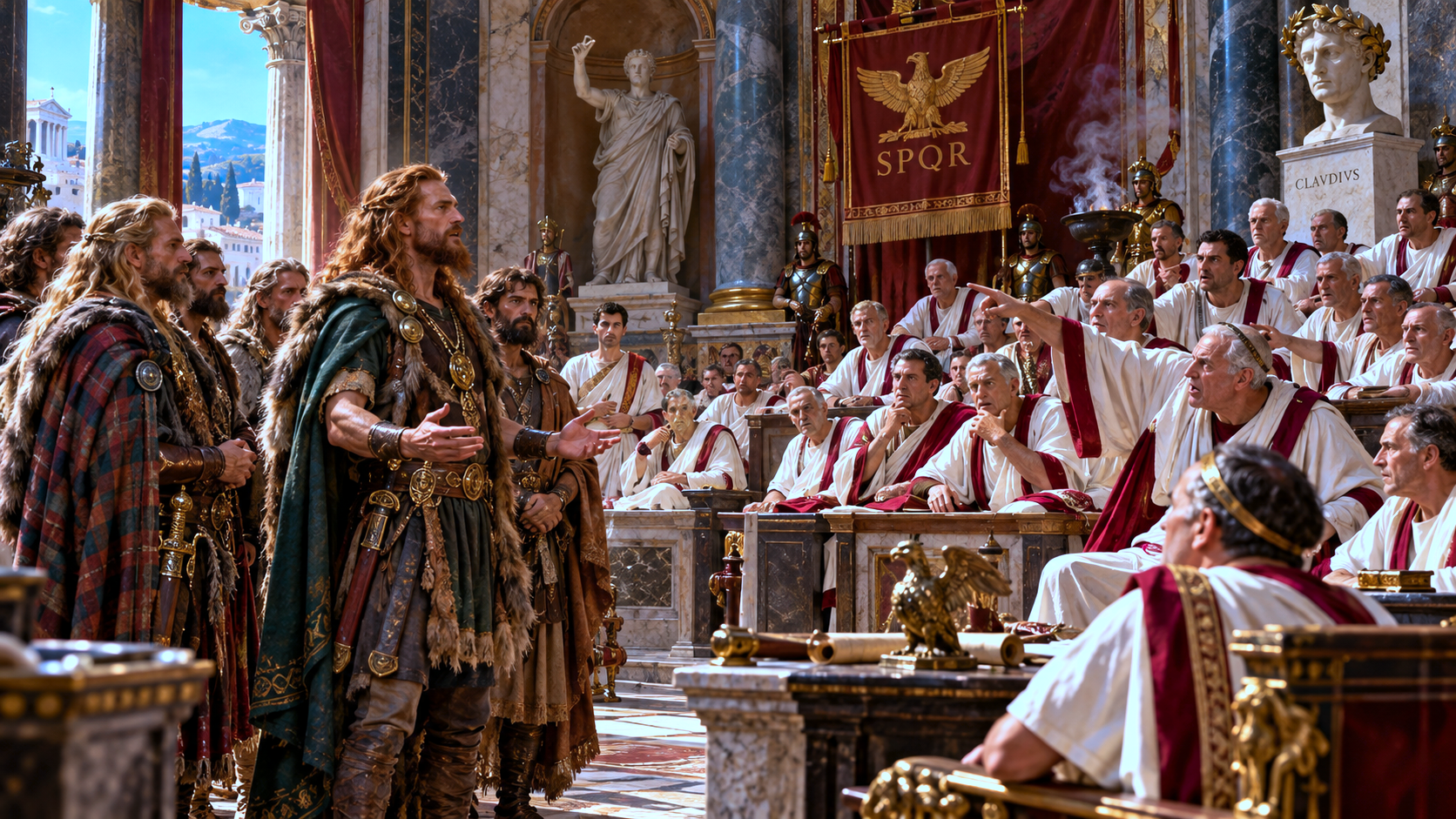
In AD 48 the chieftains of Gallia Comata, the ‘long-haired Gaul’ that Julius Caesar had conquered a century before, asked for the right to hold office at Rome and so to enter the Senate. The proposal provoked fierce resistance.
If Aristotle’s cities show what happens when strangers are admitted too fast, Rome shows what can happen when they are admitted slowly. No ancient State incorporated more peoples, and no ancient State lasted longer. The Romans were themselves conscious of this as the secret of their success, and the clearest statement of it comes from an emperor.
In AD 48 the chieftains of Gallia Comata, the ‘long-haired Gaul’ that Julius Caesar had conquered a century before, asked for the right to hold office at Rome and so to enter the Senate. The proposal provoked fierce resistance. Was Italy so exhausted, the objectors asked, that it could not supply senators for its own capital? Should the descendants of men who had besieged Caesar at Alesia now wear the insignia of Roman magistrates? The emperor Claudius answered them in a speech whose substance Tacitus preserves, and part of whose actual text survives on a bronze tablet found at Lyon.[20]
Quid aliud exitio Lacedaemoniis et Atheniensibus fuit, quamquam armis pollerent, nisi quod victos pro alienigenis arcebant? at conditor nostri Romulus tantum sapientia valuit ut plerosque populos eodem die hostis, dein civis habuerit.
What else brought ruin on the Spartans and the Athenians, powerful in arms though they were, except that they kept the conquered at arm’s length as aliens? But our founder Romulus was so wise that he held many peoples as enemies and then, on the same day, as citizens.
Tacitus, Annals XI.24
On its face this is the opposite of Aristotle’s warning: the Greek cities fell, Claudius says, because they would not admit. But read the rest of the speech and the opposition dissolves. Claudius’ case for the Gallic nobles rests entirely on the fact that they have already been formed. Since Caesar’s war, he says, there has been ‘unbroken and faithful peace’ (continua inde ac fida pax). And then the decisive phrase: ‘now that they are mingled with us in customs, arts and marriage-ties (iam moribus artibus adfinitatibus nostris mixti), let them bring their gold and wealth to us rather than keep it apart’.
The men he proposed to admit were the grandsons of the conquered, after a hundred years of Roman peace. Rome had waited three generations.
This was the Roman method throughout. Conquered or allied communities were brought into the Roman order by degrees:
First as allies under treaty,
Then with the private rights of Latin status, sometimes with ‘citizenship without the vote’ (civitas sine suffragio),
And only later with full citizenship. Individuals could earn citizenship by service, notably in the auxiliary army, where twenty-five years under the standards were rewarded with the franchise for the veteran and his children.
Membership was extended along a graded path,
and the path took generations to walk.
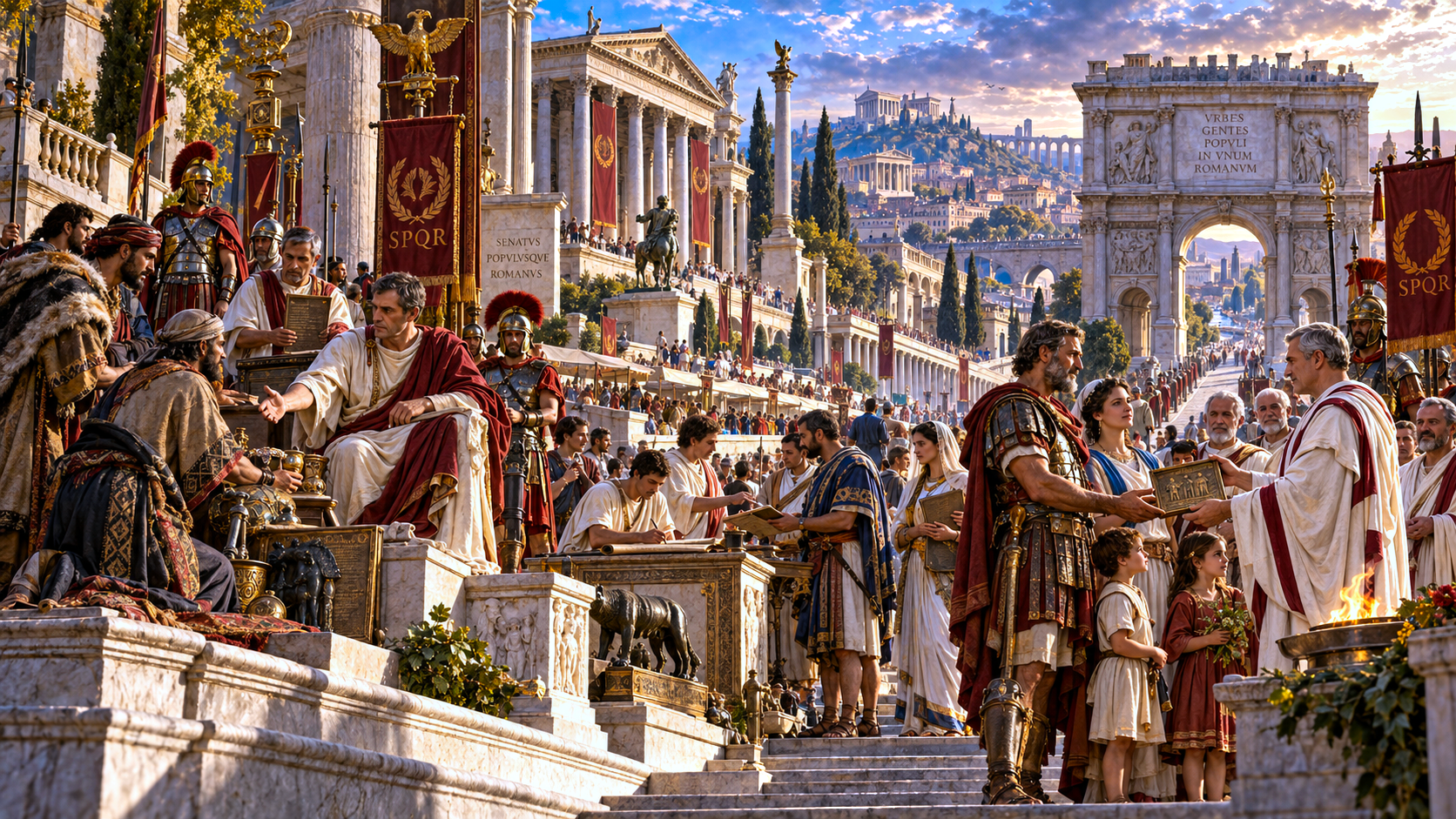
Membership was extended along a graded path, and the path took generations to walk.
Yet Rome also supplies a warning from the opposite side, and honesty requires that it be heard. When Rome refused for too long to admit her Italian allies to full citizenship, despite their having fought in her legions for two centuries and absorbed her language and law, the allies rose in the Social War of 91–88 BC. It was one of the most dangerous wars in Roman history, and it ended only when Rome conceded the citizenship she had withheld. A city can fail by admitting too fast; it can also fail by refusing to admit those who have already become, in every respect but law, its own. Aristotle’s ‘until they breathe together’ cuts both ways. When the breathing together has happened, the law should recognise it.
VII
From Athens to Jerusalem:
The Law of the Third Generation
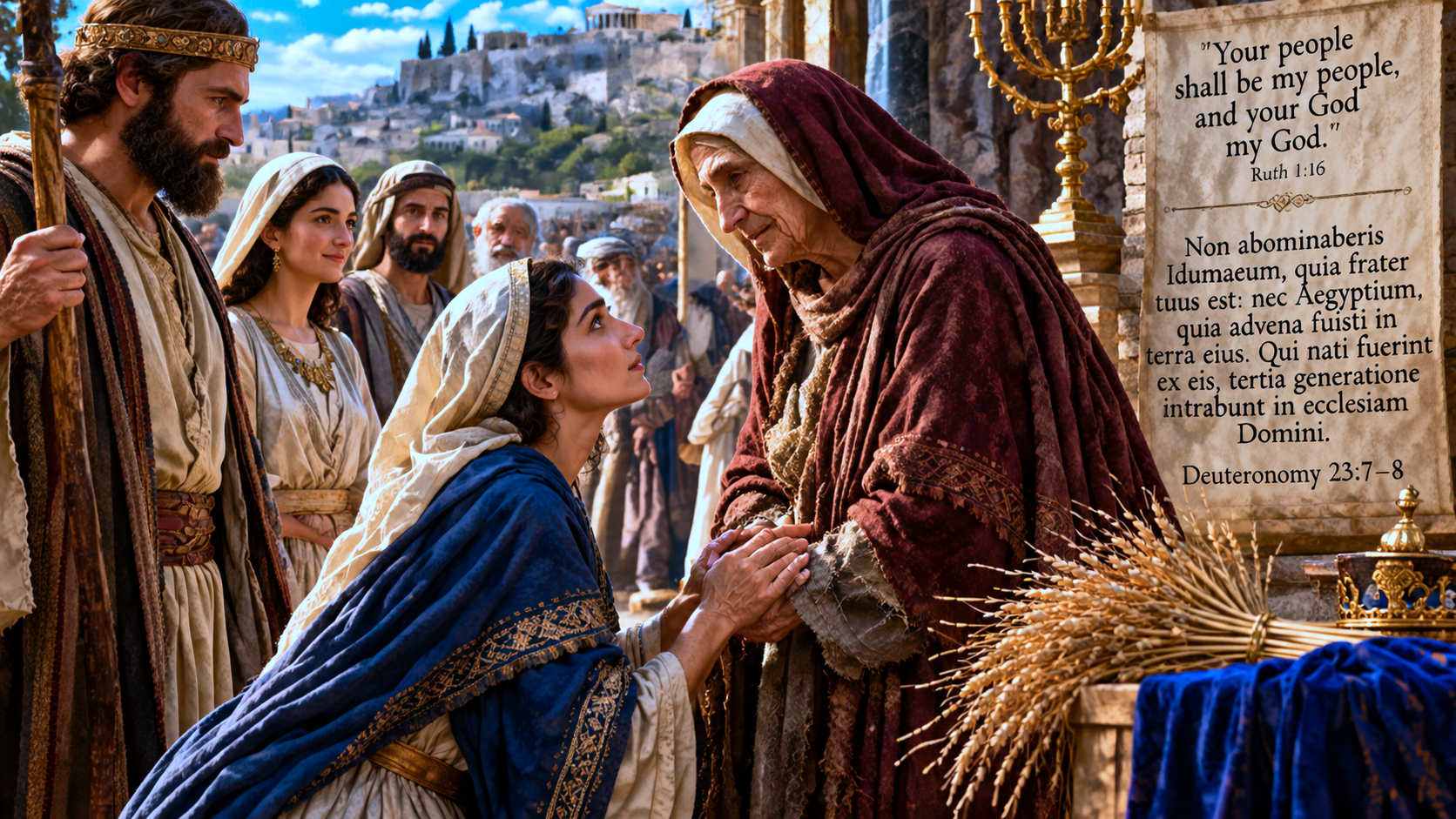
The exception that confirms the Rule: Ruth was admitted at once because she had, in a single act of total self-gift, already done what normally takes three generations. She breathed together with Israel from the moment she spoke.
It is a remarkable fact that the Law of Moses contains a provision almost identical in structure to the Roman practice and in principle to Aristotle’s:
Non abominaberis Idumaeum, quia frater tuus est: nec Aegyptium, quia advena fuisti in terra eius. Qui nati fuerint ex eis, tertia generatione intrabunt in ecclesiam Domini.
You shall not abhor the Edomite, for he is your brother; nor the Egyptian, because you were a stranger in his land. Those who are born of them shall enter the assembly of the Lord in the third generation.
Deuteronomy 23:7–8 (Vulgate)
Two things are joined here that modern debate tends to separate. The Edomite and the Egyptian are not to be abhorred. The one is a brother; the other was host to Israel in her own days as a stranger. The commandment rests on kinship and on gratitude. Yet their admission to the assembly, the civic and cultic body of Israel, waits until the third generation. Charity and prudence are not opposed; they are legislated together.
St Thomas Aquinas saw the connection to Aristotle explicitly. In his treatise on the judicial precepts of the Old Law he asks whether the precepts concerning foreigners were suitably framed, and he answers by distinguishing three kinds of peaceful relation with strangers:
Those passing through,
Those coming to dwell,
And those wishing to be admitted entirely into the people’s fellowship and worship.
For the first two, the Law commands kindness: ‘You shall not molest a stranger.’ For the third, he says, a certain order was observed:
For they were not at once admitted to citizenship: just as it was law with some nations that no one was deemed a citizen except after two or three generations, as the Philosopher says (Polit. iii, 1). The reason for this was that if foreigners were allowed to meddle with the affairs of a nation as soon as they settled down in its midst, many dangers might occur, since the foreigners not yet having the common good firmly at heart might attempt something hurtful to the people.
St Thomas Aquinas, Summa Theologiae I–II, q. 105, a. 3, corp.
(trans. English Dominican Province)
Here Aristotle’s φιλία becomes Aquinas’ ‘love of the common good’. The danger in hasty admission is not that strangers are wicked but that love for a particular common good has not yet had time to take root in them. The remedy is not exclusion but time. And Aquinas immediately adds two qualifications that keep the principle Christian.[21]:
First, the Law ‘excluded the men of no nation from the worship of God and from things pertaining to the welfare of the soul’; the waiting applied only to ‘temporal matters concerning the public life of the people’.
Second, admission could be granted by dispensation for an act of virtue, and he gives two examples: Achior the Ammonite, who in the book of Judith ‘was joined to the people of Israel with all the succession of his kindred’, and Ruth the Moabitess.[22]
Ruth is the perfect figure of everything this essay is about. She was of a people the Law excluded in perpetuity. She entered Israel not by legal grant but by love and loyalty: ‘Your people shall be my people, and your God my God’ (populus tuus populus meus, et Deus tuus Deus meus).[23] She took Naomi’s people, Naomi’s God, Naomi’s land and Naomi’s dead as her own, and she became the great-grandmother of David and an ancestress of Christ. The general rule of slow admission and the exceptional grace of immediate belonging do not contradict one another. Ruth was admitted at once because she had, in a single act of total self-gift, already done what normally takes three generations. She breathed together with Israel from the moment she spoke.
VIII
The Fathers:
Hospitality and Order
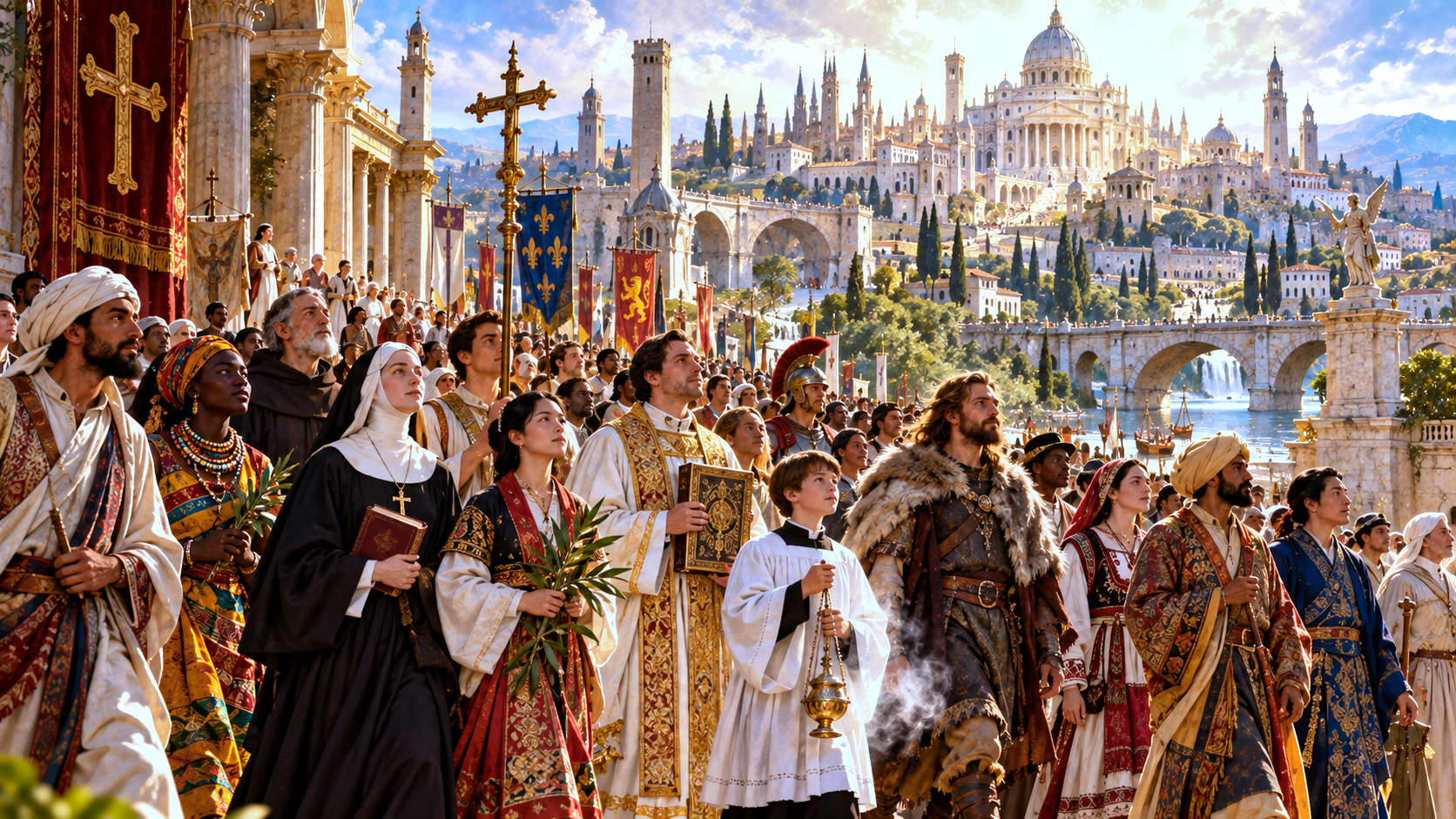
They differ among different nations they are directed to one and the same end of earthly peace, provided only that they do not hinder the religion by which the one supreme and true God is taught to be worshipped.
The Fathers of the Church did not write treatises on immigration policy; the question in its modern form did not exist for them. But they wrote a great deal about the stranger, about the peace of the earthly city and about the relation between the two, and what they wrote both supports and disciplines the argument so far.
St Augustine’s great discussion of peace in the 19th book of the City of God supplies the frame. Peace, for Augustine, is not the mere absence of conflict but the right ordering of parts: ‘the peace of all things is the tranquillity of order’ (pax omnium rerum tranquillitas ordinis). The peace of a city is ‘the ordered concord of citizens in commanding and obeying’ (ordinata imperandi atque oboediendi concordia ciuium).[24] Augustine is realistic about how fragile that concord is. Earlier in the same book he observes that diversity of language alone can estrange man from man, so that two people with no common tongue would sooner keep company with dumb animals than with one another, and that a man would rather be with his own dog than with a foreigner. He notes too that the imperial city did indeed impose its language on the conquered for the sake of peace, but at the price of wars of terrible bloodshed.[25] Unity imposed by force is not the tranquillity of order.
Against this background Augustine describes the heavenly city on pilgrimage in the world:
Haec ergo caelestis ciuitas dum peregrinatur in terra, ex omnibus gentibus ciues euocat atque in omnibus linguis peregrinam colligit societatem, non curans quidquid in moribus legibus institutisque diuersum est, quibus pax terrena uel conquiritur uel tenetur, nihil eorum rescindens uel destruens, immo etiam seruans ac sequens, quod licet diuersum in diuersis nationibus, ad unum tamen eundemque finem terrenae pacis intenditur, si religionem, qua unus summus et uerus Deus colendus docetur, non impedit.
This heavenly city, then, while it is on pilgrimage on earth, calls out citizens from all nations and gathers a pilgrim society in all languages, not caring about whatever is different in the customs, laws and institutions by which earthly peace is won or kept, rescinding or destroying none of them, but rather preserving and following them, for though they differ among different nations they are directed to one and the same end of earthly peace, provided only that they do not hinder the religion by which the one supreme and true God is taught to be worshipped.
Augustine, De civitate Dei XIX.17 (CCSL 48)
Two things are affirmed here at once, and both matter. The Church is gathered from every nation and every tongue; no people is excluded from the heavenly citizenship, and the Church does not demand that converts abandon the lawful customs of their own peoples. At the same time Augustine treats the customs, laws and institutions of each nation as real goods, instruments of earthly peace, which the Church preserves and follows rather than dissolves. The Church is universal; the earthly cities are particular; and the universality of the one does not abolish the particularity of the others. Indeed it relies on them, for the pilgrim Church ‘makes use of the earthly peace’ while she journeys.
St Ambrose supplies the necessary counterweight, and I set it here deliberately, because an argument that cannot face its strongest objection does not deserve a hearing. In the 3rd book of his De officiis, Ambrose recounts how, during a famine at Rome, strangers (peregrini) were expelled from the city to spare its food supply. He condemns the expulsion in the strongest terms. To drive out those who share our common humanity at the very moment of their need is, he says, to sever the bonds of nature itself. He contrasts it with the conduct of a prefect in an earlier famine who, instead of expelling strangers, called together the wealthy and raised a fund to buy grain, arguing that the city would need the labour of those it proposed to cast out, so that charity and the city’s own interest alike forbade the expulsion.[26]
Ambrose does not tell us how strangers should be admitted to citizenship; that is not his subject. He tells us something prior and more fundamental: that the stranger already present among us in need is our neighbour, and that no consideration of civic advantage justifies abandoning him. For St. Ambrose, any argument about the pace of integration that forgets this has ceased to be a Christian argument.
The Cappadocians show the same twofold commitment in practice. St Basil built outside Caesarea a great complex of hospital, hospice and lodging for travellers and the poor, which St Gregory of Nazianzus, in his funeral oration for Basil, called ‘a new city’.[27] St John Chrysostom urged the families of Constantinople to set aside a room in every house for the stranger, so that Christ might find lodging there.[28] Yet neither Basil nor Chrysostom imagined that hospitality dissolved the civic order. They built institutions and gave instructions within the cities they served, not against them.
The patristic witness, then, is asymmetrical, and I shall not pretend otherwise. The Fathers are emphatic, repeated and unanimous about the duty of hospitality to the stranger in need. They are far less explicit about the conditions under which strangers become citizens, and where they touch on the earthly city, as Augustine does, they assume its particularity rather than argue for it. The patristic tradition may not support a politics of exclusion. But neither will it support the view that the earthly city has no right to its own customs, institutions, constitutional and legal order, and peace.
IX
Magisterium of the
Holy Catholic Church
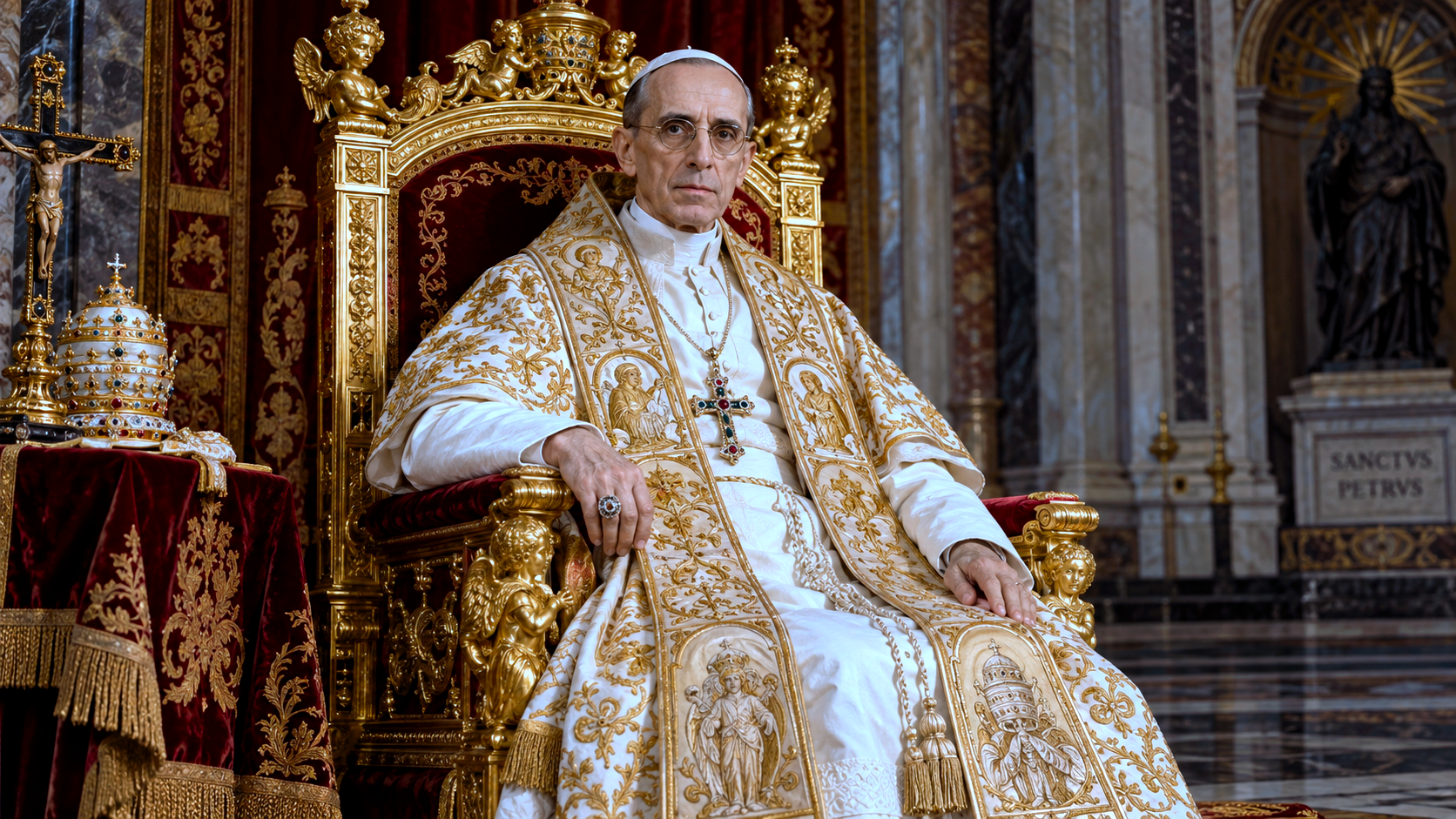
Pope Pius XII (b. March 2, 1876, - d. October 9, 1958)
Modern Catholic teaching has held these two commitments together with increasing explicitness. Pope Pius XII, in the apostolic constitution Exsul Familia of 1952, presented the Holy Family in their flight into Egypt as the model and protectors of every emigrant and refugee, and organised the Church’s pastoral care for them.[29] The Catechism of the Catholic Church states the principle in a single, carefully balanced paragraph:
More prosperous nations are obliged to welcome the foreigner in search of the security and livelihood he cannot find at home, to the extent they are able;
Public authorities may, for the sake of the common good, make the exercise of the right to immigrate subject to various juridical, material, cultural, societal and spiritual conditions;
And the immigrant in turn is obliged to respect and at all times observe with gratitude the material, juridical, cultural, societal and spiritual heritage of the country that receives him, to obey its laws and to assist in carrying civic burdens.[30]
That last clause is the Catechism’s version of Aristotle’s συμπνεῖν and Aquinas’ ‘love of the common good’. The duty runs in both directions. The host must welcome; the guest must receive the inheritance with gratitude. Pope Benedict XVI, in Caritas in veritate, describes migration as a phenomenon of epochal proportions requiring bold and far-sighted international cooperation, insists that every migrant is a human person with inalienable rights, and acknowledges at the same time that the receiving societies face real difficulties in managing it.[31]
Pope St John Paul II added an often forgotten principle: before the right to emigrate comes the right not to have to emigrate, that is, the right to live in dignity in one’s own homeland.[32]
Recent popes, it must be said, have placed far greater emphasis on welcome than on the conditions and pace of integration, and anyone invoking the magisterium should acknowledge that emphasis honestly rather than quote selectively. But the principles of the Catechism are not in doubt:
Welcome, but
Regulated by public authority for the common good,
And met by the newcomer’s grateful reception of the inheritance.
Aristotle’s analysis does not compete with that teaching. It explains why the third element matters and why it takes time.
X
Modern Parallels
We may now return to our own century. The parallels between Aristotle’s cities and the modern West are real, but they are analogies, and analogies must be drawn honestly or not at all.
In the summer of 2001 three northern English towns, Oldham, Burnley and Bradford, saw some of the worst rioting in Britain for a generation, largely between young white and young South Asian men. The independent review commissioned by the Home Office, chaired by Ted Cantle, found communities that did not riot because they hated one another but because they did not know one another. Its most famous finding was that many residents lived ‘parallel lives’: separate schools, separate neighbourhoods, separate places of worship, separate social and cultural networks, with no meaningful contact across the divide.[33] Aristotle would have recognised the diagnosis at once. The towns contained peoples who shared a place, a legal order and an economy, but not a common life. They were, in his terms, an alliance rather than a city: κοινωνία τόπου, but not yet φιλία.
France offers a starker case, and one I have discussed elsewhere in this journal.[34] The riots of 2005 and 2023 were concentrated in the suburban estates (banlieues) of the great cities, among populations largely of North African and sub-Saharan descent. But the honest fact, which must not be suppressed, is that the rioters were overwhelmingly young men born in France, French citizens by law. This is not a failure of admission in the narrow sense; it is a failure of formation, of the very thing Aristotle called ‘the greatest of all the things that preserve constitutions’ and ‘which everyone now neglects’. A second and third generation had been born into the legal citizenship of a republic without being drawn into its common life, and in many cases without the republic being confident enough to hand that life on. The same failure of transmission can be seen among the native-born, and it would be dishonest to pretend that the crisis of formation in the West touches only the children of immigrants.
There are successes too, and they confirm Aristotle as surely as the failures. The Huguenots who fled to England after the revocation of the Edict of Nantes in 1685, perhaps forty or fifty thousand of them, arrived as a distinct community with their own language and churches. Within three or four generations they were indistinguishable from their neighbours, save for their surnames and their contribution to English silk-weaving, banking and science. The Irish who came in great numbers in the nineteenth century, and the Jews from Eastern Europe in the decades before 1914, met real hostility; both, over two or three generations, became woven into British life. Their integration was neither instant nor painless, but it happened, and it happened at the pace Aristotle and Deuteronomy would have predicted.
The United States offers a further case. Between 1880 and 1924 it received more than twenty million immigrants, chiefly from southern and eastern Europe. Then, by the Immigration Act of 1924, it sharply restricted further entry until the reforms of 1965. During those four decades the children and grandchildren of the great migration were absorbed into a common American life. The historian Marcus Lee Hansen formulated in 1938 what became known as ‘Hansen’s law’: what the son wishes to forget, the grandson wishes to remember. The third generation, secure in its belonging, returns to its heritage without danger to the common life.[35] Two cautions are necessary here. The 1924 Act was built on ethnic quotas that no Christian can defend, and historians still debate how much the subsequent assimilation owed to restriction and how much to the shared ordeals of depression and world war, to mass culture and to the expansion of education. The pause is evidence for the importance of time; it is not a model to be copied.
Finally, the social sciences have measured what Aristotle described. Robert Putnam’s large American study found that, in the short run, rapid increases in local diversity tend to lower social trust, not only between groups but within them; people ‘hunker down’. Putnam was equally clear, however, that in the long run successful immigrant societies create new and broader forms of solidarity, and he warned against reading his findings as an argument against immigration.[36] Short-run strain, long-run integration: Aristotle could hardly have asked for a better confirmation.
XI
Portugal:
The “Retornados”- A Case Study

The Revolution of 25th April 1974 ended the Portuguese Overseas Empire, triggering a mass inflow of half a million people from all the colonies back to Portugal. In just over 12 months, the Portuguese Population grew from 10 million to 10.5 million.
One modern case tests Aristotle’s principle more severely than any other in recent European history, because it combines everything he warned against with an outcome he did not predict.
After the Revolution of 25th April 1974, Portugal abandoned its African Empire with great speed. In the space of little more than a year, roughly half a million people arrived in the metropole from Angola, Mozambique and the other former colonies, most of them in the summer and autumn of 1975. They were called the retornados, the ‘returned’, though many had been born in Africa and had never seen Portugal. They amounted to something like five per cent of the population of a poor country in the midst of revolutionary upheaval. The state created a special institute, the Instituto de Apoio ao Retorno de Nacionais, at the end of March 1975 to receive them, and wound it up in 1981, its work judged substantially complete.[37]
By Aristotle’s measure, this should have been a catastrophe. Here was a vast body of settlers, arriving at once, into a country that could barely feed itself, in a year when the government changed almost monthly and the streets were full of rival armed factions. Many of the newcomers were bitter, having lost everything; many of their hosts were resentful, seeing them as colonists who had brought their misfortunes on themselves. And yet Portugal did not fall into the faction Aristotle describes. Within a generation the retornados had become part of the fabric of Portuguese life.
Why? The most persuasive answer is that most of them were already Portuguese in every sense that matters to Aristotle. Many were white Portuguese whose families had emigrated within living memory. But even those who were not white shared a language, a schooling formed on the same pattern, a culture of the same table and the same songs, and above all the same Catholic faith. They knew the same prayers, kept the same feasts, and were baptised, married and buried by the same rites. In Aristotle’s terms, they were in large part ὁμόφυλοι already. The breathing together had happened before they ever boarded the aeroplanes.
The case must not be told as a simple success, however. Economically the process was far harder than culturally. Jobs were scarce, housing scarcer, and many families lived for years in hotels requisitioned by the state or in makeshift accommodation. The burden fell most heavily on the black Africans who had chosen Portuguese citizenship and left the former colonies alongside the retornados. They shared the language and almost always the Christian faith, yet they found it very difficult to obtain meaningful work, and their settling took a long time. The story of the retornados is one of belonging achieved in the face of real economic suffering, and where the suffering was greatest, belonging came most slowly.
Where it did come, it came in the ordinary places Aristotle would have expected. Children of newcomers and children of the host country sat in the same classrooms, served at the same altars and played in the same streets, and friendships formed there in 1975 were in many cases the friendships of a lifetime. This is not sentiment but evidence. Aristotle’s φιλία is not a metaphor. It is what happens between children who share a school, a faith, a culture, a street and a language, and it is what makes a city out of strangers. No institute could have decreed it; no law could have prevented it.
The Portuguese case sharpens Aristotle’s point rather than refuting it. What matters is not the pace of settlement alone, but pace measured against distance: the distance in formation between the newcomers and the host. Where that distance is small, as it was for most of the retornados, large numbers can be absorbed quickly. Where it is great, even modest numbers will need time, perhaps generations. Aristotle’s ‘difference of stock’, rightly understood as difference of formation, is the variable that determines how much time is needed.
XII. Objections
Several objections must be faced.
First, the analogy is imperfect. Aristotle’s settlers were mostly organised bodies: co-founders, armed refugees, mercenaries, imported factions. Modern migrants arrive mostly as individuals and families seeking work and safety. This is true, and it matters. The violent expulsions of Zancle and Amphipolis have few modern counterparts, and to suggest otherwise would be irresponsible. But the underlying mechanism Aristotle identifies does not depend on organisation. Where newcomers settle densely enough and quickly enough to reproduce their own common life beside that of the host, rather than entering it, they become a body in effect even if they did not arrive as one. ‘Parallel lives’ is the modern form of the ancient danger.
Second, modern states possess tools the Greeks lacked: universal schooling, the welfare state, language provision, citizenship ceremonies and an enormous capacity for administration. Also true. But tools are only as good as the will that uses them, and Aristotle’s complaint that ‘everyone now neglects’ education for the constitution is as pertinent to us as to his own age. A state that no longer believes its own inheritance worth handing on will not hand it on, however many schools it builds.
Third, Christians are commanded to love the stranger. Indeed they are, and the commandment is not negotiable. But the love of the stranger in Scripture is precisely the love of one who remains for a time a stranger, protected, fed and sheltered, as Israel was in Egypt. Deuteronomy commands both that the Egyptian be not abhorred and that his admission to the assembly wait for the third generation. Aquinas sees no contradiction. Love of the stranger is a duty owed to the person now; integration into the city is a process that unfolds over time. To confuse the two is to make the first depend on pretending that the second can be completed instantly.
Fourth, the argument is a pretext for exclusion. It can be abused as such, and it has been. But Aristotle’s remedy is not exclusion; it is time and formation, and formation places duties on the host as heavy as those on the newcomer. A city that admits strangers and then declines to teach them its language, its history, its laws and its loves, or that teaches its own children to despise these things, has no grounds for complaint when the strangers do not come to breathe with it. The argument indicts the host’s negligence as sharply as the newcomer’s reluctance.
Fifth, Rome shows that mixing works. It does, slowly, and with the full apparatus of graduated rights, long service, common law, common language and eventually common faith. Rome is not evidence against Aristotle; it is Aristotle’s principle applied successfully over centuries. And when Rome refused admission too long, it got the Social War.
XIII
When the Stranger Turns Against the City: On Sedition, Civic Allegiance,
and the Limits of Hospitality
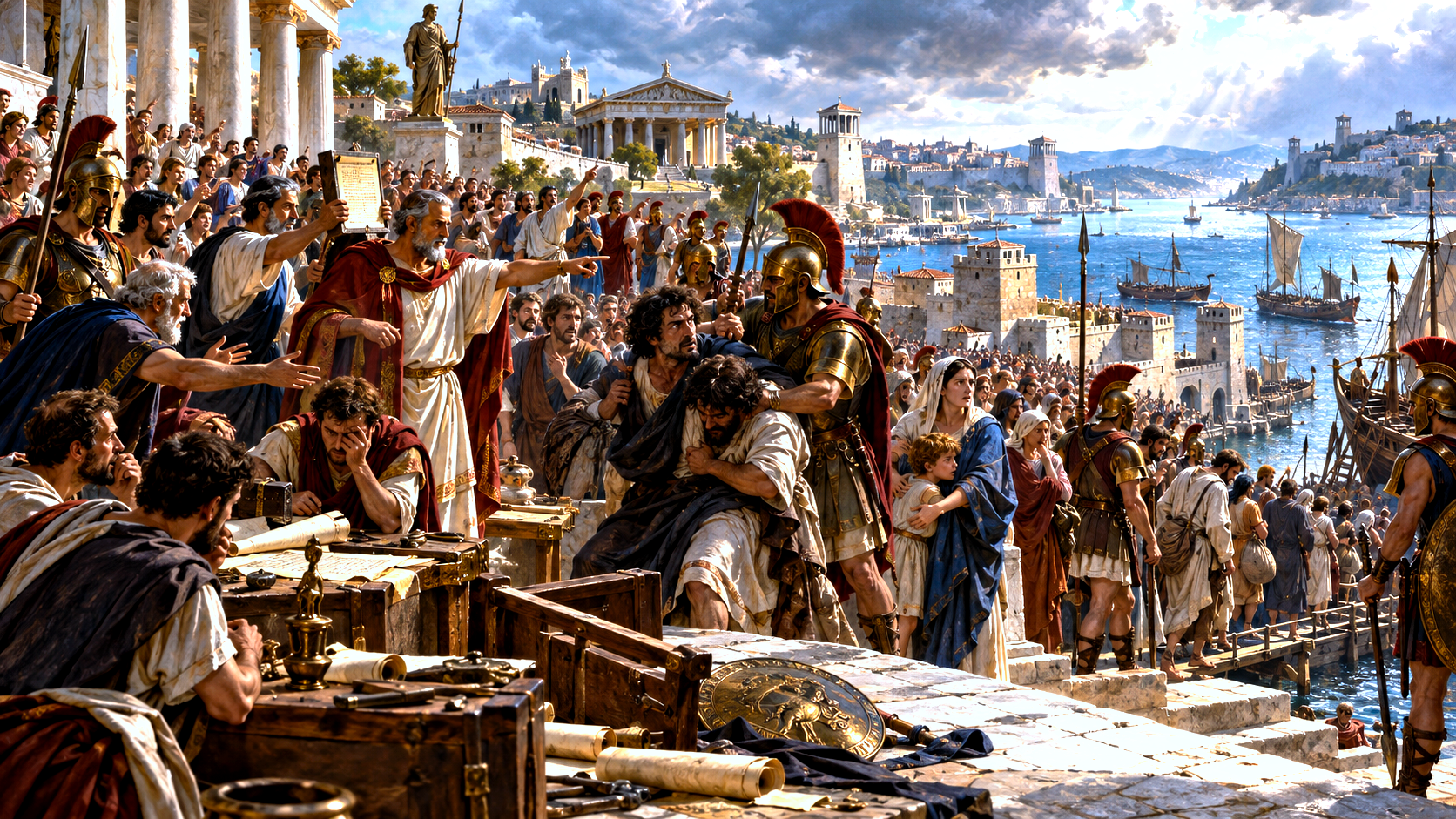
A CORE DEFINITION:
There is a difference between a stranger who has not yet become part of the political community and one who consciously seeks to overthrow or injure it.
I. The Question Beyond Assimilation
There remains a question which the discussion of Aristotle's political philosophy necessarily raises, but does not entirely resolve. What happens when the stranger admitted into a political community does not merely fail to assimilate, but deliberately acts against the peace, security, or constitutional existence of the community that has received him?
This is a different question from that of cultural difference. A newcomer may speak another language, profess another religion, preserve ancestral customs, and retain affectionate ties to his country of origin without thereby becoming an enemy of his adopted country. Nor does legitimate criticism of the government constitute disloyalty to the nation. The capacity to criticise public authority is itself among the privileges of a free political society.
But the position changes when disagreement passes into conspiracy, organised political violence, or active participation in attempts to destroy the constitutional order.
The distinction is fundamental. There is a difference between a stranger who has not yet become part of the political community and one who consciously seeks to overthrow or injure it. The first presents a challenge of integration; the second may present a question of justice and public security.
A serious theory of political membership must account for both.
II. Aristotle and the Conspiracy at Byzantium
Aristotle provides a historical illustration in Politics V.3 (1303a), where he describes the political disturbances arising from the incorporation of additional settlers into established cities.
Among his examples is Byzantium.
There, according to Aristotle, the additional settlers were discovered plotting against the existing community. They were subsequently expelled by force of arms.¹
This example is particularly significant because the difficulty was no longer simply the failure of different populations to achieve civic harmony.
It had developed into deliberate political hostility.
Aristotle does not tell us enough about the Byzantine affair to reconstruct the conspirators' precise intentions, their grievances, or the justice of every action taken against them. His testimony cannot therefore be made to establish a universal rule that expulsion is the necessary remedy for political disaffection.
Nevertheless, the distinction remains important.
A city cannot be understood simply as a collection of persons occupying the same geographical territory. Aristotle regards the polis as an association ordered towards a common conception of the good life. Its members must share not only its physical space but some measure of political friendship, reciprocal obligation, and responsibility for the community's continued existence.
Where those bonds are absent, the city may suffer faction.
Where they are deliberately attacked through conspiracy or organised violence, the community confronts a more immediate threat to its political peace.
The question then becomes not merely how newcomers may be assimilated, but how the political association may legitimately defend itself.
III. St Thomas Aquinas: The Common Good and the Sin of Sedition
St Thomas Aquinas develops the matter with particular clarity.
In the Summa Theologiae, I–II, q.105, a.3, he considers the Mosaic legislation governing relations with foreigners. He distinguishes the traveller, the resident newcomer, and the foreigner seeking full incorporation into the Israelite community.
Aquinas explains that the admission of certain peoples to full participation was delayed because newcomers might not yet have developed a sufficiently firm attachment to the common good.
His concern is not simply ancestry or foreign birth. It is whether a person admitted to political participation possesses the dispositions necessary to exercise that participation responsibly.
The historical prescriptions of the Mosaic law cannot automatically be transferred into modern legislation. Nevertheless, the underlying problem Aquinas identifies remains intelligible: political membership confers powers whose exercise presupposes some responsibility towards the community itself.
Aquinas addresses the graver question directly in II–II, q.42, De seditione.
He distinguishes sedition from ordinary disagreement and personal quarrels. Sedition concerns discord between parts of a political multitude, involving tumult or preparations for conflict, and is condemned because it attacks the unity and peace of the people.
For Aquinas, that unity is not merely convenient. It belongs to the common good.
Political peace makes possible the ordinary goods of human life: family, worship, commerce, education, justice, and the peaceful pursuit of virtue. To attack that peace deliberately is therefore to endanger goods belonging not to an individual ruler but to the community as a whole.
This explains why a political society possesses a legitimate authority to defend itself against organised violence and conspiracies directed against its lawful institutions.
Yet Aquinas introduces a qualification of the greatest importance.
Political authority exists for the common good, not the private advantage of those who govern.
He consequently refuses to identify every disturbance of an existing government with morally culpable sedition. A tyrant who deliberately divides his subjects in order to preserve his own domination may himself be responsible for sedition.
Thus, the Thomistic principle is not that established rulers must be obeyed under every circumstance. It is that the genuine common good, rather than the private interest of either rulers or factions, provides the standard of judgement.
This distinction is indispensable. Without it, the language of sedition could become an instrument by which arbitrary governments silence legitimate opposition.
IV. St Augustine: Peace, Order and the Stranger
The Augustinian contribution deepens the argument.
In The City of God, XIX.17, St Augustine describes earthly peace in terms of an ordered concord concerning the necessities of human life.
The political community exists within the temporal order. It must govern matters upon which people of different religious convictions and cultural traditions can nevertheless reach practical agreement.
Significantly, Augustine does not require that every difference of inherited custom disappear. The heavenly city draws its pilgrims from every nation and recognises the possibility of maintaining diverse customs and institutions, provided they are compatible with the higher obligations of faith.
There is therefore no warrant in Augustine for treating cultural difference, by itself, as an offence against political peace.
Indeed, Christianity itself provides a salutary warning against confusing political obedience with the surrender of conscience. The earliest Christians were frequently accused of undermining established religious and political arrangements precisely because they would not offer to the state the worship belonging to God.
Nevertheless, Augustine's account recognises the necessity of a common temporal peace.
The inhabitants of a city may disagree profoundly about ultimate religious or philosophical questions while remaining bound by laws protecting life, property, justice, and civil order.
The Christian distinction is accordingly between legitimate diversity within a peaceful political association and conduct that deliberately destroys the conditions upon which that association depends.
V. The Reciprocal Duties of Hospitality
Catholic teaching expresses the reciprocal character of these obligations with unusual precision.
Paragraph 2241 of the Catechism of the Catholic Church affirms the obligation of prosperous nations, according to their capacities, to welcome those who seek security and livelihood unavailable in their homelands.
But the same paragraph recognises that political authorities may establish juridical conditions governing immigration for the sake of the common good.
It also places duties upon immigrants: respect for the material and spiritual inheritance of the receiving country, obedience to its laws, and participation in its civic burdens.
These are not incidental requirements.
They establish that hospitality is not necessarily a relationship without reciprocal obligations.
A country which receives newcomers undertakes responsibilities towards them. They must be treated justly, protected by law, and recognised in their human dignity.
In return, newcomers incur responsibilities towards the community whose institutions, peace, and security they share.
Yet these responsibilities must be understood correctly. Respect for the country's heritage does not require abandoning every inherited custom or professing every religious belief traditionally associated with the host society. Nor does civic loyalty demand agreement with every government policy.
The essential obligation is to participate peacefully in the common civic order and to respect the legitimate rights of fellow members of the community.
Hospitality and allegiance are therefore reciprocal duties, but neither extinguishes the requirements of justice.
VI. What May the State Legitimately Do?
Once deliberate subversion or organised political violence is established, the political community is not required to remain passive.
The state has an obligation to protect its inhabitants against violence, terrorism, espionage, intimidation, and other serious offences directed against public security.
That obligation extends to protecting newcomers themselves, who are frequently among the victims of coercion and political extremism.
The appropriate response must nevertheless distinguish several different circumstances.
Ordinary political opposition, peaceful protest, religious dissent, and advocacy of constitutional reform must not be treated as sedition merely because they are unwelcome to those who hold power.
Where there is credible evidence of criminal activity, the appropriate response is investigation, prosecution where justified, and punishment proportionate to the offence following lawful proceedings.
The legal status of the offender also matters. A non-citizen whose conduct establishes a serious national-security threat may, in appropriate circumstances, be subject to exclusion or deportation under the applicable law.
But removal is not an automatic consequence of an accusation. The authorities must respect due process, relevant statutory protections, and obligations concerning refugees and the prevention of torture or other prohibited ill-treatment.
Citizenship introduces a further distinction. Once a person has become a citizen, the state cannot treat him as though he possesses no legal claim to membership merely because he has committed an offence. Citizens who engage in terrorism, espionage, or other serious crimes are answerable to criminal law. Any separate deprivation of citizenship must satisfy the exceptionally serious legal requirements governing that power.
These distinctions are not concessions to sedition. They are consequences of the very rule of law that the political community seeks to preserve.
A government which abandons lawful process in the name of defending constitutional order risks injuring the principles upon which that order rests.
Moreover, responsibility must remain individual. The criminal activity of one newcomer cannot justly be attributed to every person sharing his nationality, religion, or ancestry.
No political community can preserve genuine civic friendship by replacing judgement of conduct with collective suspicion.
VII. Allegiance, Citizenship and the Passage of Generations
We return, finally, to Aristotle's insight that political unity cannot be manufactured instantaneously.
Legal citizenship can be conferred by an act of public authority. Genuine civic attachment is ordinarily acquired through a longer process of formation.
Families establish themselves. Children are educated. Neighbours become familiar. Shared institutions and civic responsibilities create associations that did not previously exist.
But time alone guarantees nothing.
A person may live within a country for decades without developing much attachment to its institutions. Equally, another may acquire a genuine and enduring civic loyalty within a comparatively short period.
The distinction reminds us that assimilation is not a mechanical consequence of residence. It involves both the dispositions of newcomers and the capacity of the receiving society to offer meaningful participation in its common life.
The Roman example is instructive precisely because Roman citizenship developed as a relationship of privileges and obligations, though not always by one uniform route or according to a fixed timetable. Military service, local civic institutions, legal status, and participation in Roman public life could contribute to incorporation.
The central question was not simply how long a man had resided within Roman territory, but what his incorporation meant in law and civic practice.
In a modern constitutional state, the same question assumes a different form. What must be shared for persons of diverse origins to recognise a common political home?
At the very least, there must be commitment to lawful civic processes, recognition of the equal protection owed to fellow citizens, and acceptance that political conflict is to be pursued through legitimate means.
That obligation is not peculiar to immigrants. It binds the native-born citizen no less than the naturalised citizen or settled foreign resident.
A man does not acquire a moral licence to attack his country's common good merely because his ancestors have inhabited its territory for generations.
The principles of justice and civic responsibility must apply to all.
VIII. Conclusion: The City Must Be Able to Defend Its Peace
Aristotle's warning concerning the difficulty of bringing different populations into a common political life remains worth studying. Aquinas adds the moral significance of sedition as an offence against civic unity. Augustine explains why temporal peace is a good that persons of different origins and convictions may share. Catholic doctrine places obligations upon both the receiving community and those whom it receives.
Together, these considerations establish two duties which need not contradict one another.
The first is the obligation to welcome and treat the stranger justly, according to the requirements of charity, prudence, and the common good.
The second is the obligation to preserve the peace and lawful institutions of the political community against deliberate criminal attack.
Neither duty abolishes the other.
A society which refuses all obligations towards strangers mistakes exclusion for political wisdom. But a society which denies its responsibility to protect its members mistakes passivity for charity.
The proper measure is justice: hospitality without political irresponsibility, civic loyalty without enforced uniformity of conscience, and lawful protection of the community without collective punishment or arbitrary power.
For the ultimate purpose of political association is not merely that people should inhabit the same territory, but that they should learn to live together under a common and just order.
And where that order is deliberately attacked, the city's defence must be worthy of the very peace it exists to preserve.
XIV
Until They Breathe Together
What then follows? Not a policy; that is the work of statesmen, and a priest who drafts immigration law has mistaken his vocation. But certain principles follow, and the Church has a right and a duty to speak of them.
The first is proportion. The pace at which a society receives newcomers should bear some relation to its capacity to form them, and that capacity depends on the distance in language, culture and faith between the newcomers and their hosts. This is not a judgment on the worth of any people; it is a judgment about time. The retornados could be received in a year because they were already Portuguese. Others, from further away, need longer, and there is no shame in saying so. The shame lies in pretending that the difference does not exist and then blaming one party or the other when the city fails to breathe together.
The second is formation. The greatest preservative of a political community is the education of its members in its common life, and that duty falls on the host as well as the guest. A society that wishes newcomers to love its inheritance must first love it itself, know it, and teach it without apology. The migrant cannot be blamed for failing to enter a house whose owners have forgotten why it was built.
The third is the protection of the stranger in the meantime. The time required for integration is not a time of contempt or neglect. It is the time of the Egyptian who is not to be abhorred, of the peregrini whom Ambrose would not see expelled, of the guest room in Chrysostom’s house. Love of the stranger as a person and prudence about the pace of civic integration are not rivals; they are the two hands of the same justice.
The fourth is the recognition of belonging when it has come. Where newcomers and their children have truly entered the common life, have learned its language, borne its burdens and come to love its good, the law should acknowledge what has happened, as Claudius urged the Senate to acknowledge the Gauls. To refuse that recognition is to provoke the very faction one fears.
And there is a last thing to say, which belongs to the Church alone. Aristotle’s word for the unity of a city is συμπνεῖν, to breathe together. Christians cannot hear that word without thinking of another breath. On the evening of the resurrection, the risen Lord breathed on his disciples and said, ‘Receive the Holy Spirit’; at Pentecost the Spirit came as a rushing wind and made of many tongues one people.[38] The Church is the place where men and women of every nation learn, over generations, to breathe with one Spirit. She is the oldest and most successful school of integration the world has known, and she has done her work not by abolishing nations but, as Augustine saw, by gathering citizens from all of them while preserving whatever in their customs serves peace.
The earthly city cannot do what the Spirit does, and should not try. But it can learn from the Church that unity among different peoples is real, possible and precious, that it is the fruit of a shared life and a shared love, and that it takes time. Aristotle saw the danger; Deuteronomy and Aquinas named the remedy; the Fathers insisted that the stranger be loved while the remedy does its work. Between the first arrival and the full belonging lies a span of years, sometimes generations, in which the city must be patient and the newcomer must be willing. Aristotle’s warning was not that this cannot be done. It was that it cannot be done quickly. Faction is to be expected, he said, until they breathe together. Our task, as citizens and as Christians, is to make that ‘until’ come to pass. ✠
[1]Aristotle, Politica, ed. W. D. Ross, Oxford Classical Texts (Oxford: Clarendon Press, 1957), V.1, 1301a25–b4. All references to the Politics are to Bekker pages and lines in Ross’s text; translations are my own unless otherwise stated.
[2]Pol. V.2, 1302b2–5.
[3]G. V. W. Lewis, “Grafted In: On What Makes Us Who We Are,” Mind the Limoges (Canons Regular of the Sacred Heart of Jesus, October 2026).
[4]Strabo, Geographica VI.1.13, names an Achaean founder from Helice; the Troezenian partnership is known to us chiefly from Aristotle. On the foundation see T. J. Dunbabin, The Western Greeks (Oxford: Clarendon Press, 1948), 24–27.
[5]Diodorus Siculus, Bibliotheca historica XII.9–11, ed. and trans. C. H. Oldfather, Loeb Classical Library, vol. 4 (Cambridge, MA: Harvard University Press, 1946); Strabo VI.1.13. Aristotle, Rhetoric III.9, 1409a28, cites the opening of Herodotus’ history as the work of “Herodotus of Thurii.”
[6]Diodorus XII.11.1–2.
[7]Herodotus, Historiae VI.22–24, ed. N. G. Wilson, Oxford Classical Texts, 2 vols. (Oxford: Oxford University Press, 2015).
[8]Thucydides, Historiae VI.4.5–6, ed. H. Stuart Jones and J. E. Powell, Oxford Classical Texts, 2 vols. (Oxford: Clarendon Press, 1942).
[9]Diodorus XI.72.3. Figures in Diodorus should be treated with caution; the order of magnitude, rather than the precise number, is what matters here.
[10]Diodorus XI.72–73, 76. Aristotle alludes to the same episode at Pol. V.3, 1303a38–b2, the passage quoted above.
[11]Thucydides IV.102–106; on the composition of the citizen body, IV.106.1.
[12]Pol. V.6, 1305b39–1306a4: καὶ ἐν Ἀμφιπόλει ᾧ ὄνομα ἦν Κλεότιμος τοὺς ἐποίκους τοὺς Χαλκιδέων ἤγαγε, καὶ ἐλθόντων διεστασίασεν αὐτοὺς πρὸς τοὺς εὐπόρους. “And at Amphipolis a man named Kleotimos brought in the settlers from Chalcis, and when they had come he set them at faction against the wealthy.”
[13]Pol. V.6, 1306a7–9.
[14]Pol. VII.6, 1327a13–15.
[15]Pol. VII.6, 1327a37–40: τοῖς νόμοις φράζοντας καὶ διορίζοντας τίνας οὐ δεῖ καὶ τίνας ἐπιμίσγεσθαι δεῖ πρὸς ἀλλήλους.
[16]Pol. III.2, 1275b34–39.
[17]Pol. III.5, 1278a26–34.
[18]Pol. VIII.1, 1337a11–27.
[19]Plato, Leges IV, 708c–d, in Platonis Opera, ed. J. Burnet, Oxford Classical Texts, vol. 5 (Oxford: Clarendon Press, 1907); English as in the translation of B. Jowett, The Dialogues of Plato, 3rd ed. (Oxford: Clarendon Press, 1892). The Greek at 708d appears to use the same verb as Aristotle’s συμπνεύσῃ for the yoked horses drawing together; I have not been able to verify the wording against Burnet’s text in preparing this essay, and it should be checked before the lexical echo is pressed.
[20]Tacitus, Annales XI.23–25, ed. C. D. Fisher, Oxford Classical Texts (Oxford: Clarendon Press, 1906); the Lyon tablet is CIL XIII 1668 (= ILS 212). Tacitus’ version is a literary reworking, not a transcript, but its central argument corresponds to the inscription.
[21]Aquinas, Summa Theologiae I–II, q. 105, a. 3, in Opera omnia iussu Leonis XIII P. M. edita, vol. 7 (Rome: Typographia Polyglotta, 1892); English in The Summa Theologica of St. Thomas Aquinas, trans. Fathers of the English Dominican Province, 2nd rev. ed. (London: Burns, Oates & Washbourne, 1920). I quote the English translation because I could not verify the Leonine Latin of this article in preparing the essay; the Latin should be supplied from the critical edition before publication.
[22]Aquinas, ST I–II, q. 105, a. 3, ad 1, citing Judith 14:6 and Ruth 3:11.
[23]Ruth 1:16 (Vulgate).
[24]Augustine, De civitate Dei XIX.13, ed. B. Dombart and A. Kalb, CCSL 48 (Turnhout: Brepols, 1955).
[25]De civ. Dei XIX.7: linguarum diuersitas hominem alienat ab homine … ita ut libentius homo sit cum cane suo quam cum homine alieno (“diversity of languages estranges man from man … so that a man would more gladly be with his dog than with a man who is a foreigner”).
[26]Ambrose, De officiis III.45–52, ed. and trans. Ivor J. Davidson, 2 vols. (Oxford: Oxford University Press, 2001); also ed. M. Testard, CCSL 15 (Turnhout: Brepols, 2000).
[27]Gregory of Nazianzus, Oratio 43.63, ed. J. Bernardi, Discours 42–43, Sources Chrétiennes 384 (Paris: Cerf, 1992); PG 36:577–80.
[28]John Chrysostom, Homiliae in Acta Apostolorum 45.4, PG 60:319–20.
[29]Pius XII, Apostolic Constitution Exsul Familia Nazarethana (1 August 1952), AAS 44 (1952): 649–704.
[30]Catechism of the Catholic Church, 2nd ed. (Vatican City: Libreria Editrice Vaticana, 1997), §2241.
[31]Benedict XVI, Encyclical Letter Caritas in veritate (29 June 2009), §62, AAS 101 (2009): 641–709.
[32]John Paul II, Message for the 90th World Day of Migrants and Refugees (2004), §3. The paragraph reference should be checked against the official text.
[33]Home Office, Community Cohesion: A Report of the Independent Review Team (London: Home Office, 2001), §2.1. The location of the phrase within the report should be confirmed before publication.
[34]G. V. W. Lewis, “The Man Who Could Not Read,” Mind the Limoges (Canons Regular of the Sacred Heart of Jesus, October 2026).
[35]Marcus Lee Hansen, The Problem of the Third Generation Immigrant (Rock Island, IL: Augustana Historical Society, 1938).
[36]Robert D. Putnam, “E Pluribus Unum: Diversity and Community in the Twenty-first Century,” Scandinavian Political Studies 30, no. 2 (2007): 137–74.
[37]The IARN was established by Decree-Law 169/75 of 31 March 1975 and extinguished by Decree-Law 97/81 of 2 May 1981; see the preamble to Decree-Law 301/83 of 24 June 1983. On numbers and timing see Rui Pena Pires et al., Os Retornados: Um Estudo Sociográfico (Lisbon: Instituto de Estudos para o Desenvolvimento, 1987); Morgane Delaunay, “Portugal e o regresso dos colonos de Angola e Moçambique,” 87–103, available at revistas.rcaap.pt.
[38]John 20:22, in Novum Testamentum Graece, ed. B. Aland et al., 28th rev. ed. (Stuttgart: Deutsche Bibelgesellschaft, 2012): καὶ τοῦτο εἰπὼν ἐνεφύσησεν καὶ λέγει αὐτοῖς· λάβετε πνεῦμα ἅγιον. “And when he had said this, he breathed on them and said to them, Receive the Holy Spirit.” On Pentecost, Acts 2:1–11.
[39] Aristotle, Politics, V.3, 1303a25–b3, especially the account of Byzantium and the conspiracy of the additional settlers.
[40] St Thomas Aquinas, Summa Theologiae, I–II, q.105, a.3, on relations with foreigners and admission into the political community.
[41] St Thomas Aquinas, Summa Theologiae, II–II, q.42, aa.1–2, on the nature and morality of sedition.
[42] St Augustine, De Civitate Dei, XIX.17, on temporal peace and the heavenly city's relationship with earthly political communities.
[43] Catechism of the Catholic Church, §§2239–2243, on civic obligations, immigration, conscience, and resistance to oppression.
[44] European Court of Human Rights, Chahal v. United Kingdom, judgment of 15 November 1996, on the prohibition of removal to a real risk of torture or prohibited ill-treatment, including in national-security cases.