
The Man Who Could Not Read
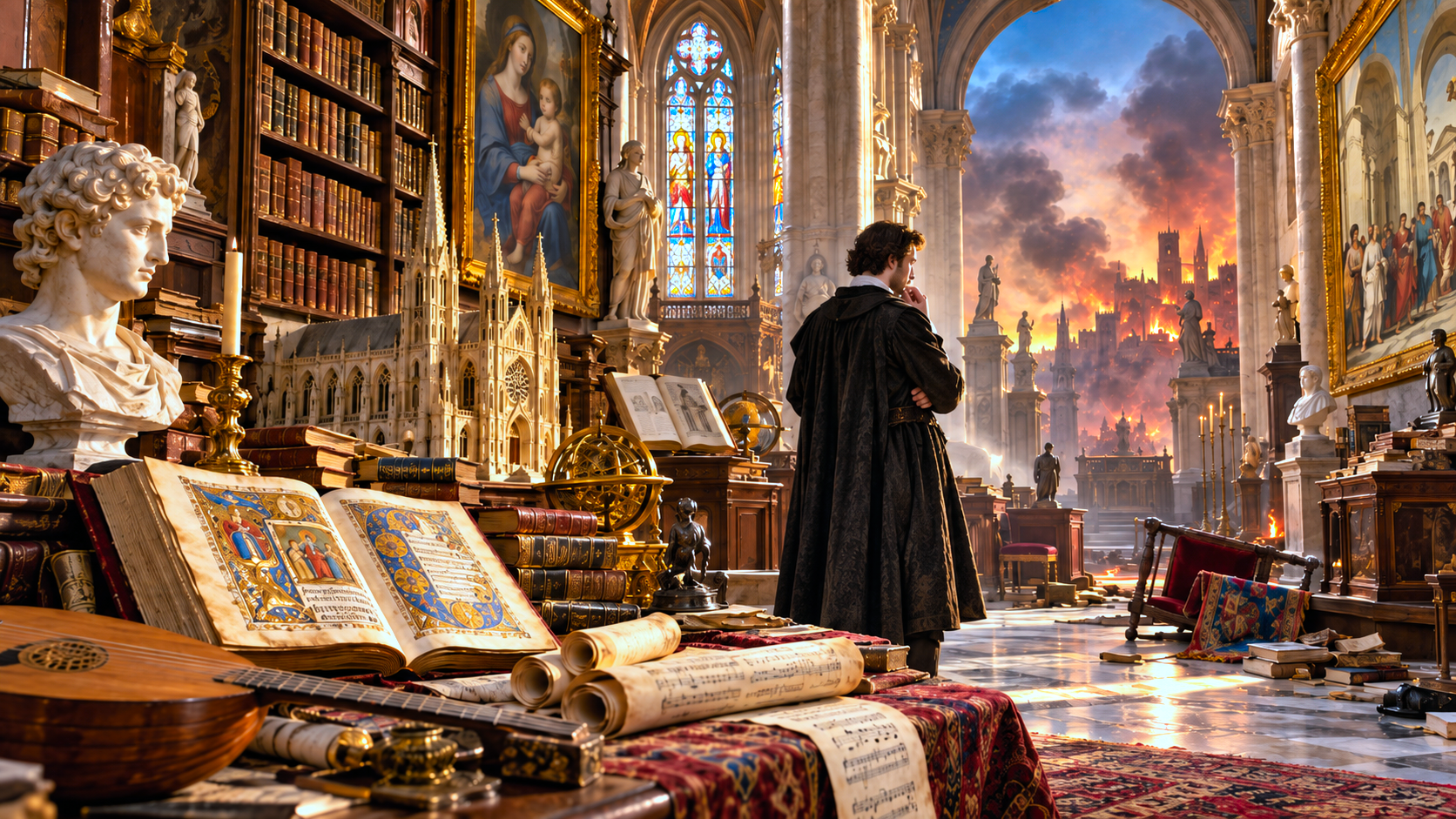
Western Civilisation, Its Inheritance, and the
New Conditions of Its Peril
I. The Warning and Its Discipline
This essay is a warning, and a warning is a genre with obligations. It must name a danger that is real. It must not inflate that danger, because an inflated warning is spent at its first test and leaves its hearers less prepared than they were before it was given. And it must say what may be done, since alarm without counsel is only another species of disorder. I intend to keep all three obligations.
My claim is this. The inheritance of the West — the buildings, images, scores, books, laws and habits of mind which the peoples of Europe and their descendants have accumulated over some three thousand years — now stands under a combination of pressures that did not exist in this form forty years ago. Among those pressures is migration on a scale, and at a speed, which outruns the capacity of the receiving societies to hand that inheritance on to those who arrive. The iconoclasm of the Levant and the riots of the French suburbs give us two concrete images of what failure would look like: the first shows that there exists, in our own century, a doctrine which counts the destruction of an inherited past as an act of piety; the second shows how quickly the fire in the street can find its way to the library. Neither image is a prophecy. Both are precedents, and prudence is the virtue that takes precedents seriously before they combine.
Readers of this journal will know the discipline I try to keep. In the trilogy on the sword and the stranger, and in the essay on the goats who were surprised, I argued that the State possesses a real and theologically grounded competence over admission, and that the stranger nevertheless has a claim upon the Christian conscience which no policy retires.[1] Nothing here retracts either half. Precisely because the argument now concerns irreplaceable things, it must not be bought with counterfeit coin. A warning resting on the assertion that migrants, as such, hold our civilisation in contempt would be false as a matter of fact, and it would collapse at the first Chaldean priest who left Mosul with his community’s manuscripts in the back of a car — as one Dominican did in the summer of 2014, ahead of the men who would have burned them.[2] The contempt is real. But it has addresses, and it is the business of an honest essay to find them rather than to post the charge to an entire population.
I shall therefore proceed in three movements. First, an inventory of what is meant by Western civilisation and of what it has made, given at sufficient length that the reader feels the weight of what is at stake. Second, an examination of the precedents — Syria and Iraq, the French riots, the attacks on churches and clergy — with the evidence weighed and its limits stated. Third, an account of who holds the inheritance in contempt and who does not, an honest statement of the objections, and the constructive counsel which the tradition supports.
II. What Is Meant by “the West”
The West is not a geography, though it has one, and it is not a race, though polemic on both flanks increasingly speaks as if it were. It is an inheritance — a body of convictions, practices and works handed from one generation to the next, received, criticised, enlarged and handed on again. The classical description names three cities, and the description has lasted because it is true. From Athens came the conviction that the world is intelligible, that reason can follow the λόγος (reason) woven through it, that the beautiful is a form of the true, and that free men may deliberate together in a πόλις (polis). From Jerusalem came the one God who creates freely out of nothing, a history with a direction and a judgement, the irreducible dignity of the person made in the divine image, and the prophet who stands before the king and tells him he is not God. From Rome came law as a discipline of reason, institutions that outlive the men who serve them, and citizenship as a juridical status rather than a tribal belonging.
Christianity fused the three. It did so not by abolishing the classical inheritance but by reading it, and the posture is visible at the very beginning, when the Apostle stands on the Areopagus.
διερχόμενος γὰρ καὶ ἀναθεωρῶν τὰ σεβάσματα ὑμῶν εὗρον καὶ βωμὸν ἐν ᾧ ἐπεγέγραπτο· Ἀγνώστῳ θεῷ. ὃ οὖν ἀγνοοῦντες εὐσεβεῖτε, τοῦτο ἐγὼ καταγγέλλω ὑμῖν.
“For as I passed through and looked carefully at the objects of your worship, I found also an altar on which was inscribed: To an unknown god. What therefore you worship without knowing it, this I proclaim to you.”
Acts 17:23 (NA28) [3]
Paul does not smash the altar. He reads its inscription, takes it as an opening, and preaches from it. The verb is ἀναθεωρῶν (reviewer) — he looked again, looked carefully. That second look is the Western posture towards an inherited past, and it is the precise opposite of the posture I shall describe in the fifth section of this essay, where the inscription is not read but dynamited. St Basil would later tell the young men of Caesarea to take from the pagan poets what was good, as the bee takes honey from the flower and leaves the rest; Augustine would speak of spoiling the Egyptians. The Church carried Virgil and Aristotle through the collapse of the Western Empire because she judged that what was true in them belonged to the Truth she served.
To the three cities must be added what the barbarian kingdoms brought — Germanic customary law, the assembly, the oath of fealty — and what Irish and Northumbrian monks brought to the copying desk: the Lindisfarne Gospels, written on Holy Island around 715 and now in the British Library, are as Western as the Parthenon.[4] And one further foundation, which belongs to the theme of this journal more than to any other. In 494 Pope Gelasius wrote to the Emperor Anastasius that two powers govern this world, the sacred authority of the pontiffs and the royal power.[5] From that plural descended, by a long and contested road, the limited State, the liberty of the Church, the notion that there are things Caesar may not touch, and at last the liberty of conscience itself. No other civilisation produced that distinction in quite that form, and much of what is most precious in the West depends upon it.
One consequence of all this must be stated at the outset, because the rest of the essay turns upon it. An inheritance is transmitted by teaching, not by blood. It has been well said that every generation receives a fresh invasion of barbarians, whom we call our children. A civilisation of this kind can therefore be joined: men and women born far from Europe have become among its finest servants. And by the same token it can be lost by those born inside it, who were never taught what they possess. Both truths will matter when we come to ask where the danger lies.
III. The Inheritance: An Inventory
What follows is not an exhaustive catalogue — no essay could be — but a reckoning sufficient to make concrete what is otherwise only a word. The reader is invited to notice, as the list proceeds, how much of it is physical, unique and combustible.
Architecture
It begins on the Acropolis, where the Parthenon was raised between 447 and 432 BC with columns so subtly swelled and inclined that the eye reads as straight what the mason cut as curved. It continues in Rome, where the dome of the Pantheon, cast around AD 126, remains the largest unreinforced concrete dome on earth. Justinian’s Hagia Sophia, dedicated in 537, was for nine centuries the greatest church in Christendom; its return to use as a mosque by decree in 2020 is a reminder that heritage may be repurposed as well as destroyed. Charlemagne’s Palatine Chapel at Aachen carried the Roman manner north. And here in the North-East of our beloved England stands the building which, for a writer in Durham, stands nearest of all: Durham Cathedral, whose high vaults, built between about 1093 and 1133, are among the earliest pointed rib vaults raised on a great scale anywhere in Europe — the structural invitation from which Gothic would follow.[6] It shelters the shrine of St Cuthbert and the tomb of the Venerable Bede.

Durham Cathedral, England
From that invitation came Chartres, with its sculpted Royal Portal and its glass; the Sainte-Chapelle, a reliquary turned inside out; Cologne, begun in 1248 and finished, on the original drawings, in 1880; Westminster Abbey; the fan vault of King’s College Chapel. Brunelleschi closed the dome of Florence Cathedral between 1420 and 1436 without centring, a feat of engineering whose method is still debated. Then St Peter’s; the Manueline Jerónimos Monastery at Belém - Lisbon, Portugal, built on the profits of the voyages; El Escorial; Versailles; Wren’s St Paul’s, raised from the ashes of 1666 — a building that is itself a lesson in what fire takes and what a confident civilisation rebuilds; Barry and Pugin’s Palace of Westminster; and Gaudí’s Sagrada Família, still rising. But the true repository of Western architecture is not the cathedral. It is the parish church: some sixteen thousand of them in the Church of England alone, the great majority listed buildings, and some forty-two thousand churches and chapels in France.[7] Most are rural. Most are kept by volunteers. Most stand open.
Sculpture
The Kritios Boy, around 480 BC, shifts his weight onto one leg and Western sculpture begins to breathe. Phidias’ frieze from the Parthenon, the Winged Victory of Samothrace on the Daru staircase of the Louvre, the Laocoön unearthed in a Roman vineyard in 1506 while Michelangelo watched, the Augustus of Prima Porta: these established a vocabulary of the human body that the Middle Ages would baptise. Gislebertus carved the Last Judgement at Autun and signed it; the jamb figures of Chartres stand like columns that have become saints; the smiling angel of Reims smiles on, though she lost her head when German shells set the cathedral alight in 1914 and had to be restored.[8] Donatello’s bronze David was the first free-standing nude since antiquity; Ghiberti’s east doors for the Florentine Baptistery were called by Michelangelo fit to be the Gates of Paradise.
Michelangelo himself gave us the Pietà, the David and the Moses — and the Pietà, it should be remembered, was struck fifteen times with a hammer in 1972 by a single man who walked up to it in St Peter’s. Bernini’s Ecstasy of St Teresa and his Apollo and Daphne made marble do what marble cannot; Canova restored classical calm; Rodin’s Gates of Hell and his Thinker carried Dante into the modern age; Henry Moore, a Yorkshire miner’s son, gave the twentieth century its reclining figures. Every one of these is unique, and most of them could be ruined in an afternoon.
Painting
From the frescoes of the catacombs and the icons of Byzantium — and none is more fitting to name in a journal devoted to Trinitarian theology than Rublev’s Hospitality of Abraham, painted in the early fifteenth century, in which three figures around a table disclose the life of the One God — Western painting learned that an image may be a window. The Book of Kells and the Lindisfarne Gospels made the page itself an icon. Giotto, in the Scrovegni Chapel at Padua around 1305, gave painted figures weight and grief; Duccio’s Maestà was carried through the streets of Siena in procession. Jan van Eyck’s Ghent Altarpiece of 1432, perhaps the most stolen painting in history, still lacks its panel of the Just Judges, taken in 1934 and never recovered.[9] Masaccio’s Trinity in Santa Maria Novella, around 1427, is the first fully realised exercise in linear perspective, and its subject is the Father holding the Cross of the Son with the Dove between them.
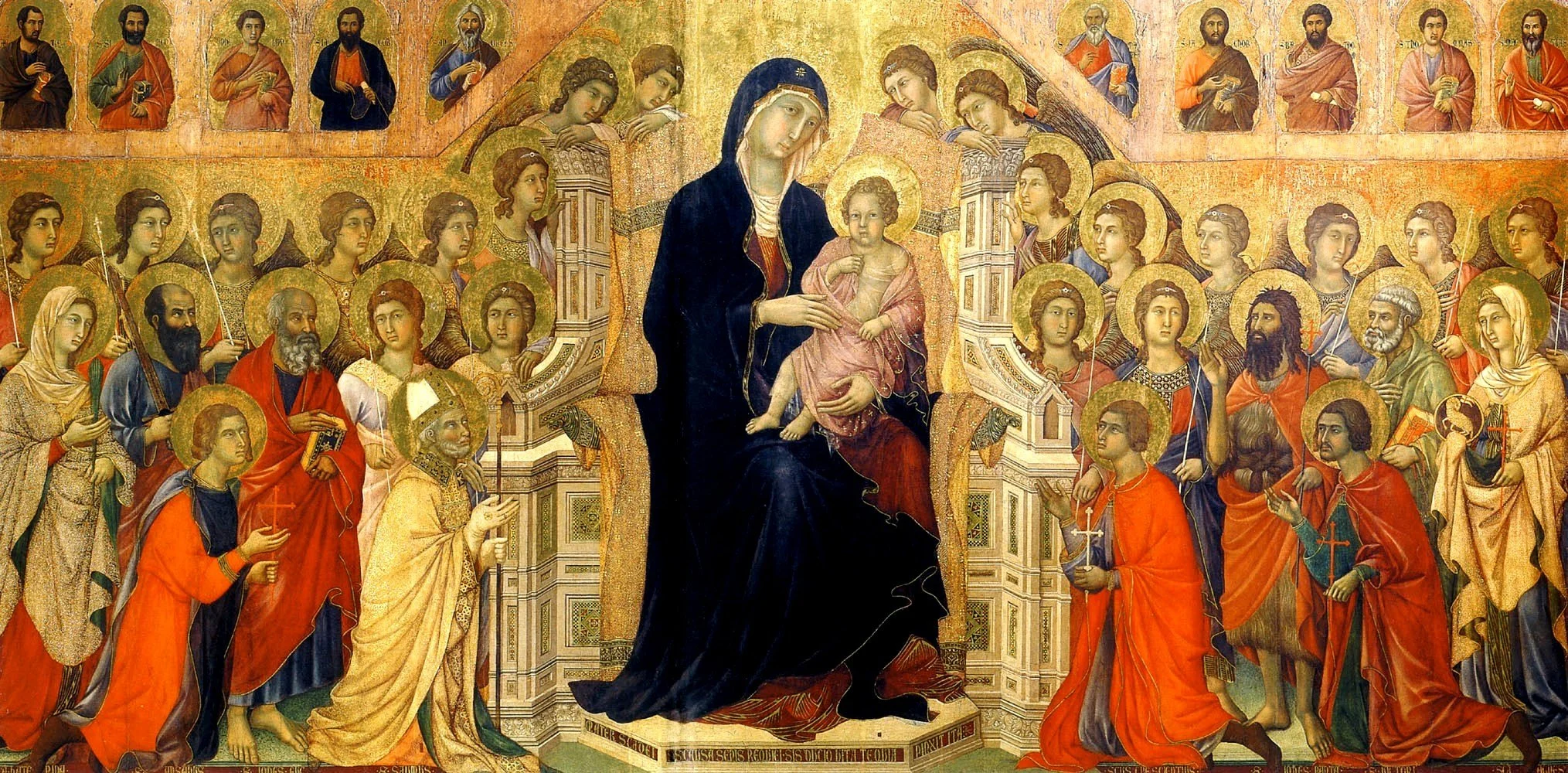
Duccio: “Maesta”
Then the High Renaissance, which is the West’s self-portrait: Leonardo’s Last Supper, Michelangelo’s Sistine ceiling and Last Judgement, Raphael’s School of Athens — Plato and Aristotle painted on the walls of the papal apartments facing the Disputation of the Holy Sacrament, Athens and Jerusalem in a single room. Titian, Dürer, Holbein, Bruegel; Nuno Gonçalves’ Panels of St Vincent in Lisbon; Caravaggio’s Calling of St Matthew, where a shaft of light falls on a tax collector at his counting; Rubens, Velázquez’s Las Meninas, Zurbarán’s monks; Rembrandt’s Night Watch and his Return of the Prodigal Son; Vermeer’s rooms of light. Goya’s Third of May turned painting into conscience; Turner and Constable, Caspar David Friedrich, Delacroix, the Impressionists, Van Gogh and Cézanne carried it to the threshold of the present; and Picasso’s Guernica showed that the West could make an icon of its own crimes. A civilisation that paints its sins is a civilisation with a conscience, and that too is part of the inheritance.
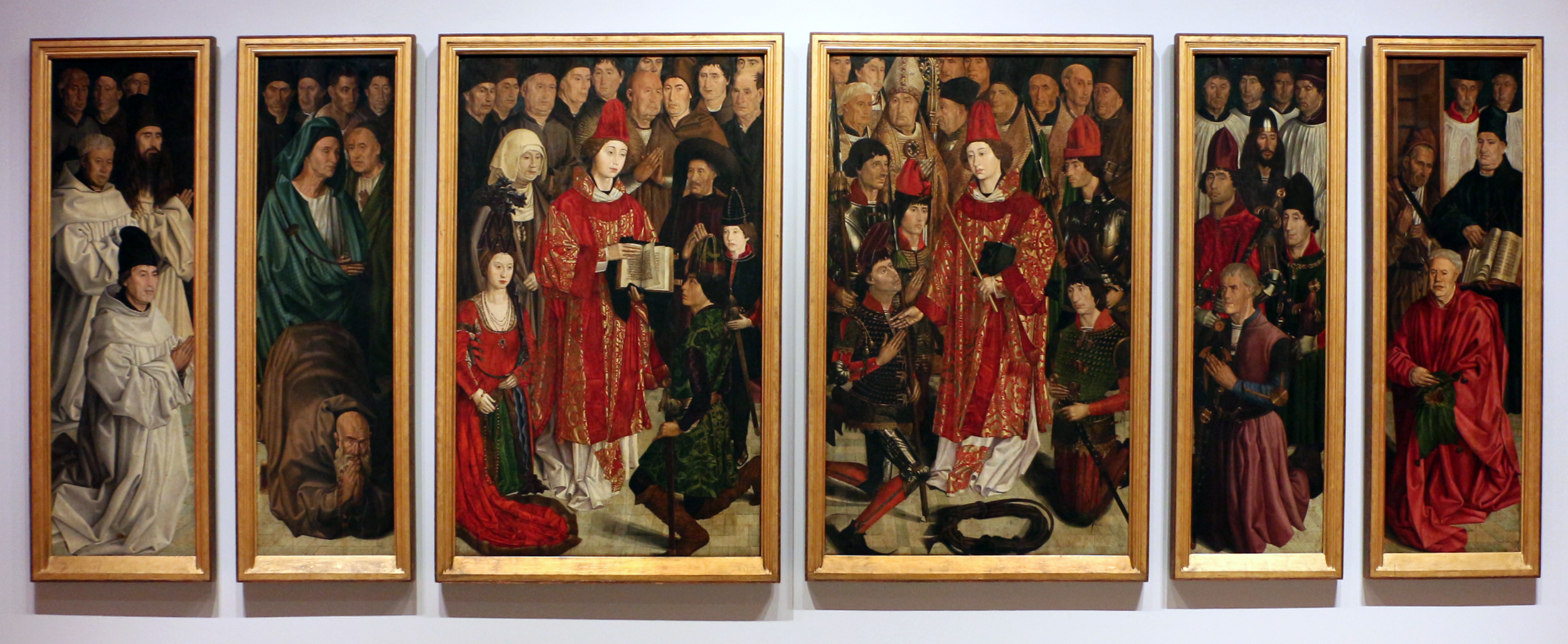
Nuno Gonçalves’ Panels of St Vincent - Lisbon, Portugal
Sacred and Classical Music
Western music begins in the choir. Gregorian chant carried the psalter through the monasteries for a millennium, and the West then did something no other musical civilisation did in the same way: it wrote music down so precisely that it could be reproduced by people who had never heard it. The neumes of St Gall and, around 1030, Guido of Arezzo’s staff and his syllables drawn from the hymn Ut queant laxis made the score possible.[10] From the score came polyphony: Léonin and Pérotin at Notre-Dame, Machaut’s Messe de Nostre Dame, Dunstable, Josquin, Palestrina, Victoria, Tallis’ forty-voice Spem in alium, Byrd composing Masses for recusants in English country houses, Allegri’s Miserere, Monteverdi’s Vespers of 1610.
Then Purcell; Bach, whose B minor Mass and St Matthew Passion are, for many who hold no faith, the nearest thing to proof that there is something to hold; Handel’s Messiah; Haydn’s Creation; Mozart’s Requiem; Beethoven’s Missa Solemnis and Ninth Symphony; Schubert, Mendelssohn — who revived the St Matthew Passion in Berlin in 1829, a century after its composition, and so recovered a lost inheritance — Brahms’ German Requiem, Verdi’s Requiem, Mahler’s Resurrection Symphony No.2, Wagner, Bruckner, Dvořák; Elgar’s Dream of Gerontius, setting Newman; Fauré; Vaughan Williams’ Fantasia on a Theme by Thomas Tallis; Rachmaninov’s Vespers; Stravinsky’s Symphony of Psalms; Poulenc; Messiaen’s Quartet for the End of Time, composed and first performed in a German prisoner-of-war camp in 1941; Pärt and MacMillan in our own day.
Gustav Mahler (1860-1911) Symphony no. 2 - Resurrection Grand Finale
Here the physical point becomes acute. A symphony is not only its performances; it exists also as an object. The autograph of the St Matthew Passion lies in the Staatsbibliothek zu Berlin; so does that of Beethoven’s Ninth, inscribed on UNESCO’s Memory of the World register; the autograph of Messiah is in the British Library; Mozart’s unfinished Requiem, with the hands of Eybler and Süssmayr visible beside his own, is in the Austrian National Library.[11] These are not curiosities. They carry the composer’s corrections, deletions and second thoughts, which no printed edition fully preserves and no recording can restore. And we know what loss looks like in this field, because we have suffered it: of Monteverdi’s L’Arianna, the opera that made Mantua weep in 1608, only the lament survives.[12] Behind the famous autographs stand thousands of unique part-books, choirbooks and cathedral music archives — the Eton Choirbook, the Old Hall Manuscript, the uncatalogued shelves of a hundred cathedral libraries — many of them still kept where they were sung.
Modern and Popular Music
The inheritance did not stop at the concert hall. Jazz was born in New Orleans out of the spirituals, the brass bands and the blues, and it is worth pausing over what that means: a music forged by the descendants of enslaved Africans, in a Christian America, out of hymnody and European harmony, became one of the West’s defining twentieth-century arts. Louis Armstrong, Duke Ellington and Mahalia Jackson are proof that the inheritance can be entered and enlarged by those whom it once wronged. From the blues and gospel came rock and roll — Elvis Presley, Chuck Berry — and then the British answer: the Beatles, the Rolling Stones, the Kinks; Bob Dylan and the Beach Boys; Pink Floyd and Queen; Kraftwerk, who invented the electronic sound of the late century in Düsseldorf; ABBA. Édith Piaf and Jacques Brel gave the chanson its tragedy; Amália Rodrigues made fado the voice of a whole people’s saudade; the Italian canzone, the American musical, the film score from Prokofiev’s Alexander Nevsky to John Williams. Popular music is the least fragile part of the inheritance in one sense — it exists in millions of copies — and the most fragile in another, since its master tapes, studio archives and original manuscripts are as combustible as any medieval part-book.
Comfortably Numb - Pink Floyd
Literature
Homer first, and the tragedians who made of the Athenian festival a public examination of conscience; Herodotus and Thucydides, who invented history as inquiry; Plato and Aristotle; Cicero; Virgil, whose Aeneas carries his father out of burning Troy — the founding Western image of a man rescuing his inheritance from fire; Ovid. Then Augustine’s Confessions and City of God, Boethius in his cell, and at the edge of the world the poet of Beowulf, whose single surviving manuscript was scorched in the Cotton Library fire of 1731 and still bears the charred margins.[13] Bede wrote the Ecclesiastical History of the English People at Jarrow, a few miles from where this is written, in 731.[14] Then the Chanson de Roland, the Arthurian romances, Dante, Petrarch, Boccaccio, Chaucer, Malory; Erasmus and More; Rabelais and Montaigne; Cervantes; Camões, whose Lusíadas sang the voyages; Shakespeare; the King James Bible; Milton, Bunyan, Molière, Racine, Pascal, Swift.
Goethe and Schiller; Austen and Wordsworth; Manzoni’s Betrothed; Hugo, whose Bishop Myriel gives the silver candlesticks to the thief who stole his plate; Dickens; Dostoevsky’s Brothers Karamazov and Tolstoy’s War and Peace; Flaubert; Hopkins and Newman; Chesterton; Eliot’s Four Quartets; Tolkien and Lewis; Waugh’s Brideshead; Bernanos’ Diary of a Country Priest; Solzhenitsyn; and, not least, the two great modern parables of a civilisation that forgets — Orwell’s Nineteen Eighty-Four, in which the past is rewritten in the Ministry’s furnaces, and Bradbury’s Fahrenheit 451, in which the firemen start the fires and the last guardians of literature are men who have learned whole books by heart. Western literature, it turns out, has been warning itself about this very essay’s subject for a long time.
Law, Mind and the Social Order
Beneath the visible works lies a habit of mind. Justinian’s jurists compiled the Corpus iuris civilis between 529 and 534; its recovery at Bologna at the end of the eleventh century gave Europe a common grammar of law. Gratian’s Decretum of around 1140 gave the Church hers, and the canonists who glossed it began to speak of ius as something a person possesses — the seed, as Brian Tierney showed, of the modern language of natural rights.[15] Magna Carta in 1215 promised that no free man would be taken or imprisoned save by the lawful judgement of his peers or the law of the land. The Investiture Controversy, the universities as self-governing corporations, the parliaments of the thirteenth and fourteenth centuries, the Salamancan theologians — Vitoria lecturing in 1539 that the peoples of the Americas were true owners of their lands and true lords of their polities — all belong to the same development.[16]
So too do institutions we now take for granted as though they were features of the landscape: the hospital, from Basil’s foundation at Caesarea and the Hôtel-Dieu of Paris; the orphanage and the almshouse; marriage as a bond requiring the free consent of both spouses, a canonical principle which quietly subverted the dynastic power of fathers; the abolition of the slave trade in 1807 and of slavery in the British Empire in 1833, carried by Christian conscience against vast economic interest. And one further trait, which the West’s critics practise without noticing where they learned it: the capacity for self-criticism. The West committed the Atlantic slave trade, the Terror and the Shoah. It also produced the moral vocabulary in which they are condemned. An honest inventory includes both, and an honest defender of the inheritance does not pretend otherwise.
Knowledge, Science and Technology
Euclid’s Elements, Archimedes, Hippocrates, Galen and Ptolemy were carried across the dark centuries by Byzantine copyists, by Cassiodorus at Vivarium, by Irish and Benedictine scriptoria, and — honesty requires it — by the translators of Baghdad, among whom the Nestorian Christian Hunayn ibn Ishaq was preeminent, and later by the Latin translators of Toledo, such as Gerard of Cremona.[17] Leonardo of Pisa brought the Hindu-Arabic numerals to Europe in his Liber abaci of 1202. The West has always absorbed; its genius lies partly in what it did with what it received. The universities of Bologna, Paris and Oxford institutionalised inquiry. Robert Grosseteste, Bishop of Lincoln, wrote on optics and experimental method; Buridan and Oresme at Paris anticipated the mechanics of impetus and the graphing of motion.
Copernicus, a canon of the cathedral chapter of Frombork, published De revolutionibus in 1543, the same year as Vesalius’ Fabrica. Then Galileo, Kepler, Descartes, Pascal; Newton’s Principia of 1687; Leibniz; Linnaeus; Lavoisier; Dalton; Faraday and Maxwell; Darwin; Gregor Mendel, Augustinian abbot of Brno, counting peas; Pasteur and Lister; Marie Curie; Planck and Einstein; Georges Lemaître, priest of the diocese of Mechelen, proposing in 1927 the expanding universe from which the theory of the Big Bang descends.[18] Fleming’s penicillin in 1928; the double helix in 1953.
And the machines: the mechanical clock of the thirteenth century; spectacles, ground in Pisa around 1286; Gutenberg’s press and the Bible of 1455; the telescope and the microscope; Newcomen’s and Watt’s engines; George Stephenson’s Locomotion hauling the first public steam railway train from Shildon on the Stockton and Darlington line in 1825, a few miles south of this office; Joseph Swan of Sunderland, whose incandescent lamps lit Mosley Street in Newcastle and Lord Armstrong’s Cragside before most of London had seen one; the telegraph, the telephone, wireless; the Wright brothers; Turing and the computer; the transistor; the World Wide Web, proposed by Tim Berners-Lee at CERN in 1989; and on 20 July 1969, two men standing on the Moon. This inheritance, unlike the others, is not principally stored in unique objects — it lives in methods and institutions — but its archives, its original notebooks and its founding instruments are as unique and as combustible as anything in a cathedral treasury.
The Gutenberg Printing Press (1440)
IV. The Fragility of the Unique Object
Before turning to the threats, a theological caution, lest the argument become idolatrous in its own way:
Μὴ θησαυρίζετε ὑμῖν θησαυροὺς ἐπὶ τῆς γῆς, ὅπου σὴς καὶ βρῶσις ἀφανίζει καὶ ὅπου κλέπται διορύσσουσιν καὶ κλέπτουσιν· θησαυρίζετε δὲ ὑμῖν θησαυροὺς ἐν οὐρανῷ.
“Do not lay up for yourselves treasures on earth, where moth and rust consume and where thieves break in and steal; but lay up for yourselves treasures in heaven.”
Mt 6:19–20 (NA28)[19]
No cathedral saves a soul, and a Christian who grieved more for a burned organ than for a murdered priest would have mistaken the order of loves. The inheritance is not the Kingdom. And yet the same faith that relativises earthly treasure also hallows matter, because the Word became flesh. When the Church fought her own iconoclasts in the eighth century, St John of Damascus gave the answer that settled the matter for East and West alike.
Οὐ προσκυνῶ τὴν ὕλην, προσκυνῶ δὲ τὸν τῆς ὕλης δημιουργόν, τὸν ὕλην δι’ ἐμὲ γενόμενον.
“I do not worship matter; I worship the Creator of matter, who became matter for my sake.”
John of Damascus, Contra imaginum calumniatores I.16[20]
The Second Council of Nicaea defined in 787 that holy images may be honoured, the honour passing to their prototype.[21] The West is therefore, in a precise theological sense, a post-iconoclastic civilisation. It decided, at an ecumenical council, that the image is not an idol and that its destruction is not piety. Iconoclasm, when it returns, is not a neutral aesthetic preference. It is a counter-theology, and we should recognise it as such.
The fragility itself needs little argument. The roll of loss is long, and most of it was not the work of mobs. War: the Leuven University Library, burned by German troops in 1914 and destroyed again in 1940; Reims; Monte Cassino; Dresden. Accident: the Cotton Library in 1731; the Museu Nacional in Rio de Janeiro in 2018, which took most of some twenty million items with it; Notre-Dame de Paris on 15 April 2019, whose spire fell before the eyes of the world, the inquiry favouring an accidental cause; Mackintosh’s Glasgow School of Art, burned twice in four years.[22] The lesson is that fire is the enemy of the unique object, and that our repositories are vulnerable to it even when no one intends harm. A mob is fire with an intention.
V. The Mesopotamian Precedent
When the so-called Islamic State took Mosul in June 2014, it did not merely govern; it set about erasing a past. In July it blew up the shrine of the Prophet Jonah on Nebi Yunus. In February 2015 it released a video in which men with sledgehammers and drills smashed Assyrian and Hellenistic statues in the Mosul Museum, a narrator explaining that these were idols and that their destruction was obedience. In March and April it bulldozed and blew up Nimrud, the ninth-century BC capital of Ashurnasirpal II, and wrecked Hatra.[23] It destroyed the monastery of Mar Behnam and the ancient monastery of St Elijah near Mosul. In Syria it took Palmyra, killed the eighty-two-year-old scholar Khaled al-Asaad, who had cared for the site for half a century and would not tell his captors where its treasures were hidden, and then destroyed the temples of Baalshamin and Bel, the funerary towers, the arch, and in 2017 the tetrapylon and part of the theatre.[24] In June 2017, retreating, it blew up the twelfth-century Great Mosque of al-Nuri and its leaning minaret, Mosul’s own landmark.
It was not alone. In 2001 the Taliban dynamited the Buddhas of Bamiyan. In 2012 Ansar Dine destroyed the Sufi mausoleums of Timbuktu and burned manuscripts in its libraries, and in 2016 the International Criminal Court convicted one of those responsible, Ahmad al-Faqi al-Mahdi, in the first case in which the destruction of cultural heritage was tried as a war crime in its own right.[25] The following year the Security Council, in Resolution 2347, recognised the deliberate destruction of heritage as a security threat in its own right.[26] Alongside the ideological destruction ran the commercial: antiquities looted from these sites were sold through intermediaries into the Western market, and so the iconoclasts funded themselves from the collectors of the very civilisation they despised.
Ahmad al-Faqi al-Mahdi conviction session at the ICC - International Criminal Court
What does this precedent establish? It establishes that there exists, in our time, a developed doctrine which counts the destruction of an inherited past — pagan, Christian and Islamic alike — as an act of worship; that this doctrine is capable of organisation, of propaganda broadcast worldwide, and of systematic execution; and that its adherents filmed their work because they expected it to be admired. That is a real and new fact about the century we inhabit, and a warning which ignored it would be negligent.
What does the precedent not establish? Here the discipline of this journal requires plain speech, since the argument is worthless if it is not true. The destruction in Iraq and Syria was not the work of migrants. It was the work of an armed movement which conquered territory amid the collapse of two states. Its first and most numerous victims were Muslims, together with the Yazidis and the Christians of the Nineveh Plains. And a great many of those who fled into Europe from that region were fleeing precisely these men: among them were the custodians of the very heritage being destroyed — the Dominican with his manuscripts, the Chaldean and Syriac families who carried their liturgy, their language and their icons into exile. The analogy therefore holds in one respect only, and that respect is the portability of the doctrine. A doctrine needs neither a caliphate nor a crowd. It travels by screen and by individual, and it can be held by a single man in a European city as firmly as by an army on the Euphrates. Whether it is in fact present among us, and acting upon our heritage, is a question to be answered by evidence. To that evidence I now turn.
VI. The French Precedent
In the autumn of 2005, after two teenagers died while hiding from police in an electricity substation in Clichy-sous-Bois, the French suburbs burned for three weeks. About twenty libraries were attacked. In the summer of 2023, after the police killing of the seventeen-year-old Nahel Merzouk at Nanterre on 27 June, the riots were larger and faster. In a single night the Ministry of the Interior recorded 234 incidents of damage or fire in buildings; town halls, schools and police stations were attacked; the Alcazar library in Marseille, the city’s great municipal library, was broken into and vandalised.[27] When the Ministry of Culture made its count, forty-seven libraries had been struck. At Metz, the Jean-Macé library in the Borny district was reduced to ash: some 110,000 documents and 2,300 square metres of public reading gone in a night.[28] The rioters’ average age, according to the territorial intelligence service, was seventeen, some no older than twelve, coordinating by encrypted messaging.[29]
Two facts must now be faced together. The first is that these rioters were overwhelmingly French-born. They were not newly arrived migrants; many were the grandchildren of migrants from North and West Africa, and Nahel himself was French. A polemic that presented 2023 as a riot of foreigners would be false. The second fact is that this, far from weakening the warning, is the warning in its exact and most serious form. The failure exposed in 2023 is not a failure at the border alone. It is a failure of transmission that compounds across generations when arrivals outpace a nation’s capacity — and its will — to make citizens of the children. The sociologist Denis Merklen, studying some seventy library burnings in the Paris suburbs between 1996 and 2013, found that the libraries in question were used by perhaps one resident in ten, and were experienced by those who burned them as the imposition of another social group upon their territory.[30] The library burned because, to those who burned it, it belonged to somebody else. That is what a failure of inheritance looks like on the ground. It is contempt, but it is contempt born of exclusion from an inheritance no one taught them to claim — and it is no comfort to the 110,000 documents at Metz that the motive was alienation rather than doctrine.
Victor Hugo saw this a century and a half ago. After the Paris Commune of 1871 he wrote a short dialogue between a man of letters and the incendiary who had burned a library, and it ends with a line that should be engraved over the door of every ministry of education in Europe.
Tu viens d’incendier la Bibliothèque ?
— Oui. J’ai mis le feu là. …
— Je ne sais pas lire.
“You have just set fire to the Library?” — “Yes. I set the fire there.” … “— I cannot read.”
Victor Hugo, “À qui la faute ?”, L’Année terrible (1872) [31]
Hugo’s burner was a Frenchman, and that is the point. The Commune itself burned the Tuileries, the library of the Louvre, and the Hôtel de Ville with the parish and civil registers of Paris, so that the genealogical memory of a capital was erased in a few days of May.[32] And in our own country, on 3 August 2024, in the disorder that followed the Southport murders, it was rioters protesting against immigration who set fire to the Spellow library in Walton, Liverpool.[33] The fire does not check passports. The threat to the inheritance comes from the mob as such, and from the alienated as such, of whatever origin. What uncontrolled migration does is enlarge the stock of combustible material — the number of young people living inside a civilisation they were never given — faster than any society can reduce it. That is the honest form of the claim, and it is serious enough without exaggeration.
VII. Churches, Clergy and Museums Already Struck
The French Ministry of the Interior records between 800 and 1000 anti-Christian acts in most years of the last decade. In 2024 the territorial intelligence service counted 770, and among them fifty arsons or attempted arsons of churches, against thirty-eight in 2023.[34] In the first half of 2025, 401 acts were recorded, a rise of thirteen per cent on the same period of the previous year.[35] The figures must be read honestly: most of these acts are thefts and vandalism; most perpetrators are never identified; and the motives of those who are run from Satanism and anarchism to mental illness, opportunism and drink, as well as Islamism. The man arrested for the destruction of the church at Saint-Omer in September 2024 was already known to the police for earlier church fires, and nothing in the reporting attaches him to migration. A warning that attributed this whole body of desecration to newcomers would again be false.
But some cases are not ambiguous. On 26 July 2016 Fr Jacques Hamel, eighty-five years old, was killed at the altar of his parish church at Saint-Étienne-du-Rouvray during the morning Mass by two nineteen-year-old Frenchmen who had pledged allegiance to the Islamic State.[36] On 29 October 2020, in the Basilica of Notre-Dame de l’Assomption in Nice, three people were murdered, among them the sacristan, by a Tunisian who had landed at Lampedusa only weeks before; he was sentenced to life imprisonment in 2025.[37] In April 2015 an Algerian student was arrested before he could carry out a planned attack on a church at Villejuif; in September 2016 a car loaded with gas cylinders was found beside Notre-Dame de Paris; in February 2017 an Egyptian national, recently arrived on a tourist visa, attacked soldiers with machetes at the Carrousel entrance to the Louvre.[38] These were the work of the doctrine described in the fifth section, carried by individuals. Some of those individuals were born in France. Some had arrived weeks before.
Nantes Cathedral fire, an arson attack, destroyed the Grand Organ (17th Century), among other damages worth more than 40 Million Euros. The arsonist, an illegal migrant from Rwanda, served 4 years in prison and then murdered the priest who gave him protection initially, Fr. Olivier Maire.
And there is the case of Nantes, which must be told accurately because it is told inaccurately so often. On 18 July 2020 the fifteenth-century Cathedral of Saints Peter and Paul was set on fire in three places. The great organ of 1621, which had survived the Revolution and the bombing of the Second World War, was destroyed; the damage was later assessed at more than forty million euros. The arsonist was a Rwandan, a volunteer of the cathedral and a Catholic, whose asylum claims had failed and who had been ordered to leave France in 2019. The prosecutor attributed his act to anger and a desire for revenge over his administrative situation; the court found his judgement impaired and sentenced him to four years. In August 2021, while under judicial supervision, he killed Fr Olivier Maire, the priest who had given him shelter.[39] Nantes is not an instance of civilisational contempt. It is an instance of something else this journal has written about at length: a State that issued a lawful decision and did not carry it out, and then failed to supervise a man it knew to be dangerous. The sword was not borne in vain; it was simply not borne.
VIII. What Has Changed in Forty Years
A warning must say what is new, and here too the claim must be calibrated. Riots are not new. Brixton and Toxteth burned in 1981; Les Minguettes outside Lyon the same summer; Broadwater Farm in 1985. Iconoclasm is not new either, as a later section will concede. What is new is a conjunction of four things which did not coexist forty years ago.
The first is a transnational iconoclastic theology equipped with a modern propaganda apparatus. In 1985 no organisation was broadcasting into European bedrooms high-definition films of men destroying museums as an act of worship, and inviting the viewer to go and do likewise. The second is scale and speed. On the Office for National Statistics’ revised estimates, net migration to the United Kingdom exceeded nine hundred thousand in a single year at its peak in 2022–23; Germany received some 890,000 asylum seekers in 2015 alone.[40] No assimilative institution — school, parish, regiment, workplace, neighbourhood — can absorb arrivals at that pace, and the Thomist teaching on graduated admission, by generations, was written precisely for the case in which a commonwealth admits faster than it can incorporate.[41] The third is the technology of coordination: the seventeen-year-olds of 2023 moved faster than the police because they organised by encrypted message. The fourth, and the gravest, is the self-doubt of the receiving civilisation itself — the loss of confidence in its own inheritance, and the consequent failure to teach it. To this last I must return, because it is the point at which the argument turns back upon us.
IX. The Scenario Taken Seriously
Prudence is the virtue that considers what has not yet happened. I have argued elsewhere, from the parable of the drowning man on the roof, that Providence does not excuse us from the use of means; a civilisation which declines to imagine a plausible danger has not trusted God but tempted Him. So let the scenario be stated, without melodrama and without operational detail.
Take a riot of the 2023 kind — sudden, youthful, coordinated, spread across many towns in a night. Now alter one variable. Suppose that among those in the streets, in some town, are young men formed not by diffuse grievance against the police but by the doctrine that filmed itself in the Mosul Museum. The choice of targets changes. In 2023 the targets were the visible symbols of the State: the town hall, the police station, the school, the library as an arm of the municipality. Under the doctrine, the targets are the visible symbols of the faith and of the inherited past: the church, the chapel, the reliquary, the statue, the museum, the archive. And the stock of such targets is immense and lightly kept: forty-two thousand churches and chapels in France, most of them in small towns, opened in the morning by a volunteer; cathedral treasuries and libraries; diocesan and municipal archives, many kept in the very town halls that were attacked in 2023; the music archives of cathedrals and collegiate churches, still housed where the music was sung.
Every element of this scenario has precedent. The riot has happened. The doctrine exists and has acted, in Europe, against churches, clergy and a museum. The targeting of cultural buildings by rioters has happened. What has not happened is their conjunction on a single night. I do not know how probable that conjunction is, and no honest writer can tell you. But the tradition of prudence does not require probability to be high before it requires preparation; it requires the loss to be grave and irreparable. A Gothic organ, an autograph score, a parish register of the sixteenth century cannot be replaced by insurance. That is why this risk deserves to be considered most seriously now, before rather than after.
X. Contempt: Who Holds It, and Who Does Not
It is commonly said, and said with growing frequency, that migrants from outside the West enter Western countries whose heritage they hold in contempt. The sentence contains a truth and a falsehood, and the work of a Christian writer is to separate them.
The truth is that some do. Those formed by Salafi-jihadi doctrine regard the West’s churches as houses of polytheism, its images as idols and its music as forbidden, and some of them have acted on that conviction on European soil, as the preceding sections record. A State that admits people without regard to whether they hold such convictions, and a culture that is embarrassed to ask, are failing in a plain duty. The Catechism itself, in the paragraph that both commands welcome and permits regulation, binds the immigrant to respect with gratitude the material and spiritual heritage of the country that receives him.[42] That is not a sentiment; it is a condition, and the receiving nation is entitled to require it.
The falsehood is the generalisation. Among the migrants to Europe are the Christians of the East — Chaldeans, Syriacs, Copts, Armenians, Eritrean Orthodox — whose churches are older than ours and who have paid for their fidelity in blood. Among them are Iranian converts baptised at great personal risk, and Muslims who bring their children to see the cathedral and stand silent in it. Among them, above all, are the Polish, Filipino, Nigerian, Indian and Latin American Catholics who now fill many of the Catholic parishes of London and the English cities, singing the Mass that the native English no longer attend. If the inheritance is defended by those who use it, a great part of its present defence in this country is being carried out by migrants.
And the contempt has native addresses too. It was not migrants who threw soup at Van Gogh’s Sunflowers in the National Gallery, or sprayed Stonehenge with orange powder, or toppled statues into harbours.[43] It is not migrants who have closed the parish churches, emptied the choir stalls, removed Latin and Greek from the schools, reduced the teaching of history to a curriculum of indictment, and taught a generation that its inheritance is chiefly a thing to apologise for. That slow fire has consumed more of the inheritance than any riot. Here is the hard sentence at the heart of this essay: you cannot ask a newcomer to respect a heritage you have yourself ceased to teach, and you cannot be surprised when the children of the suburbs burn a library that no one ever made theirs. Hugo’s burner could not read. Neither, increasingly, can ours.
XI. Objections Fairly Stated
An argument that does not state the case against itself has not earned its conclusion. There are four objections a serious reader will raise.
The first is empirical. There is no good evidence that migrants, as a class, attack heritage at higher rates than natives; most anti-Christian acts in France are unattributed; the Islamist attacks on churches and clergy, terrible as they were, number a handful across a decade; and an argument built on vivid rare events invites exactly the error of judging frequency by memorability. I concede most of this. My argument is not about base rates. It concerns capacity — the rate at which a society can transmit its inheritance relative to the rate at which it receives those who must be taught it — and tail risk: a low-probability, irreparable loss. On those terms the objection narrows the claim but does not defeat it.
The second is historical. The West has been its own worst iconoclast: Henry VIII’s commissioners and the Edwardian visitors stripped the altars; William Dowsing went through the churches of Suffolk in 1643 and 1644 smashing glass and images by parliamentary order; the revolutionaries of 1793 broke open the royal tombs at Saint-Denis and demolished Cluny; the Soviets dynamited churches by the thousand.[44] I concede this entirely, and it strengthens rather than weakens the argument of this essay. It shows that the threat is not ethnic. It is doctrine joined to disorder, of whatever provenance, and the West’s own history proves that a civilisation can turn on its inheritance when it is captured by a doctrine that hates the image.
The third is moral. Warnings of this kind, it is said, inflame hostility against innocent people and may themselves provoke the disorder they fear — and the burning of the Liverpool library by anti-immigration rioters is the proof. This objection I accept as a constraint on how the argument may be made. It is why this essay names its addresses instead of posting its charge to a population, and why it repeats what was said of Piddington: the stranger is not the enemy, the private man has no sword, and a Christian may never make the men in the camp the object of his fear or his cordon.[45] A warning that produced a mob would have destroyed what it set out to protect.
The fourth is prudential and economic. Western societies are ageing and need labour; much integration succeeds, often brilliantly, within a generation; and many of the institutions I have praised are now sustained by people born elsewhere. All true, and nothing in the tradition supplies a number. Revelation gives no quota, and anyone who claims otherwise, in either direction, is overclaiming a thin warrant. What the tradition does supply is the principle that admission should be paced to incorporation, and that the pace is a matter for the political community to decide openly and to own.
XII. What Is to Be Done
The constructive position follows from what has been established, and it has six parts.
First, numbers must be set openly, by Parliament, and paced to the nation’s real capacity to incorporate. That is St Thomas’ graduated admission in modern dress, and it should be achieved in statute, debated in the division lobby and answerable at the ballot box — not smuggled through caseworker guidance, as I argued in the essay on nationality law.[46]
Second, the condition named in the Catechism should be made concrete: respect for the material and spiritual heritage of the receiving country belongs among the requirements of settlement and citizenship, alongside language and law, and the knowledge test for naturalisation ought to include the inheritance itself and not merely the bureaucracy.
Third, the State must carry out its own decisions. Nantes is the lesson: an order to leave that is not enforced, and a man under supervision who is not supervised, are failures of the magistrate’s office, not of the Gospel. And it must prosecute acts and incitements to destroy, not opinions — the sword is for the evildoer, identified by his act, and the same essay that condemned the cordon at Piddington condemned the policing of mere speech.
Fourth, the inheritance must be physically protected and, where it can be, duplicated: security and fire precautions for churches, which Notre-Dame showed to be inadequate even at the summit; emergency plans for cathedral libraries and archives; and the systematic digitisation of unique manuscripts, as the Bach-Archiv has done for Bach’s autographs and as the Dominicans of Mosul did for the manuscripts they carried out of the path of the Islamic State. A digital copy does not replace an autograph. It does ensure that a fire cannot abolish its content.
Fifth, and most important, the inheritance must be taught — to the native child and the newcomer alike, since both are, in the old phrase, the fresh invasion of barbarians we call our children. That means choirs in schools and choristers in cathedrals; Latin and Greek restored where they have been abandoned; history taught as an inheritance to be received and judged, not merely a docket of crimes; churches kept open and used. For the Church this has a particular form. The liturgy is the living museum of the West, in which Gregorian chant, polyphony, vestment, icon and architecture are not exhibits but are used for the purpose for which they were made. The best guard a cathedral ever had is a congregation. A church that is prayed in every day is harder to burn, in every sense, than a church that has become a monument.
Sixth, charity. In principle, the stranger who is received well is the likeliest of all men to come to love what he has been received into. However, this does not cancel the duty of the magistrate (the State) to use the sword, i.e., the means and resources at the State’s discretion to ensure the protection of people and property at home first.
τῆς φιλοξενίας μὴ ἐπιλανθάνεσθε, διὰ ταύτης γὰρ ἔλαθόν τινες ξενίσαντες ἀγγέλους. … ξένος ἤμην καὶ συνηγάγετέ με.
“Do not neglect hospitality, for through it some have entertained angels unawares. … I was a stranger and you gathered me in.”
Heb 13:2; Mt 25:35 (NA28) [47]
The Chaldean family in the English parish, the Nigerian cantor, the Iranian catechumen are not a threat to the inheritance; they are among its heirs, and in many places its last practising heirs. A policy that is restrictive may remain perfectly Christian. A disposition that is cold may not. The border is the magistrate’s business; the door is ours.
XIII. Coda: The Man Who Could Not Read
Hugo’s incendiary has the last word in his poem, and it is the right last word for this essay. He burned the library, and when he is reproached with all that it held — Homer, Job, Dante, Shakespeare, the wisdom of the ages — he answers simply that he cannot read. The answer to the man who cannot read is a stronger door, certainly; prudence requires the door. But it is first and finally a teacher.
The danger set out in these pages is real, and in its conjunctions it is new. There exists in our century a doctrine that would do in Chartres what it did in Mosul, and some who hold it are among us, by birth and by arrival. There exists in our cities a generation, native and newcomer, that has never been given the inheritance it lives among, and that has shown how quickly it will burn what it does not own. Migration at a pace beyond our capacity to incorporate enlarges both dangers, and it is reasonable — it is Christian — to say so and to demand that the pace be governed. But no wall preserves an inheritance its own heirs no longer read, and no border keeps out a fire that has already been lit at home. The defence of the West begins where the West began: with a people who look again, carefully, at what they have been given, and hand it on.
Τὸ λοιπόν, ἀδελφοί, ὅσα ἐστὶν ἀληθῆ, ὅσα σεμνά, ὅσα δίκαια, ὅσα ἁγνά, ὅσα προσφιλῆ, ὅσα εὔφημα, εἴ τις ἀρετὴ καὶ εἴ τις ἔπαινος, ταῦτα λογίζεσθε.
“Finally, brethren, whatever is true, whatever is honourable, whatever is just, whatever is pure, whatever is lovely, whatever is gracious, if there is any excellence and if there is anything worthy of praise — reckon up these things.”
Phil 4:8 (NA28) [48]
The verb is λογίζεσθε: reckon, take account of, keep the inventory. It is the word of the steward who counts what has been entrusted to him because he knows he will be asked for it again.🟥
[1] Fr. G. V. W. Lewis, “The Sword and the Stranger: Nation, Law, and the Scriptural Duty of Care in the Matter of Illegal Immigration,” Mind the Limoges (9 August 2026), crshj.org/blog/3jng9zksm0lon7percsw9rfw6bwhs3; “The State and the Open Door: Romans 13, Civil Authority, and Christian Hospitality,” Mind the Limoges (16 August 2026), crshj.org/blog/tjip7onjailblpywx2wwe7savwp1sx; “Two Swords, One Enough,” Mind the Limoges (22 August 2026), crshj.org/blog/7xf1f609gj5z2hqd6nykipx1tz7rot; “The Goats Were Surprised Too,” Mind the Limoges (23 August 2026), crshj.org/blog/4uky80lw8img8iufinktqgfmsikbbs.
[2] On the evacuation of the Dominican manuscript collections from Mosul and Qaraqosh to Erbil in the summer of 2014 by Fr Najeeb Michaeel OP, later Chaldean Archbishop of Mosul, and the subsequent digitisation work of the Digital Centre for Eastern Manuscripts, see the contemporaneous reporting and his own published interviews. I give no count of the manuscripts, since the figures reported vary.
[3] Novum Testamentum Graece, ed. B. and K. Aland et al., 28th rev. ed. (Stuttgart: Deutsche Bibelgesellschaft, 2012), ad loc. Greek citations of the New Testament throughout follow NA28; English renderings are my own.
[4] London, British Library, Cotton MS Nero D IV.
[5] Gelasius I, Epistola VIII (XII) ad Anastasium imperatorem, PL 59:41–47; critical text in A. Thiel, Epistolae Romanorum Pontificum Genuinae (Braunsberg, 1868), 349–358. See further Lewis, “The Two Usurpations,” Mind the Limoges (19 September 2026), crshj.org/blog/t1wksxmv8hxmrd9tf7ebxggfkkt9s3, §II.
[6] UNESCO World Heritage List, “Durham Castle and Cathedral” (inscribed 1986). The high vaults were built between c. 1093 and 1133.
[7] Church of England, Church Heritage Record. The figures commonly given are some 16,000 churches, of which roughly 12,500 are listed.
[8] The Pietà was struck repeatedly with a hammer on 21 May 1972; the Reims “smiling angel” lost its head when the cathedral was shelled and burned in September 1914, and was restored in 1926.
[9] The panel of the Just Judges was stolen in April 1934 and has never been recovered; the panel now in place is a copy by Jef Van der Veken.
[10] Guido of Arezzo, Epistola de ignoto cantu (c. 1030), in M. Gerbert, Scriptores ecclesiastici de musica sacra potissimum, vol. 2 (St Blasien, 1784), 43–50.
[11] Berlin, Staatsbibliothek zu Berlin, Mus.ms. Bach P 25 (Matthäus-Passion); Mus.ms.autogr. Beethoven 9 (Symphony no. 9, inscribed on the UNESCO Memory of the World Register, 2001); London, British Library, R.M.20.f.2 (Messiah); Vienna, Österreichische Nationalbibliothek, Mus.Hs.17561 (Requiem).
[12] Of Monteverdi’s L’Arianna (Mantua, 1608) only the Lamento survives; the bulk of his later operatic output is likewise lost.
[13] London, British Library, Cotton MS Vitellius A XV; damaged in the fire at Ashburnham House, Westminster, on 23 October 1731.
[14] Bede, Historia ecclesiastica gentis Anglorum, ed. B. Colgrave and R. A. B. Mynors, Oxford Medieval Texts (Oxford: Clarendon Press, 1969).
[15] Brian Tierney, The Idea of Natural Rights: Studies on Natural Rights, Natural Law and Church Law, 1150–1625 (Atlanta: Scholars Press, 1997).
[16] Francisco de Vitoria, Relectio de Indis (1539), in Relectiones theologicae; on the wider Salamancan contribution see Lewis, “The State and the Open Door,” §“Historical Scholastic Contributions.”
[17] Dimitri Gutas, Greek Thought, Arabic Culture: The Graeco-Arabic Translation Movement in Baghdad and Early ʿAbbāsid Society (London: Routledge, 1998).
[18] Georges Lemaître, “Un univers homogène de masse constante et de rayon croissant,” Annales de la Société scientifique de Bruxelles 47A (1927): 49–59.
[19] Mt 6:19–20 (NA28).
[20] John of Damascus, Contra imaginum calumniatores orationes tres I.16, ed. B. Kotter, Die Schriften des Johannes von Damaskos III, Patristische Texte und Studien 17 (Berlin: de Gruyter, 1975); PG 94:1245.
[21] Second Council of Nicaea (787), Definitio de sacris imaginibus, in Denzinger–Hünermann, Enchiridion symbolorum, 43rd ed., nn. 600–601.
[22] The Leuven University Library was burned by German troops on 25 August 1914 and again destroyed in May 1940; the Museu Nacional in Rio de Janeiro burned on 2 September 2018; Notre-Dame de Paris burned on 15 April 2019, the judicial inquiry favouring an accidental cause, and reopened in December 2024. The Glasgow School of Art burned in 2014 and again in 2018.
[23] The video showing the destruction of the Mosul Museum collections was released in February 2015; the bulldozing and demolition of Nimrud followed in March and April of that year. See the statements of the Director-General of UNESCO, Irina Bokova, throughout 2015.
[24] Khaled al-Asaad, retired director of antiquities at Palmyra, was killed in August 2015; the temples of Baalshamin and of Bel were destroyed in August 2015, the tetrapylon and part of the Roman theatre in January 2017.
[25] International Criminal Court, The Prosecutor v. Ahmad Al Faqi Al Mahdi, ICC-01/12-01/15, Judgment and Sentence (27 September 2016).
[26] United Nations Security Council, Resolution 2347 (24 March 2017), on the protection of cultural heritage in armed conflict.
[27] French Ministry of the Interior figures for the night of 30 June–1 July 2023, as reported by CNN and others on 1 July 2023, including the vandalism of the Alcazar library in Marseille.
[28] “La bibliothèque dans la cité,” Livres Hebdo (early 2024), citing the Ministry of Culture’s count of forty-seven libraries affected in the summer of 2023 and the loss of 110,000 documents at Metz; about twenty libraries had been attacked in 2005.
[29] “Émeutes en France : la culture aussi prise pour cible,” The Art Newspaper (édition française), 3 July 2023, reporting the average age of the rioters as given in a note of the Renseignements territoriaux.
[30] Denis Merklen, Pourquoi brûle-t-on des bibliothèques ? (Villeurbanne: Presses de l’Enssib, 2013), examining some seventy library burnings in the Paris suburbs between 1996 and 2013.
[31] Victor Hugo, “À qui la faute ?”, in L’Année terrible (Paris: Michel Lévy frères, 1872), section “Juin.”
[32] Robert Tombs, The Paris Commune 1871 (London: Longman, 1999). The burning of the Hôtel de Ville destroyed, among much else, the parish and civil registers of Paris before 1860.
[33] The Spellow Hub library in Walton, Liverpool, was set alight during the disorder of 3 August 2024; see the national reporting of 3–5 August 2024.
[34] “Paris : l’église Notre-Dame-des-Champs visée par un incendie criminel,” Aleteia (French ed.), 25 July 2025, citing the bilan of the Direction nationale du renseignement territorial as confirmed by the Ministry of the Interior: 770 anti-Christian acts in 2024, and 50 arsons or attempted arsons of churches against 38 in 2023.
[35] Assemblée nationale, 17th legislature, Question écrite no. 10636, “Sécurité des églises et lutte contre les actes antichrétiens,” citing 401 anti-Christian acts for January–June 2025 (+13%) and some 42,000 churches and chapels.
[36] Fr Jacques Hamel was killed at Saint-Étienne-du-Rouvray on 26 July 2016.
[37] The attack on the Basilica of Notre-Dame de l’Assomption, Nice, took place on 29 October 2020; the attacker, a Tunisian national who had landed at Lampedusa weeks earlier, was sentenced to life imprisonment by the Paris special assize court in 2025.
[38] On the Louvre attack of 3 February 2017, the Villejuif plot of April 2015, and the Notre-Dame gas-cylinder plot of September 2016, see the contemporaneous French reporting and the subsequent judgments of the Paris special assize court.
[39] “Rwandan asylum seeker admits setting French cathedral fire,” Al Jazeera, 26 July 2020; AFP, “French court jails man for 2020 cathedral arson attack,” 29 March 2023 (four years’ imprisonment; damage assessed above €40 million; prosecutor’s account of motive; finding of impaired judgement); AFP, “Catholic priest murdered in France by suspected cathedral arsonist,” 9 August 2021.
[40] Office for National Statistics, Long-term international migration, provisional, successive releases of November 2024 and May 2025 (revised peak above 900,000 in the year to spring 2023); Bundesministerium des Innern, press release of 30 September 2016 (some 890,000 asylum seekers arriving in Germany in 2015).
[41] Thomas Aquinas, Summa theologiae I-II, q. 105, a. 3, c. and ad 1 (ed. Leonina, vol. 7); cf. Lewis, “The Goats Were Surprised Too,” §III.
[42] Catechismus Catholicae Ecclesiae, n. 2241: immigrans tenetur … patrimonium materiale et spirituale patriae suscipientis grato animo observare, eius leges servare et ad onera civilia conferre.
[43] Soup was thrown at Van Gogh’s Sunflowers in the National Gallery on 14 October 2022; Stonehenge was sprayed with orange powder on 19 June 2024; the statue of Edward Colston was toppled in Bristol on 7 June 2020.
[44] Trevor Cooper, ed., The Journal of William Dowsing: Iconoclasm in East Anglia during the English Civil War (Woodbridge: Boydell Press, 2001). The royal tombs at Saint-Denis were opened and their remains thrown into pits in 1793; the abbey church of Cluny was sold and demolished between 1798 and 1823.
[45] Lewis, “The Two Usurpations,” §§IV–VII.
[46] Lewis, “UK: Nationality Law under the Christian Lens,” Mind the Limoges (6 September 2026), crshj.org/blog/rx53kqs9so7wu9qcwfk95b7ahep2ol, §VII.
[47] Heb 13:2; Mt 25:35 (NA28).
[48] Phil 4:8 (NA28).