
What Do You Worship?
On a Quranic Recitation at Leuven, the Integrity of the
Eucharistic Action, and the Competence of Bishops
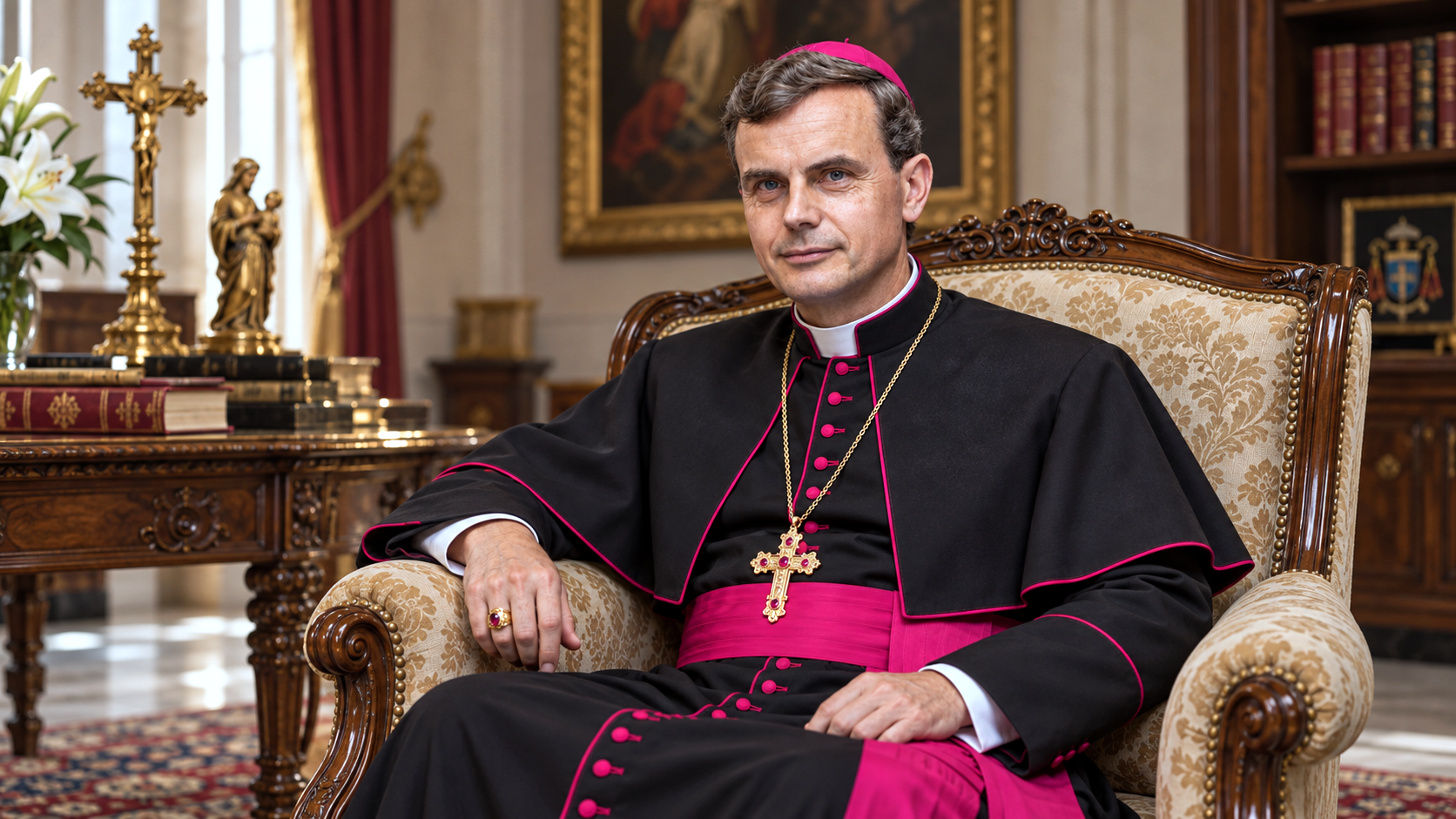
Most Reverend Luc Terlinden, Archbishop of Mechelen-Brussels
I
What Was Done
On the sixteenth of September, in the Church of Saint Peter at Leuven, the Katholieke Universiteit Leuven opened its academic year with the customary procession of the faculties in their gowns and with the offering of Mass. The celebrant was Fr Jacques Haers, of the Society of Jesus, the university pastor. Seated in the front rank of the nave, according to those who were present, was the Most Reverend Luc Terlinden, Archbishop of Mechelen-Brussels, President of the Belgian Episcopal Conference and, ex officio, Grand Chancellor of the university in whose name the Mass was being offered.
Between the prayer after Communion and the concluding rite, a young man came forward to the ambo and chanted in Arabic two verses of the twenty-sixth sura of the Qurʼan, al-Shuʼarāʼ, "The Poets": the sixty-ninth and the seventieth, in which Abraham puts to his father and to his people the question that gives this essay its title.[1] The recitation was filmed by members of KVHV-Leuven, a Flemish Catholic student association, and published some days afterwards. The controversy since has been considerable, and has been conducted, as such things now are, at the volume of the internet rather than at the pitch of theology. It is worth attempting the latter.
The university has not denied the substance of the reports; it has explained them. Its statement, given to the press, is that the decision to include such prayers is taken by the University Parish in consultation with the Rector’s Office and the Flemish bishops; that the interreligious blessings are deliberately placed towards the end of the Mass, between the prayer after Communion and the concluding prayer, which is described as the most appropriate liturgical place for them; that the practice is not new, the University Parish having for something like ten years invited representatives of the traditions with which it works through its Lifestance Network to offer a blessing at the Opening Mass and on the university’s patronal day; and that the verses recited are selected by the student mosque in accordance with the theme of the celebration, submitted in advance for approval, and reviewed each time by a university chaplain trained as an Arabist. The university adds that the same Mass included a Jewish blessing in Hebrew and prayers offered by Protestant and Anglican ministers, and that these contributions symbolise reconciliation and the Christian commitment to the making of peace.
I take the university entirely at its word. It is important to say so at the outset, because almost every element of that statement makes the case against the practice stronger rather than weaker, and I do not wish to be thought to be arguing against a straw version of it. The practice is deliberate, not accidental. It is settled, not experimental. It is approved in advance rather than improvised. It has been going on for a decade. It is not directed at Islam in particular but at a plurality of traditions, of which Islam is one instance. And its placement within the rite was chosen with care. Every one of those facts removes an excuse that might otherwise have been available.
Three things, equally, are not known, and I will not pretend otherwise. It is not known which bishops were consulted, nor when, nor in what terms; whether any gave positive approval as distinct from declining to object; nor whether what the university calls consultation would be recognised as such by the men consulted. No bishop has confirmed the university’s account and no bishop has denied it. Accounts also differ as to whether the Hebrew blessing was in fact delivered on the day or dropped from the order of service at a late stage. These are not trivial gaps, and I shall return to the first of them, which is the one that matters.
II
The Text That Was Read
The twenty-sixth sura is a Meccan composition, and the Abrahamic passage within it is among the most familiar in the Qurʼan. The patriarch asks his father and his people what they worship; they answer that they worship idols, to which they remain devoted; and there follows the interrogation which is the point of the whole — do these hear you when you call upon them? do they profit you, or harm you? It is a polemic against shirk, the association of anything whatever with God, and it is one of the great set-pieces of Quranic monotheism.
Taken by themselves, the two verses recited contain nothing that a Christian must reject. They are narrative. They concern a patriarch whom we also claim. They teach that God alone is to be worshipped, which is the first commandment. The chaplain who reviewed the Arabic will have found nothing blasphemous in it, and he was right: there is nothing blasphemous in it. Anyone who wishes to argue that the words themselves are an affront to the faith will have to do so without my assistance.
The offence lies elsewhere, in three places that no amount of proof-reading can reach.
The first is the nature of the act. The recitation of the Qurʼan is not the reading aloud of a text. Tilāwa is a liturgical act, governed by the rules of tajwīd, and it carries within itself a claim about the origin of what is being chanted: that these are the uncreated words of God, delivered in Arabic, and that to voice them thus is to participate in their descent. A Muslim who chants the Qurʼan is not quoting a religious classic. He is performing an act of Islamic worship, and he would be insulted, rightly, by the suggestion that he was doing anything less. The question before us, therefore, is not whether a Christian assembly may hear words which Muslims also hold sacred — of course it may; the Psalter is full of them — but whether the Christian eucharistic assembly may house, within its own action, a completed act of another religion’s worship. That is a different question, and it has a different answer.
The second is the identity of the Abraham invoked. The Qurʼan is not vague on this point. Abraham was neither Jew nor Christian, it says, but a ḥanīf, a muslim, and he was not of those who associate.[2] The Quranic Abraham is a figure reclaimed from both prior communities; his function in the argument of the book is precisely to establish that the covenantal lineage claimed by Jews and Christians has been misunderstood by both. Now the Roman Canon, which had been prayed in that church some minutes earlier, names him differently. It asks God to receive the offering as he received the sacrifice of Patriarchae nostri Abrahae — of Abraham our patriarch.[3] Between the possessive pronoun of the Canon and the denial of that pronoun in the sura there is no synthesis available, and there was none attempted. There was simply the one, and then, from the same sanctuary, the other.
The third is the question itself. Mā taʼbudūn — what do you worship? It is a real question, put in the imperative mood of the prophetic interrogation, and it was put to an assembly which had, a few minutes before, answered it in the only way that Christians can answer it: by eating the flesh of the Son of Man and drinking his blood. Whether or not anyone intended the irony, the Church at Leuven was asked what she worships at the very moment of her worshipping, and she did not reply. She listened politely, and then was blessed and dismissed. I do not say this to be clever. I say it because the theme of the sura is the futility of worshipping that which cannot hear, and the Catholic answer to that theme is not silence but the Real Presence, which was at that moment within the bodies of the congregation and within the tabernacle of that church. Something was owed to the question, and nothing was given.
III
The Dismissal That Was Not Made
There is an older practice against which to measure this one. In the ancient rites the catechumens, having heard the Scriptures and the homily, were dismissed before the offering began. The deacon’s summons survives in the Byzantine books to this day:
Ὁσοι κατηχούμενοι, προέλθετε· οἱ κατηχούμενοι, προέλθετε· μή τις τῶν κατηχουμένων.
As many as are catechumens, go forth; catechumens, go forth; let none of the catechumens remain.
Liturgy of St John Chrysostom, litany of the catechumens
The discipline behind that summons — the disciplina arcani — was not squeamishness about outsiders. Cyril of Jerusalem is explicit with his own candidates that the mysteries are not to be repeated to those not yet illuminated, not because the Church is ashamed of them but because they are not the sort of thing that can be handed about.[4] The Apostolic Constitutions preserve the full sequence of dismissals — catechumens, energumens, the illuminandi, the penitents — each group sent out in turn before the doors were shut upon the faithful.[5] What that architecture embodies is a judgement, and the judgement is the thing worth recovering. The eucharistic action was held to be so entirely the act of the baptised, so incapable of being witnessed at a distance or shared in part, that even those who already believed, who were already catechised, who were within weeks of the font, could not be permitted to remain in the room.
I am not arguing from a lapsed discipline to a binding law, and I want to be exact about that. The arcanum decayed early; by the sixth century, with infant baptism general and the catechumenate largely a formality, the dismissals had become in most places what they are in the Byzantine rite still, a fossil preserved in the text and not observed in fact. No canonist is going to be embarrassed by an appeal to it, and none should be. The argument is not juridical. It is that the distance between a Church which could not let a believing catechumen watch the offering and a Church which gives the ambo to an unbaptised man after Communion is a very great distance, and it has been travelled in one direction only, and nobody has been asked to approve the journey.
IV
What the Books Permit
Consider now the narrower and harder question: by what authority was this done? The Council is not ambiguous.
Quapropter nemo omnino alius, ne sacerdos quidem, quidquam proprio marte in liturgia addat, demat aut mutet.
Therefore no other person whatsoever, not even a priest, may add, remove, or change anything in the liturgy on his own authority.
Sacrosanctum Concilium 22 §3
The regulation of the sacred liturgy belongs to the Apostolic See and, within the limits of law, to the diocesan bishop; conferences of bishops have the competences the law assigns them and no others.[6] The adaptations contemplated by the Council for regions and cultures are adaptations of the rite to a people, prepared by the conference and requiring the recognitio of the Apostolic See.[7] No such instrument is alleged at Leuven. What is alleged is consultation, which is not an act of governance at all.
And there is nothing in the books to adapt. The Communion rite closes with the prayer after Communion; the concluding rite consists of the greeting, the blessing and the dismissal, with a brief announcement permitted between them if something must be announced. There is no slot. There is no category of rite into which the chanting of another religion’s scripture could be fitted even by an indulgent reading. The university’s defence of its placement — that between the postcommunion and the concluding prayer is the most appropriate liturgical place for these blessings — therefore gives away the whole case in the act of making it. To argue about where in a rite a thing belongs is to presuppose that it belongs somewhere in the rite, and the presupposition is exactly what is missing. One does not deliberate over which room of the house to put a thing one has no leave to bring indoors.
The deeper principle is the one Trent stated when it defined the extent of the Church’s own power over her sacraments: she may determine what conduces to their reverent dispensation according to the variety of circumstances, times and places, but always salva illorum substantia — saving their substance.[8] The Church has never claimed a power to lend the eucharistic action out, because she has never regarded it as hers to lend. It is not the property of the University Parish; it is not the property of the Rector’s Office; and it is not, with respect, the property of the Flemish bishops, whether they were consulted or not.
V
Assisi, and the Line
That Was Drawn There
It will be said that this is the ordinary temper of the Church since the Council, and that to complain of it now is to complain forty years late. The reply is instructive, because the most expansive interreligious gesture of the modern papacy took more care over precisely this point than a Catholic university took in 2026.
At Assisi in October 1986 the representatives of the world’s religions were brought together by John Paul II to pray for peace. The Pope’s own formula for what was happening there — repeated in his address to the Roman Curia that December, when the criticism was at its height — was that they had come to be together in order to pray, and not to pray together.[9] The architecture of the day enforced the distinction: each tradition prayed in its own place, at its own time, in its own words, and the gathering itself contained no common rite. Nobody’s scripture was recited inside anybody else’s liturgy. Above all, the Mass was not the venue.
One may think Assisi imprudent — many did, and among those who urged caution about its interpretation was the cardinal who would later have to govern its sequels, and who as Pope returned to Assisi in 2011 with the express concern that the gesture should exclude any syncretistic reading.[10] But whatever one thinks of it, the line Assisi drew is the line Leuven has erased. Assisi kept the acts separate because it understood that worship is not a sentiment but an act, and that acts of worship belonging to incompatible confessions cannot be performed as one action without one of them being subordinated to the other. Leuven has performed them as one action. The subordination is not in doubt: the Qurʼan was recited inside the Mass, and the Mass was not recited inside anything.
VI
Quod Semper
The criterion by which such a novelty is to be judged is the oldest one the Latin Church possesses, and it was formulated for exactly this kind of case:
In ipsa item catholica ecclesia magnopere curandum est ut id teneamus quod ubique, quod semper, quod ab omnibus creditum est.
Within the Catholic Church herself every care must be taken that we hold that which has been believed everywhere, always, and by all.
Vincent of Lérins, Commonitorium 2.6 (CCSL 64)
The canon is often quoted as though it were a prohibition of all movement, and so quoted it deserves the contempt it usually receives. Vincent himself did not mean that. He allows, indeed insists upon, a real growth: let understanding, knowledge and wisdom increase, he writes, in individuals and in the whole body, but in eodem scilicet dogmate, eodem sensu eademque sententia — within the same doctrine, the same meaning, the same judgement.[11] The canon is not a bar on development but a test for distinguishing development from substitution.
Apply it. There is no century, no rite, no patriarchate and no local church in which the cultic text of a non-Christian religion was recited within the eucharistic assembly as an act of that religion’s worship. Not in Alexandria, which knew Hellenism intimately; not in the Syriac churches, which lived under Islam for thirteen centuries and produced the most sophisticated Christian engagement with the Qurʼan that exists; not in Spain under the caliphate; not in the Latin missions; not anywhere. The Syriac and Arabic-speaking fathers read the Qurʼan closely, argued with it, quoted it, and in some cases could recite it from memory — and it never once occurred to any of them to have it chanted at the altar. The novelty at Leuven is not partial. It is total: neither universal nor ancient nor consented to.
A total novelty in a matter touching the substance of worship bears the entire burden of proof. It has not been discharged. It has not, so far as I can discover, even been acknowledged as a burden. What has been offered instead is a sentiment — that the gesture expresses a vision of peace and reconciliation among peoples and religious traditions — and a sentiment, however creditable, is not a warrant.
VII
Who Authorised It, and
Who Could Have
The university’s formula deserves a closer look than it has had. The decision, we are told, is taken by the University Parish in consultation with the Rector’s Office and the Flemish bishops. Observe the grammar. The acting subject is a parish; the Rector’s Office is an administrative body of a civil corporation; and the bishops appear in the plural, collectively, as a body consulted rather than as persons who decided.
But there is no such office as the Flemish bishops in the law of the Church. There is a Belgian episcopal conference, whose Dutch-speaking members are sometimes described that way in the press, and a conference has no competence whatever to admit a new element into the Order of Mass. The competence that exists here is singular and it is territorial. Leuven lies in the archdiocese of Mechelen-Brussels. The ordinary of the place is Archbishop Terlinden, who is also the Grand Chancellor of the university, and who was in the front row.
I do not assert that he, or any other named bishop, approved what was done. I do not know it, nobody has said it, and I will not print it. What can be said is that the set of men who are in a position to end the ambiguity is small, finite and public: the Archbishop of Mechelen-Brussels; his Dutch-speaking auxiliary, Bishop Koen Vanhoutte; Bishop Johan Bonny of Antwerp; Bishop Lodewijk Aerts of Bruges; Bishop Patrick Hoogmartens of Hasselt, who sits also on the university’s board of trustees; and whoever at present holds or administers the see of Ghent, vacant or in transition since Bishop Lode Van Hecke tendered his resignation on reaching seventy-five.[12] Six men, or five and an administrator, could between them settle in an afternoon what the university has left deliberately blurred.
The proper demand, then, is not a resignation. It is a signature. Either a bishop approved the recitation of the Qurʼan within the Mass, in which case let him say so over his own name and defend it, or no bishop did, in which case the university has invoked an authority it does not possess and should be made to withdraw the claim. What cannot be allowed to stand is the present arrangement, in which an act is performed in the name of the Church while no officer of the Church will own it. That vacancy is not a side-issue. It is becoming the characteristic form of misgovernment in our time, ecclesiastical and civil alike: the deed is done, the institution is invoked, and when the question is asked, the corridor is empty.
VIII
Dialogue and the Disappearance
of the Interlocutor
The justification offered is dialogue, and the conciliar text usually adduced is Nostra aetate. It repays reading rather than citing:
Ecclesia catholica nihil eorum, quae in his religionibus vera et sancta sunt, reicit. … Annuntiat autem et annuntiare tenetur indesinenter Christum, qui est “via et veritas et vita” (Io 14,6).
The Catholic Church rejects nothing of what is true and holy in these religions. … Yet she proclaims, and is bound to proclaim without ceasing, Christ, who is the way, the truth, and the life.
Nostra aetate 2
The second sentence is not a qualification appended to the first by a nervous drafting committee; it is the ground of the first. The Church can afford to recognise what is true and holy elsewhere precisely because she is not in doubt about what she herself proclaims. Remove the second sentence and the first becomes something quite different — not magnanimity but indifference. Nothing in the declaration contemplates the liturgical mingling of cults, and the Congregation for the Doctrine of the Faith found it necessary in 2000 to restate, against exactly the inference now being drawn, that the fullness of revelation is in Christ alone and that the prayers and rites of other religions cannot be accorded a parity with the sacraments of the Church.[13]
Beyond the documents there is a simpler objection, and it is the one I would press hardest, because it is the one a Muslim can hear. Dialogue requires two parties who confess something. A rite which absorbs the other man’s scripture into its own action does not honour him; it curates him. The Muslim student who chanted at that ambo believes, if he believes anything his tradition teaches, that the Qurʼan is the uncreated speech of God and that the Mass rests upon a false claim about God’s having a Son. He cannot regard his recitation as a decorative gesture of goodwill without ceasing, for ninety seconds, to be a Muslim; and the Christians who invited him cannot regard it as a Christian act without ceasing, for the same ninety seconds, to be Christians. Each party is asked to hold its own confession lightly in order that the ceremony may proceed smoothly. That is not respect. It is the politest form of contempt available to a modern institution: the conversion of another man’s faith into an item of the host’s self-presentation.
The students of KVHV put it crudely — give the church back to the Christians and leave the mosques to the Muslims, and then a real exchange between the two becomes possible. Crude, but not wrong, and it can be put better. Between men who know what they are, and who know that the other knows what he is, there can be argument, hospitality, friendship, and on occasion conversion. Between institutions which have agreed in advance that nothing either says is the sort of thing one could be wrong about, there can only be a programme.
One line of attack I decline to take. It would be easy, and it would be lazy, to reach for the Apostle’s warning that one cannot drink the cup of the Lord and the cup of demons, nor partake of the table of the Lord and the table of demons.[14] Islam is not idolatry, and the sura recited is itself an assault on idolatry more ferocious than anything in the modern Christian pulpit. Whoever quotes 1 Corinthians 10 as though a mosque were a temple of Artemis has not understood either Paul or Islam. What survives from Paul, and it is quite enough, is the structural principle beneath the polemic: that κοινωνία at a table is participation in the cult of that table, that participation is indivisible, and that the Christian altar cannot host a second cultic act without ceasing to be what it is. Paul is not fastidious about the menu. He is exact about the table.
IX
What We Are, and What We May Say
A word about the standing of this journal to complain, since it will be raised, and since it ought to be.
The Canons Regular of the Sacred Heart of Jesus are an Old Catholic institute. We hold the apostolic succession, the faith of the undivided Church and the councils of the first millennium; we are not in communion with the Roman See, and we have no standing in Roman law, no ius of recourse, no locus in any Roman forum. A Roman reader may fairly ask by what right a canon regular outside his obedience presumes to complain of what was done in a Roman church under a Roman archbishop. Three answers.
First, the complaint is not jurisdictional but eucharistic. What was interfered with at Leuven is not a Roman possession. The eucharistic action is the act of Christ in his Church, and no see, however venerable, holds it in fee. If it is wounded in Mechelen-Brussels, the wound is not confined to Mechelen-Brussels.
Second, the act was public. It was done in a church, in the presence of a congregation, at the opening of a university’s year, and it has been defended publicly by the institution that performed it. A public act invites public judgement, and the judgement of those outside a communion is not worthless merely because it is external; sometimes it is the only judgement available, the internal critics having been trained out of the habit.
Third, and least comfortably: the charge returns upon us, and I accept it. Old Catholic bodies have not been uniformly careful about liturgical innovation. There are provinces within the Utrecht communion and beyond it which have made alterations to the received rites that I would resist with precisely the arguments deployed above, and some of which I have resisted. A protest is worth nothing unless the man making it would make it against his own house. I make it against my own house. If the argument of this essay is sound, it binds the Canons Regular of the Sacred Heart of Jesus exactly as it binds the University Parish of Leuven, and any of our clergy who should attempt anything comparable would find these pages quoted against him by his superior, which is to say by me.
X
What Do You Worship?
The question was asked in Arabic from a Catholic ambo, some ninety seconds after the Body and Blood of Christ had been received by the congregation, and it went unanswered. It deserves an answer, and the answer is not difficult.
We worship the Father, through the Son, in the Holy Spirit: one God, whom no man has ever seen, and whom the only-begotten Son, who is in the bosom of the Father, has himself declared. We worship him in a rite which is not our invention and is not at our disposal, in which the one sacrifice of Calvary is not repeated but made present, and at which we eat what we adore. We hold the elements on that altar to be the Body and Blood of the Lord and not the symbols of a community’s aspirations towards peace. And we confess, because we are Canons Regular of the Sacred Heart, that the centre of this worship is a wound: the side opened by the lance, καὶ εὐθὺς ἐξῆλθεν αἷμα καὶ ὕδωρ, and at once there came out blood and water.[15] That is what we worship: a God who has a body, who was killed, and who feeds us with himself.
It is not an embarrassing answer. It is not an answer that needs to be muffled in order that a university may demonstrate its openness, nor one that becomes more attractive when it is set beside other answers as though all were contributions to a common fund of religious feeling. It is either true or it is not, and if it is true then the ninety seconds at Leuven were not an act of hospitality but a failure of nerve at the one moment when nerve was called for.
The remedy is small and entirely within reach. Nobody need be insulted; no dialogue need be abandoned; no Muslim student need be turned away from Saint Peter’s. Let the interreligious gatherings be held, at Leuven as at Assisi, in their own place and at their own hour, where each tradition may pray as it believes and be heard as it is. And let the Mass be the Mass. What is asked is not a wall. It is a door, with a threshold, and someone willing to say where it lies.🟥
[1] Qurʼan 26:69–70, in the Abrahamic pericope 26:69–104 (Cairo ed., 1924). Renderings here are my own and are given only so far as the argument requires.
[2] Qurʼan 3:67.
[3] Missale Romanum, Canon Romanus, ad Supra quae: “sicut accepta habere dignatus es munera pueri tui iusti Abel, et sacrificium Patriarchae nostri Abrahae.”
[4] Cyril of Jerusalem, Procatechesis 12 (PG 33:356); cf. the whole of the Mystagogical Catecheses, ed. A. Piédagnel, SC 126bis.
[5] Constitutiones Apostolorum VIII.6–9, ed. M. Metzger, SC 336 (Paris: Cerf, 1987).
[6] Sacrosanctum Concilium 22 §§1–3, in AAS 56 (1964): 97–138; CIC (1983) c. 838 §§1–4.
[7] Sacrosanctum Concilium 37–40.
[8] Council of Trent, Session XXI (16 July 1562), cap. 2; Denzinger–Hünermann 1728.
[9] John Paul II, Address to the Roman Curia, 22 December 1986; cf. the Assisi addresses of 27 October 1986, AAS 79 (1987).
[10] Benedict XVI, Address at Assisi, 27 October 2011; on the earlier reservations see J. Ratzinger, Glaube – Wahrheit – Toleranz (Freiburg: Herder, 2003), esp. pt. 3.
[11] Vincent of Lérins, Commonitorium 23.1–3 (CCSL 64); the distinction is between profectus and permutatio, growth and alteration.
[12] The composition of the Dutch-speaking bench is given as at the date of writing.
[13] Congregation for the Doctrine of the Faith, Dominus Iesus (6 August 2000), §§13–15, 20–22, in AAS 92 (2000): 742–65.
[14] 1 Cor 10:21 (NA28); cf. 10:14–22. See the discussion in A. C. Thiselton, The First Epistle to the Corinthians, NIGTC (Grand Rapids: Eerdmans, 2000), 771–88.
[15] Jn 19:34 (NA28). On the patristic reading of the opened side as the source of the sacraments see Augustine, In Ioannis evangelium tractatus 120.2 (CCSL 36).