
DEATH PENALTY: The Sword and the Plea
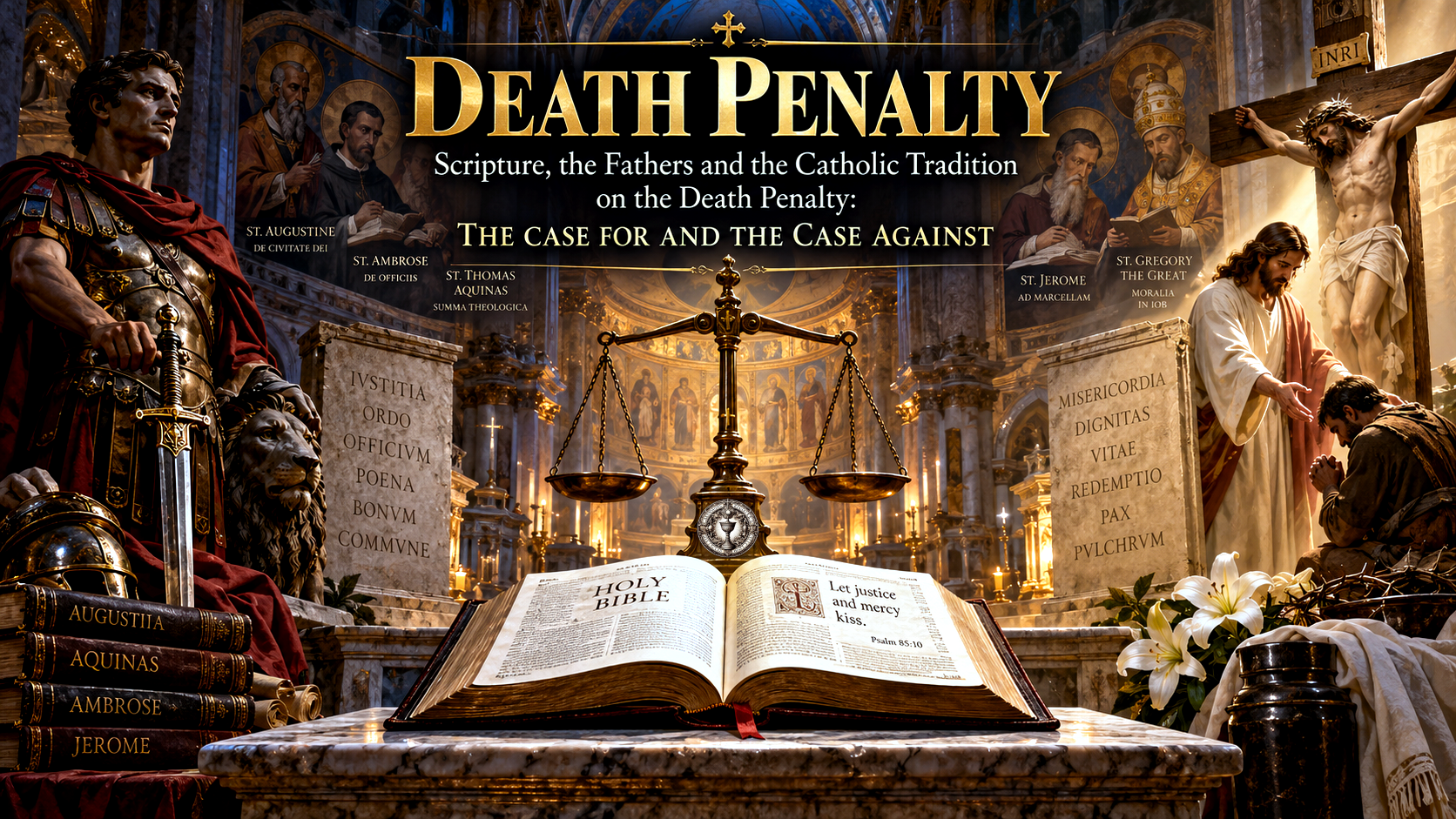
Scripture, the Fathers and the Catholic Tradition on the Death Penalty:
The Case For and the Case Against
οὐ γὰρ εἰκῇ τὴν μάχαιραν φορεῖ· θεοῦ γὰρ διάκονός ἐστιν ἔκδικος εἰς ὀργὴν τῷ τὸ κακὸν πράσσοντι.
For he does not bear the sword in vain; for he is the minister of God, an avenger for wrath upon him who does evil.
— Romans 13:4 (NA²⁸)
Non ergo frustra instituta sunt potestas regis, ius gladii cognitoris, ungulae carnificis, arma militis … Sed haec cum timentur, et coercentur mali, et quietius inter malos vivunt boni.
Not in vain, then, were instituted the power of the king, the judge’s right of the sword, the executioner’s hooks, the soldier’s arms … But when these are feared, the wicked are held in check and the good live more quietly among the wicked.
— Augustine, Ep. 153.6.16, to Macedonius
I. The Question and the Method
Few questions in Catholic moral theology have moved so far, so quickly, in the public teaching of the Roman see as the question of the death penalty. In 1952 Pius XII could speak of the public authority depriving the condemned man of the good of life in expiation of his crime; in 1995 John Paul II judged that cases of real necessity were very rare, if not practically non-existent; in 2018 Francis ordered the Catechism to say that the death penalty is “inadmissible”; and in April 2026 Leo XIV, the first pope from the United States, lent his public support to those working for its abolition in his own country and throughout the world.[1] Those who welcome the movement call it a development of doctrine; those who resist it call it a rupture. Each side claims the Scriptures, each claims the Fathers, and each accuses the other of reading the tradition through the spectacles of a later age.

St. Augustine of Hippo:
“Not in vain, then, were instituted the power of the king, the judge’s right of the sword, the executioner’s hooks, the soldier’s arms … But when these are feared, the wicked are held in check and the good live more quietly among the wicked”.
— Ep. 153.6.16, to Macedonius
This essay does not propose to settle the matter. Its purpose is narrower and, it is hoped, more useful: to set out as fairly as possible what the sources actually say, to state the strongest form of the case on each side, and to mark plainly the places where the evidence is thick and the places where it is thin. A Christian who is to form his conscience on the question deserves to know not only which texts are cited but how much weight each will bear. The temptation in any such survey is to harmonise—to make the Fathers say in chorus what they said only in part, or to make a recent magisterial formula appear to have been always latent in texts that do not contain it. That temptation will be resisted. Where the witnesses disagree, the disagreement will be left standing.
The method is the old one. Vincent of Lérins asked that the Church hold what has been believed everywhere, always and by all—a canon that the Declaration of Utrecht made its own in 1889.[2] Applied honestly, the Vincentian canon is a demanding test, and it cuts both ways. It requires the defender of capital punishment to show that what he asserts was the common mind of the Church and not merely the opinion of some of her doctors; it requires the abolitionist to show that what he denies was not so held. The first question, then, is not “What do I wish the tradition had said?” but “What, in fact, was received?” The second question—what follows for the present—must wait upon the first.
Three distinctions will recur and should be fixed at the outset. The first is between the legitimacy in principle of the State’s taking the life of a grave offender and the prudence of doing so in a given society. The second is between the authority of the State to inflict the penalty and the participation of Christians, and especially of clerics, in its infliction. The third is between the purposes ascribed to punishment—retribution, defence of society, deterrence, the amendment of the offender—since an argument that is decisive on one account of punishment may be irrelevant on another. Much confusion in the modern debate arises from collapsing these distinctions; a good deal of apparent contradiction in the ancient sources dissolves, or at least becomes intelligible, when they are kept apart.
II. The Witness of Scripture
A. The Old Testament
The classical text is Genesis 9:6, spoken to Noah after the Flood, before Abraham, before Sinai, and therefore—so the argument runs—binding upon the whole race descended from Noah rather than upon Israel alone:
שֹׁפֵךְ דַּם הָאָדָם בָּאָדָם דָּמוֹ יִשָּׁפֵךְ כִּי בְּצֶלֶם אֱלֹהִים עָשָׂה אֶת־הָאָדָם
Whoever sheds the blood of man, by man shall his blood be shed; for in the image of God he made man.
— Genesis 9:6 (MT)
The verse has a remarkable feature which the defenders of capital punishment rightly emphasise: the ground of the penalty is the very thing to which modern abolitionists appeal, namely the dignity of man as made in the image of God. The murderer is to die because man bears the divine image. Human life is so precious that the one who wantonly destroys it forfeits his own. On this reading the death penalty is not a concession to hardness of heart but an affirmation of the worth of the victim.
Three cautions, however, must be entered. First, the grammar of the Hebrew is disputed: the imperfect יִשָּׁפֵךְ may be read as a command (“shall be shed”) or as a statement of what will in fact befall the shedder of blood, and the chiastic form of the verse has suggested to some commentators a proverb of retribution rather than a statute.[3] The majority of exegetes, ancient and modern, take it as prescriptive, but the alternative is not frivolous. Second, the phrase בָּאָדָם, “by man,” which names the human agent of the penalty, is absent from the Greek of the Septuagint, which reads instead “in return for his blood”:
ὁ ἐκχέων αἷμα ἀνθρώπου ἀντὶ τοῦ αἵματος αὐτοῦ ἐκχυθήσεται, ὅτι ἐν εἰκόνι θεοῦ ἐποίησα τὸν ἄνθρωπον.
He who sheds the blood of a man, in return for that blood shall his own be shed; for in the image of God I made man.
— Genesis 9:6 (LXX, ed. Wevers)
The Vulgate likewise has no word for the human executor.[4] This matters for the patristic question. The Fathers, Greek and Latin alike, read a text in which the verse stated the principle of blood for blood without expressly naming man as its instrument. The explicit warrant that later Protestant and Catholic apologists drew from the Hebrew was not, in that form, before the eyes of most of the Fathers. Third, the same book of Genesis records that God did not put Cain to death but set a mark upon him so that none should slay him (Gen 4:15)—a passage the Fathers would set beside Genesis 9 with some care.
The Mosaic law multiplies capital offences well beyond murder—to adultery, blasphemy, sabbath-breaking, the cursing of parents and others—and it insists that no ransom be taken for the life of a murderer, since blood pollutes the land and only the blood of the one who shed it can expiate it (Num 35:31–33). Here an honest reckoning must cut in both directions. The defender of the death penalty can point to the Mosaic law as proof that God himself has, at least once, commanded a polity to execute; it cannot be intrinsically evil, he argues, since God does not command what is intrinsically evil. The abolitionist replies that almost no one now holds that the Mosaic catalogue of capital crimes binds Christian states, and that if the death penalty for adultery and sabbath-breaking has been set aside as belonging to the old dispensation, the burden lies upon the other side to show why the penalty for murder should survive when the rest has fallen. The defender answers that Genesis 9, being Noachic, is not part of the Mosaic code and does not fall with it. The argument is sound in form; whether it is sound in substance depends upon the reading of Genesis 9:6 just discussed.
B. The New Testament
The central New Testament text is Romans 13:1–7. Paul tells the Christians of Rome that the governing authority is God’s minister, an avenger for wrath upon the evildoer, who “does not bear the sword in vain” (13:4). The word is μάχαιρα, and the question is what it signifies. The traditional reading, from the Fathers through the scholastics to Cardinal Dulles and Edward Feser, is that the sword is the instrument of death and stands for the ius gladii, the power of life and death that Roman law vested in magistrates of a certain rank. On this reading Paul assumes, and in assuming approves, the State’s authority to execute.
The reading is the natural one, but it is not the only one. Some commentators have argued that μάχαιρα here may denote the short sword worn by officials as a badge of their police and judicial authority in general, so that the verse affirms the State’s power to coerce and punish without specifying the death penalty in particular.[5] The point should not be overpressed by either side. Even on the narrower reading, coercive punishment in the Roman world included death as its extreme term, and Paul shows no sign of excepting it. On the other hand, Paul’s purpose in Romans 13 is to enjoin submission, not to draft a penology, and a text written to tell subjects to obey does not straightforwardly tell rulers what they must do.
Other New Testament texts are commonly enlisted. Before Festus, Paul says:
εἰ μὲν οὖν ἀδικῶ καὶ ἄξιον θανάτου πέπραχά τι, οὐ παραιτοῦμαι τὸ ἀποθανεῖν.
If then I am a wrongdoer and have done anything worthy of death, I do not refuse to die.
— Acts 25:11 (NA²⁸)
The penitent thief on the cross confesses that he and his companion suffer “justly,” receiving the due reward of their deeds (Luke 23:41), and Christ, far from contradicting him, promises him Paradise. Christ tells Pilate that he would have no power over him unless it had been given him from above (John 19:11). The defender of capital punishment reads these as a cumulative witness: an apostle, a saint canonised by the Lord’s own mouth, and the Lord himself all speak of capital jurisdiction as real and, in principle, just. The abolitionist replies that none of these texts was addressed to the question. Paul’s words before Festus are a conditional protestation of innocence; the thief speaks of his own guilt, not of the justice of crucifixion as a Roman penalty; and the power Pilate holds “from above” is the very power by which he condemns the Innocent, so that the verse can scarcely be read as a commendation of its use.
On the other side stand the Sermon on the Mount’s repeal of the lex talionis for the disciple (Matt 5:38–39), Paul’s prohibition of private vengeance (Rom 12:19), the Lord’s word to Peter that those who take the sword shall perish by the sword (Matt 26:52), and, above all, the woman taken in adultery:
ὁ ἀναμάρτητος ὑμῶν πρῶτος ἐπ᾽ αὐτὴν βαλέτω λίθον.
Let him who is without sin among you be the first to throw a stone at her.
— John 8:7
Here the honest survey must record two inconvenient facts. The first concerns the abolitionist’s favourite text: the pericope adulterae (John 7:53–8:11) is printed by Nestle–Aland within double brackets, since it is absent from the earliest Greek witnesses, including P⁶⁶, P⁷⁵, Sinaiticus and Vaticanus.[6] The Church receives it as canonical Scripture, and its canonicity is not in question; but an argument that rests heavily on it rests on a text whose place in the Fourth Gospel is uncertain, and whose point—the Lord’s refusal to be drawn into a trap, and his mercy to a sinner—need not be read as a ruling on the State’s penal jurisdiction. The second inconvenient fact concerns the defender’s side: the Sermon on the Mount and Romans 12 are addressed to the disciple as a private person, and Paul in the very next chapter places the avenging sword in the magistrate’s hand. The juxtaposition of Romans 12:19 and 13:4 is, indeed, the single most important exegetical datum in the whole question. The disciple must not avenge himself; the magistrate is God’s avenger. Whatever one concludes, one must account for both.
The scriptural evidence, taken as a whole, may therefore be summarised as follows. The Old Testament positively commands the death penalty, and in Genesis 9:6 grounds it in the image of God in man. The New Testament nowhere commands it, nowhere forbids it, and in Romans 13 assumes the State’s coercive authority in terms that most readers, ancient and modern, have taken to include it. The New Testament’s characteristic note is mercy, but that mercy is addressed principally to the disciple and the community rather than to the penal law of the State. Whether the Gospel, by a kind of leaven, ought over time to transform that law is precisely the question that divides the parties; the text alone does not settle it.
III. The Fathers
It is in the patristic evidence that the greatest care is needed, for here both sides have been tempted to overclaim. The modern abolitionist anthology tends to quote Athenagoras, Tertullian, Lactantius and the Apostolic Tradition and to pass in silence over Augustine’s explicit defence of the magistrate’s sword; the modern defender tends to quote Augustine, Jerome and Innocent I and to treat the rigorists as eccentrics. Neither procedure is honest. The Fathers do not speak with one voice; but neither is their witness a mere cacophony. It falls, on examination, into three bands.
A. The Legitimacy of the Sword Conceded
The first band affirms that the public authority may lawfully put grave offenders to death. Clement of Alexandria compares the law to a physician who must sometimes cut away what is incurable for the sake of the whole body, an image that will reappear in Aquinas.[7] Origen, though he insists that Christians cannot execute adulterers as the Mosaic law prescribed, does not deny that the pagan magistrate wields a lawful power.[8] Chrysostom, preaching on Romans 13, treats the ruler’s punishment of evildoers as a benefaction to the city.[9]
The decisive Latin witnesses are Augustine and Jerome. In the first book of the City of God, discussing the commandment “Thou shalt not kill,” Augustine excepts those whom a just law commands to be put to death, and states expressly that those who, bearing the person of the public power, have punished the wicked with death according to its laws have not acted against the commandment.[10] Jerome, commenting on Jeremiah’s charge to the king to execute justice and shed no innocent blood, puts the matter even more bluntly: to punish murderers, the sacrilegious and poisoners is not the shedding of blood but the ministry of the laws.[11]
To these must be added the first papal text on the question. In 405, Exsuperius of Toulouse asked Innocent I what was to be done with those who, after baptism, had exercised public office and had ordered torture or pronounced capital sentence. Innocent replied that the elders had defined nothing against them, for they remembered that these powers had been granted by God and that the sword had been permitted for the punishment of the guilty.[12] The text is important not because it is an ex cathedra definition—it plainly is not—but because it shows that, at the opening of the fifth century, the Roman see regarded the matter as settled by tradition rather than open. In 447, Leo the Great, writing to Turribius of Astorga about the Priscillianists, observed that the Church’s leniency, though it shrinks from bloody vengeance and is content with priestly judgment, is nonetheless helped by the severe laws of Christian princes.[13]
B. The Rigorist Witness
The second band is the rigorist tradition of the pre-Constantinian Church. Athenagoras, defending the Christians to Marcus Aurelius, says that they cannot bear to see a man put to death even justly, and that they have therefore renounced the gladiatorial shows.[14] Tertullian holds that a Christian may not hold an office in which he must sit in judgment on a man’s life.[15] The church order known as the Apostolic Tradition directs that a magistrate who wields the power of the sword must lay it down or be refused admission.[16] And Lactantius, writing on the eve of the Constantinian settlement, forbids the just man not only to kill but even to bring a capital accusation, since it makes no difference whether one kills with the sword or with a word.[17]
These texts are real, and the abolitionist is entitled to them. But their force must be measured exactly. Athenagoras speaks in the context of the arena; his objection is to the Christian spectator of killing, and the passage does not address the magistrate’s jurisdiction as such. Tertullian’s position belongs to a general rigorism that also forbade Christians military service and most public offices, and that the Church did not in the end adopt. The Apostolic Tradition is a composite document whose attribution to Hippolytus, date and original wording are all now disputed; its witness is genuine but cannot be assigned with confidence to the Roman Church of the early third century.[18] Lactantius’ prohibition is the strongest of the four, and it is unambiguous. Yet it too is a prohibition addressed to the just man as an individual—what he may and may not do—rather than a doctrine that the State lacks the authority to punish with death. What this band establishes, then, is a powerful early Christian reluctance to participate in killing; it does not clearly establish a denial of the State’s right.
A related witness belongs here. Basil the Great records that the Fathers did not reckon killing in war as murder, yet he advises that those who have shed blood in war abstain from communion for three years, as men whose hands are not clean.[19] The canon concerns war, not judicial execution, and it is advisory. But it shows the same double instinct that runs through the whole patristic evidence: that an act may be lawful and yet leave a stain; that bloodshed, even justified, sits uneasily with the altar.
C. Intercession, Clemency and the Case of Priscillian
The third band is in some ways the most characteristic, and the most neglected by both sides. It consists of the bishops who, granting the legitimacy of the sword, nonetheless pleaded with magistrates not to use it.
Ambrose is the clearest example. When the magistrate Studius asked whether, having pronounced capital sentences, he might approach the sacraments, Ambrose replied that he could not forbid him, since the Apostle had given the sword to the authority; yet he added that many have kept themselves from communion of their own accord, and that such men are praised—and he reminded Studius that even pagan governors had boasted of returning from their provinces with an unbloodied axe.[20] Ambrose concedes the principle and commends the restraint.
Augustine, who in the City of God defended the magistrate’s sword, spent a good deal of ink trying to keep it sheathed. When Donatist clerics confessed to the murder of one Catholic priest and the mutilation of another, Augustine wrote to the tribune Marcellinus begging that they not be put to death, lest the sufferings of the Catholic servants of God be stained by the like retaliation.[21] His exchange with the vicar Macedonius is the fullest patristic treatment of episcopal intercession. Macedonius asked how a bishop could, consistently with religion, intercede for the guilty; Augustine replied that the bishop intercedes because he loves the sinner and hopes for his amendment, while in the same letter affirming—in the words placed at the head of this essay—that the king’s power, the judge’s right of the sword, the executioner’s hooks and the soldier’s arms are not instituted in vain, since by their terror the wicked are restrained and the good live more quietly among them.[22] Augustine holds both positions at once, and he does not regard them as in conflict.
The case of Priscillian of Ávila shows the same tension at the level of the whole Church. In 385, at Trier, Priscillian and several companions were condemned and executed by the usurper Maximus on charges that included sorcery—the first Christians put to death by a Christian ruler for matters touching heresy. Martin of Tours had pleaded for their lives; after the event, Ambrose and Martin refused communion with the bishops who had pressed the prosecution, and Sulpicius Severus records the deep revulsion the affair provoked.[23] Sixty years later, as we have seen, Leo the Great could speak approvingly of the help the Church’s lenity received from the severity of Christian princes. The protest of Martin and the approval of Leo both belong to the patristic record.
D. What the Patristic Evidence Establishes
What, then, may honestly be said? First, that among those Fathers who addressed the question directly after the peace of the Church, there is a broad consensus that the public authority may lawfully put grave offenders to death. Augustine, Jerome and Innocent I state this expressly; Ambrose concedes it; Leo presupposes it. No Father after Constantine of comparable standing is known to deny it outright. On the narrow question of legitimacy in principle, the patristic evidence favours the defenders of the death penalty.
Second, that this consensus is accompanied, very nearly throughout, by an equally strong preference for mercy in practice, by a reluctance to see Christians and above all clerics stained with blood, and by an expectation that bishops would intercede for the condemned. On the question of what the Church desires of the State, and of how Christians should regard the exercise of the sword, the patristic evidence favours the abolitionist instinct far more than its defenders usually admit.
Third, that the pre-Constantinian rigorist witness is real but limited. It establishes a refusal of participation, not clearly a denial of the State’s authority, and it belongs to a broader rigorism that the Church did not adopt in other matters. It cannot simply be set aside as eccentric; neither can it be presented as the authentic voice of the early Church silenced by the Constantinian compromise. Both of those narratives are too tidy.
There is, in short, an asymmetry which neither party likes to acknowledge. The Fathers who most clearly affirm the State’s right are the same Fathers who most clearly plead that it not be used. To cite their principle without their practice, or their practice without their principle, is to misrepresent them.
IV. The Medieval and Tridentine Synthesis
The medieval Church inherited the patristic double instinct and gave it juridical form. On the one hand, the right of the secular power was affirmed in terms that became, for many later theologians, the decisive magisterial text. In 1208 Innocent III required of the Waldensians returning to communion a profession of faith that included the proposition that the secular power can exercise the judgment of blood without mortal sin, provided it proceeds to punishment not from hatred but with judgment, not incautiously but with deliberation.[24] The Waldensians had denied this right; the profession was framed precisely to exclude that denial.
On the other hand, the Fourth Lateran Council in 1215 forbade clerics to dictate or pronounce a sentence of blood, to execute one, or to be present at its execution—the canonical form of the patristic unease.[25] The State might shed blood; the priest might not even be present at it. The Church thus held together, in law, the two things the Fathers had held together in exhortation.
Thomas Aquinas supplied the classical theological argument. The individual stands to the community as a part to the whole; as a physician rightly amputates a diseased limb that threatens the body, so the ruler rightly puts to death a dangerous and corrupting malefactor for the preservation of the common good.[26] To the objection that killing a man is intrinsically evil, Thomas replies in a passage that has become the crux of the modern debate:
Et ideo quamvis hominem in sua dignitate manentem occidere sit secundum se malum, tamen hominem peccatorem occidere potest esse bonum, sicut occidere bestiam.
And therefore, although it is evil in itself to kill a man who abides in his dignity, yet it may be good to kill a man who is a sinner, just as it is to kill a beast.
— Aquinas, ST II-II, q. 64, a. 2, ad 3
By sinning, man falls away from the order of reason and so from human dignity; although it is evil in itself to kill a man who keeps his dignity, it can be good to kill a man who has sinned. In the Summa contra gentiles Thomas answers the objection that execution forecloses the sinner’s repentance: the condemned are given time to repent, and those who will not turn to God even at the point of death are unlikely to do so later.[27] The Roman Catechism, issued by the authority of the Council of Trent, taught in its exposition of the Fifth Commandment that the civil power, to which the power of life and death has been entrusted, may lawfully slay, and that by the lawful exercise of that power, in punishing the guilty and protecting the innocent, it gives effect to the very commandment that forbids murder.[28]
It should be recorded, for completeness, that the popes in their temporal capacity acted on this teaching. The Papal States carried out executions until 1870, the last in 1868; and Vatican City’s penal law retained the death penalty, though it was never applied, until Paul VI removed it in 1969. The defenders of capital punishment adduce this as evidence of how the Church herself understood her teaching; the abolitionists adduce it as evidence of how long the Church’s practice lagged behind her Gospel. Both observations are fair. The fact itself is not in dispute.
V. The Modern Magisterium: From Pius XII to Leo XIV
As late as 1952, Pius XII could state that even in the case of the death penalty the State does not dispose of the individual’s right to life; rather, the public authority deprives the condemned of the good of life in expiation of his crime, after he has by that crime already disposed himself of his right to live.[29] This is the classical doctrine in its plainest modern form. It is retributive, and it locates the forfeiture of the right to life in the act of the criminal, not in the will of the State.
The decisive shift came with Evangelium Vitae. John Paul II did not deny the principle but narrowed its application drastically. The penalty ought not to go to the extreme of execution except in cases of absolute necessity, when it would not be possible otherwise to defend society; and today, as a result of improvements in the organisation of the penal system, such cases are “very rare, if not practically non-existent.”[30] The Catechism was revised in its Latin typical edition of 1997 to reflect this teaching. Its framework was still that of legitimate defence: the death penalty was not excluded where it was the only possible way of protecting human lives from an unjust aggressor.
How much this altered the classical teaching was itself disputed. Cardinal Ratzinger, as Prefect of the Congregation for the Doctrine of the Faith, wrote in 2004 that there may be a legitimate diversity of opinion even among Catholics about waging war and applying the death penalty, but not with regard to abortion and euthanasia.[31] Defenders of the death penalty have treated this as authoritative confirmation that Evangelium Vitae was a prudential judgment rather than a change in principle.
In October 2017 Francis declared that the death penalty is in itself contrary to the Gospel, and on 1 August 2018 he approved a new text of the Catechism, §2267, which states that “the death penalty is inadmissible because it is an attack on the inviolability and dignity of the person,” and that the Church works with determination for its abolition worldwide. An accompanying letter of the Congregation for the Doctrine of the Faith presented the change as an authentic development of doctrine, not in contradiction with the prior teaching of the magisterium, and grounded it in a deeper awareness of the dignity of the person, in a new understanding of the purpose of penal sanctions, and in the existence of more effective systems of detention.[32] The teaching was restated in the encyclical Fratelli tutti (2020), which appealed to Lactantius, Augustine’s letters to Marcellinus and Nicholas I’s counsel to the newly converted Bulgarians, and in the declaration Dignitas infinita (2024), which treats the death penalty among violations of a dignity that is never lost.[33]
Leo XIV has continued this line, though readers disagree as to its tenor. In April 2026, in a video message for the fifteenth anniversary of abolition in Illinois, he cited the revised Catechism that the penalty is inadmissible, affirmed that the dignity of the person endures even after very grave crimes, and offered his support to those working for abolition in the United States and throughout the world. Some commentators, notably Edward Feser, had read his earlier remarks to the diplomatic corps as a return to a more prudential and less dignity-based form of opposition, closer to that of Benedict XVI; the April message, which explicitly invoked both dignity and the 2018 text, sits less comfortably with that reading.[34] What is clear is that the present Roman magisterium teaches inadmissibility and works for abolition. What remains contested is the theological status of that teaching.
VI. The Case For the Death Penalty
The case for the legitimacy of the death penalty, in its strongest contemporary form, rests on five arguments. They are stated here as their ablest advocates would state them, chiefly Cardinal Avery Dulles, Edward Feser and Joseph Bessette, and Steven Long.[35]
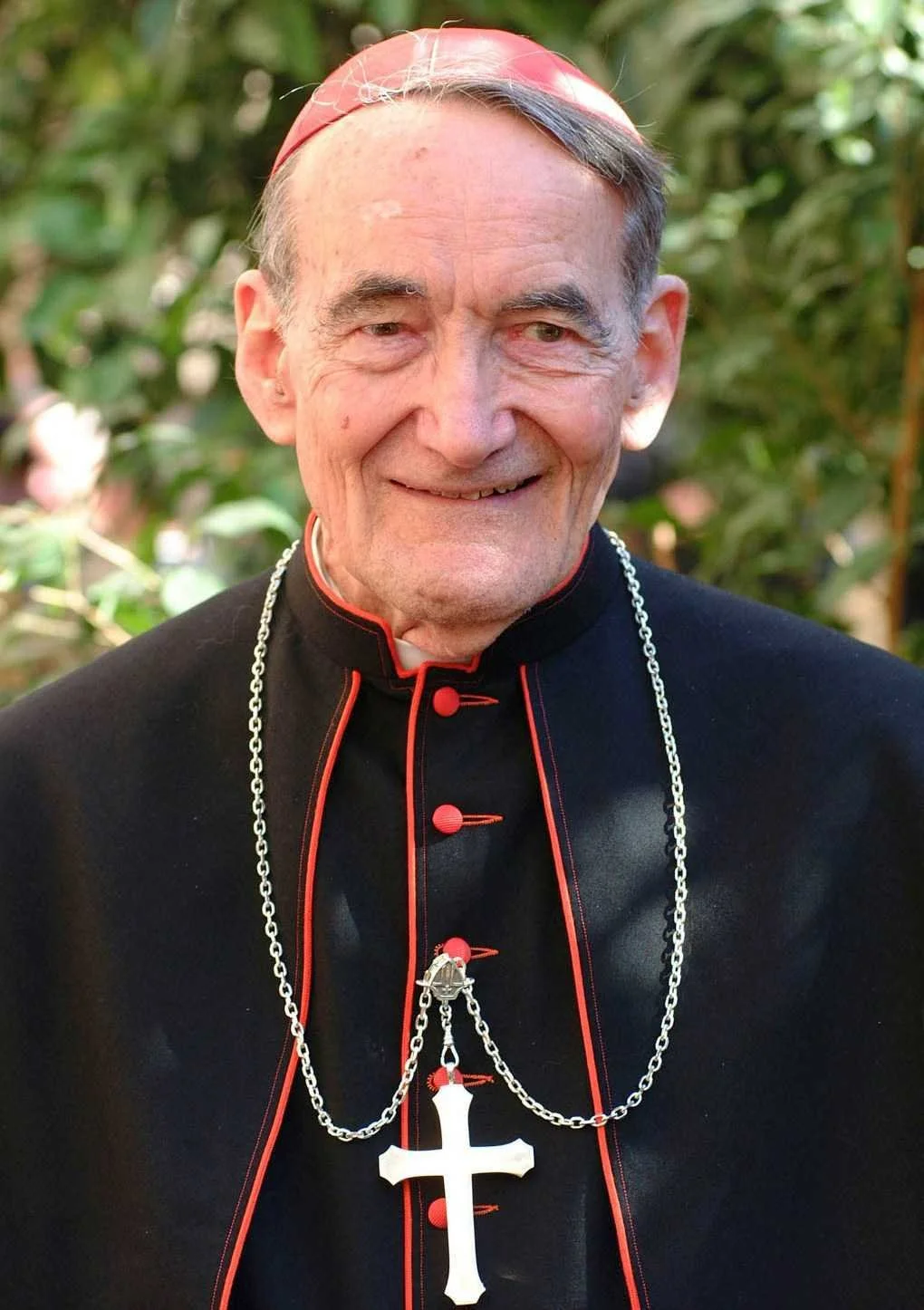
His Eminence,
Cardinal Avery Dulles
b. 24-08-1918 | d. 12-12-2008
1. The Argument from Scripture
Scripture, inspired and inerrant, positively sanctions the death penalty. Genesis 9:6 commands it for murder on the ground of the divine image, in a covenant made with all mankind; the Mosaic law commands it; Romans 13:4 assumes it. Since God cannot command what is intrinsically evil, the death penalty cannot be intrinsically evil. The Church has never, before the present age, read these texts otherwise; and the Church’s teaching on the inerrancy of Scripture forbids her to say that the sacred writers taught as God’s will something that is in itself contrary to human dignity.[36]
2. The Argument from Tradition and Magisterium
The legitimacy of the death penalty in principle was taught by the Fathers after the peace of the Church, by Innocent I, by Innocent III in a profession of faith required for reconciliation, by Aquinas and the whole scholastic tradition, by the Roman Catechism, and by the popes until the late twentieth century. A teaching so constantly held may plausibly be thought to belong to the ordinary and universal magisterium. If so, it cannot be reversed; and even if not, a reversal would cast doubt on the reliability of the magisterium in every other moral matter. It is on this ground that a group of clergy and scholars publicly appealed to the cardinals in August 2018 to advise the Pope to withdraw the revision.[37]
3. The Argument from Retributive Justice
The primary purpose of punishment, as the classical tradition and Pius XII taught, is retributive: to restore the order of justice violated by the crime by inflicting on the offender a penalty proportionate to his guilt. Some crimes are so grave that only death is proportionate. To deny this is to imply that no crime, however monstrous, deserves death, which seems to understate the gravity of murder and the worth of the victim. It is precisely because human life is sacred that its deliberate destruction deserves the gravest penalty. On this view, to ground the death penalty only in self-defence, as Evangelium Vitae appeared to do, is already to depart from the classical theory of punishment; and the 2018 revision completes the departure.
4. The Argument from Dignity Rightly Understood
Aquinas held that the grave sinner falls from the dignity that belongs to man as acting according to reason. The defender distinguishes between the ontological dignity that every man retains as a creature in God’s image and the moral dignity that he can forfeit by his acts. To treat a murderer as deserving the punishment his crime merits is to treat him as a responsible moral agent, not as a patient to be managed; the abolitionist, it is argued, risks reducing the criminal to an object of therapy. The Genesis text itself grounds the penalty in the dignity of the image, so that the appeal to dignity cannot be the exclusive property of the abolitionist.
5. The Argument from Repentance and the Common Good
Finally, the defender argues that the prospect of certain death has historically been an occasion of conversion—the penitent thief is the type—and that the Church’s ministry to the condemned is one of her noblest works. He also argues that the State must retain the gravest sanction for the protection of the innocent, especially where prisons cannot securely hold dangerous men, where offenders kill again in custody, or where the political order is too weak to guarantee perpetual confinement. On this view, even if abolition is a reasonable prudential policy in wealthy and stable nations, it cannot be made a universal moral rule.
VII. The Case Against the Death Penalty
The case against the death penalty, in its strongest Catholic form, likewise rests on five arguments. They are stated as their ablest advocates would state them, chiefly E. Christian Brugger, Germain Grisez and James Megivern, together with the recent magisterium.[38]
1. The Argument from the Gospel and the Early Church
The Gospel transforms the law of retaliation into the law of mercy. The earliest Christians, closest to the apostles, refused to take part in capital judgment; Lactantius forbade even the bringing of a capital charge; the Apostolic Tradition excluded the magistrate who wielded the sword. The post-Constantinian acceptance of the death penalty represents an accommodation to the Empire rather than a pure development of the apostolic deposit. Even then, the Fathers interceded for the condemned, Ambrose and Martin broke communion over Priscillian, and the Church forbade her ministers to shed blood. The present teaching, on this view, is a recovery of the Church’s earliest and purest instinct.
2. The Argument from the Dignity of the Person
Every human being bears an ontological dignity grounded in his creation in God’s image and his redemption by Christ, which no crime can destroy. The Thomist claim that the sinner falls from human dignity and may be killed like a beast is precisely the point at which the Church’s understanding has developed. To kill a man who is already rendered harmless is to treat his life as forfeit, which is incompatible with its inviolability. Dignitas infinita and Leo XIV’s statement that dignity endures after grave crimes express this development. Grisez and Brugger press the point further: it is always wrong intentionally to destroy a human life, and the death penalty necessarily involves such an intention.
3. The Argument from the Development of Doctrine
The Church’s teaching on matters such as religious liberty, slavery and the use of torture has developed significantly while preserving its principles. Newman showed that a true development preserves the type of the idea, continues its principles and anticipates its future.[39] The principle at stake here is the protection of human life and the common good. The earlier tradition held that, in its circumstances, the death penalty served those goods; the present teaching holds that, in a deeper grasp of human dignity and with the means now available to protect society, it does not. On this view the 2018 revision is to the classical teaching what Dignitatis humanae was to earlier teaching on the confessional State: a development that is continuous in principle though discontinuous in conclusion.
4. The Argument from Prudence and the Fallibility of Courts
Even if the death penalty were legitimate in principle, its practice is morally unacceptable. Courts err, and the death penalty is the one sentence that cannot be corrected. A widely cited study of defendants sentenced to death in the United States estimated that more than four per cent were probably innocent.[40] The penalty falls disproportionately on the poor and the poorly defended. Moreover, the empirical case for deterrence is unproven: the National Research Council of the United States concluded in 2012 that existing research was not informative about whether capital punishment increases, decreases or has no effect on homicide rates, and should not be used to inform policy.[41] And in the hands of totalitarian and authoritarian States the death penalty has been an instrument of terror against political and religious dissent, not least against Christians.
5. The Argument from Repentance and Witness
Finally, the abolitionist turns the argument from repentance against its proponents. Execution deliberately cuts short the time God gives the sinner for conversion, and Thomas’s confidence that the impenitent at the scaffold would not repent later is an empirical guess, not a theological datum. Benedict XVI, who urged the elimination of the death penalty, has been read as resting his opposition chiefly on this consideration—that sparing the offender leaves open the way to repentance.[42] A Church that preaches the mercy of God to every sinner bears a more credible witness when she asks the State to spare even the worst of men. In a culture tempted to treat human life as disposable at its beginning and its end, the Church’s refusal to sanction the deliberate killing of even the guilty is, on this view, a coherent part of her defence of life from conception to natural death.
VIII. The Points on Which the Question Turns
With both cases stated, it becomes possible to identify the points on which the dispute actually turns. It does not turn primarily on proof-texts; both sides can adduce them. It turns on four questions of interpretation and theological method.
1. Principle or Application?
The first question is whether the 2018 revision changes a principle or an application. If “inadmissible” means that, in present circumstances, the death penalty should not be used because other means suffice to protect society, the revision is a prudential judgment, continuous with Evangelium Vitae and compatible with the classical teaching that the State possesses the authority in principle. If “inadmissible” means that the death penalty is intrinsically contrary to human dignity, then the revision contradicts the explicit teaching of Innocent III, the Roman Catechism and the earlier tradition. The text of §2267 itself combines both kinds of ground: it speaks of the dignity of the person, which suggests principle, and of more effective systems of detention, which suggests circumstance. The CDF letter insists that the revision does not contradict prior teaching while grounding it in a new understanding of dignity. Each party reads the ambiguity in its own favour; the honest reader must acknowledge that the ambiguity is in the text.
2. Dignity Lost or Dignity Retained?
The second question is whether the criminal forfeits something by his crime. Here the conflict is sharp and should not be obscured. Aquinas taught that the sinner falls from human dignity; Dignitas infinita and Leo XIV teach that dignity is never lost. It is possible to reconcile these by distinguishing moral from ontological dignity, as defenders of the classical view do; and it is possible to argue, as abolitionists do, that the classical view, whatever the distinction, licensed treating a man as a beast to be slain, which cannot now be accepted. What is not possible, without sophistry, is to pretend that Aquinas and the recent magisterium were saying the same thing in different words. Genesis 9:6 complicates matters further, since it grounds the penalty in the very dignity that the abolitionist invokes against it.
3. The Status of the Tradition
The third question is how much of the tradition is binding. If the legitimacy of the death penalty in principle belongs to the ordinary and universal magisterium, a contrary teaching cannot be true. If it belongs instead to the common teaching of theologians and popes on a matter of natural law that was never proposed as definitively to be held, then a development is at least conceivable. The evidence assembled above shows that the teaching was constant, widespread and explicit; whether it was ever proposed as definitive is precisely what the parties dispute. Innocent III’s profession of faith is the strongest single text for the defenders; but it is a profession required of a particular group in particular circumstances, and theologians have long disputed what kind of assent such formulae command.
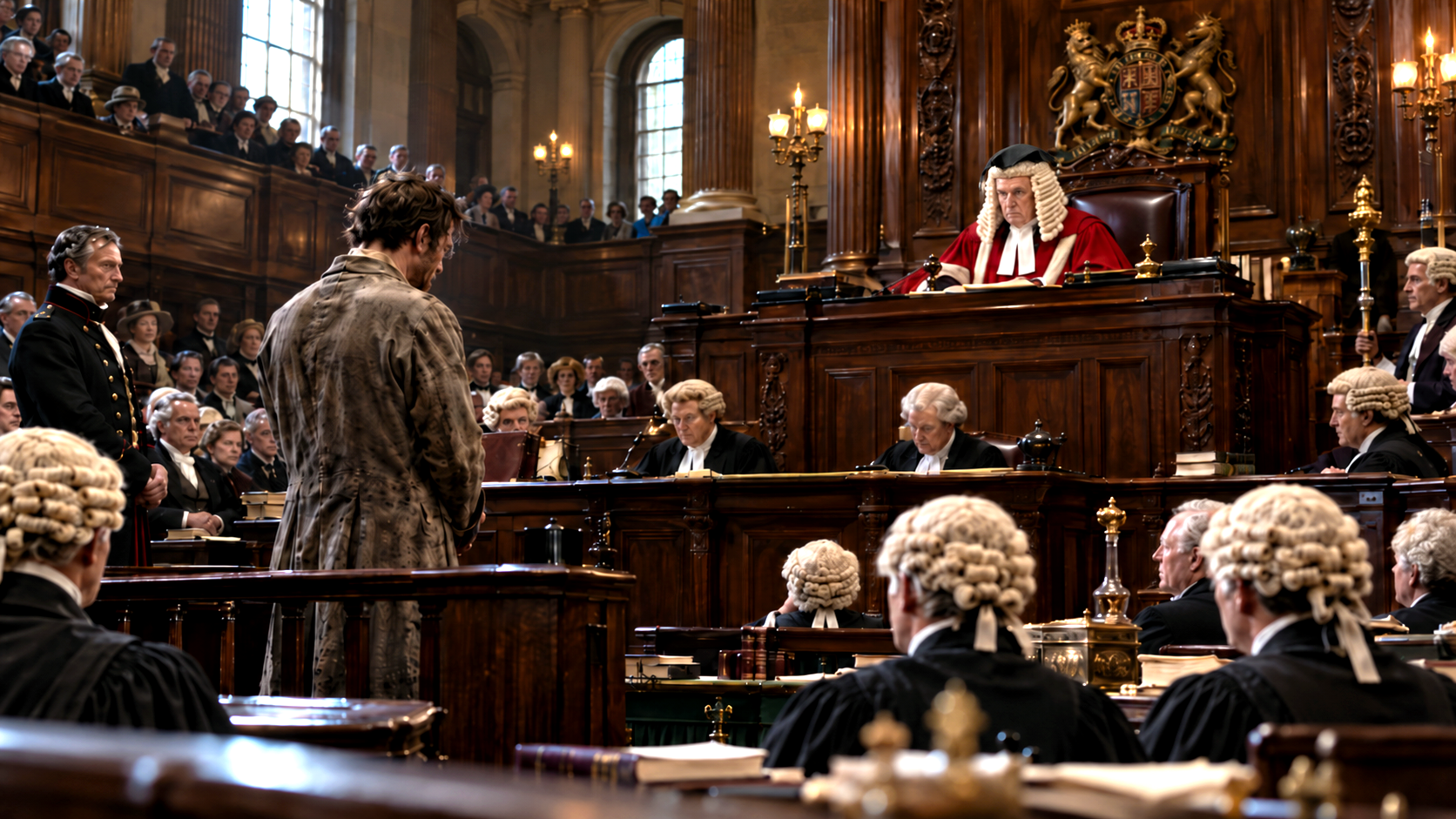
British Judge delivering a Death sentence in Court, wearing the Black Cap of Death
4. The Criterion of the Undivided Church
The fourth question is of particular interest to those who, with the Declaration of Utrecht, make the faith of the undivided Church their criterion. For them the decisive question is not what the modern Roman magisterium has taught, but what the Church of the first millennium held. The evidence surveyed above supplies a clear but complex answer. The undivided Church, after the peace of Constantine, held that the State possesses the right of the sword, including the death penalty, as Romans 13 teaches. It also held that Christians, and especially clerics, should shrink from shedding blood; that bishops should intercede for the condemned; and that mercy, where possible, is to be preferred. What it did not hold is that the death penalty is intrinsically wrong; but neither did it hold that the State’s use of the death penalty is a positive good to be encouraged. On this criterion, the classical teaching is better attested than the doctrine of inadmissibility; but the abolitionist instinct is better attested than the enthusiasm for capital punishment sometimes found among its modern defenders.
IX. Conclusion: What May Honestly Be Said
The purpose of this essay has been to set out the evidence and the arguments rather than to decide between them. It may be useful, in conclusion, to state what the evidence will and will not bear.
It will bear the claim that Scripture positively commands the death penalty in the Old Testament and assumes the State’s authority to inflict it in the New. It will not bear the claim that the New Testament commands the death penalty, nor that it forbids it. It will bear the claim that the Fathers after Constantine affirmed the legitimacy of the State’s sword. It will not bear the claim that the Fathers were enthusiastic about its use, nor that the pre-Constantinian rigorists denied the State’s right as distinct from refusing Christian participation. It will bear the claim that the medieval and early modern Church taught the legitimacy of the death penalty in explicit and authoritative terms. It will not bear the claim that this teaching was ever solemnly defined. It will bear the claim that the present Roman magisterium teaches that the death penalty is inadmissible and works for its abolition. It will not settle whether that teaching is a development of principle or a prudential judgment, since the texts themselves hold both kinds of ground together.
Above all, the evidence will not bear the comfortable narratives that each side tends to tell. The abolitionist cannot honestly present the tradition as a long betrayal of the Gospel corrected at last, since the Fathers who affirmed the sword were saints and doctors, and their affirmation was grounded in Scripture. The defender cannot honestly present the recent teaching as a mere novelty without roots, since the reluctance to shed blood, the intercession of bishops, the canonical prohibition on clerical participation and the preference for mercy run through the entire tradition. The Church has always held the sword and the plea together. The present debate is, in the end, a debate about whether the plea may now become the rule, and on what grounds.
That debate must be conducted with candour. It is not served by quotation without context, by the suppression of inconvenient texts, or by the assumption that one’s opponents are either faithless or cruel. The question is a grave one, touching the life of the guilty, the protection of the innocent, the authority of the Church’s teaching and the integrity of her witness. It deserves to be answered, if it can be answered, by those who have first looked steadily at all the evidence.🟥
[1] Pius XII, Address to the First International Congress on the Histopathology of the Nervous System, 14 September 1952, AAS 44 (1952): 779–89; John Paul II, Evangelium Vitae (25 March 1995), §56; Catechism of the Catholic Church, §2267, as revised by rescript of 1 August 2018; Leo XIV, video message to the gathering at DePaul University, Chicago, marking the fifteenth anniversary of abolition in Illinois, 24 April 2026, as reported by OSV News, 24 April 2026.
[2] The Declaration of the Old Catholic Bishops assembled at Utrecht (24 September 1889), art. 1, invokes the same principle. Vincent of Lérins, Commonitorium 2.5, ed. R. Demeulenaere, CCSL 64 (Turnhout: Brepols, 1985): “quod ubique, quod semper, quod ab omnibus creditum est.”
”What has been believed everywhere, always and by all.”
[3] See the discussion in Claus Westermann, Genesis 1–11: A Commentary, trans. John J. Scullion (Minneapolis: Augsburg, 1984), ad loc.; and Gordon J. Wenham, Genesis 1–15, WBC 1 (Waco, TX: Word, 1987), ad loc., who reads the verse as prescriptive.
[4] Genesis, ed. John William Wevers, Septuaginta: Vetus Testamentum Graecum 1 (Göttingen: Vandenhoeck & Ruprecht, 1974), ad loc.; Vulgate: “quicumque effuderit humanum sanguinem fundetur sanguis illius ad imaginem quippe Dei factus est homo.”
”Whoever sheds human blood, his blood shall be shed; for man was made to the image of God.”
[5] C. E. B. Cranfield, A Critical and Exegetical Commentary on the Epistle to the Romans, ICC, 2 vols. (Edinburgh: T&T Clark, 1975–79), ad loc., weighs the options. On the ius gladii in Roman administration see A. N. Sherwin-White, Roman Society and Roman Law in the New Testament (Oxford: Clarendon, 1963), ch. 1.
[6] Novum Testamentum Graece, ed. Barbara and Kurt Aland et al., 28th rev. ed. (Stuttgart: Deutsche Bibelgesellschaft, 2012), ad loc. Augustine, De adulterinis coniugiis 2.7.6, ed. J. Zycha, CSEL 41 (Vienna: Tempsky, 1900), already suspected that some had removed the passage from their copies for fear that it would seem to license adultery.
[7] Clement of Alexandria, Stromateis 1.27.171–73, ed. Claude Mondésert and Marcel Caster, SC 30 (Paris: Cerf, 1951); the passage concerns the purposes of legal punishment in general and should be read in that context.
[8] Origen, Contra Celsum 7.26, ed. Marcel Borret, SC 150 (Paris: Cerf, 1969).
[9] John Chrysostom, Hom. 23 in Rom., PG 60.
[10] Augustine, De civitate Dei 1.21, ed. B. Dombart and A. Kalb, CCSL 47 (Turnhout: Brepols, 1955): “his exceptis, quos vel lex iusta generaliter vel ipse fons iustitiae Deus specialiter occidi iubet, quisquis hominem … occiderit, homicidii crimine innectitur.”
”With the exception of those whom either a just law in general, or God himself, the fount of justice, in particular commands to be put to death, whoever kills a man … is bound by the crime of homicide.”
[11] Jerome, In Hieremiam prophetam 4.35 (on Jer 22:3), ed. S. Reiter, CCSL 74 (Turnhout: Brepols, 1960): “homicidas enim et sacrilegos et venenarios punire non est effusio sanguinis, sed legum ministerium.”
”For to punish murderers, the sacrilegious and poisoners is not the shedding of blood but the ministry of the laws.”
[12] Innocent I, Ep. 6.3.8, to Exsuperius of Toulouse, PL 20:499.
[13] Leo I, Ep. 15, praef., to Turribius of Astorga, PL 54:679–80.
[14] Athenagoras, Legatio 35, ed. Bernard Pouderon, SC 379 (Paris: Cerf, 1992).
[15] Tertullian, De idololatria 17.3, ed. A. Reifferscheid and G. Wissowa, CCSL 2 (Turnhout: Brepols, 1954); cf. De corona 11.
[16] Apostolic Tradition 16, in Paul F. Bradshaw, Maxwell E. Johnson and L. Edward Phillips, The Apostolic Tradition: A Commentary, Hermeneia (Minneapolis: Fortress, 2002), ad loc.
[17] Lactantius, Divinae institutiones 6.20.15–17, ed. Samuel Brandt, CSEL 19 (Vienna: Tempsky, 1890): “nihil distat utrumne ferro an verbo potius occidas.”
”It makes no difference whether you kill with the sword or rather with a word.”
[18] Bradshaw, Johnson and Phillips, Apostolic Tradition, 1–17, set out the case against a single early-third-century Roman author.
[19] Basil of Caesarea, Ep. 188, can. 13, in Saint Basile: Lettres, ed. Yves Courtonne, vol. 2 (Paris: Les Belles Lettres, 1961).
[20] Ambrose, Ep. 25 (Maurist numbering), to Studius, in Epistulae et acta, ed. Otto Faller and Michaela Zelzer, CSEL 82 (Vienna: Hölder-Pichler-Tempsky, 1968–96); the letter is numbered differently in Zelzer’s edition. Cf. Ambrose, De Cain et Abel 2.10.38, ed. C. Schenkl, CSEL 32/1 (Vienna: Tempsky, 1897), on God’s sparing of Cain.
[21] Augustine, Epp. 133 and 139, to Marcellinus, ed. A. Goldbacher, CSEL 44 (Vienna: Tempsky, 1904).
[22] Augustine, Ep. 153, esp. 6.16, ed. Goldbacher, CSEL 44; Macedonius’ letter is Ep. 152.
[23] Sulpicius Severus, Chronica 2.46–51, and Dialogi 3.11–13, ed. C. Halm, CSEL 1 (Vienna: Gerold, 1866).
[24] Innocent III, profession of faith prescribed for Durandus of Huesca and the Waldensians, 18 December 1208, in Heinrich Denzinger and Peter Hünermann, Enchiridion symbolorum, 43rd ed. (San Francisco: Ignatius, 2012), DH 795: “De potestate saeculari asserimus, quod sine peccato mortali potest iudicium sanguinis exercere, dummodo ad inferendam vindictam non odio, sed iudicio, non incaute, sed consulte procedat.”
”Concerning the secular power we assert that it can exercise the judgment of blood without mortal sin, provided that in inflicting punishment it proceeds not from hatred but with judgment, not incautiously but with deliberation.”
[25] Fourth Lateran Council (1215), c. 18, in Norman P. Tanner, ed., Decrees of the Ecumenical Councils, vol. 1 (London: Sheed & Ward; Washington, DC: Georgetown University Press, 1990).
[26] Thomas Aquinas, Summa theologiae II-II, q. 64, a. 2, Leonine ed., vol. 9 (Rome, 1897). On the restriction of this power to public authority, see a. 3.
[27] Aquinas, Summa contra gentiles III.146.
[28] Catechismus Romanus III.6.4, ed. Pedro Rodríguez (Vatican City: Libreria Editrice Vaticana; Pamplona: EUNSA, 1989).
[29] Pius XII, Address of 14 September 1952, AAS 44 (1952): 779–89.
[30] John Paul II, Evangelium Vitae, §56.
[31] Joseph Ratzinger, “Worthiness to Receive Holy Communion: General Principles” (memorandum to Cardinal McCarrick and the U.S. bishops, June 2004), §3.
[32] Francis, Address to participants in the meeting promoted by the Pontifical Council for Promoting the New Evangelisation, 11 October 2017; Congregation for the Doctrine of the Faith, Letter to the Bishops regarding the new revision of number 2267 of the Catechism of the Catholic Church on the death penalty, 1 August 2018.
[33] Francis, Fratelli tutti (3 October 2020), §§263–70; Dicastery for the Doctrine of the Faith, Dignitas infinita (2 April 2024), §34.
[34] Leo XIV, video message of 24 April 2026, as reported by Gina Christian, OSV News, 24 April 2026; Edward Feser, “Pope Leo XIV and the Death Penalty,” The Catholic Thing, 12 January 2026.
[35] Avery Dulles, “Catholicism and Capital Punishment,” First Things 112 (April 2001): 30–35; Edward Feser and Joseph M. Bessette, By Man Shall His Blood Be Shed: A Catholic Defense of Capital Punishment (San Francisco: Ignatius, 2017); Steven A. Long, “Evangelium Vitae, St. Thomas Aquinas, and the Death Penalty,” The Thomist 63 (1999): 511–52.
[36] Feser and Bessette, By Man Shall His Blood Be Shed, ch. 2, develop this argument at length; cf. Second Vatican Council, Dei Verbum, §11.
[37] ”An Appeal to the Cardinals of the Catholic Church,” First Things (online), 15 August 2018.
[38] E. Christian Brugger, Capital Punishment and Roman Catholic Moral Tradition, 2nd ed. (Notre Dame, IN: University of Notre Dame Press, 2014); Germain Grisez, The Way of the Lord Jesus, vol. 2, Living a Christian Life (Quincy, IL: Franciscan Press, 1993); James J. Megivern, The Death Penalty: An Historical and Theological Survey (New York: Paulist, 1997).
[39] John Henry Newman, An Essay on the Development of Christian Doctrine, rev. ed. (London: Longmans, Green, 1878), ch. 5.
[40] Samuel R. Gross, Barbara O’Brien, Chen Hu and Edward H. Kennedy, “Rate of False Conviction of Criminal Defendants Who Are Sentenced to Death,” Proceedings of the National Academy of Sciences 111, no. 20 (2014): 7230–35.
[41] National Research Council, Deterrence and the Death Penalty, ed. Daniel S. Nagin and John V. Pepper (Washington, DC: National Academies Press, 2012).
[42] Benedict XVI, Africae munus (19 November 2011), §83; for the reading of Benedict’s rationale, see Feser, “Pope Leo XIV and the Death Penalty.”