
The Fountain and the Fence
On the Economy of Salvation Beyond the Roman Boundary,
and its Presence in the Old Catholic Churches
A Question with Contraband in It
Ask an ordinary believer where grace comes from, and you will most often be handed a choice: from the Church, he will say, or from the Holy Spirit — as though these were two shops on the same street, and one had to be preferred. The question is put in good faith, and it is almost always put wrongly, because the little word or has smuggled contraband across the border. It has assumed that the Church and the Spirit are rivals for the same office, competitors for the same title deed, when in truth one of them is the source of grace and the other is merely, gloriously, its steward. Confuse the steward with the source and you will build an empire. Distinguish them, and the empire dissolves into what it always was: a household of servants entrusted with a treasure they did not mint.
This essay is about that confusion — where it comes from, how it is worked, and why it cannot survive its own documents. For the remarkable thing about the modern Roman case is not that it teaches error. It is that it teaches the truth, and then equivocates upon it; that its own most restrictive declaration, read to the end of its own sentence, concedes the very point it was drafted to deny. I mean to follow that sentence to its end. And having followed it, I mean to show that the economy of salvation — the whole traffic of grace between God and the world — overflows the Roman fence exactly where the Old Catholic churches stand: at the fountainhead, at the altar, and in the unbroken laying-on of hands.
The Source and the Steward
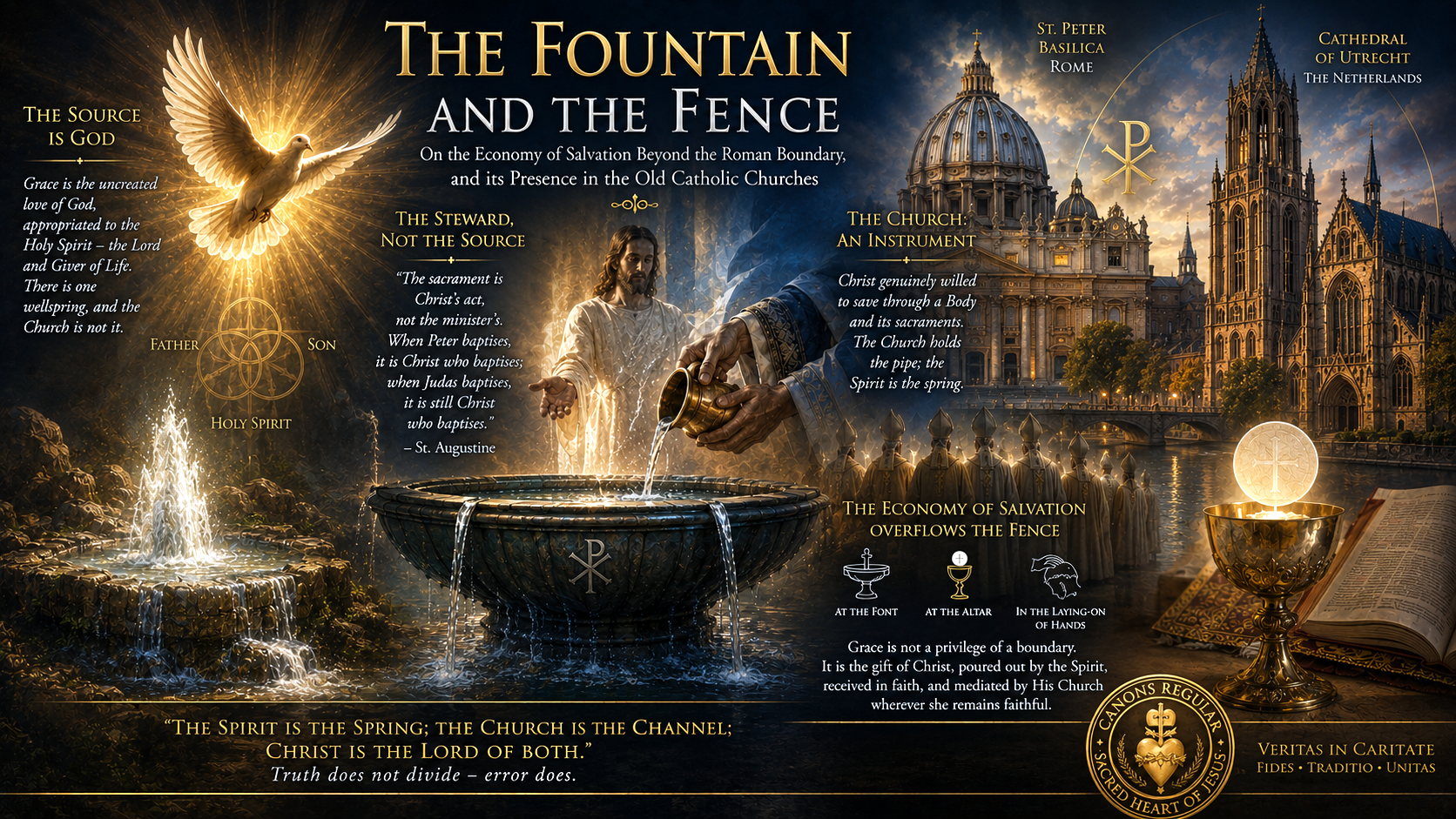
Begin where the tradition begins. Grace is not a substance the Church keeps in a cellar and decants by the cup. It is the uncreated love of God, the very life of the Trinity spilling outward, and in the proper theological grammar it is appropriated to the Holy Spirit — the Lord and Giver of Life — precisely to mark that its origin is God and not the machinery through which it reaches us. When Scripture says the love of God has been poured into our hearts, it names the pourer: the Spirit who has been given to us. There is one wellspring, and the Church is not it.
What, then, is the Church? An instrument — a real one, not a bare occasion. Christ genuinely willed to save through a Body and its sacraments, and the Body genuinely does what it was made to do. But an instrument is defined by the hand that wields it. This is the whole burden of Augustine’s long war with the Donatists, who wished to make the holiness of the minister the condition of the sacrament’s power. Augustine answered with a distinction that has never lost its edge: the sacrament is Christ’s act, not the minister’s. [1] When Peter baptises, it is Christ who baptises; when Judas baptises, it is still Christ who baptises. The efficacy was never lodged in the man, and by extension never lodged in the institution as its owner. The Church holds the pipe; the Spirit is the spring.
Aquinas gave the point its scholastic precision. The sacraments are instrumental causes of grace: the saw truly makes the bench, yet the saw is not the source of the bench’s being a bench — the carpenter is. [2] So too the sacrament truly conveys grace, and the minister truly ministers, but the principal agent is Christ, and the grace is the Spirit’s. Vatican II itself restates the Augustinian rule without a tremor: when anyone baptises, it is Christ who baptises. [3] All of this is common Catholic property. None of it is in dispute. I rehearse it only to fix the coordinate that the rest of the argument will swing upon: the Church administers a treasure it does not own, and a steward who begins to bill himself as the proprietor has committed the one theological crime that matters — he has confused himself with his Master.
Rome’s Better Self
It must be said plainly, because polemic so rarely says it: Rome’s formal doctrine of grace is impeccable. She does not teach that the Church is the source. She teaches that Christ is the one Mediator and that the Church is, in the Council’s careful phrase, veluti sacramentum — as it were a sacrament, a sign and instrument of the salvation that comes from God alone. [4] She calls the Church the universal sacrament of salvation, and the word sacrament is chosen exactly to keep the Church on the instrument side of the ledger. [5] Her systematic theology is instrumentalist to the bone, and any caricature that paints her as claiming to manufacture grace at a Vatican tap slanders the doctrine and flatters the polemicist.
More: the Council was generous past the point its critics expected. In one of the most consequential edits in the history of dogma, Lumen gentium declined to say that the Church of Christ simply is the Roman Catholic Church. It said instead that the Church of Christ subsists in the Catholic Church — and it chose the softer verb precisely so that it could affirm, in the same breath, that many elements of sanctification and truth are found outside her visible structure. [6] Real grace, real sanctification, real sacraments operate beyond the boundary. If that generous sentence were the whole of Rome’s mind, there would be no quarrel to prosecute and no fence to climb. The economy of salvation would already be confessed as unbounded, and this essay could end at its third section with a doxology. But it does not end there, because the generous sentence is not left to stand alone. It is fitted with an edge.
The Two-Edged Sword
The temptation is to read the modern Roman corpus as a quarrel between a liberal Council and a restrictive Curia — open-handed Lumen gentium in 1964, and thirty-six years later the frost of the Declaration Dominus Iesus of 6th August 2000, clawing the generosity back. That reading is comfortable and wrong. It treats subsistit in as a door left ajar by accident and the later declaration as the hand that shut it. But the two are not two moods of two parties. They are two edges of one blade, forged for a single cut.
The first edge is the magnanimous one. It concedes reality: yes, grace and sacrament and truth genuinely live outside the visible boundary. This is the edge that earns admiration; it disarms the separated brother by affirming him. And then the backstroke, which is written into the very grammar of the concession. For “subsists in” requires a fullness located in exactly one place, against which every grace found elsewhere is measured as partial, wounded, defective, ordered-back-toward. [7] The generosity was never symmetrical. It was the generosity of a centre toward its own peripheries — the compliment a capital pays its provinces. To accept the affirmation (“your grace is real”) is, in the same motion, to accept the coordinate system in which your grace is real because it derives from, and strains back toward, a fullness held at Rome.
Behind the courteous declaration stands the older, harder juridical shadow it never quite disowns: Boniface VIII’s pronouncement that submission to the Roman Pontiff is, for every human creature, a matter of the necessity of salvation — a sentence re-narrated in every generation but formally retracted in none. [8] And beside it, Vatican I’s definition of a jurisdiction over the whole Church that is ordinary and immediate, and of a personal infallibility in the definitions of the Roman See. [9] These are the grindstones. The sword is honed between two idioms and can only cut because it is never made to say which idiom it is speaking at the instant of the stroke.
Recall:
Behind the courteous declaration stands the older, harder juridical shadow it never quite disowns:
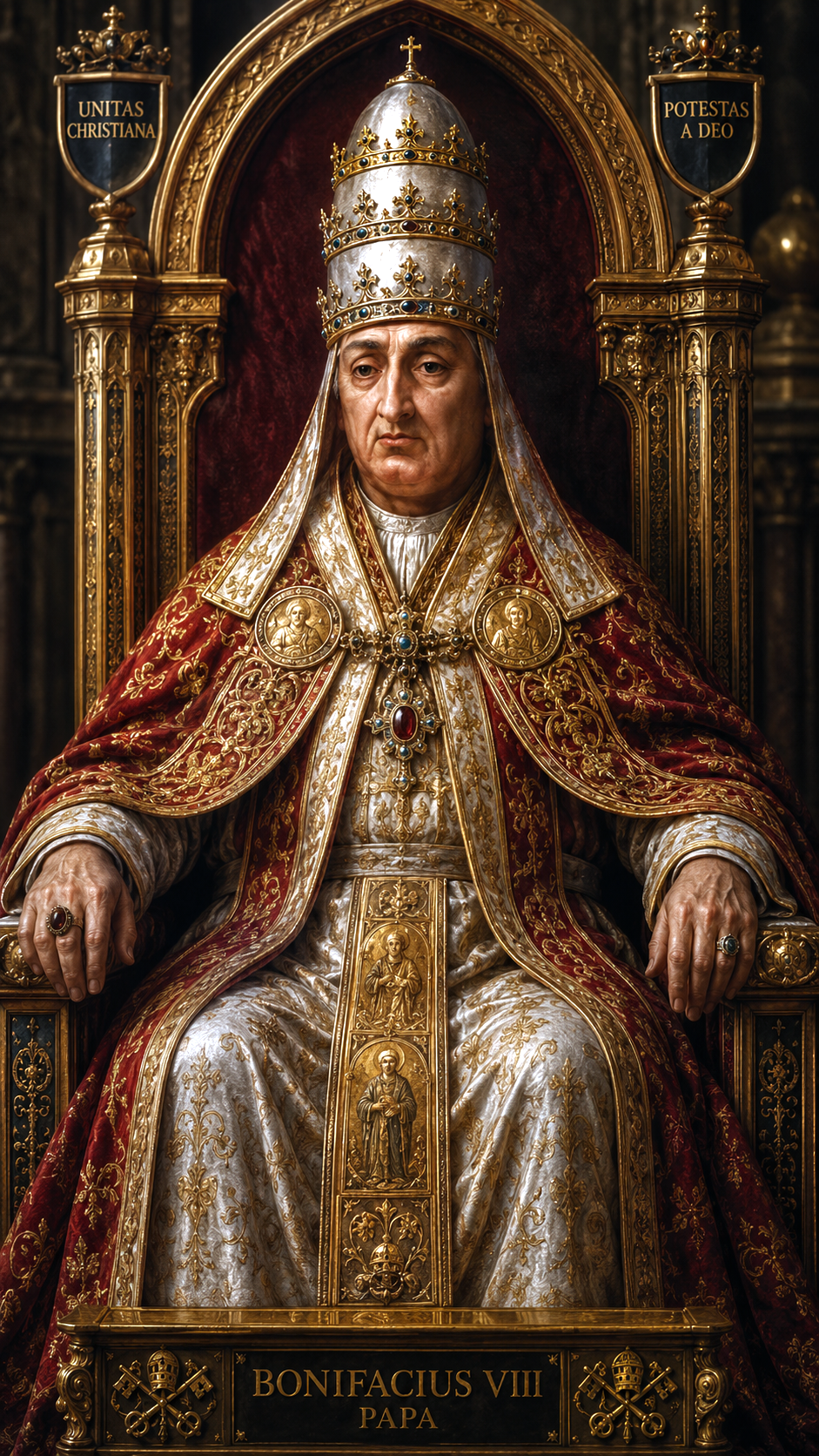
Pope Boniface VIII’s (1230-1303) pronouncement that submission to the Roman Pontiff is, for every human creature, a matter of the necessity of salvation — a sentence re-narrated in every generation but formally retracted in none. [8]
And beside it, 1870/71 Vatican I’s definition of a jurisdiction over the whole Church that is ordinary and immediate, and of a personal infallibility in the definitions of the Roman See. [9] These are the grindstones. The sword is honed between two idioms and can only cut because it is never made to say which idiom it is speaking at the instant of the stroke.
Lumen gentium in 1964, and thirty-six years later the frost of the Declaration Dominus Iesus of 6th August 2000 both deny in effect Pope Boniface VIII’s pronouncement, but conveniently never formally and officially retracted it.
For observe the equivocation. “Fullness of the means of salvation” is a theological claim — sober, defensible, arguable. “And therefore your separation from us is a wound in your very being as Church” is a juridical and affective one. The document lets the first legitimate the second. The theology earns the admiration; the canon law collects the debt. The word schism, deployed in this register, borrows the gravity of severance from the life of Christ while formally meaning no more than breach of governance — and it survives precisely because no one is ever permitted to pin down which it means as it falls.
An honest opponent has a reply here, and it deserves stating in its strongest form. He will say: the two idioms are not an evasion but the ordinary texture of any Church that must both theologise and govern. Every polity speaks doctrine and discipline in one breath; to call that duality a “sword” is itself a rhetorical trick. The objection is not fatal, and it is not to be waved away. But it fails at one joint. A Church that both theologises and governs must, when pressed, be able to say which register a given claim inhabits — must be able to answer, of any particular sentence, “this is doctrine” or “this is discipline.” The manoeuvre I am describing depends on never answering that question: on letting “wound” mean a defect of grace when admiration is wanted and a defect of order when obedience is wanted, and on refusing, at the decisive moment, to choose. Force the choice — demand, of any given cut, whether “fullness” names the Spirit’s abundance or Rome’s jurisdiction — and the blade turns to paper. The whole art of wielding it is never being made to choose.
The Witness Rome Cannot Conscript
There is a Father whom the Roman case would dearly love to enlist, and who slips the recruiter’s grasp at the last buckle. Cyprian of Carthage held, as strictly as anyone in the tradition, that there is no grace and no valid sacrament outside the Church, and that the Church’s unity is the ground of both. If ever a witness seemed made for “grace flows only through our communion,” it is Cyprian. And yet his ecclesiology refuses the Roman conclusion at the one point where it counts.
Cyprian’s unity is not a point but a communion. The episcopate, he writes, is one — and a part of it is held by each bishop in solidum, in its entirety. [10] Every bishop possesses the whole dignity, not a franchised fragment of it; the college is one as the light is one though its rays are many, one as the tree is one though its branches are many. The cathedra Petri of which he speaks is a symbol of that unity — the sacrament of the episcopate’s oneness — not a residence of jurisdiction in one see over the rest. [11] “The Church is in the bishop and the bishop in the Church,” he says, and he says it of every bishop, in every see. [12]
So Cyprian grants the modern sword its steel and denies it its point. He will concede fullness-and-derivation — grace bound to the Church, validity bound to unity. What he will not concede is that the fullness is punctiform, locatable at a single chair, so that “communion” can be measured as distance from one point on the map. His fullness is distributed: it lives in the concord of the whole college, each episcopal chair holding the entire treasure. And a fullness that is distributed cannot be weaponised, because there is no single tap to close. The witness Rome would most like to conscript for “grace flows only through our communion” turns out to testify for “grace flows through the undivided episcopate” — which is to say, he testifies for Utrecht and the Old Catholic Church in a third-century pallium.
The Sword Turned
Now to the sentence I promised to follow to its end — and it is the backstroke’s own sentence, the hard edge, Dominus Iesus §17. Read it slowly, because Rome rarely gives a better gift to the churches she means to correct:
“The Churches which, while not existing in perfect communion with the Catholic Church, remain united to her by means of the closest bonds, that is, by apostolic succession and a valid Eucharist, are true particular Churches. Therefore, the Church of Christ is present and operative also in these Churches, even though they lack full communion with the Catholic Church, since they do not accept the Catholic doctrine of the Primacy …”
Weigh what has just been solemnly conceded, under signature, by the most restrictive Roman document of the age. [13] Where the apostolic succession stands, and the Eucharist is validly confected, there is a true particular Church — not an “ecclesial community,” not a defective aggregate of individuals, but a Church in the proper sense. And in that Church the Church of Christ is present and operative: the economy of salvation is not merely trickling in from outside but is at work, at home, indigenous. And the single named deficiency — the only thing these Churches lack — is acceptance of the Roman doctrine of the Primacy.
Set that beside the equivocation of §IV and watch the blade slice the hand that holds it. The deficiency Rome names is not a defect of grace. It is not a defect of sacrament. It is not a defect in the Spirit’s operation, which §17 positively affirms is present and operative. The deficiency is juridical — the non-acceptance of a jurisdiction. Rome’s own hardest sentence, pressed to choose which idiom it speaks, chooses: the lack is a lack of governance, not of life. Which means the affective freight the word schism carries — severance from Christ, exile from grace — has just been disowned by the very document that most wished to keep it. The generous edge, swung all the way through, cuts the wielder. On Rome’s own criteria, wherever the succession and the Eucharist are found, the economy of salvation flows unbounded, and only a question of jurisdiction remains — a question about the shape of the fence, not about the water.
The Old Catholic Case
Everything now turns on a matter of fact:
do the Old Catholic churches stand where §17 draws its line?
They do — and they stand there by deliberate confession, not by accident. The founding charter of the modern Old Catholic movement, the Declaration of Utrecht of 1889, is drafted with a precision that lands it exactly inside Rome’s own concession while remaining exactly outside her jurisdiction.
Read what the Utrecht bishops actually rejected. They rejected the Vatican decrees of 1870 — the universal ordinary jurisdiction and the personal infallibility of the Roman Pontiff — as innovations contradicting the faith of the undivided Church. But they were careful, in the same article, to add that in denying this primatial jurisdiction they had no wish to deny the historical primacy which the ancient councils and Fathers accorded the Bishop of Rome as primus inter pares. [14] That is not a Protestant rejection of the papacy. It is Cyprian’s ecclesiology set down in modern ink: the cathedra Petri as symbol of unity retained; the cathedra as punctiform residence of jurisdiction refused. What Utrecht declines is precisely, and only, the thing Dominus Iesus §17 names as the sole deficiency — acceptance of the Primacy-as-jurisdiction. Utrecht and §17 are, astonishingly, describing the same line from opposite sides. Rome says: they lack only the Primacy. Utrecht says: the Primacy-as-jurisdiction is the only thing we decline. The two sentences interlock like a mortise and its tenon.
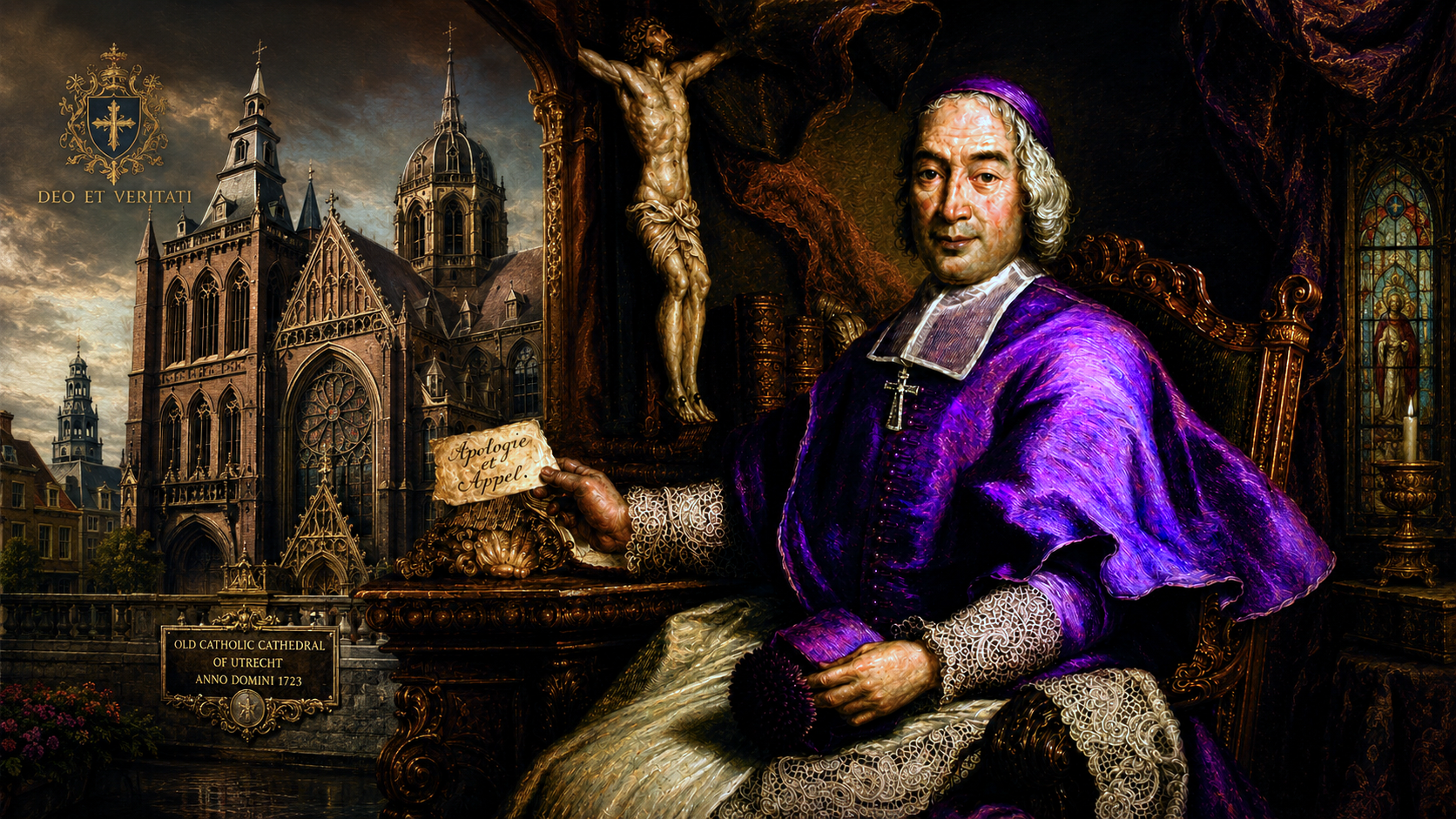
Recall:
Dominique-Marie Varlet was a French Bishop and missionary of the Roman Catholic Church who served as vicar general of the Diocese of Quebec. Later, in 1724, he consecrated four men successively as independent Archbishops of Utrecht The Western Old Catholicate of Utrecht’s independence was further affirmed in 1870/71, by rejecting Vatican Council I.
And the rest of the Catholic substance the Declaration keeps entire: the rule of faith of Vincent of Lérins — what has been believed everywhere, always, by all; [15] the Scriptures and the two ancient creeds; the dogmatic decisions of the seven ecumenical councils of the undivided Church; the seven sacraments; and the Real Presence of Christ’s Body and Blood in the Eucharist. This is not a diminished Catholicism. It is Catholicism with a single innovation of 1870 declined. Now lay the two tools of §17 against it.
I - Apostolic succession
The Old Catholic episcopate descends through the See of Utrecht, whose historic succession Rome has never seriously contested and has repeatedly, if quietly, acknowledged as valid. The contrast with Leo XIII’s verdict on Anglican orders is the proof of the pudding: Anglican orders were declared null for defect of form and intention — a judgement about the rite, not about the fact of separation [16] — whereas the Utrecht line, transmitted with unquestioned matter, form, and intention, was never so condemned. Roman canonical practice concedes the point in the most practical currency there is: in grave necessity a Catholic may licitly receive the Eucharist, penance, and anointing from an Old Catholic priest, because these are ministers “in whose churches these sacraments are valid.”[17] Rome does not permit her faithful to receive true sacraments from mere “ecclesial communities.” That she permits it here is her own admission of where the line falls.
II - The Eucharist
Where the succession stands, the Eucharist is valid; and where the Eucharist is valid, the deepest principle of Catholic ecclesiology comes into play — that the Eucharist makes the Church. [18] The Church is not a jurisdiction that then licenses an altar; she is the Body gathered at the altar, constituted wherever the one Christ gives himself in the one Eucharist. Vatican II said it of the Eastern churches without flinching: through the Eucharist celebrated in each of them, the Church of God is built up and grows. [19] The principle has no natural frontier at the Bosphorus. Wherever the true Eucharist is confected — Constantinople, Utrecht, or a chapel of the Old Catholic churches this morning — the Church of God is built up and grows, and the economy of salvation is doing there exactly what it was instituted to do.
The syllogism is now not ours but Rome’s:
Major(Dominus Iesus §17): where apostolic succession and a valid Eucharist are found, there is a true particular Church in which the Church of Christ is present and operative.
Minor(Declaration of Utrecht, and Roman canonical practice): the Old Catholic churches possess apostolic succession and a valid Eucharist.
Conclusion: the Old Catholic churches are true particular Churches in which the Church of Christ is present and operative — and the economy of salvation flows through them, whole and unbounded, lacking only a jurisdiction they have declined on the authority of the ancient Church itself.
We did not build this argument. We merely followed Rome’s sentence to its end and declined to look away.
How Far the Water Runs
If the case stood only for churches of the apostolic succession, it would already overturn the folk-theology of severance. But the water runs further than that, and honesty requires we say how far — and where the ground grows genuinely softer under the claim.
Even of the communities it declines to call Churches “in the proper sense” — those lacking the valid episcopate or the integral Eucharistic substance — Dominus Iesus concedes that the baptised are, by their baptism, incorporated into Christ and stand in a real if imperfect communion with the Church. [20] And baptism is not a lesser grace dressed as a greater; it is regeneration, the gift of the Spirit, incorporation into the death and rising of the Lord. Grace once given is grace indeed. So the boundary is porous even at its farthest edge: the economy of salvation seeps past the fence not only where the altar and the succession stand, but wherever the Triune Name is poured over a believing head in water. The fence encloses a great deal; it encloses nothing exclusively.
Books:
Hands Across Time
Apostolic Succession in the 21st Century
Who has the right to ordain? What does ordination actually do? And can a chain of hands stretched across two thousand years of history truly be trusted to carry what tradition claims it carries?… These are not questions for specialists alone. They reach into the sacramental life of millions — determining whether the Eucharist celebrated in a given church is held to be a genuine encounter with Christ or a pious but incomplete act of remembrance, shaping the pastoral care available to ordinary Christians at the most significant moments of their lives, and lying at the heart of every serious ecumenical conversation about the unity of the church. They deserve honest answers. This book attempts to provide them.
Here candour must mark the seam between what the evidence compels and what it merely invites. That the succession-churches are true particular Churches is not our inference but Rome’s explicit teaching; the argument of §VII stands on conceded ground, and an opponent who would dislodge it must dislodge Dominus Iesus §17. The wider claim of this section is of a different order. That baptismal grace is real, Rome grants; that its reach makes the Roman fence non-exclusive follows by good and necessary consequence. But the structural conclusion — that the one economy of salvation is a single unbounded field of the Spirit’s operation, of which every valid sacrament in every communion is a genuine well-head — that is offered as the most coherent reading of the conceded facts, not as a further citation. It is where argument proceeds from structure rather than from proof-text; and it is stronger for saying so, because the reader who sees the seam can test the joint for himself.
The Fountain and the Fence
Return, at the end, to the beginning. A man may build a fence around a fountain. He may do it for good reasons or bad; he may keep the ground tidy or keep the crowd out; he may even persuade himself, after long enough tending the gate, that the water rises because he owns the field. But the water does not consult the fence. It rose before the fence was built and will rise after it has fallen, because its source is not in the field at all but in the deep places of the earth — or, to drop the figure, because the source of grace is not the Church but the Spirit, and the Spirit blows where it wills.
This is why the question we began with was contraband. Grace does not come from the Church or from the Spirit, as though from rival shops. It comes from the Spirit through the Church — through her font and her altar and her laid-on hands — and it comes through them wherever they are truly found, because Christ attached his promise to the things themselves and not to the perimeter drawn around a portion of them. The Old Catholic churches keep the things themselves. They keep the succession, the Eucharist, the creeds, the councils, the Real Presence; they decline one innovation of one year on the authority of the fifteen centuries before it; and by Rome’s own reckoning that leaves them true particular Churches in which the Church of Christ is present and operative.
The steward who mistakes himself for the source will always call the neighbouring wells a theft. But the wells are not stolen; they are fed from the same water table, which no communion owns, and no fence contains. The economy of salvation is a fountain, not a cistern. It is measured by the generosity of the Spirit who is its source, and never by the perimeter of the jurisdiction that would like to be. And a channel that begins to bill itself as the reservoir has confused itself with its Master — which is the oldest error in the book, and the one the whole tradition, from Carthage to Utrecht, was written to prevent.
[1]Augustine, In Iohannis euangelium tractatus VI.7: “Petrus baptizet, hic est ‹Christus› qui baptizat … Iudas baptizet, hic est qui baptizat” (ed. R. Willems, CCSL 36 [Turnhout, 1954], 57). The principle is developed at length in De baptismo contra Donatistas (ed. M. Petschenig, CSEL 51 [Vienna, 1908]), esp. bk. IV.
[2]Thomas Aquinas, Summa theologiae III, q. 62, a. 1 (the sacraments as instrumental cause of grace) and q. 64, a. 5 (the sacrament’s efficacy does not depend on the minister’s holiness, for the principal agent is Christ). Ed. Leonina, vol. 12 (Rome, 1906).
[3]Second Vatican Council, decree Sacrosanctum concilium (4 Dec. 1963), §7: Christ is present in his sacraments, “so that when anyone baptises it is Christ himself who baptises.” AAS 56 (1964), 100–101. Cf. Catechism of the Catholic Church, 2nd ed. (Vatican City, 1997), §§1088, 1127–1129.
[4]Second Vatican Council, dogmatic constitution Lumen gentium (21 Nov. 1964), §1: the Church is in Christ veluti sacramentum — as it were a sacrament, a sign and instrument of communion with God and of unity among all men. AAS 57 (1965), 5.
[5]Lumen gentium §48 and Gaudium et spes §45 name the Church the universale salutis sacramentum, the universal sacrament of salvation. AAS 57 (1965), 53; AAS 58 (1966), 1066.
[6]Lumen gentium §8: the one Church of Christ “subsistit in” — subsists in — the Catholic Church, “licet extra eius compaginem elementa plura sanctificationis et ueritatis inueniantur”, although outside her structure many elements of sanctification and truth are found. AAS 57 (1965), 12. Cf. Unitatis redintegratio §3, AAS 57 (1965), 92–93.
[7]Congregation for the Doctrine of the Faith, declaration Dominus Iesus (6 Aug. 2000), §16. AAS 92 (2000), 757. The Church of Christ, it holds, “continues to exist fully only in the Catholic Church.”
[8]Boniface VIII, bull Unam sanctam (18 Nov. 1302): “Subesse Romano Pontifici omni humanae creaturae declaramus, dicimus, definimus et pronuntiamus omnino esse de necessitate salutis.” Denzinger–Hünermann 875 (= Extrauag. commun. I, 8, 1). The sentence has never been formally retracted, only re-narrated.
[9]First Vatican Council, dogmatic constitution Pastor aeternus (18 July 1870): the Roman Pontiff possesses “ordinaria et immediata” jurisdiction over the whole Church (DH 3060, 3064) and, defining ex cathedra, is possessed of that infallibility (DH 3074).
[10]Cyprian of Carthage, De catholicae ecclesiae unitate 5: “episcopatus unus est, cuius a singulis in solidum pars tenetur” — the episcopate is one, of which a part is held by each in its entirety. Ed. M. Bévenot, CCSL 3 (Turnhout, 1972), 249; ed. W. Hartel, CSEL 3.1 (Vienna, 1868), 214.
[11]On the two recensions of ch. 4 — the so-called Textus receptus (“Primacy Text”) and the shorter text — see M. Bévenot, St Cyprian’s De unitate, Chapter 4, in the Light of the Manuscripts, Analecta Gregoriana 11 (Rome, 1938); and his introduction to The Lapsed / The Unity of the Catholic Church, ACW 25 (Westminster, MD, 1957). Even on the longer reading, the cathedra Petri figures the Church’s unity, not a jurisdiction resident in one see.
[12]Cyprian, Epistula 66.8: “ecclesia in episcopo et episcopus in ecclesia”. Ed. G. F. Diercks, CCSL 3C (Turnhout, 1996), 442–443; CSEL 3.2 (Vienna, 1871), 732–733.
[13]Dominus Iesus §17. AAS 92 (2000), 758–759. The Latin of the operative clause: churches united to Rome “per apostolicam successionem et ualidam Eucharistiam … uerae Ecclesiae particulares sunt”; therefore “Ecclesia Christi praesens et operans est etiam in his Ecclesiis.”
[14]Declaration of Utrecht (24 Sept. 1889), art. 2: rejecting the Vatican decrees of 18 July 1870 on infallibility and the universal episcopate, the bishops add that “by denial of this primatial jurisdiction we do not wish to deny the historical primacy” which the ancient Church accorded the Bishop of Rome as primus inter pares. Text in C. B. Moss, The Old Catholic Movement, 2nd ed. (London: SPCK, 1964), app. E.
[15]Declaration of Utrecht, art. 1, adhering to the rule of faith of St Vincent of Lérins, Commonitorium 2.6: “quod ubique, quod semper, quod ab omnibus creditum est” (ed. R. Demeulenaere, CCSL 64 [Turnhout, 1985], 149).
[16]Leo XIII, bull Apostolicae curae (13 Sept. 1896), declaring Anglican orders “irritas prorsus fuisse et esse omninoque nullas” — to have been and to be utterly null and void. ASS 29 (1896–97), 198; DH 3315–3319. The verdict turned on defect of form and intention, not on the mere fact of separation.
[17]Codex Iuris Canonici (1983), can. 844 §2: in necessity, Catholics may licitly receive penance, Eucharist and anointing from non-Catholic ministers “in quorum Ecclesiis valida exsistunt praedicta sacramenta” — in whose churches these sacraments are valid. The Old Catholic churches are the paradigm Western instance.
[18]For the axiom that the Eucharist makes the Church, see H. de Lubac, Corpus mysticum: L’Eucharistie et l’Église au moyen âge, 2nd ed. (Paris: Aubier, 1949); and, for its ecclesiological development, J. D. Zizioulas, Being as Communion (Crestwood, NY: SVS Press, 1985), 143–169.
[19]Unitatis redintegratio §15: through the Eucharist celebrated in each of the Eastern churches, “the Church of God is built up and grows.” AAS 57 (1965), 102. The principle admits no reason to stop at the Bosphorus.
[20]Dominus Iesus §17: of communities lacking the valid episcopate and the integral Eucharistic substance, the baptised are nonetheless “by Baptism … incorporated in Christ” and so in a real, if imperfect, communion with the Church. AAS 92 (2000), 759.