
The Boy Who Cried Schism
On the Weaponisation of a Word That Used to Mean Something
There is a word in the Roman lexicon that has been worked half to death. It is hauled out of bed at all hours, made to stand in every doorway, set upon every passing stranger, and expected—poor exhausted thing—to do the labour of an entire theology with none of the dignity. The word is schism, and one begins, after a while, to feel a certain fondness for it. It has the haunted look of a servant who has been told that everything is his fault: the burnt toast, the falling empire, the weather, the chandelier that came crashing down. Say something Rome dislikes and it is produced at once, like a bell rung for the footman. Raise an eyebrow at an innovation and it comes running. Read a book—the wrong book, an old book, a book by a man in a toga—and it arrives already screaming.
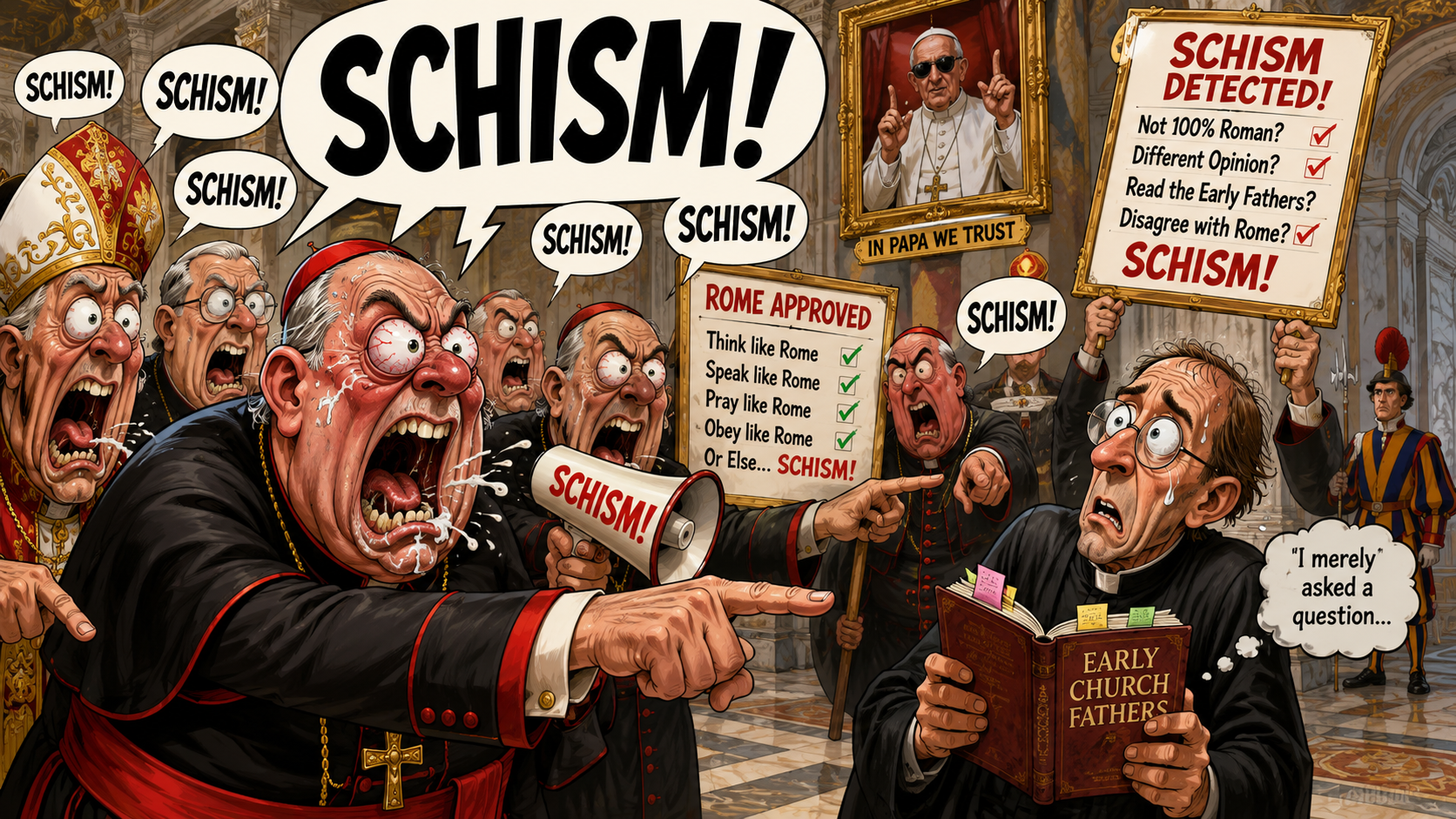
The cartoon that heads this page renders the condition with clinical accuracy. Observe the faces. Note the eyes, which have achieved a velocity of their own and appear to be attempting an escape. Note the megaphone, that sacrament of modern certainty, and the fine mist issuing from the mouth of the principal celebrant—for the foaming is not incidental to the rite; it is the rite. Note, at the back, the single Swiss Guard, who alone keeps his composure, and who is therefore the only sound piece of theology in the frame. And note, on the right, the cause of the whole commotion: a mild man with sticky-notes in his patristics, wearing the expression of one who has wandered into a hornets’ nest while looking for the lavatory. He has done something unforgivable. He has merely asked a question.
What the Word Was For
It was not always thus. The word once meant something, and meant it precisely—which is exactly why spending it on every furrowed brow is such a waste of good coinage. The Church’s own law is admirably clear, rather clearer than the men shouting it. Schism, says the Code, is the refusal of submission to the Roman Pontiff or of communion with the members of the Church subject to him.[1] It is a rupture of communion. It is a matter of standing, of jurisdiction, of the fabric of belonging. And it is emphatically not the same crime as heresy, which the very same canon defines, in the very same breath, as the obstinate denial of a truth to be held by faith.
This distinction is the whole comedy, and the whole tragedy, and I would ask the reader to hold it up to the light. Heresy is a charge about truth: you have said a false thing. Schism is a charge about obedience: you have declined to submit. They are different accusations, requiring different evidence, and—here is the point at which grown canonists become suddenly very interested in their shoes—a man may be perfectly orthodox and still be a schismatic. The charge of schism, in its exact and legal sense, is entirely compatible with your being right. It does not allege that you have erred. It alleges that you have not knelt.
This is why the checklist in the cartoon repays study. Think like Rome. Speak like Rome. Pray like Rome. And then, where a candid man might expect Believe like Rome, the list swerves: Obey like Rome. Or else… SCHISM! The artist has caught something the shouters themselves rarely notice. The final demand is not for assent but for submission. The question has been quietly changed. You came asking is this true? and you are answered are you in communion?—which is not an answer at all, but a change of subject conducted at a hundred and ten decibels.
The Unforgivable Sin of Reading
Consider next the peculiar dangerousness of books. Our man on the right is holding one, and it is not a manifesto or a pamphlet or a screed. It is, of all the seditious objects in Christendom, an anthology of the Fathers of the Church—the very men Rome claims as ancestors, quotes on her letterhead, and parades on feast days. One would think this the safest reading imaginable. One would be wrong. For there is no surer way to summon the megaphone than to be discovered, in daylight, reading the sources.
The irony here is so rich it ought to be rationed. The twentieth century’s great movement of return to the Fathers—the ressourcement, the nouvelle théologie—was for a while regarded in Rome with exactly the narrow-eyed suspicion the cartoon depicts; its practitioners were silenced, shadowed, warned off, and gently menaced by Humani Generis in 1950.[2] And then, with the serene amnesia of institutions, the same Rome convened a Council, seated those very theologians as its periti, and canonised their programme wholesale. The men who were nearly schismatics for reading the Fathers in 1950 were drafting the documents by 1964. One is tempted to conclude that in Rome the difference between a heretic and a Doctor of the Church is very often just a matter of waiting.
The Witness Who Will Not Cooperate
But the truest danger of the Fathers is not that they are old. It is that they will not do as they are told. Summon them to the witness box to testify for the megaphone, and they develop an inconvenient habit of saying their own things in their own way—and the things they say are lumpier by far than the checklist permits.
Take the great and unavoidable witness, the one every party to every argument about unity is obliged to call: Cyprian of Carthage. Here, surely, is Rome’s man. Here is the very theologian of unity, author of the treatise On the Unity of the Catholic Church, the man who gave us the seamless robe that must not be torn and the imperishable line that he can no longer have God for his Father who has not the Church for his mother.[3] No one has ever written more gravely on the sin of rupture. The megaphone lifts him aloft in triumph. Here—cries the megaphone—hear the martyr thunder against the schismatics!
And Cyprian clears his throat, and begins—and the trouble begins with him. For this same Cyprian, this same apostle of unity, presided over a council of eighty-seven bishops and opened it with words the megaphone would very much have preferred he had not said:
“For neither does any one of us set himself up as a bishop of bishops, nor by tyrannical terror compel his colleagues to the necessity of obedience.”[4]
A bishop of bishops—episcopus episcoporum—was precisely the thing Cyprian would not have. And he said it, mark you, in the very middle of a running quarrel with the Bishop of Rome himself, one Stephen, over whether heretics required re-baptism. Cyprian said yes; Stephen said no; Stephen was, as it happens, eventually held to be correct.[5] And Cyprian, being wrong on the point of doctrine, nonetheless declined to submit—and died a martyr, and is a saint, and is on the calendar, and is quoted with reverence by the very men who would excommunicate his living twin before lunch.[6]
Do you see the difficulty? The Church’s supreme witness against schism is also her supreme witness against the bishop of bishops. He held unity to be the pearl beyond price, and he held, with equal conviction, that no see on earth—not even the see of Peter—could bully a brother bishop into obedience by “tyrannical terror.” He is, in a single mortal frame, everything the megaphone wants and everything it cannot bear. And this is the general law of the Fathers: called to prove that dissent is damnable, they keep proving instead that the question was always more interesting than the shouting allowed.
How to Concoct a Schism
in Three Easy Steps
Which brings us to the mechanism itself, and to the manufacture of the thing—for the modern cry of schism has a particular and repeatable shape, and once you have seen it you cannot unsee it. It proceeds in three movements.
First, Rome innovates. She defines, in 1870, that the Roman Pontiff holds over every diocese a jurisdiction that is ordinary and immediate—that he is, in effect and at last, the bishop of every bishop—and that he may, under stated conditions, teach infallibly and of himself.[7] These are not small claims. They are, on any honest reading, new claims, or at the least newly hardened ones; the undivided Church of the first millennium contrived to manage without them, and a good many of the Fathers would have blinked.
Second, Rome demands assent to the innovation as the price of communion. What was defined yesterday must be sworn today; the addition is folded back into the deposit and presented as though it had been lying there since the Upper Room.
Third—and here is the sleight of hand—when a man declines to swear to the new thing, he is charged not with disputing an innovation but with breaking communion. His resistance to the addition is rechristened as rupture from the whole. The Church moved; he stood still; and he is called the schismatic. It is the neat trick of a man who rearranges the furniture in the dark and then charges you with trespassing when you bark your shin. This is precisely how the Old Catholics were made in 1870: they did not leave Trent; they declined to follow Rome past Trent, into territory Trent itself had never claimed—and were handed the word schism for their trouble.[8]
Here the sharp Roman reader will object, and he deserves a straight answer rather than a joke. Trent itself exalts the papacy, he will say; the Tridentine Profession of Faith has every convert swear true obedience to the Roman Pontiff.[9] Vatican I did not contradict Trent; it developed it. And this is fair, and must be met, and can be. Yes—Trent teaches obedience to the pope, and a primacy, and reveres the Roman See. But there is all the difference in the world between an acorn and an oak, and the whole art of the thing lies in not confusing botany with conjuring. A primacy of honour and even of true authority is one plant; a universal, ordinary, immediate jurisdiction that makes every bishop a branch office, welded to a personal infallibility, is quite another. To grant the seed is not to grant the forest.
The Roman apologist says development; but development is meant to unfold what was enfolded, not to smuggle in a stranger and swear he is the heir. When the thing that emerges could not have been recognised by the men who planted the seed—when Cyprian, summoned once more, says flatly that he will have no bishop of bishops—then we are entitled to ask, without foaming, whether this is an oak that grew or a tree that was quietly wheeled in overnight.
The Wolf, When He Comes
And now, having laughed, we must be grave for a paragraph, because the joke has a cost and the cost is the whole point. The boy in the old fable was not punished for believing in wolves. Wolves are real; that was never the lie. He was punished for inflation—for spending a true word on false occasions until, on the day the wolf actually came down out of the hills, the word he shouted bought nothing, and the sheep were lost, and the village slept.
That is the danger of the megaphone, and it is a danger to Rome above all. Schism is a real thing. The seamless robe can be torn; the Body of Christ can be rent; there is such a sin, and it is grave, and the Fathers were right to dread it. But a word screamed at every raised eyebrow is a word being spent into worthlessness. Cry schism at the man reading Cyprian, cry it at the man with a different opinion, cry it at the man who merely asked a question—and you are teaching the whole world to stop listening for it. You are wearing out the alarm. And an alarm worn out by false cries is not vigilance. It is the opposite of vigilance. It is noise—and noise, as it happens, is its own quiet species of tearing.
So let the megaphone rest, and let the poor exhausted word lie down, and let us return to the mild man his question, which was a good one and deserved better than a stampede. He asked whether a thing was true. That is the only question the Church was ever founded to answer, and the one the shouting is most anxious to avoid. The Swiss Guard, I notice, has not moved. He knows something the cardinals have forgotten. When you are actually guarding something precious, you do not need to scream.🟥
[1]Codex Iuris Canonici auctoritate Ioannis Pauli PP. II promulgatus (Città del Vaticano: Libreria Editrice Vaticana, 1983), can. 751: “Haeresis dicitur pertinax, post receptum baptismum, alicuius veritatis fide divina et catholica credendae denegatio, aut de eadem pertinax dubitatio; apostasia, totius fidei christianae repudiatio; schisma, detrectatio subiectionis Summo Pontifici aut communionis cum Ecclesiae membris eidem subditis.” Text in Acta Apostolicae Sedis 75, pars II (1983): 1–317. The threefold distinction is inherited from the Codex Iuris Canonici (1917), can. 1325 §2.
[2]Pius XII, encyclical Humani Generis (12 August 1950), in Acta Apostolicae Sedis 42 (1950): 561–578.
[3]Cyprian of Carthage, De catholicae ecclesiae unitate 6, in Sancti Cypriani Episcopi Opera, ed. Maurice Bévenot, Corpus Christianorum Series Latina 3 (Turnhout: Brepols, 1972): “habere iam non potest Deum patrem qui ecclesiam non habet matrem.”
[4]Sententiae episcoporum numero LXXXVII de haereticis baptizandis (Council of Carthage, 1 September 256), preface, in Sancti Cypriani Opera Omnia, ed. Wilhelm Hartel, Corpus Scriptorum Ecclesiasticorum Latinorum 3.1 (Vienna: Geroldi, 1868): “Neque enim quisquam nostrum episcopum se episcoporum constituit aut tyrannico terrore ad obsequendi necessitatem collegas suos adigit.”
[5]Cyprian, Epistula 74 (to Pompeius) and the associated correspondence of the baptismal controversy, ed. G. F. Diercks, Corpus Christianorum Series Latina 3C (Turnhout: Brepols, 1996). Stephen’s position—that baptism conferred by heretics need not be repeated—ultimately prevailed and was defended against Cyprian by Augustine, De baptismo contra Donatistas, bks. 1–2 (CSEL 51, ed. M. Petschenig).
[6]Codex Iuris Canonici (1983), can. 1364 §1: an apostate from the faith, a heretic, or a schismatic incurs a latae sententiae excommunication; cf. Codex Iuris Canonici (1917), can. 2314 §1.
[7]First Vatican Council, Dogmatic Constitution Pastor Aeternus (18 July 1870), ch. 3 (the pope’s ordinary and immediate jurisdiction over every particular church) and ch. 4 (the infallible magisterium exercised ex sese). In Heinrich Denzinger and Peter Hünermann, Enchiridion Symbolorum, 43rd ed. (San Francisco: Ignatius Press, 2012), nn. 3060–3064, 3074; text also in Acta Sanctae Sedis 6 (1870–71): 40–47.
[8]Declaration of Utrecht (24 September 1889), the founding doctrinal statement of the Union of Utrecht of the Old Catholic Churches, arts. 1–2, formally rejecting the Vatican decrees of 1870 while professing the faith of the undivided Church of the first millennium.
[9]Professio fidei Tridentina, promulgated in Pius IV, bull Iniunctum Nobis (13 November 1564): “…Romano Pontifici, beati Petri Apostolorum principis successori ac Iesu Christi vicario, veram oboedientiam spondeo ac iuro.” In Denzinger–Hünermann, Enchiridion Symbolorum, n. 1868.