
Paul: THE APOSTLE WHO RECEIVED NOTHING
St Paul, the grammar of handing-on, and the succession Rome cannot count
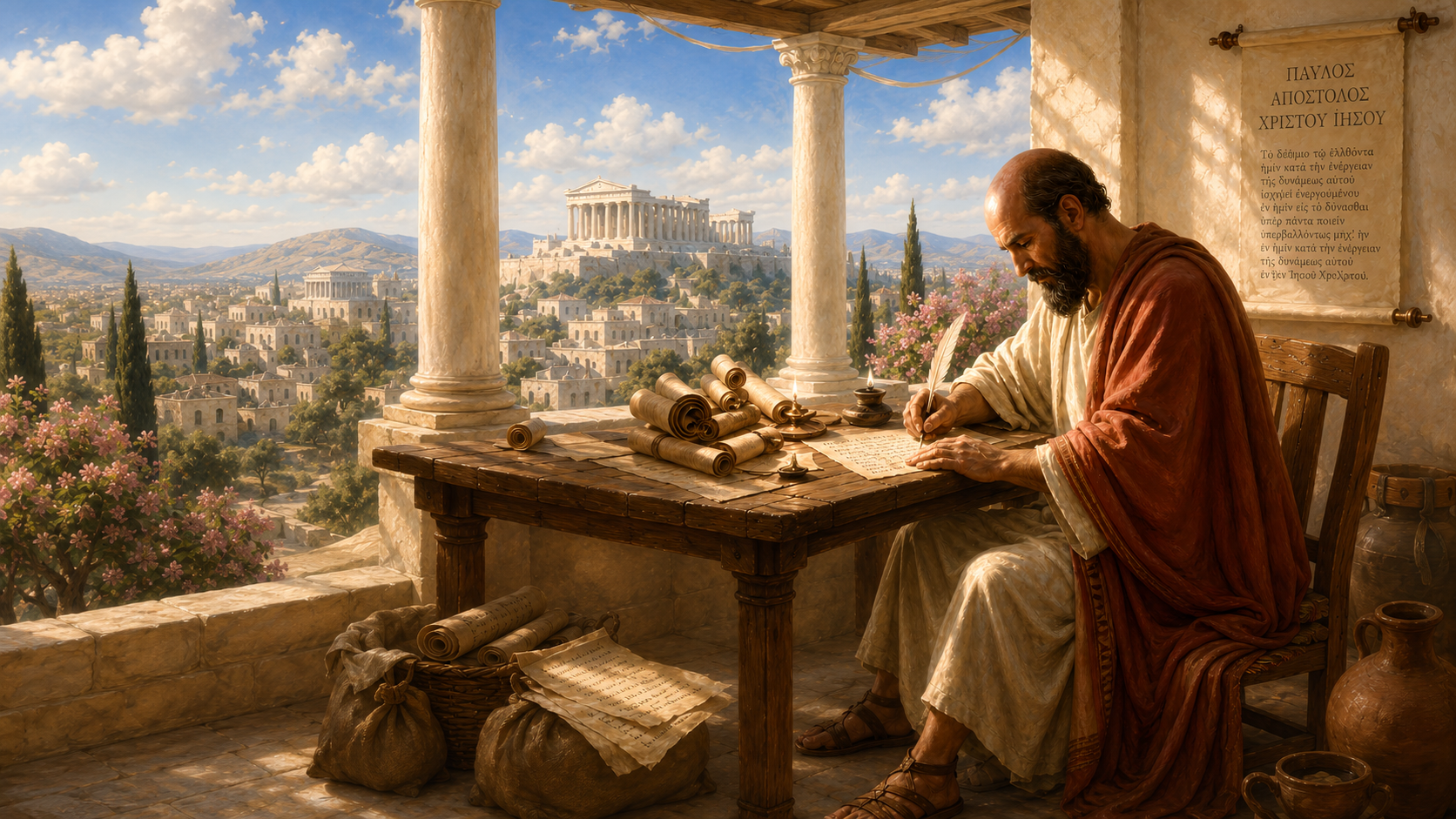
Paul, the single largest contributor to the New Testament, an author and crucially, a hands-on man of action
A COMPANION TO HANDS ACROSS TIME: APOSTOLIC SUCCESSION IN THE 21ST CENTURY
There is a sentence at the head of Paul’s angriest letter that ought to have settled the whole quarrel about apostolic succession before it was fairly begun, and which has instead been tiptoed past for the better part of two thousand years. The apostle is introducing himself to the Galatians, and he does it by naming, with some heat, everyone from whom he did not receive his office:
“Paul, an apostle — not from men, nor through a man, but through Jesus Christ and God the Father, who raised him from the dead.”
It is the theological equivalent of a man arriving late to a great dinner and announcing, before he has so much as taken off his coat, precisely which of the assembled guests did not invite him.[1] One imagines the pillars of Jerusalem exchanging glances over the soup.
The sentence is not a throwaway. It is a double negation, filed to a point. Not from men — his authority draws upon no human source. Not through a man — it was not conducted to him along any human wire, however holy the wire. Paul is not being modest, and he is not being careless; he is being exact, and what he is being exact about is that the one commission in the New Testament we are least able to do without arrived by no chain at all.
And here is the joke the tradition has never quite managed to laugh at, chiefly because it is a joke at the tradition’s own expense. This same man — this apostle-from-nobody, this ecclesiastical gate-crasher who insists he owes his office to no one on earth — is Paul, no less, the New Testament’s supreme master of handing things on.
The Grammar of Handing-On
Watch the verbs, because the whole matter lives in the verbs.
When Paul tells the Galatians that his gospel is his own by no human courtesy, the word he reaches for is parelabon — “I did not receive it from a man.”[2] It is a technical term. It belongs to the workshop of the rabbis, the Greek that renders the Hebrew qibbēl and māsar, the received-and-delivered vocabulary by which a tradition is passed from hand to careful hand.[3] Paul knows the word precisely because he was trained to use it. He is a man who spent his youth learning how to receive a deposit and hand it on unspoiled — and he tells the Galatians, in that very vocabulary, that on this one occasion he received nothing from anybody.
Now turn a few pages, to Corinth. “For I received from the Lord what I also handed on to you” — parelabon apo tou kyriou ho kai paredōka — and he is speaking of the Eucharist, the most sacred freight he carries.[4] Turn one chapter further: “I handed on to you as of first importance what I in turn had received” — and now it is the resurrection itself, the load-bearing wall of the entire faith.[5] The same verb. The identical grammar. The man who told the Galatians he received his gospel from no human hand tells the Corinthians, in the same breath of the same Greek, that he is a link in a chain of handing-on that he did not begin and will not end.
This is not a contradiction. It is the entire argument, compressed into one apostle’s working vocabulary — and it is the thing the careful books, mine among them, tend to state politely and step around. Let it be stated impolitely, for once. Paul distinguishes two kinds of succession without ever pausing to define them, because to him they are as different as a birth is from a baptism:
There is the succession of the gospel — the deposit, the message, the thing received from the Lord and handed on entire — and to this Paul is fanatically, gloriously committed; he will curse an angel out of heaven who tampers with it.[6]
And there is the succession of office — the notion that a man’s authority to minister must have travelled to him down an unbroken cord of ordaining hands — and to this Paul is not merely indifferent but, when his own case is at stake, positively hostile.
The tradition has spent centuries fusing the two and calling the weld “apostolic succession”, as though the handing-on of the message and the handing-on of the office were one seamless garment rather than two quite separable things that happen, usually and fittingly, to be worn together. Paul is the standing proof that they are separable, because in his own person they came spectacularly apart. He has the gospel without the cord. And no one — this is the point that ought to keep a Roman controversialist awake — no one in two thousand years has dared to say that Paul therefore did not have the goods.
The Company He Kept
Before we follow Paul up to Jerusalem, a smaller word deserves rescuing, because a great deal has been smuggled in under it while no one was looking. The word is apostle. We are trained to hear it and think at once of Twelve men — a fixed dozen, a closed college, a boardroom of the Spirit furnished with exactly twelve chairs. But the New Testament is markedly more generous with the title than the later arithmetic allows. Barnabas is called an apostle without apology or asterisk. Paul can write to the Thessalonians of himself and Silvanus and Timothy, all three together, as “apostles of Christ.” The very grammar of Galatians folds James the Lord’s brother in among the apostles.[7] The apostolic circle of the earliest Church is not a turnstile that clicked exactly twelve times and locked. It is a wider, warmer, more crowded room than the accountants of succession have wished it to be.
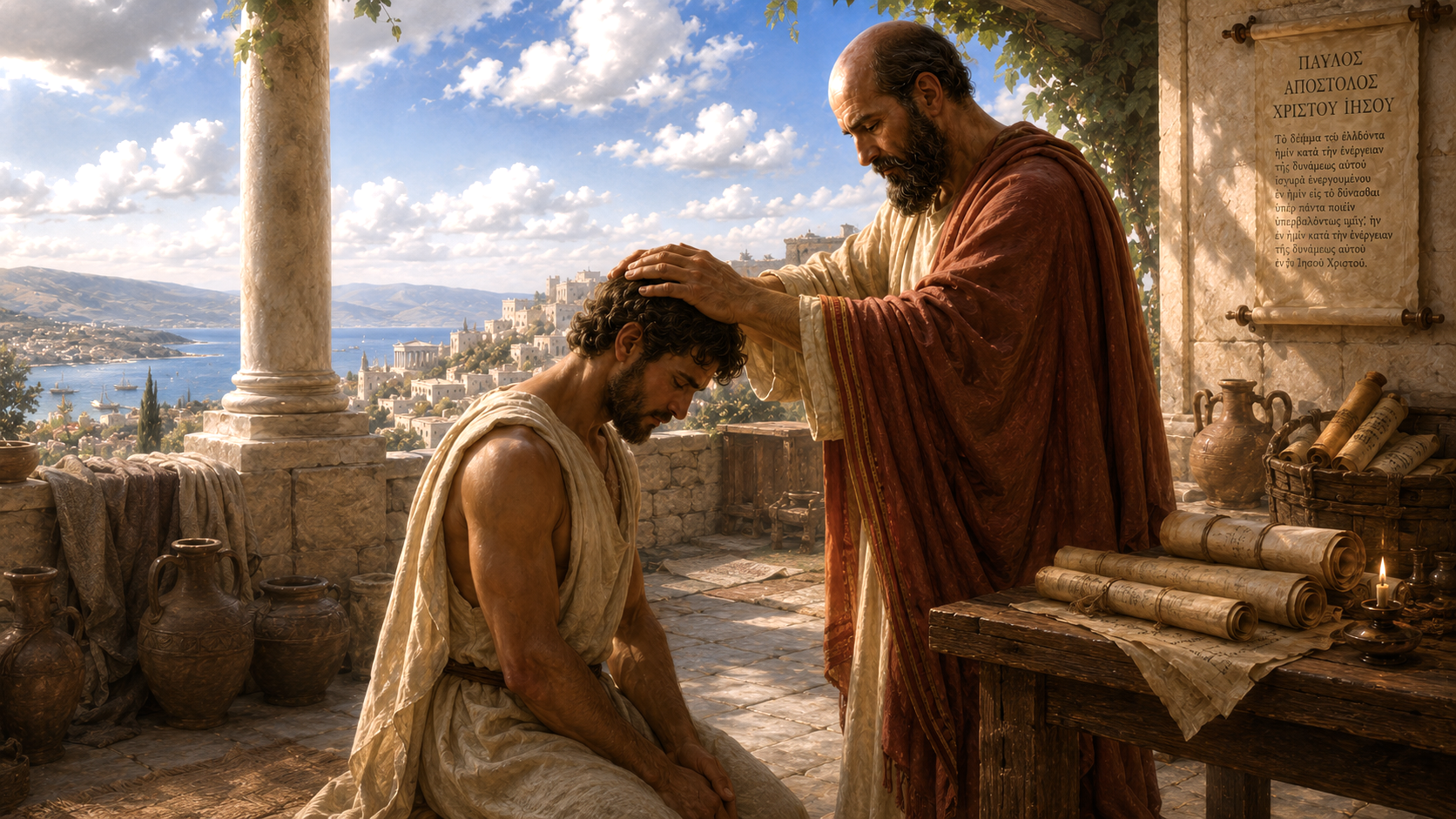
[2 Timothy 1:6]:
“For this reason I remind you to fan into flame the gift of God, which is in you through the laying on of my hands.”
Though Paul himself had never been ordained nor present at Pentecost, he ordained Timothy by laying-on of hands. In Christian theology (particularly Catholic, Orthodox, and liturgical traditions), a sacrament is considered valid when it successfully achieves its spiritual purpose through four essential components: matter (the physical element or gesture), form (the precise words spoken), minister (the qualified person performing it), and intention (the will to do what the Church does).
This matters more than it looks, because the whole picture of a single line receding into the past depends on the college at its head being small, sealed, and countable. Widen the college and the line begins to fray at its very source. If “apostle” in the New Testament’s own usage reaches past the Twelve to a Barnabas, a Silvanus, a James — men commissioned in various ways and recognised by the churches without a roll-call of the Eleven — then the tidy genealogy of single successors from a closed dozen is already, at the fountainhead, an anachronism. You cannot draw a straight line back to a point that was never a point but rather and always a crowd.
The Seam Luke Sewed Over
Here I must do something the book, for the sake of the ecumenical peace, does gently, and which a Journal article may do with the seam left showing.
We possess two accounts of how Paul came by his ministry, and they do not sit as smoothly together as devotional habit pretends. There is Paul’s, told in white heat in Galatians, and there is Luke’s, told with the serene diplomacy of a man writing a generation later to reconcile a divided Church. Read side by side, they are not so much contradictory as differently invested — and where they diverge, they diverge in a direction that is itself the evidence.
Luke, whose whole programme in Acts is to knit Paul into the fellowship of Jerusalem, gives us Ananias laying hands on the blinded Saul.[8] It is a scene the successionist eye lights upon gratefully — hands, at last! — until one actually reads it. Ananias is introduced simply as “a disciple”: not one of the Twelve, not a bishop, not a presbyter, a private Christian sent on an errand of mercy, and his hands do what the text says they do, which is to restore sight and convey the Spirit and lead to baptism. They do not ordain. And Paul, itemising his credentials at length and under fire in Galatians, never mentions Ananias at all — which is a thunderous silence from a man listing exactly how he came by his authority.
Luke gives us Antioch, too, the laying-on of hands before the first journey.[9] But look who is doing the laying-on: prophets and teachers — Barnabas, Simeon the Black, Lucius, Manaen — not an apostle among them, and the initiative belongs explicitly to the Holy Spirit, who has already called the two men before a single hand is raised. It is a sending, a communal blessing upon a mission God has already commissioned; it confers no authority Paul did not walk into the room already possessing. And once again — the tell that gives the game away — Paul, defending that very authority to the Galatians, never breathes a word of it.
Now set beside Luke’s careful stitching Paul’s own account, and feel the change in temperature. He did not confer with flesh and blood. He did not go up to Jerusalem to those who were apostles before him. He went to Arabia. Three years — three years! — before he so much as visited Cephas, and then only for a fortnight, and saw no other apostle but James.[10] And when at last he faced the pillars, the outcome was not that they authorised him but that they recognised him: they “contributed nothing”, he says, with the faint disdain of a man observing that they had nothing to contribute, and gave him the right hand of fellowship — the gesture of colleagues, not of patrons.[11]
The honest reader must notice that these are two theologies of a single event. Luke wants Paul folded into the apostolic quilt; Paul wants it known that he was cut from different cloth by the Weaver himself. And the decisive fact — the one that ought to be set in red — is that the fierce, anti-successionist version is the one told by Paul, in his own hand, under the oath of his own apostleship. In contrast, the emollient version is the one supplied for him, later, by an admirer (Luke) with a unifying agenda. When a witness and his biographer disagree about whether he needed anyone’s hands, the witness is generally worth hearing.
The Second Witness
If Paul were the only man in the New Testament to hold apostolic authority without a chain, one could, at a pinch, quarantine him — call him the lightning-strike, the glorious anomaly, the exception that leaves the rule standing in the rain. The trouble is that he is not the only one. He has a witness; and the witness is no marginal figure but the man who ran the mother church of all Christendom.
James, the Lord’s brother, did not believe in Jesus during the ministry — the Fourth Gospel says so without embarrassment. He was not among the Twelve. He was not, so far as any text tells us, in the Upper Room. And then the Risen Christ appeared to him — a private resurrection, recorded only in Paul’s list, and accepted as historical by the sceptical for the excellent reason that nobody inventing an appearance would waste one on a doubting relative who had to be won over.[12] From that encounter James rose to an authority so commanding that when he sent word to Antioch, Peter — Peter himself! — folded his tent and withdrew from the Gentile table; and when the whole Church convened in Jerusalem to settle the Gentile question, it was James who pronounced the verdict. The leader of the church from which every later chain claims to descend held his own office by no chain whatsoever. He held it exactly as Paul held his: by direct commission of the Risen Lord and the recognition of the community.
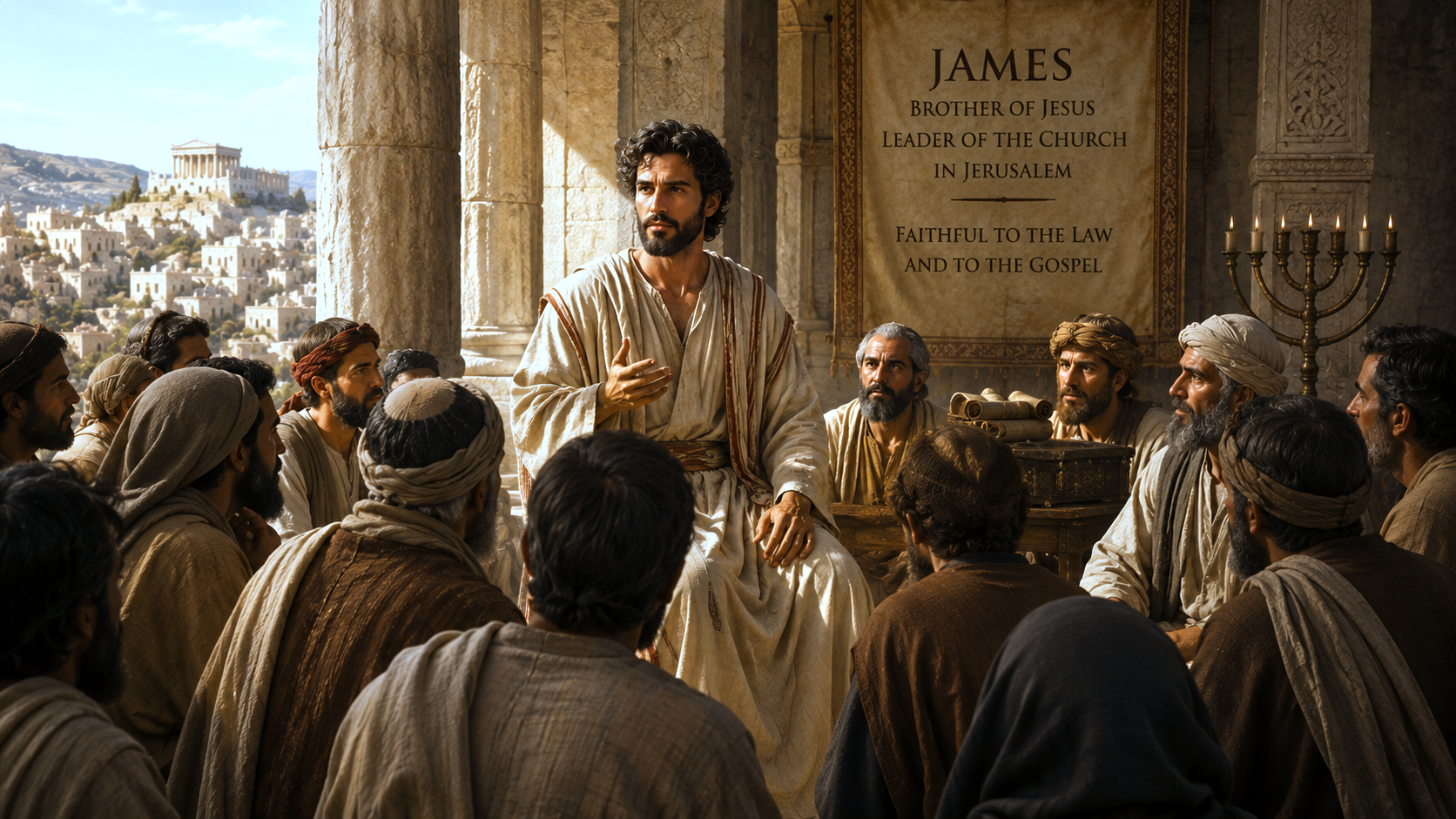
James The Just
James, Jesus’ Brother, rose to an authority so commanding that when the whole Church convened in Jerusalem to settle the Gentile question, it was James who pronounced the verdict.
Two witnesses, then, and not one — and the Law itself asks no more than two to establish a matter. The pillar of Jerusalem and the apostle to the nations, the two most authoritative men of the first Christian generation, both came to their standing around the chain rather than along it. The tradition has honoured both without a tremor. It has simply declined, for two thousand years, to notice that in honouring both it has conceded the entire argument. One exception may be quarantined. Two, standing at the very head of the Church — the man who led it and the man who spread it — are not an exception at all. They are a pattern the tradition has agreed not to see.
The Apostle Who Missed the Fire
There is one further place the successionist instinct likes to sink the fountainhead, and it too proves to have a Paul-shaped hole in it. If the chain does not begin with the ordaining hands of the Twelve, perhaps it begins at Pentecost — the rush of wind, the tongues of fire, the birthday of the Church. Here, surely, is the constituting moment from which all authority flows.
The difficulty is the guest list. Luke tells us who was in that room, and it was not a college of twelve. It was about a hundred and twenty; the Eleven among them, but far from alone — the women were there, and Mary, and the brothers of Jesus. The fire fell on all of them; “they were all filled,” Luke says, and “all of them began to speak.”[13] Whatever Pentecost constituted, it constituted something broader than a boardroom — and the questions that broader company raises have been answered by the Church in more ways than one — which I have neither the room nor the wish to adjudicate in the corner of this article.
Leave the composition of the room aside, then, and fix on the single stubborn fact that no adjudication can touch: Paul was not in it! At the hour the Spirit fell, he was, in all likelihood, still Saul — a hard young Pharisee with a heart full of subpoenas, indifferent to the Jesus movement or already sharpening himself against it. He missed the fire entirely. And yet no one doubts that the Spirit came upon him afterward, and with interest, on a road, years late, outside the sacred room and outside the sacred hour. If the man who would write a third of the New Testament could receive the Spirit’s full apostolic commission having missed Pentecost altogether, then Pentecost — whatever else it is, and it is the birthday of the Church, and I would not dim a single tongue of its flame — is not a sealed vault beyond which the Spirit will issue no further commissions. The fire fell in the Upper Room. It also fell on a road. The God who lit both is the prisoner of neither.
Counting a Chain That
Has No Second Link
There is a further embarrassment, and it is grammatical before it is theological.
When Rome and its imitators speak of “the succession of bishops”, they picture a single figure — one bishop to a city, seated in his chair, from whom the local church takes its unity, and behind him a straight line of single figures receding into the apostolic dawn. It is a tidy picture. Its only defect is that the New Testament has never heard of it.
Paul writes to the Philippians and greets “the bishops and deacons” — bishops, plural, in one town.[14] He does not know a monarchical bishop; he knows a college of episkopoi, and he uses the word interchangeably with presbyteroi, as Luke does when he has Paul summon the presbyters of Ephesus and then, in the same breath of the same speech, call them the bishops the Spirit has appointed.[15] The offices that the later chain treats as three distinct rungs — bishop, priest, deacon — are in the authentic Paul a cluster of fluid and overlapping functions: not yet sorted, not yet fixed, and emphatically not yet reduced to the one-man episcopate upon which the whole apparatus of counting depends.
The single bishop per city — the indispensable unit of any chain you propose to count backwards — does not clearly arrive until Ignatius of Antioch, early in the second century; and when he arrives, he arrives insisting, which is precisely how we know he was arguing for something not yet universally settled.[16] One does not thunder “where the bishop is, there let the congregation be” at a church that already takes it for granted. The monepiscopate is a development — a good one, a fitting one, the Spirit’s own ordering of a maturing body, and I have no wish to unsay a word of that. But it is a development, and you cannot run a chain back through a link that has not yet been forged. To trace the single bishops of the second century up through the plural, overlapping, unsorted ministers of the first is not to follow a chain. It is to draw one, and then admire the drawing.
The Lists That Argue
It is worth pausing over how the chain came to look like a chain at all, because the appearance was manufactured — manufactured for a reason, and by a man whose reason we can still read on the page.
When the Gnostics of the second century claimed a secret apostolic teaching handed down in private, Irenaeus of Lyons answered them with a brilliant stroke: he produced a public pedigree. Here, he said, is the list of the bishops of Rome, from the apostles to our own day, each handing the open apostolic teaching to the next; and against that daylight succession your whispered secret cannot stand.[17] It was a devastating argument and, in its original setting, a largely honest one — for its point was the continuity of the public teaching, the gospel handed on in the open, the very paradosis that Paul would have recognised in a heartbeat. The list was a servant of the message. It pointed away from itself, toward the thing it existed to guarantee.
What happened afterwards is what always happens to a good servant left too long alone in a great house: it began to give orders. The list, devised to vouch for the message, hardened over the centuries into a thing vouched for in its own right — no longer the evidence of continuity but the mechanism of validity, no longer the servant of the gospel but its gatekeeper. And in that hardened form it took on a new and uglier employment. Cyprian could still speak of the one episcopate held jointly and severally by all the bishops together, in solidum; but the instrument he forged for unity would be turned, in later and colder hands, into an instrument for exclusion — a way of counting who was inside the door and casting out who was not.[18] I have written elsewhere of how the word schism swelled from a description into a weapon, and I shall not rehearse it here. I note only that the swelling began the moment the list stopped pointing at the gospel and started pointing at the door.
“But Paul Was Unique”
The fittest reply to everything I have said is a single word: unique. Paul’s case, the objection runs, is a thing entirely of its own kind — a direct appearance of the Risen Lord to a chosen vessel at the very hinge of history, a one-time provision for a one-time need, from which precisely nothing may be inferred for the ordinary governance of the Church. God did an extraordinary thing once; He did not thereby licence us to expect it, still less to build upon it.
This deserves a fair hearing, because there is truth in it. Paul himself felt the strangeness of his calling; he named himself ektrōma, the one “untimely born”, the miscarriage of an apostle, a man wrenched into the college at the wrong moment and by the wrong door.[19] He did not pretend that roads to Damascus were the ordinary commute. He did not counsel the Corinthians to await their own blinding lights. Nobody here is arguing that the direct commission is the normal way, or that a man may loiter hopefully on the ring road in the expectation that the Spirit will strike him episcopal on his way to the shops.
But watch the objection closely, because it proves a great deal less than it promises. “This was unusual” is not the same proposition as “therefore the chain is the only alternative”. From the fact that Paul’s commission was extraordinary, it follows that we ought not to expect its like often. It does not follow that where the ordinary chain is absent, grace is absent with it. The unique case does exactly one piece of work, and it does that piece decisively: it establishes that the chain is not a metaphysical necessity — that there exists, on the tradition’s own sworn testimony, at least one valid apostolic commission that did not pass down the cord. And a necessity with even a single exception is not a necessity. It is a norm. The distinction is the whole game. A norm may be honoured, cherished, kept as the ordinary and fitting way, and still bend before the freedom of the God who set it — which is exactly what a norm is, and exactly what a mechanism can never be. Paul does not turn the chain into an optional extra. He turns it from a machine into a custom; and a custom is the nobler thing, because a custom serves a person, while a machine serves only itself.
The Grave Middle of the Matter
I have been enjoying myself, and the reader is entitled at this point to a solemn word, because the argument has a cliff-edge and honest men should mark it clearly.
None of this — not one line of it — licenses the notion that a man may appoint himself to the ministry of Christ, or that a community may conjure holy orders out of its own enthusiasm, or that the laying-on of hands is a pantomime the confident may skip. That is not the lesson of Paul, and to draw it would be to make of him exactly the freelancer he was not. Look again at the verb. Paul did not seize his commission; he received it — parelabon — and the fact that he received it from the Risen Christ on the Damascus road rather than from a college of men does not make it less received. It makes it more. His whole boast is not that he needed no commission but that his commission came from the highest possible hand, delivered in person, with a violence of light that left him three days blind.[20] The apostle-from-nobody is the apostle-from-Christ-himself, which is the exact opposite of the apostle-from-himself. Between those two lies all the difference in the world, and the man who blurs them has understood neither Paul nor the ministry.
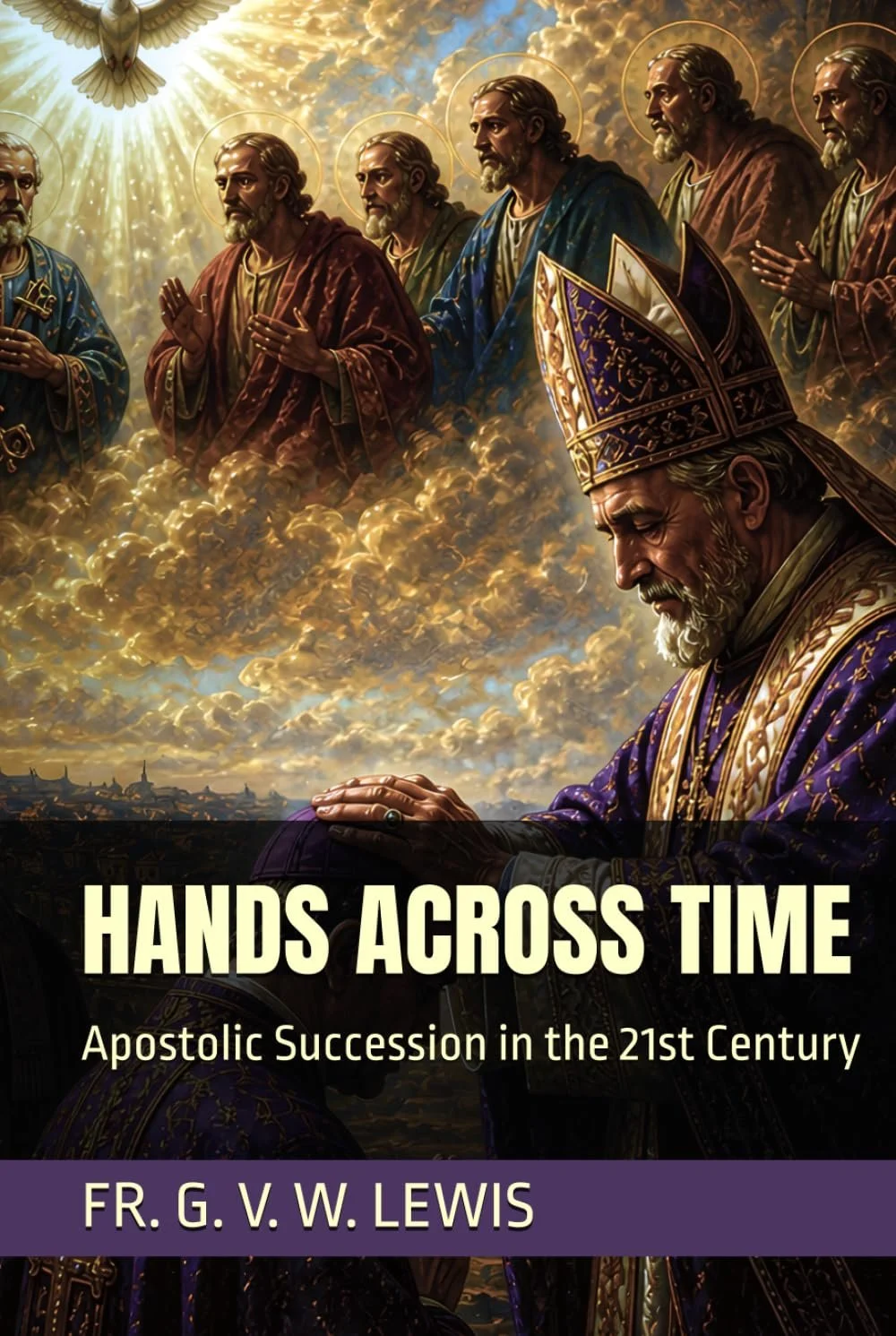
So let the record show what the sober version — the version I have argued stone by stone in Hands Across Time — actually holds.[21] The historic episcopate is a gift. The laying-on of hands is a fitting and apostolically grounded rite, kept rightly, kept gladly, kept as the ordinary and honourable form through which the Church discerns and seals a calling. The unbroken orders that the Old Catholic churches and Old Catholic ecclesial communities guard through the line of Utrecht are worth guarding, and we guard them. The sign is precious. This essay takes nothing whatsoever from the sign.
What it takes — all it takes — is the idol. It denies the sign the one thing a sign must never be permitted to become, which is a mechanism: an automatic, metaphysical necessity without which grace is simply absent and God’s own apostle would be left standing outside the door. Paul is the permanent proof that the Spirit is not so confined. The chain is real, and good, and to be honoured. It is not a set of handcuffs on the Holy Spirit.
The Bludgeon and the Boomerang
Which brings us, at last, to the use now being made of the word.
There is a particular pleasure — I will not pretend otherwise — in watching a stick beat its own wielder. When Rome reaches for “succession” as a bludgeon; when it counts links to determine who may be admitted and who unchurched; when it pronounces the terrible word schism over communities whose only crime is to have declined some innovation of the last century and a half — it is swinging a weapon it has never troubled to inspect. For the weapon has a boomerang’s habit. The very canon Rome brandishes to prove that valid ministry must travel down an unbroken cord contains, at its dead centre, the largest single contributor to that canon — the apostle without whom there would be no Christianity west of Antioch — and he came down no cord at all. He is the exception the tradition cannot expel, because it cannot survive the expulsion. Rome would sooner unchurch itself than unchurch Paul; and Paul lacked precisely the credential Rome declares indispensable.
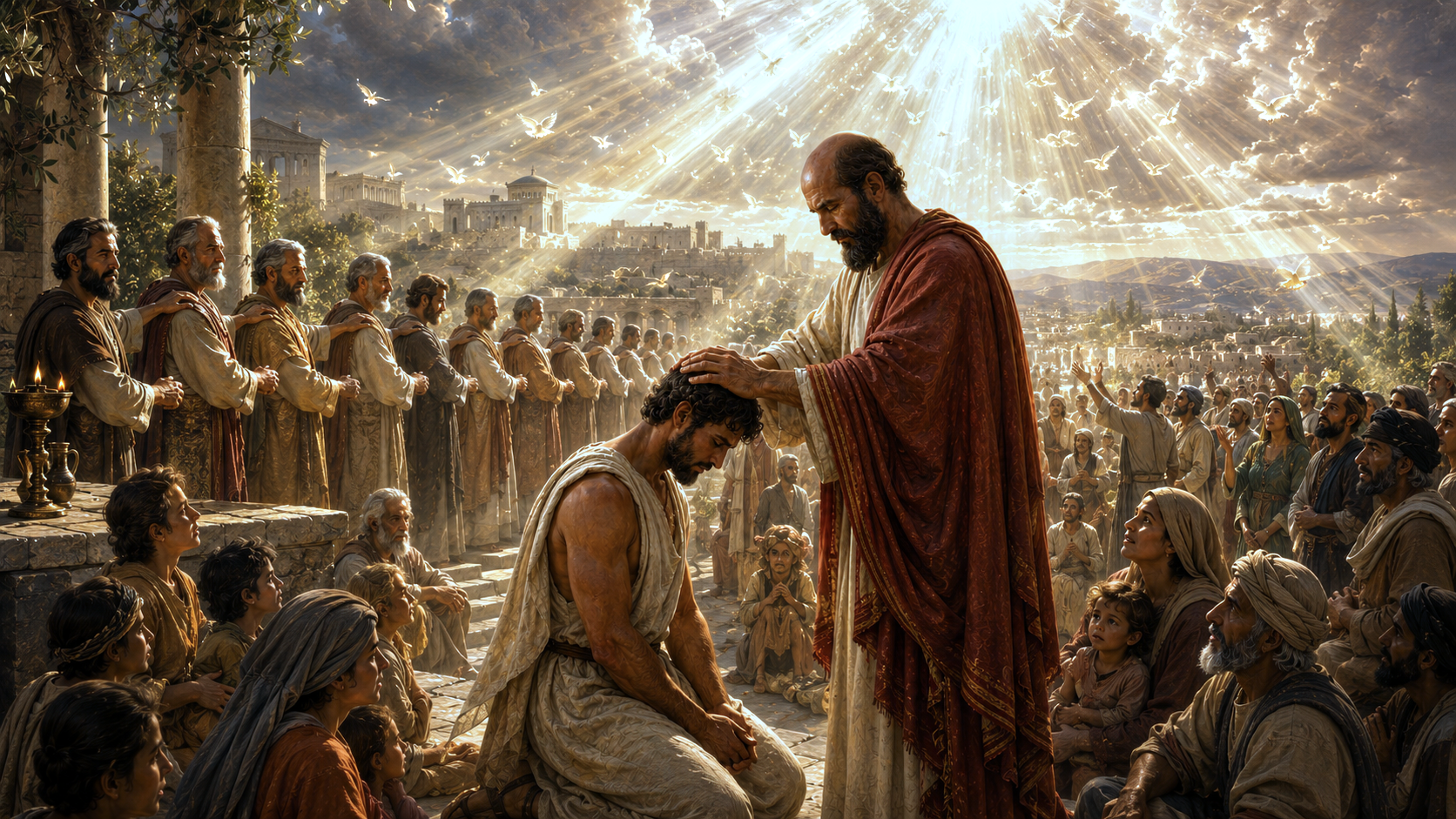
Remember:
Paul is the permanent proof that the Spirit is not confined to chain links. The apostolic succession chain is real, and good, and to be honoured. But it is not a set of handcuffs on the Holy Spirit.
This is no small debating point. It is the whole reason the schism-word, deployed as Rome now deploys it, rings false to anyone who has read the sources rather than the slogans. A Church that will not receive its neighbours because their orders cannot be traced along its preferred chain is a Church that has forgotten it possesses an apostle who cannot be traced along any chain — and honours him without a flicker of hesitation. It applies to others an absolute it has never dared apply to its own Scripture. That is not the guarding of a sign. It is the worship of a mechanism — and the mechanism, on the tradition’s own evidence, does not exist in the form the polemic requires.
I have argued the schism question at length elsewhere and shall not repeat it here.[22] I note only that the Church which cried schism at Écône, and has cried it at us, holds in its own Bible the standing rebuke to the very theology of the cry. The boy who cried wolf at least believed in wolves. The Church that cries schism over a broken chain does not appear to believe in the one Apostle its chain most conspicuously omits.
What the Exception Gives
the Divided Church
It would be a poor use of an apostle to make him a mere stick for the beating of Rome, and Paul is worth a great deal more than that. The exception he embodies is not only a rebuke; it is a gift — and its most valuable giving is to the wounds of a divided Christendom.
Consider what follows for the Churches of the Reformation, which somewhere in the storms of the sixteenth century let the historic episcopate slip through their fingers. On the strict account that loss is simply fatal — five centuries of preaching and baptising and dying in Christ reduced, at a stroke, to an elaborate pantomime, because the cord was cut. But Paul will not permit so cruel a sum. If commission can survive the absence of the chain in the person of the greatest apostle of all, then it can survive that absence in a Lutheran pastor of Leipzig or a Methodist circuit-rider in the Welsh rain. What such communities lost when they lost the historic episcopate was real and grievous — not the apostolic commission itself, which the gospel carries wherever it is truly preached, but the fullness of the apostolic sign, the visible, embodied, unbroken handclasp with the age of the apostles that the laid-on hands express and preserve.[23] That is a genuine loss, and its recovery a genuine good, and the movement of our own age toward that recovery is the Spirit healing what human anger tore. But a lost sign is not an absent grace; and the Church that has kept the sign does the Church that lost it no honour by pretending its five centuries were void.
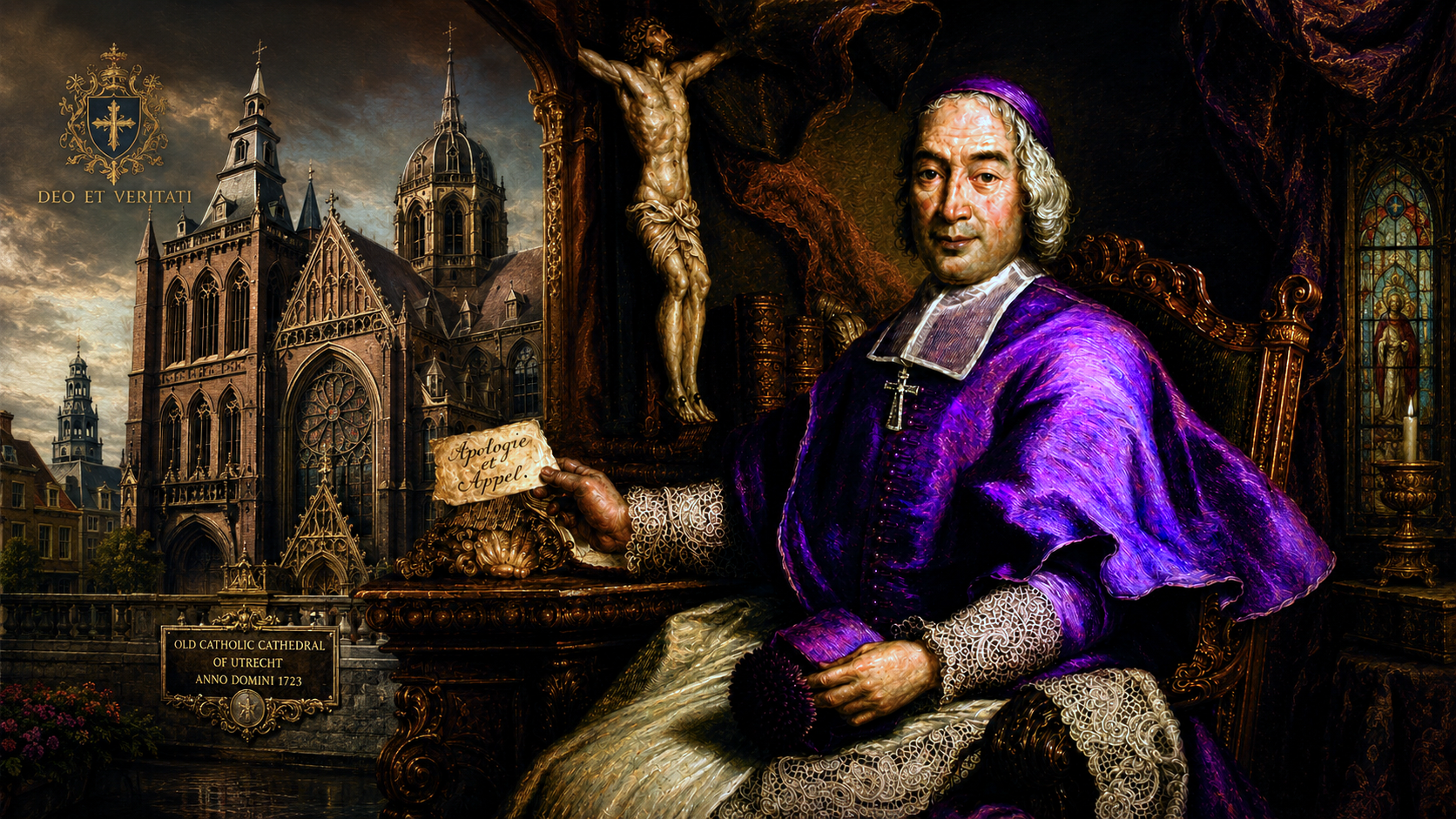
Old Catholic Church - Utrecht
Roman Catholic Bishop Dominique Marie Varlet consecrated the first 4 independent Old Catholic Archbishops of Utrecht, starting with Archbishop Cornelius Steenoven, the first Old Catholic Archbishop of Utrecht, in 1724.
Here the Old Catholic vocation shows its peculiar usefulness. Standing where we stand — inside the sacramental inheritance, outside the Roman claim to own it infallibly — we are placed to say both of the things that need saying and that the great combatants find it so hard to say in one breath: that the historic succession genuinely matters, and that the God who gave it is not chained to it.[24] We can honour the cord without worshipping it. We can prize the sign without forging it into manacles. It is not a comfortable position — it satisfies neither the party that wants the chain to be a machine nor the party that wants it to be nothing at all — but it has the considerable advantage of being where the evidence actually comes to rest. And it was Paul, the apostle who received nothing, who put it there.
Coda
The paradox with which we began was never a paradox at all, only a truth the tradition preferred to keep in two rooms so that it need never see both at once. In the one room, the message: received, handed on, guarded to the death, and Paul its most jealous custodian. In the other, the office: developed, ordered, fitting, good — and, in Paul’s own person, and in James’s, entirely dispensed with by the God who commissions whom He will. The rooms are not at war. They were only ever kept apart by a Church that found the second room easier to police when it had contrived to forget the first.
The fuller, fairer, more patient version of this argument — the one that keeps every guardrail bolted down and makes its peace, so far as peace can honestly be made, with the whole ecumenical company — is the business of Hands Across Time, and the reader who wants the case built stone by careful stone will find it built there. This has been the shorter and less careful thing: the veil lifted for an afternoon, the quiet parts said at speaking volume. But the apostle beneath the veil is the same in both books, and he is still saying, to anyone who will count his links and find them missing, the sentence with which he began — not from men, nor through a man — and daring the whole counting tradition to tell him, to his face, that he therefore never had the goods.
It never has. It never will. And in that refusal — spoken every time the tradition honours the apostle it cannot account for — it tells the truth its polemics forget: that the hand which matters most in the whole of apostolic succession is not the one that ordains, but the one, pierced, that reached down a road outside Damascus and took hold of a man who had earned nothing, received everything, and handed it on🟥
[1]Galatians 1:1: Παῦλος ἀπόστολος οὐκ ἀπ᾽ ἀνθρώπων οὐδὲ δι᾽ ἀνθρώπου ἀλλὰ διὰ Ἰησοῦ Χριστοῦ. Translation following the RSV; the double negative is emphatic and deliberate.
[2]Galatians 1:11–12; the operative verb is παρέλαβον (v. 12), “I did not receive it from a man.”
[3]On παραλαμβάνω / παραδίδωμι as the Greek carriers of the technical rabbinic idiom qibbēl / māsar — the received-and-delivered vocabulary of formal tradition — see Joachim Jeremias, The Eucharistic Words of Jesus, trans. Norman Perrin (London: SCM Press, 1966), esp. the discussion of the words of institution; cf. Birger Gerhardsson, Memory and Manuscript (Uppsala: C. W. K. Gleerup, 1961).
[4]1 Corinthians 11:23: ἐγὼ γὰρ παρέλαβον ἀπὸ τοῦ κυρίου ὃ καὶ παρέδωκα ὑμῖν.
[5]1 Corinthians 15:3: παρέδωκα γὰρ ὑμῖν ἐν πρώτοις ὃ καὶ παρέλαβον.
[6]Galatians 1:8–9.
[7]On the breadth of ἀπόστολος beyond the Twelve: Barnabas (Acts 14:14), Paul with Silvanus and Timothy together (1 Thessalonians 2:6–7), and James the Lord’s brother, whom the syntax of Galatians 1:19 numbers among the apostles. Compare Romans 16:7, where Andronicus and Junia are ἐπίσημοι ἐν τοῖς ἀποστόλοις, “prominent among the apostles” — though the precise force of the phrase is debated.
[8]Acts 9:10–19. Ananias is introduced simply as ὁ μαθητής, “a disciple” (9:10).
[9]Acts 13:1–3; the initiative is the Holy Spirit’s (13:2), and the prophets and teachers who lay on hands are named at 13:1.
[10]Galatians 1:16–19.
[11]Galatians 2:6 (ἐμοὶ … οὐδὲν προσανέθεντο, “contributed nothing to me”) and 2:9 (δεξιὰς … κοινωνίας, the right hand of fellowship).
[12]John 7:5 (“for not even his brothers believed in him”); the resurrection appearance to James, 1 Corinthians 15:7; his presiding authority, Galatians 2:12 (“certain men came from James”) and Acts 15:13–21 (James delivers the ruling of the Jerusalem council).
[13]Acts 1:14–15 (the gathered company of about a hundred and twenty, “together with the women and Mary the mother of Jesus, and with his brothers”); Acts 2:1, 4 (“all together in one place” … “all of them … began to speak”).
[14]Philippians 1:1: σὺν ἐπισκόποις καὶ διακόνοις — bishops, in the plural, in a single city.
[15]Acts 20:17 (τοὺς πρεσβυτέρους) with 20:28 (ἐπισκόπους): the same men are called presbyters and bishops in one speech; compare Titus 1:5–7, where πρεσβυτέρους (1:5) and ἐπίσκοπον (1:7) name the same office. The classic demonstration remains J. B. Lightfoot, “The Christian Ministry,” appended to Saint Paul’s Epistle to the Philippians (London: Macmillan, 1868).
[16]Ignatius of Antioch, To the Smyrnaeans 8.2 (ὅπου ἂν φανῇ ὁ ἐπίσκοπος, ἐκεῖ τὸ πλῆθος ἔστω); cf. To the Ephesians 6.1. Text and translation in The Apostolic Fathers, ed. and trans. Bart D. Ehrman, LCL 24 (Cambridge, MA: Harvard University Press, 2003). On the single-bishop office as a post-apostolic development, see Francis A. Sullivan, From Apostles to Bishops: The Development of the Episcopate in the Early Church (New York: Newman Press, 2001).
[17]Irenaeus of Lyons, Adversus Haereses 3.3.2–3, ed. A. Rousseau and L. Doutreleau, SC 210–211 (Paris: Cerf, 1974). On the Roman list as a polemical construction serving the continuity of the public teaching against Gnostic claims to a secret tradition, see Sullivan, From Apostles to Bishops.
[18]Cyprian of Carthage, De ecclesiae catholicae unitate 5 (episcopatus unus est), ed. M. Bévenot, CCSL 3 (Turnhout: Brepols, 1972). On the swelling of the canonical category of schism from a description into a weapon, see G. V. W. Lewis, “The Boy Who Cried Schism,” Mind the Limoges, 13 July 2026, https://www.crshj.org/blog/klcgg7msefqu5emz6ra4lrihgciya1.
[19]1 Corinthians 15:8: ἔσχατον δὲ πάντων ὡσπερεὶ τῷ ἐκτρώματι ὤφθη κἀμοί — “last of all, as to one untimely born, he appeared also to me.”
[20]Acts 9:3–9, with the further narrations at 22:6–11 and 26:12–18; in the last, the commission (26:16–18) is delivered directly by the Risen Christ, with no human intermediary named.
[21]G. V. W. Lewis, Hands Across Time: Apostolic Succession in the 21st Century (2026), esp. ch. III (“The Pauline Exception: The Apostle Nobody Ordained”) and ch. XIII (“What Does the Bible Actually Require?”). On the dominical institution of the eucharistic ministry among the Twelve at the Last Supper, see also idem, The Male Priesthood: Precedent and Mandate.
[22]Lewis, “The Boy Who Cried Schism,” on the 2026 episcopal consecrations at Écône and the declaration of schism that followed.
[23]For the ecumenical recovery of the historic episcopate in communities that had lost it, see Baptism, Eucharist and Ministry, Faith and Order Paper No. 111 (Geneva: World Council of Churches, 1982); on the full communion of the Old Catholic Churches of the Union of Utrecht with the Church of England, the Bonn Agreement (1931).
[24]Lewis, Hands Across Time, ch. XII, on what the Pauline exception contributes to the ecumenical conversation on ministry.