
The Mountain That Will Not Count to Three
The Transfiguration and the Grammar of the Trinity, Against the Charge of Tritheism
Light of Light, true God of true God, begotten, not made, consubstantial with the Father…
The Accusation and Its Arithmetic
There is a species of accusation that flatters itself on its arithmetic. You say one, you mean three; your religion cannot count. It has the great advantage, for the accuser, of requiring no acquaintance whatever with what is actually being said, only with the number of nouns being said about it. A Father, a Son, a Spirit — three words, evidently three gods, and the Christian who protests otherwise is merely bad at sums or worse at honesty. It is a tidy little indictment. It is also, I want to suggest, an indictment that the Gospels themselves anticipated and answered — not with a definition, which is the tool of the schoolroom, but with a mountain, which is the tool of revelation.
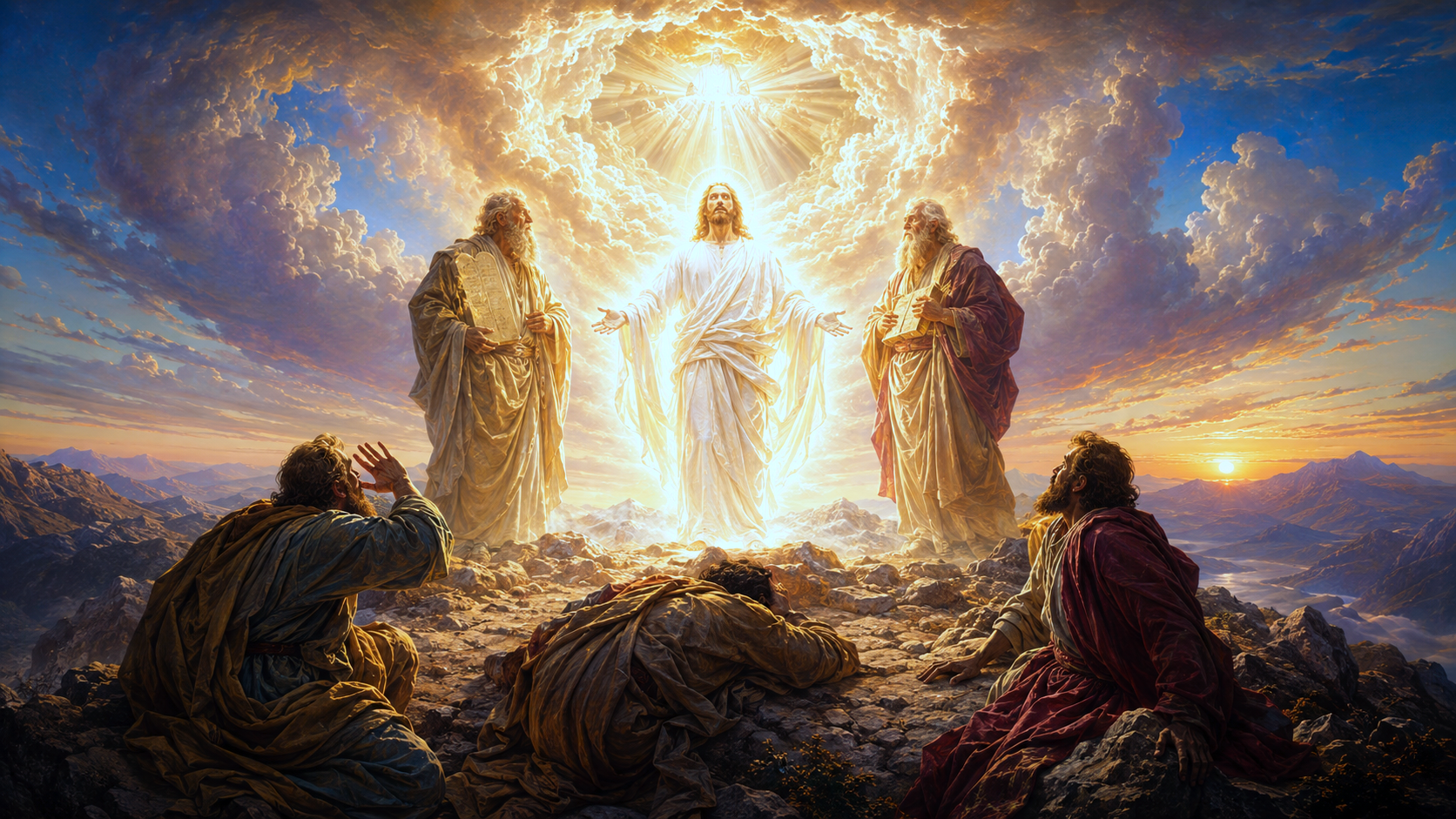
I mean the Transfiguration.[[1]] Christ takes Peter, James and John up an unnamed height and there, before their eyes, he is changed. His face shines like the sun; his clothes become white as light.[[2]] Moses and Elijah appear, talking with him. A bright cloud overshadows the scene. And a voice from the cloud says: This is my beloved Son, in whom I am well pleased; listen to him.
Read that scene slowly, and the tritheism charge does not survive it — but neither, and this is the part the sceptic never expects, does the charge's mirror-image twin, the lazy shorthand that treats “God” as a single actor who occasionally puts on different hats. Both errors die on that mountain. That is rather the point of putting it there.
The Grammar Problem the Accuser Has Not Noticed
Let us take the accusation seriously before refuting it, because stated baldly — the Father is God, the Son is God, the Spirit is God, and yet there is one God, full stop, no further account offered — it does sound like special pleading dressed up in capital letters. Any honest apologist should admit that unpacked no further, it sounds like a shell game.
But look at what happens on the mountain, and the shell-game accusation runs into a wall — not a theological wall, a grammatical one. The Son is standing there, transfigured, visibly and physically present, radiating a glory the onlookers can see with their own eyes. And a voice — from elsewhere, from the cloud, addressing the scene — speaks about him, in the third person.[[3]] Not I am my Son. Not I have now become radiant. A voice, distinct from the one it is speaking about, naming a relationship between itself and him.
Here is the difficulty for anyone who supposes Christians actually believe in one undifferentiated divine subject who merely takes turns appearing as Father, then Son, then Spirit — the ancient heresy of modalism, and it is worth naming, because it is precisely what most people levelling the “three gods” charge imagine they are correcting Christians out of, without realising the Church rejected it too, centuries before them, in exactly these terms.[[4]] A single subject cannot stand transfigured on a hillside and simultaneously address itself, from a cloud, about a third person present with it, in the third person.[[5]] That is not one actor changing masks mid-scene. That is two loci of address, co-present, in relationship, within the same recorded moment. The text will not permit collapse into a single undifferentiated “God” doing impressions of himself. Whatever this is, it is not that.
So the Transfiguration performs a peculiar service. It rules out modalism by simple grammatical necessity before a sceptic even gets to raise the tritheism charge. And once modalism is off the table, the sceptic's real question can be asked honestly: fine, there is real distinction here, Father speaking of Son — so why isn't that just two gods, or with the cloud, three?
The Cloud, and the Honesty an Argument Requires
Here I want to be exact, because a delight in paradox is worth nothing if bought at the price of overstating the evidence.
The text does not say “the Holy Spirit overshadowed them” at the Transfiguration. It says a bright cloud overshadowed them, and a voice came from the cloud.[[6]] The identification of that cloud with the Spirit is not printed on the page; it is the Church's reading of the page, and any apologist who pretends otherwise is not arguing from Scripture but smuggling doctrine into a footnote and calling it exegesis.
But the identification is not arbitrary. St Luke, who alone of the three evangelists supplies the verb, tells us the cloud ἐπεσκίαζεν — overshadowed — the scene. That is not a common word. Luke uses it in his two-volume work exactly once elsewhere, at the Annunciation: the Holy Spirit will come upon you, and the power of the Most High will overshadow you.[[7]] Two scenes, decades apart in the narrative, tied together by one unusual Greek verb, chosen — we may reasonably think — on purpose. The cloud that overshadows the Virgin at the Incarnation and the cloud that overshadows the mountain at the Transfiguration are doing the same order of work: the divine act by which the Son is made known, present, and effective in the world. John of Damascus and Anastasius of Sinai both read the mountain's cloud pneumatologically on exactly this basis, and I think they were right to.[[8]][[9]]
μυστικῶς τὴν Τριάδα ἐμφαίνουσα — mystically manifesting the Trinity.
But I would rather hand a sceptical reader a slightly weaker claim, honestly argued, than a slightly stronger claim resting on a citation that is not there. The case for the Father at the Transfiguration is explicit — a voice, naming itself in relation to the Son. The case for the Son is visible — a body, transfigured, radiant. The case for the Spirit is inferential — a verbal echo, deliberate and strong, but an echo nonetheless. A good argument says so, and does not need to inflate its weakest plank to carry the weight of the whole.
Why the Asymmetry Is Not a Weakness
It might seem that admitting this uneven footing damages the case. I think it strengthens it.
If the Fathers had simply wanted a proof-text, they had an easier one ready to hand: the baptism of Christ, where all three Synoptics name the Spirit explicitly and visibly, descending as a dove, with no inferential labour required at all.[[10]] That the Church did not rest content with the baptism alone, but went hunting through Luke's own vocabulary for the quieter echo at Tabor, tells us something about how patristic exegesis actually worked. It was not pattern-imposition — take a settled doctrine and go looking for a triad in every theophany whether the text supports it or not. It was closer to philology: notice that Luke used a rare, loaded verb twice, ask why, and let the answer inform the reading. The asymmetry is evidence of a mind actually reading the text, not a mind decorating a pre-formed conclusion. Trust an argument more, not less, when it tells you where its footing is firm and where it is inferential.
This is also, incidentally, exactly the kind of unveiling-in-time that Maximus the Confessor has in view when he treats the Transfiguration not as an addition to Christ's glory but as a temporal disclosure of what is eternally true of him — the manifestation adds nothing to the reality it discloses, it only lets creatures see what was always the case.[[11]] That principle matters for what follows, because it means the distinctions on display at Tabor are not stage effects laid on for the disciples' benefit; they are the eternal relations, momentarily made visible.
One Glory, Not Three
Ruling out modalism only gets an apologist halfway. The sceptic's real charge is tritheism — three gods, not one — and so far all that has been shown is that Father and Son are really distinct. On the sceptic's own terms, that looks like it is making the problem worse, not better. So look at the glory itself.
The text is careful to distinguish two kinds of shining, and the distinction is doing exactly the work the sceptic needs to see. When Moses came down from Sinai, his face shone — but it shone because he had been in God's presence, and the glory was borrowed, reflected, and it faded, so that Moses had to wear a veil to hide the fading.[[12]] St Paul makes theological hay of precisely this detail: the Sinai glory was τὴν καταργουμένην, “the glory that was being brought to nothing.”[[13]] Moses' light is light received. It runs down like a battery.
Christ's face on the mountain, by contrast, does not reflect anyone else's glory. It shines like the sun[[14]] — and the sun does not receive its light from a source outside itself; in the physics available to Matthew's first readers, the sun simply is luminous, self-originating, the paradigm case of a body whose light is its own. Moses and Elijah are present in the scene precisely as the control group: law and prophets, the two great recipients of derivative revelation, standing beside the one whose light is not derivative at all. The contrast is the argument. Two men who reflect God's glory, flanking one man who is God's glory, and does not have to be told so by a voice from outside, because the voice from outside is instead telling the onlookers who he is — not granting him something he lacked.
δόξασόν με σύ, πάτερ, παρὰ σεαυτῷ τῇ δόξῃ ᾗ εἶχον πρὸ τοῦ τὸν κόσμον εἶναι παρὰ σοί.
(Father, glorify me in your own presence with the glory I had with you before the world existed.)
This is the move that closes the tritheism door. The Father and the Son are distinct — the grammar of the scene requires it, on pain of modalism. But the glory is not divided between them, apportioned like territory between two rival powers. It is the single, same, underived light — the Son's own, and the Father's own, one splendour witnessed rather than two splendours compared. John's Gospel supplies the sentence the Synoptic scene is visibly enacting: Father, glorify me with the glory I had with you before the world was.[[15]] Not a glory delegated to him for the occasion of the mountain. A glory he already had, eternally, with the one now speaking of him from the cloud.
Put the two halves together, and you have exactly what Nicaea would later put into a technical vocabulary the Gospel writers never used and did not need: real distinction of persons, undivided unity of the one divine nature and its glory.[[16]] Three who, one what. Not three gods sharing a name by courtesy, and not one God wearing three masks by turns, but one Godhead whose eternal life is irreducibly triune — and the mountain does not argue this so much as let you watch it happen. The later Byzantine development of this insight into a full essence–energies distinction is not required to make the narrower point stand; it is available to those who want to press further, not a precondition of the argument as stated here.[[17]]
What This Does, and Does Not, Prove
I would rather end honestly than end triumphantly, because triumphalism is the thing that makes sceptics stop listening, and rightly so.
The Transfiguration is not a geometry proof. It does not contain the words “three persons,” it does not contain the word “nature,” and nobody on that mountain was attempting to settle a fourth-century controversy eight decades before it began.[[18]] What it is, is a piece of evidence — and a remarkably concentrated one — that the earliest Christian memory of Jesus already contained the shape that later theology would have to find words for: a scene in which Father and Son are really, grammatically, unmistakably two; in which a third divine action is present and identifiable on the text's own internal logic, even if the identification requires reading Luke closely rather than superficially; and in which the glory on display refuses, on its own internal contrast with Moses, to be divided into competing portions.[[19]]
The sceptic who says “you worship three gods” has, I think, never actually been shown this scene and asked to explain it on his own terms — to explain the third-person voice, the single unfading light, the deliberate absence of a veil. He has been shown the word “Trinity” and told it means three, and left to do the rest of the arithmetic himself, badly, unaided. Show him the mountain instead.[[20]] Let him try to make it into three gods, and watch the text refuse him at the first sentence — a voice cannot speak of itself in the third person and remain single, and a light that does not fade cannot be borrowed. And let him try to make it into one undifferentiated deity playing three parts, and watch the text refuse him just as fast — a subject and the voice addressing that subject are not the same actor changing costume mid-scene.
It will not divide, and it will not collapse. That, as it happens, is the doctrine.
[1] Matthew 17:1–8; Mark 9:2–8; Luke 9:28–36. The three Synoptic accounts agree closely; where they diverge — chiefly in Luke's vocabulary — the divergence is theologically significant and is treated below.
[2] Matthew 17:2: καὶ μετεμορφώθη ἔμπροσθεν αὐτῶν, καὶ ἔλαμψεν τὸ πρόσωπον αὐτοῦ ὡς ὁ ἥλιος, “and he was transfigured before them, and his face shone like the sun.” The verb is the same μεταμορφόω that Paul uses of the believer's transformation in 2 Corinthians 3:18 — a deliberate Pauline echo the tradition did not fail to notice.
[3] Matthew 17:5: οὗτός ἐστιν ὁ υἱός μου ὁ ἀγαπητός, ἐν ᾧ εὐδόκησα· ἀκούετε αὐτοῦ, “This is my beloved Son, in whom I am well pleased; listen to him.” Note the third-person demonstrative οὗτος — “this one” — spoken of the Son from a voice that names itself only by implication (“my”), never merging its own reference with his.
[4] On Sabellian modalism as the ancient form of the “God wearing masks” account, see Tertullian, Adversus Praxean 1–2 (CCSL 2, 1159–61), where Praxeas is charged with having “crucified the Father” by refusing any real distinction of persons — patrem crucifixit. Tertullian's rebuttal proceeds from exactly this kind of scene: two agents, one addressing the other, cannot be one undifferentiated subject.
[5] On the grammatical incoherence of self-referential third-person address within a single undifferentiated subject, cf. Basil of Caesarea, Contra Eunomium 2.22 (PG 29, 625–28), pressing an analogous point against Eunomian collapse of the divine persons into a single simple reference.
[6] Luke 9:34: ἐγένετο νεφέλη καὶ ἐπεσκίαζεν αὐτούς, “a cloud came and overshadowed them.” Neither Matthew nor Mark names the cloud's occupant or agency beyond the voice; the pneumatological reading is the Church's exegesis of the scene, not the plain sense of the verse standing alone.
[7] Luke 1:35: πνεῦμα ἅγιον ἐπελεύσεται ἐπὶ σέ, καὶ δύναμις ὑψίστου ἐπισκιάσει σοι, “the Holy Spirit will come upon you, and the power of the Most High will overshadow you.” Ἐπισκιάζω occurs in Luke's writings only at 1:35 and 9:34 — a sufficiently rare verb, in a sufficiently deliberate author, that the repetition reads as authorial signal rather than coincidence.
[8] John of Damascus, Homilia in Transfigurationem Domini 12 (PG 96, 564–65), reading the overshadowing cloud as the Spirit's presence at the theophany, in parallel with the Spirit's descent at the Jordan.
[9] Anastasius of Sinai, Oratio in Transfigurationem (PG 89, 1361–76), likewise identifying the cloud with the Spirit and reading the whole scene as a condensed manifestation of the Trinity — μυστικῶς τὴν Τριάδα ἐμφαίνουσα, “mystically manifesting the Trinity.”
[10] Matthew 3:16–17; Mark 1:10–11; Luke 3:21–22. All three name the Spirit explicitly and visibly — ὡσεὶ περιστεράν, “as a dove” (Luke 3:22) — leaving no inferential labour required at the Jordan, unlike Tabor.
[11] Maximus the Confessor, Ambigua ad Thomam 10 (PG 91, 1125–1129; critical edition in CCSG 48), where the Transfiguration is read as a temporal ἀποκάλυψις, an unveiling in time of what is eternally the case within the Godhead and within Christ's own hypostasis.
[12] Exodus 34:29–35, esp. v. 33: ἐπέθηκεν ἐπὶ τὸ πρόσωπον αὐτοῦ κάλυμμα (LXX), “he put a veil upon his face.” The veiling follows precisely because the shining was not Moses' own and could not be sustained without renewal in God's presence.
[13] 2 Corinthians 3:7, 13: Paul calls the Sinai glory τὴν καταργουμένην, “the glory that was being brought to nothing” or “fading,” and states plainly that Moses veiled his face πρὸς τὸ μὴ ἀτενίσαι τοὺς υἱοὺς Ἰσραὴλ εἰς τὸ τέλος τοῦ καταργουμένου, “so that the sons of Israel would not gaze at the end of what was fading.”
[14] Matthew 17:2 (see n. 2 above). The comparison ὡς ὁ ἥλιος, “like the sun,” trades on the ancient commonplace of the sun as the paradigm case of a self-luminous rather than a reflective body — see Aristotle, De Caelo 2.7, on the sun's light as proper to itself rather than derived; the Fathers inherited and theologised this commonplace rather than inventing it.
[15] John 17:5: δόξασόν με σύ, πάτερ, παρὰ σεαυτῷ τῇ δόξῃ ᾗ εἶχον πρὸ τοῦ τὸν κόσμον εἶναι παρὰ σοί, “Father, glorify me in your own presence with the glory I had with you before the world existed.” The imperfect εἶχον — “I was having,” a continuous past — resists any reading of the glory as bestowed rather than possessed.
[16] The technical vocabulary is of course later than the Gospels; see the Niceno-Constantinopolitan formula of 381, confessing the Son ὁμοούσιον τῷ Πατρί, “consubstantial with the Father” (Denzinger–Hünermann, Enchiridion Symbolorum, 43rd ed., no. 150), building on the Nicene formula of 325 (DS 125). The claim of this essay is not that Matthew or Luke possessed this vocabulary, but that the scene they narrate is intelligible on its terms and resistant to the terms of its rivals.
[17] Gregory Palamas develops the undivided-glory reading into the full essence–energies distinction; see the Capita 150, cc. 68–69 (PG 150, 1169–72), and Triads 3.1.9–22, on the Taboric light as the uncreated glory of God, neither the divine essence itself nor a created effect. The present argument does not require Palamas's later apparatus to stand; it requires only the narrower, common patristic point that the light is the Son's own and undivided.
[18] On the tendency of popular anti-Trinitarian polemic to conflate the doctrine with tritheism through simple non-acquaintance with its distinctions, see the author's remarks on category-conflation in ecclesiological polemic in “The Boy Who Cried Schism,”Mind the Limoges, 13 July 2026, https://crshj.org/mind-the-limoges/the-boy-who-cried-schism/.
[19] Cf. the author's treatment of the parelabon/paredōka paradox and the grammar of handing-on in The Apostle Who Received Nothing: St Paul, the Grammar of Handing-On, and the Succession Rome Cannot Count, a companion to Hands Across Time: Apostolic Succession in the 21st Century (see esp. chs. iii–iv, xii–xiii) — a different doctrine, but a structurally similar method: read the scene closely before reaching for the technical vocabulary that later ages needed and the apostolic age did not.
[20] On the veil as a live image running from Sinai through Paul to the Damascene road and back again, see also the author's The Male Priesthood: Precedent and Mandate, on typological continuity and rupture across the testaments.