
Sub Fideli Custodia
On Burning Churches, Profaned Altars, and the Criminal Negligence of Those Who Keep Them
ἐνεπύρισαν ἐν πυρὶ τὸ ἁγιαστήριόν σου, εἰς τὴν γῆν ἐβεβήλωσαν τὸ σκήνωμα τοῦ ὀνόματός σου.
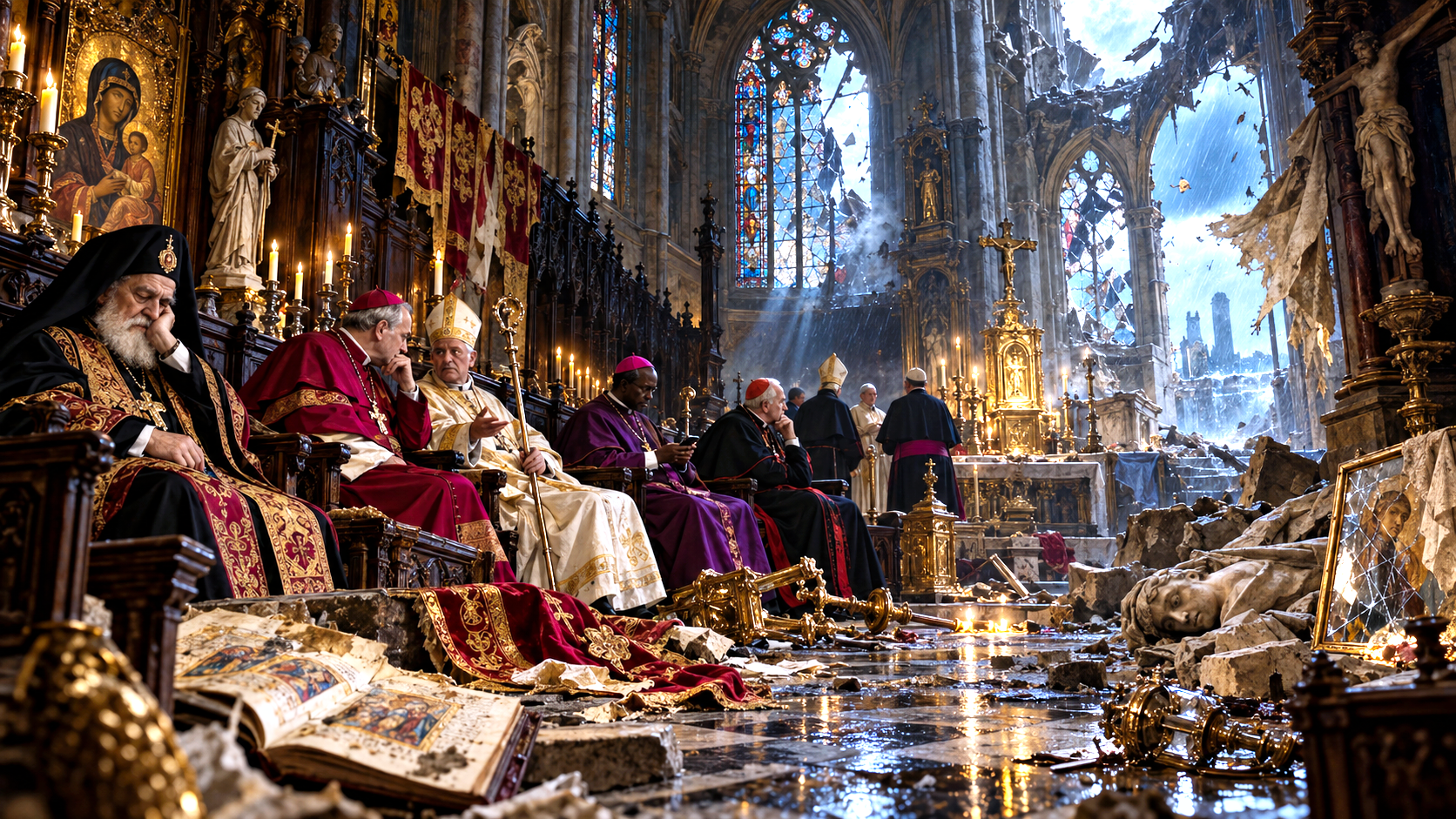
They have set your sanctuary on fire; they have profaned to the ground the dwelling-place of your name.
Ps 73:7 LXX (Ps 74:7 MT)[1]
I
The Fire and the Excuse
The Psalmist’s lament was written over a ruined Temple, and it has never since lacked an occasion. In the past seven years it could have been sung over half the Western world. In Paris, on the evening of 15 April 2019, the roof of Notre-Dame burned while a guard who had been sent to find the fire searched the attic of the wrong building.[2] In Nantes, in July 2020, the cathedral’s great organ, which had survived the Revolution and the bombing of 1944, was destroyed by fires set inside the building by the man entrusted with locking it.[3] In Santiago, in October 2020, a crowd cheered as the burning dome of La Asunción came down into the street.[4] In Bundaberg, Queensland, St Mary’s Church was gutted before dawn on 11 February 2020.[5] In Canada, at least thirty-three churches burned to the ground between May 2021 and December 2023.[6] In Saint-Omer, in September 2024, the bell tower of the Church of the Immaculate Conception collapsed in a fire set by a man already convicted, more than once, of setting fire to places of worship.[7]
Let one thing be said at the outset, plainly, so that nothing which follows can be twisted into its opposite. Those who set fire to churches, who smash statues, who break open tabernacles and scatter the Sacred Host on the floor, who strip lead from roofs and carry off chalices, are criminals. They are criminals under the civil law of every Western jurisdiction, which knows the offences of arson, burglary, theft and criminal damage. They are criminals under the law of the Church, which punishes the profanation of a sacred object with a just penalty and visits upon anyone who throws away the consecrated species, or takes or keeps them for a sacrilegious purpose, an excommunication incurred by the deed itself and reserved to the Apostolic See.[8] Nothing in this essay softens a syllable of that. The arsonist is guilty. The thief is guilty. The desecrator is guilty and, if he is baptised, also excommunicated for good measure.
But there is a second question, and the Catholic press, the episcopal communiqué, the tearful diocesan statement and the obligatory vigil of reparation all decline, with remarkable discipline, to ask it. It is the question every insurer asks, every museum director asks, and every householder asks the morning after he has been burgled: who left the door open? Who decided that a building housing the Body of Christ, the relics of the saints and seven centuries of the labour of craftsmen could be left overnight with no camera, no monitored alarm, and no detection system capable of summoning the fire brigade without first waiting for a man to climb three hundred steps and look? The answer, in diocese after diocese across the Western and westernised world, is: those to whom the custody of these things was entrusted. That means the bishops first, then the episcopal conferences and synods in which they deliberate, and then, without exemption, the clergy and the faithful.
Their disgracefully negligent failure is not misfortune. In the exact sense that the Church’s own law gives the word, it is criminal. I use the term deliberately, and I shall define it carefully, because a polemic that overclaims deserves to be dismissed. I do not say that the civil law of England, the United States or France will lockup a bishop for a missing camera; it will not. I say that the Church has legislated a duty of custody over sacred and precious things, that she has attached penalties to grave negligence in the administration of her goods, and that by her own standard the failure of her custodians to protect what has been burned, broken and stolen in our time is a crime, an offence to which the law attaches punishment. Someone needs to raise a hand and say so. This essay is that hand.
II
The Ledger of Ashes
The evidence comes from many countries, compiled by many hands, with many methods, and it would be dishonest to pretend that the figures can be added together. They cannot. But the shape they make is unmistakable.
France keeps the most careful official record. Its Interior Ministry counted 843 anti-Christian acts in 2025, an increase of 9% on the previous year, and found that the overwhelming majority, some 87%, consisted of damage to property: theft, arson, vandalism and graffiti.[9] The same report recorded 45 arson attacks on churches in that year alone (2025).[10] The Observatoire du Patrimoine Religieux told the press in 2024 that 27 French churches had burned in 2023 and 12 more in the first half of 2024.[11] Some advocacy bodies estimate that the true number of anti-Christian acts is two or three times the official figure.[12] That estimate has not been demonstrated, and I do not rest anything on it; but nor does anyone seriously suppose that the official count is too high.
In the United States, the Family Research Council, an advocacy organisation working from open sources and police records, documented 415 hostile acts against churches in 2024, including 284 acts of vandalism and 55 arsons, following 483 in 2023.[13] In Canada, a CBC review of police and court records found that 33 churches had been destroyed by fire between May 2021 and December 2023, in the wake of the announcements that year concerning unmarked graves at former residential schools. At least 24 were confirmed arsons; only 9 produced an arrest.[14] In the United Kingdom, Freedom of Information returns from 37 police forces recorded 5,831 crimes against churches and other religious buildings in a single twelve-month period: 278 lead and metal thefts, 2,152 other thefts, 1,750 cases of vandalism, arson or criminal damage, and 946 assaults.[15] The specialist insurer Ecclesiastical has reported over 150 arson attacks on British churches in a five-year span.[16]
Further south, Aid to the Church in Need records that some 60 places of worship and church facilities in Chile were attacked and burned between October 2019 and the end of 2020.[17] In Brazil, tabernacles are broken open and consecrated Hosts left scattered on chapel floors;[18] the Bishop of Campos, after a run of break-ins, remarked that “they showed how fragile the security of his churches was”,[19] and a parish in Campos dos Goytacazes announced, after its church had been ransacked, that it had fitted new grilles and locks and was considering a monitoring system.[20] The adverb is the whole story.
Two honest caveats must be entered. First, the motives behind all this are mixed. The American report itself concedes that some incidents appear to arise from hatred of Christianity, some from financial gain, and some from teenagers pursuing a destructive pastime;[21] the French ministry likewise warns that not every act of vandalism is ideologically driven.[22] Secondly, these sources measure different things in different ways. But for the argument of this essay the motive is very nearly the least important variable in the case. A camera does not enquire into the ideology of the man it records. A water-mist head does not check the passport of the arsonist before it opens.
III
The Comfortable Answer
There is a comfortable answer to all this, and it is very popular. It lays the whole matter at the feet of the perpetrators: militant secularists, anarchists, Satanists, bored adolescents, metal thieves and, most loudly in recent years, migrants. Every one of those categories has supplied its share of offenders, and some of them deserve sustained attention from the civil authorities. But the comfortable answer has a property that ought to make us suspicious of it. It asks nothing whatever of the custodian.
The arsonist responsible for the Nantes Cathedral fire was the same Rwanda national who one year later, murdered Fr. Maire, the priest who had given him shelter in the first place.
Consider the case most often cited. The man who set three fires in Nantes cathedral in July 2020, at the main organ, the choir organ and an electrical panel, was a Rwandan asylum seeker. A year later, released under judicial supervision and lodged by a religious community, he murdered the priest who had given him a home, Fr Olivier Maire.[23] The questions that story raises about the enforcement of immigration law are legitimate; they were asked at the time, and they are not settled here. But read the story again with a custodian’s eyes. He was a volunteer warden who had been given the keys because he was responsible for locking the cathedral that night.[24] Before he was a migrant, he was a keyholder. The Fourth Lateran Council, as we shall see, legislated about precisely this: about who holds the keys, and what becomes of the man who leaves the holy things carelessly exposed. In fairness, French cathedrals have belonged to the State since the separation law of 1905, so responsibility for the fabric of Nantes is shared with the civil power. The keys, however, were held under the cathedral’s own arrangements.
Look, too, at the rest of the ledger. The arsonist of Saint-Omer was a Frenchman with a long record of attempts on places of worship. The crowds that burned La Asunción were Chilean protesters marking an anniversary of their own revolt. The Canadian fires mostly have no identified culprit at all. The three Melbourne churches set alight in 2016 were all linked to priests who had abused children, which says something about a different episcopal failure that need not detain us here.[25] American vandals include thieves, ideologues and teenagers. The arsonist’s passport is very often the least interesting fact about him. It matters to the State, which has its own duties concerning who enters and who is removed. It matters very little to the question of why the building was so easy to burn.
The comfortable answer is, in short, a doctrine of perfect episcopal innocence. Evil arrives from outside, does its work, and departs, leaving behind it a bishop whose only remaining duties are to issue a statement of shock, to invite the faithful to pray, and to await the insurance loss adjuster. It is a very restful doctrine. It is also repulsively false.
IV
The Law the Church Has Already Written
The Church does not need to invent the duty this essay demands. She needs only to remember it. In 1215 the Fourth Lateran Council decreed:
Statuimus ut in cunctis ecclesiis chrisma et eucharistia sub fideli custodia clavibus adhibitis conserventur, ne possit ad illa temeraria manus extendi, ad aliqua horribilia vel nefaria exercenda. Si vero is ad quem spectat custodia ea incaute reliquerit, tribus mensibus ab officio suspendatur; et si per eius incuriam aliquid nefandum inde contigerit, graviori subiaceat ultioni.
We decree that in all churches the chrism and the Eucharist be kept under faithful custody, with locks and keys, so that no rash hand may reach them to commit anything horrible or wicked. But if he to whom the custody belongs leaves them carelessly, let him be suspended from office for three months; and if through his negligence some abomination should follow, let him be subject to a heavier punishment.
Lateran IV, const. 20[26]
Three features of this text deserve to be underlined.
First, custody is not a pious sentiment but a juridical duty attached to a determinate person: is ad quem spectat custodia, “he to whom the custody belongs.”
Secondly, the Council punishes the careless omission itself. It does not wait for the disaster; leaving the holy things unguarded is already an offence, carrying three months’ suspension.
Thirdly, when harm follows from the negligence, the penalty is increased. And notice whom the Council suspends. It does not suspend the thief. The thief had his own judge. It suspends the custodian.
The present Code carries the same logic forward. On the tabernacle it is explicit:
Tabernaculum, in quo habitualiter sanctissima Eucharistia asservatur, sit inamovibile, materia solida non transparenti confectum, et ita clausum ut quam maxime periculum profanationis vitetur. … Qui ecclesiae vel oratorii curam habet, prospiciat ut clavis tabernaculi, in quo sanctissima Eucharistia asservatur, diligentissime custodiatur.
The tabernacle in which the Most Holy Eucharist is habitually reserved is to be immovable, made of solid and non-transparent material, and so locked as to avoid the danger of profanation as far as possible. … Whoever has charge of the church or oratory is to see to it that the key of the tabernacle in which the Most Holy Eucharist is reserved is guarded most diligently.
CIC can. 938 §§3, 5[27]
Quam maxime: “as far as possible.” The standard is not what is convenient, nor what the diocesan finance committee can be persuaded to approve this year, but the maximum. The Code goes on to require that suitable measures of preservation and security be employed to protect sacred and precious goods,[28] and it treats images that are precious by age, art or veneration as so valuable that they may not even be restored without the written permission of the Ordinary, who must first consult experts.[29] It would be strange indeed if the law forbade an unlicensed parish committee to touch up a seventeenth-century altarpiece, yet regarded with equanimity its being left to the first passer-by with a can of petrol.
Above the parish stands the Bishop, and the Code names him without ambiguity:
Ordinarii est sedulo advigilare administrationi omnium bonorum, quae ad personas iuridicas publicas sibi subiectas pertinent.
It belongs to the Ordinary to watch carefully over the administration of all the goods which belong to the public juridic persons subject to him.
CIC can. 1276 §1[30]
And of every administrator, from the cathedral chapter to the smallest chapel of ease, it requires:
Omnes administratores diligentia boni patrisfamilias suum munus implere tenentur. Exinde debent: vigilare ne bona suae curae concredita quoquo modo pereant aut detrimentum capiant, initis in hunc finem, quatenus opus sit, contractibus assecurationis.
All administrators are bound to fulfil their office with the diligence of a good father of a family. They must therefore watch that the goods entrusted to their care are in no way lost or damaged, taking out insurance contracts for this purpose as far as necessary.
CIC can. 1284 §§1–2, 1°[31]
Quoquo modo: in no way whatever. Diligentia boni patris familias: the diligence of a good father of a family.
One is tempted to ask how many good fathers of families leave the front door of the house unlocked, the smoke alarm unconnected and the family silver on the sideboard in view of the window, and then tell the children that the burglary was a mystery of iniquity.
The Second Vatican Council, for its part, charged Ordinaries (the Bishops) to “take great care that sacred furnishings and precious works, as ornaments of the house of God, are not alienated or dispersed”.[32] A work reduced to ash has been dispersed very thoroughly.
Now to the penal law. Since the reform of Book VI in 2021, the Code punishes, “not excluding by deprivation of office,” anyone “who is found to have been otherwise gravely negligent in administering ecclesiastical goods.”[33] It punishes likewise anyone who, “through culpable negligence, unlawfully and with harm to another or scandal, performs or omits an act of ecclesiastical power or office or function.”[34] And among the circumstances that oblige a judge to impose a heavier punishment, it lists the case of one who “foresaw the event but nevertheless omitted to take the precautions to avoid it which any careful person would have taken.”[35]
After Notre-Dame, after Nantes, after thirty-three Canadian churches, after the steady drumbeat of the French and American figures, there is no custodian in the Western world who can plead that the event was unforeseeable.
This, then, is the precise sense in which I call the negligence criminal: it is matter for a delict under the Church’s own penal law. I make no such claim about the civil law. Civil fire-safety legislation, such as the Regulatory Reform (Fire Safety) Order 2005 in England and Wales, does reach places of worship, but it is concerned principally with the safety of persons, not the protection of patrimony or sacred things.[36] Nor do I pretend that the canonical penalties are enforced. They are not, and there is a structural reason for it: in penal causes, bishops may be judged by the Roman Pontiff alone.[37] The law exists. The tribunal that could apply it to the principal custodians sits very far away. That is exactly why the matter must be said aloud by someone, rather than left to a process that is never set in motion.
V
The Watchman, the Householder
and the Buried Talent
Behind the canons stands the Scripture, and it is less comfortable still. To the prophet Ezekiel the Lord assigns the office of watchman over the house of Israel, and defines it by its failure:
καὶ ὁ σκοπός, ἐὰν ἴδῃ τὴν ῥομφαίαν ἐρχομένην καὶ μὴ σημάνῃ τῇ σάλπιγγι, καὶ ὁ λαὸς μὴ φυλάξηται, καὶ ἐλθοῦσα ἡ ῥομφαία λάβῃ ἐξ αὐτῶν ψυχήν, αὕτη διὰ τὴν ἀνομίαν αὐτῆς ἑάλω, καὶ τὸ αἷμα ἐκ χειρὸς τοῦ σκοποῦ ἐκζητήσω.
But if the watchman sees the sword coming and does not sound the trumpet, and the people are not on guard, and the sword comes and takes a life from among them, that one is taken in his own iniquity; but his blood I will require at the watchman’s hand.
Ezek 33:6 LXX[38]
The asymmetry in the verse is exact, and it is the asymmetry of this essay. The one taken by the sword is taken in his own iniquity; the sword is not excused. But the watchman who saw it coming and kept silent is answerable for the blood. I will not pretend that the Septuagint calls the watchman an ἐπίσκοπος; it does not. The word is σκοπός. The two share a root, the verb of looking out and keeping watch, and the Fathers did not hesitate to read the watchman of Ezekiel as the bishop. Gregory the Great built a whole homily on the watchman text into a searching examination of his own episcopal conscience.[39] The application is not a pun; it is the tradition.
Our Lord, for His part, left us exactly one recorded maxim on domestic security, and He meant it as a parable of vigilance for His coming:
Ἐκεῖνο δὲ γινώσκετε ὅτι εἰ ᾔδει ὁ οἰκοδεσπότης ποίᾳ φυλακῇ ὁ κλέπτης ἔρχεται, ἐγρηγόρησεν ἂν καὶ οὐκ ἂν εἴασεν διορυχθῆναι τὴν οἰκίαν αὐτοῦ.
But know this: if the master of the house had known in what watch of the night the thief was coming, he would have stayed awake and would not have let his house be broken into.
Matt 24:43[40]
The parable works only because its premise is common sense. Nobody in the Lord’s audience needed to be told that a householder who knew the thief was coming would keep watch; that was the obvious, unarguable half of the comparison. The Western episcopate has achieved the remarkable feat of making the obvious half of a dominical parable controversial. Our custodians know that the thief is coming. They have the figures. They have the insurers’ circulars. They have the photographs of Notre-Dame. The only thing they can no longer claim is ignorance of the watch, for the thief now comes in every watch of the night.
Then there is the servant of the talents, condemned not for theft but for inertia:
ἀποκριθεὶς δὲ ὁ κύριος αὐτοῦ εἶπεν αὐτῷ· πονηρὲ δοῦλε καὶ ὀκνηρέ, ᾔδεις ὅτι θερίζω ὅπου οὐκ ἔσπειρα καὶ συνάγω ὅθεν οὐ διεσκόρπισα;
But his master answered him: “You wicked and slothful servant! You knew that I reap where I did not sow, and gather where I did not scatter?”
Matt 25:26[41]
Note the conjunction. The servant is πονηρός and ὀκνηρός, wicked and slothful, and the Lord will not allow the second to excuse the first. Sloth in a steward is not a weakness of temperament; it is a species of wickedness. Yet the slothful servant at least returned the talent intact. He had buried it, but he could dig it up. Our custodians have contrived something worse than the man in the parable. They have neither multiplied the talent nor even buried it safely. They have left it on the table by an open window.
And to all who preside over well-appointed offices while the house of God stands exposed, the prophet Haggai puts a question that has lost none of its edge:
Εἰ καιρὸς ὑμῖν μέν ἐστιν τοῦ οἰκεῖν ἐν οἴκοις ὑμῶν κοιλοστάθμοις, ὁ δὲ οἶκος οὗτος ἐξηρήμωται;
Is it a time for you yourselves to dwell in your panelled houses, while this house lies desolate?
Hag 1:4 LXX[42]
One need not name any diocese to recognise the pattern: the refurbished curial offices, the communications department, the consultancy retained to advise on “pastoral reorganisation,” the glossy report from the latest listening exercise; and, across town, a fourteenth-century parish church protected by a padlock and a prayer.
VI
“The Church Is Us”:
An Objection that Condemns Its Makers
The reply comes at once, usually with an air of having said something profound: the Church is the people, not the buildings. It is true, and it is the oldest truth in Christian ecclesiology. The ἐκκλησία is the assembly called out by God, the living stones built into a spiritual house. But those who use this truth to excuse the neglect of the buildings have not thought about who raised them.
When the Lord commanded the making of the tabernacle in the wilderness, He did not leave it to whoever happened to be free that week. He called Bezalel by name:
καὶ ἐνέπλησα αὐτὸν πνεῦμα θεῖον σοφίας καὶ συνέσεως καὶ ἐπιστήμης ἐν παντὶ ἔργῳ.
And I have filled him with a divine spirit of wisdom and understanding and knowledge in every kind of work.
Exod 31:3 LXX[43]
The first person in Scripture said to be filled with the Spirit of God is a craftsman. The masons who cut the tracery, the glaziers who leaded the windows, the carvers of rood screens and the gilders of retables, the organ builders, the anonymous labourers who hauled stone up wooden scaffolds, the architects who drew what had never been drawn before, and the patrons, from princes to widows with a few coins, who paid for it all: these are the people of whom we say, so piously, that the Church consists. They are not a separate class from “us.” They are the Church Militant of their own day, and they are the Church Triumphant and Suffering of ours. If the Church is us, then the master-mason of 1250 is us; the parish that went without for a generation to buy its bells is us. What they built was an offering, made to God and handed down to us in trust. To neglect it is not a neutral act of priority-setting. It is to despise the offering of the dead, and in the communion of saints the dead have not ceased to be our brethren.
The tradition has, moreover, already passed judgement on a bishop who failed the images in his own church. At the end of the sixth century, Serenus of Marseilles, alarmed that some of his people were adoring the images of the saints, had them broken. Gregory the Great wrote to him:
Et quidem quia eas adorari vetuisses omnino laudavimus, fregisse vero reprehendimus.
And indeed, that you forbade them to be adored we entirely commend; but that you broke them, we reprove.
Gregory the Great, Reg. XI.10[44]
Gregory’s reason is famous: the images are for the instruction of those who cannot read; what Scripture is to the lettered, the picture is to the unlettered. Serenus at least acted from zeal, however misplaced. The modern custodian does not break the images. He merely leaves them to be broken. It is hard to believe that Gregory would have regarded that as an improvement. A smashed statue of Our Lady is a burned page of the poor man’s Bible, and a burned church is a library of the unlettered put to the torch.
VII
Objections, Honestly Met
A polemic is worth only as much as its answers to the strongest objections. There are five, and none of them is contemptible.
The first objection is cost. A rural parish of thirty elderly souls cannot fund a water-mist installation, and it is grotesque to call such a parish criminal. That is true, and it is the reason culpability in this essay is graded, falling first and most heavily where authority and means reside. The Code itself anticipates the problem. It provides for a common fund in each diocese:
In singulis dioecesibus constituatur, quatenus opus sit, massa communis qua valeant Episcopi obligationibus erga alias personas Ecclesiae deservientes satisfacere variisque dioecesis necessitatibus occurrere, quaque etiam dioeceses divitiores possint pauperioribus subvenire.
In each diocese there is to be established, as far as necessary, a common fund by which bishops may meet their obligations towards other persons who serve the Church and provide for the various needs of the diocese, and through which the richer dioceses may also help the poorer.
CIC can. 1274 §3[45]
The machinery for pooling resources across a diocese, and even across the territory of a conference, is already written into the law. Nor is all the money the Church’s own. In England and Wales, the Home Office offers places of worship, churches included, security measures such as CCTV, intruder alarms and secure doors, installed free of charge with a year’s maintenance.[46] In the United States, the federal Nonprofit Security Grant Program funds physical security for houses of worship, and Catholic parishes have received it; one state’s published allocations list Catholic parishes awarded sums from tens of thousands to nearly three hundred thousand dollars.[47] The question in many places is therefore not whether money exists. It is whether anyone in the chancery has filled in the form.
The second objection is conservation. Sprinklers, it is said, would do more damage to ancient interiors than many fires, and pipework would disfigure listed infrastructure. The objection is serious, and it was part of the reason Notre-Dame had neither sprinklers nor fire walls in its roof space.[48] But the technology has moved on. High-pressure water mist uses a fraction of the water of a conventional sprinkler and is already installed in buildings as delicate as the National Portrait Gallery and the basement of the Palace of Westminster.[49] Notre-Dame itself has now been fitted with a misting system in its attics, its roof space has been divided by two fire walls into three compartments, and air-sampling detection and thermal cameras watch the concealed spaces.[50] Honesty requires the note that Notre-Dame belongs to the French State, which bore the principal responsibility for its protection; the point here concerns not the culpability of any archbishop but what was possible. Everything installed after the roof had gone was available before it went.
The third objection is the poor. Should not the money go to the hungry? The objection has an unfortunate pedigree:
Διὰ τί τοῦτο τὸ μύρον οὐκ ἐπράθη τριακοσίων δηναρίων καὶ ἐδόθη πτωχοῖς; εἶπεν δὲ τοῦτο οὐχ ὅτι περὶ τῶν πτωχῶν ἔμελεν αὐτῷ ἀλλ᾽ ὅτι κλέπτης ἦν.
“Why was this ointment not sold for three hundred denarii and given to the poor?” He said this not because he cared for the poor, but because he was a thief.
John 12:5–6[51]
But it would be cheap to dispose of the objection by its first proponent, because it has a far nobler advocate. After the disaster of Adrianople, Ambrose of Milan broke up the Church’s sacred vessels to ransom captives, and when he was attacked for it he replied:
Aurum Ecclesia habet non ut servet, sed ut eroget, et subveniat in necessitatibus.
The Church has gold not to hoard it, but to spend it, and to bring relief in times of need.
Ambrose, De officiis II.28.137[52]
This is the strongest text against the thesis of this essay, and it must not be harmonised away. Ambrose plainly held that the Church’s treasure is not an absolute, and that the custodian may rightly convert it into the ransom of human beings. If the question were whether a bishop might sell a chalice to free a slave, Ambrose answers it, and not in favour of the chalice. But that is not our question. Ambrose’s act was a deliberate choice by a custodian to spend the treasure for a higher good. Neglect is the absence of any choice at all. The gold that melts in a burning sacristy ransoms nobody. The arsonist does not distribute the proceeds as alms. And Ambrose’s principle presupposes that the treasure still exists to be spent; one cannot erogare what one has allowed to be stolen. Read rightly, the bishop of Milan is the patron of responsible custody, not of carelessness.
The fourth objection is hospitality. Churches should be open, not fortified. The Code agrees: a church in which the Eucharist is reserved is to be open to the faithful for some hours every day, unless a grave reason prevents it.[53] The insurers agree as well, observing that a well-used church, regularly visited, offers fewer opportunities to vandals.[54] But consider what actually happens where there is no surveillance and no alarm: the door is locked, except for an hour on Sunday. The camera and the monitored alarm are precisely what make the open door affordable. Security, rightly understood, is the servant of hospitality, not its rival. The Cathedral of St Patrick in Ballarat, Victoria, which has known its share of scandal, reported years ago that it had cameras throughout and movement sensors monitored by a security firm.[55] It is not beyond the wit of a diocese.
The fifth objection is that cameras do not stop fires. Quite true. Detection connected to the fire brigade stops fires from becoming catastrophes, and suppression stops them from spreading; cameras deter and identify. I must also concede that rigorous evidence for the deterrent effect of cameras on church crime specifically is thin. What exists is the settled professional judgement of the insurers who pay for the losses, who recommend intruder alarms and CCTV monitored by an alarm-receiving centre.[56] It is worth noticing that only nine of the thirty-three Canadian church fires produced an arrest.[57] I cannot prove that cameras would have changed that ratio. It is difficult to argue that they would have made it worse.
VIII
The Indictment
The finger points first, and most firmly, at the bishops. The duty of vigilance over the goods of every parish and chapel in the diocese is theirs by name, and the Code gives them the right to intervene whenever a local administrator is negligent:
Administratio bonorum ecclesiasticorum ei competit, qui immediate regit personam ad quam eadem bona pertinent, … et salvo iure Ordinarii interveniendi in casu neglegentiae administratoris.
The administration of ecclesiastical goods belongs to the one who immediately governs the person to whom those goods belong, … without prejudice to the right of the Ordinary to intervene in case of negligence by the administrator.
CIC can. 1279 §1[58]
A bishop cannot, therefore, shelter behind his parish priests. If the rector of a listed church has left it with a broken alarm and no detection for a decade, the bishop had the right, and therefore the duty, to step in. He did not. The negligence of the parish is, in the eyes of the law, also the negligence of the chancery.
Next come the episcopal conferences. They issue documents on a remarkable range of subjects, from the environment to the digital economy. This essay invites correction on one point: let any conference in the Western world that has decreed binding minimum standards for fire detection, monitored alarms, the protection of tabernacles and the custody of keys publish them, and let the faithful compare them with what stands in their own parishes. If such norms exist, it will be a pleasure to retract. If they do not, the silence is itself the evidence.
And then there are the synods. The universal Church has just devoted the better part of four years to learning how to listen. It is a worthy aim. One might now suggest a listening device of a more modest kind: a smoke detector, wired to the fire brigade, in the roof space of every cathedral in Christendom. It is cheaper than a continental assembly, and on the night it matters it listens rather better.
What should be demanded?
First, that every diocese conduct a security and fire audit of every church, chapel and sacristy it is responsible for, with the results reported to the faithful who pay for them.
Secondly, that every episcopal conference decree, under can. 1276 §2 and its own competence, binding minimum standards: detection connected to an alarm-receiving centre, intruder alarms, cameras covering entrances and sanctuary, a tabernacle that meets the requirements of can. 938 in fact and not merely on paper, and a register of keyholders.
Thirdly, that the common fund of can. 1274 be used for its stated purpose, so that richer dioceses help poorer, and wealthy urban parishes help rural ones.
Fourthly, that every chancery appoint someone whose explicit task is to apply for every public security grant to which its churches are entitled.
Fifthly, that the inventory required by can. 1283, 2°, which must include cultural goods, be completed with photographs, so that what is stolen can at least be identified and pursued.[59]
None of this is exotic. All of it is already implied by the law.
The clergy are not absolved. The priest who leaves the tabernacle key in the lock, or on the credence table, has broken canon 938 §5 as surely as if he had handed it to the thief. The rector who switches off the alarm because it is a nuisance, who hands the keys to a volunteer nobody has vetted, who leaves broken windows unrepaired although the insurers warn that a damaged building invites further attack, including arson, is a custodian in name only.[60] The Nantes keys were given to someone. Somebody chose him.
Nor are the faithful absolved, and this is where the slogan with which we began finally comes home to roost. If the Church is us, then the custody of the Church is ours too. The laity built these churches, endowed them and filled them; the laity can protect them. They can fund the monitoring contract. They can form a rota of watchers, as their forebears formed guilds and confraternities to keep the lamps burning. They can refuse to accept the episcopal shrug, and they can put the canons quoted in this essay before their bishops and ask, respectfully and persistently, what is being done to obey them.
“The Church is us” is not an excuse for doing nothing.
It is a summons to guard duty.
IX
Three Months’ Suspension
It is an amusing exercise, though not a cheerful one, to imagine the penalty of Lateran IV applied today. Every custodian in the Western world who has left the holy things carelessly exposed, three months’ suspension from office; and where some abomination has followed, something heavier. One suspects that there would be a sudden and severe shortage of clergy in a number of sanctuaries, and some unexpected vacancies in more than one episcopal palace. One suspects also that the security industry would enjoy an exceptionally prosperous quarter.
But the purpose of this essay is not to sneer. It is to recover a truth the Church once legislated and has since allowed to lapse into sentiment. We guard what we believe in:
A people that really believed the Lord of glory dwelt in the tabernacle would not leave it to be forced with a screwdriver.
A hierarchy that really believed the work of the craftsmen was an offering to God would not leave it to the first man with a lighter.
Custody is not a concession to a fallen world, nor a failure of trust:
It is an act of faith in the Real Presence, of gratitude to the dead who built for us, and of justice to the generations who will inherit what we were given.
The arsonist will answer for his fire, and the desecrator for his sacrilege; let no one doubt it. But the watchman who saw the sword coming will answer too.
May it never be written of our generation that they burned the sanctuary of the Lord, and that we, who held the keys, were asleep.
[1] Septuaginta, ed. Alfred Rahlfs, rev. Robert Hanhart (Stuttgart: Deutsche Bibelgesellschaft, 2006), Ps 73:7. All translations in this essay are the author’s own unless otherwise stated.
[2] “How Was It That Fire Ravaged Notre Dame Cathedral? And How Was It Saved?” summarising the New York Times investigation published 17 July 2019, https://www.wral.com/archive/18516034/; see also “Notre-Dame Fire,” https://en.wikipedia.org/wiki/Notre-Dame_fire, for the official timeline.
[3] “Church Volunteer Says He Was Responsible for Arson Attack on French Cathedral,” Associated Press via Global News, 26 July 2020, https://globalnews.ca/news/7218939/church-volunteer-france-cathedral/.
[4] “In Chile, Archbishop Condemns Arson Attacks that Destroyed Catholic Churches,” Catholic News Agency, 19 October 2020, https://www.catholicworldreport.com/2020/10/19/in-chile-archbishop-condemns-arson-attacks-that-destroyed-catholic-churches/.
[5] “Man Charged with Alleged Arson of Bundaberg Catholic Church,” The Catholic Leader, 13 February 2020, https://catholicleader.com.au/?p=71326.
[6] CBC News, “At Least 33 Canadian Churches Have Burned to the Ground since May 2021. So Far, 24 Are Confirmed Arsons,” January 2024, https://www.cbc.ca/1.7055838.
[7] “Devastating Attack on Church in France Renews Concerns over Security in Country’s Places of Worship,” Catholic News Agency, 4 September 2024, https://www.catholicworldreport.com/2024/09/04/devastating-attack-on-church-in-france-renews-concerns-over-security-in-countrys-places-of-worship/.
[8] Codex Iuris Canonici (1983), Book VI as revised by Francis, apostolic constitution Pascite gregem Dei (23 May 2021), cann. 1369 and 1382 §1; official English text, Holy See Press Office, 1 June 2021, https://press.vatican.va/content/salastampa/en/bollettino/pubblico/2021/06/01/210601b.html.
[9] Ministère de l’Intérieur, “Actes antireligieux – Tendances 2025,” communiqué de presse, https://www.interieur.gouv.fr/actualites/communiques-de-presse/actes-antireligieux-tendances-2025; for the property-damage proportion, “Report Shows Rise in Anti-Christian Incidents in France,” Christian Today, https://www.christiantoday.com/news/report-shows-rise-in-anti-christian-incidents-in-france.
[10] “Anti-Religious Attacks Skyrocket in France,” Evangelical Focus, https://evangelicalfocus.com/europe/35048/anti-religious-attacks-skyrocket-in-france-jews-are-subjected-to-personal-attacks-christian-churches-are-targeted-and-muslims-face-threats.
[11] Catholic News Agency, “Devastating Attack on Church in France,” as above, n. 7.
[12] European Centre for Law and Justice, “Anti-Religious Hatred: France Fails to Rise to the Challenge,” https://eclj.org/religious-freedom/french-institutions/anti-religious-hatred-france-fails-to-rise-to-the-challenge.
[13] “Report Finds over 400 Cases of Vandalism, Other ‘Hostile’ Acts against Churches in 2024,” Catholic News Agency, 13 August 2025, https://www.catholicworldreport.com/?p=376380; “Report Documents Hostility against US Churches in 2024,” Decision, https://decisionmagazine.com/report-documents-hostility-against-us-churches-in-2024.
[14] CBC News, “At Least 33 Canadian Churches,” as above, n. 6.
[15] Countryside Alliance, “Annual Report into Crimes on Churches and Religious Buildings in the UK 2019–20,” https://www.countryside-alliance.org/resources/news/special-report-into-crimes-against-churches-and-re.
[16] “Arson Attacks on Churches Highlighted by Insurer,” FS Matters, https://www.fsmatters.com/Arson-attacks-on-churches-highlighted-by-insurer.
[17] Aid to the Church in Need, “Chile in 2020,” https://acninternational.org/?p=138246.
[18] “Desconocidos ingresan a iglesia y profanan sagrario,” ACI Prensa, https://www.aciprensa.com/noticias/76554/desconocidos-ingresan-a-iglesia-y-profanan-sagrario.
[19] “Desconocidos vandalizan iglesia católica en Brasil,” ACI Prensa, https://www.aciprensa.com/noticias/desconocidos-vandalizan-iglesia-catolica-en-brasil-48643.
[20] “Igrejas são alvo de furtos e vandalismo no Rio de Janeiro,” Revista Oeste, https://revistaoeste.com/brasil/igrejas-sao-alvo-de-furtos-e-vandalismo-no-rio-de-janeiro/.
[21] Catholic News Agency, “Report Finds over 400 Cases,” as above, n. 13.
[22] “The Attacks on Christianity France Has Learned to Ignore,” The European Conservative / Standard, https://statement-com.recovery.dennikstandard.sk/1257457/the-attacks-on-christianity-france-has-learned-to-ignore.
[23] Catholic News Service, “Cathedral Arsonist Turns Himself In for Killing French Montfort Provincial,” 9 August 2021, https://www.scross.co.za/2021/08/cathedral-arsonist-turns-himself-in-for-killing-french-montfort-provincial/; Vatican News, “Priest Killed in France, Investigation Underway,” 9 August 2021, https://vaticannews.va/en/world/news/2021-08/priest-killed-in-france-investigation-underway.html.
[24] Catholic News Service, “Cathedral Arsonist,” as above, n. 23; Catholic News Agency, “After Nantes Cathedral Fire, Volunteer Detained but Not Called a Suspect,” 20 July 2020, https://www.catholicworldreport.com/2020/07/20/after-nantes-cathedral-fire-volunteer-detained-but-not-called-a-suspect/.
[25] “Who Is Burning Down Melbourne’s Churches?,” Daily Mail Australia, excerpted at BishopAccountability.org, https://www.bishop-accountability.org/?p=190863.
[26] Concilium Lateranense IV, const. 20, in Decrees of the Ecumenical Councils, ed. Norman P. Tanner, vol. 1 (London: Sheed & Ward; Washington, DC: Georgetown University Press, 1990), 244; see also Conciliorum Oecumenicorum Decreta, ed. Giuseppe Alberigo et al., 3rd ed. (Bologna: Istituto per le Scienze Religiose, 1973), ad loc. The constitution passed into the Decretales Gregorii IX.
[27] Codex Iuris Canonici (1983), can. 938 §§3, 5, Latin text at https://www.vatican.va/archive/cod-iuris-canonici/latin/documents/cic_liberIV_la.html.
[28] Ibid., can. 1220 §2. The canon is paraphrased rather than quoted here; the reader is referred to the printed Latin text.
[29] Ibid., can. 1189.
[30] Codex Iuris Canonici (1983), can. 1276 §1, Latin text at https://www.vatican.va/archive/cod-iuris-canonici/latin/documents/cic_liberV_la.html.
[31] Ibid., can. 1284 §§1–2, 1°.
[32] Second Vatican Council, constitution Sacrosanctum Concilium (4 December 1963), art. 126, Acta Apostolicae Sedis 56 (1964): 97–138.
[33] CIC can. 1376 §2, 2°, official English text, Holy See Press Office, as above, n. 8.
[34] Ibid., can. 1378 §2.
[35] Ibid., can. 1326 §1, 3°. The canon applies where a penalty for a culpable offence has already been constituted, as it has been by can. 1376 §2, 2°; I offer this as a natural reading, not as a settled interpretation of the tribunals.
[36] Legal Advisory Commission of the General Synod, “The Application of the Regulatory Reform (Fire Safety) Order 2005 in Relation to Parish Churches,” https://www.churchofengland.org/sites/default/files/2017-12/parish%20churches%20and%20fire%20safety.pdf.
[37] Codex Iuris Canonici (1983), can. 1405 §1, 3°.
[38] Rahlfs–Hanhart, Septuaginta, Ezek 33:6.
[39] Gregorius Magnus, Homiliae in Hiezechihelem prophetam I.11, ed. Marcus Adriaen, CCSL 142 (Turnhout: Brepols, 1971), on Ezek 3:17.
[40] Novum Testamentum Graece, ed. Barbara Aland et al., 28th rev. ed. (Stuttgart: Deutsche Bibelgesellschaft, 2012), Matt 24:43.
[41] NA28, Matt 25:26.
[42] Rahlfs–Hanhart, Septuaginta, Hag 1:4; cf. Vulgate, “numquid tempus vobis est ut habitetis in domibus laqueatis et domus ista deserta,” Biblia Sacra iuxta Vulgatam Versionem, ed. Robert Weber and Roger Gryson, 5th ed. (Stuttgart: Deutsche Bibelgesellschaft, 2007).
[43] Rahlfs–Hanhart, Septuaginta, Exod 31:3.
[44] Gregorius Magnus, Registrum epistularum XI.10, ed. Dag Norberg, CCSL 140A (Turnhout: Brepols, 1982); text as cited in the Cult of Saints database, University of Oxford, E06415, https://portal.sds.ox.ac.uk/articles/online_resource/E06415/13902944. Cf. the earlier letter, Reg. IX.209 (NPNF numbering IX.105).
[45] Codex Iuris Canonici (1983), can. 1274 §3; §4 permits such funds to be federated among dioceses or established for the whole territory of an episcopal conference.
[46] Home Office, “Places of Worship Protective Security Scheme,” GOV.UK, https://www.gov.uk/guidance/places-of-worship-protective-security-scheme.
[47] Colorado Division of Homeland Security and Emergency Management, “Nonprofit Security Grant Program,” https://dhsem.colorado.gov/NSGP; Kathleen McKeown, “Public Funds for Church Security: Which States Are Stepping Up?,” National Catholic Register, https://www.ncregister.com/news/mckeown-public-funds-for-church-security.
[48] New York Times investigation, 17 July 2019, as above, n. 2.
[49] British Automatic Fire Sprinkler Association, “Use of Automatic Fire Suppression in Heritage Buildings,” BIF 3, https://www.bafsa.org.uk/assets/Downloads/BIF3_HeritageBuildings.pdf.
[50] “Rebuilding Notre Dame: Modern Fire Solutions Blended with Historic Architecture,” FireRescue1, https://www.firerescue1.com/international-firefighting/rebuilding-notre-dame-modern-fire-solutions-blended-with-historic-architecture; Thomas Adamson, Associated Press, 16 December 2023, https://kvia.com/news/2023/12/16/notre-dame-spire-to-be-crowned-with-new-rooster-symbolizing-cathedrals-resurgence/.
[51] NA28, John 12:5–6.
[52] Ambrosius, De officiis II.28.137, ed. Maurice Testard, CCSL 15 (Turnhout: Brepols, 2000); see also De officiis, ed. and trans. Ivor J. Davidson, 2 vols. (Oxford: Oxford University Press, 2001).
[53] Codex Iuris Canonici (1983), can. 937.
[54] “Protecting Your Church from Vandals,” Building Conservation, https://buildingconservation.com/articles/vandals/vandals.htm; Ecclesiastical, “Churches Urged to Review Security,” https://ecclesiastical.com/media-centre/churhes-review-security.
[55] “Watch on St Patrick’s Cathedral,” The Courier (Ballarat), https://www.thecourier.com.au/story/2986593/watch-on-st-patricks-cathedral/.
[56] Ecclesiastical, “Churches Urged to Review Security,” as above, n. 54.
[57] CBC News, “At Least 33 Canadian Churches,” as above, n. 6.
[58] Codex Iuris Canonici (1983), can. 1279 §1.
[59] Codex Iuris Canonici (1983), can. 1283, 2°.
[60] Ecclesiastical, “Churches Urged to Review Security,” as above, n. 54.