
On the Beheading of the Crucified in Bewsey Street,
and Those Who Stood By

I
What Was Done in
Bewsey Street
On the evening of Friday, 30 October 2026, somewhere between six and ten o’clock, someone walked into the grounds of St Alban’s Church in Bewsey Street, Warrington, and struck the head from the figure of Christ on the parish war memorial.[1] Then, lest anyone mistake the act for an accident, he took a can of paint and sprayed across the plaque a coarse obscenity aimed at the Cross.[2] He did not choose a bus shelter or a shop shutter. He chose a crucifix; and of all the crucifixes in the town he chose the one that stands over the names of the men of that parish who went to two world wars and did not come home.
St Alban’s is no ordinary target. It is the oldest surviving Catholic parish in Warrington, founded in 1772, when the public celebration of the Mass was still forbidden by English law. Its people kept the faith through the penal years, built their church when they were permitted to, and sent their sons to the trenches of a country that had only lately ceased to treat them as suspects. When the guns fell silent they did what Catholics have always done with their dead: they set up the Crucified above their names and asked the passer-by to pray.
The damage was found at twenty-three minutes past nine on Sunday, 1 November, the Solemnity of All Saints, by a member of the congregation arriving for Mass. The parishioners did what they could with what they had to hand. They drew a blue cloth over the mutilated corpus and bound it to the shaft, so that the Lord should not hang there disfigured before the street; a volunteer scrubbed the obscenity from the plaque; and the parish priest, Canon Christopher Cunningham, called it by its true name, “an act of persecution”.[3] Then they went in to Mass. Remembrance Sunday is five days away.
Cheshire Police are treating the attack as a hate crime. They published a CCTV image of a man they wished to speak to, said there had been several other incidents in the area, and announced forensic enquiries.[4] On Tuesday, 3 November, the police confirmed that a 42-year-old man had been detained under the Mental Health Act, and described him as “the suspect.”[5] I shall return to that, and to what it does and does not mean. But let me say at once what this essay will not do. It will not name anyone, and it will not say that the man now detained is the man who did this. A suspect is not a culprit until a court says so, and no reader of this essay knows more than the police have said. A Christian polemic that wishes to be believed must refuse to fill the empty space where the culprit ought to be with whichever villain best suits its convictions. It must also take care to say nothing that could prejudice the course of justice.[6] It is enough, for now, to know what was done; for what was done speaks loudly enough on its own.
II
The Head That Had
Nowhere to Rest
Consider first what part of the image was struck. Not the arms, not the feet, not the cross itself: the head. There is a saying of the Lord, preserved in Matthew and Luke, spoken to a scribe who offered to follow Him wherever He went:
ὁ δὲ υἱὸς τοῦ ἀνθρώπου οὐκ ἔχει ποῦ τὴν κεφαλὴν κλίνῃ.
But the Son of Man has nowhere to lay His head.
— Matthew 8:20 (NA28)[7]
The verb is κλίνω, to incline, to lay down, to bow. All His life He had nowhere to lay it. Then, at the end of the Fourth Gospel’s account of the Passion, the same verb returns with the same object:
καὶ κλίνας τὴν κεφαλὴν παρέδωκεν τὸ πνεῦμα.
And bowing His head, He handed over the spirit.
— John 19:30 (NA28)
The place where the Son of Man at last laid His head was the Cross. He bowed it there, of His own will, and gave up His spirit. I should be candid about what kind of observation this is. The echo is real, in the Greek, word for word; but it runs between a saying in the Synoptic tradition and a narrative in John, so it is an echo the Church hears in her canon rather than a cross-reference any single evangelist can be shown to have planted.[8] I offer it as a reading, not as a proof. But it is a reading that tells us exactly what was done in Bewsey Street. Someone took the head that had nowhere to rest except the Cross, and would not even let it rest there.
There is a second sense, which no reader of St Paul can miss. Christ “is the head of the body, the Church.”[9] The oldest dream of the Church’s enemies has always been to sever the Head from the Body: to keep the Christians, perhaps, as a tolerated association of pleasant people with a heritage interest in old buildings, but to cut away the One whose Body they are. On Friday night, someone enacted that dream in stone.
And there is a third sense, peculiar to this place. The parish is dedicated to St Alban, the protomartyr of Britain, who sheltered a hunted priest in his house at Verulamium, put on the priest’s cloak, gave himself up in his place, and was beheaded on the hill above the town. The parishioners of St Alban’s have lived for two and a half centuries under the patronage of a man whose head was struck off for the Name of Christ. Now their Lord’s image has suffered the same.
III
Honour Passes Over,
and So Does the Insult
Why should the breaking of a statue matter so much? Our age, which has turned iconoclasm into a weekend pastime, likes to answer that it does not: that a statue is stone, that stone can be repaired, and that the rest is sentiment. The Church settled this question twelve centuries ago. The Second Council of Nicaea, drawing on a principle St Basil had laid down for the Trinity, defined the reason for the veneration of holy images:
ἡ γὰρ τῆς εἰκόνος τιμὴ ἐπὶ τὸ πρωτότυπον διαβαίνει, καὶ ὁ προσκυνῶν τὴν εἰκόνα προσκυνεῖ ἐν αὐτῇ τοῦ ἐγγραφομένου τὴν ὑπόστασιν.
For the honour paid to the image passes over to the prototype, and whoever venerates the image venerates in it the person (hypostasis) of the one depicted.
— Second Council of Nicaea, Definition (787), DH 601[10]
The principle cuts both ways. If honour passes through the image to the One it represents, so does contempt. The iconoclast knows this better than the sceptic does; that is precisely why he strikes. Nobody beheads a lamp-post. Nobody sprays obscenities about the Cross on a plaque because he is indifferent to the Cross.
St Thomas Aquinas gives the classical definition of the sin. A thing is sacred because it has been set apart for the worship of God, and so a reverence is owed to it which is referred to God Himself:
Et ideo omne illud quod ad irreverentiam rerum sacrarum pertinet, ad iniuriam Dei pertinet, et habet sacrilegii rationem.
And therefore whatever pertains to irreverence towards sacred things pertains to an injury against God, and has the character of sacrilege.
— Thomas Aquinas, Summa theologiae II–II, q. 99, a. 1[11]
The Catechism of the Catholic Church says the same in modern dress: “sacrilege is the profanation or unworthy treatment of the sacraments and of persons, things or places consecrated to God, and it is a grave sin”.[12] An injury to God. Not an offence against “heritage,” not “anti-social behaviour,” not even, in the first place, a “hate crime,” though it may well be all of those. It is an injury done to God, through the image of His Son, on ground set apart for His worship.
And the Lord Himself has told us how He takes such things. When Saul of Tarsus was on the road to Damascus, breathing threats against the Christians, the voice that stopped him did not say, “Why do you persecute My people?” It said:
Σαοὺλ Σαούλ, τί με διώκεις;
Saul, Saul, why are you persecuting ME?
— Acts 9:4 (NA28)
The Parish Priest, Canon Cunningham’s word, then, was not an exaggeration. It was exact.
IV
The Names Beneath
the Cross
There are two kinds of war memorial in this country, and the difference between them is a theology. The national Cenotaph in Whitehall was designed to carry no religious symbol at all; it is an empty tomb that speaks to every creed and none, and it says, with great dignity, we remember them. The Catholic parish memorial says something more. It sets the Crucified above the names of the dead, and in doing so it says: we commend them. We do not merely remember these men; we hand them over to the One who bowed His head and handed over His own spirit, and we ask Him to receive them.
This is the oldest war memorial in the Bible. After the battle against Gorgias, Judas Maccabaeus went to recover the bodies of his fallen soldiers and found sin upon them. He did not erase their names. He took up a collection, sent it to Jerusalem for a sacrifice for their sins, and the sacred writer praises him for it:
Sancta ergo et salubris est cogitatio pro defunctis exorare, ut a peccatis solvantur.
It is therefore a holy and wholesome thought to pray for the dead, that they may be loosed from their sins.
— 2 Maccabees 12:46 (Vulgate)[13]
That is what the cross in Bewsey Street is: a petition in stone, raised by the families of a working parish, for the souls of their sons. It was found broken on All Saints, and the next day was All Souls, the very day on which the whole Church does what that memorial was built to do. Whoever struck it did not merely damage a statue of Christ. He struck at a prayer for the dead, a week before the nation stands in silence for them. The names on that plaque belonged to men who bled for the freedom he enjoyed while he was doing it.
V
God Is Not Mocked
Readers will forgive a priest for saying what the modern Church has grown embarrassed to say. There is such a thing as the Wrath of God, and crimes like this one call it down.
The embarrassment is recent. The early Church did not share it. Lactantius, writing in the years when Christians were being martyred for refusing to burn incense to the emperor, wrote an entire treatise against the philosophers who held that God is too serene to be angry. His argument was simple and devastating: a God who does not care about wickedness does not care about goodness either.
Nam si deus non irascitur inpiis et iniustis, nec pios utique iustosque diligit.
For if God is not angry with the impious and the unjust, then neither does He love the pious and the just.
— Lactantius, De ira Dei 5.9[14]
St Augustine, more careful about the language, taught the same truth with greater precision. God’s anger is not a passion that disturbs Him; it is His justice in action:
Ira Dei non perturbatio animi eius est, sed iudicium quo inrogatur poena peccato.
The anger of God is not a disturbance of His mind, but the judgment by which punishment is inflicted on sin.
— Augustine, De civitate Dei 15.25[15]
Scripture is not shy about showing that judgment fall upon those who lay hands on holy things. Belshazzar drank from the vessels of the Temple at his feast, and that very night he was slain. Heliodorus came to plunder the Temple treasury and was struck down in its precincts before he could carry anything away.[16] And the parish of St Alban’s need look no further than its own patron. When the executioner struck off Alban’s head, Bede tells us, he was not allowed to rejoice over it:
Sed ille qui piis cervicibus impias intulit manus gaudere super mortuum non est permissus: namque oculi eius in terram una cum beati martyris capite deciderunt.
But he who laid impious hands on that holy neck was not permitted to rejoice over the dead: for his eyes fell to the ground together with the blessed martyr’s head.
— Bede, Historia ecclesiastica gentis Anglorum I.7[17]
One need not read that story as a forensic report to grasp what Bede, and the whole tradition with him, believed: that God does not leave the profanation of His holy ones unanswered. The Apostle puts it in a single line, and the Epistle to the Hebrews in another:
Μὴ πλανᾶσθε, θεὸς οὐ μυκτηρίζεται.
Do not be deceived: God is not mocked.
— Galatians 6:7 (NA28)
φοβερὸν τὸ ἐμπεσεῖν εἰς χεῖρας θεοῦ ζῶντος.
It is a fearful thing to fall into the hands of the living God.
— Hebrews 10:31 (NA28)
Now the man the police call the suspect has been detained under the Mental Health Act, and there will be some who think that this puts an end to such talk. It does not; but it does require us to say precisely what the tradition says, and no more. The Church has always distinguished the act from the agent. What was done in Bewsey Street was sacrilege objectively, whoever did it and whatever was in his mind, because the honour of the image is the honour of Christ, and that does not depend on the condition of the one who strikes. Whether the one who did it is guilty of the sin is another question, and the Church answers it with care.
The Catechism puts it plainly:
“Imputability and responsibility for an action can be diminished or even nullified by ignorance, inadvertence, duress, fear, habits, inordinate attachments, and other psychological or social factors.”[18]
So I will not stand in a pulpit and threaten damnation to a man who may be ill. Nor will I pretend that a diagnosis is an absolution. If he was out of his mind, God, who made the mind, knows it exactly, and He is more just and more merciful than any tribunal in Warrington or Court of Law in the Land. If he was not, then no form signed in a police station will avail him at the only bar where nothing is hidden. Either way the judgment is God’s, and it is sure. That is not a softening of the doctrine of divine wrath. It is the doctrine of divine wrath, stated properly: Augustine’s iudicium, not our appetite for vengeance.
For the tradition that affirms God’s wrath affirms in the same breath that it is God’s. The same Apostle who wrote that God is not mocked wrote this:
μὴ ἑαυτοὺς ἐκδικοῦντες, ἀγαπητοί, ἀλλὰ δότε τόπον τῇ ὀργῇ, γέγραπται γάρ· ἐμοὶ ἐκδίκησις, ἐγὼ ἀνταποδώσω, λέγει κύριος.
Do not avenge yourselves, beloved, but give place to the wrath; for it is written, “Vengeance is Mine, I will repay, says the Lord.”
— Romans 12:19 (NA28)
Because the wrath belongs to God, it does not belong to us. No Catholic of Warrington is licensed by this outrage to go looking for someone to punish. The faithful who scrubbed that plaque on Sunday morning and then went in to Mass understood this perfectly. One parishioner was reported as saying that it is hard to pray for cruel people, but that they must.[19] That is not weakness. That is the faith of the Cross.
I will not rest the duty of praying for the guilty on the most famous text that might be cited for it, the Lord’s prayer from the Cross for those who crucified Him, because the textual evidence for that verse is genuinely divided, and honesty requires that it be said.[20] I rest it on a text that is not in doubt. When Stephen was being stoned, he knelt and cried:
κύριε, μὴ στήσῃς αὐτοῖς ταύτην τὴν ἁμαρτίαν.
Lord, do not hold this sin against them.
— Acts 7:60 (NA28)
And standing by, approving of the killing, was a young man named Saul.[21] The persecutor whom Christ challenged with “Why are you persecuting Me?” became the Apostle of the Nations. So we pray for whoever broke the head of Christ in Bewsey Street, and we pray two things at once without embarrassment: that justice be done, and that he be healed and brought to his knees, in whichever order God wills.
VI
Dumb Dogs That
Cannot Bark
A parish has been attacked. Its priest has spoken. The police have spoken. Parishioners have spoken, with dignity and with grief. Newspapers and some Media, from GB News to the Catholic Herald have spoken. And the shepherd of the archdiocese in which St Alban’s stands?
As I write, on the night of Tuesday, 3 November, four days after the attack, I can find no public word from the Archbishop of Liverpool. Nor can I find one from any other Catholic bishop of England and Wales, or from the Bishops’ Conference. Every report I have read, up to and including those published today, quotes the parish priest and the police, and no one else.[22] I want to be exact about what that means and what it does not. It does not mean the Archbishop has not telephoned Canon Cunningham, or that a statement is not being drafted, or that he will not be at the memorial on Sunday. If a word has been spoken by the time these lines are read, let it be read aloud from every pulpit in the archdiocese on Remembrance Sunday, and I will be the first to welcome it. But a shepherd’s word that the flock cannot find is, for the flock, a word unspoken. Four days is a long time for the image of Christ to stand headless under a blue cloth while the successors of the Apostles keep their counsel.
The Deafening Silence of the Archbishop of Liverpool - John Sherrington
Four days after the attack, I can find no public word from the Archbishop of Liverpool. Nor can I find one from any other Catholic bishop of England and Wales, or from the Bishops’ Conference. That’s the supposed successors of the Apostles for you. Jesus is decapitated, and they have nothing to say whatsoever! What would they do if this were the night of the Lord’s Passion? Deny Him, like Peter did, three times over?… SHAMEFUL! As Gregory the Great puts it, “they are dumb dogs that cannot bark”
Fr. G.V.W. Lewis (CRSHJ)
Imagine the scene had a mosque or a synagogue in Warrington been daubed with obscenities and its holiest symbol smashed a week before a day of national mourning. We would expect, and rightly, a statement before nightfall, a vigil by the weekend, and the Catholic bishops of the region among the first to stand in solidarity. Catholics would be right to stand there too. The question is only this: why should the head of Jesus Christ on a Catholic war memorial be owed less, by His own shepherds, than they would rightly offer to others?
St Gregory the Great, writing the handbook that shaped the bishops of the West for a thousand years, knew exactly what to call pastors who fall silent when the flock is attacked. He reached for the prophet Isaiah:
Speculatores eius caeci omnes, nescierunt universi; canes muti non valentes latrare.
His watchmen are all blind, they all know nothing; they are dumb dogs that cannot bark.
— Isaiah 56:10 (Vulgate), cited by
Gregory the Great - Regula pastoralis II.4[23]
Gregory’s point was not that bishops should be loud for the sake of it. It was that a pastor’s silence in the face of an assault on the fold is itself a pastoral act, and a disastrous one. It tells the wolf that the sheepdog sleeps; it tells the sheep that they are on their own. And Ezekiel’s warning to the watchman remains on the books: “if he sees the sword coming and does not blow the trumpet, the blood of those who fall will be required at his hand”.[24]
Nor can the silence be excused by the news that a man has been detained. If anything, that news makes a bishop’s voice more necessary, not less. A wounded parish now has two griefs to carry: the desecration itself, and the bewildering possibility that it will end without a verdict. That is precisely the moment at which a father in God is meant to stand among his people and tell them that the Church will see this through: that she will pray for the sick, insist on justice, repair what was broken, and not be quiet about any of it.
The deeper charge is not about public relations. If our shepherds cannot bring themselves to say, plainly and in public, that the beheading of the Crucified is an outrage against God, then one must ask whether they still believe what Nicaea believed: that the honour of the image passes to the Lord, and so does the insult. A hierarchy that speaks fluently of community cohesion but stammers when Christ Himself is struck has not grown more charitable. It has grown less sure that there is Anyone there to be struck. That is the frailty of faith which silence betrays, and it is a frailty every Catholic in this country should fear more than any vandal.
VII
The Police and
the Vanishing Case
Now to Cheshire Police, who will find in what follows neither the deference they are used to from churchmen nor the slander they would find easy to dismiss.
Let me first give the police their due, because what follows will be hard, and it must be fair. Within four days they had, in their own words, “identified the suspect through an extensive and fast-moving investigation.”[25] They have moved quickly, and that is to their credit as far as it goes.
But then Chief Inspector McNally added something else. He hoped that “parishioners and residents will be somewhat reassured.”[26] Reassured by what? Reassurance is what institutions offer when they have nothing else to offer. In this country it has a way of coming first, and “no further action” of coming after; the one prepares the ground for the other, whether or not anyone intends it. No one has been arrested. No one has been interviewed under caution. No one has been charged. A man has been taken, not to a cell, but into the care of the mental health services, and the public has been told nothing more. “Somewhat reassured” is the language of a file being closed, not of a case being pursued. Only last week the same officer promised that the police were “committed to identifying those responsible.” Identifying is not prosecuting. If Cheshire Police believe their commitment is now discharged, let them say so plainly, and let the parish judge that for itself.
I do not accept that a detention under the Mental Health Act settles anything, nor should any Catholic in Warrington. Let us be clear about what such a detention is. The Act gives a police officer an emergency power to remove a person who appears to be suffering from mental disorder and to be in immediate need of care, and to hold him for assessment.[27] The officer does not diagnose him; the law requires a doctor and an approved mental health professional to do that, normally within twenty-four hours. A detention is therefore not a finding of anything. It is not a verdict that the man is ill, still less that he is not responsible, and least of all that he did or did not do what was done in Bewsey Street. And it is no bar to prosecution. A man can be detained for assessment today and arrested, interviewed and charged when he is fit.
Nor is the fact that the man has not been named a sign of conspiracy. The law in England is that a person under investigation has, as a rule, a reasonable expectation of privacy until he is charged; the Supreme Court said so in 2022.[28] The police would be acting unlawfully if they named him now. I say this not to defend Cheshire Constabulary but to aim at the right target. The danger in this case is not that the police are hiding a man. It is that they may find it convenient to let a case disappear.
For that is how such things usually end in this country: not with a cover-up, which requires effort, but with drift, which requires none. A man is detained; weeks pass; the word “unwell” settles over the file like dust; the hate-crime classification is quietly forgotten; and one day, if anyone thinks to ask, the answer is “no further action.” Nobody decided anything, nobody can be blamed, and the head of Christ lies in a box in a sacristy.
It would not be the first time a British institution has found that the easiest way to deal with an uncomfortable crime is to let it lapse. And it would sit very ill beside the energy with which the police of this country have found the time and resources to arrest street preachers for what they said in the street, and people by the thousand for what they wrote online. A State that can always find an officer for an offensive word ought to be able to find one for a beheaded crucifix.
Cheshire Police called this a hate crime. Good. Now let them act as though they meant it. They said that places of worship should be safe and welcoming environments. A churchyard where the Lord’s image can be beheaded on a Friday night and lie unremarked until Sunday morning is neither, and platitudes will not make it so. So here are the questions to which the parish of St Alban’s, and the public, are owed answers in writing:
First, now that the police have identified the man they call the suspect, will he be arrested and interviewed under caution as soon as clinicians judge him fit?
Second, does Cheshire Police still classify and investigate this as a hate crime, and will that classification stand whatever the outcome?
Third, will the file go to the Crown Prosecution Service, so that the decision whether to charge is taken by prosecutors and not allowed to lapse at a desk?
Fourth, if no one is charged, will the parish be told why, by whom, and on what grounds, in a form it can make public?
These are not hostile questions. They are the questions any victim of crime is entitled to ask, and the parish of St Alban’s is the victim of a crime. I have no confidence that they will be answered unless they are asked loudly, and I intend to keep asking them. Cheshire Police have earned, so far, neither our trust nor our contempt. They have earned our attention, and they shall have it, every week, until there is an answer.
VIII
The Lock After
the Door Is Broken
Then there is the Government, which likes to tell us how much it is doing.
In February of this year the Home Office and the Treasury announced what they called “record funding to protect faith communities”: up to £73.4 million for 2026–27. Of that, up to £28.4 million goes to the Jewish Community Protective Security Grant, administered by the Community Security Trust; up to £40 million to the Protective Security for Mosques Scheme; and £5 million, “a record,” to the Places of Worship Protective Security Scheme, which serves every other faith in the land: every Christian church of every denomination, every gurdwara, every Hindu temple, together.[29] The Home Secretary marked the occasion with a fine sentence: “Nobody should be forced to live a smaller life in this country because of their faith.”[30]
Let me say first what I will not say. I will not begrudge a synagogue its bollards or a mosque its cameras. Jews and Muslims in this country face real threats, and the Government’s own figures record far more hate crimes against them than against Christians: of some ten thousand religious hate crimes recorded in England and Wales in the year to March 2025, 45 per cent targeted Muslims, 29 per cent Jews and 5 per cent Christians.[31] A Christian who wants to be believed must face those numbers honestly, and I do. The principle that the State should help protect places of worship at risk is right, and the Government has already conceded it. My quarrel is not with the principle. It is with the way it has been applied to the Christian Churches.
The first fault is in the measuring. The general scheme funds protection only where there is a risk of hate crime, and its own guidance warns that applications describing anti-social behaviour without a link to hate crime are unlikely to succeed.[32] So the money follows the classification. How many thefts of lead and chalices, how many smashed windows and fouled porches and burnt-out doors, enter the books as criminal damage or anti-social behaviour, and never as attacks on Christians at all? Bewsey Street is in the figures only because the vandal was kind enough to spell out his motive on the plaque. A system that counts only the crimes that announce themselves will always find that the Church is rarely attacked, and will always fund her accordingly.
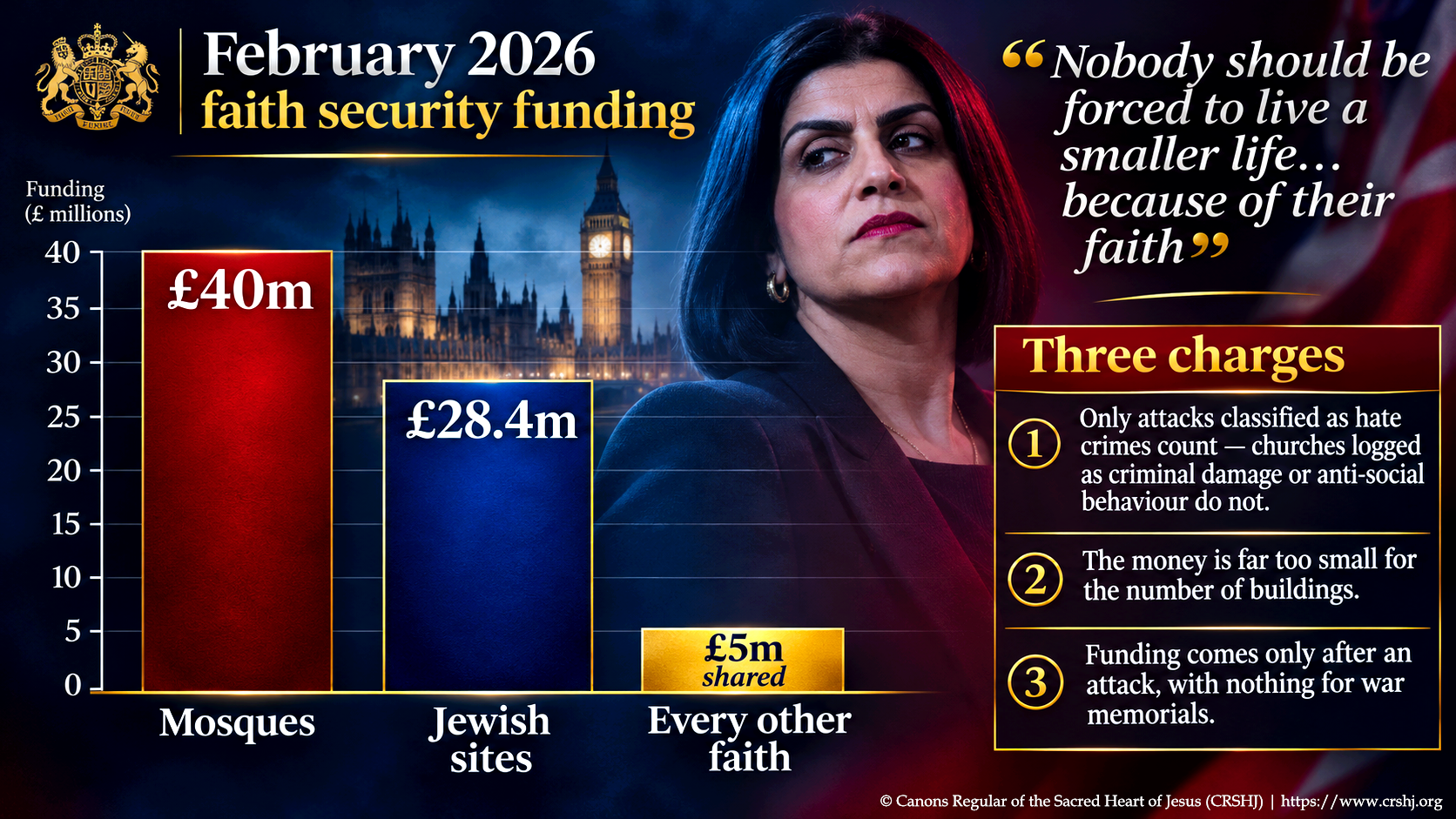
So the question for the Home Secretary is simple, and it is her own sentence turned back to her. If nobody should be forced to live a smaller life in this country because of their faith, will she now see to it that the protection of Christian places of worship, and of the war memorials in their care, is funded and administered on the same footing (…) Equality of esteem does not require equality of statistics. It requires that a beheaded crucifix be treated by the State as the outrage it is.
The second fault is in the scale. Five million pounds, shared between tens of thousands of Christian churches and the temples and gurdwaras of every other faith, is not a security programme. It is a grotesque lottery. The mosques scheme, a single budget eight times larger, is reported to accept applications on a rolling basis; the general scheme opens in windows, the last of which closed on 8 December 2025, with the next promised for “later in 2026.”[33] A parish attacked in a closed season must wait its turn.
The third fault is in the design. The scheme pays for the lock after the door has been broken. It funds cameras, lighting and fencing for places that can show they have been targeted, or that neighbours like them have been. Its guidance says nothing at all of the thousands of Christian war memorials standing open in churchyards across the country, each of them a monument to the nation’s dead as much as to the parish’s. The State that asks us to keep two minutes’ silence at eleven o’clock on Sunday has not thought to ask who keeps watch over the crosses beneath which those names are carved.
So the question for the Home Secretary is simple, and it is her own sentence turned back to her:
If nobody should be forced to live a smaller life in this country because of their faith, will she now see to it that the protection of Christian places of worship, and of the war memorials in their care, is funded and administered on the same footing, with the same rolling access and the same seriousness, as the protection she rightly extends to others? Equality of esteem does not require equality of statistics. It requires that a beheaded crucifix be treated by the State as the outrage it is.
And here the bishops come back into view, because the Church is not only the victim in this matter but the custodian. The general scheme exists; the archdioceses know it exists; a camera already hangs on the wall of St Alban’s. A camera that records a crime is not the same as a churchyard that deters one. A floodlit memorial, monitored cameras and an alarm cost less than a single restoration of a listed monument, and far less than the wound to a parish when its Lord is mutilated in the dark…
These are the duties of those who hold the Church’s patrimony in trust, from the diocesan curia downward. They are not discharged by expressions of regret after the event, and they are certainly not discharged by silence.
IX
What Must Be Done
Polemic that ends in grievance is useless. This outrage, terrible as it is, can become the occasion of something better, if Church and State will let it.
First, let the image be restored, and restored well: the head of Christ made whole again, by a craftsman worthy of the work, and the memorial blessed anew according to the rite for the blessing of images in the Roman Ritual. Let it be done publicly, so that the town sees that what was broken in the dark is mended in the light.
Second, let Remembrance Sunday at St Alban’s be kept at the foot of that cross, blue cloth and all if the repair is not yet done. Let the names be read, every one of them. Let the parish pray for those men as Judas Maccabaeus prayed for his, and let it add an act of reparation for the outrage done to the Lord above them. There is no more eloquent answer to a man who beheads a crucifix than a congregation kneeling before it.
Third, let the Archbishop of Liverpool come to Bewsey Street. Not to issue a statement from an office, but to stand at that cross and say aloud what a bishop is ordained to say: that an insult to the Crucified is an insult to every Catholic in his care, and that the Church will not be quiet about it. And let him put the resources of the archdiocese behind the lighting and security of that memorial, and of every other in his care, so that this does not happen twice.
Fourth, let Cheshire Police answer the four questions above, publicly and in writing, and let the file go to the Crown Prosecution Service. If the man detained is ill, let him be treated with the care owed to the sick. If he is responsible, let him be charged. In neither case let the case simply evaporate.
Fifth, let the Government end the two-tier treatment of places of worship: rolling access for churches as for mosques, a budget proportioned to the number of buildings at risk and not merely to the crimes that happen to be classified, and explicit cover for war memorials in the care of churches. Let every Member of Parliament who lays a wreath next Sunday be asked whether he has written to the Home Secretary about it.
Sixth, let the faithful do their part without bitterness. Check the footage. Speak to the police. Write to your Member of Parliament and to your bishop. Visit the memorial. Pray for whoever did this, and pray that he be healed. Take no vengeance, in word or in deed. The wrath belongs to God, and He has never yet needed our help to wield it.
Seventh, and above all, let the Church in this country remember what a crucifix is. It is not heritage; it is not a marker of community identity; it is not a piece of public art. It is the image of the Son of God, who had nowhere to lay His head until He laid it on the Cross for the very man who struck it off. Recover that faith, and the silence will end of its own accord. Lose it, and no amount of funding or statements will cover the loss.
He bowed His head for us at the ninth hour. Someone in Bewsey Street struck it off. God is not mocked; and neither, we pray, will that man be lost.🟥
[1]Cheshire Constabulary, “Appeal for Witnesses Following Vandalism of War Memorial in Warrington,” news release, accessed 2 November 2026, https://www.cheshire.police.uk/news/cheshire/news/appeals/2026/10/appeal-for-witnesses-following-vandalism-of-war-memorial-in-warrington/.
[2]“Jesus Statue Smashed and Anti-Catholic Graffiti Sprayed on War Memorial ahead of Remembrance Sunday,” GB News, 2 November 2026, https://www.gbnews.com/news/warrington-news-jesus-statue-smashed-anti-catholic-graffiti-war-memorial-remembrance-sunday. The same report gives the parish’s foundation in 1772, the cleaning of the plaque by a volunteer, and the parishioners’ comments cited in this essay.
[3]“War Memorial Statue Depicting Jesus Vandalised at Warrington Church,” BBC News report, reproduced by Head Topics UK, 2 November 2026, https://uk.headtopics.com/news/war-memorial-statue-depicting-jesus-vandalised-at-89470490, reporting Canon Cunningham’s video on the parish Facebook page.
[4]“Police Launch CCTV and Forensic Enquiries after Church War Memorial Vandalism,” Warrington Worldwide, 2 November 2026, https://www.warrington-worldwide.co.uk/2026/11/02/police-launch-cctv-and-forensic-enquiries-after-church-war-memorial-vandalism/. Cheshire Police incident reference IML 2449856.
[5]Warrington Guardian, 3 November 2026, https://www.warringtonguardian.co.uk/news/26694951.man-detained-warrington-war-memorial-vandalism/, quoting Chief Inspector Joseph McNally of Warrington Local Policing Unit; see also “Man Detained under Mental Health Act after Church War Memorial Vandalised,” Premier Christian News, 3 November 2026, https://premierchristian.news/us/news/article/man-detained-after-church-war-memorial-vandalised.
[6]Under the Contempt of Court Act 1981, ss. 1–2 and sch. 1, criminal proceedings become “active” from arrest, and any publication creating a substantial risk of serious prejudice to them is a contempt regardless of intent. Nothing in this essay identifies, or attributes guilt to, any individual.
[7]Barbara Aland et al., eds., Novum Testamentum Graece, 28th rev. ed. (Stuttgart: Deutsche Bibelgesellschaft, 2012); hereafter NA28. The saying stands in identical form at Luke 9:58.
[8]The Synoptic saying (Matt 8:20 // Luke 9:58) and the Johannine Passion narrative (John 19:30) belong to independent strands of the tradition; there is no evidence that John is alluding to the Q saying. The verbal correspondence (κλίνω + τὴν κεφαλήν) is therefore canonical rather than authorial, and is offered here as a theological reading, not as evidence of literary dependence.
[9]Col 1:18: καὶ αὐτός ἐστιν ἡ κεφαλὴ τοῦ σώματος τῆς ἐκκλησίας (“and He is the head of the body, the Church”), NA28.
[10]Heinrich Denzinger and Peter Hünermann, eds., Enchiridion symbolorum, definitionum et declarationum de rebus fidei et morum, 43rd ed. (San Francisco: Ignatius Press, 2012), no. 601. The Council is quoting Basil of Caesarea, De Spiritu Sancto 18.45, ed. Benoît Pruche, SC 17 bis (Paris: Cerf, 1968), where the principle is first stated of the Son as the image of the Father.
[11]Thomas Aquinas, Summa theologiae II–II, q. 99, a. 1, co., in Opera omnia iussu Leonis XIII P. M. edita, vol. 9 (Rome: Typographia Polyglotta, 1897).
[12]Catechism of the Catholic Church, 2nd ed. (Vatican City: Libreria Editrice Vaticana, 1997), no. 2120.
[13]Biblia Sacra iuxta Vulgatam versionem, ed. Robert Weber and Roger Gryson, 5th ed. (Stuttgart: Deutsche Bibelgesellschaft, 2007). Candour requires a note: the Vulgate’s sentence is fuller than the Greek of the Septuagint (2 Macc 12:45), which says more compactly that Judas “made atonement for the dead, that they might be loosed from their sin” (περὶ τῶν τεθνηκότων τὸν ἐξιλασμὸν ἐποιήσατο, τῆς ἁμαρτίας ἀπολυθῆναι). The substance, prayer and sacrifice for the fallen, is the same in both; the celebrated phrase “holy and wholesome thought” is the Latin tradition’s.
[14]Lactantius, De ira Dei 5.9, in L. Caeli Firmiani Lactanti opera omnia, pt. 2, fasc. 1, ed. Samuel Brandt, CSEL 27 (Vienna: Tempsky, 1893); see also Lactance, La colère de Dieu, ed. Christiane Ingremeau, SC 289 (Paris: Cerf, 1982).
[15]Augustine, De civitate Dei 15.25, ed. Bernard Dombart and Alfons Kalb, CCSL 48 (Turnhout: Brepols, 1955).
[16]Dan 5:1–4, 30; 2 Macc 3:24–28.
[17]Bede, Historia ecclesiastica gentis Anglorum I.7, in Bede’s Ecclesiastical History of the English People, ed. Bertram Colgrave and R. A. B. Mynors, Oxford Medieval Texts (Oxford: Clarendon Press, 1969). The miracle is also recorded in Bede’s Martyrologium under 22 June.
[18]Catechism of the Catholic Church, 2nd ed., no. 1735.
[19]“Jesus Statue Smashed and Anti-Catholic Graffiti,” GB News.
[20]Luke 23:34a is absent from a weighty and early group of witnesses, including P75 and Codex Vaticanus (B), and NA28 prints it within double brackets as a secondary, though very ancient, addition to the text of Luke. Whatever its origin, the prayer is fully in keeping with the Lord’s teaching (Matt 5:44); but an argument that leans on it should acknowledge that the textual ground beneath it is contested.
[21]Acts 7:58; 8:1.
[22]Reports consulted include those of Cheshire Constabulary (n. 1); GB News (n. 2); Warrington Worldwide (n. 4); “Police Appeal for Witnesses after Head Smashed off Jesus Statue at Church War Memorial,” Christian Today, 3 November 2026, https://www.christiantoday.com/news/police-appeal-for-witnesses-after-head-smashed-off-jesus-statue-at-church-war-memorial; and “Police Seek Man after Anti-Catholic Graffiti Daubed on Warrington War Memorial and Crucifix Vandalised,” Catholic Herald, 3 November 2026, https://thecatholicherald.com/article/police-seek-man-after-anti-catholic-graffiti-daubed-on-warrington-war-memorial-and-crucifix-vandalised. Cheshire Police state only that they are working with “church representatives.”
[23]Gregory the Great, Règle pastorale II.4, ed. Floribert Rommel, trans. Charles Morel, intro. Bruno Judic, SC 381–382 (Paris: Cerf, 1992). Gregory pairs the text with Ezek 13:5 against pastors who fear to speak.
[24]Ezek 33:6.
[25]Warrington Guardian, 3 November 2026.
[26]Ibid.
[27]Mental Health Act 1983, ss. 135–136, as amended by the Policing and Crime Act 2017. The detention period under s. 136 is normally limited to twenty-four hours, during which the person is to be examined by a registered medical practitioner and interviewed by an approved mental health professional. The public reports do not say which power was used in this case.
[28]Bloomberg LP v ZXC [2022] UKSC 5.
[29]Home Office and HM Treasury, “Record Funding to Protect Faith Communities,” press release, 19 February 2026, https://www.gov.uk/government/news/record-funding-to-protect-faith-communities. See also the written answer of Dan Jarvis MP, 31 March 2026, to Afzal Khan MP, UIN 123295, giving the annual sums: £3.5 million a year for the general scheme from 2021–22 to 2025–26, and £29.4 million (2023–24 and 2024–25) and £39.4 million (2025–26) for the mosques scheme and Muslim faith schools.
[30]Ibid.
[31]Home Office, Hate Crime, England and Wales, Year Ending March 2025, table 2.2: of 10,065 religious hate crimes recorded, the perceived targeted religion was Muslim in 4,478 (45%), Jewish in 2,873 (29%), Christian in 502 (5%), Sikh in 259 (3%) and Hindu in 182 (2%). https://www.gov.uk/government/statistics/hate-crime-england-and-wales-year-ending-march-2025/hate-crime-england-and-wales-year-ending-march-2025.
[32]Home Office, “Places of Worship Protective Security Scheme,” guidance, https://www.gov.uk/guidance/places-of-worship-protective-security-scheme. The scheme funds CCTV, fencing and gates, stronger doors and locks, alarms and external lighting, installed by the Home Office’s appointed contractor, for places of worship that have experienced hate crime or are at risk of it.
[33]“Home Office Announces That £73.4 Million Will Be Available in 2026/2027 to Protect Jewish, Muslim and Other Faith Sites,” GRIN, 24 February 2026, https://grin.coop/home-office-announces-that-73-4-million-will-be-available-in-2026-2027-to-protect-jewish-muslim-and-other-faith-sites-next-application-window-to-open-later-in-2026/; “Home Office Reopens Places of Worship Protective Security Scheme (Application Deadline: 8th December 2025),” GRIN, https://grin.coop/home-office-reopens-places-of-worship-protective-security-scheme-application-deadline-8th-december-2025/.