
Episcopacy for a Church of Households, and the Episcopate of the Wardrobe
Vigil of All Saints, 2026

Scire debes episcopum in ecclesia esse et ecclesiam in episcopo, et si qui cum episcopo non sit in ecclesia non esse.
You ought to know that the bishop is in the Church and the Church in the bishop, and that if anyone is not with the bishop, he is not in the Church.
— Cyprian of Carthage, Ep. 66.8

Discover Us In Your
Own Language
Click the drop-down Language menu at the top right corner, select your language and that’s it!
😉
I. A Prophecy, Rightly Read
At the end of 1969 a German theologian of forty-two, Joseph Ratzinger, closed a series of radio addresses with a forecast that has since been quoted more often than it has been read.[1] The Church, he said, would emerge from the crisis of his age much reduced: smaller in number, poorer in buildings, stripped of the social privileges she had enjoyed for centuries, and regarded no longer as the natural religion of a people but as a voluntary association which one chooses to join. She would demand far more of the initiative of each of her members. She would live, increasingly, in small communities. And from that diminished Church, tried and purified, would come a renewal which a weary world would one day recognise as a home. A quarter of a century later, by then a cardinal, he returned to the theme and spoke of a Christianity of the mustard seed, existing in small and apparently insignificant groups which nonetheless live the faith with intensity.[2]
It has become common to gloss this as a prediction that the Church of the future will be a Church of households: thousands, perhaps millions, of domestic churches gathered around kitchen tables rather than high altars. The gloss deserves a little care. Ratzinger spoke of smallness, of voluntary membership and of intense small communities; he did not speak of millions of house churches, and still less did he imagine the sacramental and hierarchical structure of the Church dissolving into them. The phrase ecclesia domestica (the domestic church) belongs to another register of the Church’s teaching, where it names the Christian family as the first school of faith and prayer, not a new unit of ecclesial organisation.[3] The domestic reading of Ratzinger is therefore an extrapolation. It is, however, a reasonable one. Where Christians are few, scattered, and without the protection of law or custom, they meet where they can, and they can always meet at home.
The extrapolation forces a question which the forecast itself left unasked. If the Church does come to live chiefly in small communities, many of them in private houses, what becomes of the bishop? Two answers are already being given, and both are wrong. The first is congregational: the gathering in the house is a church complete in itself, needing no one beyond its own walls, and the bishop is either a distant administrator to be tolerated or an encumbrance to be dispensed with. The second is inflationary: every small gathering acquires its own bishop, and every bishop of a small gathering, finding the title insufficient, acquires a grander one. The first error may be observed in the house-church networks of the evangelical world. The second is a commonplace of the independent sacramental world, where it is quite possible to meet an archbishop whose archdiocese would fit comfortably into his sitting room.
This essay argues that neither answer is necessary, because the Church already possesses a better one. She worked it out the first time she was a communion of households, in the generations between the apostles and Constantine, and her Fathers wrote it down. The bishop they describe is the bishop of a real local Church, small enough to know his people by name, presiding over one Eucharist through a body of presbyters who serve the households in his name, assisted by deacons, and held in visible communion with his brother bishops. The same Fathers, and the councils which followed them, had hard things to say about bishops multiplied without a flock and about men who mistook the insignia of the office for the office. Both halves of that inheritance are needed now. These words are written from within the wider Catholic world which stands outside the Roman obedience, and what they say of its vanities is meant as a rebuke within the household, not a sneer from outside it.
II. The Church in the House
The New Testament does not need to be coaxed into speaking of house churches. Paul greets them by name. In Rome there is the church which meets in the house of Prisca and Aquila; in Asia the same couple host another; at Laodicea there is the church in the house of Nympha; and the letter to Philemon is addressed, among others, to the church in his house.[4]
καὶ τὴν κατ᾽ οἶκον αὐτῶν ἐκκλησίαν.
[Greet] also the church in their house.
— Rom 16:5
Luke’s summary of the first community at Jerusalem already joins the Temple and the home. The believers attended the Temple together day by day, and the Eucharistic bread was broken in their houses:
κλῶντές τε κατ᾽ οἶκον ἄρτον, μετελάμβανον τροφῆς ἐν ἀγαλλιάσει καὶ ἀφελότητι καρδίας.
And breaking bread at home, they partook of food with gladness and simplicity of heart.
— Acts 2:46
The Pastoral Epistles go further, and in a direction which matters for this argument. They do not merely locate the Church in houses; they think of the Church itself as a house. Timothy is to know how one ought to behave in the household of God:
ἵνα εἰδῇς πῶς δεῖ ἐν οἴκῳ θεοῦ ἀναστρέφεσθαι, ἥτις ἐστὶν ἐκκλησία θεοῦ ζῶντος.
That you may know how one ought to conduct oneself in the household of God, which is the Church of the living God.
— 1 Tim 3:15
And the qualification of the man who oversees that household is drawn directly from the management of his own:
τοῦ ἰδίου οἴκου καλῶς προϊστάμενον … εἰ δέ τις τοῦ ἰδίου οἴκου προστῆναι οὐκ οἶδεν, πῶς ἐκκλησίας θεοῦ ἐπιμελήσεται;
Managing his own household well… for if anyone does not know how to manage his own household, how will he take care of the Church of God?
— 1 Tim 3:4–5
The analogy runs in both directions. The overseer’s competence is learned at his own hearth, and the Church he oversees is a hearth writ large. A theology of episcopacy for a Church of households need not, therefore, be invented. It is the native theology of the office.[5]
Honesty requires an immediate qualification. The New Testament shows the household setting of the Church clearly. It does not show, with anything like the same clarity, a single bishop presiding over each local Church. Paul writes to the Philippians together with their overseers and deacons, in the plural. Luke’s Paul summons the presbyters of Ephesus and then addresses them as the overseers whom the Holy Spirit has set over the flock. The letter to Titus passes from presbyters to overseer without any sign that two distinct offices are in view. The Roman letter we call 1 Clement, written towards the end of the first century, still uses the two words interchangeably, and the Shepherd of Hermas speaks of the presbyters who preside over the Church in Rome.[6] The pattern of one bishop with his presbyters and deacons is unmistakable in the letters of Ignatius of Antioch, written around the year 110, and is general by the time Irenaeus compiles his lists of episcopal succession some seventy years later.[7]
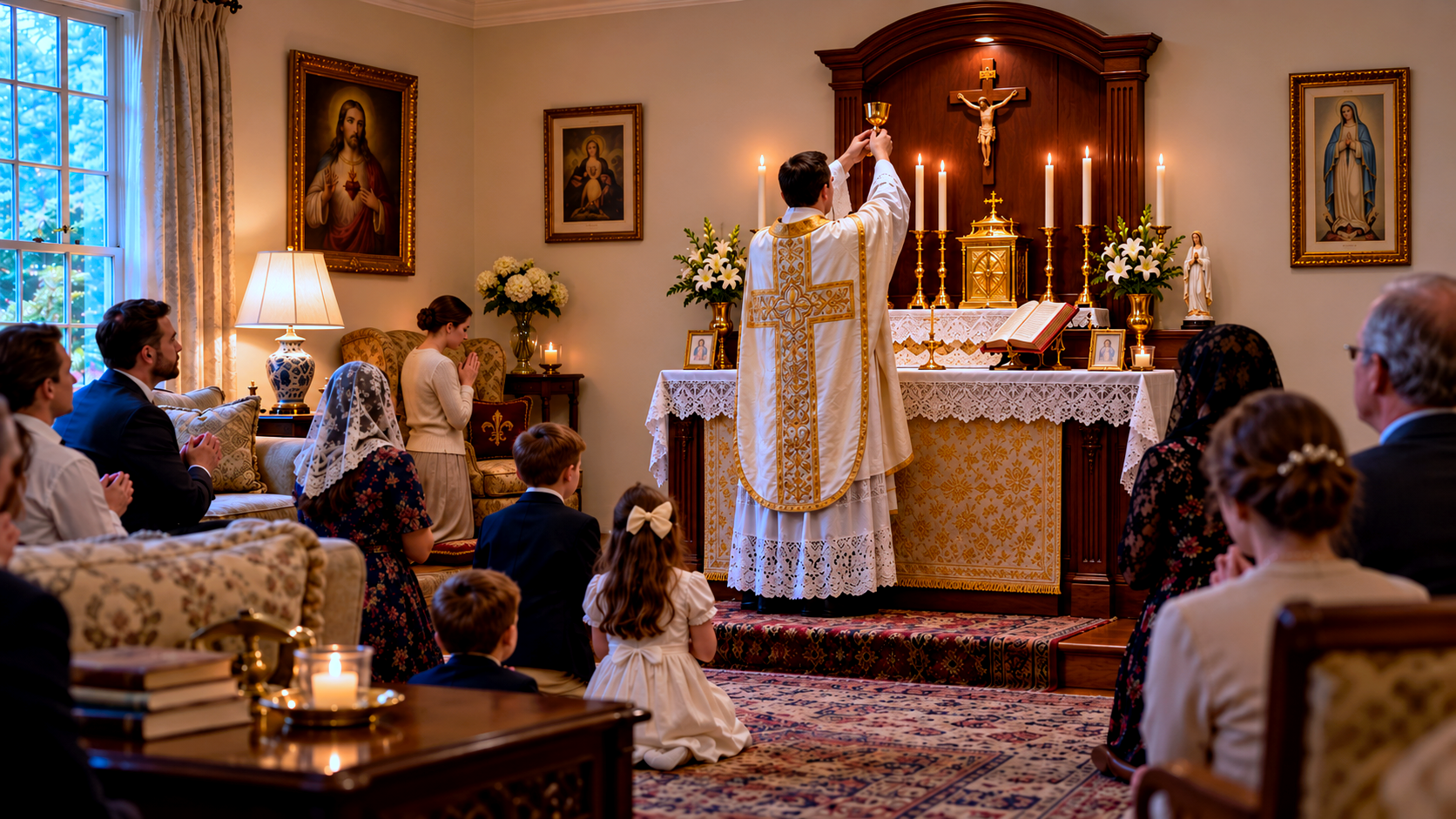
One altar, many hearths. The Church in the house: where the Eucharist is
offered by the bishop’s mandate, every altar is his altar.
Nothing in this obliges the Catholic theologian to abandon the Church’s settled judgement that the episcopate is of apostolic and divine institution.[8] It does oblige him not to pretend that the evidence is symmetrical. The household Church is attested from the beginning; the single presiding bishop comes clearly into view a generation or two later. For the present argument the asymmetry is instructive rather than embarrassing. Whatever the precise path by which the threefold ministry reached its settled form, it reached that form in a Church of households and for a Church of households. The monarchical bishop was not designed for the basilica. He was designed for the house, and for the problem which houses create.
III. The Ignatian Settlement
The problem is easily stated. A Church which meets in many houses is a Church in which anyone with a large enough room can hold a meeting, and in which any meeting can drift, by degrees, into being a church of its own. Ignatius knew this from experience. At Smyrna there were those who kept away from the Eucharist and the common prayer because they would not confess the Eucharist to be the flesh of our Saviour Jesus Christ; at Magnesia there were those who used the bishop’s name while doing everything without him.[9] His answer was not to abolish the houses but to bind them, and the binding was the bishop.
μηδεὶς χωρὶς ἐπισκόπου τι πρασσέτω τῶν ἀνηκόντων εἰς τὴν ἐκκλησίαν. ἐκείνη βεβαία εὐχαριστία ἡγείσθω, ἡ ὑπὸ τὸν ἐπίσκοπον οὖσα ἢ ᾧ ἂν αὐτὸς ἐπιτρέψῃ.
Let no one do anything that pertains to the Church without the bishop. Let that Eucharist be held valid which is under the bishop, or under one to whom he entrusts it.
— Ignatius, Smyrn. 8.1
The second sentence is the hinge on which any episcopal theology of the household turns. Ignatius does not require the bishop to preside in person at every altar. He requires that every altar be his, either because he stands at it himself or because the one who stands there has been entrusted by him. The validity he has in view is not, in the first place, the later scholastic question of sacramental validity; it is the question whether a given gathering is a gathering of the Church or of a party within it. A Eucharist under the bishop or his delegate is the Church’s Eucharist. A Eucharist held in defiance of him is a faction’s meal. He continues:
ὅπου ἂν φανῇ ὁ ἐπίσκοπος, ἐκεῖ τὸ πλῆθος ἔστω, ὥσπερ ὅπου ἂν ᾖ Χριστὸς Ἰησοῦς, ἐκεῖ ἡ καθολικὴ ἐκκλησία.
Wherever the bishop appears, there let the people be, just as wherever Jesus Christ is, there is the Catholic Church.
— Ignatius, Smyrn. 8.2
Here the local and the universal are held together in a single sentence. The people gather where their bishop is, as the whole Church is wherever Christ is. The bishop stands to the local assembly as Christ stands to the Church throughout the world: not as a substitute, but as the visible point of unity which makes many gatherings one. The same thought governs the Eucharistic theology of the letter to Philadelphia:
σπουδάσατε οὖν μιᾷ εὐχαριστίᾳ χρῆσθαι· μία γὰρ σὰρξ τοῦ κυρίου ἡμῶν Ἰησοῦ Χριστοῦ, καὶ ἓν ποτήριον εἰς ἕνωσιν τοῦ αἵματος αὐτοῦ, ἓν θυσιαστήριον, ὡς εἷς ἐπίσκοπος ἅμα τῷ πρεσβυτερίῳ καὶ διακόνοις.
Be eager, then, to use one Eucharist; for there is one flesh of our Lord Jesus Christ, and one cup for union with his blood, one altar, just as there is one bishop together with the presbytery and the deacons.
— Ignatius, Phld. 4
One flesh, one cup, one altar, one bishop. The Church at Philadelphia may well have met in more than one house; Ignatius’s repeated exhortations to frequent assembly suggest that the faithful were not always in one place. But there is one altar, because there is one bishop with his presbyterate and deacons. The plurality of houses is real, and it is not a plurality of Churches. Indeed, without that ordered ministry Ignatius will not allow the name of Church at all:
ὁμοίως πάντες ἐντρεπέσθωσαν τοὺς διακόνους ὡς Ἰησοῦν Χριστόν, ὡς καὶ τὸν ἐπίσκοπον ὄντα τύπον τοῦ πατρός, τοὺς δὲ πρεσβυτέρους ὡς συνέδριον θεοῦ καὶ ὡς σύνδεσμον ἀποστόλων. χωρὶς τούτων ἐκκλησία οὐ καλεῖται.
Likewise let all respect the deacons as Jesus Christ, as also the bishop, who is a type of the Father, and the presbyters as the council of God and the band of the apostles. Without these it is not called a Church.
— Ignatius, Trall. 3.1
The negative is as important as the positive. Ignatius does not say that a gathering without bishop, presbyters and deacons is a poorer or less tidy Church; he says it does not bear the name. That is the substance of the formula later attached to Cyprian, already present more than a century before him. Nor are the presbyters a second set of rulers alongside the bishop, still less his rivals:
τὸ γὰρ ἀξιονόμαστον ὑμῶν πρεσβυτέριον, τοῦ θεοῦ ἄξιον, οὕτως συνήρμοσται τῷ ἐπισκόπῳ, ὡς χορδαὶ κιθάρᾳ.
For your presbytery, worthy of its name and worthy of God, is attuned to the bishop as strings to a lyre.
— Ignatius, Eph. 4.1
They are the strings of his instrument, and the music is the concord of the Church. Finally, and decisively for the question of scale, Ignatius tells Polycarp what kind of bishop he must be:
πυκνότερον συναγωγαὶ γινέσθωσαν· ἐξ ὀνόματος πάντας ζήτει.
Let the assemblies be held more frequently; seek out all by name.
— Ignatius, Pol. 4.2
A bishop who is to seek out all his people by name cannot have a hundred thousand of them. The Ignatian bishop is not the chief executive of a territory. He is the father of a household of households, and the size of his Church is bounded by the reach of a pastor’s memory.
IV. The Bishop in the Church, and the Church in the Bishop
Cyprian of Carthage, writing in the middle of the third century, inherits the Ignatian settlement and gives it its classic Latin form. The occasion is characteristic. A certain Florentius Puppianus had let it be known that he entertained doubts about Cyprian himself, about the manner of his election and his conduct during persecution, and had appointed himself judge of whether Cyprian was truly bishop. Cyprian’s reply is not a defence of his own person. It is a statement of what a bishop is:[10]
Scire debes episcopum in ecclesia esse et ecclesiam in episcopo, et si qui cum episcopo non sit in ecclesia non esse.
You ought to know that the bishop is in the Church and the Church in the bishop, and that if anyone is not with the bishop, he is not in the Church.
— Cyprian, Ep. 66.8
The formula is reciprocal, and the order of its terms matters. The bishop is in the Church first; only then is the Church in the bishop. He is not a sovereign who possesses a Church as a landlord possesses an estate. He is a member of a body who has been set at its centre, so that communion with him is the visible form of communion with the whole. The man who separates himself from the bishop has not merely quarrelled with an official; he has stepped outside the place where the Church is to be found. It is worth adding that the familiar summary of this teaching, “no bishop without a Church, and no Church without a bishop,” is precisely that: a summary. Cyprian does not write the sentence in that form, and so far as can be determined no other Father does either.[11] The doctrine is his; the epigram is ours.
Cyprian is equally clear that the bishop does not rule alone, either within his Church or beyond it. Within it, he governs with his presbyters and in the sight of his people. Writing from hiding during the Decian persecution, he reminds his clergy of the rule he had set himself from the first:[12]
…a primordio episcopatus mei statuerim nihil sine consilio vestro et sine consensu plebis mea privatim sententia gerere.
…since from the beginning of my episcopate I resolved to do nothing on my own private judgement without your counsel and without the consent of the people.
— Cyprian, Ep. 14.4
Counsel from the presbyters and consent from the people: the bishop of a household Church is not an autocrat, and the Cyprianic model already contains safeguards against episcopal tyranny which later centuries would sometimes forget. Beyond his own Church, the bishop is bound to every other bishop by the unity of the office itself:[13]
Episcopatus unus est, cuius a singulis in solidum pars tenetur.
The episcopate is one; each bishop holds his share of it in full, and is answerable for the whole.
— Cyprian, De unitate 5
This is the principle which allows a Church composed of very many small local Churches to remain one Church. No bishop is the branch manager of a larger concern, and none is a free agent. Each holds the one episcopate jointly and entirely, and therefore each is answerable to all the others for the manner in which he holds it. Cyprian’s practice matched his principle: he governed in constant correspondence with his fellow bishops and brought the great questions of his day before councils at Carthage. A century and a half later, in a dialogue against the followers of Lucifer of Cagliari, Jerome gave the negative half of the doctrine its most compact form:[14]
Ecclesia non est, quae non habet sacerdotes.
That is no Church which has no priests.
— Jerome, Altercatio Luciferiani et orthodoxi 21
Jerome’s sacerdotes (priests) embrace bishops and presbyters alike, and his context is a quarrel over the reception of clergy compromised under Arian pressure; but the principle is the same. A gathering without the priesthood the Church has received is not a Church, however sincere its members.
V. The Warning of Serdica
If the argument stopped here, it would invite an easy conclusion: let every household, or at least every small cluster of households, have its own bishop, and the problem of the future is solved. The tradition does not permit that conclusion, and it would be dishonest to pretend otherwise. The same Church which insisted on the presence of the bishop among his people also legislated, repeatedly, against the multiplication of bishops for places too small to need one.
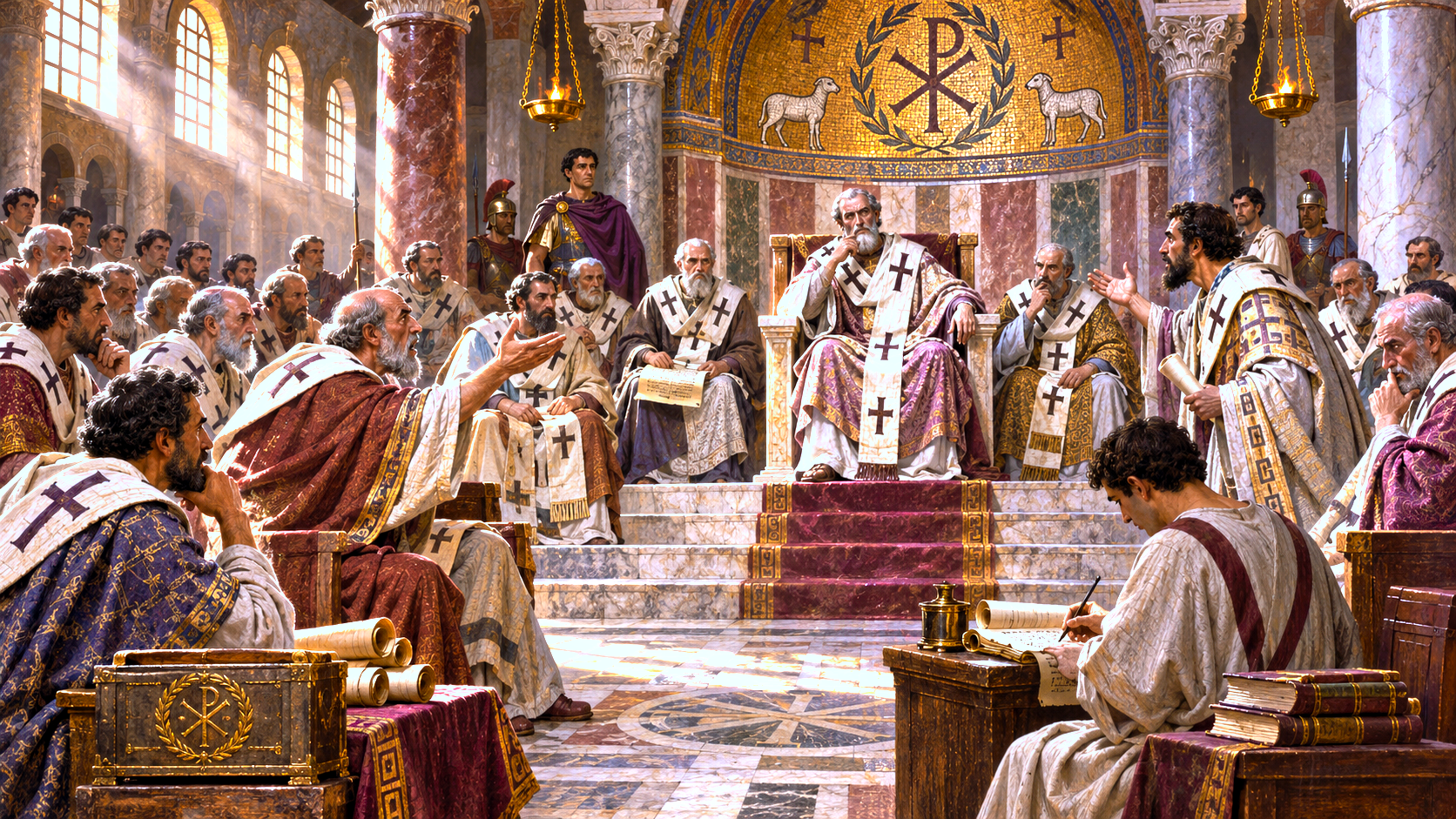
Council of Serdica in session, year 343 AD
The Council of Serdica in 343 forbade the consecration of a bishop for a village, or for a small town where a single presbyter would suffice, and gave its reason in a clause which deserves to be carved over the door of every independent chancery:[15]
…ne vilescat nomen episcopi et auctoritas.
…lest the name and authority of a bishop be cheapened.
— Council of Serdica, c. 6 (Latin)
The Council of Laodicea, probably later in the same century, was blunter still:[16]
ὅτι οὐ δεῖ ἐν ταῖς κώμαις καὶ ἐν ταῖς χώραις καθίστασθαι ἐπισκόπους, ἀλλὰ περιοδευτάς.
That bishops must not be appointed in villages and country districts, but visitors.
— Council of Laodicea, c. 57
The periodeutai (visitors) were presbyters who travelled a circuit of rural congregations in the bishop’s name. The East had, for a time, a middle figure, the chorepiscopus or country bishop, and the councils of Ancyra, Neocaesarea and Antioch spent a good deal of effort restricting what he might do.[17] The direction of travel is unmistakable. The early Church wanted the bishop near his people, but it did not want him cheapened, and it judged that a bishop for every hamlet would cheapen him.
Nor was this mere metropolitan snobbery. The Church of North Africa, which had more bishops than any other region of the West, shows what can happen when sees multiply faster than Churches. At the conference of Carthage in 411 nearly three hundred Catholic bishops faced a comparable number of Donatist bishops, many of them rival claimants to the same small towns.[18] A multitude of tiny sees made rival altars easy to erect and hard to dislodge. Augustine himself learned the lesson at cost. Wishing to provide a bishop for the Punic-speaking district of Fussala, which had proved hard to serve from Hippo, he created a new see and consecrated for it a young man named Antoninus, who proved rapacious and tyrannical. Augustine’s letter to Pope Celestine on the affair is among the most painful documents of his episcopate, and he does not spare himself in it.[19] A see created for sound pastoral reasons, filled with the wrong man, became a scandal.
The tension is therefore real, and it will not be harmonised away. Ignatius wants a bishop who knows his people by name. Serdica forbids a bishop where a presbyter suffices. Both principles belong to the inheritance, and an honest proposal must answer to both. The way between them is not to split the difference but to ask what, in each case, the bishop is for. He is for the unity of a local Church, and a local Church in the full sense is more than a single gathering. It is a communion of Eucharistic assemblies, served by a presbyterate and by deacons, sufficiently numerous and sufficiently various to need a centre of unity, oversight and ordination. Where there is such a Church, a bishop is not a luxury but a necessity, however small it may be by the standards of a modern diocese. Where there is only one gathering, however devout, it needs a presbyter, and its bishop is elsewhere.
VI. A Framework for the Church of Households
What, then, might be advocated? Not a blueprint, which would be presumptuous, but a framework: a set of principles, each drawn from the tradition already surveyed, which together describe what episcopacy could look like if the small Church of Ratzinger’s forecast were to become, in large part, a Church of households.
First, the local Church is a communion of households gathered about one altar. The unit of the Church’s life is neither the household alone nor the bishop alone, but the bishop with his presbyterate and deacons and the many assemblies they serve. This is the one altar of Ignatius and the Church-in-the-bishop of Cyprian, and it is also the teaching of the Second Vatican Council, which recognised that the Church of Christ is truly present in local congregations, on a stated condition:[20]
Haec Christi Ecclesia vere adest in omnibus legitimis fidelium congregationibus localibus, quae, pastoribus suis adhaerentes, et ipsae in Novo Testamento ecclesiae vocantur.
This Church of Christ is truly present in all legitimate local congregations of the faithful which, united with their pastors, are themselves called churches in the New Testament.
— Lumen Gentium 26, Vatican Council II
The condition is the whole matter. The household gathering is a church in the New Testament sense precisely in so far as it adheres to its pastors. Without that adherence it is a meeting.
Second, the see must be small enough for the bishop to know his flock. The modern territorial diocese, in which a bishop may be responsible for hundreds of thousands of souls he will never meet, is the product of particular historical conditions and is not the measure of the office. In a Church of households the Ignatian measure returns: a bishop must be able to seek out all his people by name. That implies sees measured in hundreds or a few thousands of the faithful rather than in hundreds of thousands, and a bishop whose principal work is visitation. Serdica’s limit holds at the other end of the scale. A see must be a Church, not a congregation.
Third, the bishop’s unity with the households must be made visible, not merely asserted. The Roman Church of late antiquity offers a remarkable precedent. Writing in 416 to Decentius, bishop of Gubbio, Pope Innocent I explained that on Sundays the presbyters serving the titular churches of the city, who could not leave their own people to attend the Pope’s Mass, received from him by the hands of acolytes a portion of the Eucharist he had consecrated, the fermentum (leaven):[21]
…ut se a nostra communione maxime illa die non iudicent separatos.
…so that, on that day above all, they may not judge themselves separated from our communion.
— Pope Innocent I, Ep. 25, to Decentius
The fermentum was the one altar of Ignatius made tangible across a city of many congregations.[22] A Church of households would need its own equivalents, and the Roman Rite already supplies the chief of them. The holy oils blessed and consecrated by the bishop at the Chrism Mass, carried to every place where baptism is administered and the sick are anointed, are a yearly sign that every altar of the local Church depends upon his. The bishop’s ordinary ministry of confirmation in the Latin Church, and his presidency at ordinations, have the same effect. In a dispersed Church these are not ceremonial survivals; they are the sinews of communion. To them should be added the stational gathering: the assembly of the whole local Church around its bishop on the great feasts, and at Easter above all, so that the households regularly see themselves as one people.
Fourth, the bishop should himself live in a household. Here the tradition offers something more intimate than administrative arrangements. When Augustine became bishop of Hippo he did not abandon the common life he had led as a presbyter; he brought it into the bishop’s house:[23]
…volui habere in ista domo episcopii mecum monasterium clericorum.
…I wished to have with me, in this bishop’s house, a monastery of clerics.
— Augustine, Sermo 355.2
His biographer Possidius describes the clerics formed in that house going out to serve as bishops throughout Africa.[24] From this monasterium clericorum (monastery of clerics), by a long and winding road, the canons regular descend. The model is directly suited to a Church of households. The bishop’s house becomes the first household of the local Church: a place of common prayer under a rule, where presbyters and deacons are formed, from which they go out to the scattered assemblies and to which they return. The bishop is then not a remote figure who arrives by car twice a year, but the head of a visible household whose life is the pattern of the others. A Church of hearths is best governed from a hearth.
Fifth, the presbyterate must be the bishop’s council and his presence in the houses. The presbyters of a household Church are not semi-independent rulers of parishes. They are the strings of the Ignatian lyre and the Cyprianic council without whose advice the bishop does nothing. In each household assembly the presbyter presides by the bishop’s mandate, and the people know it. Ratzinger himself foresaw that a smaller Church would find new forms of ministry, and might call to the priesthood approved Christians who continue in a secular profession.[25] Whatever one judges of that suggestion, which touches the Church’s discipline rather than her doctrine, the principle behind it is sound: a dispersed Church needs presbyters close to the households, and their number cannot be governed by the economics of a seminary built for a Church of basilicas.
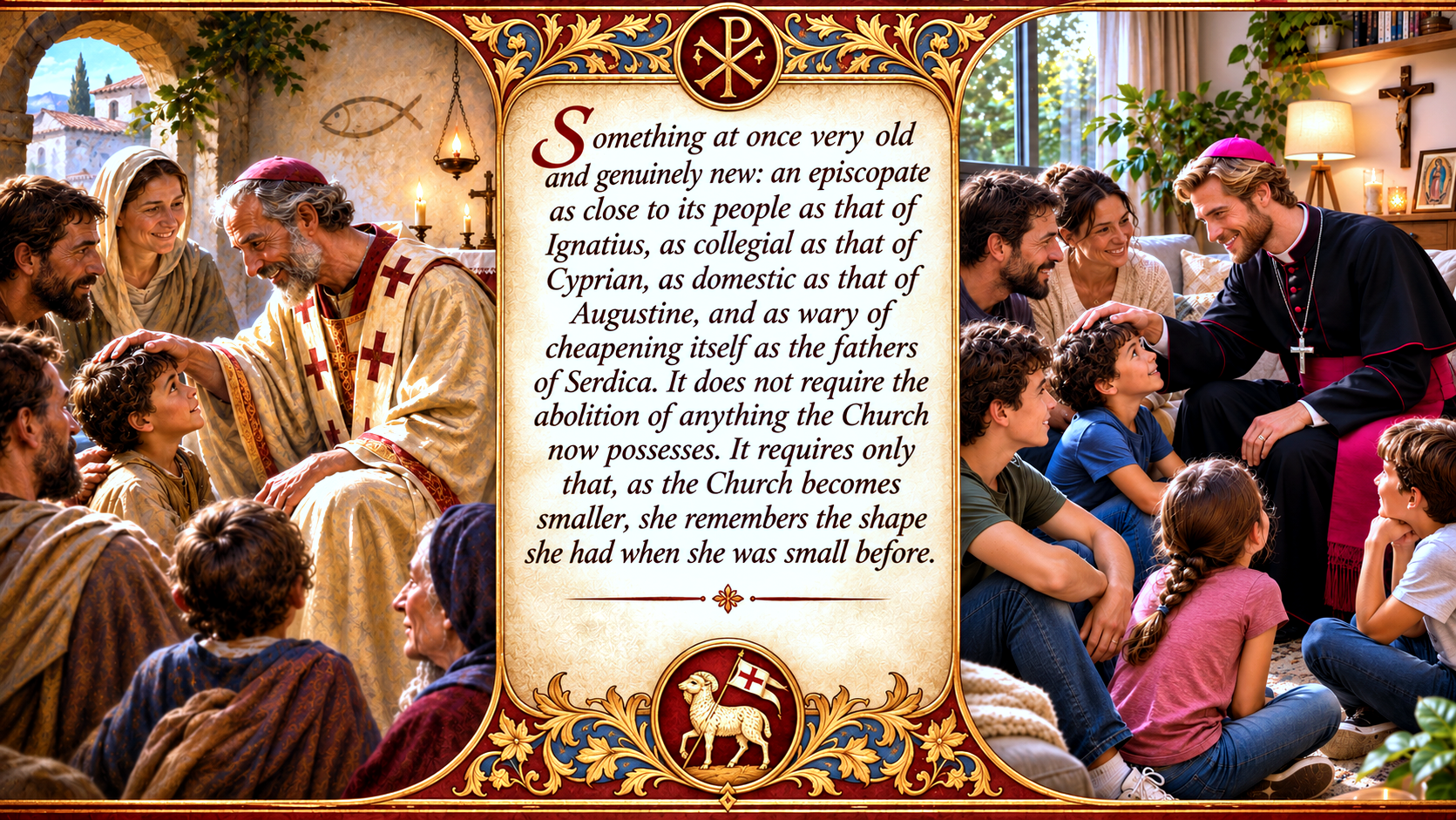
The Bishop in the Early Church must become the modern Bishop again.
Sixth, the deacons must be the connective tissue. Ignatius insists that the deacons are ministers of the mysteries of Jesus Christ and servants of the Church of God, not mere stewards of food and drink.[26] In a dispersed Church their ancient tasks return with new urgency: the care of the poor across the households, the carrying of word between the bishop and the assemblies, the keeping of the common order. A Church of households without deacons would be a Church of isolated rooms.
Seventh, no bishop may stand alone. The episcopate is one, and each holds it in full. A bishop of a small see is safe from the vices of smallness only if he is genuinely and visibly bound to his brother bishops: consecrated by several of them, as Nicaea required; meeting with them in synod; receiving and giving fraternal correction; sharing with them one rule of faith and one liturgical discipline.[27] Smallness is no defect in a Church which is in communion. It becomes a defect, and quickly a disease, in a Church which is in communion with nobody.
Taken together, these principles describe something at once very old and genuinely new: an episcopate as close to its people as that of Ignatius, as collegial as that of Cyprian, as domestic as that of Augustine, and as wary of cheapening itself as the fathers of Serdica. It does not require the abolition of anything the Church now possesses. It requires only that, as the Church becomes smaller, she remembers the shape she had when she was small before.
VII. Against the Episcopate of the Wardrobe
There is a second reason why the tradition guarded the name of bishop, and it brings us to the less edifying half of this essay. A small Church with a bishop at its centre can be the most evangelical thing in the world. A small Church with a bishop at its centre whose chief interest is himself is a parody of the episcopate, and the independent sacramental world has produced such parodies in abundance. Anyone who has spent time in that world knows the type: the prelate whose correspondence is chiefly concerned with the cut of his choir dress, whose website gives more space to his pectoral cross than to his people, whose lines of succession are collected and displayed like the pedigree of a show dog, and who, finding the title of bishop too modest for a jurisdiction of three congregations, styles himself archbishop, metropolitan, or patriarch.
The tradition has an answer to every element of this, and the answers are worth setting out, because they are not merely rebukes. Each of them points back to what the bishop is for.
The name of a work. Begin with the word itself. The Pastoral Epistles do not call the episcopate an honour; they call it a work:
εἴ τις ἐπισκοπῆς ὀρέγεται, καλοῦ ἔργου ἐπιθυμεῖ.
If anyone aspires to the office of overseer, he desires a noble work.
— 1 Tim 3:1
Augustine draws the conclusion with characteristic sharpness:[28]
Episcopatus nomen est operis, non honoris… ut intellegat non se esse episcopum, qui praeesse dilexerit, non prodesse.
Episcopate is the name of a work, not of an honour… so that he may understand that he is no bishop who has loved to preside rather than to profit others.
— Augustine, De civitate Dei 19.19
The man who loves to preside rather than to serve is, on Augustine’s terms, no bishop in the sense that matters, whatever the validity of his orders. And Augustine knew where the danger lay, because he felt it in himself:[29]
Vobis enim sum episcopus, vobiscum sum christianus. Illud est nomen suscepti officii, hoc gratiae; illud periculi est, hoc salutis.
For you I am a bishop; with you I am a Christian. The first is the name of an office undertaken, the second of grace; the first is a name of danger, the second of salvation.
— Augustine, Sermo 340.1
A name of danger. The man who delights in the title has not grasped that, before it is anything else, it is a sentence of judgement upon himself.
The same priesthood at Rome and at Gubbio. Title inflation rests on a confusion between rank and order. There is no order higher than the episcopate, and the bishop of the smallest see is as much a bishop as the bishop of the greatest. Jerome made the point with his usual vigour:[30]
Ubicumque fuerit episcopus, sive Romae sive Eugubii, sive Constantinopoli sive Rhegii, sive Alexandriae sive Tanis, eiusdem meriti, eiusdem est et sacerdotii.
Wherever a bishop may be, whether at Rome or at Gubbio, at Constantinople or at Rhegium, at Alexandria or at Tanis, he is of the same worth and of the same priesthood.
— Jerome, Ep. 146.1
Honesty requires a word on Jerome’s purpose. He wrote to deflate the pretensions of certain deacons, and in the same letter he exalts the presbyterate in a manner which later theology would not wholly follow. But the sentence cuts against the vanity bishop more sharply than against anyone. If the bishop of Gubbio is the equal of the bishop of Rome in order, the bishop of a household Church needs no grander title to be what he is. The appetite for one betrays a doubt about the reality of the thing itself.
Titles are relations. The senior titles of the hierarchy are not decorations. They name relations between bishops. A metropolitan is the bishop of the mother city of a province who presides over the bishops of that province; it was to him that Nicaea gave the confirmation of episcopal elections within it. An archbishop, in Western usage, is in the ordinary case a metropolitan. A patriarch presides over metropolitans. The ancient rule is stated in the Apostolic Canons with a balance which every self-styled metropolitan should study:[31]
τοὺς ἐπισκόπους ἑκάστου ἔθνους εἰδέναι χρὴ τὸν ἐν αὐτοῖς πρῶτον καὶ ἡγεῖσθαι αὐτὸν ὡς κεφαλήν… ἀλλὰ μηδὲ ἐκεῖνος ἄνευ τῆς πάντων γνώμης ποιείτω τι.
The bishops of each nation must recognise the first among them and regard him as their head… but neither let him do anything without the mind of all.
— Apostolic Canons 34
An archbishop without suffragans is therefore not a modest archbishop. He is a contradiction in terms, like a father without children or a captain without a ship, for the title claims a relation which does not exist. It will be objected that the Roman Church itself confers the title of archbishop on nuncios, on bishops of ancient titular sees, and occasionally on a bishop personally. So it does; but in each case the title is conferred by another, attaches to a see or an office within a communion of many bishops, and is not assumed by a man about himself. That is precisely the difference. Honest usage would have the self-styled archbishop call himself what he is, a bishop, and spend the energy saved on the people who make him one.
Distinguished by doctrine, not by dress. Vestments are not the problem. The Roman Rite prescribes them, and the diversity of sacred vestments is one of the ways in which the diversity of ministries is made visible in the liturgy. But the same Missal asks that their beauty and nobility be sought in their material and form rather than in an abundance of superadded ornament.[32] The tradition’s suspicion of clerics preoccupied with what they wear is very old. In 428 Pope Celestine I rebuked bishops in southern Gaul who had begun to affect a distinctive dress of their own devising:[33]
Discernendi a plebe vel ceteris sumus doctrina, non veste; conversatione, non habitu; mentis puritate, non cultu.
We are to be distinguished from the people and from others by our teaching, not our clothing; by our conduct, not our dress; by purity of mind, not by adornment.
— Pope Celestine I, Ep. 4.1.2
Augustine, by his biographer’s account, practised what Celestine preached:[34]
Vestis eius et calceamenta vel lectualia ex moderato et competenti habitu erant, nec nitida nimium nec abiecta plurimum.
His clothing, his footwear and his bedding were of a moderate and fitting kind, neither too fine nor too mean.
— Possidius, Vita Augustini 22
And the Gospel itself names the vice, and its remedy:
πάντα δὲ τὰ ἔργα αὐτῶν ποιοῦσιν πρὸς τὸ θεαθῆναι τοῖς ἀνθρώποις· πλατύνουσιν γὰρ τὰ φυλακτήρια αὐτῶν καὶ μεγαλύνουσιν τὰ κράσπεδα.
They do all their works in order to be seen by men; for they make their phylacteries broad and their fringes long.
— Matt 23:5
ὁ δὲ μείζων ὑμῶν ἔσται ὑμῶν διάκονος.
But the greatest among you shall be your servant.
— Matt 23:11
The broadened phylactery and the lengthened fringe have their exact modern equivalents, and they may be ordered from any ecclesiastical outfitter.
The silent bishop. Ignatius offers the most searching counter-image of all. Writing to the Ephesians about their bishop Onesimus, whose quietness some among them may have mistaken for weakness, he reverses the judgement:
καὶ ὅσον βλέπει τις σιγῶντα ἐπίσκοπον, πλειόνως αὐτὸν φοβείσθω.
And the more anyone sees the bishop keeping silence, the more let him revere him.
— Ignatius, Eph. 6.1
The reason he gives is, once again, domestic. Whomever the master of the house sends to manage his household, we must receive as we would receive the one who sent him. The bishop’s authority lies not in his self-assertion but in the One who sent him. The silent bishop is the steward who has no need to announce himself. The bishop of the wardrobe is the steward who has forgotten whose house it is.
Succession is of Churches, not of pedigrees. Finally, the vanity bishop’s most treasured possession, his catalogue of lines of succession, rests on a misunderstanding of what succession is for. When Irenaeus appealed to the bishops who had succeeded the apostles, he appealed to them as witnesses to a teaching publicly handed on in identifiable Churches:[35]
Traditionem itaque apostolorum in toto mundo manifestatam in omni ecclesia adest perspicere omnibus qui vera velint videre.
The tradition of the apostles, made manifest throughout the whole world, can therefore be seen in every Church by all who wish to see the truth.
— Irenaeus, Adversus haereses 3.3.1
Succession, for Irenaeus, is the succession of bishops in sees, and its value lies in the continuity of Church and teaching which it guarantees. It is not a personal heirloom. Here too honesty requires precision. The Western tradition, following Augustine against the Donatists, holds that orders conferred outside the Church’s communion are not to be repeated, and Catholic theology has generally been willing to recognise that orders conferred outside her visible communion may be valid where the requisite matter, form and intention are present.[36] The question is therefore not validity. A man may be validly a bishop and still possess an episcopate without a Church, as a man may be validly a husband and live as though he had no wife. The accumulation of further lines of succession adds nothing to orders already valid, and it supplies nothing that is missing; for what is missing is not a line but a flock, a presbyterate and a communion.
These rebukes are not an end in themselves. Each restates a principle of the framework already proposed. The bishop who knows his people by name has no leisure for his wardrobe. The bishop bound to his brothers in synod cannot style himself their head. The bishop who lives in a common household under a rule cannot easily make himself its ornament. And the bishop whose see is a real Church, a communion of households about one altar, has no need of a grander title, because he has something better: a people. Title inflation is the symptom of an episcopate without a Church. The remedy is not a better title but a Church.
VIII. The Bishop at the Hearth
Ratzinger’s forecast was, in the end, a hopeful one. The small Church he foresaw was not a defeated Church but a purified one, from which the world would one day learn again what it had lost. If that Church comes to live largely in households, as seems increasingly likely in parts of the West, it will not need fewer bishops in the sense that matters. It will need bishops more than ever, because a Church of many houses is a Church in constant danger of becoming many churches. What it will not need are bishops of the kind to which the modern administrative diocese has accustomed us, remote and overburdened, or bishops of the kind the independent world too often produces, self-appointed and self-adorned.
It will need bishops of the kind Ignatius described to Polycarp: men who seek out all their people by name. It will need the Cyprianic bishop, who is in the Church before the Church is in him, who does nothing without the counsel of his presbyters and the consent of his people, and who holds the one episcopate in full communion with his brothers. It will need Augustine’s bishop, who lives with his clergy in a common household from which the scattered households are served, and whose clothing is neither too fine nor too mean. And it will need the bishop whom Serdica guarded, whose name is not cheapened because it is given only where there is a Church to bear it.
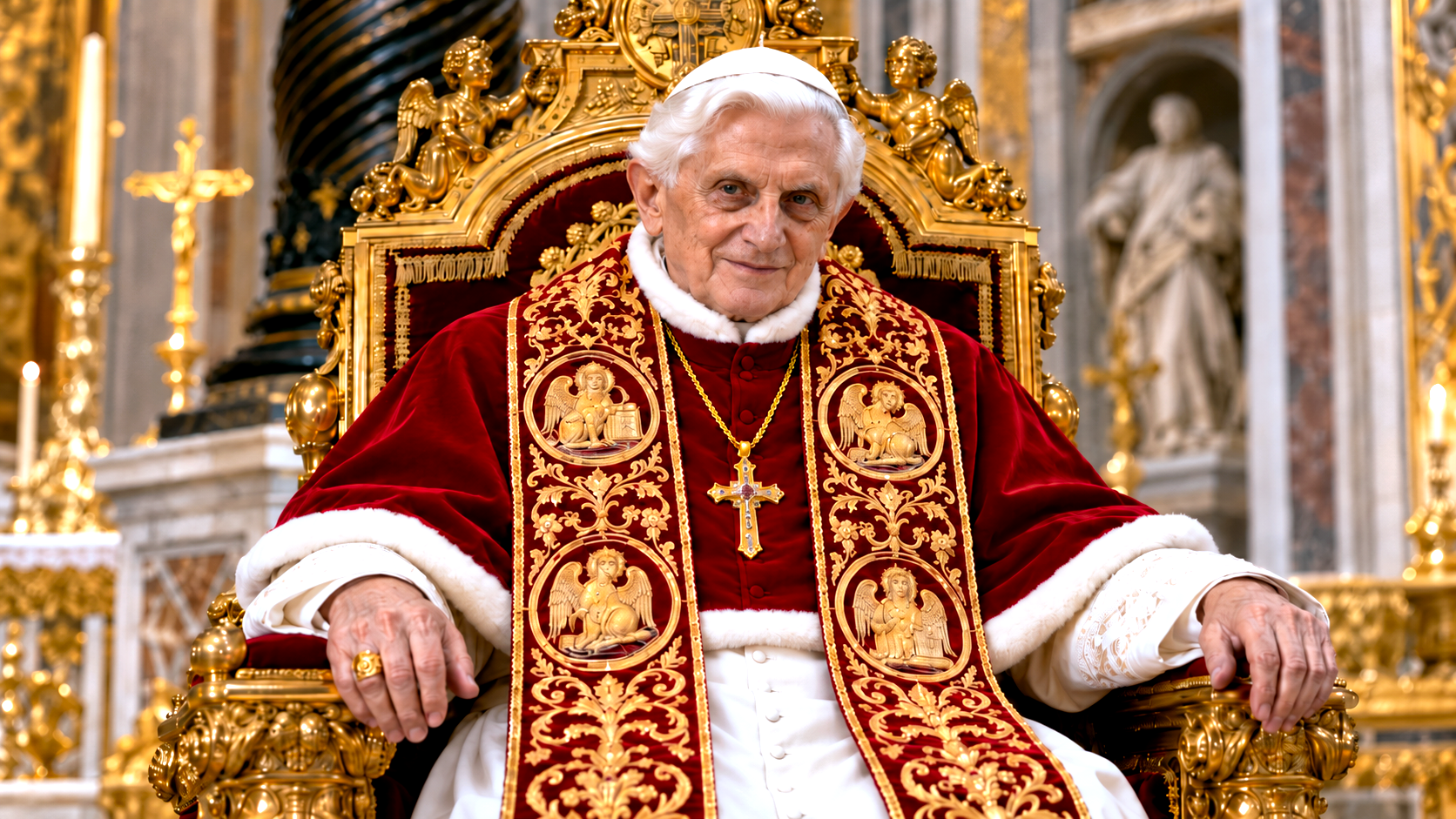
Pope Benedict XVI:
“The Church shall emerge from the crisis of this age much reduced: smaller in number, poorer in buildings, stripped of the social privileges she had enjoyed for centuries, and regarded no longer as the natural religion of a people but as a voluntary association which one chooses to join. She would demand far more of the initiative of each of her members. She would live, increasingly, in small communities. And from that diminished Church, tried and purified, would come a renewal which a weary world would one day recognise as a home.”
Radio addresses, 1969
Such a bishop is a bishop at the hearth, and the image is apt in more than one sense. The hearth is the centre of a household, the place around which its members gather and from which warmth goes out to every room. It is also the place where the fire is kept, and from which, in older times, fire was carried to kindle other hearths. The oils carried from the Chrism Mass, and the fermentum once carried from the Pope’s altar to the titular churches of Rome, are forms of the same act: a fire kept at one hearth and carried to many. That is what a bishop is for. The pectoral cross is welcome to come along, provided it hangs on a man too busy carrying the fire to notice it.
On the vigil of All Saints it is worth remembering that the communion over which a bishop presides is not confined to the living. Every altar of the local Church is joined not only to the bishop’s altar but, through it, to the altar before the throne, where the saints of every age offer their worship with ours. The bishop at the hearth stands at the point where a household of a few hundred souls opens onto the household of God, which is the Church of the living God. No title could add anything to that, and none should be wanted.
[1] Joseph Ratzinger, Faith and the Future (San Francisco: Ignatius Press, 2009), chap. 5, “What Will the Church Look Like in 2000?” The addresses were broadcast at the end of 1969 and first published as Glaube und Zukunft (Munich: Kösel, 1970). The account in the text is a paraphrase.
[2] Joseph Ratzinger, Salt of the Earth: Christianity and the Catholic Church at the End of the Millennium; An Interview with Peter Seewald, trans. Adrian Walker (San Francisco: Ignatius Press, 1997).
[3] Second Vatican Council, Dogmatic Constitution on the Church Lumen Gentium 11, Acta Apostolicae Sedis 57 (1965); John Paul II, Apostolic Exhortation Familiaris Consortio 21, Acta Apostolicae Sedis 74 (1982). In both documents the phrase refers to the Christian family.
[4] Rom 16:3–5; 1 Cor 16:19; Col 4:15; Phlm 2. The Greek New Testament is cited throughout from Nestle–Aland, Novum Testamentum Graece, 28th rev. ed. (Stuttgart: Deutsche Bibelgesellschaft, 2012). Translations of Scripture and the Fathers are the author’s own. On the household churches of Rom 16, see C. E. B. Cranfield, A Critical and Exegetical Commentary on the Epistle to the Romans, ICC, 2 vols. (Edinburgh: T&T Clark, 1975–79), on 16:5.
[5] On the household language of 1 Tim 3, see I. Howard Marshall, in collaboration with Philip H. Towner, A Critical and Exegetical Commentary on the Pastoral Epistles, ICC (Edinburgh: T&T Clark, 1999), on 1 Tim 3:4–5 and 3:15.
[6] Phil 1:1; Acts 20:17, 28; Titus 1:5–7. Clément de Rome, Épître aux Corinthiens, ed. Annie Jaubert, SC 167 (Paris: Cerf, 1971), 42.4–5 and 44.1–5; Hermas, Le Pasteur, ed. Robert Joly, SC 53bis (Paris: Cerf, 1968), Vis. 2.4.3. It is also noteworthy that Ignatius’s letter to the Romans, alone among his letters to Churches, names no bishop of the Church addressed.
[7] Irenaeus, Adversus haereses 3.3.1–3, in Irénée de Lyon, Contre les hérésies, Livre III, ed. Adelin Rousseau and Louis Doutreleau, SC 211 (Paris: Cerf, 1974).
[8] Lumen Gentium 20; cf. Council of Trent, Session XXIII, canons on the sacrament of order, cans. 6–7 (DH 1776–77).
[9] Ignatius, Smyrn. 7.1; Magn. 4. Ignatius is cited from Ignace d’Antioche, Polycarpe de Smyrne: Lettres; Martyre de Polycarpe, ed. P. Th. Camelot, 4th ed., SC 10bis (Paris: Cerf, 1969). The authenticity of the seven letters of the middle recension, established for most scholars by Zahn and Lightfoot, has been challenged in recent decades, notably by Reinhard M. Hübner and Thomas Lechner, who would date them to the later second century. The argument of this essay would survive a later date, since the letters would then witness to the mind of the second-century Church rather than to its first decade; but the majority view is assumed here.
[10] Cyprian, Ep. 66.8, in Sancti Cypriani episcopi epistularium, ed. G. F. Diercks, CCSL 3C (Turnhout: Brepols, 1996). Puppianus’s doubts concerned Cyprian’s election and his withdrawal during the Decian persecution; see Ep. 66.1–5.
[11] The formula appears in many modern handbooks without reference, and attempts to locate it verbatim in Cyprian are bound to fail. Ep. 66.8 is its proper source; Ignatius, Trall. 3.1, is its earliest anticipation.
[12] Cyprian, Ep. 14.4, ed. G. F. Diercks, CCSL 3B (Turnhout: Brepols, 1994).
[13] Cyprian, De ecclesiae catholicae unitate 5, ed. M. Bévenot, CCSL 3 (Turnhout: Brepols, 1972). The well-known textual problem of the two recensions concerns chapter 4, not chapter 5.
[14] Jerome, Altercatio Luciferiani et orthodoxi 21, ed. A. Canellis, CCSL 79B (Turnhout: Brepols, 2000).
[15] Council of Serdica (343), c. 6 in the Latin tradition. Only the closing clause is quoted here, since the numbering and wording of the canons differ between the Latin and Greek collections. See Hamilton Hess, The Early Development of Canon Law and the Council of Serdica (Oxford: Oxford University Press, 2002).
[16] Council of Laodicea, c. 57, in Périclès-Pierre Joannou, Discipline générale antique (IVe–IXe s.), vol. 1/2 (Grottaferrata: Tipografia Italo-Orientale S. Nilo, 1962). The council’s date is uncertain; the later fourth century is usually assumed.
[17] Council of Ancyra (314), c. 13; Council of Neocaesarea, c. 14; Council of Antioch (341), c. 10; texts in Joannou, Discipline générale antique, vol. 1/2.
[18] Actes de la Conférence de Carthage en 411, ed. Serge Lancel, 4 vols., SC 194, 195, 224, 373 (Paris: Cerf, 1972–91). The precise counts of bishops present and absent on each side are discussed in Lancel’s introduction in SC 194.
[19] Augustine, Ep. 209, ed. A. Goldbacher, CSEL 57 (Vienna: Tempsky, 1911); see also Ep. 20*, ed. Johannes Divjak, CSEL 88 (Vienna: Hölder-Pichler-Tempsky, 1981).
[20] Lumen Gentium 26.
[21] Innocent I, Ep. 25 (to Decentius of Gubbio, 416), in Robert Cabié, La lettre du pape Innocent Ier à Décentius de Gubbio (19 mars 416) (Louvain: Publications universitaires, 1973). The chapter numbering of this passage varies between editions.
[22] The older view that the Roman tituli grew directly out of private house churches was given classic form by J. P. Kirsch, Die römischen Titelkirchen im Altertum (Paderborn: Schöningh, 1918). It has since been seriously qualified; see Kim Bowes, Private Worship, Public Values, and Religious Change in Late Antiquity (Cambridge: Cambridge University Press, 2008). The argument here does not depend upon it: whatever their origins, the tituli of Innocent’s day were many congregations of one Church, bound to its bishop by the fermentum.
[23] Augustine, Sermo 355.2, PL 39; critical text in Cyrille Lambot, ed., Sancti Aurelii Augustini sermones selecti duodeviginti, Stromata Patristica et Mediaevalia 1 (Utrecht: Spectrum, 1950).
[24] Possidius, Vita Augustini 11, in Vita di Cipriano, Vita di Ambrogio, Vita di Agostino, ed. A. A. R. Bastiaensen, Vite dei Santi 3 (Milan: Fondazione Lorenzo Valla / Mondadori, 1975). Possidius speaks of about ten such bishops known to him.
[25] Ratzinger, Faith and the Future, chap. 5.
[26] Ignatius, Trall. 2.3.
[27] Council of Nicaea (325), cc. 4 and 6, in Norman P. Tanner, ed., Decrees of the Ecumenical Councils, vol. 1 (London: Sheed & Ward; Washington, DC: Georgetown University Press, 1990).
[28] Augustine, De civitate Dei 19.19, ed. B. Dombart and A. Kalb, CCSL 48 (Turnhout: Brepols, 1955).
[29] Augustine, Sermo 340.1, PL 38.
[30] Jerome, Ep. 146.1, ed. I. Hilberg, CSEL 56 (Vienna: Tempsky, 1918). The same letter argues for the original identity of presbyter and bishop; compare Jerome’s Commentarius in epistulam ad Titum on 1:5. That thesis is not adopted here, and it is a reason to cite Jerome on episcopal equality with some care.
[31] Canones apostolorum 34, in Les Constitutions apostoliques, vol. 3, ed. Marcel Metzger, SC 336 (Paris: Cerf, 1987), at Const. ap. 8.47.34.
[32] Institutio Generalis Missalis Romani, 3rd typical ed. (2002), nos. 335 and 344.
[33] Celestine I, Ep. 4.1.2 (to the bishops of the provinces of Vienne and Narbonne, 428), PL 50.
[34] Possidius, Vita Augustini 22, ed. Bastiaensen.
[35] Irenaeus, Adversus haereses 3.3.1, SC 211.
[36] Augustine, Contra epistulam Parmeniani 2.13.28, ed. M. Petschenig, CSEL 51 (Vienna: Tempsky, 1908).