

On the Constitution of the “Islamic Party for Labour and Youth” in Ireland
Preamble
In the second week of November 2026 a website announcing an Islamic political party for Ireland passed from obscurity into wide circulation. Within days it had been shared, mocked, feared and exaggerated in roughly equal measure. Some declared that Ireland now had its first Islamist party and that its members had vowed to seize power and imprison unbelievers; others pronounced the whole thing a hoax and moved on. Neither reaction is adequate. The first claims more than the text contains; the second excuses itself from reading the text at all. This essay does what neither did. It reads the document as it stands, in both of the languages in which it was published, and asks what kind of order it describes, what kind of loyalty it demands, and what answer a Christian people owes it.
I
A Document
Without Authors
Honesty about the evidence must come first, because a polemic built on a mistake serves its target. The site, islamicparty.ie, publishes a constitution in Arabic and English, a page of objectives, and a page announcing a “shadow government.” Every other page is empty.[1] No founder, leader, officer or member is named. The Electoral Commission has confirmed that the organisation is not on the Register of Political Parties and has had no correspondence with it.[2] The domain was registered on 2 October 2025, more than a year before the apparent launch, and the registrant’s identity is concealed. The organisation does not even keep one name: it is the “Islamic Party of Ireland,” the “Islamic Labour Party of Ireland,” the “Islamic Labor and Youth Party,” the “Islamic Action and Youth Party,” and, in the constitution itself, the “Islamic Party for Labour and Youth in Ireland.”
Ireland has seen counterfeits of this kind before. In 2024 stickers attributed to the Irish Muslim Council and calling for “Sharia Ireland” circulated widely online; they were a hoax, betrayed among other things by Arabic so faulty that no native writer could have produced it.[3] The present document cannot be dismissed on the same grounds. Its Arabic is fluent, idiomatic and technically exact. It uses the administrative vocabulary of Arab political life and the juristic vocabulary of the schools of Islamic law, and it uses them correctly. The confusion of names, moreover, is less damning than it looks: the Arabic word ʿamal means both “labour” and “action,” and the party’s Arabic name, al-Ḥizb al-Islāmī li-l-ʿAmal wa-l-Shabāb, yields “Labour” or “Action” according to the translator’s choice. Jordan’s Muslim Brotherhood party, Jabhat al-ʿAmal al-Islāmī, is known in English as the Islamic Action Front for exactly this reason.
None of this proves that an organisation stands behind the website. Fluent Arabic can be forged, and machines now write it. There remain oddities that point the other way: regional meetings for “Ulster” are assigned to Dundalk, which lies in County Louth and therefore in Leinster;[4] and one clause of the shadow-government page, as will be seen, turns on a typing error. The honest position is therefore this: we do not know who wrote this document, and we have no evidence that anyone has joined the party it describes.
But a text does not need a known author to have a meaning. Whoever composed it knew precisely what an Islamic political order looks like from the inside, and wrote it down. If it is genuine, it is a programme. If it is a provocation, it is a provocation that succeeds only because it is plausible, and its plausibility is drawn from real models. Either way it is a faithful specimen of a political idea, and the idea can be judged on its own terms. That is what follows.
II
What the Text Says
The public face of the party is mild. Its objectives page, which repeats Article 2 of the constitution, sets out two aims: to represent “the voice of the Muslim community in Ireland” and defend “its rights and interests,” and to work for “the economic and social reform of the country from an Islamic perspective and values that achieve justice, development, and prosperity for all citizens and residents.” Any lobbying association could adopt the first sentence. The second is vague enough to mean almost anything.
The constitution then lays out a structure. At its head stands a Secretary-General, who must be “a Muslim, male, sane, and of legal age,” an Irish citizen “by birth/origin (not through naturalization),” of “correct, intact creed,” with “proven and recognized contributions and achievements in Islamic work,” resident in Ireland for at least ten years, and preferably learned in Sharia and eloquent in Arabic.[5] He appoints the six members of a Shura Council and the members of an Executive Bureau.[6] A General Congress elects his successor from names put forward by the Bureau.[7] Membership is open only to adult Muslims who have lived for a year on the island of Ireland, belong to no other party, and carry a written recommendation (tazkiya) from “an accredited mosque or Islamic centre.”[8] New members serve six months’ probation before taking an oath and acquiring a vote.[9] Attendance at monthly meetings is compulsory.[10] There follow articles on dismissal, “organisational treason,” and repentance;[11] and finally an article directing that on dissolution all the party’s property shall pass “exclusively to Islamic Waqfs,” or failing that be disposed of “in full compliance with the provisions of Islamic Sharia.”[12]
A fairness the viral commentary did not show must be recorded here. The constitution does not, in terms, propose to replace Irish law with Sharia. It does not mention bacon. It says nothing of imprisoning unbelievers. Those claims were invented by people who had not read it, and anyone who repeats them hands the authors an easy rebuttal. The document is damning enough as written; it needs no embroidery. What it reveals lies not in any slogan but in its architecture: in its titles, its oath, its discipline, and the conditions it attaches to government.
III
The Emir Behind
the Secretary-General
To the outside world the party’s leader is a “Secretary-General,” the title of any modern party official. Article 3 tells the members what they are actually to call him.
الأمير: اللقب التنظيمي المعتمد في تخاطب وتوجيه الخطاب للأمين العام للحزب.
“The Emir: the approved organisational title for addressing the Secretary-General of the Party and directing correspondence to him.”
— Constitution, art. 3.
Emir, in Arabic amīr, means commander. It is the title of the caliph as amīr al-muʾminīn, Commander of the Faithful; it is the title by which the cells of the twentieth-century Islamist movements addressed their leaders. Members address one another as akh, “brother”; the councillors are styled shaykh. The English version reserves shaykh for the Shura Council; the Arabic extends it to the Executive Bureau as well.[13] The party thus wears two faces. Outwardly, a Secretary-General; inwardly, an Emir and his sheikhs.
The structure behind the titles is a closed loop. The Emir appoints the whole Shura Council and the Executive Bureau. The Shura Council, his appointees, propose his successor; the Bureau, his appointees, alone place names before the Congress. No amendment to the constitution can reach the Congress unless the Shura proposes it and the Emir approves it.[14] The Council’s function is to give “counsel and advice”; nothing obliges the Emir to take it. Islamic political thought has long debated whether shūrā binds the ruler or merely informs him, and this constitution has quietly taken the second view. There is a vote, but the Emir decides what may be voted on. There is consultation, but it binds no one.
The vocabulary and the form will be familiar to anyone who has studied the Society of the Muslim Brothers: the murshid at the summit, a Guidance Bureau and a Shura Council beneath him, an oath of allegiance, brotherhood as the bond of membership, and secrecy as its discipline.[15] The resemblance establishes no affiliation, and none is claimed here. It establishes a lineage of ideas. This is not the constitution of a party that hopes to sit among other parties. It is the constitution of a jamāʿa, a society of the faithful under a commander, which has taken the outward form of a party because that is the form a democracy permits.
IV
An Oath
Without a Country
Everything turns on Article 11. Before he may vote, every member swears this oath:
أقسم بالله العظيم أن يكون عملي خالصاً لله تعالى وموافقاً لسنة النبي صلى الله عليه وسلم، ثم أن أتقيد بالنظام الأساسي للحزب ولوائحه وتعليمات
… وأن يكون ولائي وتعصبي للحق والشريعة وليس للحزب، وأن لا أبوح بالأسرار والأمانات.“I swear by Allah the Almighty that my work shall be sincerely for the sake of Allah the Almighty and in accordance with the Sunnah of the Prophet, peace be upon him; then that I shall abide by the Basic Law of the Party, its regulations and instructions … that my loyalty and my partisanship shall be for the Truth and the Sharia, and not for the Party; and that I shall not divulge secrets and trusts.”
— Constitution, art. 11 (translation from the Arabic).
There is a great deal in this oath, and most of it is pious. A Christian does not object to a man’s swearing that his work shall be for God. The objection lies in what the oath orders and in what it omits.
It orders loyalties. First God and the Sunnah; thumma, “then,” the party’s law; and over all, a loyalty and a partisanship (walāʾ wa-taʿaṣṣub: the second word is stronger than the English “allegiance,” and means zealous attachment) owed to the Sharia. It omits everything else. In sixteen articles and an oath, the constitution of a body that proposes to form the government of Ireland never once mentions the Constitution of Ireland, its laws, its courts, its people, or the common good of its citizens who are not Muslims. Loyalty runs upward to the Sharia and inward to the brotherhood; it never runs outward to the country. It is, quite literally, an oath without a country.
Set it beside the instrument it proposes in effect to supersede. Bunreacht na hÉireann (Constitution of Ireland) opens:
In the Name of the Most Holy Trinity, from Whom is all authority and to Whom, as our final end, all actions both of men and States must be referred …
— Bunreacht na hÉireann, Preamble.
and declares that “all powers of government, legislative, executive and judicial, derive, under God, from the people, whose right it is to designate the rulers of the State and, in final appeal, to decide all questions of national policy, according to the requirements of the common good.”[16] The Irish Constitution is a confessing document: it names the Holy Trinity, and it acknowledges in its preamble the Lord Jesus Christ. But it does not place any revealed code above the people as a rule of decision. Authority comes from God, and it passes through the people. The oath of Article 11 admits no such passage. The Sharia is not one source of law to be weighed by citizens; it is the object of a sworn and partisan loyalty that precedes all deliberation.
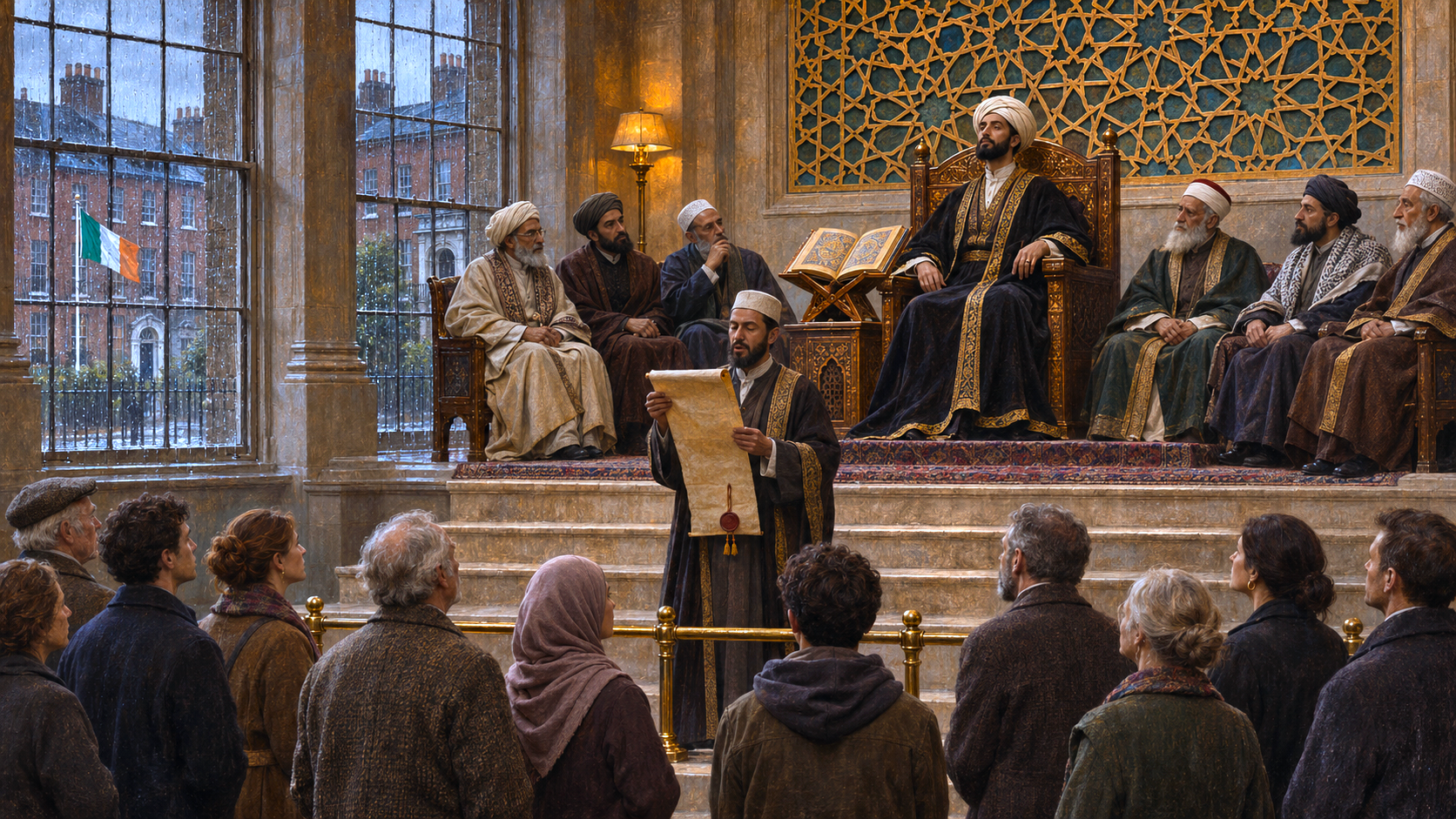
In the Islamic Labour Party of Ireland program, Ireland will cease to exist as a Western Nation-State and become an Islamic Republic, ruled by an Emir, supported by Islamic institutions as prescribed in Shariah Law. Under the proposed scheme, the Irish native people and all other non-Muslim people will be subjects, as the Western concept of citizenship will cease to exist. The Muslim program for Ireland is the blueprint for the entire Western world, in Europe, the United Kingdom and beyond. Similar proposals exist for North America. We should remind ourselves that the lives and aspirations of millions of secular Muslims would also be under threat under such a seditious and treasonous program. What does such a program depend on?… Enough numbers to weigh in to elect enough Muslim politicians, using the current democratic structures and, when a majority is reached, convert Ireland to the Islamic model, outside the Western Democratic structure, which would be made redundant at this point. But most importantly, such a program depends on the ability (or the lack thereof!) of cutting off all avenues available to Islam to attain political Power, and that will require a gloves-off political resolve. The threat is only as threatening as the Western Nations allow it to be.
Fr. G.V.W. Lewis
This is precisely the conflict the European Court of Human Rights examined in Refah Partisi v. Turkey. The Grand Chamber unanimously upheld the dissolution of a party that had proposed a plurality of legal systems and a regime based on Sharia. It “concurs in the Chamber’s view that sharia is incompatible with the fundamental principles of democracy,”[17] because a law held to be divinely fixed and unalterable leaves no room for political pluralism or for the evolution of public liberties. And it held that a State “cannot be required to wait,” before intervening, until such a party has seized power and begun to implement its policy.[18] The Court also observed that parties with aims hostile to democracy have historically disclosed them in their official publications only after taking power. The Irish document is unusual in having disclosed its loyalties beforehand.
The final clause of the oath deserves its own sentence. A political party in a free country publishes its programme, argues for it in public, and stands or falls by the public’s verdict. This one binds its members to secrecy before it has published a single policy. Its tax-reform page is empty. Its oath of silence is complete.
V
Treason and Repentance
How a body governs its own members is the best evidence of how it would govern others. Articles 13 and 14 are therefore the most revealing in the document.
Article 13 expels any member found to belong to “any other political party, or jamāʿa, or firqa.” The English version renders the last term as “any other party attributing itself to Islam,” which is not what the Arabic says. A firqa is a sect; the word carries the weight of the well-known tradition that the Muslim community would divide into seventy-three sects, only one of them saved.[19] Read with Article 4’s requirement of a “correct, intact creed” (ʿaqīda ṣaḥīḥa wa-salīma), it means that the party claiming to speak for “the Muslim community in Ireland” reserves the right to decide which Muslims hold the correct creed and to exclude those who do not.
The same article then defines “organisational treason”:
أي منتسب يقوم بإنشاء تكتلات … داخل الحزب، أو يربط علاقات مستقلة مع أحزاب أخرى، أو يقوم بانتقاد الحزب وتشويهه من الخارج؛ يُعتبر فعله خيانة تنظيميّة ويُحال فوراً إلى «لجنة الأمن والتأديب» لاتخاذ الإجراءات الردعية.
“Any affiliate who forms blocs … within the Party, or establishes independent relations with other parties, or criticises and defames the Party from outside: his act shall be deemed organisational treason, and he shall be referred immediately to the ‘Security and Discipline Committee’ for deterrent measures.”
— Constitution, art. 13.
Criticism from outside is treason. Not lies, not betrayal of confidences, but criticism. The remedy is not expulsion, which any party may impose, but referral to a committee of security for measures that are deterrent (al-ijrāʾāt al-radʿiyya). The document does not say what those measures are. It does not need to. A party that treats a member’s public criticism as treason has told us what it would make of a citizen’s.
Article 14 completes the picture. For “ideological or organisational violations” (mukhālafāt fikriyya) short of treason, the member is offered a door of “Repentance and Review” before a “Sharia and Disciplinary Committee.” The English adds, in brackets, the soothing word “Rehabilitation.” The Arabic says al-istitāba. That is not a word of party management. It is the technical term of Islamic criminal jurisprudence for the summons to repentance extended to the apostate, and by extension to the heretic, before judgement is passed on him.[20] Within the document, its only consequence is expulsion, and it would be dishonest to pretend otherwise. But the authors did not choose the word by accident. They have imported into the discipline of a political party the juridical framework of apostasy: a deviation of thought is a matter for a Sharia committee, and the deviant is to be invited to repent.
Here the Christian reader recognises the opposite of what the Church learned, slowly and at cost, about the dignity of conscience. Vatican II taught that “the human person has a right to religious freedom,” meaning that “no one is to be forced to act in a manner contrary to his own beliefs.”[21] A political party, above all, is a place where conscience should be most free, since it is the place where citizens argue about the common good. Articles 13 and 14 make it the place where conscience is policed.
VI
The Sovereign Ministries
The shadow-government page applies the same logic to the State. On the basis of a circular from the Secretary-General dated 5 Jumādā al-Ūlā 1448, which is Friday 16 October 2026,[22] a shadow government is formed “to draw up the plans and strategies necessary for the administration of the country.” Three conditions follow:
انتساب كافة الوزراء للحزب الإسلامي للعمل و الشباب
“All ministers to be members of the Islamic Party for Labour and Youth.”
يمنع على أعضاء مجلس الشورى و المكتب التنفيذي تولي وزارة سيادية
“Members of the Shura Council and the Executive Office are forbidden to hold a sovereign ministry.”
يقبل الوزير من خارج الحزب و ذلك من خلال استثناء من الأمين العام للحزب حصراً على ان لا تكون وزارة سياحية
“A minister from outside the Party is accepted, by an exception granted exclusively by the Secretary-General of the Party, provided that it is not a [sovereign] ministry.”
— islamicparty.ie, “Shadow Government.”
The site’s English version renders the end of the third condition as “provided that the ministry is not a tourism ministry,” and the clause has been widely ridiculed. The ridicule is misplaced. The Arabic word printed is siyāḥiyya, “touristic”; but the word used in the preceding clause is siyādiyya, “sovereign.” The two differ by a single letter, ح against د, and on the standard Arabic keyboard those letters lie side by side. In context the meaning is almost certainly “provided that it is not a sovereign ministry.” The “sovereign ministries” (wizārāt al-siyāda) are, in the political vocabulary of the Arab world, the ministries that wield the State’s coercive and representative power: defence, the interior, foreign affairs, justice.
Read correctly, the clause is not comic at all. Every minister must be a member of a party that only Muslims may join. A non-member, and therefore a non-Muslim, may hold office only by the personal exception of the Emir; and even then never a ministry of the sword, the police, the courts or the embassies. This is not an improvisation. It reproduces with some precision a distinction drawn in the eleventh century by the jurist al-Māwardī. In his treatise on the ordinances of government he distinguished the wazīr al-tafwīḍ, the minister of delegated authority, who may judge, appoint officials, and dispatch armies, from the wazīr al-tanfīdh, the executive minister, who carries out orders but holds no authority of his own. A dhimmī, a protected non-Muslim subject, may be an executive minister, al-Māwardī ruled, but never a minister of delegation.[23]
The shadow government of the Islamic Party for Labour and Youth follows the classical rule. Non-Muslims may serve, at the pleasure of the commander; they may never govern. Whether the authors had al-Māwardī open before them or simply breathed the political air he shaped, the result is the same. Christians, Jews, and the unbelieving majority of the Irish people would hold office in their own country not by right of citizenship but by grace, and only where office carries no power over Muslims. The analogy with the dhimma is an analogy, and should be stated as such; but it is not a loose one. It is the structure the text itself prescribes.
VII
Who Is Excluded
Turn back to Article 4. The leader of a party claiming to represent “the Muslim community in Ireland” must be an Irish citizen bi-l-aṣāla, by birth or origin, “and not by acquisition or naturalisation.”
The irony is considerable. The great majority of Ireland’s Muslims are immigrants or the children of immigrants; their community numbered some eighty-two thousand at the 2022 census, most of it formed within a generation.[24] The party that proposes to be their voice bars the naturalised among them from leading it. It draws, within its own walls, precisely the distinction between native and naturalised citizens that its authors would denounce as racism if the Irish State drew it. The point is not that the distinction is always wrong. It is that the party claims for itself a right of discrimination by origin, by sex, by creed and by sect which it would never concede to the country it hopes to govern.
"We shall go on to the end, we shall fight in France, we shall fight on the seas and oceans, we shall fight with growing confidence and growing strength in the air, we shall defend our Island, whatever the cost may be, we shall fight on the beaches, we shall fight on the landing grounds, we shall fight in the fields and in the streets, we shall fight in the hills; we shall never surrender..."
Sir Winston Churchill
30 Nov. 1874 – 24 Jan. 1965
The list of the excluded is long when it is written out. Women may join, but may not lead. Muslims without a mosque’s recommendation may not join at all; their political standing depends on a religious institution’s certificate. Muslims of the wrong firqa are expelled. Members who criticise are traitors. Non-Muslims may never join, may hold ministries only by the Emir’s favour, and may never hold the sovereign ones.
That list should be read most carefully of all by the many Muslims in Ireland, and in these islands, who want nothing to do with any of this. They are the first people such a document would govern. It is their mosques that would be made gatekeepers of political life, their consciences that would be examined by a Sharia committee, their dissent that would be named treason, their sects that would be judged deviant. The Muslim citizen who keeps his faith and keeps the law, who votes as he judges best and argues in public with whom he pleases, is not this party’s constituent. He is its first subject.
VIII
Render unto Caesar
Against all this the Christian answer is old, and it was not invented in the Enlightenment. When the Herodians brought the coin of the tribute, the Lord did not refuse Caesar his due, nor did He make Caesar the judge of what belongs to God:
ἀπόδοτε οὖν τὰ Καίσαρος Καίσαρι καὶ τὰ τοῦ θεοῦ τῷ θεῷ.
“Render therefore unto Caesar the things which are Caesar’s; and unto God the things that are God’s.”
— Matthew 22:21 (NA28).
And before Pilate He said, ἡ βασιλεία ἡ ἐμὴ οὐκ ἔστιν ἐκ τοῦ κόσμου τούτου, “My kingdom is not of this world.”[25] From the first, Christianity distinguished two orders of authority. In 494 Pope Gelasius I gave the distinction its classical form, writing to the Emperor Anastasius:
Duo quippe sunt, imperator auguste, quibus principaliter mundus hic regitur: auctoritas sacrata pontificum et regalis potestas.
“There are two, august Emperor, by which this world is chiefly ruled: the sacred authority of the pontiffs and the royal power.”
— Gelasius I, Ep. 12 (Famuli vestrae pietatis), ed. A. Thiel,
Epistolae Romanorum pontificum genuinae (Braunsberg, 1868), 1:349–58; DH 347.
Two, not one. The Church does not rule the State, and the State does not rule the Church; each answers to God in its own order.
Honesty requires an admission here, and a Catholic writer should make it without being asked. Christendom did not always keep the Gelasian balance. There were confessional states that penalised dissenters, popes who claimed temporal supremacy, and centuries in which the civil arm enforced the Church’s discipline. The Church has said so, and has drawn the lesson. The Catechism teaches that the Church “is not to be confused in any way with the political community,” and the Council that she is bound to no political system whatever.[26] The difference between the two traditions is not that Christians never fused the two powers. It is that the fusion contradicted the foundations of Christianity, and Christianity was able to correct it from its own sources: the words of Christ, the letter of Gelasius, the long tradition of the freedom of the Church. The constitution before us does not represent a deviation that its own sources rebuke. It represents those sources applied: the commander, the oath, the shūrā that binds no one, the istitāba, the minister who may execute but not govern.
That is why the Christian objection to this document is not a request for tolerance, nor a complaint of discrimination. It is a claim about the nature of political authority. Authority comes from God and is exercised for the common good of all who live under it. It is not the property of one confession to be lent to others by permission.
IX
Ireland’s Answer
What, then, should Ireland do? The temptation, visible in much of the week’s commentary, is to answer the Emir with an Emir of our own: to bar Muslims as such from political life, as this document bars non-Muslims from its government. That would be to accept the authors’ premise, that political rights follow creed. The answer is better, stronger, and already to hand. It is to judge programmes, not people.
Irish law already holds the instruments. A party may contest elections under its name only if it is registered, and registration requires a constitution, a real membership, and accountable officers.[27] An anonymous website with an oath of secrecy has none of these. The Constitution guarantees the right of association “subject to public order and morality,” and forbids the State itself to “impose any disabilities or make any discrimination on the ground of religious profession, belief or status.”[28] And the jurisprudence of Strasbourg, by which Ireland is bound, has settled that a democracy may dissolve a party whose programme is to establish a Sharia-based order, and need not wait until it is strong enough to succeed.[29] These are weapons aimed at the programme. They strike the Emir, the secret oath, the security committee, and the minister who may never govern. They leave untouched the Muslim citizen who wants none of it, and thereby they make him an ally rather than a suspect.
The law, however, is the lesser part of the answer. A political idea of this kind grows in empty space: where a society no longer knows what it believes, a creed that knows exactly what it believes will always find recruits. Ireland’s Constitution still begins in the name of the Most Holy Trinity. The real question is whether the Irish people, and with them the peoples of these islands, still mean it. A Christian people that believed its own confession would not be frightened by a website. It would read the document, see in it the old dream of one law over all, and answer it with the older truth that God has given Caesar his due and kept His own.
Conclusion
We do not know who wrote the constitution of the Islamic Party for Labour and Youth in Ireland, and we should say so plainly. But we know what it says. It gives its leader the title of a commander and its councillors the honour of sheikhs. It binds its members by a secret oath of loyalty to the Sharia that never mentions the country it proposes to govern. It calls criticism treason and deviation a matter for repentance before a Sharia committee. It reserves every ministry to Muslims and every sovereign ministry beyond the reach of non-Muslims altogether. And it does all this in the measured prose of a document that expects to be obeyed.
Such political Islam programs must only meet one possible outcome. First, the closure of all avenues and loopholes allowing programs of Islamisation of the West to attain political Power. Secondly, their authors and supporters must be charged with Sedition, prosecuted, sentenced to lengthy prison terms, followed by Deportation.
To such a project the answer must leave no room for doubt. Ireland is not a field awaiting a new jurisdiction, and the West is not a vacancy waiting to be filled. Its order was built on the distinction between the two powers, on the dignity of conscience, and on the equal standing of citizens before the law; and it will be defended on those grounds, by Christians first of all, and by every citizen of good will, Muslim or not, who prefers being a citizen to being a subject. There is no future in which this oath becomes the law of the land. The sooner its authors understand that, whoever they are, the better for everyone, and for no one more than the Muslims in whose name they presume to speak.
[1] The site’s pages were examined on 14 November 2026. The constitution is published under the heading “Constitution of the Islamic Party for Labour and Youth in Ireland (Arabic & English)”; the objectives and shadow-government pages are reproduced in both languages. Pages headed, among others, “Social Reform” and “Muslim Community Affairs” carry no text.
[2] “Islamic Labour Party Launches in Ireland, but Is Not Officially Registered, ‘Post’ Finds,” Jerusalem Post, 11 November 2026, updated 12 November 2026.
[3] “Debunked: The Irish Muslim Council Has Not Put Up Stickers Advocating for ‘Sharia Law,’” TheJournal.ie, February 2024.
[4] Constitution, art. 12. The phrase may mean only that Ulster members are to meet at a border town; but it is not how an author at home in Irish geography would put it.
[5] Constitution, art. 4. The Arabic adds proficiency in English (wa-l-inglīziyya), which the English version omits.
[6] Ibid., arts. 5–7.
[7] Ibid., art. 8.
[8] Ibid., art. 9.
[9] Ibid., arts. 10–11.
[10] Ibid., art. 12.
[11] Ibid., arts. 13–14.
[12] Ibid., art. 16.
[13] Constitution, art. 3. The English glosses shaykh as “The Councilor,” which disguises a religious honorific as an administrative one.
[14] Constitution, arts. 5, 7–8.
[15] Richard P. Mitchell, The Society of the Muslim Brothers (London: Oxford University Press, 1969); on the movement’s organisational life in Europe, Lorenzo Vidino, The New Muslim Brotherhood in the West (New York: Columbia University Press, 2010).
[16] Bunreacht na hÉireann, art. 6.1.
[17] Refah Partisi (the Welfare Party) and Others v. Turkey [GC], nos. 41340/98, 41342/98, 41343/98 and 41344/98, ECHR 2003-II, § 123.
[18] Ibid., § 102.
[19] Abū Dāwūd, Sunan, Kitāb al-sunna. The tradition is widely cited in Islamic heresiography to distinguish the saved community from the sects.
[20] On istitābat al-murtadd, the summons of the apostate to repentance, see Ibn Qudāma, al-Mughnī, Kitāb al-murtadd; the term is standard across the four Sunni schools.
[21] Second Vatican Council, Dignitatis humanae (7 December 1965), § 2.
[22] The date is given only by the Hijri calendar; conversion by the Umm al-Qurā reckoning.
[23] Abū al-Ḥasan al-Māwardī, al-Aḥkām al-sulṭāniyya, ch. 2 (on the appointment of viziers); English translation in Al-Ahkam as-Sultaniyyah: The Laws of Islamic Governance, trans. Asadullah Yate (London: Ta-Ha, 1996), ch. 2.
[24] Central Statistics Office, Census of Population 2022, Profile 5: Diversity, Migration, Ethnicity, Irish Travellers and Religion (Cork: CSO, 2023).
[25] John 18:36 (NA28).
[26] Catechism of the Catholic Church, § 2245; Second Vatican Council, Gaudium et spes (7 December 1965), § 76.
[27] Electoral Act 1992, s. 25, as amended by the Electoral Reform Act 2022; registration is now administered by the Electoral Commission (An Coimisiún Toghcháin).
[28] Bunreacht na hÉireann, arts. 40.6.1°iii and 44.2.3°.
[29] Refah Partisi, §§ 102–103, 123.