

The STATE and the Open Door: Romans 13, Civil Authority, and Christian Hospitality

St. Paul’s Letter to the Romans 13:1–7 does not present civil government as a regrettable concession to human sin, a necessary evil merely to be endured until the Parousia. The Apostle Paul assigns the ruler a positive title and a genuine function. The one in authority is διάκονος θεοῦ—God’s servant or minister—twice over (v. 4). He “does not bear the sword in vain”(τὴν μάχαιραν οὐ γὰρ εἰκῇ φορεῖ). He is “an avenger for wrath against the one who practices evil”(ἔκδικος εἰς ὀργὴν τῷ τὸ κακὸν πράσσοντι). Submission is required not only out of fear of punishment but “also for the sake of conscience,” and taxes are paid because the authorities are “God’s ministers, attending to this very thing.”
This is not grudging tolerance. It is a theological affirmation that the civil office, within its proper sphere, participates in the divine ordering of the present age. The sword is the concrete instrument of a delegated ὀργή—wrath directed against wrongdoing for the protection of the common good.
Biblical Parallels
The same pattern appears elsewhere in Scripture. In 1 Peter 2:13–14 the Apostle Peter exhorts submission “to every human institution,” whether the emperor or “governors as sent by him to punish those who do evil and to praise those who do good.” The purpose is explicit: the restraint of evil and the commendation of good. Genesis 9:6 establishes the principle after the Flood that human blood is to be required by human agency, grounding the state’s authority over life in the image of God. Proverbs repeatedly links the king’s throne to justice and the execution of judgment against the wicked (e.g., Proverbs 20:8, 26; 21:15). Jesus Himself acknowledges that Pilate’s authority is “given from above”(John 19:11) and distinguishes the things of Caesar from the things of God without abolishing the former (Matthew 22:21).
The Old Testament theocracy of Israel, while not identical to later civil polities, consistently treats the protection of the land, the removal of evil from the midst of the people, and the defence of the vulnerable within the covenant community as duties of rightful authority (Deuteronomy 13; 19; 21–25; Nehemiah’s rebuilding of the walls). The New Testament does not repeal the principle that ordered society requires the restraint of those who would prey upon it; it relocates the exercise of that restraint primarily to the civil magistrate while forbidding private vengeance(Romans 12:19).
The Patristic Witness
The early Church Fathers consistently read Romans 13 in this political sense. Irenaeus of Lyons taught that the earthly kingdom was established by God “for the help of the gentiles… so that, fearing the human kingdom, men shall not devour each other as do the fish, but by the establishment of laws may strike down the manifold injustice of the gentiles” (Against Heresies 5.24). John Chrysostom, in his Homilies on Romans, insists that the command applies even to priests, monks, apostles, and prophets: “Let every soul be subject.” The ruler is a benefactor who procures peace and the blessings of civil institutions; the sword is not borne for nothing. Basil the Great affirms that it is right to submit to authority whenever a command of God is not violated. The Apostolic Constitutions (late fourth century) instruct believers to “be subject to all royal power and dominion in things which are pleasing to God, as to the ministers of God, and the punishers of the ungodly.”
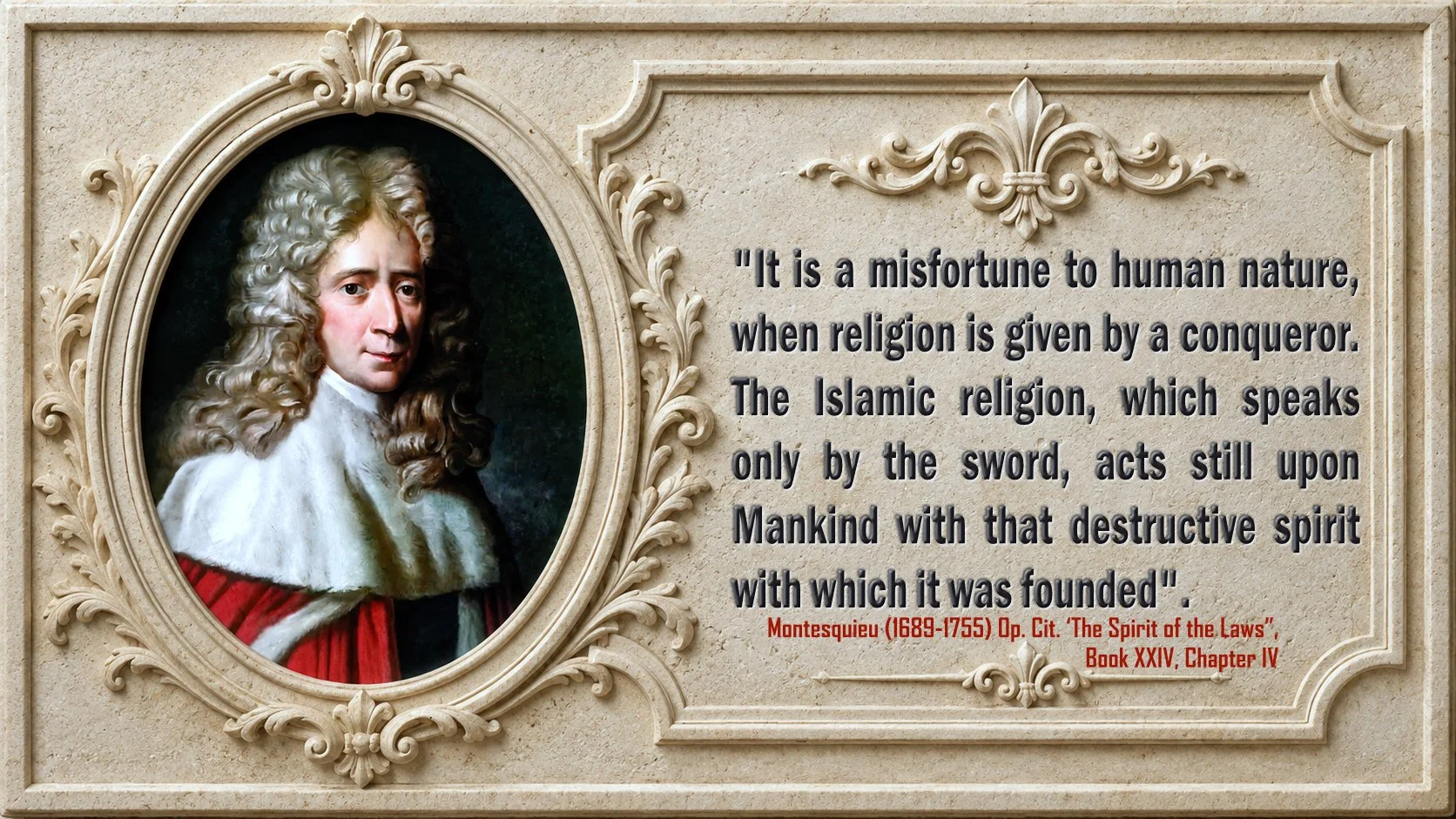
Concerns regarding Islam’s agenda of conquest, dominance and extreme violence have been a mainstay throughout the last 1400 years. Above is an 18th Century quote authored by Montesquieu (1689-1755), from “The Spirit of the Laws”.
Augustine of Hippo is especially clear. In The City of God and his letters, he distinguishes the two cities while affirming that the state, with its power to command, coerce, punish, and even put to death, restrains the wicked and preserves a measure of temporal peace. Those who carry out lawful executions or just war act as “a sword in the hand” and do not thereby violate the commandment against murder (City of God 1.21; cf. Letter 153). Later, in the Donatist controversy, he accepted the use of civil power to restrain schism and violence for the sake of public order and the good of the erring, always insisting that the sword belongs to the [State] magistrate, not private individuals or the Church as such.
The Fathers therefore recognised both the divine origin of civil authority and its proper function: the protection of the common good through the restraint of evil. They did not imagine a polity without borders, without the capacity to defend its territory, or without the right to remove or punish those who persistently endanger the societal peace and the innocent citizenry.
Love of Neighbour
and the Duty of Hospitality
None of this cancels the Gospel’s radical commands. The second great commandment is to love one’s neighbour as oneself (Matthew 22:39). The parable of the Good Samaritan (Luke 10:25–37) defines the neighbour as the one in need who crosses one’s path, regardless of ethnic or religious boundary. Hebrews 13:2 urges, “Do not neglect to show hospitality to strangers, for thereby some have entertained angels unawares.” Abraham’s reception of the three visitors (Genesis 18) and Lot’s protection of the angels in Sodom (Genesis 19) stand as paradigms of hospitality. The Church Fathers repeatedly exhort the faithful to welcome the stranger, the poor, and the pilgrim, seeing in them the face of Christ (Matthew 25:35).
In the microcosmos of Human interpersonal relations, hospitality is a Christian virtue of the highest order. It is not optional.
Sodom and Gomorrah:
The Failure of Hospitality
Yet the same Scriptures that command hospitality also record its catastrophic failure. Genesis 19 narrates the men of Sodom laying siege and surrounding Lot’s house and demanding that the angelic visitors be brought out “that we may know them”—an attempted gang rape that constitutes both sexual violence and a violent repudiation of the sacred duty of hospitality. Ezekiel 16:49 adds that the guilt of Sodom included “pride, excess of food, and prosperous ease, but [she] did not aid the poor and needy.”Jude 7 and 2 Peter 2:6–8 speak of sexual immorality and the pursuit of predatory desire. The biblical portrait is not one-dimensional. The sin of Sodom was a complex of pride, injustice, sexual depravity, and—centrally in the Genesis narrative—the transformation of hospitality into predation, by direct external agency, in this case the men who surrounded Lot’s house.
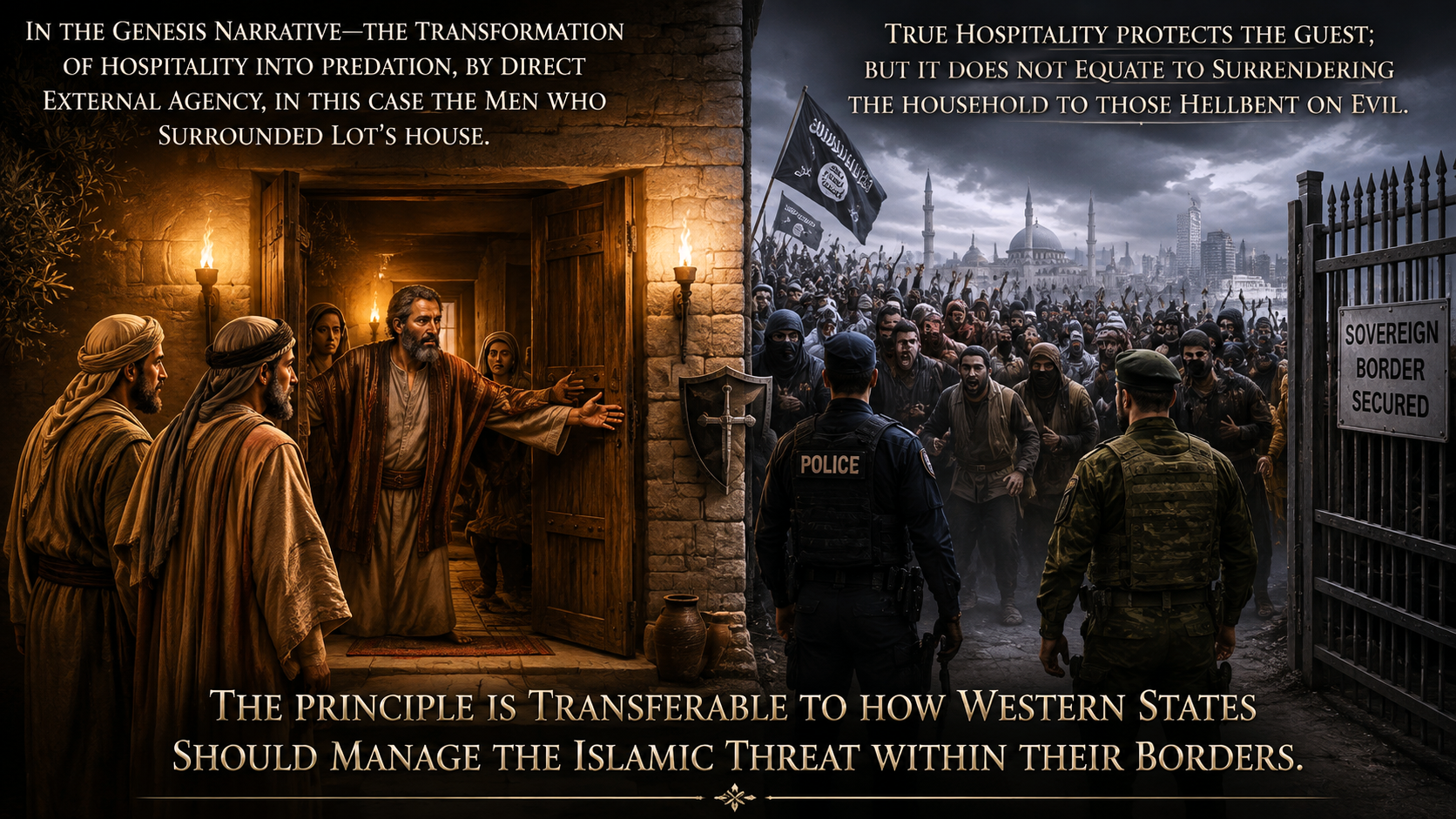
The destruction of the cities is therefore a warning against both the neglect of the vulnerable and the corruption of hospitality into a licence for those who would harm the household. True hospitality protects the guest; but it does not equate to surrendering the household to those hellbent on evil. The principle is transferable to how Western states should manage the Islamic threat within their borders.
Not Incompatible,
but Complementary
The two strands—State Authority’s sword and the Church’s ministry of love—are not rivals. They operate in distinct spheres and serve complementary ends:
The individual Christian and the Church are forbidden private vengeance and are commanded to love their adversaries, feed the hungry, and welcome the stranger.
The Nation-State and/or the magistrate, by divine appointment, bears the sword precisely so that the conditions of ordered peace may exist in which such charity can be practised without being destroyed by the predatory. Anarchy is not hospitality; it is the abandonment of the weak to the strong. A polity that refuses to protect its territory, its citizens, and the moral and religious foundations that sustain a recognisably Christian (or even simply just secular) social order does not thereby become more Christian. It becomes less able to protect the very people to whom hospitality is owed:
The early Christian tradition never equated hospitality with the abolition of borders, the suspension of criminal law, or the compulsory admission of those who demonstrate by word and deed an intention to undermine the common good. The Didache already places practical limits on the stay of travelling teachers. Later monastic and episcopal practice distinguished genuine need from idleness or threat. Augustine and others recognised that the state’s coercive power could, under certain conditions, serve the peace of the Church itself by restraining public violence and sedition.
Thus Romans 13 and its associated witness remain entirely Christian. The διάκονος θεοῦ who bears the sword for wrath against the wrongdoer does not contradict the Gospel of neighbour-love; he protects the arena in which that love can be freely and safely exercised. Christian faith holds both truths together: the open door of charity and the sword of justice. Neither is optional. Neither may be absolutised at the expense of the other.
St. Augustine “Just War” Theory
Meaning and BOUNDARIES
Augustine of Hippo (354–430) did not write a systematic treatise titled “Just War Theory.” What later tradition calls Augustinian just-war thought consists of scattered but coherent reflections across works such as Contra Faustum Manichaeum (Against Faustus), De Civitate Dei (The City of God), letters (especially Letter 189 to the military commander Boniface), and other writings. These reflections became the foundational Christian articulation of when and how force may be used by public authority, later systematised by thinkers such as St. Thomas Aquinas.

Augustine of Hippo
(354–430)
Augustine’s starting point is theological and pastoral rather than purely philosophical. He defends the moral possibility of Christian participation in military service against Manichaean critiques that rejected the Old Testament’s wars as incompatible with the Gospel. He also addresses Christian soldiers and officials living under the pressures of a crumbling Roman order. War is never presented as a positive good; it is a tragic necessity arising from human sin and the disordered loves that mark the earthly city.
Core Principles
Three criteria emerge with particular clarity and became the classical jus ad bellum (right to go to war) framework:
Legitimate Authority, Only public authority—those who hold supreme power for the common good—may declare and wage war. Private individuals may not take up the sword on their own initiative. In Contra Faustum 22.75, Augustine writes that “the natural order conducive to peace among mortals demands that the power to declare and counsel war should be in the hands of those who hold the supreme authority.” Soldiers act as ministers of that authority, not as private avengers. This directly parallels the Pauline teaching in Romans 13 that the magistrate is διάκονος θεοῦ who “does not bear the sword in vain.”
Just Cause War is justified when it responds to real wrongdoing: to avenge injuries, punish a nation or state that refuses to make amends for wrongs inflicted by its subjects, or restore what has been unjustly seized. Defensive wars to protect the innocent and restore order fall under this heading. Aggressive wars of conquest, glory, or plunder do not. Augustine repeatedly insists that the injustice of the opposing side lays the duty of war upon the wise man (City of God 19.7). The goal is not domination but the restraint of evil and the recovery of a just peace.
Right Intention Even when authority and cause are present, the intention must be upright. The real evils of war, Augustine says, are “love of violence, revengeful cruelty, fierce and implacable enmity, wild resistance, and the lust of power, and such like” (Contra Faustum 22.74). Good men undertake wars precisely to punish these disorders when force is required. The decisive aim is peace. In Letter 189 to Boniface he writes:
“Peace should be the object of your desire; war should be waged only as a necessity, and waged only that God may by it deliver men from the necessity and preserve them in peace. For peace is not sought in order to the kindling of war, but war is waged in order that peace may be obtained.” Even while fighting, the Christian soldier is to cherish “the spirit of a peacemaker,” keep faith even with the enemy, and show mercy to the defeated once the disturbance of peace is no longer to be feared.
Important Supporting Notes
War as Tragic Necessity In City of God 19.7, Augustine observes that the wise man will wage just wars, yet “he will rather lament the necessity of just wars.” The existence of just wars is itself evidence of the fallen condition of the human race. Peace remains the higher and proper end of political life.
The Soldier as Instrument of Public Justice Drawing on John the Baptist’s counsel to soldiers (Luke 3:14), Augustine notes that they were not told to abandon their arms but to avoid extortion, false accusation, and discontent with their wages. Authorised force under lawful authority is not murder. In City of God 1.21 he explains that the agent of public authority is “but a sword in the hand” of the one who uses it and is not himself guilty of private homicide when acting according to just law or divine command.
Continuity with the Old Testament and Distinction of Offices: Augustine defends the wars of Moses as acts of obedience to divine command and righteous retribution, not personal ferocity. He carefully distinguishes the private Christian (who is called to turn the other cheek and love the enemy) from the public office-holder who, as minister of the law, may use coercive force for the common good. The two callings are not contradictory; they operate in different spheres.
Relation of “Just War” to
the Broader Tradition
Augustine supplied the decisive Christian foundations—authority, just cause, and right intention directed toward peace—upon which later medieval and modern just-war thought built. Aquinas formalised the three criteria in the Summa Theologiae (II-II, q. 40) and explicitly cited Augustine. Subsequent developments added further jus ad bellum considerations (last resort, proportionality of ends, reasonable hope of success) and a fuller jus in bello (discrimination between combatants and non-combatants, proportionality of means). Augustine himself does not elaborate these later refinements in systematic detail, yet his insistence on right intention and the avoidance of the “real evils” of war provides their moral root.
In the context of Romans 13, Augustine’s teaching confirms that the civil power’s bearing of the sword is not a regrettable pagan residue but a divinely permitted instrument for restraining evil and protecting the temporal peace in which the Church’s ministry of charity and the ordinary life of citizens can continue. The same bishop who urged radical personal love of enemy also insisted that public authority may, under the conditions above, use force without ceasing to act as God’s servant for the common good.
THOMAS AQUINAS RATIONALE ON
THE AUTHORITY OF THE STATE
Thomas Aquinas (1225–1274) did not invent new criteria so much as he gave Augustine’s scattered reflections systematic, juridical, and philosophical form. The classic statement appears in the Summa Theologiae II-II, Question 40, Article 1: “Whether it is always sinful to wage war?”
Aquinas answers that war is not always sinful, provided three conditions are fulfilled. These three conditions are drawn directly from Augustine, but Aquinas states them with scholastic precision and embeds them in a broader framework of natural law, the common good, and the virtue of charity.
AQUINAS’ Three Necessary Conditions
Aquinas writes:
“In order for a war to be just, three things are necessary. First, the authority of the sovereign by whose command the war is to be waged. Secondly, a just cause is required, namely that those who are attacked should be attacked because they deserve it on account of some fault. Thirdly, it is necessary that the belligerents should have a rightful intention, so that they intend the advancement of good or the avoidance of evil.”

Thomas Aquinas
(1225–1274)
He supports each point with explicit citations of Augustine.
Legitimate Authority: Only the public sovereign (the princeps) charged with the care of the common good may declare war. Private persons may not, because they can seek redress through higher judicial authority. Aquinas links this power to the same authority that punishes internal wrongdoers (citing Romans 13:4). Just as the magistrate bears the sword against domestic evil-doers, so he may use the sword of war against external threats to the common weal. This is a clearer juridical formulation of Augustine’s insistence that the power to declare war belongs to those who hold supreme authority.
Just Cause: Those attacked must deserve attack “on account of some fault.” Aquinas quotes Augustine’s definition: a just war avenges wrongs when a nation, state or community have refused to make amends for injuries inflicted by its subjects or to restore what it has unjustly seized. The cause is therefore retributive and restorative: the righting of a serious injustice. Self-defence against aggression is included, but Aquinas’s formulation is broader than pure defence; it encompasses the punishment of grave wrongdoing and the recovery of what has been unjustly taken.
Right Intention: Even when authority and cause are present, a wicked intention can render the war unjust. The intention must aim at the advancement of good or the avoidance of evil—above all, the restoration of peace. Aquinas again cites Augustine’s list of the “real evils” in war: the passion for inflicting harm, the cruel thirst for vengeance, an unpacific and relentless spirit, the lust of power, and the like. The positive goal remains the same as in Augustine: “We do not seek peace in order to be at war, but we go to war that we may have peace.”
What Aquinas Adds
Aquinas’ distinctive contribution lies less in new criteria than in the following:
Systematisation. Augustine’s insights were dispersed across polemical and pastoral writings. Aquinas gathers them into a single, tightly structured article within the moral theology of the Summa, under the treatise on charity. War is treated as a question of ordered love and the common good rather than merely as a tragic necessity.
Integration with natural law and Aristotelian political thought. The sovereign’s authority is grounded not only in divine ordinance (as in Augustine) but also in the natural responsibility of the ruler for the bonum commune (the common good). War becomes an extension of the ordinary coercive power of government from the internal to the external sphere.
Clarification of related practical questions. In the same Question 40 Aquinas addresses whether clerics may fight (generally no, because their office is spiritual), whether ambushes are lawful (yes, provided they do not involve breaking pledged faith), and whether war may be waged on holy days (yes, when necessity requires the defence of the common good).
Distinction of spheres. Like Augustine, Aquinas maintains that the Gospel precepts of patience (turning the other cheek) bind the individual Christian in personal conduct, while the public authority may and sometimes must use force for the protection of the community. The two are complementary, not contradictory.
What Aquinas Does Not Add
The later, fuller list of just-war criteria that became standard in modern discussions—last resort, overall proportionality of the war, reasonable probability of success, and detailed jus in bello rules of discrimination and proportionality of means—are developments that post-date Aquinas. He provides the classical three conditions and the moral framework; subsequent scholastic and early-modern thinkers expanded the prudential and in-bello requirements.
In short, Aquinas took Augustine’s foundational Christian insights—legitimate authority, just cause directed against wrongdoing, and right intention ordered to peace—and gave them the clear, systematic, and juridically usable form that has shaped Catholic and much Western just-war thinking ever since. The διάκονος θεοῦ of Romans 13 who bears the sword receives, in Aquinas, a precise set of conditions under which that sword may be drawn in the service of the common good, both within the domestic and the external contexts.
HISTORICAL SCHOLASTIC CONTRIBUTIONS
Later scholastic expansions of just-war theory occurred primarily in the sixteenth and early seventeenth centuries, especially among the theologians of the School of Salamanca. Building on Augustine’s foundations and Aquinas’s systematic three criteria (legitimate authority, just cause, and right intention), these thinkers refined the doctrine in response to new historical realities: the Spanish encounter with the Americas, wars of religion, the rise of sovereign states, and questions of international relations.
The most important figures are Francisco de Vitoria (c. 1483–1546) and Francisco Suárez (1548–1617), with contributions also from Luis de Molina, Gabriel Vázquez, and others.
Limits and Tensions with COMMON POPULAR CALLS FOR HARSH POLICIES
Several of the specific proposals popular with Public Opinion go beyond, or sit uneasily with, the Classical Christian Framework criteria:
Blanket population quotas by religion (e.g., 2 % Muslim) and numerical reduction of mosques treat religious identity itself as the problem. Thus, if a particular religious identity is indeed a problem, posing a threat to the overall citizenry, discretion in the application of the default framework may become necessary. Otherwise, by default, the tradition distinguishes between the public effects of certain ideologies or behaviours and the persons who hold a faith. Collective demographic engineering by religion risks violating the principle that the innocent are not to be punished for the faults of others and the rejection of religion as a free-standing just cause. However, immediate, consistent and systematic surgical removal of wrongdoers is not unchristian and remains commensurate within the framework.
Removing automatic nationality of newborns and forcing ancestral nationalities can be framed as a revision of citizenship and nationality law (a matter within the state’s competence). But if applied in a way that creates permanent second-class status for citizens on ethno-religious grounds, it collides with natural-law equality of persons and the classical concern for justice toward those already within the polity.
Immediate expulsion of all illegal migrants is not unchristian and remains fully compatible with the enforcement of law. Distinctions of individual fault, genuine refugee claims, and due process (even if fast-tracked) remain relevant under the same tradition that insists on right intention and the avoidance of unnecessary harm.
Limitation of access to elected office is entirely defensible if tied to loyalty, oaths, or demonstrated rejection of ideologies incompatible with the constitutional order, such as Shariah. Purely abstract religious disqualification of citizens is harder to square with the tradition’s emphasis on individual justice.
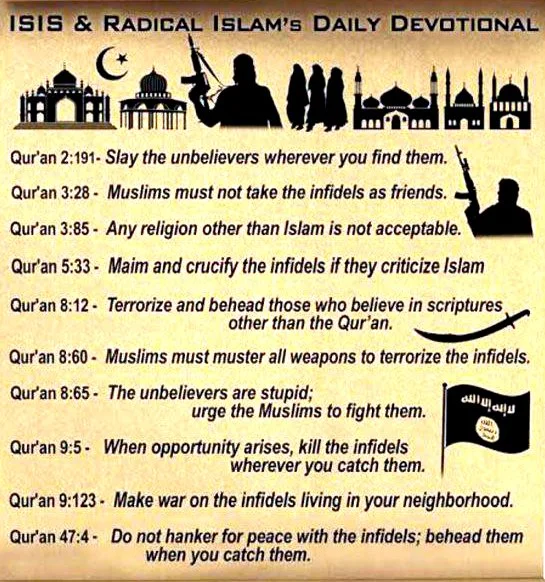
RECALL:
Limitation of access to elected office is entirely defensible if tied to loyalty, oaths, or demonstrated rejection of ideologies incompatible with the constitutional order, such as Shariah.
Hospitality and the command to love the neighbour are binding; but it must be said they do not abolish borders or the duty to protect the existing native political community, and therefore such measures should effectively constrain the means and the motives at the disposal of wrongdoers.
Augustine and Aquinas insist that the “sword” is for the restraint of wrongdoing, not for the abstract elimination of religious difference. Right intention requires that measures aim at peace and the common good, not at hatred, permanent subjugation, or the erasure of a religious minority as such. Hospitality and the command to love the neighbour are binding; but it must be said they do not abolish borders or the duty to protect the existing native political community, and therefore such measures should effectively constrain the means and the motives at the disposal of wrongdoers.
Measures More Clearly Commensurate
with the CHRISTIAN Framework
Policies that stay closer to the classical criteria of legitimate authority, just cause(actual injury or threat to order), and right intention ordered to peace would include:
The strictest, consistent and emphatic enforcement of existing immigration and asylum law, including rapid removal of those who enter or remain illegally and of non-citizens who commit crimes, whether serious or not.
Ending or tightly conditioning chain migration and family-reunion routes that have produced rapid, unassimilated demographic change in specific localities or nationwide.
Citizenship and naturalisation rules that require demonstrated knowledge of, and loyalty to, the constitutional and legal order, including explicit rejection of parallel legal systems or theocratic political goals.
Robust defence of free speech, the right to criticise religious doctrines, and the public practice of Christianity against intimidation or legal harassment.
Suppression and criminal banishment of organisations and networks that actively promote the replacement of the societal, civil, legal and constitutional order with Sharia or any Islamic model, ideologies that nurture takeover of the host Nation, incite sedition, or that engage in violence, entryism, infiltration, cooptation, or the grooming of parallel societies.
Requirements of linguistic, civic, cultural, and legal integration as conditions of long-term residence or citizenship.
Protection of women’s rights, children’s rights, and freedom of apostasy/exit from religion against practices justified by religious claims.
Transparent data collection and public discussion of crime, welfare, and integration outcomes by origin and ideology, so that policy rests on evidence of actual effects rather than either denial or collective demonisation.
These aim at the defence of the existing political community’s capacity to maintain justice, peace, Western societal and cultural values, democracy, civil liberties and the free practice of Christianity—goods the classical Christian tradition recognises as legitimate objects of the state’s care—without converting the state into an instrument of religious exclusion for its own sake.
Articulation in Summary
The Pauline, Augustinian, and Thomistic framework supports a Nation-State that is not neutral toward its own dissolution or toward ideologies that reject its fundamental legal, societal, and cultural order. It authorises border control, the expulsion of illegal entrants, the defence of citizens, and the restraint of subversive or violent movements. It restrains the treatment of an entire religion as a collective enemy, the engineering of religious quotas, or the punishment of the innocent for the sake of demographic purity. But it places the cornerstone of the State’s discretion on right intention that remains ordered to a just peace in which the native and overall are protected and the common good is preserved.
Empirical questions—scale of illegal migration, integration failures, Islamist political goals, crime differentials, fertility and demographic trends—belong to the prudential judgement of the magistrate and the citizenry. The theological framework supplies the moral boundaries within which that judgement must operate: authority is real, the sword is legitimate against actual wrongdoing, hospitality does not abolish the political community, and justice forbids collective punishment of the innocent.🟥
Conclusions Applicable to
Most western or non-Muslim Nations
Western nations are not uniformly “failing” in every respect—they retain high material prosperity, technological capacity, and formal legal systems—but on the specific question of preserving cultural continuity, social cohesion, the inherited legal-moral order, and the demographic character of the citizenry, there is a widespread and measurable shortfall relative to what the classical Christian tradition of civil authority would expect from a magistrate charged with the common good.
The reasons are structural, ideological, demographic, and institutional rather than a single conspiracy or moral collapse.
1. Demographic and economic incentives override cultural ones
Native fertility across Western Europe and much of the English-speaking world has been far below replacement (typically 1.3–1.6) for decades. Populations are aging rapidly. This creates real labour shortages and fiscal pressure on pension and welfare systems. Economic analyses and government planning documents consistently treat net immigration as a necessary offset for growth and system sustainability. Elites therefore prioritise inflows even when public opinion is more restrictive. The short-term economic calculus systematically outweighs longer-term concerns about cultural transmission, trust, or the character of the political community.
2. Post-1945 legal and normative architecture constrains enforcement
The 1951 Refugee Convention, the European Convention on Human Rights, national constitutions, and expansive judicial interpretations make rapid removal of illegal entrants, failed asylum seekers, and even criminal non-citizens difficult. Return rates to many origin countries remain low (often under 20 percent in the EU). Origin states frequently refuse cooperation. Asylum systems designed for individualised claims have been overwhelmed by volume, producing multi-year backlogs during which claimants remain and form families. The classical tradition (Romans 13, Augustine, Aquinas) treats the state’s power to control territory and expel those who violate its order as legitimate; contemporary human-rights regimes have subordinated that power to individual claims and non-refoulement doctrines in ways that systematically slow enforcement.
3. Elite ideology and loss of civilizational confidence
Since the 1960s a dominant strand of elite opinion—across academia, media, civil service, and much of the political class—has treated Western particularity itself with suspicion. National identity, cultural continuity, and the public role of Christianity are frequently framed through the lens of historical guilt (colonialism, racism, the Holocaust). Multiculturalism and anti-discrimination norms are elevated as higher moral goods than the preservation of the inherited order. Dissent is readily stigmatised as xenophobic or racist, creating strong incentives for politicians and institutions to avoid robust defence of the existing cultural majority. This is the opposite of the classical expectation that the magistrate protects the concrete common good of this people under this legal and moral order.
4. Public–elite divergence and political short-termism
Opinion data across Europe and the Anglosphere repeatedly show majorities concerned about the scale and composition of immigration and about integration failures. Yet policy has remained relatively open for long periods. Business interests favour labour supply; left-leaning parties often see demographic change as electorally advantageous; centrist parties fear being outflanked on the “racism” charge. The result is policy inertia even as visible problems—parallel societies, higher crime rates among certain cohorts, Islamist networks, pressure on free speech and women’s rights—accumulate. Enforcement is politically costly in the short run; the costs of non-enforcement are diffuse and long-term.
5. Integration realities and differential group outcomes
Not all immigration produces the same effects. Large-scale inflows from culturally distant, high-fertility, lower-trust, or more religiously assertive societies (particularly significant Muslim-majority sources) have generated persistent gaps in employment, education, crime involvement, and attitudes toward core Western norms (secular law, gender equality, free speech, apostasy). Surveys in several countries show substantial minorities among Muslim populations who prioritise Sharia over national law or hold views incompatible with liberal democratic norms. Higher fertility differentials mean the share of these populations continues to rise even under zero further migration. Parallel social structures and “no-go” or high-crime neighbourhoods in parts of France, Sweden, Belgium, the UK, and Germany are documented realities, not inventions. The classical tradition requires the state to restrain threats to public order and the conditions of a just peace; many Western governments have been slow or reluctant to treat these patterns as matters requiring decisive corrective action.
6. The cumulative effect relative to the classical framework
The Pauline–Augustinian–Thomistic line treats the civil power as God’s servant charged with defending the temporal common good of a concrete people—its peace, its justice, its capacity to live according to its inherited moral and legal order. Modern Western states have largely inverted the priority: universal individual claims, economic growth metrics, and anti-discrimination norms frequently take precedence over the concrete protection of the existing political community’s character and continuity. The result is not total collapse, but a progressive erosion of the conditions under which that community can reproduce itself culturally and demographically while maintaining high-trust, high-cohesion norms.
In short, the failure is over-determined: economic necessity meets legal constraint meets ideological self-doubt meets political cowardice meets the brute facts of differential fertility and incomplete assimilation. The classical Christian understanding of civil authority supplies a clear standard against which this pattern can be measured and found wanting. Whether Western societies recover the will and capacity to reverse it remains an open political question.🟥