
On Government by Request, Punishment by Process,
and the Prostitution of Democratic Power
Mind the Limoges Series · November 2026

Freedom only to speak inoffensively is not worth having.
— Sedley LJ, Redmond-Bate v Director of Public Prosecutions (1999)
I. Three Scenes from One Week
In a single week of November 2026, three things happened in England that might each be filed under a different heading and forgotten: a celebrity scandal, a local policing story, a civil-liberties statistic. Read together, they describe a pattern. The pattern is of a State that has learned to exercise power where the law has given it none, and to withhold judgment where the law requires it.
On Sunday 15 November, the wife of Russell Brand read out a message from him on the couple’s YouTube channel. He had lately been sentenced at Southwark Crown Court to ten and a half years’ imprisonment, and in the message he maintained that he is not guilty. The Prime Minister’s spokesman called the video “clearly appalling.” The Ministry of Justice, through the Prison Service, then formally asked Google to remove it. A government minister, Matthew Pennycook, admitted on the BBC that the authorities “don’t have any power to mandate a removal of content.” In the same breath he said the government remained in “close dialogue” with the company.[1] Sky News reported that what was sought was the removal not merely of the video but of the channel.[2] Google declined, finding that the video broke none of its rules, though it says its teams are still reviewing the content.[3] Then the Prime Minister spoke for himself. The victims, he said, had “heard quite enough from this convicted criminal,” and he told the social media companies to “show some decency.” Asked whether he would change the law, he answered: “I wouldn’t leap to that.”[4]
This essay takes no position on the verdict, and its argument does not need one. A jury has decided the question of guilt, and a court of appeal may yet revisit it. Neither is the business of a journal of theology. The question here is a different one. May a Ministry of the Crown do by request what it admits it cannot do by law? And may it do so to silence a denial of guilt, which is the oldest and most ordinary speech a prisoner has?
On 17 November, Hertfordshire Constabulary confirmed that no further action would be taken against Steve Maile, a sixty-six-year-old pastor in Watford. Seven months earlier, on 18 April, he had been preaching in the town centre, singing hymns, calling passers-by to repentance and questioning whether Islam is a religion of peace. Three officers arrested him on suspicion of assault and of racially or religiously aggravated disorderly behaviour. The assault allegation, which he denied from the first, was dropped within two days.[5] He was held for up to twelve hours, first at Watford and then at Hatfield. He was double-handcuffed for about ninety minutes, needed medical attention and wore wrist splints for three weeks. One officer can be heard on the footage telling him, “In the name of Jesus, get in the car.” For seven months, he remained under investigation over what he had said. Then the Crown Prosecution Service decided on no further action “at this time.” The force reviewed its officers’ conduct and concluded that no further action was necessary there either.[6]
Behind both cases stand the figures that Big Brother Watch (official website and YouTube channel) published in September. Between 2021 and 2025, at least 62,199 people in the United Kingdom were arrested for communications offences. Of these, 18,510 were charged and 12,292 convicted.[7]
This journal has addressed those figures twice. It argued that the civil sword is given ad bonum commune and is abused when turned on opinion. It argued that, for most of those arrested, the arrest is the sentence.[8] Neither argument is repeated here. The claim of this essay is narrower and graver: the three scenes of this week share a single grammar. In each, the forms of democratic government are kept, but the thing those forms exist to serve has been sold. The Old Testament prophet Isaiah had a word for that.
II. The Faithful City
איכה היתה לזונה קריה נאמנה מלאתי משפט צדק ילין בה ועתה מרצחים
Quomodo facta est meretrix civitas fidelis, plena iudicii? Iustitia habitavit in ea, nunc autem homicidae.
How has the faithful city become an harlot! It was full of judgment; righteousness lodged in it; but now murderers.
— Isaiah 1:21[9]
Isaiah’s charge against Jerusalem is not chiefly sexual. The harlotry (zônâ) is the infidelity of a covenanted city to the thing it was covenanted to keep. The prophet names that thing precisely. The faithful city (qiryâ ne’ĕmānâ) was “full of judgment” (mišpāṭ), and righteousness (ṣedeq) lodged in it. Its fidelity was a fidelity to judgment. Its harlotry is that judgment has been put to other uses. Two verses later he says whose doing this is:
“Thy princes are rebellious, and companions of thieves: every one loveth gifts, and followeth after rewards: they judge not the fatherless, neither doth the cause of the widow come unto them.”[10]
The offices are still filled and the princes still sit. What has changed is the master they serve.
This is the sense in which the phrase “the prostitution of democracy” is used here. It is meant as a diagnosis, not as abuse. The Latin prostituere means to set something out in public for sale. A democracy is prostituted when its offices are hired out to ends other than the judgment for which they were given. Those offices include the authority of a minister, the constable’s power of arrest and the machinery of prosecution. The other ends may be the management of a news cycle, the soothing of a complainant or the gratification of a constituency. Elections continue, Parliament sits, and the forms remain. The fidelity has gone.
The three scenes show three marks of that infidelity:
The first is power without law: a Ministry asks a corporation to do what Parliament has never authorised it to command.
The second is law without judgment: a constabulary punishes by process a man it never brings before a court.
The third, which binds the other two together, is judgment by offence: what may be said is measured by the distress of whoever hears it.
Each is taken in turn below.
III. Government by Request
Begin with the minister’s admission, because it gives the whole case away. The government has no power to require the removal of the video. Then why ask?
A request from a Ministry of the Crown is not the request of a private citizen. The company to which it was addressed operates in Britain under a regulatory regime that this same government created and directs. Every legal department in such a company knows that the hand making a polite request is attached to the arm that holds the regulator’s pen. The phrase “close dialogue” is the velvet on that glove. The government did not say it would stop asking. It said it would keep talking.
The Prime Minister then stated the method outright. He would not leap to changing the law; he would first appeal to the companies’ decency. That is the whole of government by request in a sentence. A change in the law must be argued in Parliament, voted on and tested in the courts, and it binds the government as much as anyone else. An appeal to decency needs none of these things. It passes through no lobby, can be challenged in no court and has no limit set to it. The pressure it carries is measured by how much the company fears the government, not by anything the law says.
The law of the land is not silent here. The Human Rights Act makes it unlawful for a public authority to act incompatibly with a Convention right. Article 10 of the Convention permits interference with expression only where the interference is “prescribed by law” and “necessary in a democratic society.”[11] By the minister’s own account, the removal sought here was prescribed by nothing. Had Google complied, the government would have achieved through a private company an interference that it could not lawfully have made itself. Nor can the second limb be met by appeal to taste. The Strasbourg Court held half a century ago that freedom of expression extends to ideas “that offend, shock or disturb the State or any sector of the population,” and gave its reason: “Such are the demands of that pluralism, tolerance and broadmindedness without which there is no ‘democratic society.’”[12] The phrase “democratic society” is not ornament there. It is the test. A government that demands the removal of lawful speech because it disturbs fails the test by the very standard it professes to serve.
Honesty requires a qualification. The American Supreme Court has held unanimously that an official may not coerce a private party into suppressing disfavoured speech on the government’s behalf, but its test turns on coercion. A public request, openly made and openly refused, might well survive it.[13] The British case is not stronger because the request was more menacing. It is stronger because it had no lawful footing at all. It is weaker in one respect, which we should feel more sharply than we do. In Britain the last line of defence for a prisoner’s speech turned out to be the content policy of a corporation in California. It is a strange democracy whose liberties are kept for it by a foreign company’s terms of service.
Grant everything the government may fairly claim. The Ministry of Justice has opened an inquiry into whether the prisoner broke the rules that govern prisoners’ public statements. That inquiry is lawful and proper. It is aimed at the prisoner, it follows a procedure and it has a remedy. If he broke the rules, let the rules take their course. A request to a corporation to delete a lawful video is a different kind of act. It is aimed not at the breach but at the speech, and it reaches past the prisoner to everyone who might hear him.
That speech is the denial of guilt. The British State knows better than most that convicted men are sometimes innocent, because it has built institutions on that knowledge. Since 1997 the Criminal Cases Review Commission has existed because juries make mistakes. Andrew Malkinson was convicted of rape in 2004 and spent seventeen years in prison, the latter part of them because he refused to admit a crime he had not committed. His conviction was quashed in 2023. Parliament itself had to quash the convictions of the sub-postmasters by statute, because the courts had convicted them on evidence that was false.[14] None of this says anything about the case now in the news, and nothing here is meant to. It says something about every case…
The State cannot know in advance which denials are true. That is precisely why it permits all of them to be spoken. A Ministry that funds the Commission cannot also treat a prisoner’s protestation of innocence as an obscenity to be scrubbed from public view.
There is a Gospel scene for this, and it is the Lord’s own. Under arrest, before the high priest, Jesus Christ answers a question about his teaching. An officer strikes him for the manner of his reply. He does not turn the other cheek. He asks for the evil to be named:
εἰ κακῶς ἐλάλησα, μαρτύρησον περὶ τοῦ κακοῦ· εἰ δὲ καλῶς, τί με δέρεις;
If I have spoken evil, bear witness of the evil: but if well, why smitest thou me?
— John 18:23[15]
Augustine noticed that the Lord did not, in that moment, literally offer the other cheek, and asked why. His answer is that the precept governs the readiness of the heart. Christ showed that readiness by giving his whole body to the Cross. What he gave the officer was the truth, and a demand for evidence.[16] The officer’s blow is the type of every administration that answers words with force instead of with proof. The demand of John 18:23 is the right one to put to the government this week. If the speech is unlawful, bear witness of the evil: name the law, bring the charge, let a court decide. If it is lawful, why smitest thou it?
IV. Punishment by Process
The Watford case must be stated fairly, and fairness cuts both ways. The police were told that an assault had taken place, and they must investigate allegations of assault. No one suggests otherwise. But the assault allegation was abandoned within two days. What then kept a sixty-six-year-old Christian pastor on bail, under investigation, for seven months was not anything he was said to have done with his hands. It was what he had said with his mouth, and his mouth had said what Christian preachers have said in English market squares for centuries. Nicodemus put the question that a constabulary ought to put to itself before it reaches for the handcuffs:
μὴ ὁ νόμος ἡμῶν κρίνει τὸν ἄνθρωπον ἐὰν μὴ ἀκούσῃ πρῶτον παρ’ αὐτοῦ καὶ γνῷ τί ποιεῖ;
Doth our law judge any man, before it hear him, and know what he doeth?
— John 7:51[17]
The arrest was made under the Section 5 public order offence in its religiously aggravated form.[18] The governing law on preachers and hostile audiences has been settled for more than a quarter of a century. In 1999, three women were preaching from the steps of Wakefield Cathedral when a crowd turned against them. One was arrested and convicted. The Divisional Court quashed the conviction, and Lord Justice Sedley gave English law one of its finest sentences:
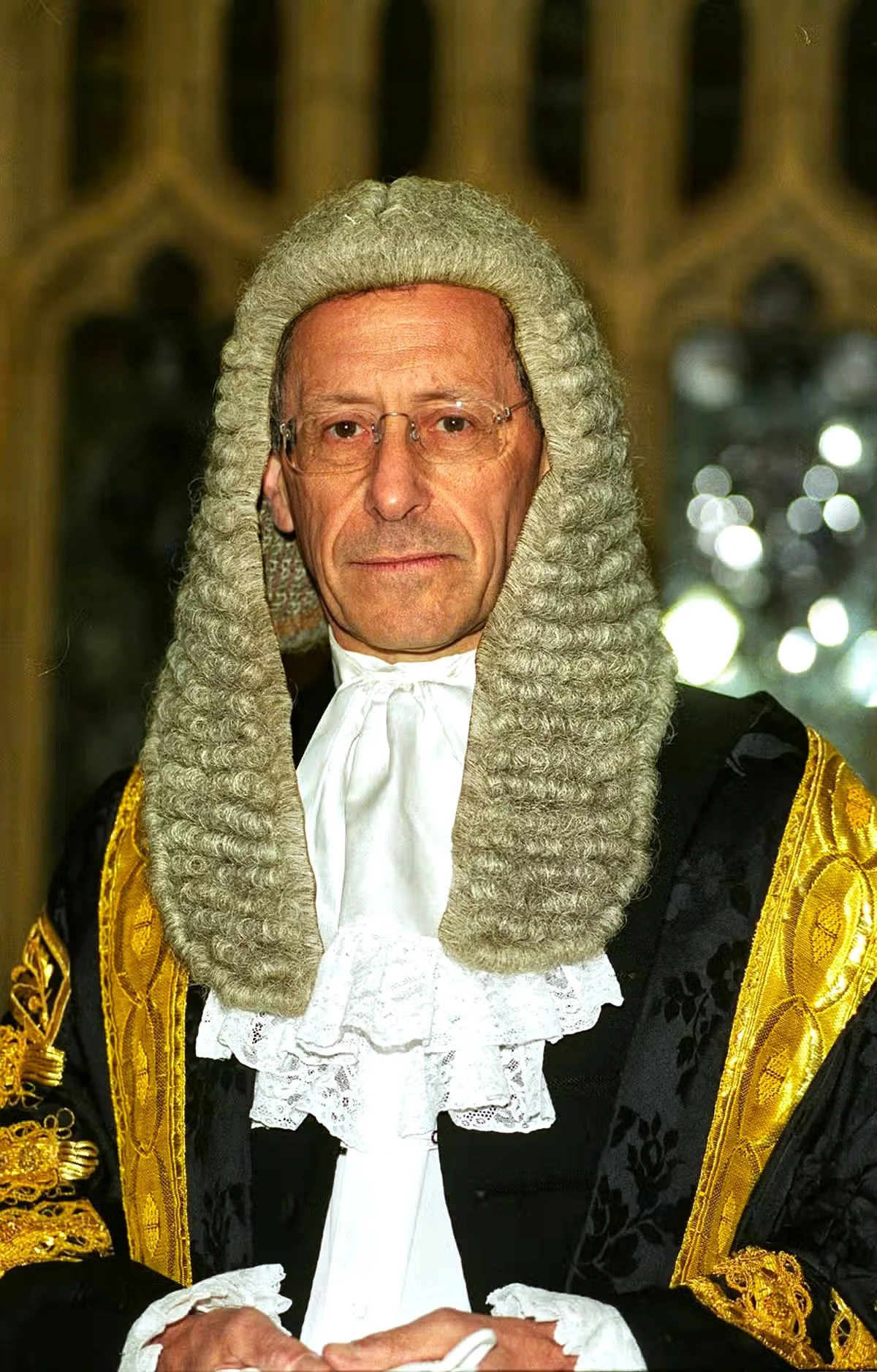
Lord Justice Stephen J. Sedley:
Free speech includes not only the inoffensive but the irritating, the contentious, the eccentric, the heretical, the unwelcome and the provocative provided it does not tend to provoke violence. Freedom only to speak inoffensively is not worth having.
— Redmond-Bate v DPP (1999)[19]
No officer in England has an excuse for not knowing this. So the problem is not ignorance of the law. It is a habit that has grown up beside the law. And on closer inspection, it rings suspiciously purposeful:
The arrest quiets the scene.
The investigation deters the speaker and every other speaker who watches the footage.
The case is quietly dropped before it can reach a court that would say what Sedley said.
This journal has argued elsewhere that in such cases the arrest is the sentence. The Watford Case adds a sadistic refinement:
The investigation is the sentence too. Seven months is a long time to live under the threat of a criminal charge for preaching the Gospel in a high street.
The ancient world knew a wiser magistrate than Hertfordshire has lately found. After the Sanhedrin had arrested the apostles for preaching and was minded to kill them, Gamaliel rose to advise restraint:
ἀπόστητε ἀπὸ τῶν ἀνθρώπων τούτων καὶ ἄφετε αὐτούς· ὅτι ἐὰν ᾖ ἐξ ἀνθρώπων ἡ βουλὴ αὕτη ἢ τὸ ἔργον τοῦτο, καταλυθήσεται, εἰ δὲ ἐκ θεοῦ ἐστιν, οὐ δυνήσεσθε καταλῦσαι αὐτούς, μήποτε καὶ θεομάχοι εὑρεθῆτε.
Refrain from these men, and let them alone: for if this counsel or this work be of men, it will come to nought: but if it be of God, ye cannot overthrow it; lest haply ye be found even to fight against God.
— Acts 5:38–39[20]
Gamaliel was not a believer. He was a Pharisee and a jurist, and his counsel is the counsel of prudence, not of faith. He knew that coercion is the wrong instrument for a contest of ideas: false teaching fails of itself, and true teaching cannot be suppressed by force…
That a first-century member of the Sanhedrin understood this and a twenty-first-century Constabulary in Hertfordshire does not is itself a commentary on our times.
The Fathers made the same point with greater force, because they wrote as the persecuted. Lactantius wrote under the last and worst of the persecutions:
Non est opus vi et iniuria, quia religio cogi non potest; verbis potius quam verberibus res agenda est, ut sit voluntas. … Nihil est enim tam voluntarium quam religio.
There is no need of force and injury, because religion cannot be compelled; the matter must be carried on by words rather than by blows, so that there may be free will. … For nothing is so much a matter of free will as religion.
— Lactantius, Divinae Institutiones 5.19.11, 23[21]
A generation later, Hilary of Poitiers wrote to an emperor who had begun to coerce bishops:
Deus cognitionem sui docuit potius quam exegit, et operationum caelestium admiratione praeceptis suis concilians auctoritatem, coactam confitendi se aspernatus est voluntatem.
God taught the knowledge of Himself rather than exacted it; winning authority for His precepts by the wonder of His heavenly works, He scorned a will that was forced to confess Him.
— Hilary of Poitiers, Liber I ad Constantium 6[22]
These texts cut in both directions, and a Christian must let them. Lactantius and Hilary forbid the State to handcuff a preacher for criticising Islam. They equally forbid a Christian to ask the State to handcuff a Muslim for criticising Christianity. The Council taught the same when it declared that religious communities have the right “not to be hindered in their public teaching and witness to their faith, whether by the spoken or by the written word.” It added that in spreading their faith they must refrain from anything carrying “a hint of coercion.”[23] A man singing hymns on a pavement coerces no one. Those who disliked him were free to walk on. The only coercion in Watford on 18 April was applied with handcuffs.
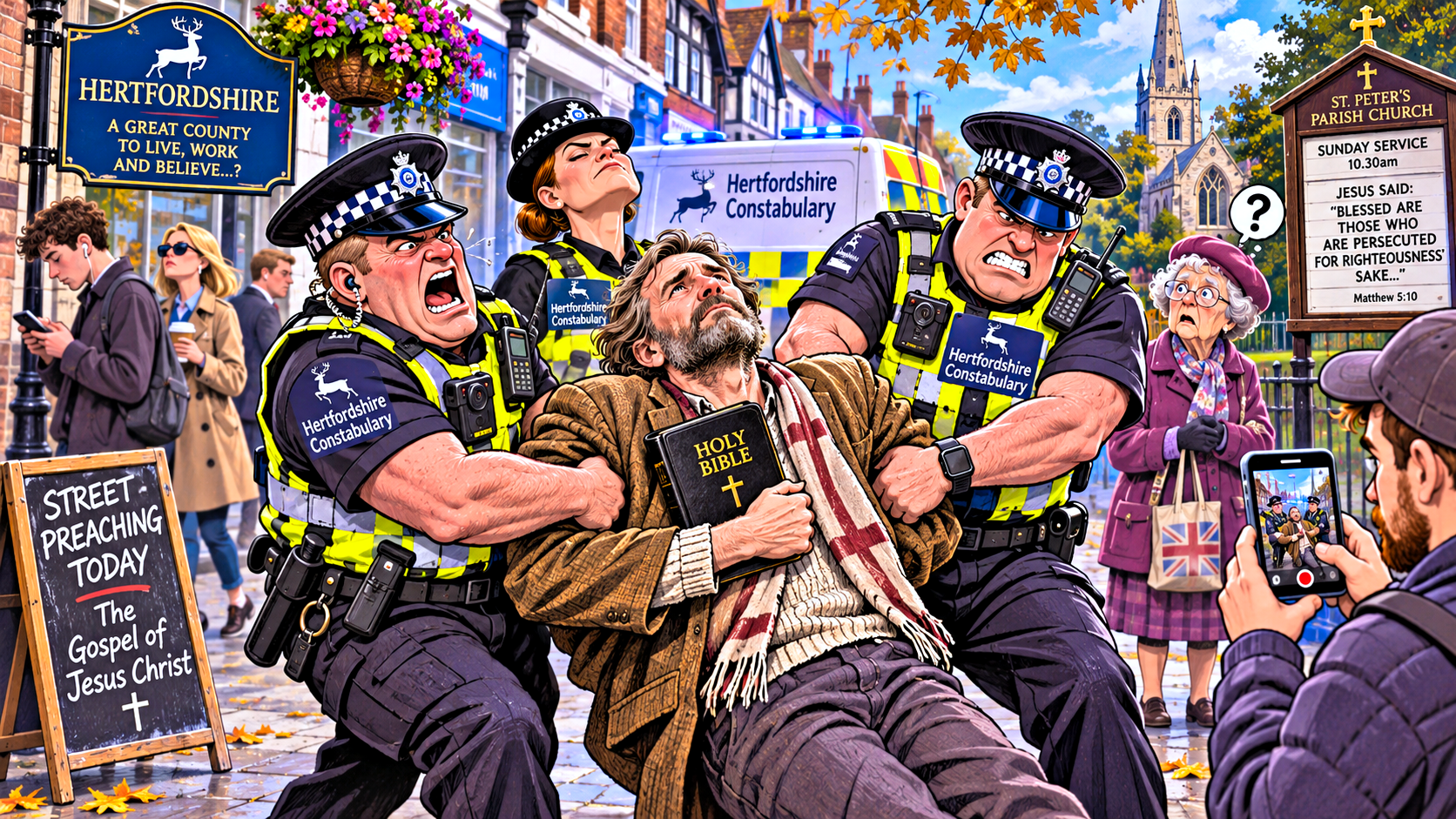
The only coercion in Watford on 18 April was applied with handcuffs.
V. The Arithmetic of a Hired Sword
Return now to the figures, and do the sums that the Home Office prefers not to do. Over five years there were 62,199 arrests: more than 34 every day. Fewer than three in ten of those arrested were charged, and fewer than one in five was convicted. That leaves 49,907 people arrested for something they said or wrote who were never convicted of anything. The rate also varies by police force. Cumbria arrested at 25.7 per ten thousand residents and neighbouring Northumbria at 1.9: roughly thirteen and a half times the rate, under the same statutes, in the same country, across a county boundary.[24]
Honesty again requires a concession, and it should be made without grudging. Some of those arrests were right. Threatening messages and campaigns of harassment, especially by abusive partners, are real wrongs. Big Brother Watch says so itself, and so did this journal in September. The twelve thousand convictions include genuine offenders. But a law enforced thirteen times more heavily on one side of a county line than the other is not being applied as law. It is being exercised as discretion. When four out of five arrests lead nowhere, the arrest has stopped being the first step towards judgment and has become a substitute for it.
Augustine has the sentence for this, and it is the most famous he ever wrote on politics:
Remota itaque iustitia quid sunt regna nisi magna latrocinia? quia et latrocinia quid sunt nisi parva regna?
Justice being taken away, then, what are kingdoms but great robberies? For what are robberies themselves, but little kingdoms?
— Augustine, De civitate Dei 4.4[25]
He follows it with a story. A captured pirate is brought before Alexander the Great, who asks him what he means by infesting the sea. The pirate answers: “What you mean by seizing the whole earth; but because I do it with a small ship, I am called a robber, while you, who do it with a great fleet, are called an emperor.” Augustine’s point must not be overstated. He does not say that every State is a band of robbers, and neither does this essay. His point is that what distinguishes the kingdom from the gang is justice, not size, uniform or official title. Apply the pirate’s logic to this week. A private citizen who pressed a company to delete a man’s words, having no right to demand it, would be called a bully. A private citizen who handcuffed a pensioner for an afternoon over words he was legally entitled to speak would be called something worse. Done by a Ministry, the first is called “close dialogue.” Done by a constabulary, the second is called an “operational decision.” The acts are no different. Only the fleet is larger.
VI. The Sovereignty of Offence
What unites the three scenes is not hostility to any one man or any one creed. It is a principle, and the principle is the real subject of this essay. The Ministry gave its ground plainly: the video was “distressing for victims.” The Watford pastor was arrested on the complaint of people offended by what he said. The communications offences behind the 62,199 arrests are framed around messages that are “grossly offensive” or meant to cause “distress or anxiety.” In each case, what may be said is measured by how it is received. The hearer’s distress has become the law.
This is where a Christian reader must be most careful, because the principle is attractive whenever it is aimed at someone he dislikes. Some who would be outraged by the arrest in Watford will cheer the request to Google, since the speaker in the second case is a convicted man and the hearers are his victims. But the principle that would delete the prisoner’s denial is exactly the principle that handcuffed the preacher. Distress was the stated ground in both. A Christian who applauds the request has already conceded the rule under which his own preachers are led away. Liberties are not held one speaker at a time. They are held by rule, or not at all.
None of this belittles the distress of victims. It is real, and the Church owes them more than the State does: her care, her presence and her prayer, and the plain acknowledgement that a court has found them wronged. But distress is a pastoral category, not a legal one. The law of Moses saw the danger of letting sympathy tilt judgment as clearly as it saw the danger of letting power tilt it:
לא תעשו עול במשפט לא תשא פני דל ולא תהדר פני גדול בצדק תשפט עמיתך
Ye shall do no unrighteousness in judgment: thou shalt not respect the person of the poor, nor honour the person of the mighty: but in righteousness shalt thou judge thy neighbour.
— Leviticus 19:15[26]
The poor and the mighty stand together in that verse. Judgment must not bend for the sympathetic any more than for the powerful, because a judgment that bends for either has stopped being judgment. The victims in the Brand case have already received what the law owes them: a verdict and a sentence. What the law does not owe them, and cannot give them without ceasing to be law, is a guarantee that they will never again hear the convicted man deny it.
VII. What a Democracy Is For
The Magisterium has never treated democracy as self-justifying. When it has praised democratic government, it has praised it on conditions. Pope John Paul II stated them in the year the Soviet empire fell:
Authentic democracy is possible only in a State ruled by law, and on the basis of a correct conception of the human person. … As history demonstrates, a democracy without values easily turns into open or thinly disguised totalitarianism.
— John Paul II, Centesimus annus 46[27]
The open kind of totalitarianism abolishes elections. The thinly disguised kind keeps them and governs between them by other means: by the request that cannot be refused, by the arrest that will never come to trial, by the complainant’s veto. Two paragraphs earlier the same encyclical defined the alternative. It is “the principle of the ‘rule of law,’ in which the law is sovereign, and not the arbitrary will of individuals.” Arbitrary will is exactly the right description of a request made without legal power, and of a statute enforced thirteen times more heavily in one county than in the next.
The Catechism goes further and lays a positive duty on the civil authority: “It is for the civil authorities to defend and safeguard a true and just freedom of information.” Pacem in terris counts among the natural rights of the person the freedom to search for the truth and, within the limits of the moral order and the common good, the freedom to speak and to publish.[28] The Church does not teach that this right is unlimited, as that qualifying clause makes plain, and this essay accepts the limit. But limits are to be set by law, publicly debated and applied by judges. They are not to be set by ministerial request or by the temperature of a crowd. The duty to safeguard freedom of information falls on the civil authorities. This week, the civil authority was the party trying to curtail it.
Behind the modern texts stands Augustine again. In the nineteenth book of the City of God he takes up Cicero’s definition of a people: a multitude “bound together by a common acknowledgement of right and by a community of interest” (iuris consensu et utilitatis communione sociatus). He presses it hard. Where there is no true justice, he says, there can be no common right, and so no people in Cicero’s sense at all.[29] A democracy is not merely a counting of heads. It is a people bound by a law that holds for all of them, and that law is what makes them one people. When pressure replaces that law, the people dissolves into constituencies. Each petitions the sovereign to silence the other, and the sovereign obliges whichever is louder that week. That is the deepest sense in which this week’s events are a prostitution of democracy. The people’s own authority has been hired out to its factions.
VIII. Four Objections
First: the request failed, so no harm was done. An attempt that fails is still an attempt, and the principle was conceded the moment it was made. The request failed for a reason that should alarm, not reassure: a corporation’s policy happened to be more liberal than a Ministry of the Crown. That is luck, not a constitution.
Second: the Ministry had a legitimate interest in prison discipline. Granted. If the prisoner broke the rules, the rules supply the remedy, and the remedy applies to him. Nothing in this essay argues against that inquiry. The objection is to the other act: a request aimed at the speech, not at the breach, with no law behind it.
Third: the Watford preacher said provocative things about Islam, and the police must keep the peace. They must. Redmond-Bate tells them how: protect the lawful speaker and restrain the violent hearer, rather than arresting the speaker to placate the hearer. Christians, for their part, should hold their own preachers to the apostolic rule: to give a reason for the hope that is in them “with meekness and fear” (μετὰ πραΰτητος καὶ φόβου).[30] If a preacher falls short of that, the remedy lies with the Church. It does not lie in the cells at Hatfield.
Fourth: speech can wound, and the Church herself condemns detraction and calumny. She does, and rightly.[31] But she names these as sins, to be confessed and repaired. She does not ask the magistrate to arrest them. The distinction between sin and crime was set out in this journal in September and need not be repeated. The State that forgets that distinction does not become more moral. It becomes more powerful, which is not the same thing.
IX. The City of Righteousness
Isaiah does not leave the faithful city in its harlotry. The same chapter that indicts it promises its restoration, and promises it in the same terms:
ואשיבה שפטיך כבראשנה ויעציך כבתחלה אחרי כן יקרא לך עיר הצדק קריה נאמנה
And I will restore thy judges as at the first, and thy counsellors as at the beginning: afterward thou shalt be called, The city of righteousness, the faithful city.
— Isaiah 1:26[32]
The restoration begins with judges. Whatever else it requires, fidelity is first restored to judgment. A Christian critique of this week’s events cannot stop at denunciation, and so this essay ends with three plain requests to those who hold civil office, and a word to the Church.
To ministers: where you have no power, do not counterfeit it by pressure. If you believe the law should allow the State to remove a prisoner’s lawful words from public view, then ask Parliament for that power, in public, and let it be debated in the light. A power you are ashamed to seek openly is one you should not exercise in private. The Prime Minister said he would not leap to changing the law, and he has it the wrong way round. An open change in the law is the only leap a lawful government is entitled to make. Pressure is the way of avoiding it.
To chief constables: charge or release. Arrest a man for his words only when the words themselves are a crime on any reasonable reading of the statute and of Redmond-Bate. When you are wrong, as you were in Watford, apologise. A pastor who spent three weeks in wrist splints for preaching in a high street is owed an apology, not a conduct review that exonerates the officers.
To Parliament: the provisions that turn offence and distress into criminal categories have produced 62,199 arrests and fewer than one conviction in five, enforced with a thirteenfold variation between neighbouring counties. A law that behaves like that is not doing the work of law. Amend it until it can be applied as law, equally and predictably, or repeal it.
To the Church, finally, the reminder that the word entrusted to her has never depended on the magistrate’s leave. The Apostle wrote it while held in chains as a malefactor:
ἐν ᾧ κακοπαθῶ μέχρι δεσμῶν ὡς κακοῦργος, ἀλλ’ ὁ λόγος τοῦ θεοῦ οὐ δέδεται.
Wherein I suffer trouble, as an evil doer, even unto bonds; but the word of God is not bound.
— 2 Timothy 2:9[33]
The principle of that verse is not that every prisoner is innocent. Paul does not claim it, and neither does this essay. The principle is that chains are made for bodies. Power may bind a man, and sometimes rightly. It has never yet succeeded in putting a thought behind bars, and a democracy that tries has forgotten what it was for. The faithful city was full of judgment. It can be again, but only when its princes remember that they were set over it to judge, not to be obeyed for their own sake.🟥
[1]“UK Government Asks YouTube to Remove Russell Brand’s Innocence Claim Video,” New Zealand Herald, 20 November 2026; “UK PM Andy Burnham Urges Google to Show ‘Decency’ and Remove Russell Brand Video,” ABC News (Australia), 20 November 2026. Mr Pennycook’s words were spoken on BBC Breakfast and are reported in both.
[2]Cam Wakefield, “UK Minister Asked Google to Remove Russell Brand’s Channel,” Todayville, 20 November 2026, reporting Sky News. The other reports speak of a request to remove the video only. The claim that the channel itself was named in a request rests on the Sky report. On 19 November the Prime Minister’s spokesman was asked whether YouTube should close the channel. He did not say no: “The public have heard enough from Russell Brand. His victims now deserve peace from him,” adding that “we hope and trust YouTube will do the right thing.” See “Google Refuses Government Request to Remove Russell Brand YouTube Video,” Yahoo News UK, 19 November 2026. That is neither a request in terms nor a refusal, and it should not be presented as either.
[3]“Google Declines to Remove Russell Brand’s Prison Video Statement,” Washington Times, 19 November 2026; “Google Says It’s Investigating Russell Brand YouTube Video,” Hollywood Reporter, 20 November 2026, citing BBC News. Google’s statement read: “We are aware of the new content and our teams are investigating.” The same reports note that the Ministry of Justice has opened an inquiry into whether the statement breached prison rules on public statements by prisoners.
[4]“UK PM Andy Burnham Urges Google to Show ‘Decency’ and Remove Russell Brand Video,” ABC News (Australia), 20 November 2026. The report does not record that the Prime Minister himself asked for the channel to be closed. His public words concern the video and “these interviews.”
[5]“Street Preacher Arrested in Watford,” Christian Today, 20 April 2026, quoting Hertfordshire Constabulary: the man was arrested on suspicion of assault and of a section 5 public order offence (racially or religiously aggravated), and “no further action is being taken in relation to the assault.” The allegation, as later reported, concerned a teenager; Pastor Maile denied it from the first.
[6]Free Speech Union, “Police Drop Case against Watford Pastor Arrested after Criticising Islam,” 17 November 2026; “Police Drop Case against Street Preacher Who Criticised Islam,” Christian Today, 17 November 2026. The account of the handcuffing, the injury and the officer’s words is taken from the Free Speech Union report and the footage it describes. The police spokesman’s statement, which gives the Crown Prosecution Service’s decision as no further action “at this time,” is quoted in Christian Today.
[7]Big Brother Watch, report on arrests for communications offences, September 2026, summarised in Free Speech Union, “More than 62,000 People Have Been Arrested for ‘Speech Offences’ over the Last Five Years,” 7 September 2026. The figures were obtained by Freedom of Information requests to police forces and cover 2021–2025. One press summary gives the charged figure as 18,150; the Free Speech Union and most others give 18,510, which is used here. Nothing in the argument turns on the difference.
[8]G. V. W. Lewis, Nineteen in Twenty: On Burglars, Blasphemers, Keyboard Warriors, and What the Law Is Actually For, Mind the Limoges (crshj.org), 7 September 2026; idem, No Further Action: On Arrest as Sentence, the Complainant’s Veto, and a State That Has Learned to Punish Without Convicting, Mind the Limoges, 20 September 2026. The arguments from Romans 13, from Aquinas on law ad bonum commune, from Tertullian’s Apologeticum and from the canonical protection of the accused’s good name are made there and are not repeated here.
[9]Isa 1:21. Hebrew from Biblia Hebraica Stuttgartensia, ed. K. Elliger and W. Rudolph, 5th ed. (Stuttgart: Deutsche Bibelgesellschaft, 1997), given unpointed; Latin from Biblia Sacra iuxta Vulgatam Versionem, ed. R. Weber and R. Gryson, 5th ed. (Stuttgart: Deutsche Bibelgesellschaft, 2007); English from the Authorised Version, as throughout this essay.
[10]Isa 1:23 (AV). The Vulgate renders the princes as infideles, “faithless,” which keeps the prophet’s thread: the infidelity of verse 21 is the infidelity of the rulers in verse 23.
[11]Human Rights Act 1998, s. 6(1); Convention for the Protection of Human Rights and Fundamental Freedoms, art. 10(1)–(2).
[12]Handyside v. United Kingdom, no. 5493/72, § 49, Series A no. 24 (ECtHR, 7 December 1976).
[13]National Rifle Association of America v. Vullo, 602 U.S. 175 (2024); Bantam Books, Inc. v. Sullivan, 372 U.S. 58 (1963). In Vullo the Court held unanimously that a government official may not coerce a private party into punishing or suppressing disfavoured speech on her behalf. The American test turns on coercion, and an open request may well fall short of it. The British request should be judged honestly by that standard. Its fault lies less in any proven coercion than in the absence of any lawful footing at all.
[14]Criminal Appeal Act 1995, pt. II; R v Malkinson [2023] EWCA Crim 954; Post Office (Horizon System) Offences Act 2024.
[15]John 18:23. Greek from Nestle-Aland, Novum Testamentum Graece, 28th ed. (Stuttgart: Deutsche Bibelgesellschaft, 2012), as for all Greek New Testament citations in this essay.
[16]Augustine, In Iohannis Evangelium Tractatus 113.4, ed. R. Willems, CCSL 36 (Turnhout: Brepols, 1954). Augustine raises the objection that the Lord did not literally turn the other cheek. He answers that the precept governs the readiness of the heart, and that this readiness Christ showed by giving his whole body to the Cross. The answer he gave the officer was truth, not retaliation.
[17]John 7:51.
[18]Public Order Act 1986, s. 5; Crime and Disorder Act 1998, s. 31(1)(c).
[19]Redmond-Bate v Director of Public Prosecutions (1999) 163 JP 789, [2000] HRLR 249 (DC), per Sedley LJ. The appellant was one of three women preaching from the steps of Wakefield Cathedral, arrested when a crowd grew hostile. The court held that the police had no lawful ground to require her to stop.
[20]Acts 5:38–39.
[21]Lactantius, Divinae Institutiones 5.19.11, 23, ed. S. Brandt, CSEL 19 (Vienna: Tempsky, 1890); cf. P. Monat, ed., Lactance: Institutions divines, livre V, SC 204–205 (Paris: Cerf, 1973).
[22]Hilary of Poitiers, Liber I ad Constantium 6, ed. A. Feder, CSEL 65 (Vienna: Tempsky, 1916). The text’s place in Hilary’s corpus is disputed. Feder prints it among the historical fragments, and it may be composite. The sentence is nonetheless securely Hilarian in its tradition, and is cited here as such, not as a freestanding treatise.
[23]Second Vatican Council, Declaration Dignitatis humanae (7 December 1965), §§ 2, 4, AAS 58 (1966): 929–46; DzH 4240–45.
[24]Computed from the Big Brother Watch figures cited in section I: 18,510 ÷ 62,199 = 29.8 per cent charged; 12,292 ÷ 62,199 = 19.8 per cent convicted; 62,199 − 12,292 = 49,907 not convicted; 62,199 arrests over 1,826 days = 34.1 per day. The Cumbria and Northumbria rates (25.7 and 1.9 arrests per 10,000 residents over the period) are those reported from the same study; 25.7 ÷ 1.9 = 13.5.
[25]Augustine, De civitate Dei 4.4, ed. B. Dombart and A. Kalb, CCSL 47 (Turnhout: Brepols, 1955).
[26]Lev 19:15. Hebrew from BHS, unpointed.
[27]John Paul II, Encyclical Letter Centesimus annus (1 May 1991), §§ 44, 46, AAS 83 (1991): 793–867. English from the Vatican translation.
[28]Catechism of the Catholic Church, 2nd ed. (Vatican City: Libreria Editrice Vaticana, 1997), § 2498; John XXIII, Encyclical Letter Pacem in terris (11 April 1963), § 12, AAS 55 (1963): 257–304.
[29]Augustine, De civitate Dei 19.21, ed. B. Dombart and A. Kalb, CCSL 48 (Turnhout: Brepols, 1955), taking up Cicero’s definition from De re publica 1.25.39 by way of De civitate Dei 2.21.
[30]1 Pet 3:15–16.
[31]Catechism of the Catholic Church, §§ 2477–79, on rash judgement, detraction and calumny.
[32]Isa 1:26. Hebrew from BHS, unpointed.
[33]2 Tim 2:9.