
I Sent You a Boat
Providence, Secondary Causes, and the Duty of Means
I
A Parable and Its Two Uses
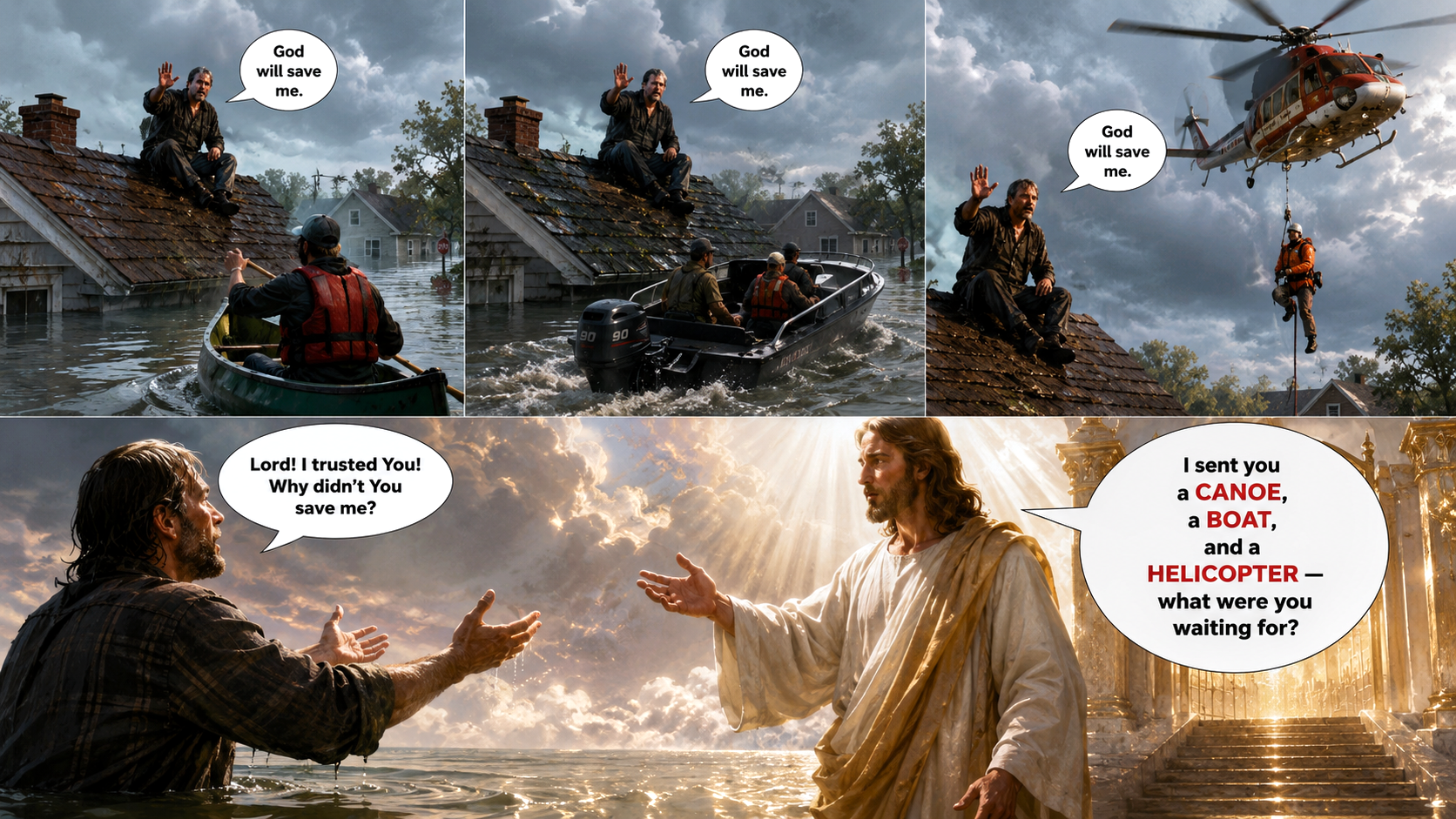
The story is told in every pulpit and half the pubs of Christendom, and it needs no introduction to anyone who has sat through a homily on trust. A flood comes. A man climbs onto the roof of his house and prays. A neighbour rows past in a canoe and offers to take him off; he declines, saying that God will save him. The water rises; a motorboat comes; he declines again. The water rises further; a helicopter lowers a line; he waves it away. He drowns. Presented at last before the throne of God, he asks, with some justice as he sees it, why his faith was not rewarded. And the answer comes: I sent you a canoe, a motorboat, and a helicopter. What exactly were you waiting for?
It circulates as a joke, and jokes are a species of folk-theology: they work because they detonate a confusion the hearer is already half-carrying. The confusion here is worth naming precisely, because a great deal of real Christian life is disordered by it — sometimes disastrously, in matters of health, money, marriage, and the government of communities. It is the belief that trust in God is measured by the refusal of secondary causes; that piety is a kind of purity of dependence, and that every instrument accepted is a portion of confidence withheld.
But the parable, left to itself, is theologically underdetermined, and this is the first thing a preacher who uses it ought to notice. Two men can laugh at it for opposite reasons. The believer laughs because he recognises the canoe as a gift of providence and the refusal as a species of ingratitude dressed up as devotion. The unbeliever laughs because, on his reading, the story shows that there is no rescue but the boat, that God is simply the name we give to the aggregate of available resources, and that the pious man drowned of a metaphysical error. The joke is identical; the theology is not. Its Christian use therefore requires more than the joke itself supplies, and the burden of what follows is to supply it.
A second caution. The moral most people extract from the story is the proverb: “God helps those who help themselves”. That proverb is not Scripture. It is not in Scripture in any form, and its ancestry is pagan: Aeschylus has it that the god is fond of joining his effort to the man who labours[1], and the sentiment travels through Sophocles, through Varro's dii facientes adiuvant, into Sidney and Franklin and thence into the English-speaking pulpit, where it is now widely believed to be a verse.
The pagan proverb and the Christian doctrine are not the same claim, and the difference is not decorative. The proverb makes divine assistance the wage of a prior, unassisted human initiative: bestir yourself, and heaven will match your contribution. The Christian doctrine reverses the order of dependence entirely. The bestirring is itself already the effect of grace. St Paul's formula is not work, and God will help, but work, because God is the one working in you — and the whole weight of this essay rests on that little causal conjunction. So we are not, in the end, defending the proverb. We are rescuing the parable's truth from the proverb's error, which is a different and more delicate operation than it looks.
II
The Pinnacle of the Temple
The decisive text is not, as one might expect, a wisdom saying about diligence. It is the second temptation in Matthew's ordering, and it is the closest thing in Scripture to a direct treatment of our man on the roof.
Τότε παραλαμβάνει αὐτὸν ὁ διάβολος εἰς τὴν ἁγίαν πόλιν καὶ ἔστησεν αὐτὸν ἐπὶ τὸ πτερύγιον τοῦ ἱεροῦ,
καὶ λέγει αὐτῷ· Εἰ υἱὸς εἶ τοῦ θεοῦ, βάλε σεαυτὸν κάτω· γέγραπται γὰρ ὅτι Τοῖς ἀγγέλοις αὐτοῦ ἐντελεῖται
περὶ σοῦ καὶ ἐπὶ χειρῶν ἀροῦσίν σε, μήποτε προσκόψῃς πρὸς λίθον τὸν πόδα σου.
ἔφη αὐτῷ ὁ Ἰησοῦς· Πάλιν γέγραπται· Οὐκ ἐκπειράσεις κύριον τὸν θεόν σου.Then the devil takes him with him into the holy city, and set him on the pinnacle of the temple, and says to him:
"If you are the Son of God, throw yourself down; for it is written, 'He will give his angels charge
concerning you, and on their hands they will bear you up, lest you strike your foot against a stone.'
" Jesus said to him: "Again it is written, 'You shall not put the Lord your God to the test.'"Mt 4:5–7 (NA28)
Observe what the tempter is doing. He is not proposing unbelief. He is proposing a superlative act of faith, and he is proposing it from Scripture, quoting the great providence-psalm. The proposal is that the Son of God should demonstrate his confidence in the Father by declining the stairs. There are stairs down from the pinnacle of the Temple. The stairs are the canoe.
And there is a detail in the quotation that has long been noticed and is worth pressing. The psalm as it stands in the Greek reads that he will command his angels concerning you to guard you in all your ways — τοῦ διαφυλάξαι σε ἐν πάσαις ταῖς ὁδοῖς σου. Matthew's devil omits both the infinitive and the qualifying clause; Luke's retains the infinitive but likewise drops in all your ways.[2]
The temptation to make too much of this is real, and it should be resisted at least partly. Abbreviated citation is ordinary in first-century usage, and Luke's partial retention makes it awkward to argue that the truncation is a deliberate satanic falsification agreed on by two evangelists independently. A commentator who tells you that the devil has been caught doctoring the text has overclaimed. But the substance of the observation survives the loss of the rhetorical flourish, because the psalm's own logic is unchanged whether the clause is quoted or not: the guardianship promised is guardianship along the ways one walks. The psalm addresses the man travelling a road, and promises that on that road he will not be abandoned. It does not address, and does not promise anything to, the man who has invented a way that no one walks in order to see whether the promise holds. That is not a road. That is a leap.
Our Lord's answer does not dispute the psalm. It cites Deuteronomy, and it cites the one text in the Torah that names this precise sin:
Οὐκ ἐκπειράσεις κύριον τὸν θεόν σου, ὃν τρόπον ἐξεπειράσασθε ἐν τῷ Πειρασμῷ.
You shall not put the Lord your God to the test,
in the way you put him to the test at Testing.Dt 6:16 LXX
The reference is to Massah, where Israel, thirsty at Rephidim, demanded water on terms of its own setting and framed the demand as a question about God's presence: Is the Lord among us or not?[3] The verb ἐκπειράζειν is the intensive: not to be tested by God, which is the ordinary condition of the faithful, but to put God to the proof, to construct a situation in which he must either act or be shown not to exist. This is the reason the sin is so easily mistaken for its opposite. Presumption wears the costume of trust. It speaks the language of trust fluently. It quotes the psalms of trust. What distinguishes it is that it takes the promise out of God's hands and puts it into a test of the creature's devising.
St Thomas gives the analysis its cleanest form when he treats tentatio Dei among the vices opposed to religion: one tempts God when one does or omits something in order that the divine power should be put to the trial without necessity, and among the ways of doing so he lists precisely the omission of the means that lie to hand while expecting the effect.[4] The man on the roof is standing on the pinnacle of the Temple. He has the psalm; he believes the psalm; and he has mistaken his belief in God's promise for a licence to dictate its execution.
III
Unless These Men Remain in the Ship
If the temptation narrative gives the negative rule, the twenty-seventh chapter of Acts gives the positive pattern, and it does so with an economy that no argument of mine will improve on. Paul, prisoner aboard a grain ship driven fourteen days across the Adria, receives an explicit revelation and announces it to the ship's company: there will be no loss of life, only of the vessel, for an angel of the God whose he is and whom he serves has stood by him in the night. He then adds the sentence that ought to be engraved over the door of every sacristy: I believe God, that it shall be even as it was told me.[5]
Nothing could be more absolute. The promise is unconditional in form, divinely given, publicly proclaimed, and staked on the apostle's credit before a hostile audience of soldiers and sailors. And then, a few verses later, the same apostle, holding the same promise, sees the crew lowering the ship's boat under pretence of laying out anchors from the bow, and says to the centurion and the soldiers:
Ἐὰν μὴ οὗτοι μείνωσιν ἐν τῷ πλοίῳ, ὑμεῖς σωθῆναι οὐ δύνασθε.
Unless these men remain in the ship, you cannot be saved.
Acts 27:31 (NA28)
Unless these men remain in the ship, you cannot be saved. The soldiers cut the ropes and let the boat fall away. Shortly after, Paul urges them all to take food, because it is for their σωτηρία, and he breaks bread and gives thanks in the sight of them all, and they are encouraged and eat.[6]
Here is a divine promise of universal survival, and here, within the same episode and on the same lips, is a set of strictly necessary human conditions: the sailors must stay aboard, the passengers must eat, the swimmers must swim and the rest must float in on planks and wreckage. Luke betrays no consciousness whatever that these two things stand in tension. He does not argue for their compatibility. He does not pause to reconcile them. He narrates them as one continuous piece of good sense, which is the most eloquent testimony possible to how obvious the compatibility seemed to the primitive Church.
It is worth adding, since the point does real work, that the text here is not in dispute. Chapter 27 contains one celebrated variant — the ship's company numbered two hundred and seventy-six in most witnesses, but about seventy-six in Vaticanus and the Sahidic — and it touches nothing in the argument.[7] Verse 31 stands unchallenged. Whatever else is uncertain in this chapter, the sentence doing the theological work is not.
Chrysostom, preaching through Acts, presses exactly this point: the promise did not render the seamanship idle, and Paul's confidence in the angel's word did not prevent his taking a firm hand in the management of the vessel.[8] A candid reader will grant that Luke is telling a sea-story and not composing a treatise on concurrence, and that we should not extract from narrative a precision it does not offer. But the pattern is not a one-off, and it is to its recurrence in the didactic material that we now turn.
IV
The Grammar of Cooperation
The Pauline formulation that governs the whole question is at Philippians 2, and everything depends on a conjunction:
…μετὰ φόβου καὶ τρόμου τὴν ἑαυτῶν σωτηρίαν κατεργάζεσθε·
θεὸς γάρ ἐστιν ὁ ἐνεργῶν ἐν ὑμῖν καὶ τὸ θέλειν καὶ τὸ ἐνεργεῖν ὑπὲρ τῆς εὐδοκίας.…work out your own salvation with fear and trembling; for God is the one
working in you both the willing and the working, for the sake of his good pleasure.Phil 2:12b–13 (NA28)
Work out your own salvation with fear and trembling — for God is the one working in you both the willing and the working, for his good pleasure. Not but. Not and yet. The γάρ makes divine agency the reason for human exertion rather than a limit upon it, and it does so at the most intimate point available, the θέλειν, the willing itself. Paul is not dividing a task into a divine and a human share. He is saying that the whole of the human share is itself divinely worked, and that this is precisely why one had better get on with it.
This is the death of the pagan proverb. On the proverb's logic, if God is doing the willing then my exertion is redundant; the two agencies compete for the same territory, and whatever is credited to one is debited from the other. Paul's logic runs the other way. He repeats it, autobiographically, at 1 Corinthians 15:10 — he laboured more than all of them, yet not I, but the grace of God which is with me. The sentence does not withdraw the labour. It reassigns its subject without cancelling its reality.[9]
A word of restraint is owed here, since this is the point at which enthusiasts overreach. It is often said that Paul calls us God's fellow-workers, and 1 Corinthians 3:9 is produced: θεοῦ γάρ ἐσμεν συνεργοί. But the genitive θεοῦ is ambiguous, and the context — I planted, Apollos watered, but God was giving the growth — tells against the strongly synergistic construal. Paul's emphasis in that passage is that the planter and the waterer are nothing, and the whole efficacy lies with the God who gives increase; συνεργοί may as easily mean fellow-workers belonging to God, that is, colleagues of one another in God's field, as fellow-workers with God.[10] I would not build on that verse, and a reader who has been told that it settles the matter has been told something the Greek does not deliver.
There is, finally, a New Testament community that provides the closest available analogue to the man on the roof. At Thessalonica certain members were living ἀτάκτως, out of rank, refusing to work; and whatever the precise cause, their disorder is bound up in the letter with an overheated expectation of the Lord's imminent action. Paul's response is not to correct their eschatology in the first instance but to issue a command: if anyone will not work, neither let him eat.[11] The confidence that the decisive divine act is at hand had made ordinary means appear beneath a Christian. It is the roof, transposed.
V
Honour the Physician
Nowhere is the question more practically urgent, then or now, than in sickness, and here Scripture is unembarrassed. The thirty-eighth chapter of Sirach is the locus classicus, and it is worth quoting because its structure is exactly the structure we are after:
Τίμα ἰατρὸν πρὸς τὰς χρείας αὐτοῦ τιμαῖς αὐτοῦ, καὶ γὰρ αὐτὸν ἔκτισεν κύριος· […]
κύριος ἔκτισεν ἐκ γῆς φάρμακα, καὶ ἀνὴρ φρόνιμος οὐ προσοχθιεῖ αὐτοῖς. […]
καὶ ἰατρῷ δὸς τόπον, καὶ γὰρ αὐτὸν ἔκτισεν κύριος, καὶ μὴ ἀποστήτω σου, καὶ γὰρ αὐτοῦ χρεία.Honour the physician according to your need of him, with the honours due to him,
for the Lord also created him. […] The Lord created medicines out of the earth, and a prudent
man will not despise them. […] And give place to the physician, for the Lord also created him;
and let him not leave you, for you have need of him.Sir 38:1, 4, 12 (Rahlfs–Hanhart)
Honour the physician, for the Lord created him. The refrain is the argument: the causal chain does not terminate in the apothecary but passes through him. And the same chapter, without a flicker of inconsistency, instructs the sick man to pray, to turn from his faults, and to make his offering — and then to give place to the physician. Both, and in that order, and with no sense that the second qualifies the first.[12]
St Basil takes up the question directly in the Longer Rules, asking whether recourse to medicine is consonant with the profession of piety, and his answer is a model of the balance this essay is trying to keep. The arts are given by God as a remedy for our weakness, an image in the body of what grace performs in the soul, and to refuse them wholesale is not faith but ingratitude. Yet he refuses with equal firmness to let medicine become the whole of a Christian's hope, and he insists that some afflictions are sent for correction, in which case the proper remedy is repentance and not a poultice.[13] Basil is not a naturalist with a mitre. He is doing the harder thing: holding that the means are genuinely God's gift and that they are not God.
And it must be said, lest the whole argument degenerate into a defence of prudent self-interest, that when the Church actually applied this doctrine under pressure she applied it in a direction no prudence would have chosen. In the plague at Carthage, Cyprian's answer to the epidemic was not flight but organised nursing of the sick, the Christian and the pagan alike; and Dionysius of Alexandria's paschal letter, preserved by Eusebius, describes the presbyters and deacons of his city drawing the contagion onto themselves in the course of tending others, and dying of it in numbers.[14] The duty of means is not the duty of self-preservation. These men used every instrument available and used it to die. That is the shape of the doctrine when it is under load, and it should be enough to acquit it of the charge of being merely sensible.
VI
Two Causes, Not Two Candidates
Why should any of this be so? The underlying metaphysics is worth stating plainly, because the confusion in the parable is at bottom a confusion about causality, and no amount of proof-texting will cure it if the underlying picture remains competitive.
Augustine supplies the anthropological half in a sentence from a sermon on the Nativity of John, so often quoted and so rarely placed: qui ergo fecit te sine te, non te iustificat sine te — he who made you without you does not justify you without you.[15] The point of the sentence is a distinction between two orders. In creation there is no creature to cooperate, and so no cooperation. In justification there is, and God does not bypass what he has made. The refusal of the canoe is a small attempt to reimpose the conditions of creation upon the order of governance — to be dealt with as though one were not there.
Augustine supplies the cosmological half as well, in a formula from the Contra Faustum that has never been bettered: a miracle happens not contrary to nature but contrary to what is known to us of nature.[16] The consequence is the one we need. Nature's ordinary course is not the region of God's absence, against which the miracle stands out as the region of his presence. Both are his governance; one is habitual and one is not. To insist on the extraordinary as the only real evidence of divine care is not high faith. It is a low doctrine of creation.
The Greek Fathers press the same conclusion pastorally rather than metaphysically, and Chrysostom above all. His homilies return incessantly to the pairing of our σπουδή and προθυμία with the inclination from above: when we contribute what is ours, then God lavishes what is his.[17]
Honesty requires the immediate admission that this language became a serious problem. Read through Latin spectacles after Carthage and Orange, the Chrysostomic formula sounds as though grace were the response to an unaided human initiative — which is precisely the position that the Second Council of Orange condemned in 529, defining that the very beginning of faith and the increase of it are themselves the gift of grace and not the reward of nature.[18]
The usual reconciliation — that the Greeks are describing the phenomenology of effort as it is experienced from within, while the Latins are analysing the causal order of grace — is, I think, substantially right. But it is a systematising move made largely in retrospect, by men with a controversy in front of them that Chrysostom did not have, and it should be conceded that a fair number of individual sentences in the Antiochene tradition resist it. The reader who wants a patristic consensus delivered whole on this point is going to be disappointed by the sources, and it is better to say so than to iron the corpus flat.
The settlement, when it comes, is Thomistic and it turns on refusing the competitive picture altogether. God's providence is executed through secondary causes, and the created cause is real because God is not one agent among others contending for a share of the work; the divine and the creaturely causality operate at different levels and are therefore not in a zero-sum relation. Hence the great line of the Contra Gentiles: to take away the proper actions of things is to derogate from the divine goodness.[19]
That sentence is the answer to the man on the roof, and it is sharper than the joke. His error is not merely imprudence. It is an insult to the giver, disguised as a compliment. He supposes he honours God by emptying the creature of its own operation, when in fact the creature's own operation is the very thing God's goodness has conferred. God and the boat are not two candidates for the same job.
VII
Where the Evidence Runs Thin
A polemic is only worth as much as the counter-evidence it is willing to state at full strength, and there is more of it here than the confident preacher of this parable usually lets on:
First, and most obviously, Scripture contains deliverances without means. The angel of the Lord strikes the camp of Sennacherib and Jerusalem is saved by nobody's exertion; the chains fall from Peter's wrists and the iron gate opens of its own accord.[20] The thesis of this essay is therefore not that God never acts immediately, which would be a rationalism and would in any case be refuted by the Resurrection. It is that He ordinarily governs through causes, and that the disposal of the exception belongs to him and not to us. The whole difference between faith and presumption lies in who is holding the timetable.
Second, there is at least one text in which the means are not merely permitted to be dispensed with but are explicitly suspended by prophetic word. Before the Ammonite and Moabite coalition, Jahaziel tells Jehoshaphat that the battle is God's and that Judah will not need to fight it: stand still and see.[21] This is the hardest counter-instance, and the honest answer is a distinction that is easier to state than to apply: a revealed word may suspend an ordinary obligation, and where such a word is genuinely given, the obligation is suspended. What may not be done is to manufacture the word out of one's own confidence and then act as though it had been given. I do not pretend that this distinction removes the difficulty of discernment in a hard case. It does not. It locates it.
Third, and most awkwardly for anyone claiming patristic unanimity, the Fathers themselves disagreed about whether taking the boat is faithlessness — and they disagreed in the highest-stakes case available to them. Tertullian argued in De fuga in persecutione that flight from persecution is a refusal of the divine will, since nothing befalls the Christian without the Father's permission and to run is to attempt an escape from providence itself. Cyprian fled, and had to defend it. Athanasius fled repeatedly, and wrote an entire apology for the practice, appealing to the dominical instruction to flee to the next city and to the conduct of the saints.[22] This is not a case where one side is obviously eccentric. It is a genuine and unresolved disagreement about the very question we are treating, and it should be reported as one.
Fourth, there is a psalm that in the wrong hands is the roof-man's charter: unless the Lord build the house, they labour in vain that build it. It must not be softened. But neither should it be misread: the psalm does not counsel against building. It presupposes the builders, and declares their labour vain apart from the Lord — which is a judgement on the labour's sufficiency, not a dispensation from it.[23]
Fifth, a text that is regularly conscripted into this argument and should be discharged from it. James on faith without works is not addressing the prudential use of created means at all.His question is whether a faith that produces nothing is faith in any sense the word will bear — a question about the form and evidence of faith, not about canoes.[24] The two questions overlap; they are not the same; and borrowing James's rhetorical force for an argument he was not making is the kind of thing that makes careful readers distrust the rest of one's case.
Sixth and last, the parable's own limits. Pressed into service as a complete theology, the story of the flood produces a deism — a world in which God is the name for the sum of available resources and never acts at all, and in which the pious fool drowned of nothing worse than bad engineering. That is not the doctrine of providence; it is its counterfeit, and the counterfeit is at present far commoner in the developed West than the error the joke was written to correct. The theological virtue of hope is destroyed from two directions: presumption expects from God what he has not promised, and in a manner he has not appointed; despair expects nothing at all.[25] The man on the roof sins by presumption. The man who is certain that the helicopter is the only thing in the sky has made the opposite error, and our own generation is not in much danger of the first.
VIII
Anxiety Is Not Foresight
One objection remains, and it comes from the Lord's own mouth. Do not be anxious for your life, what you shall eat; consider the birds, who neither sow nor reap nor gather into barns; do not be anxious about tomorrow. Is this not a straightforward prohibition of exactly the forethought we have been commending?
It is not, and the vocabulary shows why. The verb is μεριμνάω, whose sense is the divided, corroding care that fractures the mind — the same word Luke uses of Martha, distracted about many things, and Paul of the man divided between the Lord and his wife.[26] What is forbidden is a disposition of the heart, not the exercise of foresight. And the birds themselves make the point: they do not sow, but they are not idle. They forage from dawn. The comparison is not between labour and indolence; it is between a creature who works within a providence it trusts and a creature who works as though the outcome rested on the work.
Nor is this an argument from silence. The apostolic band kept a common purse, and kept it badly enough that its custodian could steal from it; the Lord instructs a man contemplating a tower to sit down first and count the cost, and a king contemplating a war to take advice about numbers; the sluggard is sent to the ant, who has no ruler and yet provides her food in the summer; and the proverb that comes closest of all to our subject sets the two clauses side by side without a seam — the horse is made ready for the day of battle, and the victory is the Lord's.[27] St Thomas is accordingly able to ask whether solicitude for temporal things is lawful and to answer that it is, provided the order of ends is kept: what is unlawful is not foresight but the inversion in which temporal provision becomes the terminus of one's care.[28]
IX
The Logic of Mediation
All of this could be established, and something important would still be missing, because it would all remain at the level of prudence. The deepest reason the man on the roof is wrong is not that he has miscalculated. It is that he has repudiated, in a small and domestic instance, the entire logic on which his salvation rests.
For God did not save the world by an unmediated fiat from heaven. He saved it through a Galilean girl's consent, a womb, nine months, a body, a road, wood, iron, and a tomb cut in rock. When the moment came for the decisive divine act in history, the Almighty sent an angel to ask a creature's permission, and waited for the answer: γένοιτό μοι κατὰ τὸ ῥῆμά σου.[29] And the economy he established afterwards is of a piece with it: water, oil, bread, wine, a hand laid on a head, a word spoken by a man who is himself no more than an instrument. The Church has never been able to obtain grace neat. She has always had to take it through something.
So the man who will not get into the boat because he wants God without instruments is asking for something rather larger than he realises. He is asking for a salvation that does not pass through anything creaturely — which is to say, for a God who did not become incarnate. Set beside the mystery of the Word made flesh, his refusal is not excessive faith. It is a small domestic Docetism, applied to his own rescue: the conviction that the real thing cannot be arriving in so ordinary a vehicle as a neighbour with an outboard motor.
There is a lesson in this for those of us who live under a rule, and it is not a comfortable one. The Canon Regular does not wait on the roof-ridge of his own temperament for infused sanctity to arrive. He goes down to Matins. The horarium, the common table, the chapter of faults, the obligation of the Office, the ups and downs of Humanity — these are not obstacles interposed between the soul and God, to be borne until something more direct is offered. They are the boat! A religious who has begun to think of his observance as the thing he must get past in order to reach God has already made the error we have been examining, and has merely made it in a habit.
X
Conclusion
The joke ends with God sounding faintly exasperated, and the exasperation is well placed, but its grounds are usually misstated. God does not work miracles on tap; that much the parable gets right. The reason, however, is not that he is sparing with miracles, as though each one cost him something and he must be induced to part with it. It is that he is prodigal with causes. He has filled the world with them. He has made a creation dense with secondary agency — with neighbours, with boats, with physicians and medicines drawn out of the earth, with the ordinary competence of sailors who know how to keep a ship's head to the wind — and every one of these is already a work of his providence and not an alternative to it.
To wave them away in his name is not to trust him more. It is to hold the gift at arm's length while praising the giver, and it is the one style of piety about which Scripture leaves us in no doubt at all, because the Son of God met it on the pinnacle of the Temple and named it: οὐκ ἐκπειράσεις κύριον τὸν θεόν σου.
Take the boat. It was sent.
[1] Aeschylus, fr. 395 Nauck² (φιλεῖ δὲ τῷ κάμνοντι συσπεύδειν θεός); cf. Sophocles, fr. 407 Nauck², and the Latin proverb dii facientes adiuvant preserved at Varro, Res rusticae 1.1.4. The English formula is Algernon Sidney's (Discourses Concerning Government, III.vi, published posthumously 1698) and was popularised by Franklin in Poor Richard's Almanack (1736).
[2] Ps 90:11–12 LXX (= MT 91:11–12); cf. Mt 4:6 and Lk 4:10–11. The omission of ἐν πάσαις ταῖς ὁδοῖς σου is common to both evangelists; Luke alone retains τοῦ διαφυλάξαι σε. See the apparatus at NA28 ad loc., and the discussion in W. D. Davies and D. C. Allison, A Critical and Exegetical Commentary on the Gospel According to Saint Matthew, ICC, 3 vols (Edinburgh: T&T Clark, 1988–97), I, ad 4:6.
[3] Ex 17:1–7; the etymologies of Massah (testing) and Meribah (quarrelling) are given at v. 7. On ἐκπειράζω as the intensified form — to put to the proof, to force an outcome — see LSJ s.v., and cf. its use at 1 Cor 10:9.
[4] Thomas Aquinas, Summa theologiae II-II, q. 97, aa. 1–2. Cf. II-II, q. 21, on presumption as a vice against hope, and q. 20 on despair as its contrary.
[5] Acts 27:21–26; the words are πιστεύω γὰρ τῷ θεῷ ὅτι οὕτως ἔσται καθ᾽ ὃν τρόπον λελάληταί μοι (v. 25).
[6] Acts 27:30–36. The play on σῴζω / σωτηρία across the chapter (vv. 20, 31, 34, 43–44) carries the ordinary maritime sense of coming safe to land while remaining audible to a reader who knows Luke's theological register; whether Luke intends the double sense is disputed and should not be pressed.
[7] At Acts 27:37, ὡς ἑβδομήκοντα ἕξ in B and sa against διακόσιαι ἑβδομήκοντα ἕξ in the great majority; see the apparatus at NA28 ad loc. Verse 31 is transmitted without significant variation.
[8] John Chrysostom, Homiliae in Acta Apostolorum, hom. 53, PG 60. (Column reference to be verified against the Migne text; the homily number is secure.)
[9] 1 Cor 15:10: περισσότερον αὐτῶν πάντων ἐκοπίασα, οὐκ ἐγὼ δὲ ἀλλὰ ἡ χάρις τοῦ θεοῦ ἡ σὺν ἐμοί. NA28 prints the article before σὺν ἐμοί; the reading without it is attested and would yield the looser sense not I but the grace of God with me rather than making ἡ χάρις the grammatical subject of ἐκοπίασα. The theologically sharper reading is therefore also the textually contestable one, and the argument above does not depend on it.
[10] 1 Cor 3:5–9. For the genitive, see the standard commentaries; the possessive construal is supported by the immediately following θεοῦ γεώργιον, θεοῦ οἰκοδομή ἐστε, where the genitives are unambiguously possessive.
[11] 2 Thess 3:6–12; the command at v. 10 is εἴ τις οὐ θέλει ἐργάζεσθαι μηδὲ ἐσθιέτω. The connection between the ἄτακτοι and eschatological over-expectation is inferential rather than stated, and is disputed; the alternative explanation is a client-and-patron pattern of dependency in the Greek city. Either way, the response is the same.
[12] Sir 38:9–15. The book is deuterocanonical and its authority is not conceded by all Christian communions; the argument here does not stand or fall with it, but its witness to the mind of Hellenistic Judaism on this precise question is uncontested and early.
[13] Basil of Caesarea, Regulae fusius tractatae 55, PG 31, 1044–1052. English in Anna M. Silvas, The Asketikon of St Basil the Great (Oxford: Oxford University Press, 2005). (Column span cited from the Migne pagination and to be checked against the volume.)
[14] Cyprian, De mortalitate, CSEL 3.1, ed. W. Hartel; Pontius, Vita Cypriani 9–10. Dionysius of Alexandria in Eusebius, Historia ecclesiastica 7.22, SC 41, ed. G. Bardy.
[15] Augustine, Sermo 169, xi.13, PL 38, 923. The context is the exposition of Phil 3:13; the distinction drawn is precisely between creation, in which the creature can contribute nothing because it does not yet exist, and justification, in which the creature's consent is required though it too is God's gift.
[16] Augustine, Contra Faustum Manichaeum 26.3, CSEL 25.1, ed. J. Zycha: non est contra naturam quod fit voluntate Dei, cum voluntas tanti utique conditoris conditae rei cuiusque natura sit; the paired formula contra quam est nota natura appears in the same discussion. Cf. De Genesi ad litteram VI.13, IX.17, CSEL 28.1.
[17] The formula recurs throughout the Homiliae in Genesim (PG 53–54) and the Homiliae in Matthaeum (PG 57–58); for the temptation narrative specifically, In Matthaeum hom. 13, PG 57. Individual column references require verification against Migne.
[18] Orange II (529), canons and conclusion, in Denzinger–Hünermann, Enchiridion symbolorum, 43rd ed. (San Francisco: Ignatius, 2012), nn. 370–397 (canon numbering to be verified against the edition in use). For the immediate background, John Cassian, Collationes 13 (Chaeremon, De protectione Dei), CSEL 13, ed. M. Petschenig; SC 54, ed. E. Pichery.
[19] Thomas Aquinas, Summa contra Gentiles III.69: detrahere ergo actiones proprias rebus est divinae bonitati derogare. Cf. Summa theologiae I, q. 22, a. 3 (whether God provides immediately for all things); I, q. 103, a. 6; I, q. 105, a. 5 (utrum Deus operetur in omni operante).
[20] 2 Kgs 19:35 (= Is 37:36); Acts 12:6–10. Even the exodus at the Sea, which is often cited as the purest case, includes Moses's outstretched hand and a people who must walk (Ex 14:15–16, 21–22): the means are minimal but they are not absent.
[21] 2 Chr 20:14–17. Cf. Ex 14:14, where the same instruction is given at the Sea, and yet followed immediately by an order to move.
[22] Tertullian, De fuga in persecutione, esp. 4–9 and 12, CCSL 2, ed. J. J. Thierry; Athanasius, Apologia de fuga sua, PG 25, 643–680; SC 56, ed. J.-M. Szymusiak. The dominical warrant appealed to is Mt 10:23. Tertullian's treatise is of his Montanist period, which affects but does not dissolve its force as a witness.
[23] Ps 126:1 LXX (= MT 127:1): ἐὰν μὴ κύριος οἰκοδομήσῃ οἶκον, εἰς μάτην ἐκοπίασαν οἱ οἰκοδομοῦντες αὐτόν.
[24]J as 2:14–26. The overlap with the present question is real but partial, and the difference in the sense of ἔργα between James and this essay's concerns is considerable.
[25] Thomas Aquinas, Summa theologiae II-II, q. 21 (praesumptio) and q. 20 (desperatio).
[26] Mt 6:25–34 // Lk 12:22–31; cf. Lk 10:41 (μεριμνᾷς καὶ θορυβάζῃ) and 1 Cor 7:32–34. On the semantic range, see BDAG s.v. μεριμνάω, and the discussion in Davies and Allison, ICC Matthew, I, ad 6:25.
[27] Jn 12:6, 13:29; Lk 14:28–32; Prov 6:6–8; Prov 21:31 (LXX: ἵππος ἑτοιμάζεται εἰς ἡμέραν πολέμου, παρὰ δὲ κυρίου ἡ βοήθεια).
[28] Thomas Aquinas, Summa theologiae II-II, q. 55, a. 7, on solicitude for the future; cf. II-II, q. 47, on prudence as the virtue that commands the choice of means.
[29] Lk 1:38. The theological weight placed on the fiat as a genuine created cooperation is patristic and standard from Irenaeus onward; see Adversus haereses III.22.4, SC 211, ed. A. Rousseau and L. Doutreleau.