
The Square and the Cross
© Christian Köppchen
On Christian Renewal, Public Witness, and the Challenge of a Secular Age
Fr. Lewis, Superior General, Canons Regular of the Sacred Heart of Jesus
I. A Scene in Trafalgar Square
Holy Week, Palm Sunday 2026: On the 16th of March 2026, Trafalgar Square became the site of the Open Iftar, organised by the Ramadan Tent Project. Thousands gathered to break the Ramadan fast together. The Mayor of London attended. The adhan rang out across the square, over the fountains, past the lions guarding the base of Nelson's Column. Those who organised it described it as an act of hospitality — an invitation, open to all, to share in the spirit of Ramadan. Christians, Jews, Hindus, Sikhs, and atheists were reportedly present.
The political reaction was swift, and in many quarters, ugly. A Conservative MP described it as 'an act of domination.' A Reform UK politician called it a 'domineering show of religious authority.' Others went further, using language that would be unworthy of repetition in a serious theological journal. Nigel Farage called for all public religious gatherings to be banned — a proposal that, if enacted, would of course have abolished the annual re-enactment of the Passion of Christ on Good Friday in the very same square, a tradition of ten years' standing.
I write as a Christian priest. I write as someone who has spent considerable time studying Islam, who has engaged seriously with Muslim scholars, and who has arrived at firm theological conclusions about the deep differences between Christianity and Islam — conclusions I have set out at length elsewhere. I do not write as someone who regards the Trafalgar Square iftar with indifference or as theologically neutral. But I write equally as someone who regards the reaction of much of the political right as a profound failure of Christian witness — a failure that tells us more about the spiritual condition of Western Christianity than it does about anything Islam has done.
This article is not about Islam. It is about us. It is about what we, as Christians, have lost — and what we must recover.
II. The Void and Its Origins
The argument one hears most frequently in response to scenes like Trafalgar Square is a version of the following: Christianity has been weakened by secularism; secularism created a void; Islam is filling that void. There is a grain of truth in this analysis. But as it is usually deployed, it is both intellectually lazy and, for the Christian, spiritually evasive. It is a way of pointing the finger outward when the more urgent task is to look inward.
Let us be honest about what has happened to Christianity in Britain and across much of Western Europe. It is not primarily that secularism was imposed upon a vigorous, confident Church against its will. The retreat of Christianity from the public square has been, in significant part, a failure of nerve within the Church itself — a gradual capitulation to the cultural assumption that faith is a private matter, that religious conviction ought to be invisible, that the role of the Church is to comfort the bereaved and bless the occasional wedding rather than to proclaim the Lordship of Christ over all of human life.
The sociologist Grace Davie famously characterised British religion as 'believing without belonging' — a residual, privatised faith that had lost its communal and public dimensions. Decades of declining Sunday attendance, the closure of parishes, the retreat of Christian moral reasoning from public discourse, the embarrassed silence of many Church leaders in the face of cultural pressure — these are not the consequences of external assault. They are, in large part, self-inflicted wounds.
One need not romanticise the past to acknowledge this. The Christendom of medieval Europe had its corruptions and its cruelties. But it also had something that we have largely lost: a conviction that the faith is not merely one lifestyle option among many, but a claim about reality — about who God is, about what human beings are, about how society ought to be ordered. It is that conviction, not any particular institutional form, that we must recover.
III. The Witness of the South
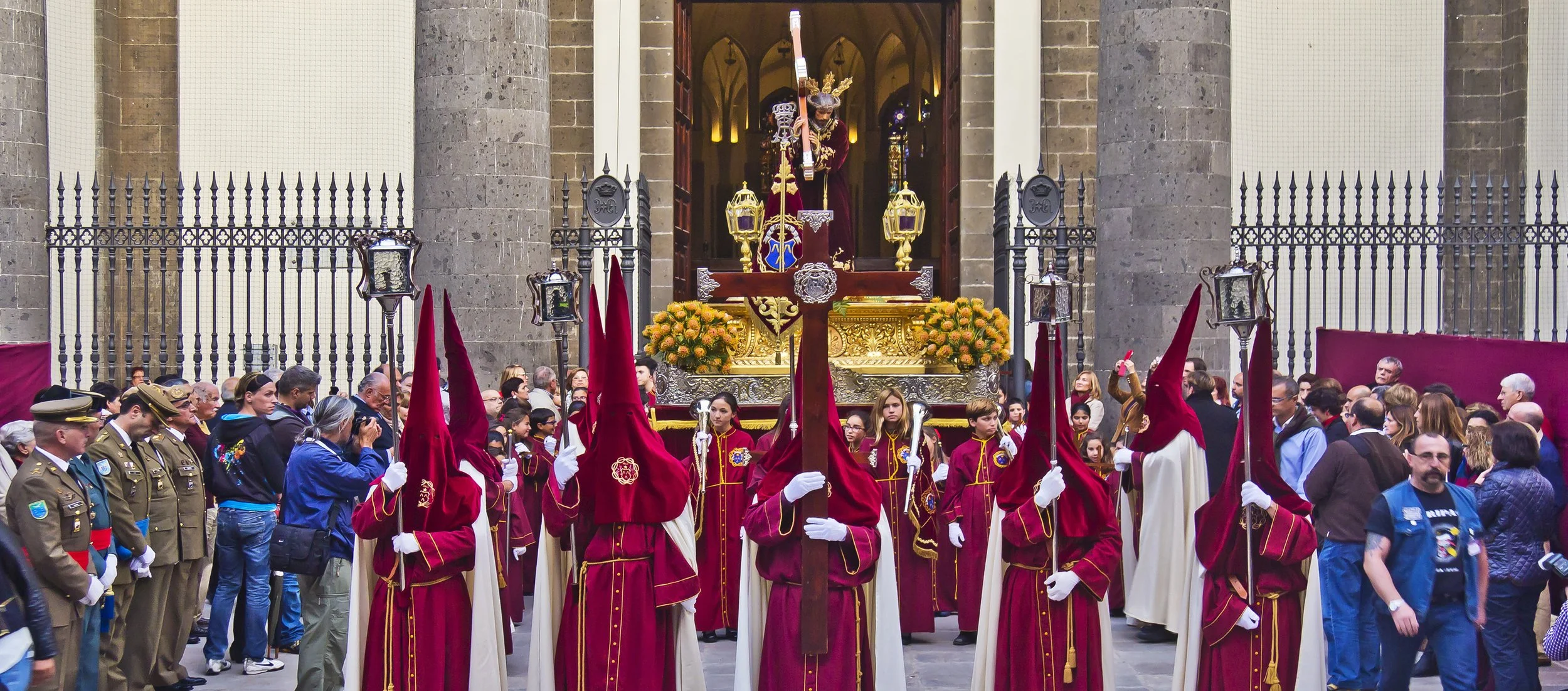
I have shared, alongside this article, a photograph. It shows a Holy Week procession in Southern Europe — penitents in deep crimson robes, their faces hidden beneath pointed capirotes, processing in ordered, solemn silence through ancient streets. Before them is carried a paso, a magnificent float bearing a statue of the Ecce Homo: Christ crowned with thorns, robed in purple, holding the reed sceptre, his gaze meeting ours across the centuries. Golden ornament, amber flowers, lanterns swaying in the spring air.
It is a strikingly different sight from the embarrassed Christianity of the British establishment — the mumbled apologies, the anxious inclusivity, the bishops who struggle to say with any confidence that Jesus Christ is Lord. Here is faith that takes up space. Here is devotion that moves through public streets unashamedly, that arrests the attention of the passerby, that makes a claim — quietly, beautifully, insistently — upon the imagination of the city.
The cofradías of Spain and the irmandades of Portugal, the processions of Sicily and Andalusia, the Semana Santa traditions that draw millions each year — these are not merely cultural curiosities or tourist attractions. They are an ecclesiology made visible: the Body of Christ moving through the world, bearing its wounds, confessing its faith. They represent something that the nervously secular Christianity of Northern Europe has largely abandoned: the willingness to be seen.
It is sometimes said, in commentary on such scenes, that Southern European Christianity survives because of its proximity to Islam — because living in sight of North Africa concentrates the Christian mind. There is perhaps something in this. The memory of the convivencia and the Reconquista, of the Ottoman advance and the battles of Malta and Lepanto, is woven into the culture of the Mediterranean littoral in ways that have no equivalent in the comfortable insularity of Northern Europe. The sense that Christianity is not simply the default cultural background but a living tradition that must be actively maintained, actively proclaimed, actively celebrated — that sense is sharper where the boundaries have always been less settled.
But I want to resist the temptation to make this primarily about Islam. The processions of Holy Week are not anti-Islamic demonstrations. They are not protests. They are worship. Their power lies precisely in the fact that they are directed toward Christ, not against anything else. The appropriate Christian response to the erosion of Christian public life is not to regard Islam as the enemy and to organise our identity around opposition to it. It is to renew our own worship, our own proclamation, our own willingness to take up space in the public square — not as a political statement, but as an act of love.
IV. What Confident Christianity Looks Like
Let me be concrete about what I mean by Christian confidence in the public square. I do not mean aggression, political lobbying for special privileges, or the attempt to use state power to suppress the religious expression of others. I have noted that Nigel Farage's call to ban all public religious gatherings would, as a matter of simple logic, eliminate the Good Friday Passion at Trafalgar Square itself. Christians who support such proposals have not thought them through, or have thought them through and concluded that the suppression of Muslim public worship is worth the sacrifice of their own. Either way, it is not a serious Christian position.
What I mean by confidence is something altogether different. I mean the recovery of the conviction — rooted in Scripture, sustained by two millennia of theological reflection, and embodied in the lives of the saints — that Jesus Christ is not one religious opinion among many, but the Lord of history, the eternal Word made flesh, the one in whom all things hold together. That conviction, when it is genuinely held, does not produce anxiety. It produces generosity. It produces the kind of fearless, open-handed engagement with the world that we see in the great missionary saints, in the intellectual courage of the Church Fathers, in the pastoral boldness of a priest who stands in the public square and offers Christ to whoever will receive him.
Confident Christianity is visible Christianity. It is the Easter Vigil fire kindled in the darkness of a city centre. It is the church whose doors stand open on a weekday afternoon, where the sanctuary lamp burns before the reserved Sacrament, where anyone who wanders in will find a space for silence and encounter. It is the religious community whose members are known in their neighbourhood — not as lobbyists or protesters, but as people of prayer, of service, of genuine human warmth. It is the bishop who does not apologise for the Creed.
It is also — and this must be said — a Christianity that takes its intellectual responsibilities seriously. The privatisation of faith has been accompanied, in many quarters, by an intellectual retreat: a reluctance to engage rigorously with questions of truth, a tendency to retreat into therapeutic language and managerial ecclesiology, a failure to form Christians who can articulate what they believe and why. If we want Christian young people to remain in the faith, to inhabit it with conviction, to commend it to their contemporaries, we must invest in catechesis, in theological formation, in the kind of serious engagement with Christian thought that equips a person not merely to feel the faith but to think it.
V. On the Public Square
The public square is contested. It always has been. The fantasy of a neutral, secular public square — in which religion is one lifestyle preference among others, kept safely behind closed doors — has always been exactly that: a fantasy. Every society organises its shared life around some vision of the good, some account of what human beings are and what they are for. The question is never whether any such vision will shape the public square, but which one will, and how.
Christians who are alarmed by the Open Iftar in Trafalgar Square are right to notice that the public square is not theologically neutral. But the conclusion to draw from this is not that we should seek to exclude others from it. It is that we should show up. We should bring our worship into the streets. We should process through the city with our crosses and our candles. We should re-enact the Passion in the public square. We should ring the church bells. We should be present, visibly and joyfully, as the community of those who believe that God has entered human history, has suffered and died and risen for the sake of all, and will come again.
The answer to the absence of Christianity from the public square is the presence of Christianity in the public square. Not the presence of Christian resentment, or Christian anxiety, or Christian political agitation. The presence of Christian worship. The presence of Christian love. The presence of the proclamation: Jesus is Lord.
This requires courage. In the present cultural climate, in Britain especially, public Christian witness is more likely to be met with embarrassment or mild ridicule than with persecution. But embarrassment is a powerful deterrent. Many Christians have internalised the secularist assumption that faith should be invisible, and feel acutely self-conscious about any expression of it that might be noticed by those who do not share it. Overcoming that self-consciousness — learning to worship without apology, to proclaim without shame — is not a small thing. It is a form of spiritual growth.
VI. A Note on Islam
I have said that this article is not about Islam, and I have meant it. But fairness requires me to say something directly. The Open Iftar in Trafalgar Square was, by all accounts, an act of hospitality: open to all faiths, organised by a charity that describes its mission as bringing communities together, attended by a Mayor who explicitly welcomed the diversity of those present. Whatever one thinks of the theological claims of Islam — and I have expressed my own views on those at length, with what I hope is scholarly honesty and theological seriousness — this particular event was not an act of aggression. Describing it as 'domination' or a 'conquest ritual' is not theological analysis. It is fear dressed up as conviction.
Christians who engage with Islam seriously — who have read the Qur'an carefully, who have sat with Muslim scholars and entered into genuine dialogue, who understand the profound theological differences between tawhid and Trinitarian monotheism, between the Qur'anic 'Isa and the Christ of the Nicene Creed — such Christians do not need to be afraid of a public iftar. They can engage with confidence, with clarity, and with love. They can affirm, with all the courtesy and directness that genuine dialogue requires, that Jesus Christ is the eternal Son of God, that the crucifixion and resurrection are historical realities of cosmic significance, and that no other account of God and humanity does justice to what has been revealed in him. That is not domination. That is witness.
The Christian tradition does not require us to pretend that all religions say the same thing, or that the differences between them do not matter. They matter enormously. But the appropriate response to religious difference is not anxiety and exclusion. It is the confident proclamation of what we believe to be true, offered in freedom and in love, to whoever will hear it.
VII. Holy Week and the Call to Witness
I write this in Holy Week — or on the threshold of it. In a few days, Christians around the world will re-enter the Paschal Triduum: the Three Days of the Lord's Passion, Death, and Resurrection. We will gather on Thursday evening to remember the night on which he was betrayed, to wash one another's feet, to receive the Body and Blood given for us. On Friday we will kneel before the Cross — that instrument of imperial torture which the Church has made the sign of all her hope. On Saturday we will keep vigil in the darkness, and then, as the first light of Easter breaks, we will shout our ancient acclamation: Christ is risen. He is risen indeed.
This is the story that Christianity has to tell. It is not a story about Western civilisation, or cultural heritage, or the need to resist demographic change. It is the story of the Son of God, who became flesh and dwelt among us, who suffered under Pontius Pilate, who was crucified, died, and was buried — and who rose again on the third day. It is a story that makes a claim: not a cultural claim, not a political claim, but a theological one. The claim that God has acted, decisively and finally, in the history of one human life; and that this action changes everything.
The processions of Holy Week — the crimson-robed penitents, the swaying pasos, the candlelight in the spring darkness — are beautiful not because they are Spanish, or Mediterranean, or culturally distinctive, but because they are an attempt, in every human imperfection, to make that story visible. To bring it into the streets. To say to the passerby: this is what we believe, and it is worth your attention.
That is what we are called to do. Not to protest someone else's worship. Not to organise our identity around fear. But to worship — visibly, joyfully, and with that peculiar freedom that comes to those who know that the tomb is empty.
Conclusion: The Renewal We Need
The debate provoked by the Open Iftar in Trafalgar Square has been, on the whole, a depressing spectacle. It has revealed a Christian community — or what remains of it in the British public square — that is more comfortable with reactive indignation than with the hard work of evangelical renewal. It has revealed politicians who invoke Christianity as a cultural marker while showing little evidence of any personal acquaintance with its actual content. It has revealed media commentators who can generate heat around questions of religious identity without shedding much light on what any of the faiths in question actually teach.
What it has not revealed — at least not prominently — is the Christianity we actually need. The Christianity of the Holy Week processions. The Christianity of the open door and the burning lamp. The Christianity of the priest who takes the gospel to the streets, not because he wishes to dominate anyone, but because he has been grasped by something he cannot keep to himself.
That is the Christianity to which we are called. It requires, first, a genuine renewal of faith — a return to the springs of Scripture, tradition, and prayer from which Christian confidence has always flowed. It requires intellectual seriousness — the willingness to engage with the great questions of our age, including the question of religious truth, with rigour and honesty. It requires pastoral courage — the willingness to say, kindly and clearly, what we believe, even when the culture finds it inconvenient.
And it requires what the penitents of Holy Week have always known: that before we can witness to the Resurrection, we must first enter into the Passion. We must be willing to be seen, to be exposed, to carry our cross through the streets of a city that may not understand what we are doing. We must be willing to look foolish.
But we must also know, with the certainty that no cultural pressure can entirely extinguish, that the story does not end at the tomb.