
MIND THE LIMOGES
On the Society of St Pius X (SSPX), the Holy See, and…
… The spectacle the world has made of both!
There is a word the English keep for a certain genre of marital combat: the domestic. It is the row the neighbours hear through the partition wall — the raised voices, the slammed door, and, at the climax, the unmistakable timpani of crockery making contact with plaster. Nobody calls the police. Everybody listens. And the next morning, over the fence, the verdict is delivered: Did you hear them last night?
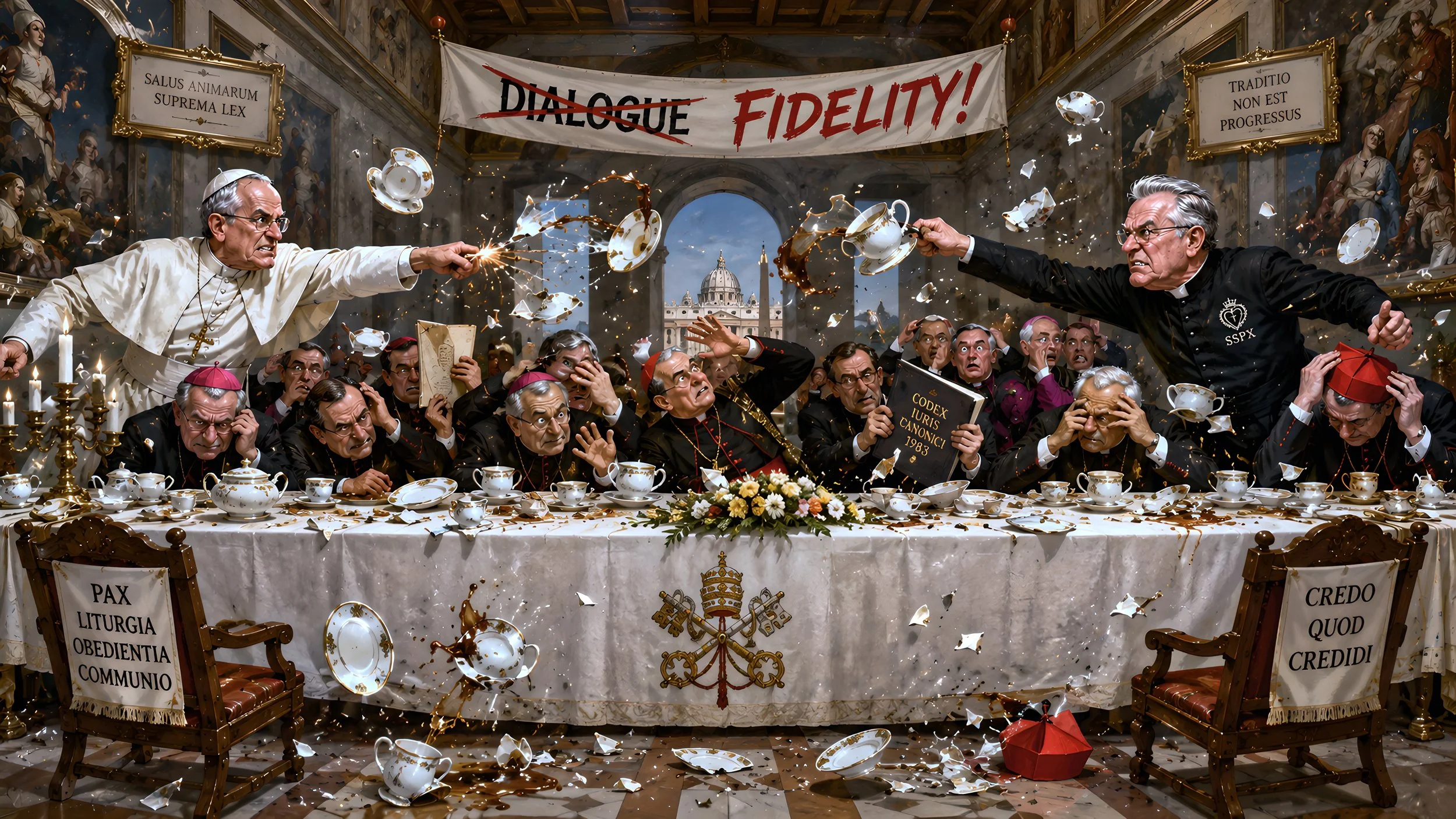
Our artists have rendered the present unpleasantness between Rome and Écône in exactly this key — a Last Supper repurposed as a flying-teapot farce, the good china airborne, the coffee describing parabolas across a banquet that was meant to end in communion and is ending in cleanup. I commend the picture to you not only because it is funny but because it is, in one respect, more honest than the news: it admits that we are all standing at the window.
For the news has decided, with the certainty it reserves for things it has only just discovered, that this is a soap opera. A wire service informs us that the Pope is “locked in a stand-off with breakaway traditionalist priests,” a phrase that does for ecclesiology roughly what “boffins baffled” does for physics. A tabloid has run a feud “erupting” over the Latin Mass, which is impressive, given that the feud is older than most of the journalists covering it. And somewhere, a man who could not on Monday have distinguished a Society of Apostolic Life from a pop boy-band dissolving over artistic differences has, by Friday, mastered the phrase latae sententiae and is wielding it in a comment thread like a man who has found a sword in a hedge.
The framing that has won, though — the one that quietly organises all the others — is the divorce. You have read it a dozen times this week without noticing, because it flatters everyone who uses it. Rome and the Society are the estranged couple; the laity are the children; the deposit of faith is the house neither will vacate; and 2012, when an accord very nearly happened, is wheeled out as the holiday in Sorrento where it might all have been saved. A canonist writing this month reached for the very same metaphor and made it sting[1]. He meant it gravely. The internet, predictably, kept the costume and threw away the grief: it wants the divorce as entertainment, with sides, a winner, and ideally a redemption arc by Advent.
I should like to spoil this for you
Strip away the bunting and the quarrel is not about personalities, nor about Latin, nor about whether the Pope is a nice man. It is about a single stubborn act, and a single stubborn question lying underneath it.
The act first. On the first of July, at Écône, the Society intends to consecrate four of its priests bishops — Schreiber, Goldade, Poinsinet de Sivry, and Hanappier[2] — without a mandate from the Pope. That is the whole of the immediate matter. Not a Mass, not a manifesto… A Consecration. And a bishop is not a private chaplain whom a society may commission for its own convenience. He is a public officer of the whole Church, which is precisely why, for as long as the Roman Catholic Church has been “the Church”, one does not make a bishop without the man to whom the whole Church is entrusted. The papal mandate is not red tape. It is the visible proof that the new bishop is being given to the Church, and not merely to a faction within her. To consecrate without it is to announce, in the one language the Church cannot mistake, that one’s private estimate of an emergency outranks the judgment of Peter. That is the act that drew the line in 1988, and the Society proposes to walk up to the same line on its anniversary.
The defence is as old as the act: necessity. Opération survie, Archbishop Lefèbvre called it — Operation Survival. The Code itself provides that a man who acts under grave necessity is shielded from penalty, and the Society argues, not unseriously, that a traditional faithful left without bishops to ordain its priests and confirm its children is a genuine emergency to which the consecrations are the only answer. To this it adds a subtler plea: that schism requires the will to break from the Pope, and that it possesses no such will — it professes his primacy, prays for him by name, and wants not a rival Church but a recognised corner of this one.
Rome’s reply is equally old and equally canonical. The Dicastery for the Doctrine of the Faith has said plainly that to consecrate without the mandate is not the prelude to a schismatic act but is one, and that the penalty follows automatically — no trial, no gavel, the door simply locking behind you[3]. And here is the part the divorce-watchers miss, because it is the part that requires sitting still: the mandate is the test of the very submission the Society professes. “I obey you in everything except the one thing you have actually asked of me” is a sentence every parent has heard and no parent has ever believed. The whole weight of the dispute rests on that point, and you cannot livestream it.
Underneath even this lies the real, sixty-year question — the one the cameras will never find interesting, because it cannot be photographed. When the Council taught things that were not defined dogmas but pastoral orientations — on religious liberty, on ecumenism, on the Church’s regard for other religions — what precisely does a Catholic owe them? Bare assent, as to revealed truth? Or the religious submission of mind and will owed to the Church’s ordinary teaching, which is real but is not the same thing? In February, when the two sides last sat at a table that was still, of all things, cordial, this was the very distinction Rome proposed they examine together: the act of faith and the obedience of faith[4]. It is the hinge on which the entire quarrel turns. It is also, I regret to report, completely undramatic. No teapot has ever been smashed over the distinction between fides and obsequium, and none ever shall be, which is exactly why it never makes the news.
The dialogue meant to examine it did not survive the spring. On the twenty-fourth of June the Society answered the invitation to keep talking with a hundred and fifty-four articles of doctrine and an open letter — addressed not to the Pope alone but to the whole College of Cardinals, two days before they gathered[5] — under a banner that, in our artists’ rendering, puts it best: Dialogue struck through in red, and over it, Fidelity! The reigning Pope, for his part, smashed nothing. He said, in public and almost wearily, “Do not do this. Let us try to live in communion in the Church,”[6] and added that the choice was theirs, and so were the consequences. It was not the line of a man hurling china. It was the line of a man watching it sail past his head.
So where, then, is the domestic? Not, I submit, at the table. The two ends of that table are doing something old and grave and genuinely tragic, in the strict sense of the word: a conflict in which both parties can recite reasons that are not contemptible. That is what makes it a tragedy and not an opera buffa.
The farce is at the window
The farce is the convert of eighteen months who has appointed himself prosecutor of the Apostolic Signatura from the top deck of a bus. It is the traditionalist who learned “hermeneutics of rupture” on Wednesday meeting the ultramontane who learned “latae sententiae” on Tuesday, the two of them settling the matter on Thursday in the only forum either trusts — a comment section — to the last block button standing. It is the irresistible human need to assign jerseys, Team Pope and Team Tridentine, to a dispute about the nature of the episcopate, as though the Mystical Body were a fixture list. It is the man explaining canon 1382 to a canon lawyer. It is your cousin, who darkens the door of no Mass of any rite, electrified for a fortnight by a quarrel he would not cross the road to mend, forwarding a meme of a teacup.
We have, in short, taken one of the gravest wounds the Church can suffer and made of it a content opportunity. The Society performs its fidelity for an audience; the louder partisans of Rome perform their loyalty for the same audience; and the audience — the only party guaranteed to profit from the whole affair — performs its outrage for itself, and calls the performance “following the situation.”
I should not like to be misunderstood, for the temptation of a piece such as this one is to laugh all the way to the bottom, and that would be its own sort of failure. The spectacle is ridiculous. The thing being watched is not. A schism is a tear in a living body, and one does not gather a crowd to watch surgery and then complain that the surgeon is taking the fun out of it. If the consecrations proceed, real men will incur real penalties, real faithful will be told once more that the altar rail runs straight through the middle of the family, and the scandal of a divided house — the one thing Our Lord prayed against by name, on the night the original of that painting depicts — will be handed, gift-wrapped, to every enemy the Church has, and to a few she invented herself.
So by all means hang the caricature in the refectory. Laugh at the flying Limoges; the artists earned it, and a Church that cannot laugh at the sight of her own quarrels has missed a remedy she badly needs. But laugh at the right thing. The crockery in the picture is china, and china is replaceable. The thing it stands for is Communion, and Communion is not replaceable: it does not survive being smashed by either hand, and it cannot be swept up afterwards and glued back together.
Pray for both ends of the table. Pray, if you have it in you, for the people at the window, a company that includes the author of these lines and, I would gently suggest, the reader of them. And consider — purely as a matter of spiritual hygiene — setting down the telephone, which makes a poor reliquary, a worse magisterium, and quite the worst confessor any of us has ever had.
[1]A canonist writing this month drew the same comparison, contrasting 1988 — a bitterly contested divorce in which both sides still sought custody of the children — with 2026, in which both sides appear resigned to the break and the grown children have already chosen sides. See “SSPX Consecrations and Impending Schism,” Where Peter Is, June 2026.
[2]The Society named the four priests to be consecrated on 26 May 2026: Pascal Schreiber (Rector of the Herz-Jesu Seminary), Michael Goldade (Rector of St Thomas Aquinas Seminary), Michel Poinsinet de Sivry (Superior of the Benelux District), and Marc Hanappier.
[3]Cardinal Víctor Manuel Fernández, Prefect of the Dicastery for the Doctrine of the Faith, stated on 13 May 2026 that episcopal consecrations without a pontifical mandate would constitute “a schismatic act” incurring automatic excommunication, latae sententiae, for consecrators and consecrated alike. Reported in the Catholic Herald, 25 June 2026.
[4]“Holy See proposes theological dialogue with Society of Saint Pius X,” Vatican News, February 2026. The Dicastery described the meeting between Cardinal Fernández and Fr Davide Pagliarani as “cordial and sincere,” and the proposed agenda expressly included the distinction between the act of faith and the obedience of faith — the religious submission of intellect and will.
[5]Society of Saint Pius X, Profession of Catholic Faith of the Society of Saint Pius X to Enlighten Souls in the Face of Modern Errors — a declaration of 154 articles — with an accompanying open letter to Pope Leo XIV and the College of Cardinals, 24 June 2026 (fsspx.news). The extraordinary consistory met 26–27 June; the consecrations are planned for 1 July, the anniversary of the 1988 excommunications.
[6]Pope Leo XIV, remarks outside Villa Barberini, Castel Gandolfo, 16 June 2026.