
‘Fear No One’ Homily Sunday 21/06/2026
Homily for the Twelfth Sunday in Ordinary Time (Year A)
Jeremiah 20:10–13 · Matthew 10:26–33
Just before today’s First Reading opens, Jeremiah does something that ought to catch our attention. He has been arrested in the Temple, beaten, and locked overnight in the stocks by Pashhur, the priest who held charge there. When he is released the next morning, the prophet does not run. He turns to the man who has humiliated him and gives him a new name. He calls him Magor-missabib—“Terror on every side.”
And then, in the very passage we have just heard, that phrase comes back to haunt him: “I hear the whisperings of many: ‘Terror on every side!’” His own words are now thrown back in his face. The terror he had named in his persecutor has become the air the prophet breathes. Worse still, Scripture is careful to tell us that the ones watching for him to stumble, hoping to catch him in some misstep, are his friends. “All those who were my friends are on the watch for any misstep of mine.”
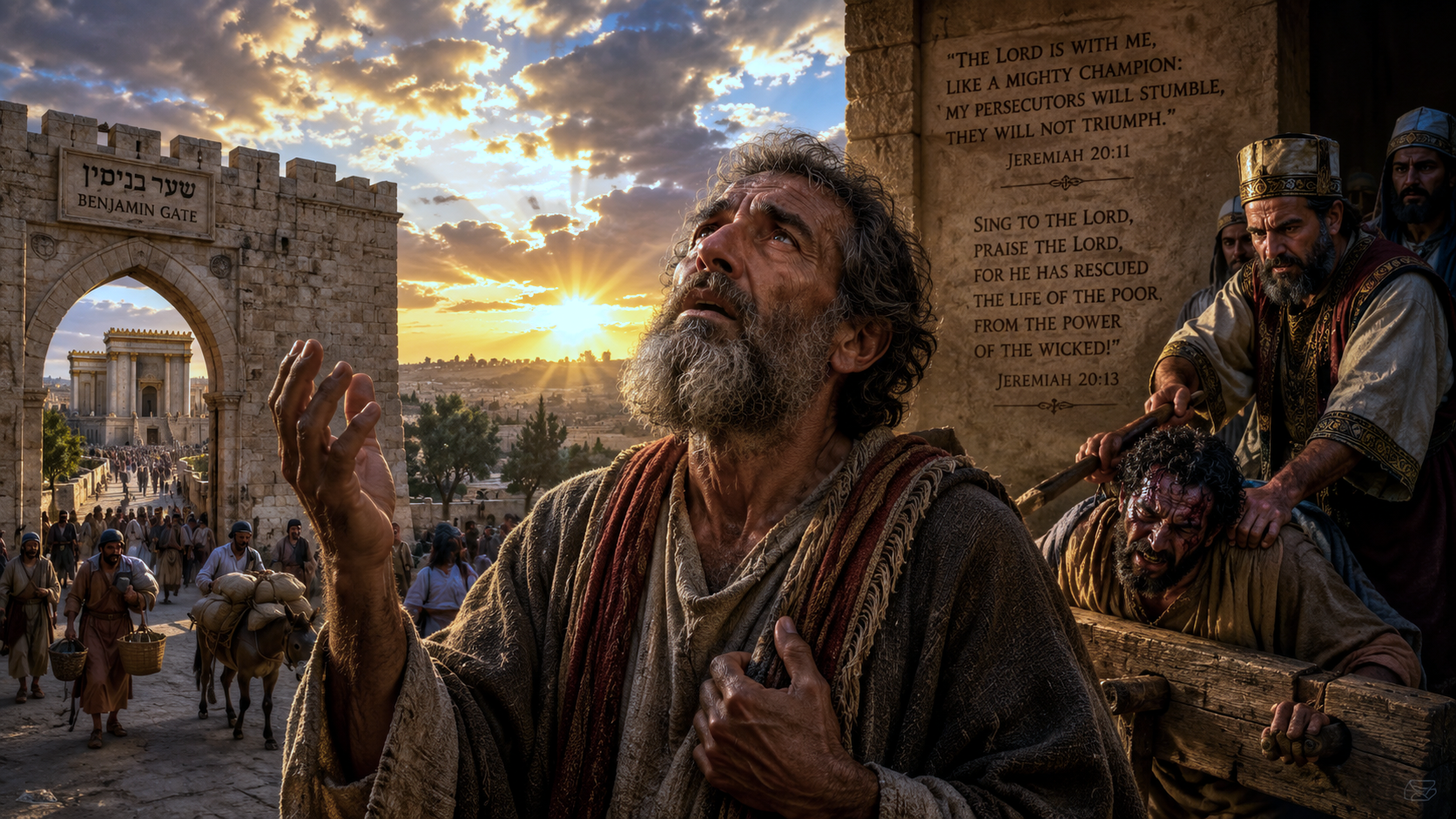
This is what faithfulness had cost him. God had sent Jeremiah to stand in the Benjamin Gate and call Judah back—back to the Sabbath, back to the Lord. He had promised them life if they repented and ruin if they did not, and for his trouble, he was beaten and shackled. The prophet’s reward for speaking God’s word was to be surrounded by enemies and abandoned by friends.
If the reading ended there, it would simply be the diary of a broken man. But it does not end there. Right in the middle of his complaint, something turns: “But the Lord is with me, like a mighty champion: my persecutors will stumble, they will not triumph.” And by the time he is finished, the prophet who began in lament is singing: “Sing to the Lord, praise the Lord, for he has rescued the life of the poor from the power of the wicked!”
Notice what has not changed. Pashhur is still in charge. The whisperers are still whispering. The danger is still real. What has changed is that Jeremiah has remembered who is standing beside him.
Hold on to that image of the surrounded prophet, because in the Gospel, the Lord turns to his own disciples and tells them, plainly, that the same thing is coming for them. Just before today’s passage, Jesus had warned them that they would be handed over, dragged before authorities, hated, and persecuted. And then, into that bleak forecast, he speaks three words that he will repeat three times: “Do not be afraid.”
He does not simply command it; he gives reasons. Four of them.
The first is that nothing is hidden. “Nothing is concealed that will not be revealed, nor secret that will not be known.” The whispered campaigns against Jeremiah, the plots hatched in private, the quiet cruelties that no one sees—God sees them. And the good done in secret for the sake of the Kingdom, the faithfulness no one applauds—God sees that too. There is a reckoning, and it rests in the hands of One who misses nothing. The persecutor’s secrecy is an illusion; so is the disciple’s obscurity.
The second reason reorders our fear. “Do not be afraid of those who kill the body but cannot kill the soul; rather, be afraid of the one who can destroy both soul and body in Gehenna.” This is not the abolition of fear—it is the correction of it. Our enemies can reach the body; they cannot reach the soul unless we hand it over to them. So the Lord lifts our fear off its small and frightened object and fixes it where it belongs. The world teaches us to fear whatever can kill us. Christ teaches us to fear only what can damn us—and then to walk through everything else unafraid.
The third reason is the tenderest: the Father’s care. “Are not two sparrows sold for a small coin? Yet not one of them falls to the ground without your Father’s knowledge. Even all the hairs of your head are counted.” A sparrow was worth almost nothing in that economy—two of them for a penny—and yet not one drops from the sky outside the Father’s care. If his providence reaches that far down, to the death of a bird and the count of your hair, then “terror on every side” is not outside it either. The same God who allowed Jeremiah to be surrounded had not, for one moment, taken his eyes off him.
And the fourth reason anchors all the others: we have an advocate. “Everyone who acknowledges me before others I will acknowledge before my heavenly Father.” We do not stand alone in that courtroom. Christ himself stands before the Father as our advocate and high priest, naming as his own everyone who has dared to name him. The confession we make below is answered by a confession he makes above.
Here is where the two readings become one. Jeremiah was a man who suffered for God’s word and longed to be vindicated. Centuries later, another Prophet stood before another high priest in that same city. He, too, was struck. He, too, was condemned by the authorities of the Temple. He, too, was surrounded—abandoned even by his friends, who watched from a distance as he fell. But what Jeremiah could only hope for, Christ accomplished: he was vindicated, raised up, and seated at the right hand of the Father. The pattern that runs through Jeremiah runs through Christ, and now it runs through us. To follow him is to be conformed to him—in his rejection, yes, but for that very reason also in his vindication.
So we should ask ourselves honestly: where do we meet “terror on every side”? For most of us it is not the prison and the stocks. It is something quieter and, in its way, more dangerous. It is the pressure to keep our faith small and private—the raised eyebrow, the cooling friendship, the sense that to speak plainly about Christ is to step outside polite company. And notice how the Lord describes denial. He does not picture some dramatic renunciation before a tribunal. “Whoever denies me before others”—and that denial can be almost silent. It can be a careful changing of the subject. The opposite of confessing Christ is not always cursing him; very often it is simply going quiet. And to a world that would prefer us inaudible, the Lord’s instruction is striking: “What you hear whispered, proclaim on the housetops.”
Brothers and sisters, Jeremiah did not sing because the danger had passed. He sang because the Lord was with him like a mighty champion while the danger was still all around him. That is the song the Church has always sung—in the catacombs, before the magistrates, in every age that has found the Gospel inconvenient. We are worth more than many sparrows. The hairs of our head are numbered. The One who sees in secret will not forget what we have done for love of him, and the One who stands before the Father will not be ashamed to call us his own.
So, fear no one. Take whatever has surrounded you this week, whatever has whispered “terror on every side,” and look at it the way Jeremiah finally did—as something real, but smaller than the God who is standing beside you. And then do what the prophet did. Turn your complaint into an anthem.