
Good Words at the Top, Friction Below
On Pope Leo’s Interfaith Address and the Limits of Diplomatic Dialogue
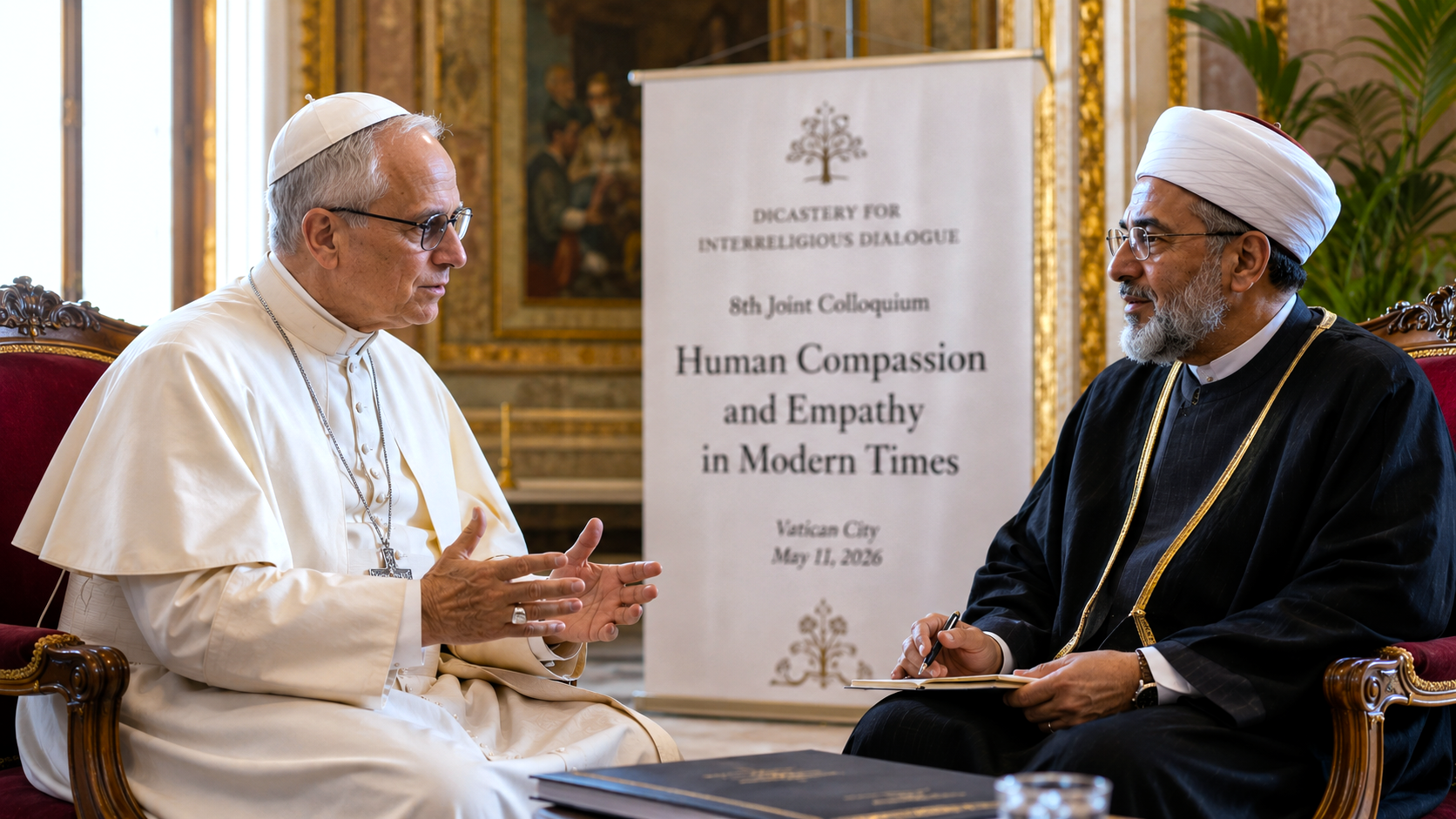
On the morning of Monday, 11 May 2026, Pope Leo XIV received participants in the eighth joint colloquium organised by the Holy See’s Dicastery for Interreligious Dialogue and Jordan’s Royal Institute for Inter-Faith Studies. The theme chosen for this year’s gathering was “Human Compassion and Empathy in Modern Times.” In his address — delivered in the Clementine Hall of the Apostolic Palace, with Prince Hasan bin Talal of Jordan among those present — the Pope spoke with evident warmth and theological seriousness. He drew on the Islamic concept of ra‘fa, the divine compassion embedded in the ninety-nine names of God, and set it alongside the Christian understanding of a God who, in Jesus Christ, does not merely observe human suffering from a distance but enters into it, becoming, as the Pope put it, “the living embodiment of compassion.” He warned of a growing apathy in the digital age — a compassion fatigue born not of hardship but of the endless, numbing scroll of other people’s pain. He called Christians and Muslims to a common mission: “to revive humanity where it has grown cold, to give voice to those who suffer and to transform indifference into solidarity.”
These are beautiful words. They are also, in their way, true words. The Pope is not wrong to observe that ra‘fa and the Christian theology of compassion share a common grammar of mercy, that Jordan has behaved with notable generosity towards refugees, and that digital connectivity has not, in practice, made us more compassionate. These are real observations from a thoughtful man who clearly desires peace.
And yet something important is absent from this picture. Not ill-will. Not insincerity. Something structural — something that no amount of colloquium-level goodwill can reach. It is the gap between what is said at the top and what is lived at the bottom; between the world of diplomatic theology and the world of the Friday sermon, the madrasa, the street.
The Architecture of the Problem
Elite interfaith dialogue operates in a particular register. It assumes shared commitments to mutual respect, humanitarian concern, and the possibility of coexistence. It draws, quite naturally, on the most irenic voices within each tradition. The scholars and dignitaries who gather in the Clementine Hall are not representative of global Islam in the way that a parish congregation or a neighbourhood mosque is representative. They are the best-case interlocutors — learned, often Western-educated, committed to dialogue as a value in itself. The agreements they reach, the language they share, the communiqués they issue: none of this travels downward with any automatic authority.

RECALL
The agreements reached in the Clementine Hall do not travel downward with automatic authority. The Quran does not defer to diplomatic communiqués.
This is not a problem unique to Islam. Within Christianity too, there is often a significant gap between what theologians and bishops say to one another in ecumenical settings and what shapes the devotional life of ordinary believers. But the gap is especially acute in the case of Islam, for a reason that is not cultural or contingent but doctrinal. It is rooted in the nature of the Quran itself.
The Quranic Floor
The central dogmas of Christianity — the Holy Trinity, the Crucifixion and atoning death of Jesus, the Resurrection, the Real Presence in the Eucharist, the hypostatic union of full humanity and full divinity in the person of Christ — are not merely unfamiliar to Islam. They are explicitly and repeatedly repudiated by it.
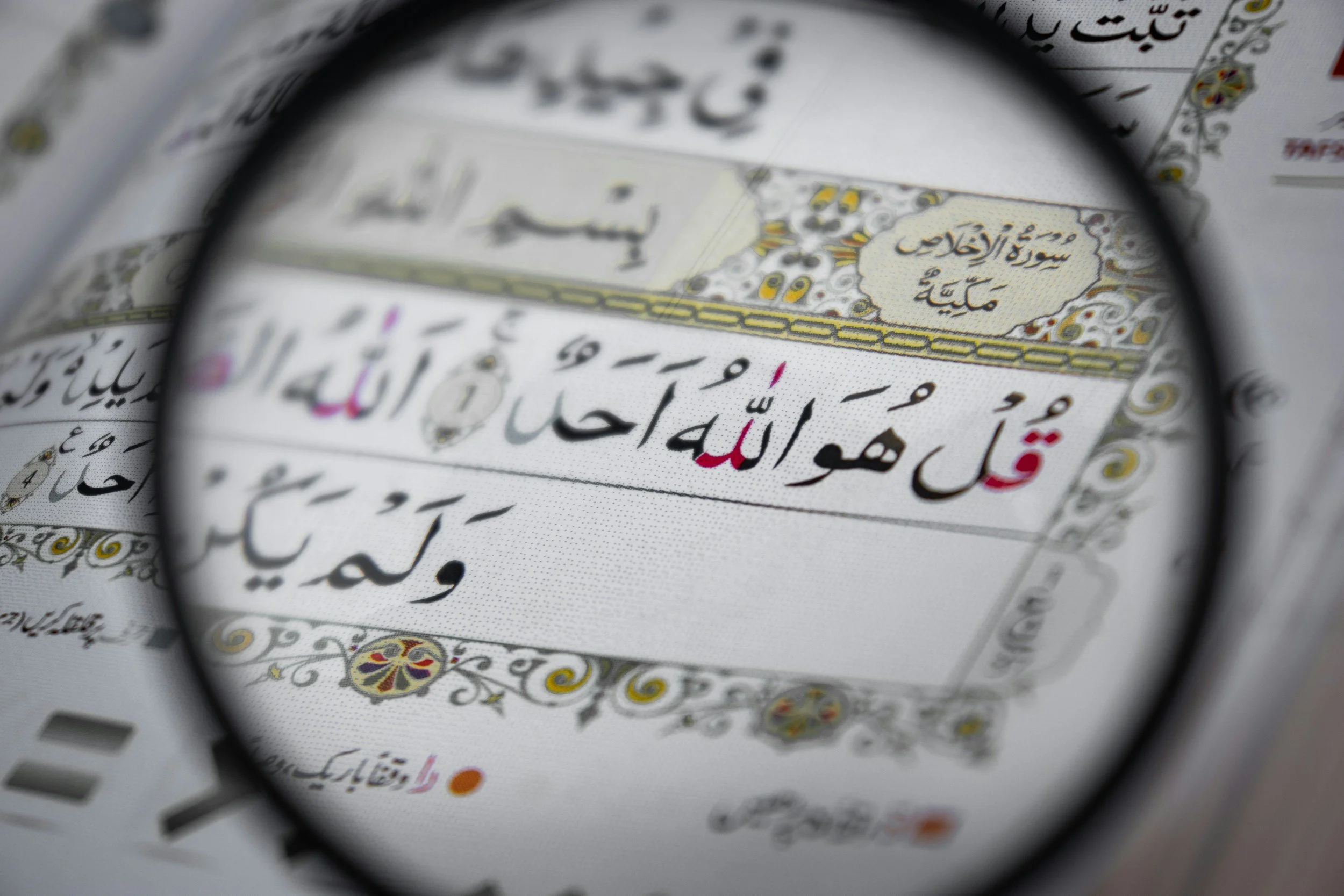
The doctrine of the Trinity is, in Islamic theology, shirk: the gravest conceivable sin, the association of partners with God. The Quran is unambiguous: “They have certainly disbelieved who say that God is the third of three” (Surah 5:73). The Crucifixion is denied in terms that admit of no reinterpretation: wa ma qatalūhu wa ma salabūhu — “they did not kill him, nor did they crucify him” (Surah 4:157). Jesus is honoured as a prophet, even granted the title of Messiah and “the Word” — but these terms carry entirely different theological weight in Islam than they do in Christianity. To say that Jesus is the Word of God in the Quranic sense is emphatically not to say what John’s Gospel means by the Logos.
These are not the opinions of extremists. They are not peripheral positions held at the margins of the tradition. They are Quranic nass: definitive, binding text, carrying the full weight of divine revelation as Islam understands it. The Muslim who accepts the Quran as the literal and final word of God — and the overwhelming majority of the world’s 1.8 billion Muslims do — cannot simply set these passages aside in response to a warm speech in the Apostolic Palace. They are, epistemologically speaking, more authoritative than anything any human institution can say. The Vatican Dicastery for Interreligious Dialogue does not outrank the Quran.
Recall
The overwhelming majority of the world’s 1.8 billion Muslims accept the Quran as the literal and final word of God. No Vatican dicastery outranks it.
This is not to say that Muslim-Christian relations are inevitably hostile. The history of these two traditions is vastly more complex than simple antagonism. There have been long centuries of coexistence, genuine intellectual exchange, and mutual influence. The problem is not that peace is impossible. The problem is that peace cannot be achieved by pretending that the theological disagreements do not exist or can somehow be dissolved by appeals to shared humanitarian values. They cannot. The irreconcilable nature of Islam and Christianity at the level of core doctrine is a permanent feature of the landscape, not a misunderstanding awaiting resolution.
The Civic Formation Gap
There is a second structural problem, distinct from but related to the first. It concerns not theology but formation — the civic and moral education that shapes how ordinary believers relate to those outside their community.
Western Christianity has been shaped, over the past three centuries, by a series of transformations that fundamentally altered its relationship to religious pluralism. The Reformation shattered the unity of Christendom and forced Christian communities to develop frameworks for living alongside those who believed differently. The Enlightenment, for all its hostility to institutional religion, pressed Christian thought towards universalist conceptions of human dignity and rights. The catastrophe of the Wars of Religion, culminating in the Peace of Westphalia, made religious tolerance not merely an ideal but a political necessity. Vatican II, whatever one makes of its other aspects, represented a formal and authoritative Catholic commitment to religious liberty as a theological value, rooted in the dignity of the human person.
Islam, as a global civilisation, has not undergone an equivalent process. This is not a racial or ethnic judgement — it is a historical observation. The dominant jurisprudential traditions within Islam developed their frameworks for non-Muslim minorities (the dhimma system) in contexts of Muslim political supremacy, and those frameworks, while often more protective than their Christian equivalents in the medieval period, were not designed for contexts of genuine religious equality. The concept of the nation-state with equal citizenship regardless of religion is, in many parts of the Muslim world, a recent and imperfectly absorbed import. The theological resources for a robust doctrine of religious liberty — resources that do exist within Islam, and have been developed by a minority of Muslim thinkers — have not yet become the common property of the grassroots.
Recall
The theological resources for a robust doctrine of religious liberty exist within Islam — but they have not yet become the common property of the grassroots.
The result is a gap that elite dialogue cannot close. A colloquium in Rome can issue the finest communiqué imaginable about shared compassion and common humanity. It cannot reach the madrasa in Lahore, the mosque in Molenbeek, the sermon in Kano. The formation that shapes grassroots Muslim attitudes to Christians, to apostates, to blasphemy, to the public expression of other faiths, is not formed by interfaith colloquiums. It is formed by centuries of jurisprudential tradition, by childhood religious education, by communal identity, by the visceral logic of belonging. Changing it requires not diplomatic elegance but patient, sustained, internal reform — and that reform, where it is happening at all, is happening slowly and against significant resistance.
What the Church Actually Needs
None of this is an argument for hostility. Christians are not called to regard Muslims with contempt or fear. The Gospel demands that we see every human being, including the Muslim neighbour, as a person made in the image of God and loved by him. The call to compassion that Pope Leo articulated is real and binding — on us as much as on anyone.
But compassion without clarity is not, ultimately, compassion. It is a kind of sentimentality that serves no one. The Church does not honour Muslims by pretending that the theological differences between us are smaller than they are. It does not serve the cause of peace by creating the impression — in the minds of Catholics who may already be confused about the identity of their own faith — that Islam and Christianity are essentially saying the same thing in different words. They are not. We worship the Triune God: Father, Son, and Holy Spirit. We confess that Jesus of Nazareth is the eternal Son of God, who took on human flesh, died on the Cross for our sins, and rose bodily from the dead. These are not negotiable positions. They are the faith.
What the Church needs, in this moment, is not less dialogue but more honest dialogue — dialogue that names the disagreements clearly and does not dissolve them in warm language about shared humanity. It needs robust catechesis: Catholics who know what they believe and why, who can articulate the Gospel with confidence without aggression, who are not ashamed to say that Jesus Christ is Lord in a public square that increasingly regards such a claim as impolite. It needs a recovery of the missionary instinct — not in the mode of colonial imposition, but in the mode of joyful witness. The early Church did not grow by finding lowest-common-denominator agreement with the religious cultures around it. It grew by proclaiming something specific, true, and transformative.
Recall
Compassion without clarity is not compassion. It is sentimentality. The Church does not honour Muslims by pretending the disagreements are smaller than they are.
At the grassroots level, the practical need is equally urgent. Christian communities living alongside large Muslim populations need not diplomatic abstractions but concrete support: for their legal rights, for their safety, for their freedom to practise their faith without intimidation. The violence that continues to mark Christian-Muslim relations in Nigeria, Pakistan, Egypt, and elsewhere is not produced by a deficit of interfaith colloquiums. It is produced by the gap described above — between the tolerant sentiments expressed at the top and the theological formation operative at the bottom. Addressing that gap requires honest naming, not elegant circumnavigation.
Honour and Honesty
We pray for Pope Leo XIV. He is a man of evident intelligence and genuine pastoral concern, and his desire to build bridges between Christians and Muslims flows from a real love for humanity. The compassion he spoke of is real. The warning about digital apathy is perceptive. The hope that Jordan might “continue to be a living witness” to dialogue and solidarity in a troubled region is a generous one.
But the Church’s task in the world is not to be liked. It is to be faithful. And faithfulness, in this case, requires saying clearly what the diplomatic register tends to obscure: that the theological divide between Christianity and Islam is not a misunderstanding but a chasm; that goodwill at the top cannot substitute for formation at the bottom; and that the violence against Christians in Muslim-majority contexts will not be ended by warm speeches in the Clementine Hall.
Mutual acceptance — the peaceful coexistence of two communities that hold irreconcilable beliefs about God — is a worthy and achievable goal. It is, in many places and times, the best that can be hoped for. But it can only be built on honesty. The foundation of genuine coexistence is not the pretence that our differences do not matter. It is the mutual acknowledgement that they matter enormously — and the shared commitment, nonetheless, to live together without violence.
That is a harder thing to say in a formal address than “compassion and empathy can be our instruments.” It is also, in the long run, the only thing worth saying.