
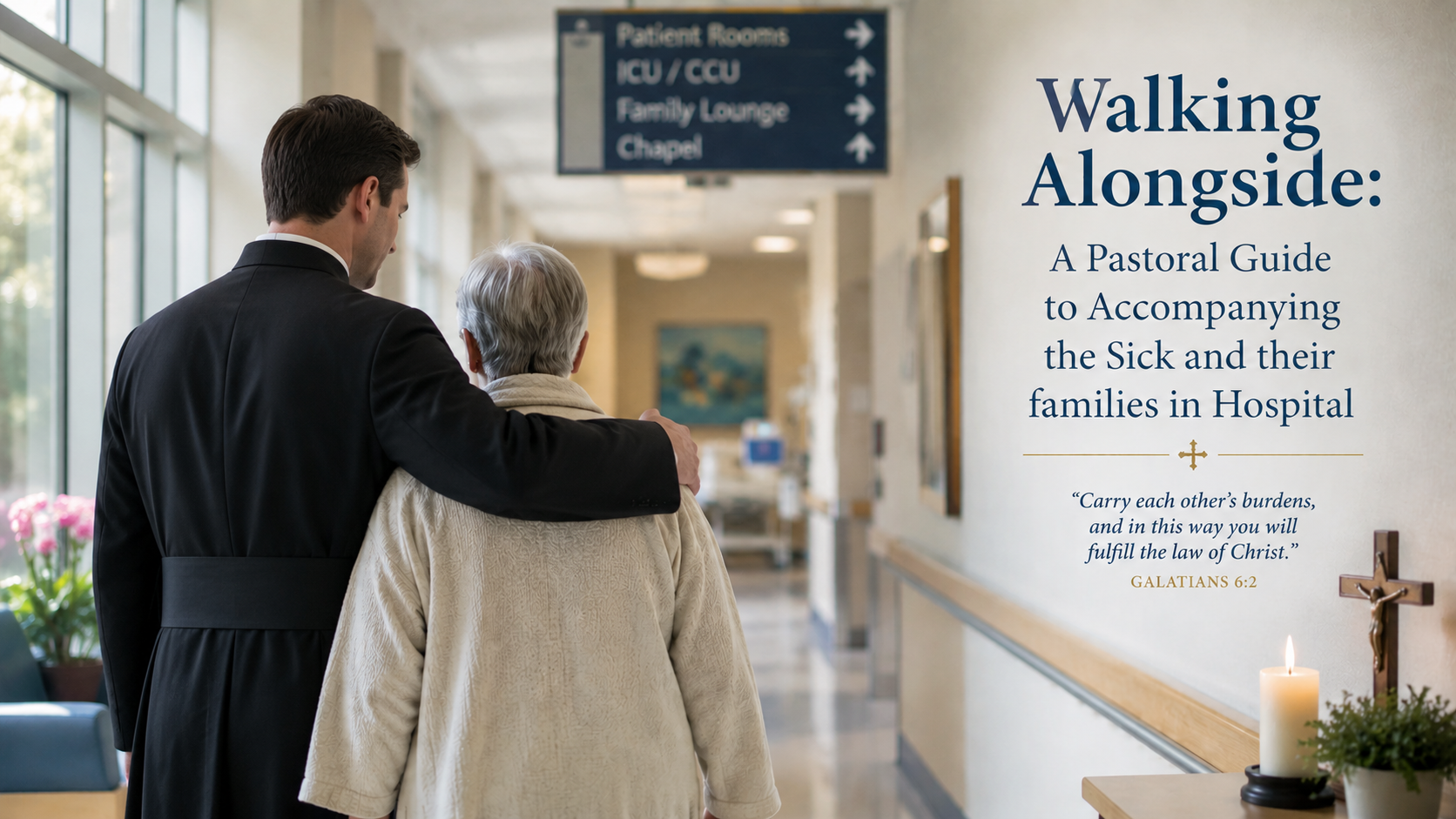
Walking Alongside
A Pastoral Guide to Accompanying the Sick in Hospital
Do not be far from me, for trouble is near and there is no one to help.
Psalm 22:11
There is a moment that most of us know, even if we have never spoken of it aloud. You are standing in a hospital car park. The engine is off. You have been sitting there for a few minutes longer than necessary. Through the windscreen you can see the entrance — automatic doors opening and closing, visitors coming and going, the ordinary business of a place that is, for someone you love, anything but ordinary.
You know you should go in. You want to go in. But something holds you in the car just a moment longer. It might be fear — fear of saying the wrong thing, fear of the sight of someone you love diminished by illness, fear of your own helplessness in the face of suffering you cannot fix. It might be grief, already present before anything has been lost. It might simply be the strange gravity of the threshold between the ordinary world and the world of the sick.
If you have ever felt that hesitation, this article is written for you.
And if you are a pastor, a church leader, a chaplain, a deacon, a home group leader, a friend from the congregation who has been asked to visit someone in hospital — this article is especially written for you. Because the ministry of accompanying the sick is one of the most ancient, most sacred, and most humanly demanding callings in the life of any community of faith. It is also one of the least talked about, the least trained for, and the most feared.
We talk a great deal about preaching, about worship, about community, about mission. We talk far less about what it means to sit beside a hospital bed with nothing to offer but your presence, your prayers, and the quiet testimony that this person — this suffering, frightened, perhaps dying person — is not alone.
This article is an attempt to begin that conversation. It is built around a single image — that of walking alongside — and it takes its cue from one of the most beautiful and quietly devastating stories in all of Scripture.
The Road to Emmaus — and the Hospital Ward
In the twenty-fourth chapter of Luke's Gospel, two disciples are walking away from Jerusalem. They are walking in the wrong direction — away from the place where the resurrection has just occurred — because they do not yet know what has happened. They are broken. They had hoped, they tell the stranger who falls into step with them, that Jesus was the one who would redeem Israel. Had hoped. Past tense. The hope is in the past now, and in front of them is only the long walk home through grief.
The stranger who joins them does not appear dramatically. He does not announce himself. He does not correct their theology before they have had a chance to speak. He simply falls into step beside them. He asks them what they are talking about. He listens. He lets them tell their story. He walks at their pace, on their road, towards their destination.
Only later — much later, when they have reached Emmaus, when the day is almost over, when they have urged him to stay and broken bread together — do they recognise who he is. And he vanishes from their sight.
But here is what strikes me every time I read that story: Jesus chose to walk with them before they recognised him. He chose presence before explanation. He chose accompaniment before proclamation. He entered their grief and their confusion and their misdirected journey and he walked with them through it, and in the walking, something began to shift. Their hearts, they would say later, were burning within them even as he talked with them on the road.
That is the image at the heart of all genuine pastoral ministry with the sick. You do not arrive at a hospital bed with answers. You arrive as a companion for the road. You fall into step. You listen before you speak. You stay long enough to matter. And you trust that in the faithful act of accompaniment — in the simple, profound, exhausting, holy act of showing up and staying — something of Christ himself is made present.
This is not a small thing. It is, in fact, everything.
The Walk to the Ward — Entering Someone Else's Road
Let us begin, then, with the walk to the ward itself. Because before any pastoral care can happen, someone has to choose to enter. And that choice — that act of pushing through the hospital doors, finding the right ward, pressing the buzzer, walking past the nurses' station — is itself a significant pastoral act.
Hospitals are disorienting places for visitors. They have their own smell — antiseptic, institutional, with undercurrents of something harder to name. They have their own rhythms — the squeak of trolley wheels, the intercom announcements, the particular quality of artificial light that flattens everything. They are full of strangers in various states of distress, and the corridors seem designed to be simultaneously too long and too public for any genuine human encounter.
For many people, especially those who have had difficult experiences with hospitals in the past — a parent who died there, an illness of their own — the mere act of entering is an achievement that deserves to be named. If you are a pastoral visitor who finds yourself dreading the visit, or who has to sit in the car park for a few minutes before going in, please know: that is not weakness. That is human. The willingness to enter the discomfort of another person's suffering is one of the most courageous things one human being can do for another.
What You Are Choosing When You Choose to Visit
Recall:
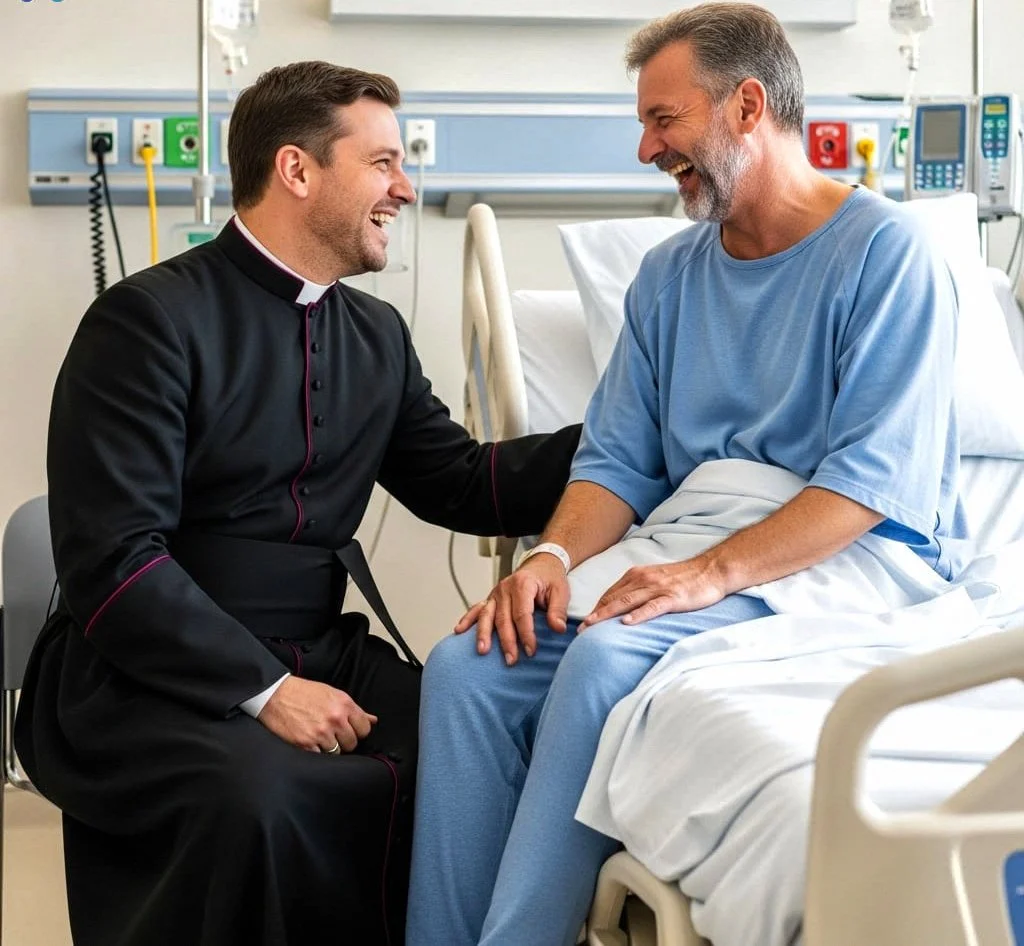
Accompanying is something you do with a person. It is responsive rather than predetermined. It follows the lead of the person you are with. If they want to talk, you talk. If they want silence, you sit in silence. If they want to laugh — and sick people often do, with a particular kind of dark and gallows humour that is itself a form of resilience — you laugh with them. If they want to cry, you do not hand them a tissue and change the subject. You stay.
When you visit someone in hospital, you are making a choice that carries far more weight than you may realise. You are choosing to leave the ordinary world — your home, your work, your comfort — and enter a world defined by vulnerability, uncertainty, and the proximity of death. That is not nothing. That is a significant act of love.
You are also choosing to be present to something you cannot fix. And this is, for many of us, the hardest part. We are problem-solvers by nature. We want to help, to advise, to improve the situation. The hospital visit confronts us with a situation we cannot improve — at least not in any direct, practical, immediately satisfying way. The person is ill. They may be in pain. They may be frightened. They may be facing something very serious. And there is nothing you can do about any of that.
What you can do is show up. And in the theology of presence that runs through the Scriptures — from the God who comes to walk in the garden in the cool of the day, to the God who pitches his tent among us in John's prologue, to the God who falls into step with grieving disciples on an Emmaus road — showing up is not nothing. Showing up is, in fact, the very shape of divine love.
Practical Wisdom for the Walk In
A few practical notes on the approach, because they matter more than we sometimes think.
Find out beforehand what ward the person is on, and whether they are allowed visitors. Check visiting hours. This sounds obvious, but arriving at a ward during a procedure or at a time when the patient is asleep or unable to receive visitors is distressing for everyone involved. A quick call to the family, or a message to check, shows care and respect before you even arrive.
Consider what you are bringing. Flowers are traditional but not always appropriate — some wards do not allow them, and some patients find them oppressive (they are a reminder, perhaps, that people expect them to be there long enough for flowers to be needed). Fruit, a book the person loves, a card from the congregation, a small token that says 'we are thinking of you' — these are often better. But more than anything, bring yourself. Your presence is the gift.
When you arrive at the ward, introduce yourself to the nursing staff. Not intrusively — they are busy — but a simple, 'I'm here to visit [name], I'm from their church' is courteous and can open doors. Hospital chaplains and nursing staff often deeply appreciate the presence of community visitors, and a friendly relationship with the ward can make future visits easier.
And then, having done all of this — take a breath before you go in. Say a quiet prayer if that is your practice. Prepare yourself, not to have all the answers, but to be present. To listen. To stay. To walk alongside.
The Patient — Seen, Not Just Treated
Hospitals are extraordinary places. The skill, the technology, the dedication of the staff, the sheer complexity of what is accomplished within those walls — all of it is remarkable. Modern medicine has transformed human life in ways that previous generations could scarcely have imagined. We should be grateful for it.
And yet hospitals have a way of reducing persons to problems. This is not a criticism of the staff — it is a structural reality. The system is organised around conditions, diagnoses, treatments, outcomes. The patient has a bed number, a chart, a presenting complaint. The language of the ward is the language of clinical management, and it is necessarily somewhat detached. Emotional distance is, to a degree, a professional requirement for those who work daily in the presence of suffering and death.
The pastoral visitor enters this environment with a different task. Your task is not to treat the condition. Your task is to see the person.
The Whole Human Being in the Hospital Bed
When illness strikes, it has a way of stripping a person down to their most basic self — and not always in a comfortable way. The person in the hospital bed may have been, in ordinary life, a parent, a professional, a leader, a person of considerable competence and dignity. They may have been the strong one, the capable one, the one others leaned on. Now they are wearing a hospital gown. They cannot always choose when to eat, when to sleep, when to receive visitors. They may be in pain. They may be embarrassed by their dependence. They may feel a deep, unspoken grief at the loss of the self they were before illness took hold.
A good pastoral visit begins by seeing all of this without flinching — and responding with a quality of regard that says: you are still fully you. Your dignity is intact. Your worth is not located in your health or your productivity or your capacity to care for others. You are seen. You are valued. You are loved.
This is communicated less through what you say than through how you are. The quality of your attention. The steadiness of your eye contact. The fact that you put your phone away. The fact that you are not in a hurry. These small things communicate an enormous amount.
Asking the Right Question
Most visitors, nervous and eager to appear normal, open with a version of: 'How are you feeling?' This is understandable. It is also, often, the wrong question — or at least an incomplete one.
'How are you feeling?' tends to elicit medical updates. 'My temperature was down this morning. They're changing my medication on Thursday.' This is useful information, but it is not the territory of pastoral care. The more searching and more valuable question is something like: 'How are you really doing?' Or even simpler: 'What's it been like?' These are questions that open a door rather than a window — they invite the person to speak not about their condition but about their experience.
And their experience may be complex. They may be frightened. They may be angry — at their body, at God, at the randomness of illness. They may be overwhelmed with gratitude for small kindnesses from nurses. They may be desperately worried about the people they are supposed to be caring for at home. They may be experiencing, for the first time in years, a kind of enforced stillness that is both unwelcome and, in strange ways, illuminating. They may not know what they are feeling. They may feel many contradictory things at once.
Your pastoral gift is to create the space in which any or all of this can be said without judgement, without correction, without rush. You are not there to fix their feelings. You are there to receive them.
Dignity in Dependency
One aspect of serious illness that is rarely spoken about in pastoral contexts is the profound impact on dignity. Illness strips away independence. It makes the body strange and unreliable. It places the person in dependency on others for things they have managed alone for decades — washing, dressing, moving from bed to chair, managing the most basic bodily functions. For many people, especially those who have prided themselves on their independence and capability, this is experienced as a form of humiliation, even shame.
A pastoral visitor who can acknowledge this gently — who can name the courage it takes to receive care, who can reframe dependency not as weakness but as the condition of all humanity before God — does something genuinely valuable. We are all dependent creatures. We are all held by forces and persons outside ourselves. The hospital bed makes this visible in ways we normally avoid. The pastoral word is one that honours this truth rather than papering over it.
The Ministry of Presence — When Words Are Not Enough
We come now to the theological and practical heart of this article. It is, in many ways, the hardest truth for eager pastoral visitors to absorb, because it runs counter to much of what we have been taught about ministry.
You do not need to have anything to say.
In fact, arriving at a hospital bed with a prepared speech, a set of comforting things to offer, a theological framework for making sense of suffering — this is often the least helpful approach. It can even, when handled clumsily, do harm. The person in the bed is living in the reality of their illness. They have no need of a commentary on it. They need a companion within it.
The Fear of Silence
One of the most powerful forces driving unhelpful speech in pastoral visits is the fear of silence. We fill silence because silence feels like failure. It feels as though we are not doing enough, not offering enough, not being enough. The silence of someone in pain or fear is uncomfortable to sit with, and the instinct is to break it — to say something, anything, that creates the sense of activity and purpose.
But silence is not failure. Silence, in the pastoral context, is often the most honest and the most generous response available. When someone is suffering, there is nothing to say that makes the suffering go away. The silence that acknowledges this — that does not rush to fill the space with words that diminish the reality of what is being experienced — is a silence that honours the person and their situation.
Jesus, on the Emmaus road, began by asking questions and listening. He did not open with a sermon. He did not rebuke the disciples for their grief and confusion. He walked with them into their experience before he spoke. The speaking came later, and it came out of the walking.
The Difference Between Visiting and Accompanying
There is an important distinction to be made here between visiting and accompanying, and it is worth dwelling on.
Visiting is something you do to a person. You arrive, you deliver your presence, you say your things, you leave. It has a beginning, a middle and an end, and the shape of it is determined largely by the visitor. It is, essentially, a transaction — however kindly intended.
Accompanying is something you do with a person. It is responsive rather than predetermined. It follows the lead of the person you are with. If they want to talk, you talk. If they want silence, you sit in silence. If they want to laugh — and sick people often do, with a particular kind of dark and gallows humour that is itself a form of resilience — you laugh with them. If they want to cry, you do not hand them a tissue and change the subject. You stay.
The accompanist has no agenda beyond presence. This is, for many trained and gifted communicators in ministry, genuinely difficult. We are used to having an objective, a point, a destination. The ministry of accompaniment asks us to lay those things down and simply be present to another person's journey, wherever it goes.
What Your Presence Communicates
When you sit beside a hospital bed without flinching, without checking your phone, without rushing to fill every silence, without trying to fix what cannot be fixed — you communicate something profound and countercultural.
You communicate: I am not afraid of your suffering.
You communicate: You do not have to manage my feelings right now. You do not have to pretend to be better than you are, or braver than you feel, or more at peace than you are. You can be exactly where you are, and I will stay.
You communicate: You are not alone. And in a world where illness so often brings a form of profound isolation — from one's normal life, from one's sense of self, from the ordinary rhythms of community — this is not a small thing. This may be the most important thing.
How Long to Stay
There is an art to the length of a pastoral visit, and it is worth addressing directly because it is a source of considerable anxiety for many visitors.
The general principle is this: stay long enough to matter, but leave before you become a burden. This requires reading the room with care and humility.
A patient who is seriously ill, or who has recently undergone a procedure, or who is in significant pain, may not be able to sustain a long visit. Twenty minutes of genuine, attentive, unhurried presence may be worth more than an hour of visiting that gradually drains them. Watch for signs of tiredness — closed eyes, slower responses, increased pain, a growing quietness. When you see them, begin to wrap up gently and without drama.
On the other hand, do not flee too quickly out of your own discomfort. If you have only just arrived, if the person is clearly wanting to talk, if they have been isolated and lonely and are grateful for the company — stay a while. Let the visit breathe. Be responsive to what is actually needed rather than to what you had planned.
And when you leave, leave well. Do not vanish with a quick goodbye and a vague promise to pray. Say a specific prayer if that is welcome. Hold their hand if that is appropriate. Tell them something true and particular: 'I'm glad I came. You matter to me. The congregation is thinking of you.' Leave them with something they can hold onto after you have gone.
Walking the Corridors with Families
Recall:
This simple redirection of attention can unlock something significant. The family member who has been holding themselves together, who has been performing strength for everyone else, who has had no one ask them directly how they are bearing up — may find this question unexpectedly powerful. Be prepared for tears.
So far we have focused primarily on the patient in the bed. But the hospital experience is not confined to the ward. It extends into waiting rooms and corridors, into hospital canteens where cold tea is drunk at odd hours, into car parks where people sit alone for longer than they intended. And it is lived, with a particular kind of exhausting intensity, by the families who are keeping vigil.
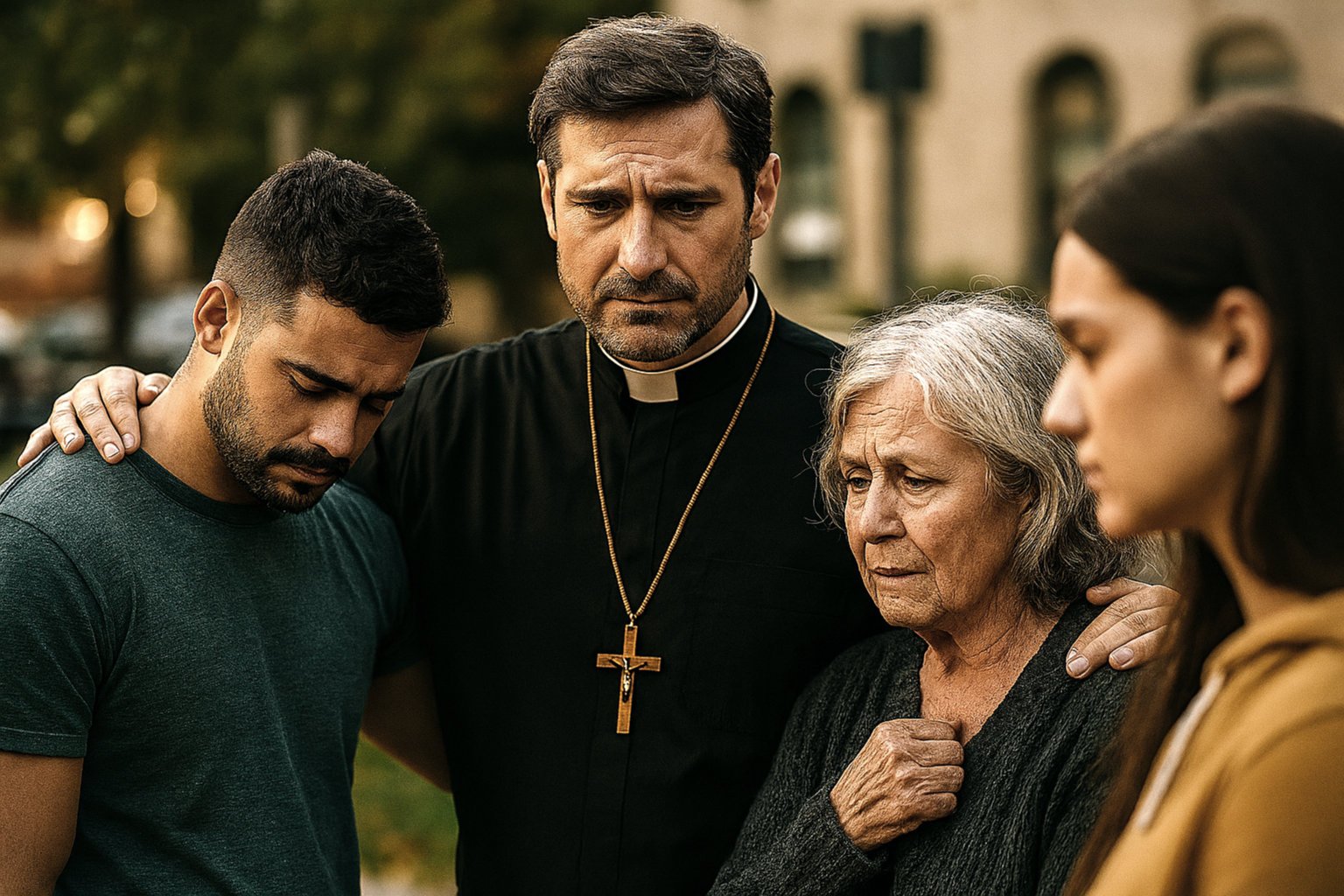
The family of the sick person are often the invisible sufferers in a hospital situation. All the attention — from medical staff, from visitors, from the wider community — is naturally and rightly focused on the patient. But the family members are carrying an enormous weight of their own. They are frightened. They are exhausted. They are managing the practical chaos of a life suddenly reorganised around hospital visiting hours. They may have children at home, jobs to maintain, other commitments that do not stop simply because someone they love is in hospital. And they are doing all of this while trying to appear calm and strong for the person in the bed.
Seeing the Family
One of the most valuable things a pastoral visitor can do is turn to the family member in the room and ask: 'And how are you doing?'
Not 'how is he doing' or 'how is she doing' — but how are you. This simple redirection of attention can unlock something significant. The family member who has been holding themselves together, who has been performing strength for everyone else, who has had no one ask them directly how they are bearing up — may find this question unexpectedly powerful. Be prepared for tears. Be prepared for a rush of words that have been dammed up for days. Be prepared for the real story to emerge, which may be quite different from the official version.
The real story might include: terror about what the diagnosis means. Exhaustion that goes beyond anything they have known before. Guilt — the particular, irrational, devastating guilt of the carer who had a cross word with their loved one before the ambulance came, or who did not notice the symptoms sooner, or who has occasionally, in the depths of exhaustion, wished it were over. Grief that has already begun, long before any loss has occurred. Anger — at the medical system, at God, at the randomness of it all.
None of these feelings should be fixed or corrected. All of them are normal. All of them deserve to be received with compassion and without judgement.
The Gift of Release
One of the most practical and most profound things you can offer a family member who is keeping vigil is the gift of release. This is the offer to sit with the patient for a period — an hour, an afternoon — so that the family member can go home, sleep, eat a proper meal, have a shower, see their children, do the ordinary things that help a human being continue to function.
This offer sounds simple. Its impact can be enormous. The family member who has not left the hospital in two days, who is sleeping in a chair and eating from a vending machine, who is afraid to leave in case something happens — this person needs permission to go. They need to know that someone trustworthy is present, that the person they love will not be alone, that it is acceptable to attend to their own basic needs.
Giving that permission — embodying it, sitting in the chair and saying 'go, I've got this, take your time' — is a pastoral act of genuine substance. It may not feel like ministry. It is ministry.
Listening to the Unspeakable
Family members in a hospital situation will often have thoughts and feelings they dare not voice. Not because the thoughts are wrong, but because they fear being judged for them, or because voicing them feels like a kind of betrayal, or because they are frightened of what it would mean to acknowledge what they actually think and feel.
They might be thinking: I cannot imagine life without this person and I do not know how I will survive it. They might be thinking: This is taking so long and I am so tired and I cannot sustain this. They might be thinking: We have unresolved things between us and I do not know how to address them now. They might be thinking: I find hospitals unbearable and every visit costs me more than I can explain.
The pastoral gift in these situations is to create a space in which unspoken things can be said. Sometimes this happens naturally, in a quiet corridor, away from the ward, over a cup of tea. Sometimes it requires a gentle and direct invitation: 'Is there anything you haven't been able to say to anyone? Because I'm not going anywhere, and nothing you say will shock me.'
That last phrase matters: nothing you say will shock me. It is one of the most liberating things a pastoral visitor can offer. It creates permission. It removes the fear of judgement. And it opens the door to conversations that can, in themselves, be healing.
The Long Haul of a Lengthy Illness
Not all hospital stays are brief. Some people are in hospital for weeks or months. Some are admitted, discharged, readmitted. Some are managing a chronic illness that brings them back to the ward repeatedly over years. For these situations, the pastoral challenge is one of sustained accompaniment — continuing to show up long after the initial surge of community concern has faded.
This is where pastoral care most often fails. The first week of a hospital admission, the church responds magnificently — visits, meals, cards, prayers. Six weeks later, when the patient is still there, the family is still exhausted, and the novelty has worn off — the visits thin out. The meals stop coming. The cards dry up. The family is left with the realisation that they are now dealing with something that the community found it could not sustain.
There is no easy solution to this, because it reflects a genuine human limitation. We cannot sustain crisis-level response indefinitely. But a community that is honest about this, that builds structures for the long haul rather than just the acute phase — a rota for visits, a system for meals, a designated person to maintain contact — does something that the individual visitor cannot do alone. It provides presence that does not depend on novelty or on emotional intensity. It provides the faithful, unspectacular accompaniment of the long road.
The Clinical World and the Pastoral World
One of the peculiarities of the hospital visit is that it takes place in an environment that has its own culture, its own language, and its own authority structures — and that pastoral visitors are guests in that environment, not residents. Understanding this, and navigating it with grace and humility, is an important pastoral skill.
The Language of Medicine
Medicine speaks a different language from ordinary life. Diagnoses, treatments, prognoses — these are expressed in terminology that can be impenetrable to those outside the medical world. Families often emerge from conversations with consultants with only a partial understanding of what has been said. They have heard the words, but the words have not fully landed. They are dealing with too much shock, too much fear, too much information arriving at once.
The pastoral visitor can play a valuable role here — not by interpreting the medical information (this is not your expertise and attempting it can cause harm), but by helping the family to articulate what they do and do not understand, and to formulate the questions they want to ask. 'Do you feel like you understood everything the doctor said? Is there anything you wish you had asked? Would it help to write down some questions before the next appointment?'
This is a form of advocacy — gentle, respectful, and carefully bounded within your actual competence. You are not a medical professional. You are not there to second-guess the clinical team. But you can help a family feel less lost in a world that is not their own.
Knowing When to Involve the Hospital Chaplain
Most hospitals have chaplains — trained professionals whose role is precisely the kind of spiritual and pastoral care we are discussing in this article. They know the hospital environment intimately. They have relationships with the staff. They can access parts of the hospital that community visitors cannot. They are experienced in accompanying people through illness, crisis, and death.
The community pastoral visitor is not in competition with the hospital chaplain. They are complementary. The chaplain provides professional pastoral care within the hospital system; the community visitor provides the continuity of relationship — they are the person who knew the patient before illness, who is part of the community they will return to, who carries the accumulated history of a shared life of faith.
If the situation is complex — if there are spiritual crises or theological questions that feel beyond your competence, if the patient would benefit from anointing or communion that requires an ordained minister, if the family needs sustained pastoral support that exceeds what you can offer as a volunteer visitor — do not hesitate to contact the hospital chaplain. They will be grateful for the contact, and the patient and family will be better served.
Dignity and Advocacy
Hospitals, for all their extraordinary capabilities, are not always environments in which the dignity of the patient is fully maintained. This is rarely the result of ill will — it is more often the consequence of systemic pressure, shortage of staff, and the sheer volume of need. But the effect on the patient can be significant.
The pastoral visitor who witnesses a situation in which a patient's dignity is being compromised — whether through a lack of privacy, an insensitive conversation, a dismissive manner — faces a delicate challenge. You are a guest in this environment. You have no formal authority. And yet you have a moral responsibility to the person in your care.
The wisest approach is usually gentle and direct: address the concern to the relevant member of staff, privately and respectfully, without accusation. 'I wonder if it might be possible for [name] to have a bit more privacy when...' This approach is far more likely to achieve the desired outcome than a confrontational one, and it models the kind of respectful advocacy that honours everyone involved.
If the concern is serious enough — if you believe the patient's welfare is at risk — do not hesitate to raise it with a senior member of staff or the ward manager. But choose your moments with care, and always begin from a posture of respect rather than confrontation.
Sacred Space in a Clinical Place
Hospitals can feel like the least spiritual places on earth. The fluorescent lighting, the institutional furniture, the constant background noise of a busy ward — none of it is conducive to a sense of sacred encounter. And yet the hospital has always been, in the history of the church, a place of profound spiritual significance. The very word 'hospital' shares its root with 'hospitality' — it is, at its origins, a place of welcome for the suffering stranger.
Within the clinical environment, there is almost always a chapel or a multifaith prayer room. And within any encounter between a pastoral visitor and a sick person, the potential for sacred space exists — regardless of the setting.
The Hospital Chapel
The chapel or multifaith prayer room in a hospital is one of the most underused and most important spaces in the building. It is a place apart — away from the noise and the busyness and the clinical apparatus of the wards. It is a place where tears can be shed without embarrassment, where prayers can be prayed, where silence can be inhabited without feeling out of place.
Many families do not know the chapel exists, or feel that they are not the sort of people who would go to such a place, or assume it is only for people of formal religious commitment. Part of the pastoral visitor's gift is to introduce them to it — to say, simply, 'There's a chapel here. Some people find it helpful. Would you like me to show you where it is?' Even if the family member never goes, the knowledge that it is there can be a comfort.
For the pastoral visitor, the chapel can be a place of preparation and decompression — a place to sit for a few minutes before a visit, to pray, to gather yourself, and a place to return to afterwards, to set down what you have carried.
Prayer at the Bedside
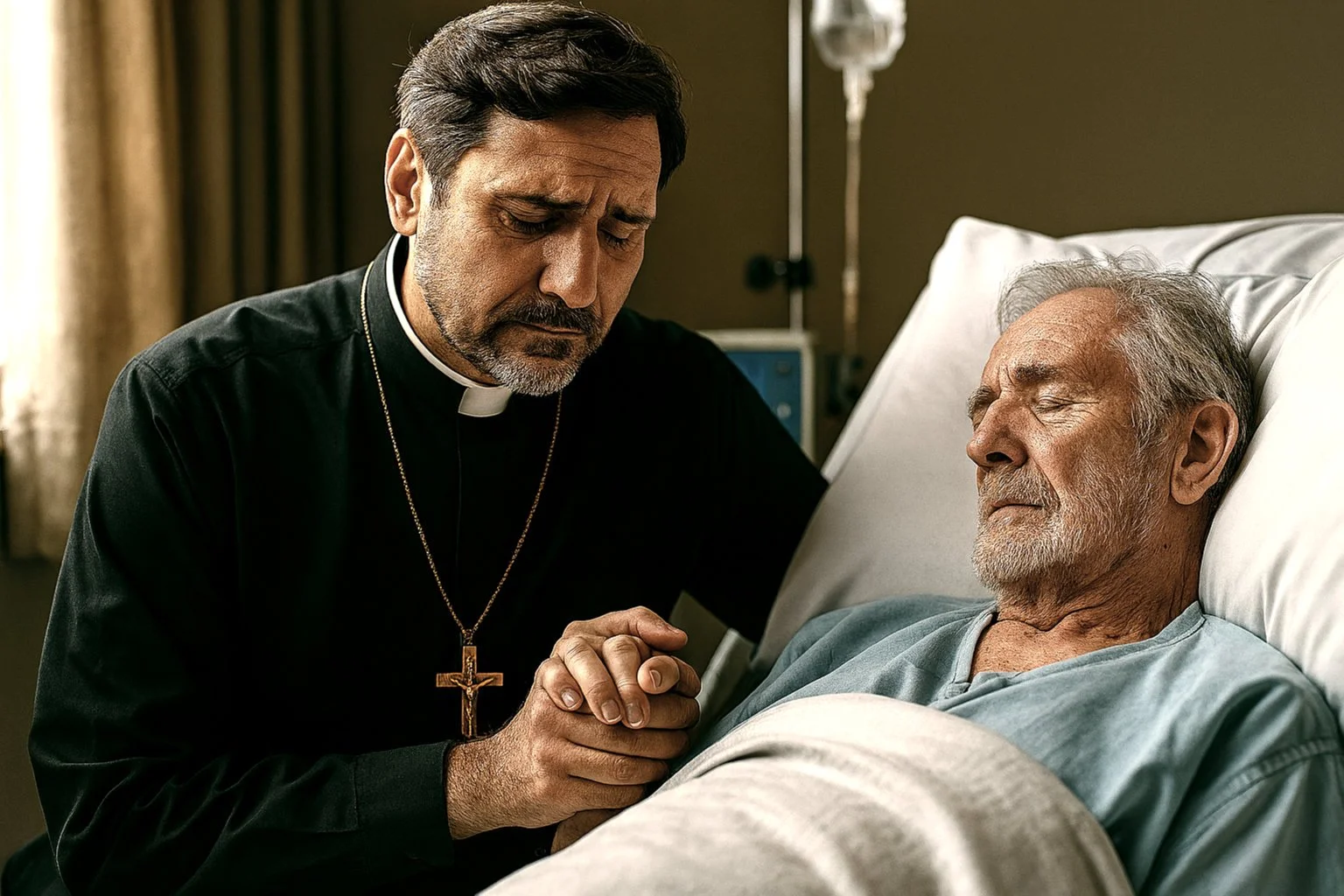
Recall:
Prayer is one of the most powerful and most delicate tools in the pastoral visitor's repertoire. Powerful, because it does something that nothing else in the pastoral encounter does — it brings the situation explicitly before God, it names what is real, it places the person and their suffering in the context of a larger story.
Prayer is one of the most powerful and most delicate tools in the pastoral visitor's repertoire. Powerful, because it does something that nothing else in the pastoral encounter does — it brings the situation explicitly before God, it names what is real, it places the person and their suffering in the context of a larger story. Delicate, because done badly, it can feel imposed, performative, or — perhaps most damagingly — like a way of ending a conversation that has become uncomfortable.
A few principles for bedside prayer.
Always ask first. 'Would you like to pray together?' This is not a formality — it is a genuine question that respects the autonomy and the spiritual state of the person in the bed. They may say yes. They may say not today. They may say they don't know how they feel about prayer right now. All of these answers are valid and should be received without disappointment or pressure.
Keep it honest. The bedside prayer that consists of upbeat affirmations of God's goodness and the certainty of healing can feel, to a person who is frightened and in pain, like a profound disconnection from reality. The most powerful bedside prayers are often the ones that speak honestly — that acknowledge the fear, the pain, the uncertainty; that name the thing rather than spiritualising it away. The psalms of lament are a masterclass in this kind of honest prayer. 'How long, O Lord?' is a perfectly legitimate thing to say to God from a hospital bed.
Hold their hand if appropriate and if welcome. Physical touch, done with respect and sensitivity, can communicate what words cannot. A hand gently held during prayer creates a connection — a tangible, physical reminder that you are there, that they are not alone, that someone is present to their suffering.
And sometimes — when the person is very ill, or barely conscious, or beyond the capacity for sustained engagement — pray for them rather than with them. Say the words aloud, gently, as a gift. A blessing. A commendation. The prayer does not require the person to respond in order to be real.
Simple Liturgical Acts
Beyond prayer, there are other sacramental and liturgical acts that can be profoundly meaningful in the hospital setting. The Eucharist, brought to a bedside, can be an extraordinary gift — the tangible presence of the community, the physical act of receiving bread and wine, the reminder that this person is still part of the body of Christ even from a hospital bed. Anointing with oil, where this is practised in your tradition, carries centuries of pastoral weight and can be a moment of remarkable spiritual intensity.
These acts require appropriate authorisation and sensitivity to the person's own tradition and wishes. But for those who welcome them, they can do something that no amount of good conversation can fully replicate. They bring the whole company of heaven into the hospital room. They locate this particular suffering in the vast, redemptive narrative of Scripture. They say, in a language older than words: you belong. You are held. You are not alone.
Even simpler: reading a psalm aloud. Saying the Lord's Prayer together. Singing, very quietly, a hymn the person loves. These are small things and enormous things simultaneously. They carry the accumulated weight of centuries of Christian prayer. They connect the person in the bed to a community of faith that stretches backwards through history. And they can bring, in the middle of the fluorescent clinical world, a moment of genuine and unmistakable holiness.
What Not to Say — and What to Say Instead
We come now to the section that will, I suspect, generate the most recognition and perhaps the most relief. Because one of the most anxiety-inducing aspects of the pastoral hospital visit is the fear of saying the wrong thing. And the truth is that many of us have said the wrong thing. We have said it with the best of intentions. And we have, in some cases, done real and lasting harm.
This is not a section designed to create shame or to make pastoral visitors afraid to open their mouths. It is designed to free them from the tyranny of trying to say the right thing — because, as we shall see, the best pastoral speech is often the simplest and the most honest, and it is available to everyone.
The Things We Say That Do Not Help
Let us name them honestly.
'Everything happens for a reason.' This is perhaps the most common and most damaging piece of pastoral shorthand in the English-speaking world. It is intended to comfort. It frequently does the opposite. To the person lying in a hospital bed, frightened and in pain, the suggestion that their suffering has a reason — that it is, in some sense, intended — can raise more questions than it answers. Who intended it? What could possibly justify it? Is God teaching me a lesson? Am I being punished? These questions, raised by the phrase in ways the speaker never anticipated, can be spiritually devastating.
The Christian tradition has a great deal to say about suffering. It has the book of Job, which refuses easy answers. It has the psalms of lament, which give voice to anguish and abandonment without resolution. It has the cross, which tells us that God enters suffering rather than explaining it. None of this is captured by 'everything happens for a reason.' It is worth leaving the phrase behind entirely.
'God won't give you more than you can handle.' Another well-meant and theologically problematic reassurance. Leaving aside the question of whether this is actually taught in Scripture (the passage usually cited — 1 Corinthians 10:13 — refers to temptation, not to suffering in general, and is almost universally misapplied in this context), it simply does not match the experience of many people in serious illness. Many people find themselves given more than they can handle. Many people are broken by what happens to them. To be told, in the midst of that breaking, that God has calculated it to be within their capacity is not comforting. It is isolating. It implies that if they are struggling, they are somehow failing.
'At least...' — followed by any number of completions. 'At least it's not worse.' 'At least you have your family.' 'At least they caught it early.' The 'at least' construction is a well-intentioned attempt to provide perspective. Its effect is to minimise. When someone is suffering, they do not need perspective. They need acknowledgement. The person in front of you is not experiencing 'at least' — they are experiencing the full weight of what is happening to them. Meet them there.
'I know how you feel.' You almost certainly do not — and even if you have had a similar experience, this moment belongs to them, not to you. The risk with this phrase is that it redirects attention from the person who is suffering to the person who is visiting. This is the opposite of what the moment requires. Even if your own experience is relevant and might eventually be shared helpfully, this is not the moment for it.
'You just need to trust God.' This one stings because it carries an implied criticism — that the person's fear or anguish or doubt represents a failure of faith. The person in the hospital bed may be trusting God with everything they have, and still be terrified. Trust and fear are not mutually exclusive. The psalms make this abundantly clear: 'My God, my God, why have you forsaken me?' is a cry of faith, not a failure of it.
What to Say Instead
Here, then, is the good news: the most helpful things to say in a pastoral visit are almost always the simplest, the most honest, and the most human. They require no theological sophistication. They require only the willingness to be present and to speak truthfully.
I don't know what to say, but I didn't want you to be alone.
This is one of the most powerful sentences a pastoral visitor can speak. It is honest. It is humble. And it communicates the most important thing: I chose to be here. My presence is deliberate, even in the absence of words.
You don't have to be strong right now.
This sentence gives permission. For many patients, especially those who feel the pressure of maintaining morale for the sake of their family, this can be an enormous release. You do not have to perform courage or faith or optimism for me. You can be exactly where you are.
I'm not going anywhere.
Three words that speak directly to one of the deepest fears of the sick person: abandonment. Illness isolates. The world carries on without you. People have lives. And yet: I am not going anywhere. I will stay.
Tell me about what it's been like.
This is an invitation rather than a question. It opens the floor entirely. It does not specify what kind of answer is expected. It simply says: I want to hear your story. I have time. I am interested. You matter enough for me to want to know.
And sometimes — perhaps most profoundly — no words at all. A hand held. A presence maintained in silence. A willingness to sit with what cannot be fixed or explained or improved, and to let that willingness be enough. Because it is. It is more than enough. It is, in its own quiet way, a form of proclamation: love that does not require anything in return, presence that does not depend on outcome, faithfulness that does not evaporate in the presence of suffering.
That is the pastoral word that can only be spoken with the whole of one's being. And it is available to every one of us.
The Walk Back Out — Caring for the Carer
We began this article in a hospital car park, with the pastoral visitor gathering courage before going in. We end it, fittingly, in the same place — but now you are walking back out.
The visit is over. You have sat by the bed. You have listened to things that were hard to hear. You have held a hand, perhaps, or prayed a prayer, or simply been present in the room with someone's fear and pain. You have walked the corridors with a family member and heard things they have not said to anyone else. You have done something that required courage to begin and sustained presence to maintain.
And now you are walking back through the automatic doors, back into the ordinary world, back to your car. And you may be carrying more than you expected.
The Cost of Accompaniment
Pastoral care of the sick has a cost. It is a cost that is rarely spoken about openly in church communities, because we tend to hold up this ministry as a privilege and a calling — which it is — without being equally honest about what it asks of those who undertake it.
It asks you to enter, repeatedly, environments that most people instinctively avoid. It asks you to be present to suffering without the option of looking away. It asks you to hear stories that stay with you, to carry concerns that you cannot fully set down, to maintain a quality of attention and compassion over time that is genuinely demanding. If you are doing this regularly — visiting several sick members of your congregation, accompanying families through extended illness — the accumulated weight of that work is real and should be named.
What you feel when you leave a difficult hospital visit may include: grief, for what you have witnessed. Helplessness, because there is so much you could not do. Fear, because what you have seen has reminded you of your own mortality. Exhaustion, because genuine presence is emotionally demanding. And sometimes — in quieter moments — a kind of awe, because you have been allowed into something sacred, and that is not nothing.
The Pastoral Carer Needs Pastoral Care
Here is a truth that communities of faith often fail to embody: the person doing the visiting needs to be visited too. The person providing pastoral care needs pastoral care themselves. The companion on another person's road also needs a companion on theirs.
This is not weakness. It is wisdom. It is the basic recognition that human beings have limits, and that those who regularly press against those limits in the service of others need support, reflection, and care if they are to sustain the work without burning out or becoming compassion-fatigued.
If you are a pastoral visitor, please find someone — a supervisor, a spiritual director, a trusted colleague or minister — with whom you can process what you carry. Not to gossip about the people you visit, but to tend to your own soul. To name what the work is doing to you. To receive care in turn.
And if you are a church leader or pastor overseeing a team of pastoral visitors — please build this into your structure. Do not assume that those doing the visiting are fine simply because they are not complaining. Check in with them. Offer debriefing. Create space for the team to support one another. The sustainability of pastoral care for the sick depends, more than we usually acknowledge, on the health of those who provide it.
The Long Walk
We return, at the end, to the road to Emmaus. Those two disciples walked with a stranger who turned out to be the risen Christ. And when they finally recognised him — in the breaking of bread, in that ordinary and extraordinary moment — he vanished from their sight.
They went back to Jerusalem. They walked the same road they had just come down, but in the opposite direction now, with burning hearts, with a story to tell. The walking had not solved anything. The grief was still real. The confusion had not entirely cleared. But something had shifted in the course of the companionship, and they were different for it.
This is, I think, the most honest and the most hopeful thing that can be said about the ministry of accompanying the sick. You will not heal them. You will not always know what to say. You will sometimes say the wrong thing, and you will sometimes miss the moment, and you will sometimes walk away feeling as though you have failed. You will carry things that are heavy. You will be asked to stay present to realities that frighten you.
And yet. In the choosing to show up. In the falling into step. In the listening before speaking, the staying before leaving, the praying when words run out. In all of this — in all of the ordinary, costly, faithful, unheroic practice of walking alongside — Christ himself is made present. Not because you are extraordinary. But because you showed up.
That is the whole of it. That is enough. That is, in the end, everything.