
H₂Oh! Understanding the Holy Trinity Through Water
It's ice. It's steam. It's the stuff in your kettle. And somehow, it might just be the best classroom lesson for one of Christianity's greatest mysteries.
Raise your hand if you've ever sat in a pew, a Sunday school class, or a late-night dorm room conversation and thought: "The Holy Trinity? Sure. Absolutely. Three-in-one. Totally got it." — while absolutely not getting it. 😂
Don't worry. You're in excellent company. Theologians have been wrestling with the doctrine of the Trinity since the Council of Nicaea in 325 AD, and the debate has been lively enough to make modern Facebook arguments look like polite tea parties. In fact, one bishop reportedly punched another bishop in the face over it. At a church council. Which, when you think about it, is an extremely committed way to do theology. 🤨
The Trinity — the belief that God is one Being in three distinct Persons: Father, Son, and Holy Spirit — is genuinely one of the most intellectually demanding ideas in all of religious thought. It isn't meant to be easy. But that doesn't mean we can't find helpful footholds along the way.
So let's talk about water.
Not in a metaphysical "living water" sense (though that conversation is lovely and we'll get there). I mean the stuff you boiled this morning for your coffee. The stuff you slipped on in its ice form last winter. The invisible stuff rising from your shower that fogs up the bathroom mirror. That water. Because H₂O — humble, universal, taken entirely for granted — turns out to be one of the richest natural analogies for understanding how something can be genuinely one and yet exist in three genuinely distinct modes.
Let's dive in. Carefully. The ice is slippery.
State One - The Father: Water in Its Liquid Form
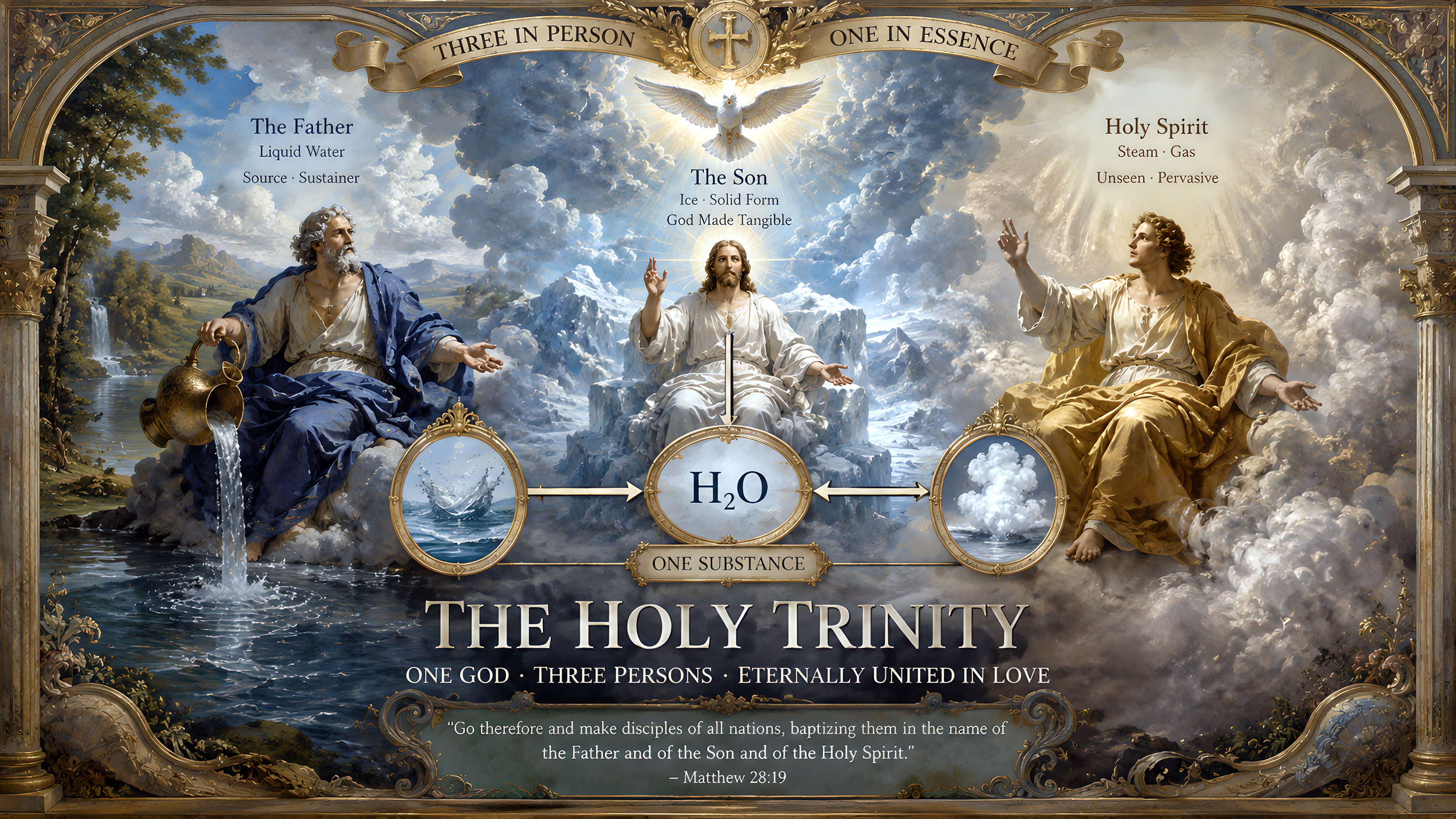
Begin with liquid water… Water in what we might call its primary, most recognisable state. It's the state we reference by default when we say "water." It is the source, the foundation, the sustainer of life.
In the Christian theological tradition, God the Father is understood as the source of all things — the Creator, the uncaused cause, the one from whom all existence flows. And just as liquid water is the form from which the other states emerge (ice forms when liquid water freezes; steam rises when liquid water is heated), the Father is classically understood as the fount of the Godhead, from whom the Son is eternally generated and the Spirit eternally proceeds.
Think about what liquid water does. It finds its level. It fills the shape of whatever container it inhabits. It is persistent, present, and quietly foundational to everything alive. Remove it, and nothing else functions. It doesn't announce itself with drama; it simply is, and everything depends on it being so.
Scripture Quote:
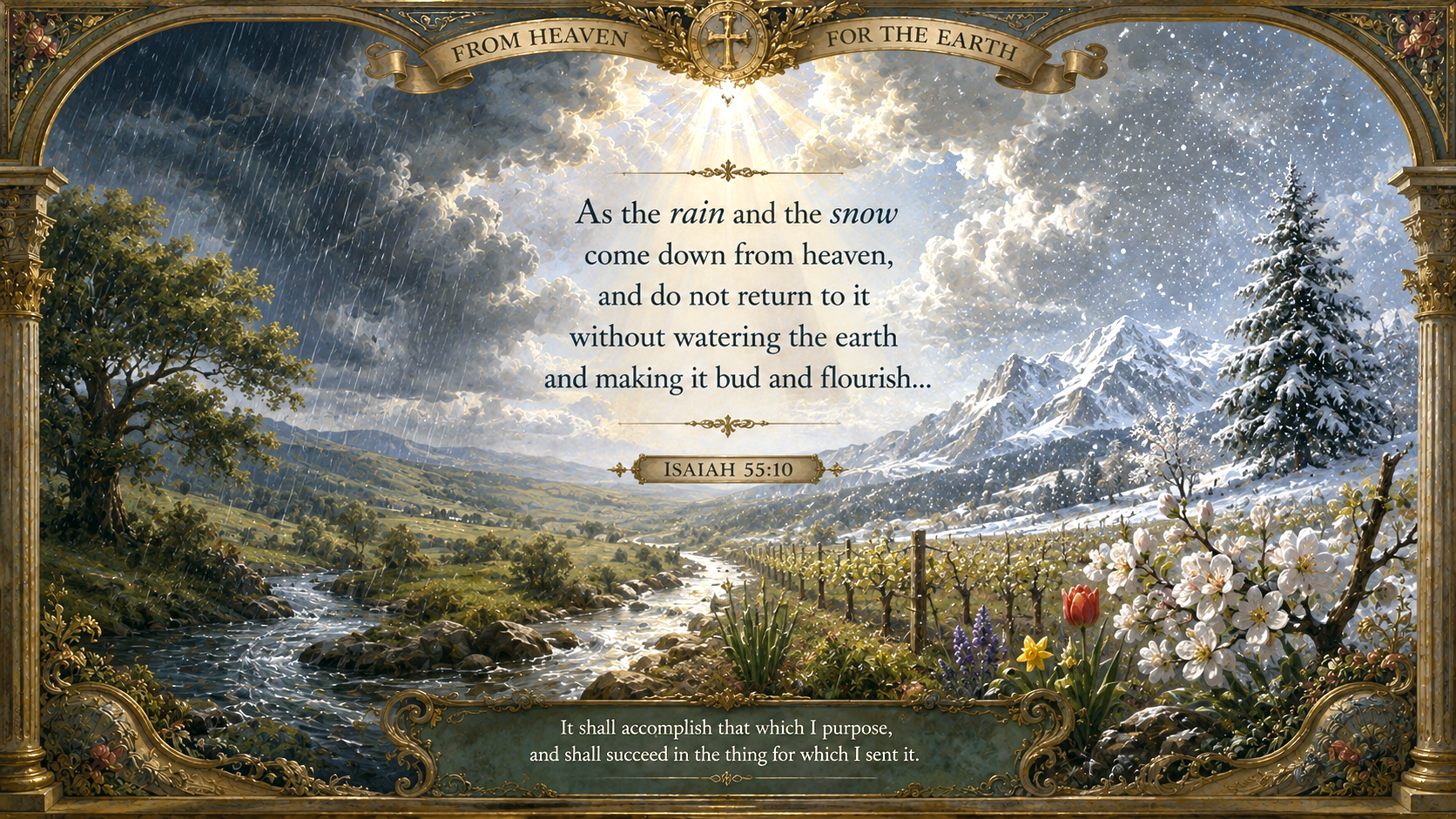
"As the rain and the snow come down from heaven, and do not return to it without watering the earth and making it bud and flourish..." — Isaiah 55:10
This is a rather good picture of how Christian theology has long spoken about the Father: omnipresent, sustaining, the invisible backdrop to all of created reality. Not absent, but not always the most immediately visible. Like water itself, we tend to notice the Father most acutely when something in our lives is parched and in need.
And here's where the analogy starts to earn its keep: liquid water is not more water than ice or steam. It is not the "real" water while the others are knockoffs. All three states are equally, fully H₂O. Similarly, the Father is not "more God" than the Son or the Spirit. Each person of the Trinity is fully, completely, ontologically God — not a third of God, not a department of God, but the whole thing, distinctly expressed.
A Note on Limitations
Every analogy limps, and this one is no different. The key difference to keep in mind is that the three states of water cannot coexist under normal conditions. You can't have ice, liquid water, and steam all being the same water at the same time in the same place. But the Trinity does not work in shifts. The Father, Son, and Spirit are not taking turns being God. They are co-eternal, co-equal, and simultaneously present — always. We'll come back to this. For now, let the analogy carry you forward, not all the way.
State Two - The Son: Water Made Solid
Now things get interesting. Take that same water — same molecular composition, same essential nature — and cool it down. Drop it below zero degrees Celsius and something remarkable happens: water becomes tangible. Holdable. Visible in a new way. It takes on fixed form, occupies definite space, and can be picked up and handed to someone.
Christian theology describes the Son — Jesus of Nazareth — as God taking on human form. The Gospel of John opens with one of the most extraordinary sentences in religious literature: "The Word became flesh and dwelt among us." God, who in some sense permeates everything and transcends everything, became localised, embodied, solid. You could look at him. Touch him. Ask him questions over dinner. Watch him get annoyed at fig trees (Mark 11 — genuinely worth reading; it's delightfully odd). 😁
This is what theologians call the Incarnation, and it is, by any measure, a staggering claim. The Infinite in a finite frame. The Eternal within time. It is the most dramatic event in cosmic history, and the water-to-ice transition is — admittedly imperfectly — one of the more intuitive ways to picture the logic of it.
When water freezes, it hasn't stopped being water. It hasn't abandoned its essential H₂O nature and become something else entirely. It remains fully itself — but it has taken on a form that allows it to be encountered in a new, tangible way. Ice can do things liquid water cannot: it can bear weight, it can be carved, it can be placed in your hand and held. It has a specificity and a locatedness that liquid water does not.
And so with the Son. The claim is not that God stopped being God and became a man as if in disguise — some supernatural Clark Kent who hung up his cape in Bethlehem. The claim is that God, remaining fully God, also became fully human. The early church creeds were at pains to articulate this: "fully divine and fully human" — not 50/50, not mostly one and a bit of the other, but the whole thing on both counts.
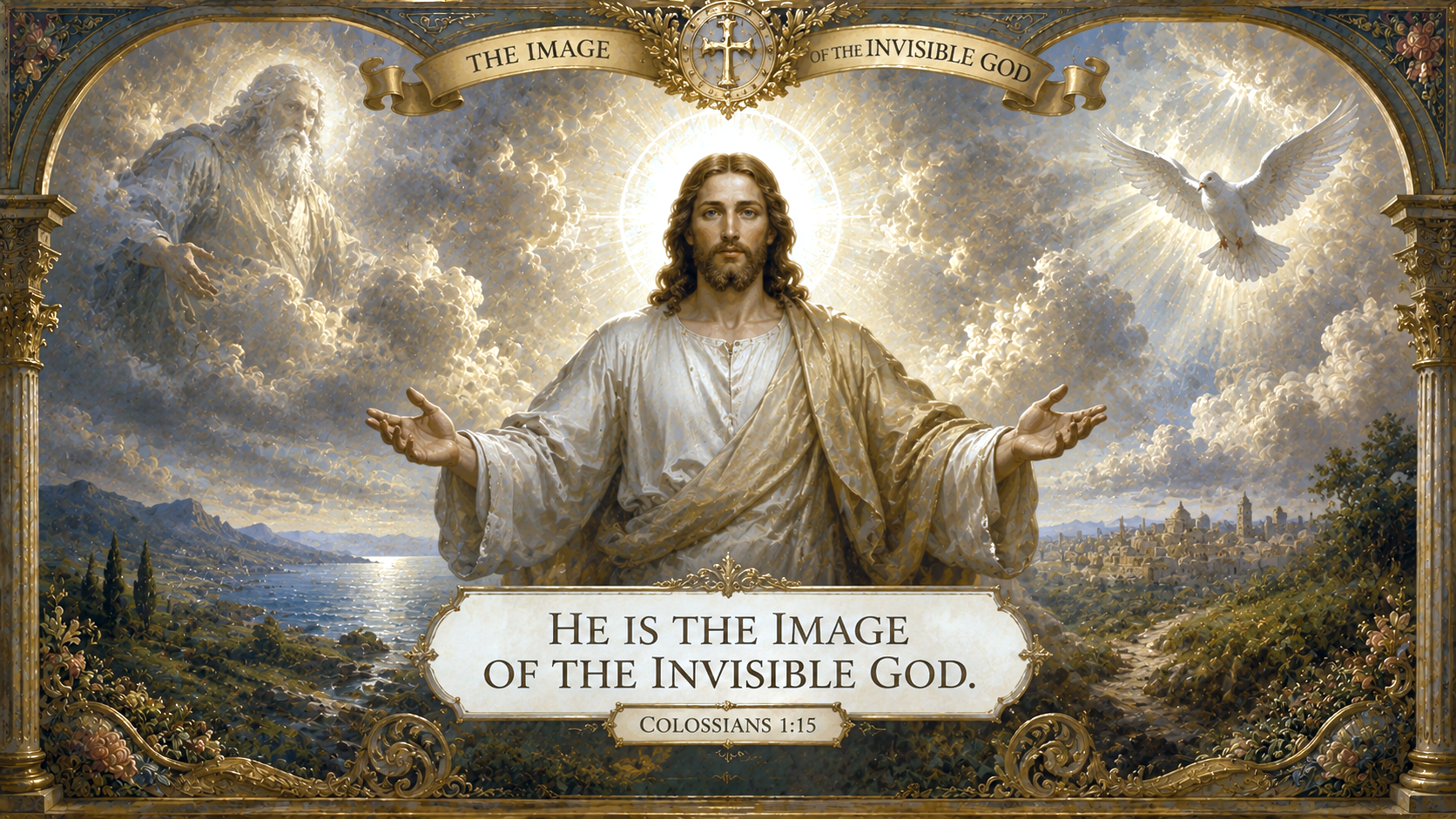
Scripture Quote:
"He is the image of the invisible God." — Colossians 1:15
This is the Incarnation's essential grammar: the invisible made visible, the intangible made graspable — like the moment liquid water crystallises into a form you can actually hold in your hands.
There's something else worth noting about ice. It has the same chemical formula as water. If you were to analyse a sample of ice and a sample of liquid water in a laboratory, you would find them to be identical in composition. No one would say, "Ah yes, this ice is merely like water, but not genuinely water." Ice is water. Period. This matters theologically, because one of the oldest heresies surrounding Jesus was the suggestion that he was merely like God, of similar substance — but not the real thing. The Council of Nicaea's ringing rejection of that position was to insist: same substance, fully, without qualification. The ice is not "merely water-adjacent."
State Three - The Holy Spirit: Water Set Free
And then there is steam.
Increase the temperature past 100 degrees Celsius and water does something rather extraordinary: it becomes invisible. It disperses. It moves where it will. You cannot grab it, contain it easily, or point to it and say "there it is." And yet it is everywhere — present throughout a room, capable of rising to the ceiling, of slipping through gaps, of moving across great distances. It is water in its most dynamic, pervasive, uncontainable form.
The Holy Spirit has, in Christian theology, always been the hardest person of the Trinity to pin down — and perhaps that is entirely appropriate. Jesus himself, talking to a religious leader named Nicodemus, made an analogy of his own: "The wind blows wherever it pleases. You hear its sound, but you cannot tell where it comes from or where it is going. So it is with everyone born of the Spirit." (John 3:8) The Greek word for Spirit in the New Testament is pneuma — which also means breath, or wind. The Hebrew equivalent, ruach, carries the same layered meaning.
The Spirit is, in the classical tradition, the person of the Trinity who is most immediately present with us now — the one who, according to Christian belief, dwells within believers, moves through communities, animates prayer, inspires the imagination, and shows up in places no one was expecting. Like steam, the Spirit is not less real for being invisible; if anything, invisibility is part of what makes the Spirit so utterly pervasive.
Think about what steam actually does. It carries energy. It can drive turbines. It rises — always upward. It penetrates. It is water in a state of maximum freedom, unbound by the particular shape of any container, moving according to thermodynamic principles that the steam itself, in a manner of speaking, embodies. It warms the rooms it fills. It is powerful beyond what its invisibility might suggest.
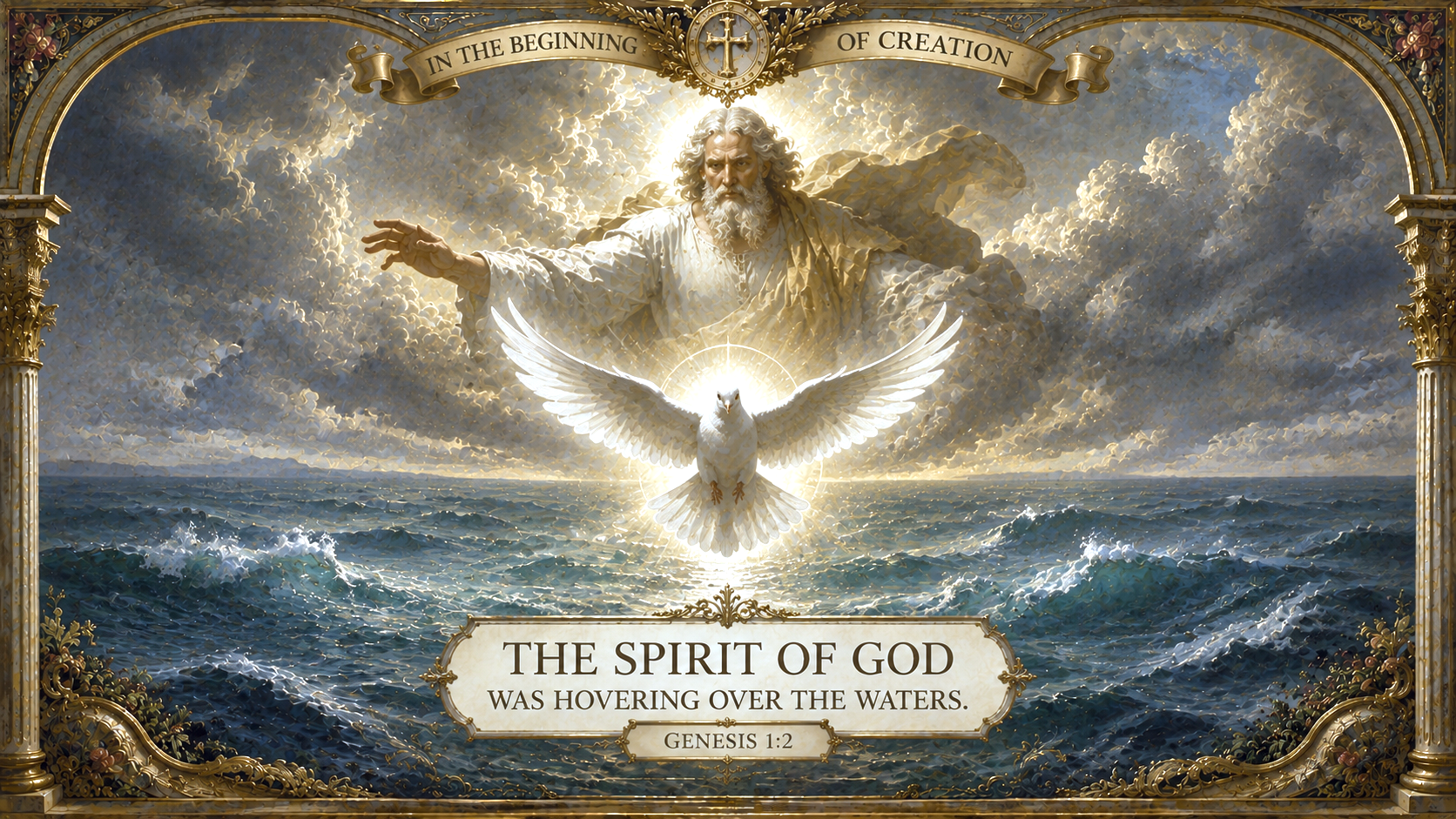
Scripture Quote:
"The Spirit of God was hovering over the waters." — Genesis 1:2
The very first description of the Holy Spirit in Scripture places the Spirit in motion — hovering, brooding, active over the primordial deep. It is a picture of creative energy at the very dawn of existence. Not a passive presence, but a dynamic one. Steam is perhaps the only state of water that genuinely captures something of that active, free-ranging, energetic quality.
And here again: steam is not "less water" for being invisible. A room full of steam is a room full of water. The Spirit, Christian theology insists, is not a lesser emanation of God or a kind of divine afterthought. The Spirit is fully God — present, active, real — even when (especially when) you cannot see exactly where the Spirit is or where the Spirit is going.