
MY BOOK ABOUT THE MALE PRIESTHOOD AND WHY I WROTE IT
Precedent and Mandate: Why
I Wrote The Male Priesthood
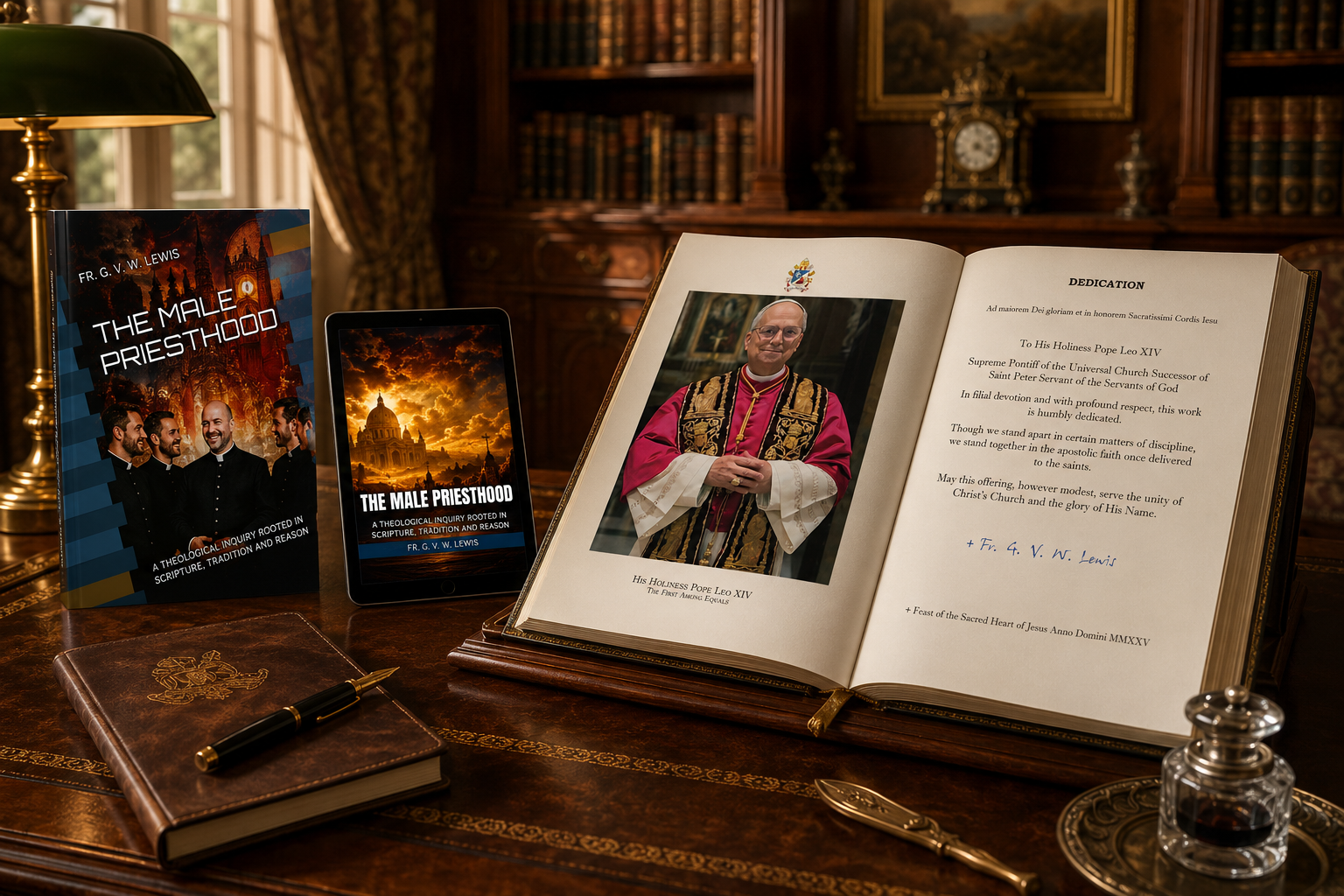
There are some questions a writer chooses, and others that choose the writer. The question of who may be ordained to the priesthood is, for me, very much the latter. It is a question that has followed me through years of ministry, study, and conversation — with seminarians, with fellow clergy, with faithful women who have felt called to serve at the altar, and with sceptics who simply want to understand why so many ancient churches still hold the line they do. The Male Priesthood: Precedent and Mandate is my attempt to set down, as carefully and as honestly as I can, what I believe the answer to be and why.
A question that will not go away
For most of Christian history, the question of who could be ordained was not really a question at all. It was settled practice, inherited without controversy across East and West. That changed in the twentieth century. Beginning with various Anglican provinces in the 1970s, and spreading through most of mainline Protestantism, churches began ordaining women to the priesthood and episcopate. The Old Catholic churches of the Union of Utrecht — communities with whom my own institute shares deep historical ties — followed in the 1990s, a decision that opened new divisions within the wider Old Catholic family.
Meanwhile, the Roman Catholic Church, the Eastern and Oriental Orthodox churches, and the Assyrian Church of the East have maintained, without exception, the practice of ordaining only men. Calls for reconsideration continue within Roman Catholicism despite repeated and definitive statements from the magisterium that the matter is closed.
RECALL:
The Roman Catholic Church, the Eastern and Oriental Orthodox churches, and the Assyrian Church of the East have, without exception, maintained the practice of ordaining only men.
So here we are: a question that much of the Christian world considers settled in one direction, and a smaller but ancient and significant portion considers settled in the other. That is not a comfortable place for ecumenism, and it is not a question that can simply be left to one side. It touches on Christology, on the nature of the sacraments, on what it means for a priest to act in persona Christi, and ultimately on whether the Church has the authority to change what she believes she has received from Christ Himself. These are not small matters. They sit close to the heart of the deposit of faith.
Why I am positioned to write about this
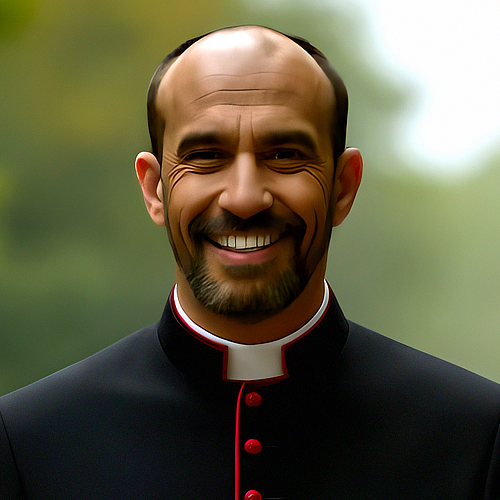
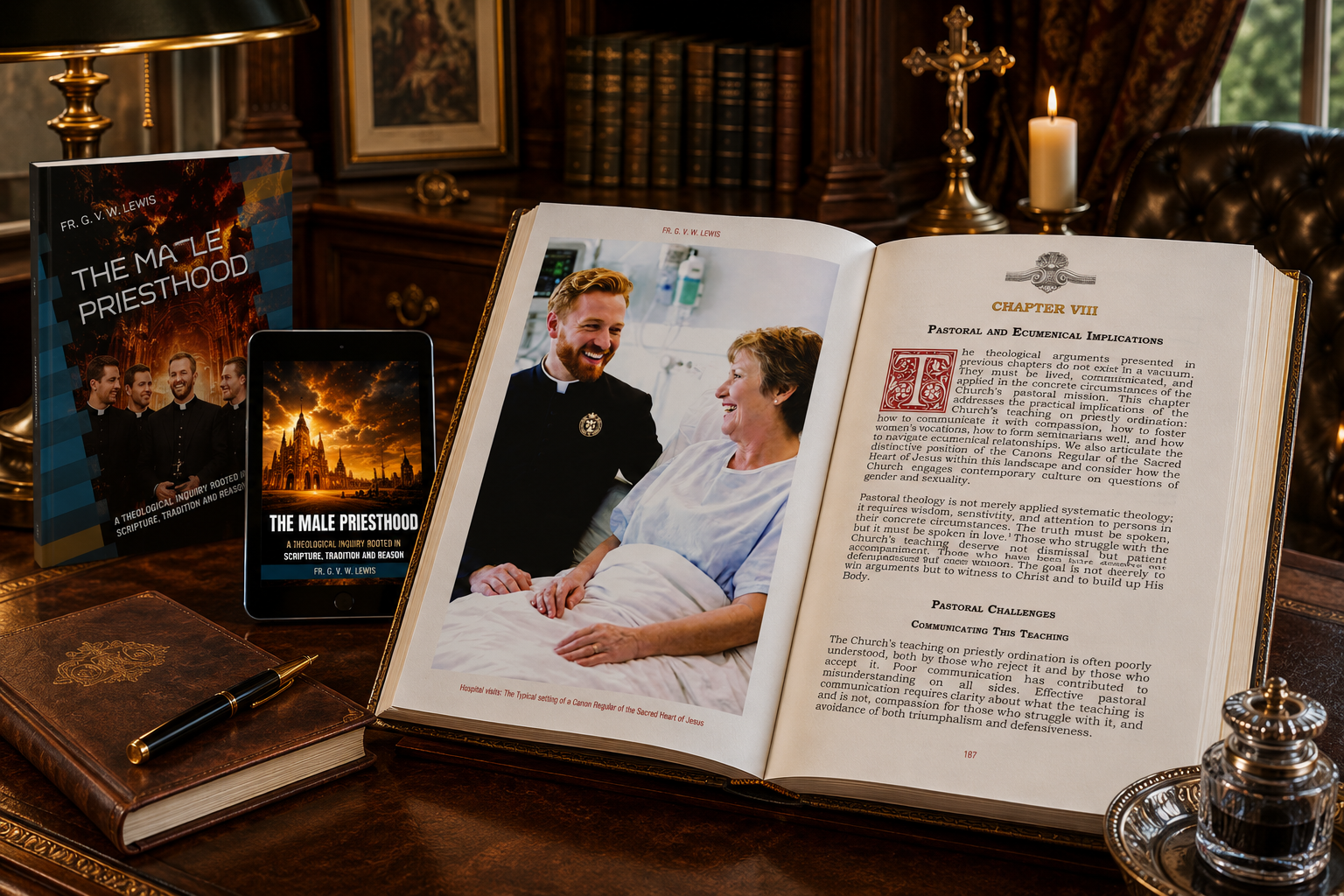
I write as a priest of the Old Catholic tradition, serving within the Canons Regular of the Sacred Heart of Jesus — an institute that occupies, I think, an unusually interesting vantage point for this conversation. We are independent of Rome's juridical authority, yet in deep theological sympathy with the Roman Catholic tradition. We celebrate the Roman liturgy. We hold to the apostolic faith of the undivided Church of the first millennium.
And yet — and this is the part people often find surprising — we have also embraced pastoral accommodations that set us apart from Rome. We ordain married men. We do not exclude the divorced and remarried from the sacraments. We extend a full and genuine welcome to lesbian, gay, and bisexual Catholics who have too often found themselves pushed to the margins elsewhere.
I mention this not to claim any particular virtue, but because it matters for understanding the book. We are not traditionalists who reject all development. Our very existence as a community testifies to the opposite: that the Church can and must respond pastorally to the needs of the people in front of her. So when a community like ours — one that has shown itself willing to adapt discipline where discipline can be adapted — nonetheless holds firmly to a male-only priesthood, that position deserves to be taken seriously on its own terms, rather than dismissed as simple conservatism or reflexive resistance to change.
What we hold, in short, is that radical inclusivity and fidelity to the sacraments as Christ instituted them are not in tension. They flow from the same conviction: that the Gospel is for everyone, and that the sacraments are not infinitely malleable to the preferences of any age, including our own.
What the book argues
The book rests on two pillars, which I have called Precedent and Mandate.
By Precedent, I mean the unbroken witness of Scripture and Tradition — the universal practice of the apostolic churches across two thousand years, and the consistent teaching of the Fathers on this question. This is not a case of one or two ambiguous texts; it is a pattern of practice maintained, without serious exception, across enormously diverse cultures, centuries, and ecclesial contexts.
By Mandate, I mean something more specific: the institution of the Eucharist itself. At the Last Supper, Christ gathered the Twelve — and the Twelve alone — and gave them the command, "Do this in memory of me." Taken together, Precedent and Mandate are meant to show something stronger than mere historical inertia: that the Church ordains only men not out of habit, but in what she understands to be obedience to the explicit will of her divine Founder.
RECALL:
The book rests on two pillars, which I have called Precedent and Mandate.
I want to be honest about something else, too: this book does not claim to say anything new. The arguments for a male-only priesthood have been made before, by scholars and churchmen with far more learning than I can claim. What I have tried to do is gather these arguments into one accessible, carefully reasoned synthesis — one that takes the strongest objections seriously, represents them fairly, and responds to them with argument rather than dismissal. Where I have failed to do that fairly, the fault is mine alone.
Why I wrote it the way I did
I could have written a shorter, sharper polemic. I chose not to, for a simple reason: this question causes real pain to real people. Many faithful Roman Catholic women have discerned, with sincerity and depth of love for Christ and His Church, a call to priestly ministry. I do not doubt that sincerity for a moment, and I did not want to write a book that treated their experience as a problem to be argued away.
At the same time, I could not write a book that simply avoided the hard parts of the argument out of a desire not to give offence. That would have been its own kind of dishonesty — and ultimately less respectful to everyone involved, including those who disagree with me. So I tried to walk a narrower path: to engage the strongest form of the opposing arguments, to let those who hold them speak in their own voices as far as possible, and to explain — as clearly and charitably as I know how — why I nonetheless believe the Church's consistent practice reflects something other than arbitrary discrimination.
Whether or not a reader agrees with my conclusions, I hope they will recognise that the question has been approached with the seriousness it deserves.
What I hope the book does
I do not expect The Male Priesthood to end the debate — no single book could, and this is far too large a question for that. What I hope, more modestly, is threefold.
First, that it gives readers — whatever their starting position — a clear and honest account of why so much of the Christian world, East and West, ancient and modern, continues to hold this line.
Second, that it models a way of disagreeing about something that matters without losing sight of the people on the other side of the disagreement. The Church's unity is fragile enough already; arguments conducted in bad faith only make the wounds deeper.
And third — and this is the hope closest to my heart — that the book might, in some small way, serve the truth. Not my truth, but the truth the Church believes she has received and is bound to hand on faithfully, whatever the cost in popularity or ease.
The Sacred Heart of Jesus, from which my own community takes its name, is a heart open to everyone who seeks Him. I wrote this book in that spirit: not to close a door, but to explain, as carefully as I can, why I believe one particular door has always been — and remains — open only in the way Christ Himself opened it.
---
Fr. G. V. W. Lewis is Superior General of the Canons Regular of the Sacred Heart of Jesus and Principal of the Clerical Studies Academy. His book, The Male Priesthood: Precedent and Mandate*, is available in all Amazon outlets. Hardcover ISBN 979-8251688085 and Paperback ISBN 979-8251814071.