
The Most Studied ‘Bedsheet’ in Human History
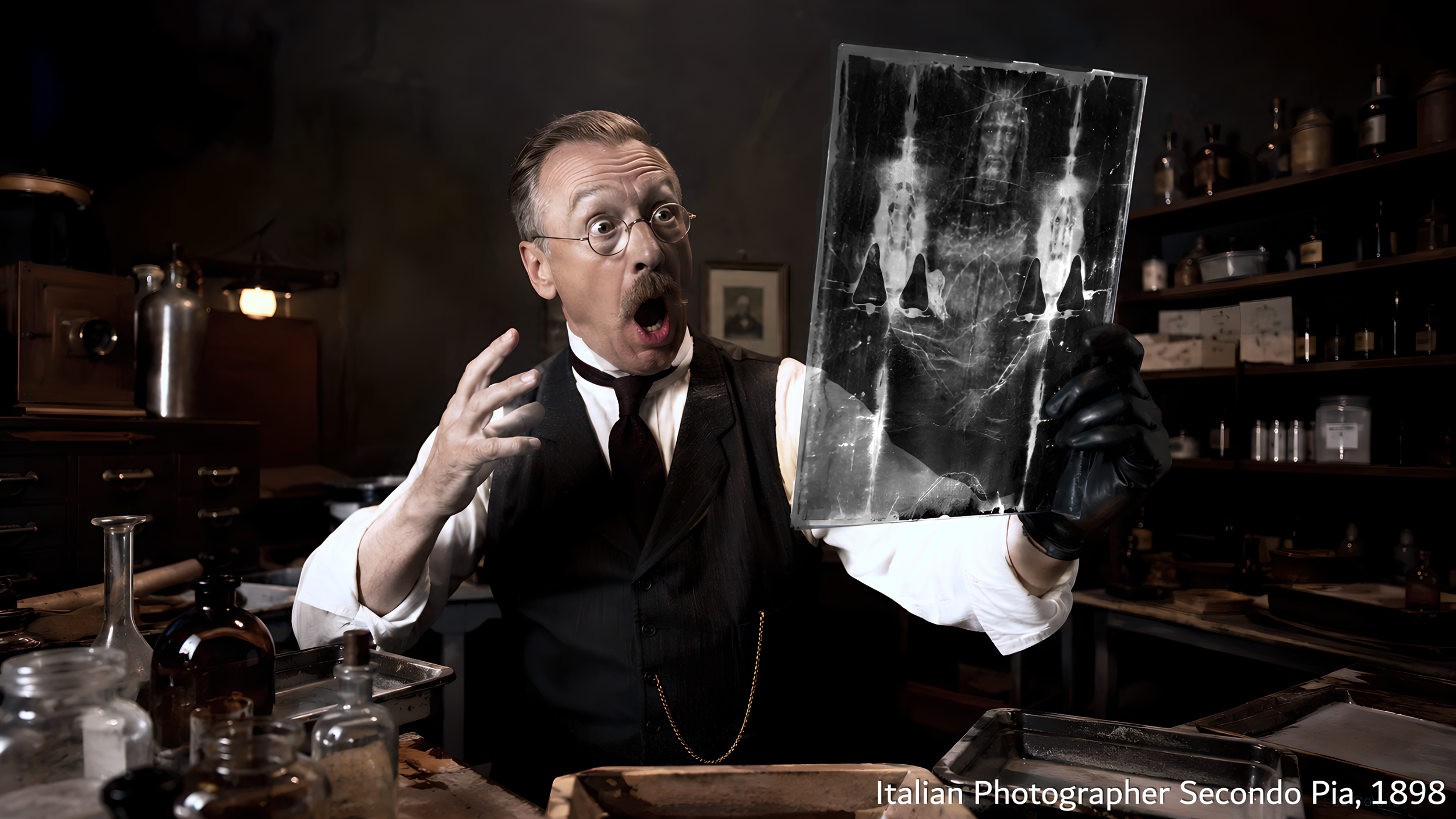
The scariest fright of a lifetime…
A long, slightly irreverent, scrupulously honest tour of the Shroud of Turin — the carbon-dating fiasco, the bloodstains, the man who fainted in his darkroom, and the one question that has out-survived every expert who ever tried to answer it.
Prologue
A man, a camera, and the worst
night's sleep of his life
In May 1898, an Italian lawyer and amateur photographer named Secondo Pia was handed an assignment that would ruin his composure forever: take the first official photograph of the Shroud of Turin.[1]
You have to picture the scene with appropriate sympathy. Pia is wrestling a camera roughly the size of a wardrobe up onto scaffolding in a dim cathedral, the electric lighting of the era is doing him no favours, and the object he's photographing is a 14-foot strip of yellowing linen bearing an image so faint that up close it looks like someone spilt tea on a tablecloth and then felt bad about it. He makes his exposures. He goes home. He develops the plates in his darkroom.
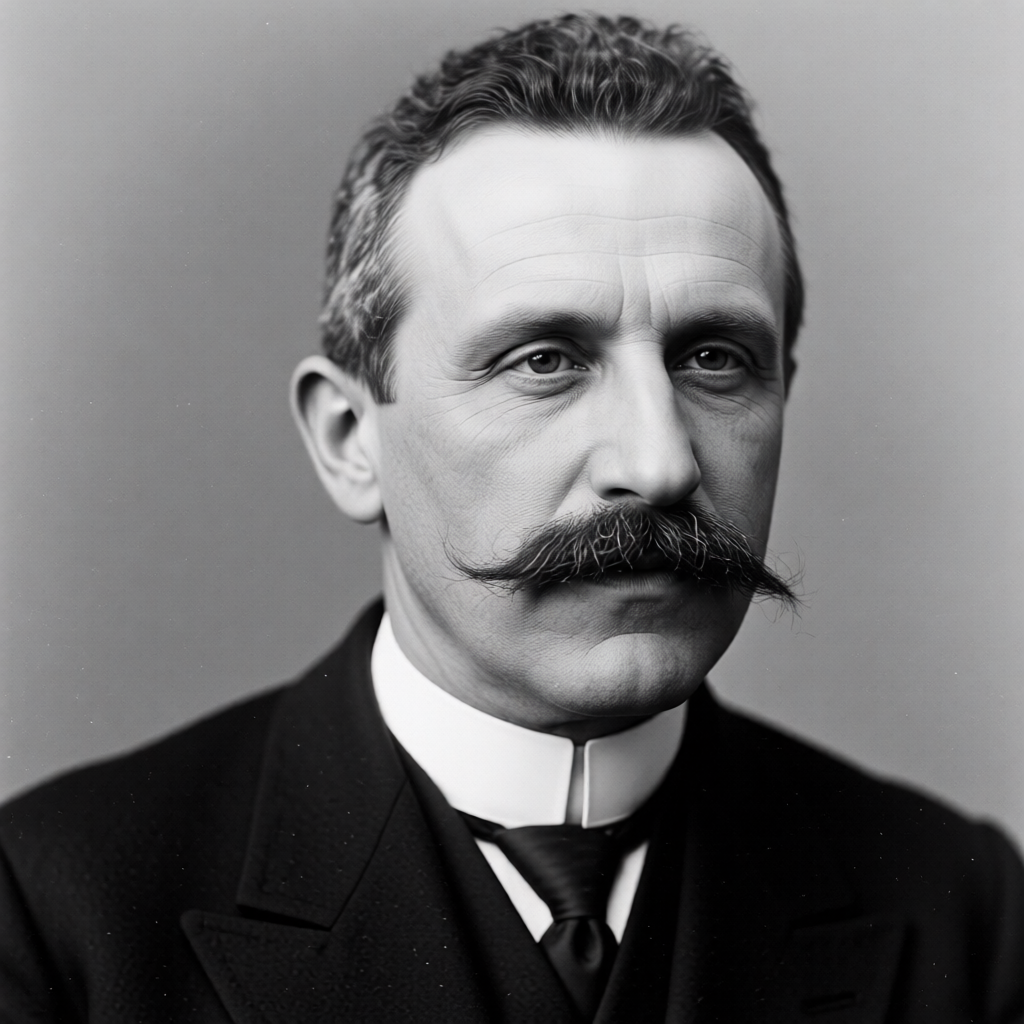
In Remembrance:
Secondo Pia (9 Sept. 1855 – 7 Sept. 1941) was an Italian lawyer and amateur photographer. He is best known for taking the first photographs of the Shroud of Turin on 28 May 1898 and, when he was developing them, noticing that the photographic negatives showed a positive image of the man in the shroud in addition to a clearer rendition of the image.
And there, in the red gloom, he watches the negative come up — and nearly drops the glass plate in fright.
Because on the negative, where light and dark are flipped, the vague brownish smudge resolves into a face. A coherent, three-dimensional, profoundly human face, rendered in correct light and shadow. Which meant — and this is the part that kept Pia up at night — that the image on the cloth was itself behaving like a photographic negative. A negative produced, if the relic was what tradition claimed, roughly 1,800 years before anyone on Earth knew what a negative was.
That is where the modern story of the Shroud begins. Not in a church, not on bended knee, but with a Victorian hobbyist going pale in a darkroom. Everything that has happened since — the NASA image analysers, the radiocarbon labs, the particle physicists muttering about event horizons, the man who injected himself with a radioactive isotope to win an argument (we'll get there) — is, in a sense, just the rest of us catching up to the scary fright Secondo Pia had that night.
So let's take the tour… Let’s take that tour honestly, and with our sense of humour intact, because the Shroud is strange enough, it doesn't need help, and gullible enough audiences have already done it plenty of damage. The goal here is the most interesting true version of the story. As it turns out, that version is plenty.
Chapter 1
What in the world
is this thing, actually?
Let's start with the unglamorous physical description, because nearly everyone who has a strong opinion about the Shroud has skipped this part.
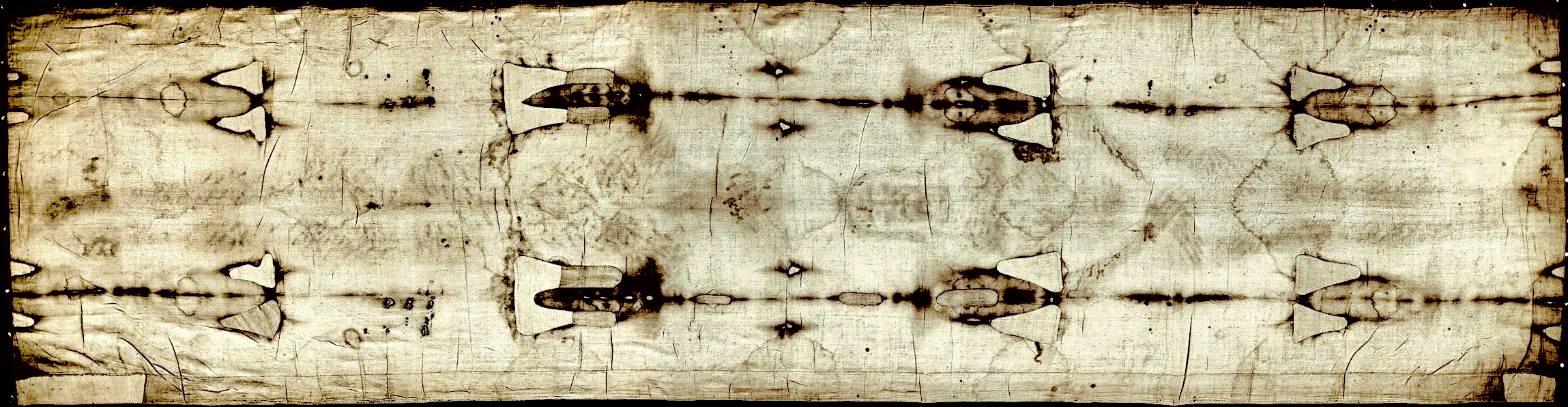
The Shroud of Turin
The Shroud of Turin is a single sheet of linen, about 4.4 metres long and 1.1 metres wide — roughly the dimensions of a generous single duvet, if your duvet had survived a documented fire in 1532, a near-miss in another fire in 1997, several centuries of being folded, unfolded, prayed over, and occasionally stitched by nuns.[2] It's woven in a three-to-one herringbone twill - which is a detail that will matter enormously later, so file it away - herringbone, the pattern on your grandfather's nicest jacket.
Laid flat, the cloth shows the front and back of a naked, bearded man, laid out head-to-head, as if a body had rested on one half and the other half had been folded up and over the top of him. The man is in his thirties, well-built, and — there is no gentle way to put this — has been comprehensively brutalised in a manner that matches a Roman crucifixion with a precision that is, frankly, rude:
Scourge marks raining across the back, buttocks, and legs, in the dumbbell-shaped pattern left by a Roman flagrum, the whip with little metal weights on the thongs.
Puncture wounds scattered across the entire scalp — a cap of thorns, not the tidy decorative wreath of every Renaissance painting you've ever seen.
A roughly two-centimetre wound between the ribs on the right side, with what appears to be a separation of blood and clear fluid.
Raw, abraded shoulder blades, as though something heavy and rough had been carried across them.
And nail wounds through the wrists — not the palms.
Hold onto that last one. It's about to do some heavy lifting.[3]
The cloth, which lives in the Royal Chapel of Turin Cathedral, is shown to the public only on rare occasions (and otherwise rests in a climate-controlled case flooded with inert argon gas, treated with more care than most defunct heads of state), and has the distinction of being the single most analysed object on planet Earth. After more than a century of investigation by chemists, physicists, biologists, historians, statisticians, and at least one radiologist with questionable boundaries, the global expert community has reached consensus on precisely one point: there is no consensus. We will be respecting that fact throughout.
Chapter 2
The 1988 bombshell, or, How to
End a Debate That Refuses to End
For a long time, the trump card against the Shroud was beautifully simple.
In 1988, the three most respected radiocarbon laboratories on Earth — Oxford, Zurich, and the University of Arizona — were each given a snippet of the cloth and asked, independently, to date it. Their combined verdict was published the following year in Nature, which is roughly the scientific equivalent of being announced from a mountaintop: the linen dated to between AD 1260 and 1390, with 95% confidence.[4] Medieval. Not first-century. Not even close. The man leading the Oxford effort, Professor Edward Hall, was not one to mince his words; he was an archaeological heavyweight who had earlier helped expose the Piltdown Man as a fraud, and he treated the Shroud verdict with the same brisk and impolite finality.[5]
If you know exactly one fact about the Shroud, it's almost certainly this one. For decades it functioned as a conversation-stopper, the scientific equivalent of dropping the mic and walking offstage.
Here is the part that the mic-droppers tend to leave out of the anecdote, and it's a big part: that result has spent the last fifteen years getting roughed up with a proper beating in the peer-reviewed literature — and not only by people who go to church.
The trouble lies in a single word: sampling. All three labs were given pieces cut from one spot — a single corner of the cloth. Now, any field archaeologist will tell you that dating one corner and declaring a verdict on the whole object is a gamble. If that corner isn't representative of the rest, neither is your date. And there's a specific, irritating reason to suspect this particular corner. It's an edge that was gripped by human hands for centuries every time the cloth was held up for display — exactly the sort of high-traffic margin a careful restorer might have patched. Several researchers proposed that the corner had been mended with newer thread using "invisible reweaving," a technique skilled enough to fool the naked eye, which would have salted the sample with younger carbon and dragged the date forward.[6]
The reweaving theory is genuinely contested — and in the interest of not doing the very thing this article keeps warning against, I'll tell you that sceptical chemists, including Luigi Garlaschelli (a name you'll meet again, wearing a different hat), published a rebuttal arguing there's no mass-spectrometry evidence of a medieval patch in the tested sample.[7] That fight is unresolved. Fine.
But there's a second problem, and this one is harder to wave away with a confident hand gesture. In 2019, after years of polite-but-relentless legal requests, the historian Tristan Casabianca and colleagues finally pried the labs' raw data loose and ran a fresh statistical analysis, published in the Oxford journal Archaeometry.[8] Their finding: the measurements from the three labs were statistically heterogeneous. They didn't agree with one another the way sub-samples of a single, uniform piece of cloth ought to. Tellingly, the original 1988 Nature paper had itself quietly noted some scatter in the numbers and then proceeded to the headline anyway, the way one might mention a strange noise in the engine and then book the road trip regardless.
In plain English: the celebrated medieval date may rest on a sample that wasn't representative, analysed in a way that papered over its own internal disagreements. This does not prove the Shroud is ancient. I want to be very clear, because this is precisely the junction where excitable writers floor the accelerator and drive straight off a cliff. What it proves is narrower and duller and more important: the "settled science" of 1988 not only is not settled, it is actually considerably wobblier than its reputation, and anyone who still treats it as a case-closer is, at minimum, a few years behind on their reading.
Chapter 3
The new dating evidence
(please keep your arms and sCepticism
inside the vehicle at all times)
Since 2022, several teams have tried to date the cloth by methods that don't touch carbon at all. This is the stretch of road where the headlines do about 140 miles an hour, and the actual science is back at the rest stop, so buckle up and keep one hand on your wallet.
The X-ray clock. In 2022, Liberato De Caro of Italy's Institute of Crystallography, working with Giulio Fanti and others, published a study in the journal Heritage using a technique called Wide-Angle X-ray Scattering, or WAXS.[9] The logic: the cellulose in linen degrades structurally at a measurable, predictable rate, so its molecular breakdown can in principle, act as a clock independent of carbon. They compared a Shroud thread against a linen sample of known age recovered from the Siege of Masada (roughly AD 55–74) and reported the Shroud was "fully compatible" with that first-century material.
The flax argument. Researcher William Meacham analysed the flax fibres of the cloth and argued their characteristics point to an origin in the Levant — geographically the correct neighbourhood for a first-century Jewish burial.
Fanti's bench tests. Giulio Fanti, an engineering professor at Padua, has run mechanical and chemical ageing experiments on Shroud fibres that, by his measurements, cluster the date around the first century — his frequently quoted figure being something like AD 33, give or take a couple of centuries, which is a margin of error you could drive that 140-mph headline through sideways.[10]
Now, the part where I am contractually obligated by my own conscience to slow us down. None of these methods is anywhere near as established or independently validated as radiocarbon dating. The WAXS approach in particular rests, so far, on very few samples and needs to be reproduced by independent teams who don't already believe the answer — a point De Caro himself conceded.9 And Fanti's more recent flourishes, including reports at a 2025 conference of detecting radioactivity and neutron emissions in blood samples, are out at the speculative fringe and should be filed under "unverified claim presented at a conference," not "finding."
Here is the single most useful rule for navigating this entire subject, and if you take nothing else from this article, take this: be exactly as sceptical of the thrilling pro-authenticity headline as you would want a sceptic to be of the 1988 result. Scepticism that only points in one direction isn't scepticism; it's cheerleading with a lab coat on.
What you can say, fairly and calmly, is this. Where the dating evidence was once a lonely single carbon result pointing "medieval," it is now a contested carbon result flanked by several independent, non-carbon methods pointing "ancient." The scoreboard is no longer one-sided. That is a real and reportable shift — and it does not require a single exclamation mark.
Chapter 4
The body of evidence
(this is where it gets genuinely hard to laugh off)
Set the dating aside completely. Pretend we never measured a single atom. Just look at what is on, and in, the cloth. This is the part of the case that survives every round of the carbon wars unscratched, and it is much harder to dismiss as a weekend craft project than people expect:
The blood is real, and it tells an awkward story. Chemical analysis, most thoroughly by John Heller and Alan Adler in the STURP era, identified genuine human blood on the cloth — type AB — carrying high levels of bilirubin, a compound the body dumps into the bloodstream under conditions of severe trauma and torture.[11]. Strangely enough, the blood type is the same as that consistently found in all tested Eucharistic miracles. More damning for the forgery hypothesis: the blood went onto the cloth before the image formed. There is no image underneath the bloodstains. This is precisely backwards from how a painter works. A forger paints the figure and then adds tasteful rivulets of blood for dramatic effect; he does not somehow lay down the blood first and conjure the body image around it afterwards.
The wounds are anatomically correct — and embarrassingly unfashionable. Return now to those wrists. Every crucifix in every church, every Renaissance masterpiece, every dashboard ornament, shows the nails driven through the palms. That's the artistic convention, handed down for a thousand years. The problem is that it's wrong: a nail through the palm tears straight out under the weight of a hanging body, as a French surgeon named Pierre Barbet demonstrated with cadavers in experiments that did not, one imagines, make him popular at parties. A nail through the wrist, by contrast, lodges against bone and holds. The figure on the Shroud is nailed through the wrists. A medieval forger copying the art of his era would have done the palms, because that's what he'd have seen his whole life. Whoever — or whatever — made this image knew an anatomical detail that the entire visual culture of the period got wrong.
Pollen, dust, and other things stuck to the fabric. Studies have reported pollen grains and, in the foot and nose regions, traces of travertine aragonite limestone, which are considered consistent with the flora and the geology around Jerusalem. I include this with a raised eyebrow and full disclosure: pollen and dust contamination on an object that has been handled by thousands of people across centuries is genuinely difficult to control for, and this strand of evidence is among the most disputed. It belongs in the file, but in pencil, not ink.
The Sudarium of Oviedo. There exists, in a cathedral in northern Spain, a separate bloodstained cloth that some identify with the "face cloth" mentioned in John's Gospel, and whose documented history runs back earlier than the Shroud's. Researchers have claimed correspondences between its bloodstains and the Shroud's facial wounds. Like nearly everything here, it's contested. But two independent cloths telling a consistent story is, at the very least, the kind of thing that makes you put your coffee down.[12]
And, for the defense's sake, the strongest physical point against authenticity. Andrea Nicolotti, a historian at the University of Turin and the author of the most rigorous skeptical history of the relic, argues that the complex three-to-one herringbone twill of the cloth required a sophisticated loom he associates with later medieval Europe rather than first-century Palestine.[13](Remember, I told you the herringbone would come back.) It's a serious argument from a serious scholar, and a piece that hides it is a piece you shouldn't trust. So there it is, in ink.
Chapter 5
The Real Mystery
how on earth was the image made?
We now arrive at the question that has outlived every expert who ever strode confidently up to it, the one that made Secondo Pia drop his composure in 1898, and the one that — believer, sceptic, or bewildered bystander — nobody has cleanly solved:
How did the image get on the cloth?
We actually know a tremendous amount about what the image is, thanks largely to STURP — the Shroud of Turin Research Project — a team of mostly American scientists who in 1978 got five straight days of hands-on access to the cloth with a truck's worth of instruments.[14] What they found is, in technical terms, deeply weird:
It is shockingly shallow. The image exists only on the topmost fibres of the linen, to a depth of a few microns — thinner than the cloth's own threads are thick. It does not soak in. Think of it less as a stain and more as the world's most precise, most patient sunburn, applied only to the very tips of the fibres.
There is no paint. No pigment, no dye, no brushstrokes, no binding agent, glueing colour to cloth. The "image" is a chemical alteration — a dehydration and oxidation — of the linen fibres themselves. STURP went looking for the artist's materials and came back empty-handed.
It encodes three dimensions. Here is the trick that broke everyone's brain. When you feed the image's brightness values into a 3D image analyser — the original was a VP-8, a gadget built to render depth from spacecraft imagery — it resolves into a coherent three-dimensional relief of a human body. The darkness of each point encodes the distance between the body and the cloth at that point. Run a normal photograph or painting through the same device and you get distorted garbage; faces stretch into funhouse horrors. The Shroud comes out as a body.[15]
The image appears where the cloth never touched. There is image data in regions a draped sheet simply wouldn't have been pressing against. This rules out a straightforward contact-transfer mechanism — you can't have made it by, say, pressing a paint-smeared statue into the fabric.
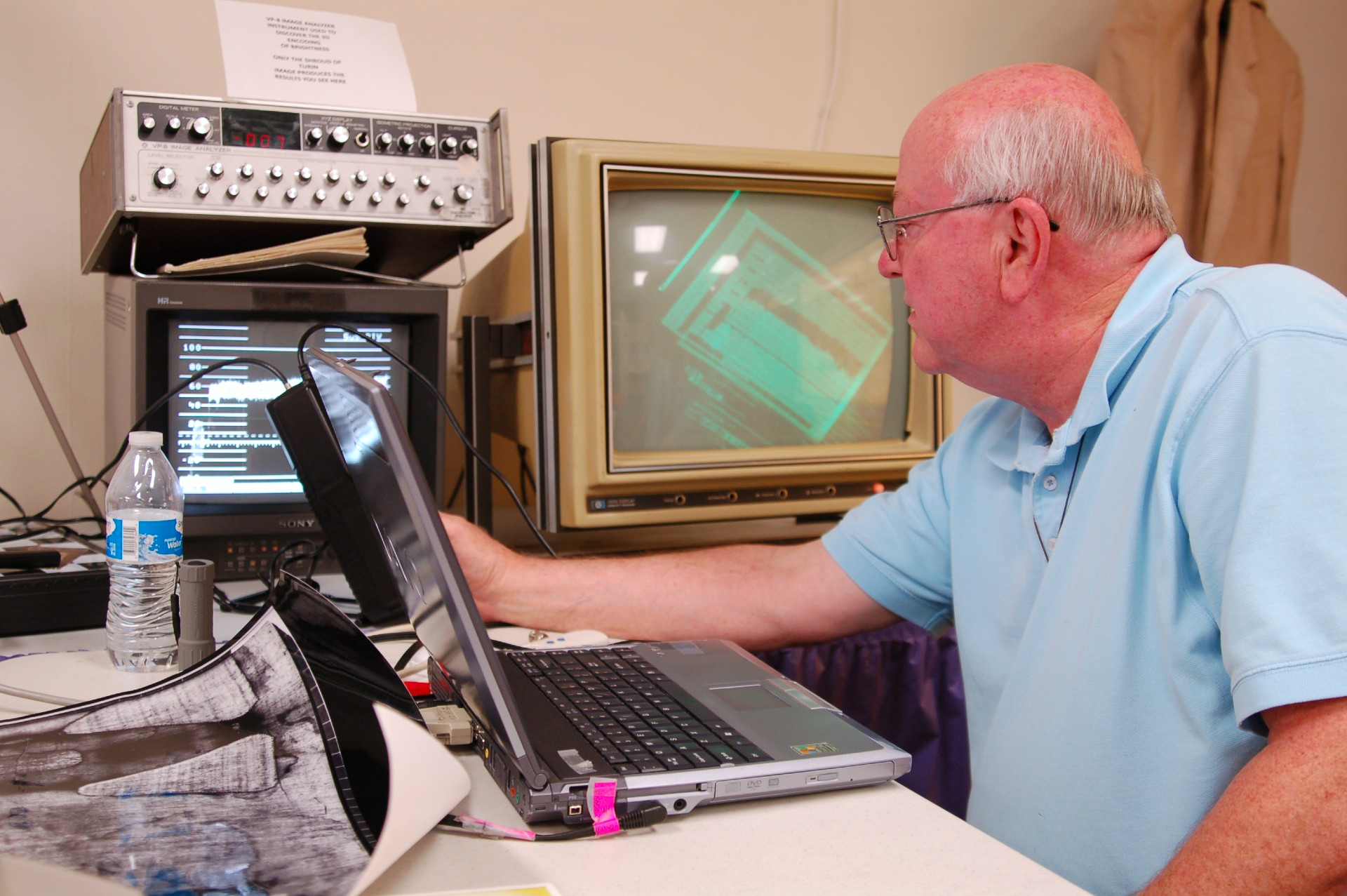
RECALL:
The VP-8 Image Analyzer has been used to image the Shroud of Turin. The VP8 makes a brightness map of whatever data it processes. White areas on the map appear to be higher in elevation; black areas appear lower in elevation, and mid-range areas appear between these two extremes. When the device was used with photographs or paintings, the result was a distorted and inaccurate representation of the original image. However, the Shroud image produced an accurate three-dimensional representation of the man depicted on the Shroud, with facial features, arms, legs and chest all contoured correctly.
So…
Could a medieval artist have faked all of that?
Enter Luigi Garlaschelli — yes, the same chemist from the carbon-dating rebuttal, now wearing his other hat — who in 2009, with partial funding from an Italian association of atheists and agnostics (a detail he cheerfully volunteered), produced a credible-looking Shroud replica.[16] He draped linen over a volunteer, rubbed on an acidic pigment, baked it to simulate ageing, and added the bloodstains and scorches. It was a genuinely clever demonstration that something shroud-ish can be conjured with medieval means, and intellectual honesty demands we tip our hat to it. Garlaschelli, who has a sense of humour, predicted that believers wouldn't accept his copy — and on the question of his own funding, delivered the immortal line that “money has no smell”. Okay, then…
But — and it is a substantial but — replicas like his tend to nail the vibe while missing the hard physics. They look right from across the room. They do not, on measurement, reproduce all of it at once: the micron-thin superficiality, the total absence of pigment, and the coherent 3D encoding, and the photographic-negative property, and image data where no contact occurred. "Resembling the Shroud at conversational distance" is not the same standard as "passing the battery of tests STURP ran on the original." To date, nobody has produced a copy that clears the whole bar.
I want to be careful about what this does and doesn't mean, because this is the exact point where the article could sprout wings and fly off into nonsense. It does not mean "therefore, a miracle." It means something more modest and, honestly, more interesting: the leading natural explanations don't fully fit the measurements, and the best human-made replica doesn't fully match. We are, scientifically, at an honest stalemate — staring at an object whose method of manufacture remains, after a century of the best efforts of clever people, genuinely unexplained. That is a rare and remarkable thing to be able to say about any object, let alone a bedsheet.
Chapter 6
About that "event horizon" — the radiation rabbit hole
This is by a wide margin the most speculative thing in the entire article, so I'm going to hang a flashing neon "SPECULATION" sign over the entrance, and then we'll have our fun.
Because nothing conventional seems to explain a shallow, pigment-free, 3D-encoding, photo-negative image, several researchers reached for the one mechanism that could, even in principle, produce that exact menu of features: a brief, intense burst of radiation emanating from the body itself.
The physicist John Jackson — one of the STURP leaders, and not a man given to wild talk — proposed that a flash of vacuum ultraviolet radiation, emitted by a body that had somehow become briefly "mechanically transparent," could discolour only the surface fibres while encoding the body-to-cloth distance as image intensity. It's an elegant fit for the data, which is exactly why it's tempting.[17] And it isn't pure hand-waving: researchers at Italy's ENEA laboratory in Frascati later showed that ultra-short pulses from excimer (ultraviolet) lasers can produce that characteristic micron-thin colouration on linen.[18] Which is suggestive — though I feel obliged to note that an excimer laser in a 21st-century physics lab and a corpse in a first-century tomb are separated by a few logistical difficulties.
Then the road forks toward the genuinely wild. The Hungarian-born particle physicist and muralist Isabel Piczek — a woman who painted enormous church frescoes and worked in high-energy physics, which is a combination you don't meet every day — argued that the body's image shows no distortion from gravity or contact pressure. The figure doesn't look squashed against a surface; it looks, to her trained eye, almost suspended. From this she proposed that at the moment of the Resurrection, the body passed through something analogous to an event horizon: a boundary where ordinary space and time break down, the body held in a state of non-gravity, releasing the radiation that branded the cloth.[19] And the cosmologist Frank Tipler, in his book The Physics of Christianity, went further still, theorising about baryon-level particle physics producing the necessary energy — a book that achieves the rare accomplishment of alarming physicists and theologians simultaneously.[20]
Here is where I have to be your honest guide rather than your hype man, because you asked for truth above all and I intend to deliver it even when it's less fun.
These ideas are hypotheses, not findings — and out at the Piczek-and-Tipler end, they are arguably theology wearing a physics costume to the party. The sharpest objection, and it's raised by some Shroud researchers themselves, is brutally fair: a "hypothesis" you cannot test, measure, or potentially falsify, isn't really doing scientific work. It's a story that fits the data. "A burst of radiation from the Resurrection made the image" does explain every feature beautifully — but it explains them by invoking a unique, miraculous, un-repeatable event that, by its very definition, cannot be wheeled into a laboratory and made to happen again on a Tuesday afternoon for peer review. There's even an internal tension worth noticing: the same hypothetical neutron flux that some invoke to explain the image is also invoked, very conveniently, to explain away the carbon date — and whenever one miraculous mechanism is asked to solve two unrelated problems at once, a good scientist's eyebrow should rise of its own accord.
So why include any of it? Because it is the most honest articulation of where the evidence actually pushes a believing scientist, and pretending otherwise would be its own kind of dishonesty. The image's measured properties really do point toward some kind of radiant event. And if you already hold — on other grounds, by faith — that the Resurrection occurred, then the Shroud is precisely the sort of fingerprint you might expect such an event to leave smoke behind it. That is a coherent, intellectually respectable, and, I'd say, rather beautiful position. It simply needs to be labeled accurately: it is an interpretation of the evidence in the light of faith, not a measurement that drags every observer, believer and atheist alike to the same forced conclusion. Anyone who tells you the second thing is selling something.
(For the record, the radiologist I mentioned in the prologue — Dr. Richard Kent — really did inject himself with a radioactive isotope and image himself to test whether radiation could produce a Shroud-like picture. I include this not because it settles anything but because the history of Shroud research is, gloriously, full of people who were willing to suffer mild personal irradiation rather than lose an argument, and that deserves recognition.)
Chapter 7
Myth-busting — and yes, your
side has myths too
Half of getting the Shroud right is hauling away the rubbish, and the rubbish comes in both flavors. A representative haul, with the dignified ones and the embarrassing ones side by side:
"Science proved it's a medieval fake. Done. Next." Overstated to the point of being misleading. The verdict rests almost entirely on one contested 1988 sample from one suspect corner, and the raw-data reanalysis exposed real statistical cracks. You are perfectly entitled to believe it's medieval. You are not entitled to call the matter settled, at least not if you've done the reading.
"Science has proven it's the literal burial cloth of Jesus of Nazareth." Overstated in the opposite direction, and just as wrong. Nothing on the cloth carries a name tag, a date stamp, or a notarised affidavit. The strongest honest statement is that the Shroud is consistent with a real first-century crucifixion victim treated exactly as the Gospels describe, which is genuinely striking, but is also not the same thing as a positive identification.
"It's obviously just a painting." No! STURP looked, specifically and hard, for paint, pigment, and binder, and found none. Whatever this image is, it is not a painting. You can dislike that conclusion; you cannot paint your way around it.
"Leonardo da Vinci faked it with a primitive camera." A wonderfully cinematic theory, fatally strangled by a calendar. The Shroud is documented in France in the 1350s.[21] Leonardo was born in 1452. Unless we're now adding time-travel to Leonardo’s already intimidating CV, the great man is in the clear.
"The 1988 result was a deliberate cover-up by the labs / the Church / shadowy enemies of the faith." And here is where well-meaning enthusiasm sprints past the guardrail and into the ravine. This is the genre where sensational headlines pin invented quotes on famous Catholic celebrities and promise that "they don't want you to know." Please, for the love of the very evidence you're trying to defend, resist it. The legitimate critique of the 1988 dating is methodological — it's about sampling and statistics — and it is robust enough to stand entirely on its own without a single villain in a trench coat. The moment you reach for a global conspiracy, you have handed every skeptic on Earth a free, gift-wrapped reason to dismiss you and the entire case along with you. Don't do their work for them.
Notice the pattern, because it's the most useful thing in this whole article: the Shroud's defenders win when they're calm, precise, and willing to concede the strong points against them — and they lose, badly, the instant they overclaim. The same is true, in the exact mirror image, of its critics. The cloth rewards humility and punishes arrogance. It always has.
Chapter 8
So — does it prove
the Resurrection?
Let's answer this head-on, because it's the question crouching beneath all the others, and dodging it would be cowardly.
No. It does not prove the Resurrection. And — stay with me — that is not the letdown it sounds like. It might even be the point.
Consider what a miracle is. If it could be proven by instruments, reliably reproduced, and printed on a readout for peer review, it wouldn't be a miracle; it would be physics, and we'd schedule it for Thursdays. The Resurrection, by its very nature, is a claim about a singular, un-repeatable event that sits permanently outside the testable, repeatable domain where science holds its authority. Science can tell you, with confidence, that the Shroud's image is microns deep, pigment-free, and three-dimensionally encoded. It cannot print the words "and therefore God raised Jesus from the dead" at the bottom of the lab report. That final step — from the evidence to the empty tomb — is, and will always remain, a movement of faith. A reasonable movement. An evidence-informed one. But faith, not proof. Anyone promising you proof is either confused about what proof means or hoping you are.
So what does the Shroud do, if not prove?
It does something quieter, and I'd argue sturdier. It removes the easy exits. It is genuinely difficult to explain as a medieval forgery. It is genuinely consistent with a first-century crucifixion rendered in anatomical detail that the era's own artists got wrong. It bears an image that the combined ingenuity of modern science still cannot fully reproduce or account for. It is, in the most literal and least mystical sense of the word, an unexplained object that points in a particular direction.
For the believer, that isn't a threat to faith, and it isn't a substitute for it — it's the quiet satisfaction of finding that faith and evidence are facing the same way. For the honest sceptic, it's a standing invitation to admit, against considerable cultural pressure, that the file is not closed and the 1988 mic-drop didn't actually end the show. And for everyone else, believer and atheist and the vast bewildered middle, it remains one of the great genuine mysteries of the world, lying quietly in an argon-filled case in Turin, refusing century after century to be either debunked or domesticated.
Secondo Pia watched a face rise out of the dark in 1898 and never entirely got over it. More than a hundred and twenty years and untold millions of research dollars later, the rest of us are, in a sense, still standing in that darkroom beside him — watching the image come up, unable to fully explain what we are looking at, unwilling to look away.
That's not a reason to overclaim.
It's a much better reason than that.
It's a reason to believe and keep looking.
A note on doing
your own homework
The fastest way to lose an argument about the Shroud is to have read only one side of it, so don't. If you want to chase any of this down to the source — and you genuinely should — start with the works in the footnotes below. Read the original 1988 Nature paper so you've seen the actual claim rather than the legend of it. Read Casabianca's raw-data reanalysis for the strongest pro-authenticity statistical argument. Read Andrea Nicolotti's history for the strongest sceptical case, argued by a serious scholar in good faith. And browse the great and sadly now deceased Barrie Schwortz's archive at www.shroud.com — he was STURP's documenting photographer, a Jewish man who spent his life on a relic of Christianity, and one of the most careful, least hysterical voices the subject ever had.[22]
Reading the sceptics is not a betrayal of the cloth. It is the only way to build a case that can survive contact with the strongest objections to it. The Shroud has already survived two fires, a flood, two world wars, six and a half centuries of handling, and the full weaponised arsenal of modern analytical science. It can comfortably survive your honest questions. Bring them.
[1] Secondo Pia photographed the Shroud on the night of 28 May 1898 and reported being startled when the photographic negative revealed a positive, lifelike image — the discovery that the cloth's image behaves like a photographic negative. The episode is recounted in essentially every history of the relic; for a careful treatment see Andrea Nicolotti, The Shroud of Turin: The History and Legends of the World's Most Famous Relic (Waco: Baylor University Press, 2019/2020).
[2] Dimensions are conventionally given as approximately 4.4 × 1.1 m. The weave is a 3:1 herringbone twill. The cloth survived a 1532 fire in Chambéry (which left symmetrical burn and water-stain patterns still visible) and a 1997 fire in Turin Cathedral, from which it was rescued. Since 2002 it has been kept in a sealed, climate-controlled case under inert gas.
[3] The wrist-versus-palm point traces largely to the experimental work of the French surgeon Pierre Barbet, A Doctor at Calvary (1950), who argued from cadaver studies that nails through the palms cannot support a crucified body's weight, whereas nails through the wrist (the space of Destot) can. The Shroud image shows a wound consistent with the wrist, contrary to standard medieval and Renaissance artistic convention.
[4] P. E. Damon et al., "Radiocarbon Dating of the Shroud of Turin," Nature 337 (1989): 611–615. The combined result assigned the linen, with 95% confidence, to AD 1260–1390. The paper itself notes scatter among the laboratory measurements.
[5] Edward Hall directed the Oxford Radiocarbon Accelerator Unit and had earlier been involved in the scientific exposure of the Piltdown Man forgery. His public statements after the 1988 result treated the medieval dating as conclusive.
[6] The "invisible reweaving" / repaired-corner hypothesis was advanced by, among others, Sue Benford and Joseph Marino, and later taken up by chemist Raymond Rogers, who argued (in Thermochimica Acta, 2005) that the sampled area differed chemically from the main cloth. The hypothesis remains disputed.
[7] Marco Bella, Luigi Garlaschelli, and Roberto Samperi, "There is no mass spectrometry evidence that the C14 sample from the Shroud of Turin comes from a 'medieval invisible mending'," Thermochimica Acta 617 (2015): 169–171.
[8] Tristan Casabianca, Emanuela Marinelli, Giuseppe Pernagallo, and Benedetto Torrisi, "Radiocarbon Dating of the Turin Shroud: New Evidence from Raw Data," Archaeometry 61, no. 5 (2019): 1223–1231. Using the laboratories' raw data, obtained after legal requests, the authors reported statistical heterogeneity inconsistent with a single homogeneous sample.
[9] Liberato De Caro, Teresa Sibillano, Rocco Lassandro, Cinzia Giannini, and Giulio Fanti, "X-ray Dating of a Turin Shroud's Linen Sample," Heritage 5, no. 2 (2022): 860–870. The Wide-Angle X-ray Scattering (WAXS) analysis reported the sample compatible with linen from c. AD 55–74 (Masada). De Caro called for further independent testing of additional samples.
[10] Giulio Fanti and collaborators have published mechanical and chemical (FT-IR/Raman) aging analyses arguing for a first-century date (e.g., Fanti et al., Vibrational Spectroscopy, 2013), with a commonly cited central estimate around 33 AD ± ~250 years. More dramatic claims regarding detected radioactivity and neutron emission in blood samples were presented at the 2025 Shroud of Turin International Conference and should be regarded as unverified conference claims rather than established findings.
[11] John H. Heller and Alan D. Adler reported the presence of human blood and identified blood-related compounds including bilirubin (e.g., Heller and Adler, "A Chemical Investigation of the Shroud of Turin," Canadian Society of Forensic Science Journal, 1981). The blood type has been reported as AB. Subsequent analyses found no body image beneath the bloodstains, implying blood was deposited before image formation.
[12] The Sudarium of Oviedo is a separate bloodstained cloth held in the Cámara Santa of Oviedo Cathedral, Spain, with a documented history predating the Shroud's appearance in France. Claimed correspondences between its bloodstains and the Shroud's facial wounds have been argued by researchers such as those associated with the Spanish Center for Sindonology, and are disputed.
[13] Andrea Nicolotti, The Shroud of Turin: The History and Legends of the World's Most Famous Relic (Baylor University Press, 2019/2020). Nicolotti argues, among other points, that the cloth's complex herringbone weave and overall characteristics fit a medieval European production better than first-century Palestine.
[14] The Shroud of Turin Research Project (STURP) conducted direct examination over five days in October 1978; its members published numerous papers, summarized in L. A. Schwalbe and R. N. Rogers, "Physics and Chemistry of the Shroud of Turin," Analytica Chimica Acta 135 (1982): 3–49. STURP found the image to be an extremely superficial dehydration/oxidation of the surface fibres, with no pigments, dyes, or binders constituting it.
[15] The three-dimensional, distance-encoded nature of the image was demonstrated by John Jackson, Eric Jumper, and colleagues using a VP-8 Image Analyzer (originally developed for spacecraft imagery); see Jackson, Jumper, and Ercoline, "Correlation of Image Intensity on the Turin Shroud with the 3-D Structure of a Human Body Shape," Applied Optics 23 (1984): 2244–2270.
[16] Luigi Garlaschelli, "Life-Size Reproduction of the Shroud of Turin and Its Image," Journal of Imaging Science and Technology 54, no. 4 (2010). The work was reported widely in 2009 and was funded partly by an Italian rationalist/atheist association, which Garlaschelli disclosed; the "money has no odor" remark was made to Reuters in connection with that funding.
[17] John P. Jackson, "An Unconventional Hypothesis to Explain All Image Characteristics Found on the Shroud Image," in History, Science, Theology and the Shroud (Shroud of Turin Conference proceedings). Jackson proposed image formation by a burst of (vacuum-ultraviolet) radiation from a body that became momentarily "mechanically transparent."
[18] Paolo Di Lazzaro et al. (ENEA, Frascati), "Superficial and Shroud-like Coloration of Linen by Short Laser Pulses in the Vacuum Ultraviolet," Applied Optics 51 (2012): 8567–8578. The experiments showed VUV excimer-laser pulses can produce a coloration of linen comparable in superficiality to the Shroud image — a demonstration of plausibility, not a claim of historical mechanism.
[19] Isabel Piczek (1927–2016), a Hungarian-born monumental artist and particle physicist, argued from the apparent absence of gravitational/contact distortion in the image that the body was effectively in a state of non-gravity, and proposed an "event horizon" interpretation associated with the moment of Resurrection. Her arguments were presented at Shroud conferences and in documentary interviews.
[20] Frank J. Tipler, The Physics of Christianity (Doubleday, 2007), proposes speculative particle-physics mechanisms (including baryon-level processes) for Resurrection-associated phenomena. The book has been sharply criticized by physicists and is best read as speculative theology rather than mainstream physics.
[21] The Shroud's documented history is generally traced to Lirey, France, in the 1350s, in the possession of the knight Geoffroi de Charny. In 1389 the bishop of Troyes, Pierre d'Arcis, wrote a memorandum to the Avignon pope asserting that the cloth was a painted forgery and that an artist had confessed — the classic early documentary argument for forgery. (Leonardo da Vinci, b. 1452, postdates all of this.)
[22] Barrie M. Schwortz (1944–2024) was STURP's documenting photographer and founder of shroud.com (the Shroud of Turin Education and Research Association archive), widely regarded as the most comprehensive online resource on the relic and notable for its relatively measured tone. Schwortz, who was Jewish, often described being drawn to the subject by the evidence rather than by Christian belief. See also Tristan Casabianca's 2024 "Systematic Evaluation of Recent Research on the Shroud of Turin," which applies Bayesian and argument-mapping methods to weigh the medieval-forgery and authenticity hypotheses.